7BSP0353 - Global Economy: M&A and Development in China, India
VerifiedAdded on 2023/04/22
|12
|3548
|270
Essay
AI Summary
This essay examines cross-border mergers and acquisitions (M&A), focusing on factors influencing their success and patterns. It highlights the importance of incentives, due diligence, and political-economic stability for peaceful M&A operations. The essay also compares the economic development models of China and India, noting differences in their approaches to globalization, sectoral focus (manufacturing vs. services), and government intervention. China's development through Special Economic Zones and manufacturing is contrasted with India's service-led growth driven by IT sector liberalization. The analysis incorporates statistical data to illustrate economic growth and sectoral contributions in both countries.
1
GLOBAL ECONOMY
7BSP0353-0901
STUDENT ID - 17073877
Contents
GLOBAL ECONOMY
7BSP0353-0901
STUDENT ID - 17073877
Contents

Paraphrase This Document
Need a fresh take? Get an instant paraphrase of this document with our AI Paraphraser
2
Question 3-Factor influencing the peace and the pattern of cross border merger and
acquisition..................................................................................................................................3
Question 4 -Economic development models of China and India...............................................6
Reference..................................................................................................................................10
Question 3-Factor influencing the peace and the pattern of cross border merger and
acquisition..................................................................................................................................3
Question 4 -Economic development models of China and India...............................................6
Reference..................................................................................................................................10
3
Question 3-Factor influencing the peace and the pattern of cross border merger and
acquisition
The overview of Cross border merger and acquisition
The cross border acquisition is a process of merger deals between two companies located in
two different countries. The cross border merger and acquisition is a common process to
enter a foreign market under globalisation. In the year 2000, when most of the economy of
the world opened their economy for the global economy, these kinds of deal increased
prodigiously. Humphery‐Jenner, Sautner, and Suchard (2017) highlighted that, there was a
sudden jump of 200% in the number of cross border merger and acquisition in most of the
world. One of the biggest advantages of the cross border merger and acquisition is that it
allows the companies to share the customer base and the means of production. The Asia
Pacific is the best area in terms of the successful merger and acquisition that is still in
operation. The main reason for the reason to be successful is the fact, that, customer base in
this area is dense and the nature of the economies in this area is somewhat similar to each
other. Nevertheless, other areas of the world such as Latin America also have shown signs of
cross border merger acquisition through different trade blocs and associations. Most of the
merger and acquisition is being attracted by Brazil since the year 2012 due to the inefficient
policies of countries like India and saturation in countries like China. Other economies in the
Latin America region have also been doing great over the years leading to a rise in cross
border merger and acquisition in this region.
The factor affecting the pattern and peace of cross border merger and acquisition
There is a pattern in the cross border merger and acquisition which is heavily affected by
some external factors. First and the foremost factor that influences the merger and acquisition
process is the incentives of two of the companies located in two different countries. Huang,
Officer, and Powell (2016) stated that both the companies and the nations must gain
positively from cross border acquisition for it become fruitful. There have been many
instances where the merger and acquisition deal has fallen apart due to insufficient gains of
some of the partner companies. One of the most important and recent examples of this is the
cross border merger and acquisition between two of the biggest companies in the world.
Nokia which is located in Finland and Microsoft located in the United States of America
Question 3-Factor influencing the peace and the pattern of cross border merger and
acquisition
The overview of Cross border merger and acquisition
The cross border acquisition is a process of merger deals between two companies located in
two different countries. The cross border merger and acquisition is a common process to
enter a foreign market under globalisation. In the year 2000, when most of the economy of
the world opened their economy for the global economy, these kinds of deal increased
prodigiously. Humphery‐Jenner, Sautner, and Suchard (2017) highlighted that, there was a
sudden jump of 200% in the number of cross border merger and acquisition in most of the
world. One of the biggest advantages of the cross border merger and acquisition is that it
allows the companies to share the customer base and the means of production. The Asia
Pacific is the best area in terms of the successful merger and acquisition that is still in
operation. The main reason for the reason to be successful is the fact, that, customer base in
this area is dense and the nature of the economies in this area is somewhat similar to each
other. Nevertheless, other areas of the world such as Latin America also have shown signs of
cross border merger acquisition through different trade blocs and associations. Most of the
merger and acquisition is being attracted by Brazil since the year 2012 due to the inefficient
policies of countries like India and saturation in countries like China. Other economies in the
Latin America region have also been doing great over the years leading to a rise in cross
border merger and acquisition in this region.
The factor affecting the pattern and peace of cross border merger and acquisition
There is a pattern in the cross border merger and acquisition which is heavily affected by
some external factors. First and the foremost factor that influences the merger and acquisition
process is the incentives of two of the companies located in two different countries. Huang,
Officer, and Powell (2016) stated that both the companies and the nations must gain
positively from cross border acquisition for it become fruitful. There have been many
instances where the merger and acquisition deal has fallen apart due to insufficient gains of
some of the partner companies. One of the most important and recent examples of this is the
cross border merger and acquisition between two of the biggest companies in the world.
Nokia which is located in Finland and Microsoft located in the United States of America
⊘ This is a preview!⊘
Do you want full access?
Subscribe today to unlock all pages.

Trusted by 1+ million students worldwide
4
merged their operation a few years ago. However, the cross border merger failed due to an
insufficient gain of one of the partner and hence the merger fell apart.
Apart from that, another factor that needs to be there before the cross border merger and
acquisition is the due diligence. Alimov and Officer (2017) noted that generally domestic
companies overstate their performances and achievements in order to get a good and lucrative
merger and acquisition deal and then it fails to lead to a loss for the foreign company or the
bigger company. Thus, in the peace of cross border acquisition, the due diligence reports of
each of the company matter a lot. A lot of massive consultancy companies are there in the
market that assists the companies in understanding the operational history of the other firm.
These reports become the factor for the initiation of a cross border merger and acquisition
deal between the two companies. Another important factor for the peaceful operation of the
cross border merger and acquisition deal is the presence of political, economic and social
harmony in the two countries . Political unrests limit the scope of foreign investment in the
business as it reduces the rate of return for the investors. Therefore, the prospective growth of
the merger and acquisition deal gets limited and hence the deal falls apart. In addition to that,
the economic performance in the target country is also important for the cross border merger
and acquisition as it will provide the market base to both of the companies. Lastly, social
structure and some of its measure also help determine the pattern of cross border merger and
acquisition (Francis, Huang and Khurana, 2016). For example, in a target country full of
unskilled labour, production merger and acquisition will be more than service. Thus, the
scope of the different company is there in different countries of the world. For example, India
is a country full with service sector worker who is only slightly skilled. The country has seen
cross border merger and acquisitions among the domestic service company and its global
counterpart.
One of the most used ways to study the risk for undertaking a cross border merger and
acquisition strategy is to understand the risk matrix. According to Buckley et al. (2016), the
study of the risk matrix makes the deal more peaceful and harmonious. The evaluation of the
risk matrix is important to find out any vulnerability of the other company as well. Risk
matrix includes all the risk elements and their weights. The risk matrix finds out the risk
associated with the deal and the companies take a decision based on that matrix. The pattern
of merger and acquisition often depends on the intensity of the risk. In some of the cases, the
foreign counterpart often decides to invest in the domestic company through licensing
without getting fully associated with the operation of the company.
merged their operation a few years ago. However, the cross border merger failed due to an
insufficient gain of one of the partner and hence the merger fell apart.
Apart from that, another factor that needs to be there before the cross border merger and
acquisition is the due diligence. Alimov and Officer (2017) noted that generally domestic
companies overstate their performances and achievements in order to get a good and lucrative
merger and acquisition deal and then it fails to lead to a loss for the foreign company or the
bigger company. Thus, in the peace of cross border acquisition, the due diligence reports of
each of the company matter a lot. A lot of massive consultancy companies are there in the
market that assists the companies in understanding the operational history of the other firm.
These reports become the factor for the initiation of a cross border merger and acquisition
deal between the two companies. Another important factor for the peaceful operation of the
cross border merger and acquisition deal is the presence of political, economic and social
harmony in the two countries . Political unrests limit the scope of foreign investment in the
business as it reduces the rate of return for the investors. Therefore, the prospective growth of
the merger and acquisition deal gets limited and hence the deal falls apart. In addition to that,
the economic performance in the target country is also important for the cross border merger
and acquisition as it will provide the market base to both of the companies. Lastly, social
structure and some of its measure also help determine the pattern of cross border merger and
acquisition (Francis, Huang and Khurana, 2016). For example, in a target country full of
unskilled labour, production merger and acquisition will be more than service. Thus, the
scope of the different company is there in different countries of the world. For example, India
is a country full with service sector worker who is only slightly skilled. The country has seen
cross border merger and acquisitions among the domestic service company and its global
counterpart.
One of the most used ways to study the risk for undertaking a cross border merger and
acquisition strategy is to understand the risk matrix. According to Buckley et al. (2016), the
study of the risk matrix makes the deal more peaceful and harmonious. The evaluation of the
risk matrix is important to find out any vulnerability of the other company as well. Risk
matrix includes all the risk elements and their weights. The risk matrix finds out the risk
associated with the deal and the companies take a decision based on that matrix. The pattern
of merger and acquisition often depends on the intensity of the risk. In some of the cases, the
foreign counterpart often decides to invest in the domestic company through licensing
without getting fully associated with the operation of the company.
Paraphrase This Document
Need a fresh take? Get an instant paraphrase of this document with our AI Paraphraser
5
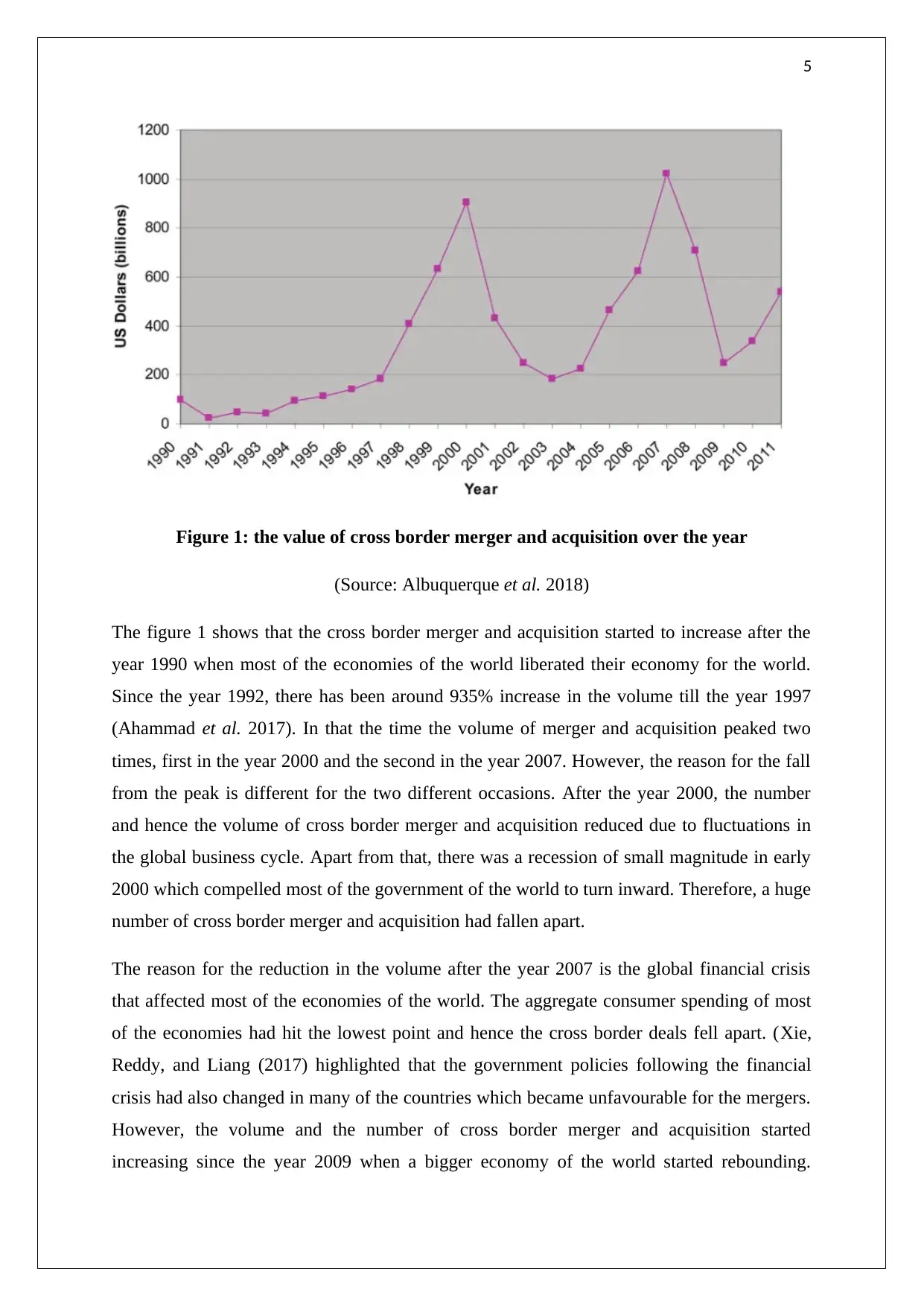
Figure 1: the value of cross border merger and acquisition over the year
(Source: Albuquerque et al. 2018)
The figure 1 shows that the cross border merger and acquisition started to increase after the
year 1990 when most of the economies of the world liberated their economy for the world.
Since the year 1992, there has been around 935% increase in the volume till the year 1997
(Ahammad et al. 2017). In that the time the volume of merger and acquisition peaked two
times, first in the year 2000 and the second in the year 2007. However, the reason for the fall
from the peak is different for the two different occasions. After the year 2000, the number
and hence the volume of cross border merger and acquisition reduced due to fluctuations in
the global business cycle. Apart from that, there was a recession of small magnitude in early
2000 which compelled most of the government of the world to turn inward. Therefore, a huge
number of cross border merger and acquisition had fallen apart.
The reason for the reduction in the volume after the year 2007 is the global financial crisis
that affected most of the economies of the world. The aggregate consumer spending of most
of the economies had hit the lowest point and hence the cross border deals fell apart. (Xie,
Reddy, and Liang (2017) highlighted that the government policies following the financial
crisis had also changed in many of the countries which became unfavourable for the mergers.
However, the volume and the number of cross border merger and acquisition started
increasing since the year 2009 when a bigger economy of the world started rebounding.
Figure 1: the value of cross border merger and acquisition over the year
(Source: Albuquerque et al. 2018)
The figure 1 shows that the cross border merger and acquisition started to increase after the
year 1990 when most of the economies of the world liberated their economy for the world.
Since the year 1992, there has been around 935% increase in the volume till the year 1997
(Ahammad et al. 2017). In that the time the volume of merger and acquisition peaked two
times, first in the year 2000 and the second in the year 2007. However, the reason for the fall
from the peak is different for the two different occasions. After the year 2000, the number
and hence the volume of cross border merger and acquisition reduced due to fluctuations in
the global business cycle. Apart from that, there was a recession of small magnitude in early
2000 which compelled most of the government of the world to turn inward. Therefore, a huge
number of cross border merger and acquisition had fallen apart.
The reason for the reduction in the volume after the year 2007 is the global financial crisis
that affected most of the economies of the world. The aggregate consumer spending of most
of the economies had hit the lowest point and hence the cross border deals fell apart. (Xie,
Reddy, and Liang (2017) highlighted that the government policies following the financial
crisis had also changed in many of the countries which became unfavourable for the mergers.
However, the volume and the number of cross border merger and acquisition started
increasing since the year 2009 when a bigger economy of the world started rebounding.
6
According to the current value, it is estimated that the volume of cross border merger and
acquisition would increase at a huge rate in the coming years (Lee, 2018). The main region
that can boost the cross border merger and acquisition is the Asia Pacific region as it is
growing at an impressive rate and the median income of the consumers are increase which
necessitates that chances of political unrest are low.
Question 4 -Economic development models of China and India
Comparison of Chinese and Indian economy
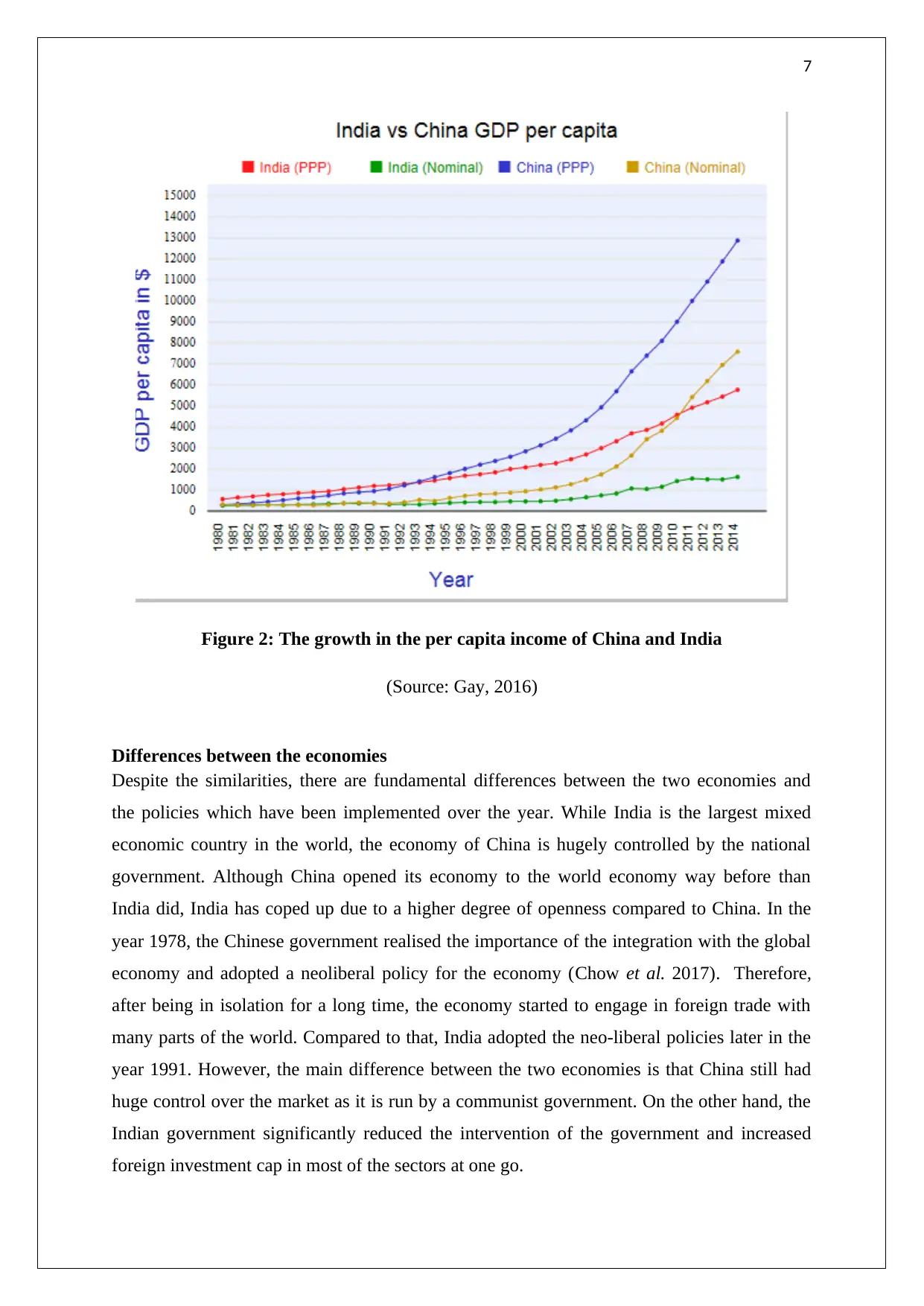
China and India are two of the most growing and developing nations of the world. One f the
common feature of both the country is that they both have a huge consumer base with high
median income. The median income in these two economies is growing at a huge rate. The
GDP per capita income is one of the most reliable measure of the per capita income which
suggests a study of which suggests that both these economies are growing at a sharp rate. The
per capita income of the consumer in China has increased by 71% compared to the data of the
year 2000. For India, the per capita income has grown about 41% since the year 2000. Both
countries attract a huge foreign investment owing to growing aggregate demand in the two
countries. Ahmad et al. (2016) noted that the means of production and skill set of the
employees are decent that makes these two economies attractive target market.
According to the current value, it is estimated that the volume of cross border merger and
acquisition would increase at a huge rate in the coming years (Lee, 2018). The main region
that can boost the cross border merger and acquisition is the Asia Pacific region as it is
growing at an impressive rate and the median income of the consumers are increase which
necessitates that chances of political unrest are low.
Question 4 -Economic development models of China and India
Comparison of Chinese and Indian economy
China and India are two of the most growing and developing nations of the world. One f the
common feature of both the country is that they both have a huge consumer base with high
median income. The median income in these two economies is growing at a huge rate. The
GDP per capita income is one of the most reliable measure of the per capita income which
suggests a study of which suggests that both these economies are growing at a sharp rate. The
per capita income of the consumer in China has increased by 71% compared to the data of the
year 2000. For India, the per capita income has grown about 41% since the year 2000. Both
countries attract a huge foreign investment owing to growing aggregate demand in the two
countries. Ahmad et al. (2016) noted that the means of production and skill set of the
employees are decent that makes these two economies attractive target market.
⊘ This is a preview!⊘
Do you want full access?
Subscribe today to unlock all pages.
Trusted by 1+ million students worldwide
7
Figure 2: The growth in the per capita income of China and India
(Source: Gay, 2016)
Differences between the economies
Despite the similarities, there are fundamental differences between the two economies and
the policies which have been implemented over the year. While India is the largest mixed
economic country in the world, the economy of China is hugely controlled by the national
government. Although China opened its economy to the world economy way before than
India did, India has coped up due to a higher degree of openness compared to China. In the
year 1978, the Chinese government realised the importance of the integration with the global
economy and adopted a neoliberal policy for the economy (Chow et al. 2017). Therefore,
after being in isolation for a long time, the economy started to engage in foreign trade with
many parts of the world. Compared to that, India adopted the neo-liberal policies later in the
year 1991. However, the main difference between the two economies is that China still had
huge control over the market as it is run by a communist government. On the other hand, the
Indian government significantly reduced the intervention of the government and increased
foreign investment cap in most of the sectors at one go.
Figure 2: The growth in the per capita income of China and India
(Source: Gay, 2016)
Differences between the economies
Despite the similarities, there are fundamental differences between the two economies and
the policies which have been implemented over the year. While India is the largest mixed
economic country in the world, the economy of China is hugely controlled by the national
government. Although China opened its economy to the world economy way before than
India did, India has coped up due to a higher degree of openness compared to China. In the
year 1978, the Chinese government realised the importance of the integration with the global
economy and adopted a neoliberal policy for the economy (Chow et al. 2017). Therefore,
after being in isolation for a long time, the economy started to engage in foreign trade with
many parts of the world. Compared to that, India adopted the neo-liberal policies later in the
year 1991. However, the main difference between the two economies is that China still had
huge control over the market as it is run by a communist government. On the other hand, the
Indian government significantly reduced the intervention of the government and increased
foreign investment cap in most of the sectors at one go.
Paraphrase This Document
Need a fresh take? Get an instant paraphrase of this document with our AI Paraphraser
8
The Development channel and processes of development
The development channels for these two economies have also been different due to the nature
of the two economies. While India is an economy dependent mostly on the service sector, the
Chinese economy mainly depends on the manufacturing sector. Although, both the
economies had a huge share of contribution from the agricultural sector of the respective
economies, it had declined sharply after the adoption of the respective neoliberal policies.
The contribution of the manufacturing sector of the economy of China increased from 44.1%
in the year 2004 to 67% in the year 2014. In case of India, the share of service sector in the
GDP of the country increased from a 31% in the year 2001, to a 69% in the year 2015
(Becker et al. 2019). As a developmental programme government of these two economies
undertook different policies. For example, China mainly concentrated on the development of
the Special economic Zone throughout the country that helped in the establishment of a huge
number of manufacturing units in the country. Foreign investment in manufacturing further
reduced the cost of production using which Chine cruised to the first spot as a manufactured
good exporting country surpassing the USA (Breslin, 2016).
India, on the other hand, concentrated on business process exportation which is a service
export to many developed economies of the world. The neo-liberal policies of the Indian
government put a cap of 79% in the IT sector of the economy that allowed a number of
Foreign Service Company to invest and use the labour force of the Indian market. This
mainly helped the English speaking population of the economy and the higher middle classes
the most. The same has been seen in case of China as well, where the domestic investors of
higher income classes have managed to rip benefit from the development policies where
lower income manufacturing workers have hardly realised the gains. Ahmed et al. (2016)
noted that the distribution of the gains in both China and India has been unequal over the
years. Apart from that, the unorganised sector of both the economies has suffered post
introduction of the new developmental policies. The Gini coefficient measure of India shows
that 90% of the wealth of the nation is headed by only 4.6% of the population of the country.
Although China's Gini Coefficient reading is better than that of India, it has a major income
inequality among the working class population of the country.
Another common factor that can be seen in the development model of these economies is that
they both used the trade blocs around the world to flourish the trade with other countries of
the world. China is part of a number of important trade blocs such as ASEAN, ACFTA and
many more that allows the economy to use its customer base for the manufactured goods.
The Development channel and processes of development
The development channels for these two economies have also been different due to the nature
of the two economies. While India is an economy dependent mostly on the service sector, the
Chinese economy mainly depends on the manufacturing sector. Although, both the
economies had a huge share of contribution from the agricultural sector of the respective
economies, it had declined sharply after the adoption of the respective neoliberal policies.
The contribution of the manufacturing sector of the economy of China increased from 44.1%
in the year 2004 to 67% in the year 2014. In case of India, the share of service sector in the
GDP of the country increased from a 31% in the year 2001, to a 69% in the year 2015
(Becker et al. 2019). As a developmental programme government of these two economies
undertook different policies. For example, China mainly concentrated on the development of
the Special economic Zone throughout the country that helped in the establishment of a huge
number of manufacturing units in the country. Foreign investment in manufacturing further
reduced the cost of production using which Chine cruised to the first spot as a manufactured
good exporting country surpassing the USA (Breslin, 2016).
India, on the other hand, concentrated on business process exportation which is a service
export to many developed economies of the world. The neo-liberal policies of the Indian
government put a cap of 79% in the IT sector of the economy that allowed a number of
Foreign Service Company to invest and use the labour force of the Indian market. This
mainly helped the English speaking population of the economy and the higher middle classes
the most. The same has been seen in case of China as well, where the domestic investors of
higher income classes have managed to rip benefit from the development policies where
lower income manufacturing workers have hardly realised the gains. Ahmed et al. (2016)
noted that the distribution of the gains in both China and India has been unequal over the
years. Apart from that, the unorganised sector of both the economies has suffered post
introduction of the new developmental policies. The Gini coefficient measure of India shows
that 90% of the wealth of the nation is headed by only 4.6% of the population of the country.
Although China's Gini Coefficient reading is better than that of India, it has a major income
inequality among the working class population of the country.
Another common factor that can be seen in the development model of these economies is that
they both used the trade blocs around the world to flourish the trade with other countries of
the world. China is part of a number of important trade blocs such as ASEAN, ACFTA and
many more that allows the economy to use its customer base for the manufactured goods.
9
India is also part of a number of trade blocs that gives the economy access to a large number
of markets (Sharma, 2016). The international trade allowed China to increase its potential in
terms of economic growth. As per the estimates of the year 2003, China was supposed to
experience a reduction in the growth of the GDP after the year 2010 due to its rising age
dependency ration. The ratio of youth population to the retired population was rising which
could have impacted the aggregate demand within the economy. However, successful trading
with many other countries of the world allowed China to deal with the excess production and
inventory management. Now, as per the data of the year 2017, the economic growth of china
has been a thumping 6.9% which is more than most of the similar developing nations of the
world .
Figure 3: The age demographics of India as per 2016
(Source: Narayanan and Sharma, 2016)
In contrast to that, India has the advantage of a huge percentage of the young population in
the economy. Figure 2 points out that 73% of the population of the country is less than the
age of 55 (Zhang et al. 2017). This, on hand, means the government's spending on benefits
and pensions is hugely outnumbered by the national product that is being estimated.
India is also part of a number of trade blocs that gives the economy access to a large number
of markets (Sharma, 2016). The international trade allowed China to increase its potential in
terms of economic growth. As per the estimates of the year 2003, China was supposed to
experience a reduction in the growth of the GDP after the year 2010 due to its rising age
dependency ration. The ratio of youth population to the retired population was rising which
could have impacted the aggregate demand within the economy. However, successful trading
with many other countries of the world allowed China to deal with the excess production and
inventory management. Now, as per the data of the year 2017, the economic growth of china
has been a thumping 6.9% which is more than most of the similar developing nations of the
world .
Figure 3: The age demographics of India as per 2016
(Source: Narayanan and Sharma, 2016)
In contrast to that, India has the advantage of a huge percentage of the young population in
the economy. Figure 2 points out that 73% of the population of the country is less than the
age of 55 (Zhang et al. 2017). This, on hand, means the government's spending on benefits
and pensions is hugely outnumbered by the national product that is being estimated.
⊘ This is a preview!⊘
Do you want full access?
Subscribe today to unlock all pages.
Trusted by 1+ million students worldwide
10
However, the real concern for India is the contribution of different sectors in the national
economy. While this young pool of a population is expected to benefit the service and
manufacturing sector the economy, the agricultural sector of the economy is expected to
suffer.
Therefore, since the year 1975, the economies of China and India have changed a lot in terms
of structure and the capabilities. It is important to mention that the neo-liberal policies
adopted by these two governments at two different times have benefited the economy at the
aggregate level. However, distributions of the gains have been a major problem over the
years which need to be fixed in order to expand the potential of the economies.
However, the real concern for India is the contribution of different sectors in the national
economy. While this young pool of a population is expected to benefit the service and
manufacturing sector the economy, the agricultural sector of the economy is expected to
suffer.
Therefore, since the year 1975, the economies of China and India have changed a lot in terms
of structure and the capabilities. It is important to mention that the neo-liberal policies
adopted by these two governments at two different times have benefited the economy at the
aggregate level. However, distributions of the gains have been a major problem over the
years which need to be fixed in order to expand the potential of the economies.
Paraphrase This Document
Need a fresh take? Get an instant paraphrase of this document with our AI Paraphraser
11
Reference
Ahammad, M.F., Leone, V., Tarba, S.Y., Glaister, K.W., and Arslan, A., 2017. Equity
ownership in cross‐border mergers and acquisitions by British firms: An analysis of real
options and transaction cost factors. British Journal of Management, 28(2), pp.180-196.
Ahmad, A., Zhao, Y., Shahbaz, M., Bano, S., Zhang, Z., Wang, S. and Liu, Y., 2016. Carbon
emissions, energy consumption and economic growth: An aggregate and disaggregate
analysis of the Indian economy. Energy Policy, 96, pp.131-143.
Ahmed, S., Mahmood, A., Hasan, A., Sidhu, G.A.S. and Butt, M.F.U., 2016. A comparative
review of China, India and Pakistan renewable energy sectors and sharing
opportunities. Renewable and Sustainable Energy Reviews, 57, pp.216-225.
Albuquerque, R., Brandao-Marques, L., Ferreira, M.A. and Matos, P., 2018. International
corporate governance spillovers: Evidence from cross-border mergers and acquisitions. The
Review of Financial Studies, 32(2), pp.738-770.
Alimov, A. and Officer, M.S., 2017. Intellectual property rights and cross-border mergers and
acquisitions. Journal of Corporate Finance, 45, pp.360-377.
Becker, U., Fernandes, T., Arora, R., Banerjee, A. and Saluja, M.S., 2019. The Indian
Resource Panel: A Mechanism to Promote Resource Efficiency Policy Throughout the Indian
Economy. In Waste Management and Resource Efficiency(pp. 275-285). Springer, Singapore.
Breslin, S., 2016. China and the global political economy. Springer.
Buckley, P.J., Yu, P., Liu, Q., Munjal, S. and Tao, P., 2016. The institutional influence on the
location strategies of multinational enterprises from emerging economies: Evidence from
China's cross-border mergers and acquisitions. Management and Organization Review, 12(3),
pp.425-448.
Chow, S.C., Cunado, J., Gupta, R. and Wong, W.K., 2017. Causal relationships between
economic policy uncertainty and housing market return in China and India: Evidence from
the linear and nonlinear panel and time series models. Studies in Nonlinear Dynamics &
Econometrics, 22(2).
Reference
Ahammad, M.F., Leone, V., Tarba, S.Y., Glaister, K.W., and Arslan, A., 2017. Equity
ownership in cross‐border mergers and acquisitions by British firms: An analysis of real
options and transaction cost factors. British Journal of Management, 28(2), pp.180-196.
Ahmad, A., Zhao, Y., Shahbaz, M., Bano, S., Zhang, Z., Wang, S. and Liu, Y., 2016. Carbon
emissions, energy consumption and economic growth: An aggregate and disaggregate
analysis of the Indian economy. Energy Policy, 96, pp.131-143.
Ahmed, S., Mahmood, A., Hasan, A., Sidhu, G.A.S. and Butt, M.F.U., 2016. A comparative
review of China, India and Pakistan renewable energy sectors and sharing
opportunities. Renewable and Sustainable Energy Reviews, 57, pp.216-225.
Albuquerque, R., Brandao-Marques, L., Ferreira, M.A. and Matos, P., 2018. International
corporate governance spillovers: Evidence from cross-border mergers and acquisitions. The
Review of Financial Studies, 32(2), pp.738-770.
Alimov, A. and Officer, M.S., 2017. Intellectual property rights and cross-border mergers and
acquisitions. Journal of Corporate Finance, 45, pp.360-377.
Becker, U., Fernandes, T., Arora, R., Banerjee, A. and Saluja, M.S., 2019. The Indian
Resource Panel: A Mechanism to Promote Resource Efficiency Policy Throughout the Indian
Economy. In Waste Management and Resource Efficiency(pp. 275-285). Springer, Singapore.
Breslin, S., 2016. China and the global political economy. Springer.
Buckley, P.J., Yu, P., Liu, Q., Munjal, S. and Tao, P., 2016. The institutional influence on the
location strategies of multinational enterprises from emerging economies: Evidence from
China's cross-border mergers and acquisitions. Management and Organization Review, 12(3),
pp.425-448.
Chow, S.C., Cunado, J., Gupta, R. and Wong, W.K., 2017. Causal relationships between
economic policy uncertainty and housing market return in China and India: Evidence from
the linear and nonlinear panel and time series models. Studies in Nonlinear Dynamics &
Econometrics, 22(2).
12
Francis, J.R., Huang, S.X. and Khurana, I.K., 2016. The role of similar accounting standards
in cross‐border mergers and acquisitions. Contemporary Accounting Research, 33(3),
pp.1298-1330.
Gay, R.D., 2016. Effect of macroeconomic variables on stock market returns for four
emerging economies: Brazil, Russia, India, and China. The International Business &
Economics Research Journal (Online), 15(3), p.119.
Huang, P., Officer, M.S. and Powell, R., 2016. Method of payment and risk mitigation in
cross-border mergers and acquisitions. Journal of Corporate Finance, 40, pp.216-234.
Humphery‐Jenner, M., Sautner, Z. and Suchard, J.A., 2017. Cross‐border mergers and
acquisitions: The role of private equity firms. Strategic Management Journal, 38(8), pp.1688-
1700.
Lee, K.H., 2018. Cross‐border mergers and acquisitions amid political uncertainty: A
bargaining perspective. Strategic Management Journal, 39(11), pp.2992-3005.
Narayanan, B. and Sharma, S.K., 2016. An analysis of tariff reductions in the Trans-Pacific
Partnership (TPP): implications for the Indian economy. Margin: The Journal of Applied
Economic Research, 10(1), pp.1-34.
Sharma, D., 2016. The nexus between financial inclusion and economic growth: Evidence
from the emerging Indian economy. Journal of financial economic policy, 8(1), pp.13-36.
Xie, E., Reddy, K.S. and Liang, J., 2017. Country-specific determinants of cross-border
mergers and acquisitions: A comprehensive review and future research directions. Journal of
World Business, 52(2), pp.127-183.
Zhang, G., Xiao, X., Biradar, C.M., Dong, J., Qin, Y., Menarguez, M.A., Zhou, Y., Zhang,
Y., Jin, C., Wang, J. and Doughty, R.B., 2017. Spatiotemporal patterns of paddy rice
croplands in China and India from 2000 to 2015. Science of the Total Environment, 579,
pp.82-92.
Francis, J.R., Huang, S.X. and Khurana, I.K., 2016. The role of similar accounting standards
in cross‐border mergers and acquisitions. Contemporary Accounting Research, 33(3),
pp.1298-1330.
Gay, R.D., 2016. Effect of macroeconomic variables on stock market returns for four
emerging economies: Brazil, Russia, India, and China. The International Business &
Economics Research Journal (Online), 15(3), p.119.
Huang, P., Officer, M.S. and Powell, R., 2016. Method of payment and risk mitigation in
cross-border mergers and acquisitions. Journal of Corporate Finance, 40, pp.216-234.
Humphery‐Jenner, M., Sautner, Z. and Suchard, J.A., 2017. Cross‐border mergers and
acquisitions: The role of private equity firms. Strategic Management Journal, 38(8), pp.1688-
1700.
Lee, K.H., 2018. Cross‐border mergers and acquisitions amid political uncertainty: A
bargaining perspective. Strategic Management Journal, 39(11), pp.2992-3005.
Narayanan, B. and Sharma, S.K., 2016. An analysis of tariff reductions in the Trans-Pacific
Partnership (TPP): implications for the Indian economy. Margin: The Journal of Applied
Economic Research, 10(1), pp.1-34.
Sharma, D., 2016. The nexus between financial inclusion and economic growth: Evidence
from the emerging Indian economy. Journal of financial economic policy, 8(1), pp.13-36.
Xie, E., Reddy, K.S. and Liang, J., 2017. Country-specific determinants of cross-border
mergers and acquisitions: A comprehensive review and future research directions. Journal of
World Business, 52(2), pp.127-183.
Zhang, G., Xiao, X., Biradar, C.M., Dong, J., Qin, Y., Menarguez, M.A., Zhou, Y., Zhang,
Y., Jin, C., Wang, J. and Doughty, R.B., 2017. Spatiotemporal patterns of paddy rice
croplands in China and India from 2000 to 2015. Science of the Total Environment, 579,
pp.82-92.
⊘ This is a preview!⊘
Do you want full access?
Subscribe today to unlock all pages.
Trusted by 1+ million students worldwide

1 out of 12


Related Documents


Your All-in-One AI-Powered Toolkit for Academic Success.
+13062052269
info@desklib.com
Available 24*7 on WhatsApp / Email
![[object Object]](/_next/static/media/star-bottom.7253800d.svg)
Unlock your academic potential
Copyright © 2020–2026 A2Z Services. All Rights Reserved. Developed and managed by ZUCOL.