Global Environment 12: UK-EU Trade Integration and Brexit's Impact
VerifiedAdded on 2020/05/11
|15
|3799
|87
Report
AI Summary
This report delves into the multifaceted implications of Brexit on the trade integration between the UK and the EU-27, examining various theoretical frameworks and potential economic models post-Brexit. It begins by identifying the theories underpinning trade integration, focusing on the reduction of tariff barriers and the implications of free movement of capital and labor, as well as the sovereignty aspects of the Single Market. The study then explores potential economic models for the UK-EU relationship post-Brexit, including the Norwegian, Swiss, and Canadian models, analyzing their respective benefits and drawbacks. Furthermore, the report identifies potential opportunities and threats for the UK air transport industry in the context of Brexit, followed by strategic recommendations, such as ECAA membership or a comprehensive UK-EU agreement, to exploit opportunities and mitigate threats. The analysis considers various factors, including regulatory divergence, market access, and the impact on policy-making, concluding with a comprehensive overview of the challenges and prospects for the UK in the post-Brexit economic landscape.
Global Environment 1
Global Economic Environment and Marketing
Global Economic Environment and Marketing

Paraphrase This Document
Need a fresh take? Get an instant paraphrase of this document with our AI Paraphraser
Global Environment 2
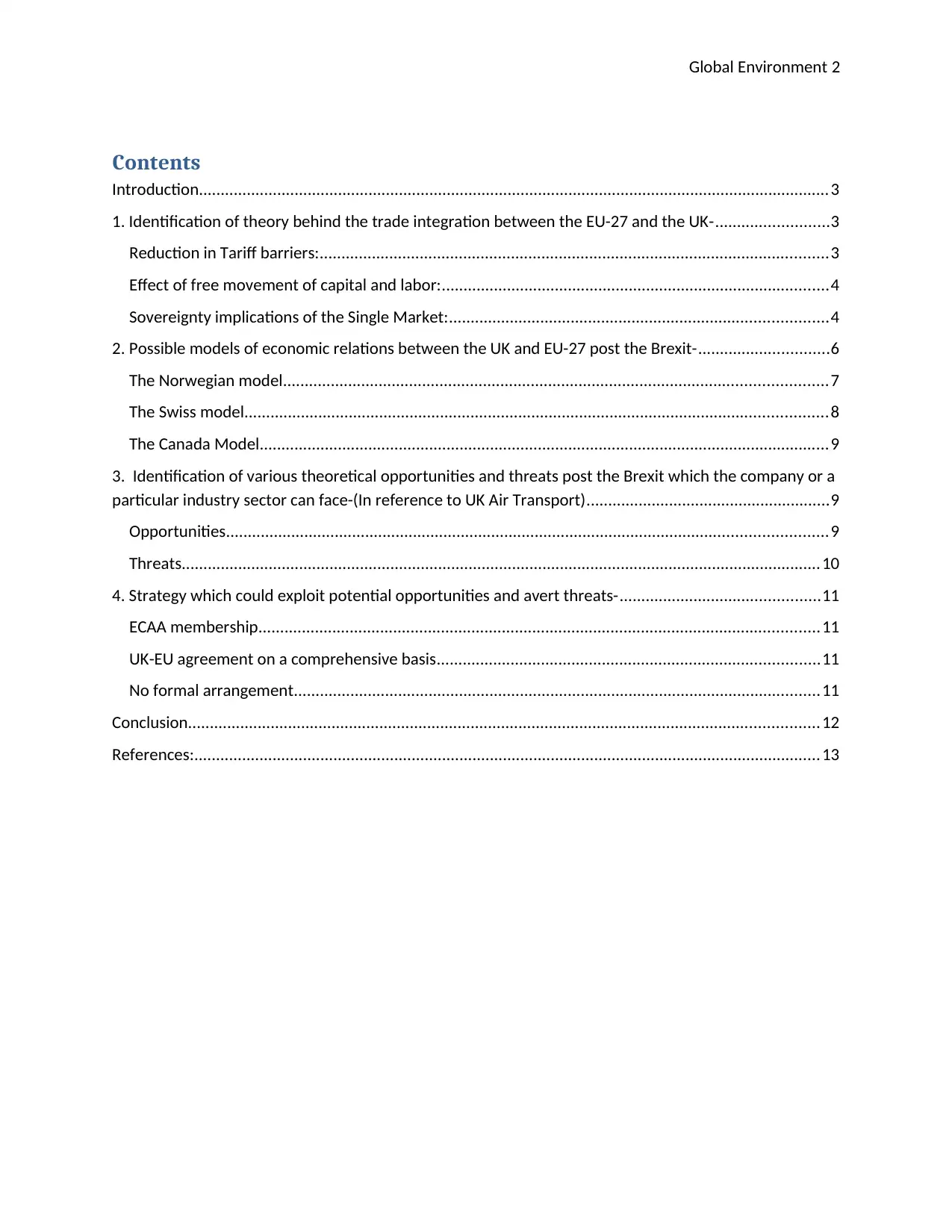
Contents
Introduction.................................................................................................................................................3
1. Identification of theory behind the trade integration between the EU-27 and the UK-..........................3
Reduction in Tariff barriers:.....................................................................................................................3
Effect of free movement of capital and labor:.........................................................................................4
Sovereignty implications of the Single Market:.......................................................................................4
2. Possible models of economic relations between the UK and EU-27 post the Brexit-..............................6
The Norwegian model.............................................................................................................................7
The Swiss model......................................................................................................................................8
The Canada Model...................................................................................................................................9
3. Identification of various theoretical opportunities and threats post the Brexit which the company or a
particular industry sector can face-(In reference to UK Air Transport)........................................................9
Opportunities..........................................................................................................................................9
Threats...................................................................................................................................................10
4. Strategy which could exploit potential opportunities and avert threats-..............................................11
ECAA membership.................................................................................................................................11
UK-EU agreement on a comprehensive basis........................................................................................11
No formal arrangement.........................................................................................................................11
Conclusion.................................................................................................................................................12
References:................................................................................................................................................13
Contents
Introduction.................................................................................................................................................3
1. Identification of theory behind the trade integration between the EU-27 and the UK-..........................3
Reduction in Tariff barriers:.....................................................................................................................3
Effect of free movement of capital and labor:.........................................................................................4
Sovereignty implications of the Single Market:.......................................................................................4
2. Possible models of economic relations between the UK and EU-27 post the Brexit-..............................6
The Norwegian model.............................................................................................................................7
The Swiss model......................................................................................................................................8
The Canada Model...................................................................................................................................9
3. Identification of various theoretical opportunities and threats post the Brexit which the company or a
particular industry sector can face-(In reference to UK Air Transport)........................................................9
Opportunities..........................................................................................................................................9
Threats...................................................................................................................................................10
4. Strategy which could exploit potential opportunities and avert threats-..............................................11
ECAA membership.................................................................................................................................11
UK-EU agreement on a comprehensive basis........................................................................................11
No formal arrangement.........................................................................................................................11
Conclusion.................................................................................................................................................12
References:................................................................................................................................................13
Global Environment 3
Introduction
For the very first time there is a serious outlook of a member country willing to leave the
European Union. The force of Brexit through the skill and speculation channels could be
harmful in the UK. Regulatory divergence will increase with the times and thus will make
an effect on the volumes of trade and also a reduction in the attractiveness for the
investment in UK. This study will help in identification of different theories behind the
integration of trade between UK and EU-27. The reduction in barriers lead towards
more free movement of services and goods and this proves significantly fruitful to UK as
UK will produce more goods according to its specialization and thus can increase its
GDP. By making an increase in the market size into which the organization can make a
sale and thus this will help UK to attain economies of scale.
Possible models of economic relations between the UK and EU-27 post the Brexit is
also discusses in the given study. It can be analyzed that the main opportunity after
Brexit is that the policy makers in UK will able to formulate the policies on their own and
without any interference. All the policies regarding aviation sector can be taken by the
policy makers in the country for the benefit of the state. There will be sterling fall in the
trading situations. The currency of the country will remain weak after the post Brexit.
This will impact on the air travelers and the weakness of pound will lead towards more
expensive fair for the residents of the country (Baier, et. al., 2008). A discussion on
Strategy which could exploit potential opportunities and avert threats is also discussed.
1. Identification of theory behind the trade integration between the EU-
27 and the UK-
Reduction in Tariff barriers:
The basic concept of non-discrimination states that any member state will not be treated
more advantageous than then other states. There should be equality for all the
countries in order to make free movement of goods and services. But the exceptions
have been provided to various regional trade blocks like EU. This will lead towards
reduction in tariff barriers for UK and thus there will be more free movement of goods,
Introduction
For the very first time there is a serious outlook of a member country willing to leave the
European Union. The force of Brexit through the skill and speculation channels could be
harmful in the UK. Regulatory divergence will increase with the times and thus will make
an effect on the volumes of trade and also a reduction in the attractiveness for the
investment in UK. This study will help in identification of different theories behind the
integration of trade between UK and EU-27. The reduction in barriers lead towards
more free movement of services and goods and this proves significantly fruitful to UK as
UK will produce more goods according to its specialization and thus can increase its
GDP. By making an increase in the market size into which the organization can make a
sale and thus this will help UK to attain economies of scale.
Possible models of economic relations between the UK and EU-27 post the Brexit is
also discusses in the given study. It can be analyzed that the main opportunity after
Brexit is that the policy makers in UK will able to formulate the policies on their own and
without any interference. All the policies regarding aviation sector can be taken by the
policy makers in the country for the benefit of the state. There will be sterling fall in the
trading situations. The currency of the country will remain weak after the post Brexit.
This will impact on the air travelers and the weakness of pound will lead towards more
expensive fair for the residents of the country (Baier, et. al., 2008). A discussion on
Strategy which could exploit potential opportunities and avert threats is also discussed.
1. Identification of theory behind the trade integration between the EU-
27 and the UK-
Reduction in Tariff barriers:
The basic concept of non-discrimination states that any member state will not be treated
more advantageous than then other states. There should be equality for all the
countries in order to make free movement of goods and services. But the exceptions
have been provided to various regional trade blocks like EU. This will lead towards
reduction in tariff barriers for UK and thus there will be more free movement of goods,
⊘ This is a preview!⊘
Do you want full access?
Subscribe today to unlock all pages.

Trusted by 1+ million students worldwide
Global Environment 4
services and labors. The reduction in barriers lead towards more free movement of
services and goods and this proves significantly fruitful to UK as UK will produce more
goods according to its specialization and thus can increase its GDP. By making an
increase in the market size into which the organization can make a sale and thus this
will help UK to attain economies of scale. This lead towards decrease in prize of all the
consumer goods and thus economic welfare programs can be enhanced as there will be
less amount of competition (PWC, 2016). These repayments occurring from trade
creation that might be counteracted by diversion of trade from different countries outside
the scope of EU.
Effect of free movement of capital and labor:
The free movement of goods and services helps in various production of services and
goods in order to make it more efficient. The free movement of capital and people will
help in increase in the efficiency with different inputs in the process of production by
allowing labor and capital from all over the world (Bloom et. al., 2012).
Sovereignty implications of the Single Market:
The Single Market today will help in reduction in the differences and to make elimination
on the differences between the member states and thus the relations between member
states can be reduced. This will help in consumer protection, health and safety
legislation and thus all the member states can get different benefits with an increase in
GDP.
services and labors. The reduction in barriers lead towards more free movement of
services and goods and this proves significantly fruitful to UK as UK will produce more
goods according to its specialization and thus can increase its GDP. By making an
increase in the market size into which the organization can make a sale and thus this
will help UK to attain economies of scale. This lead towards decrease in prize of all the
consumer goods and thus economic welfare programs can be enhanced as there will be
less amount of competition (PWC, 2016). These repayments occurring from trade
creation that might be counteracted by diversion of trade from different countries outside
the scope of EU.
Effect of free movement of capital and labor:
The free movement of goods and services helps in various production of services and
goods in order to make it more efficient. The free movement of capital and people will
help in increase in the efficiency with different inputs in the process of production by
allowing labor and capital from all over the world (Bloom et. al., 2012).
Sovereignty implications of the Single Market:
The Single Market today will help in reduction in the differences and to make elimination
on the differences between the member states and thus the relations between member
states can be reduced. This will help in consumer protection, health and safety
legislation and thus all the member states can get different benefits with an increase in
GDP.
Paraphrase This Document
Need a fresh take? Get an instant paraphrase of this document with our AI Paraphraser
Global Environment 5
Global Environment 6
2. Possible models of economic relations between the UK and EU-27 post
the Brexit-
Brexit will make an agreement which can be considered as new between UK and
European Union which will help both the countries to improve their relations on a mutual
basis. There are various feasible alternatives available which will help both the countries
to develop a trade area in order to maintain a market area which can be considered
single whereby the UK can actively participate in the promotion of the regulations of EU.
There are various models of relationships presented below which will show the political
and economical benefits of UK on one side and on the other side various member
countries of EU like France, Italy and Germany. This section will define different
2. Possible models of economic relations between the UK and EU-27 post
the Brexit-
Brexit will make an agreement which can be considered as new between UK and
European Union which will help both the countries to improve their relations on a mutual
basis. There are various feasible alternatives available which will help both the countries
to develop a trade area in order to maintain a market area which can be considered
single whereby the UK can actively participate in the promotion of the regulations of EU.
There are various models of relationships presented below which will show the political
and economical benefits of UK on one side and on the other side various member
countries of EU like France, Italy and Germany. This section will define different
⊘ This is a preview!⊘
Do you want full access?
Subscribe today to unlock all pages.
Trusted by 1+ million students worldwide
Global Environment 7
alliances with EU in reference to the EU and UK relationships post Brexit relations
between various member countries (Dustmann and Frattini, 2014).
There are different models of relations in terms of economic available for UK after the
Brexit and these models are stated below-
Make an exit from EU but become a member country of EFTA and EEA in order
to get an access to the market which can be considered as single: The
Norwegian model
Make an exit from EU and become a member country of EFTA and not to join
EEA, where The relations in EU are carried on basis of agreements which are
bilateral: The Swiss model
The Canada Model
The Norwegian model
The first alternative available to UK is to make an exit from EU and become a member
country of EEA with the member states Norway, Liechtenstein and Iceland presently
and also become a member state of EFTA with the Switzerland who is a member
country presently and get access to a market which can be considered single. This was
the same approach adopted by the country Norway in the year 1994. UK does not
possess a right which can be considered valid in order to become a member state of
EFTA or a member state to EEA Agreement. Therefore the existing member countries
will possess a veto that if UK can join or not (Campos and Coricell, 2015). The
agreements of EEA do not enclose the scope of freedom, justice and safety.
Under The Norwegian model the policies formulated by EU are not enclosed by the
EEA Agreement and hence will not apply to UK. UK will able to formulate its own laws in
only particular regions and also not get any other additional advantage from EU policies
and procedures. The main feature of “Norwegian model” is that the UK will have to face
to EU legislation resulting in loss of all the voting rights and UK will also have no right to
take any decision regarding legislation (Holehouse, 2015). Countries like Norway and
Liechtenstein will able to have some right but at the end will not having any voting
power.
alliances with EU in reference to the EU and UK relationships post Brexit relations
between various member countries (Dustmann and Frattini, 2014).
There are different models of relations in terms of economic available for UK after the
Brexit and these models are stated below-
Make an exit from EU but become a member country of EFTA and EEA in order
to get an access to the market which can be considered as single: The
Norwegian model
Make an exit from EU and become a member country of EFTA and not to join
EEA, where The relations in EU are carried on basis of agreements which are
bilateral: The Swiss model
The Canada Model
The Norwegian model
The first alternative available to UK is to make an exit from EU and become a member
country of EEA with the member states Norway, Liechtenstein and Iceland presently
and also become a member state of EFTA with the Switzerland who is a member
country presently and get access to a market which can be considered single. This was
the same approach adopted by the country Norway in the year 1994. UK does not
possess a right which can be considered valid in order to become a member state of
EFTA or a member state to EEA Agreement. Therefore the existing member countries
will possess a veto that if UK can join or not (Campos and Coricell, 2015). The
agreements of EEA do not enclose the scope of freedom, justice and safety.
Under The Norwegian model the policies formulated by EU are not enclosed by the
EEA Agreement and hence will not apply to UK. UK will able to formulate its own laws in
only particular regions and also not get any other additional advantage from EU policies
and procedures. The main feature of “Norwegian model” is that the UK will have to face
to EU legislation resulting in loss of all the voting rights and UK will also have no right to
take any decision regarding legislation (Holehouse, 2015). Countries like Norway and
Liechtenstein will able to have some right but at the end will not having any voting
power.
Paraphrase This Document
Need a fresh take? Get an instant paraphrase of this document with our AI Paraphraser
Global Environment 8
UK will not be able to make its representation in the process of decision making which
will result in straight consequences for the country. It can be analyzed that although is
not a member of EU but as a member state of EEA, UK will have to follow some
legislations of EU like free movement of people in the state. UK will make an access to
the market which can be considered as single for doing trade in the Norwegian mode.
But it can also be analyzed that EEA is making a very steadily progress in making an
incorporation with the legislations prevalent In EU on the topic of financial services and
thus the services regarding finance are quite limited in scope (Pain and Young, 2004).
The Swiss model
The other model that is available for UK after making an exit from EU is to become a
member state of EFTA and not to join EEA. The relationship between UK and EU is
generally carried out by agreements which are termed as bilateral and thus includes
partial access to the market which is single. Under the model stated above UK will make
an access to the single market but only in those particular regions where the bilateral
agreements can be negotiated by the country. For instance, Switzerland does not have
any particular agreement in the area of financial services and thus it will provide benefit
to the economy of UK (Sampson, 2015). Thus, it can be analyzed that this model would
not be beneficial for those who want to make a reduction in EU legislations.
Under the Swiss model, UK will have to face the challenges of losing its power in terms
of legislation of EU as same under the Norwegian model. EU must have to follow the
rules and procedures of EU in order to make an access to the single market. The
challenges faced by UK will more worst in the Swiss Model in comparison to Norwegian
option as there are very few structures in order to have influence on the decisions taken
by EU. Therefore it can be analyzed that UK will have a little contribution in terms of
finance. Switzerland do not make any contribution in the budget of EU but takes an
actively participation in the programs related to research. If UK will make a payment of
equal per capita rate as same as Switzerland than the net involvement will decline by
59% approximately (Ottaviano et. al., 2014).
UK will not be able to make its representation in the process of decision making which
will result in straight consequences for the country. It can be analyzed that although is
not a member of EU but as a member state of EEA, UK will have to follow some
legislations of EU like free movement of people in the state. UK will make an access to
the market which can be considered as single for doing trade in the Norwegian mode.
But it can also be analyzed that EEA is making a very steadily progress in making an
incorporation with the legislations prevalent In EU on the topic of financial services and
thus the services regarding finance are quite limited in scope (Pain and Young, 2004).
The Swiss model
The other model that is available for UK after making an exit from EU is to become a
member state of EFTA and not to join EEA. The relationship between UK and EU is
generally carried out by agreements which are termed as bilateral and thus includes
partial access to the market which is single. Under the model stated above UK will make
an access to the single market but only in those particular regions where the bilateral
agreements can be negotiated by the country. For instance, Switzerland does not have
any particular agreement in the area of financial services and thus it will provide benefit
to the economy of UK (Sampson, 2015). Thus, it can be analyzed that this model would
not be beneficial for those who want to make a reduction in EU legislations.
Under the Swiss model, UK will have to face the challenges of losing its power in terms
of legislation of EU as same under the Norwegian model. EU must have to follow the
rules and procedures of EU in order to make an access to the single market. The
challenges faced by UK will more worst in the Swiss Model in comparison to Norwegian
option as there are very few structures in order to have influence on the decisions taken
by EU. Therefore it can be analyzed that UK will have a little contribution in terms of
finance. Switzerland do not make any contribution in the budget of EU but takes an
actively participation in the programs related to research. If UK will make a payment of
equal per capita rate as same as Switzerland than the net involvement will decline by
59% approximately (Ottaviano et. al., 2014).
Global Environment 9
The Canada Model
This model has its definition lies in the Comprehensive Economic and Trade Agreement
(CETA) and the major part of this model is free trade of manufactured items, agricultural
goods and other services. The major drawback of this model is the quotas of exports in
different sectors (Ugwumadu, 2013). This model has a limited access of qualifications of
professionals and also not covers free movement of individuals and also there in any
freedom of making investments in the sector of banking.
It can be analyses that the economic relationship between EU and UK will grow as
described under the above models but as each model has its particular circumstances
and different bilateral agreements this will not make any duplication. It can also be
analyzed that that the negotiations lead towards innovation of a new model for both the
countries after EU exit relationship where in one situation it will lead towards a single
market and in the another circumstance it will lead towards degrading the relations
between EU and UK to the agreements of WTO (Parker, 2015).
3. Identification of various theoretical opportunities and threats post
the Brexit which the company or a particular industry sector can face-(In
reference to UK Air Transport)
Opportunities
UK is following various legislation of EU uncovering various sectors and also the area of
business of aviation industry. UK has to follow all the rules regarding security, protection
of customer, rules regarding environment and different regulations regarding economy.
The main opportunity after Brexit is that the policy makers in UK will able to formulate
the policies on their own and without any interference. All the policies regarding aviation
sector can be taken by the policy makers in the country for the benefit of the state
(Gomez, 2015).
The UK is always played a chief role in making proponent of unusual European
initiatives like a market access which is more liberalize in the sector of aviation.
Accordingly, US can make an advance progress in the policy agenda of the state.
Moreover in terms of market access, the UK participates in different technical
The Canada Model
This model has its definition lies in the Comprehensive Economic and Trade Agreement
(CETA) and the major part of this model is free trade of manufactured items, agricultural
goods and other services. The major drawback of this model is the quotas of exports in
different sectors (Ugwumadu, 2013). This model has a limited access of qualifications of
professionals and also not covers free movement of individuals and also there in any
freedom of making investments in the sector of banking.
It can be analyses that the economic relationship between EU and UK will grow as
described under the above models but as each model has its particular circumstances
and different bilateral agreements this will not make any duplication. It can also be
analyzed that that the negotiations lead towards innovation of a new model for both the
countries after EU exit relationship where in one situation it will lead towards a single
market and in the another circumstance it will lead towards degrading the relations
between EU and UK to the agreements of WTO (Parker, 2015).
3. Identification of various theoretical opportunities and threats post
the Brexit which the company or a particular industry sector can face-(In
reference to UK Air Transport)
Opportunities
UK is following various legislation of EU uncovering various sectors and also the area of
business of aviation industry. UK has to follow all the rules regarding security, protection
of customer, rules regarding environment and different regulations regarding economy.
The main opportunity after Brexit is that the policy makers in UK will able to formulate
the policies on their own and without any interference. All the policies regarding aviation
sector can be taken by the policy makers in the country for the benefit of the state
(Gomez, 2015).
The UK is always played a chief role in making proponent of unusual European
initiatives like a market access which is more liberalize in the sector of aviation.
Accordingly, US can make an advance progress in the policy agenda of the state.
Moreover in terms of market access, the UK participates in different technical
⊘ This is a preview!⊘
Do you want full access?
Subscribe today to unlock all pages.
Trusted by 1+ million students worldwide
Global Environment 10
exhibitions in order to make facilitation of the free movement of passengers and cargo
at the same time. This will help the UK to increase its competitiveness by indulging itself
towards different technical exhibitions and adoption of new techniques according to
modernization and do not rely itself on the policies formulated by EU. Therefore, a key
consideration in perceptive the regulatory implication of Brexit is the level to which the
UK is agreeable or able to agree continued access in order to the Single Aviation
Market. The major opportunity which is prevalent to the country is the freedom of
formulation in policy making and decision making without any interference for the
betterment of the country growth (Roy and Mathur, 2016).
Threats
The Impacts will make a variation according to the different scenario and the different
assumptions. The GDP of UK will get a reduction by 2.5% to 3.5% by the end of year
2020 when a comparison is made to post Brexit. It can be analyzed that the influence of
Brexit will move a shift at the downward side in the terms of GDP and it will also be not
a temporary influence and also cannot be covered in a shorter span of time. The
estimation of the measurement of the elasticity between income and air transport will
make a variation. In between emerging and well developed markets are positive and
measurement of elasticity will always be more than one. The approach of Income
elasticity can pick different scenarios that may impact demand for UK air transport in the
long run.
There will be sterling fall in the trading situations. The currency of the country will
remain weak after the post Brexit. This will impact on the air travelers and the weakness
of pound will lead towards more expensive fair for the residents of the country of UK as
a GBP will now make purchase of goods and services in less quantity (Adler-Nissen et.
al., 2017). There will be adverse impact of the depreciation of GBP on air transport in
UK.
exhibitions in order to make facilitation of the free movement of passengers and cargo
at the same time. This will help the UK to increase its competitiveness by indulging itself
towards different technical exhibitions and adoption of new techniques according to
modernization and do not rely itself on the policies formulated by EU. Therefore, a key
consideration in perceptive the regulatory implication of Brexit is the level to which the
UK is agreeable or able to agree continued access in order to the Single Aviation
Market. The major opportunity which is prevalent to the country is the freedom of
formulation in policy making and decision making without any interference for the
betterment of the country growth (Roy and Mathur, 2016).
Threats
The Impacts will make a variation according to the different scenario and the different
assumptions. The GDP of UK will get a reduction by 2.5% to 3.5% by the end of year
2020 when a comparison is made to post Brexit. It can be analyzed that the influence of
Brexit will move a shift at the downward side in the terms of GDP and it will also be not
a temporary influence and also cannot be covered in a shorter span of time. The
estimation of the measurement of the elasticity between income and air transport will
make a variation. In between emerging and well developed markets are positive and
measurement of elasticity will always be more than one. The approach of Income
elasticity can pick different scenarios that may impact demand for UK air transport in the
long run.
There will be sterling fall in the trading situations. The currency of the country will
remain weak after the post Brexit. This will impact on the air travelers and the weakness
of pound will lead towards more expensive fair for the residents of the country of UK as
a GBP will now make purchase of goods and services in less quantity (Adler-Nissen et.
al., 2017). There will be adverse impact of the depreciation of GBP on air transport in
UK.
Paraphrase This Document
Need a fresh take? Get an instant paraphrase of this document with our AI Paraphraser
Global Environment 11
4. Strategy which could exploit potential opportunities and avert
threats-
ECAA membership
Membership in the European Common Aviation Area will help in providing the place for
making a continue access towards an Aviation market which can be considered single.
This will increase access to the single area for the market for the country. Though, to
become a member state of ECCA approval of law of aviation of EU will be required and
thus this will lead towards freedom of the policies and decision making of the country
UK. The agreement on air services require a negotiation in order to make assure that it
will lead towards an access in continuous ways as likely for important to Canada.
Moreover, member states of ECCA like Norway and Iceland are the member states to
the agreements between US and EU instead of not a member state of EU. This will
help the country to avail the opportunities prevailing in today’s time.
UK-EU agreement on a comprehensive basis
The Other option to become a member state of ECCA and to avail the rights of decision
making and negotiation on agreement on comprehensive basis which are equal to the
EU-US agreements is UK-EU agreement on a comprehensive basis. This will help the
country UK to make a limited exposure in the aviation law of EU. This will lead towards
some freedom in the policy making for the country and can also attain some power over
decisions regarding aviation industry and thus the adverse impact on UK Air Transport
can be reduced and minimized (ECONOMIC, 2016).
No formal arrangement
This option will lead towards Brexit leading to disqualification and an also a shatter from
terms of aviation industry. The bilateral services in air industry and the agreements
between the UK and the EU will lead towards a limit in the market access. This option
will help in attaining maximum policy freedom for the country UK and its policy makers
as they will only get influence from Chicago Convention framework of ICAO and not
from EU (Johnston and Buongiorno, 2017). Also, the Country UK can also get an
exclusion from EU and also can make its own policies for the promotion of aviation
industry.
4. Strategy which could exploit potential opportunities and avert
threats-
ECAA membership
Membership in the European Common Aviation Area will help in providing the place for
making a continue access towards an Aviation market which can be considered single.
This will increase access to the single area for the market for the country. Though, to
become a member state of ECCA approval of law of aviation of EU will be required and
thus this will lead towards freedom of the policies and decision making of the country
UK. The agreement on air services require a negotiation in order to make assure that it
will lead towards an access in continuous ways as likely for important to Canada.
Moreover, member states of ECCA like Norway and Iceland are the member states to
the agreements between US and EU instead of not a member state of EU. This will
help the country to avail the opportunities prevailing in today’s time.
UK-EU agreement on a comprehensive basis
The Other option to become a member state of ECCA and to avail the rights of decision
making and negotiation on agreement on comprehensive basis which are equal to the
EU-US agreements is UK-EU agreement on a comprehensive basis. This will help the
country UK to make a limited exposure in the aviation law of EU. This will lead towards
some freedom in the policy making for the country and can also attain some power over
decisions regarding aviation industry and thus the adverse impact on UK Air Transport
can be reduced and minimized (ECONOMIC, 2016).
No formal arrangement
This option will lead towards Brexit leading to disqualification and an also a shatter from
terms of aviation industry. The bilateral services in air industry and the agreements
between the UK and the EU will lead towards a limit in the market access. This option
will help in attaining maximum policy freedom for the country UK and its policy makers
as they will only get influence from Chicago Convention framework of ICAO and not
from EU (Johnston and Buongiorno, 2017). Also, the Country UK can also get an
exclusion from EU and also can make its own policies for the promotion of aviation
industry.
Global Environment 12
Conclusion
From the above studu it can be identified that the force of Brexit through the skill and
speculation channels could be harmful in the UK. Regulatory divergence will increase
with the times and thus will make an effect on the volumes of trade and also a reduction
in the attractiveness for the investment in UK. The first alternative available to UK is to
make an exit from EU and become a member country of EEA with the member states
Norway, Liechtenstein and Iceland presently and also become a member state of EFTA
with the Switzerland who is a member country presently and get access to a market
which can be considered single in order to make a relationship with EU after Brexit. It
can also be concluded that The Impacts will make a variation according to the different
scenario and the different assumptions. The GDP of UK will get a reduction by 2.5% to
3.5% by the end of year 2020 when a comparison is made to post Brexit (Goodwin and
Heath, 2016). In this study various Strategy which could exploit potential opportunities
and avert threats are also analyzed to reduce the negative impact on the country.
Conclusion
From the above studu it can be identified that the force of Brexit through the skill and
speculation channels could be harmful in the UK. Regulatory divergence will increase
with the times and thus will make an effect on the volumes of trade and also a reduction
in the attractiveness for the investment in UK. The first alternative available to UK is to
make an exit from EU and become a member country of EEA with the member states
Norway, Liechtenstein and Iceland presently and also become a member state of EFTA
with the Switzerland who is a member country presently and get access to a market
which can be considered single in order to make a relationship with EU after Brexit. It
can also be concluded that The Impacts will make a variation according to the different
scenario and the different assumptions. The GDP of UK will get a reduction by 2.5% to
3.5% by the end of year 2020 when a comparison is made to post Brexit (Goodwin and
Heath, 2016). In this study various Strategy which could exploit potential opportunities
and avert threats are also analyzed to reduce the negative impact on the country.
⊘ This is a preview!⊘
Do you want full access?
Subscribe today to unlock all pages.
Trusted by 1+ million students worldwide

1 out of 15


Related Documents


Your All-in-One AI-Powered Toolkit for Academic Success.
+13062052269
info@desklib.com
Available 24*7 on WhatsApp / Email
![[object Object]](/_next/static/media/star-bottom.7253800d.svg)
Unlock your academic potential
Copyright © 2020–2026 A2Z Services. All Rights Reserved. Developed and managed by ZUCOL.