English as a Global Language: Benefits and Challenges

Verified

Added on  2020/03/16

|4
|652
|300
Essay
AI Summary
This essay explores the multifaceted role of English as a global language. It begins by defining a global language and highlighting the widespread use of English, citing statistics on its native and non-native speakers. The essay discusses the importance of English in international trade, policy, and education, emphasizing its prevalence in various sectors like international air traffic control and the entertainment industry. The essay also examines the factors that have contributed to English's global dominance, such as the political influence of English-speaking countries and technological advancements. While acknowledging the benefits of English in fostering global communication and unity, the essay also addresses the potential drawbacks, such as the potential loss of other native languages and their associated cultures. The essay concludes by advocating for the preservation of native languages to maintain cultural diversity.
Document Page
ENGLISH AS A GLOBAL LANGUAGE 1
Name
Institution
Tutor
Course
Date of submission
ENGLISH AS A GLOBAL LANGUAGE
Introduction
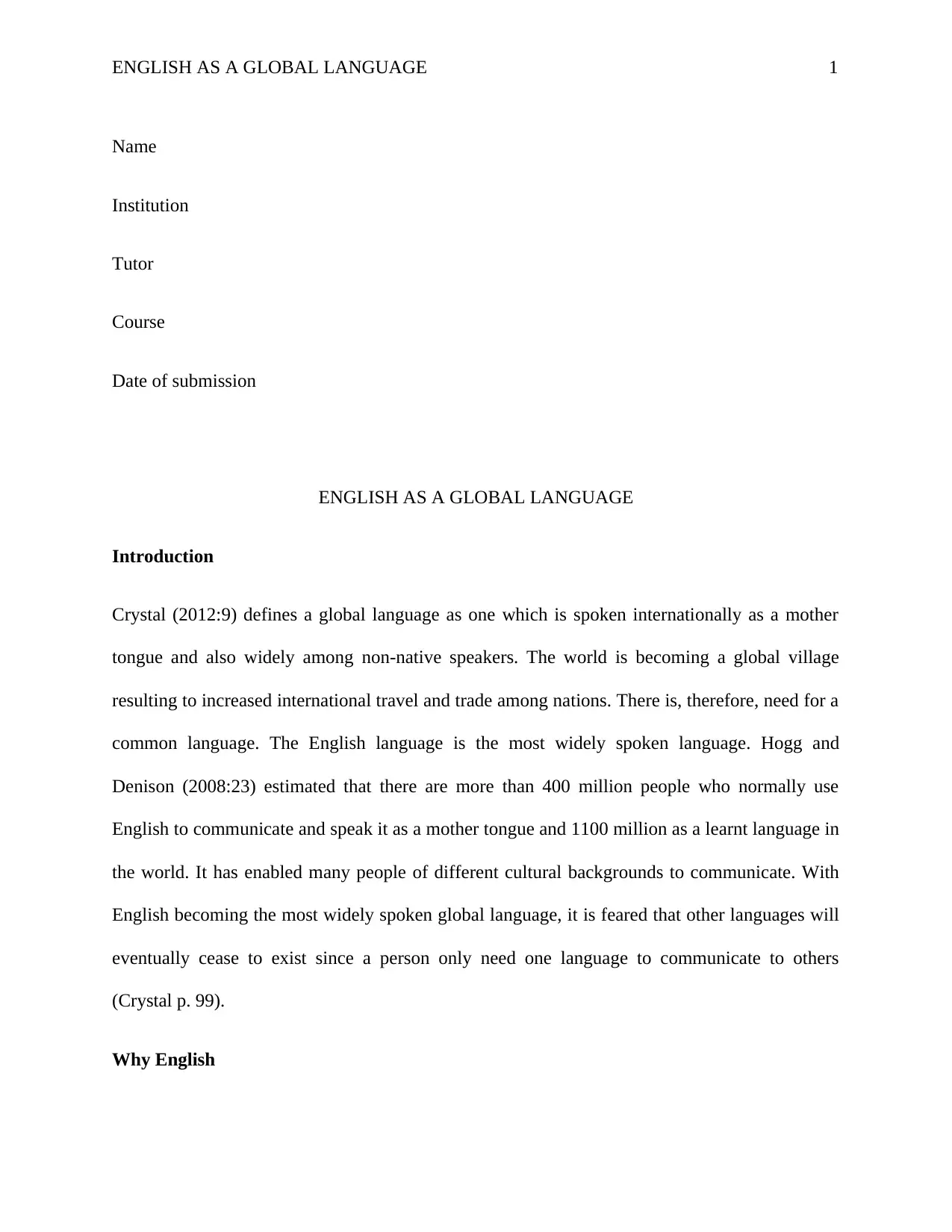
Crystal (2012:9) defines a global language as one which is spoken internationally as a mother
tongue and also widely among non-native speakers. The world is becoming a global village
resulting to increased international travel and trade among nations. There is, therefore, need for a
common language. The English language is the most widely spoken language. Hogg and
Denison (2008:23) estimated that there are more than 400 million people who normally use
English to communicate and speak it as a mother tongue and 1100 million as a learnt language in
the world. It has enabled many people of different cultural backgrounds to communicate. With
English becoming the most widely spoken global language, it is feared that other languages will
eventually cease to exist since a person only need one language to communicate to others
(Crystal p. 99).
Why English
tabler-icon-diamond-filled.svg

Paraphrase This Document

Need a fresh take? Get an instant paraphrase of this document with our AI Paraphraser
Document Page
ENGLISH AS A GLOBAL LANGUAGE 2
English fluency has become vital since most firms prefer English for negotiations making it the
language of trade. It is an important language in the international policy. For example, it is
estimated 31% of EU population use English as a second or foreign language followed by French
with 12% (Phillipson, p.8). The English language is also the language used in nautical and
international air traffic control. It is therefore taught in school to bridge the cultural barriers
between nations and people of different backgrounds.
Crystal (2012:89) suggests that a language becomes global as a result of the political and military
power of its population. English usage increased because it is the language of the most
technological inventions like the computer, keyboard, and the internet which originated from
English speaking countries. This spread was as a result of British political powers which lead to
its spread as a colonial language (Kachru, p.5). Many non-native English countries use it now in
their institutions like courts, parliament, and schools to bridge the cultural gap between different
communities. English is also the language of entertainment especially movies, music, sports, and
telecommunication. This growth has been promoted mainly by American economic and cultural
supremacy.
English language as a global language has allowed better communication among people of
different cultural backgrounds. Which in turn has enhanced global unity and cohesion and hence
reduction of crime. It has also enhanced education through information sharing (Hogg and
Denison, p. 78). However, the use of English as a global language leads to less usage of various
native languages which might eventually become extinct. Their loss will result in erosion of
cultures and national identity by having people with one culture. And in turn, finish tourism
industry which is the backbone of the economies of many countries.
Document Page
ENGLISH AS A GLOBAL LANGUAGE 3
Conclusion
Increasing growth of English use as a global language has made the world a better place as a
means of communication. However, it is leading to loss of relevance of many other languages
due to their less usage. Therefore, native languages should also be preserved to prevent loss of
important cultures in them.
Document Page
ENGLISH AS A GLOBAL LANGUAGE 4
References
Crystal, D., 2012. English as a global language. Cambridge university press.
Hogg, R. and Denison, D. eds., 2008. A history of the English language. Cambridge University
Press.
Kachru, B.B., 1986. The alchemy of English: The spread, functions, and models of non-native
Englishes. University of Illinois Press.
Phillipson, R., 2003. English-only Europe? Challenging language policy. Psychology Press.
chevron_up_icon
1 out of 4
circle_padding
hide_on_mobile
zoom_out_icon
[object Object]