Report: Global Expansion Strategies for XYZ Clothing and Footwear
VerifiedAdded on 2023/04/22
|7
|1307
|365
Report
AI Summary
This report examines the potential for XYZ Company, a clothing and footwear business, to expand into global markets. The report focuses on three countries: India, China, and Canada, analyzing the risks and opportunities associated with manufacturing and selling products in each location. The analysis considers factors such as labor costs, resource availability, market demand, and regulatory environments. The report highlights the importance of a robust market entry strategy, incorporating resource-based, industry-based, and institution-based views. The report concludes that China presents the most promising market for XYZ due to its low labor costs, high demand for western fashion, availability of resources, and flexible regulations. The report includes a table comparing the three countries across various parameters, including obstacles to entry, impact of law and rules, product liability, competition, and labor limitations. Ultimately, the report aims to provide XYZ with insights to make informed decisions about its international expansion strategy.
Running Head: BUSINESS 0
Business
Business
Paraphrase This Document
Need a fresh take? Get an instant paraphrase of this document with our AI Paraphraser

BUSINESS 1
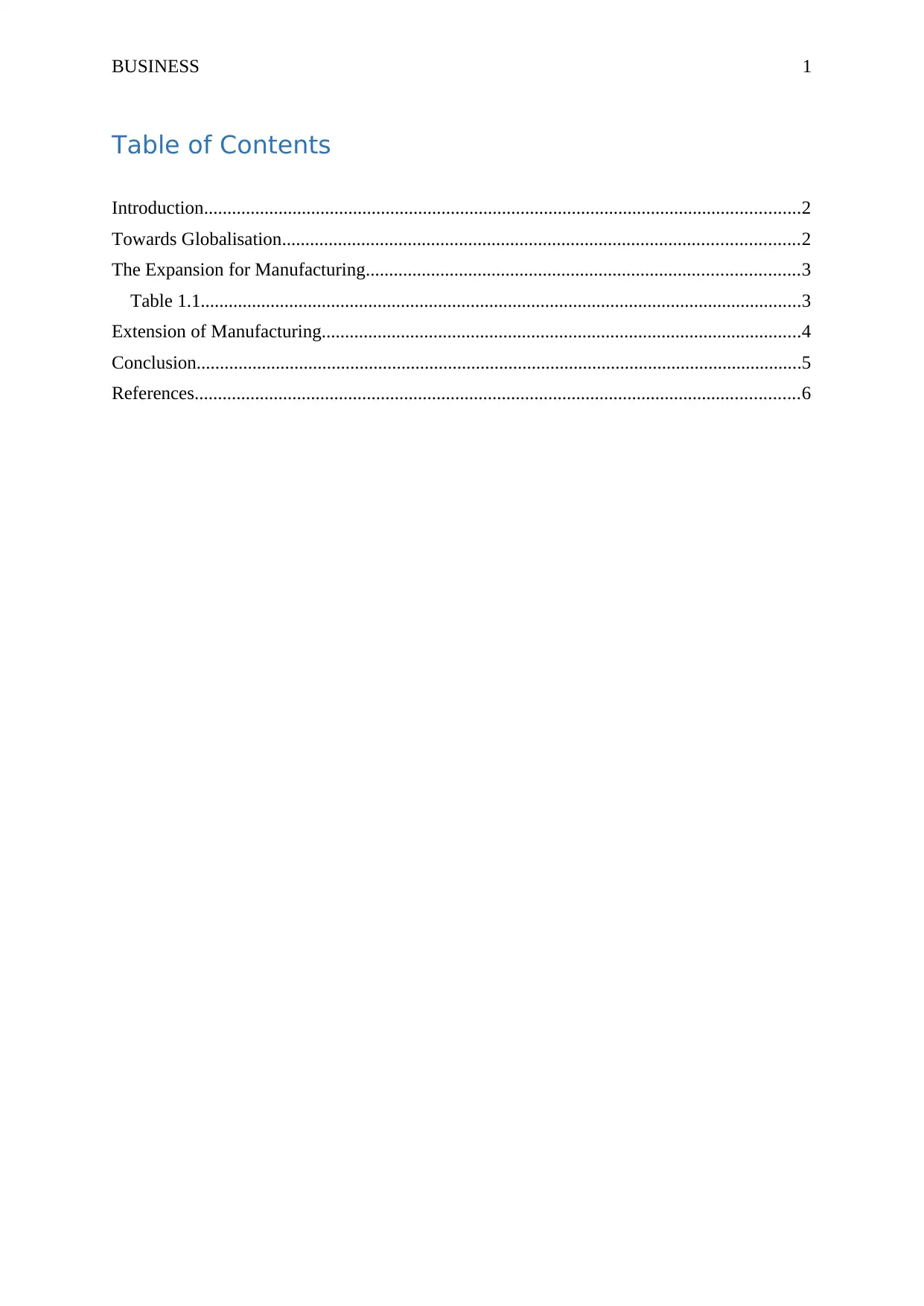
Table of Contents
Introduction................................................................................................................................2
Towards Globalisation...............................................................................................................2
The Expansion for Manufacturing.............................................................................................3
Table 1.1.................................................................................................................................3
Extension of Manufacturing.......................................................................................................4
Conclusion..................................................................................................................................5
References..................................................................................................................................6
Table of Contents
Introduction................................................................................................................................2
Towards Globalisation...............................................................................................................2
The Expansion for Manufacturing.............................................................................................3
Table 1.1.................................................................................................................................3
Extension of Manufacturing.......................................................................................................4
Conclusion..................................................................................................................................5
References..................................................................................................................................6

BUSINESS 2
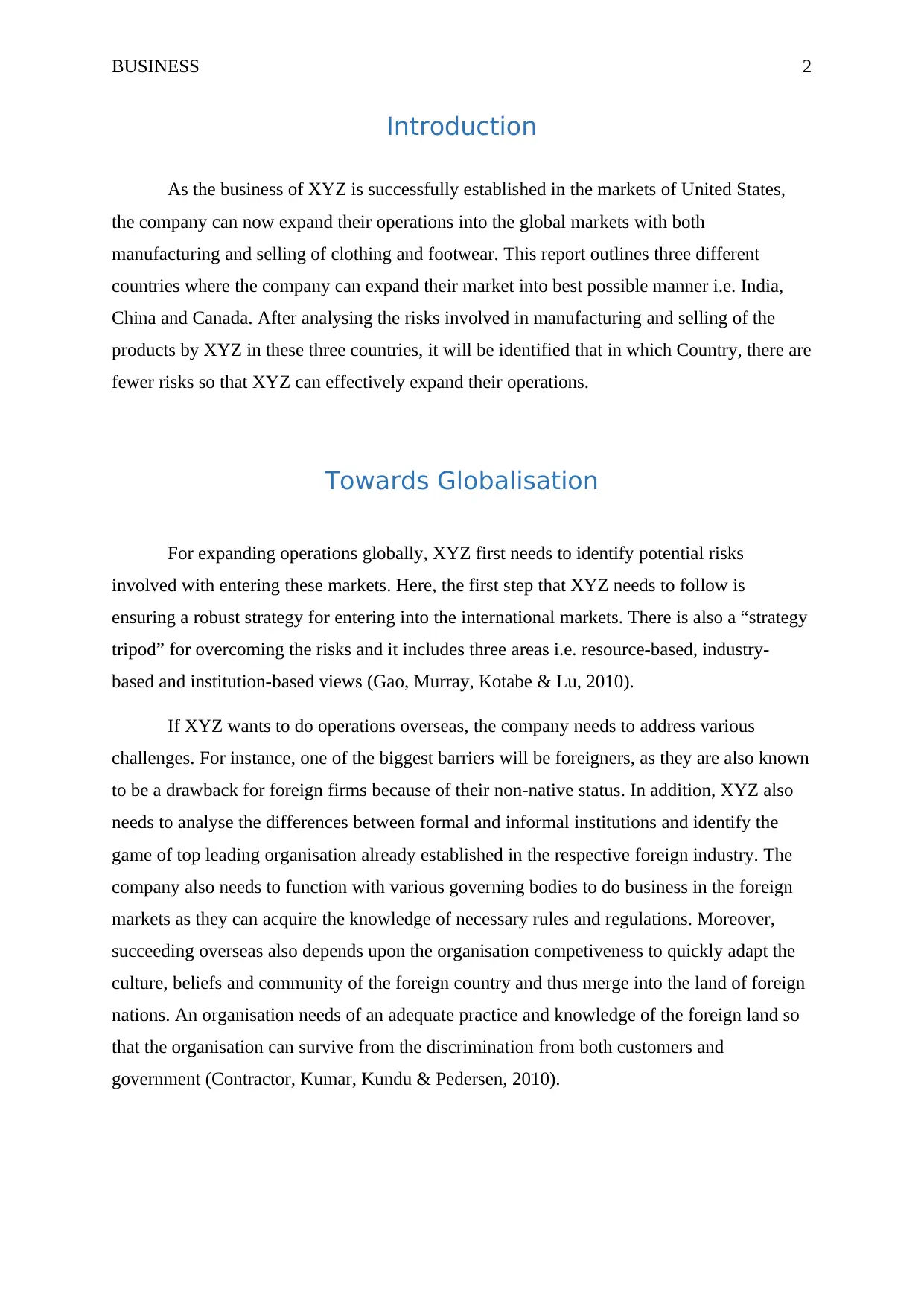
Introduction
As the business of XYZ is successfully established in the markets of United States,
the company can now expand their operations into the global markets with both
manufacturing and selling of clothing and footwear. This report outlines three different
countries where the company can expand their market into best possible manner i.e. India,
China and Canada. After analysing the risks involved in manufacturing and selling of the
products by XYZ in these three countries, it will be identified that in which Country, there are
fewer risks so that XYZ can effectively expand their operations.
Towards Globalisation
For expanding operations globally, XYZ first needs to identify potential risks
involved with entering these markets. Here, the first step that XYZ needs to follow is
ensuring a robust strategy for entering into the international markets. There is also a “strategy
tripod” for overcoming the risks and it includes three areas i.e. resource-based, industry-
based and institution-based views (Gao, Murray, Kotabe & Lu, 2010).
If XYZ wants to do operations overseas, the company needs to address various
challenges. For instance, one of the biggest barriers will be foreigners, as they are also known
to be a drawback for foreign firms because of their non-native status. In addition, XYZ also
needs to analyse the differences between formal and informal institutions and identify the
game of top leading organisation already established in the respective foreign industry. The
company also needs to function with various governing bodies to do business in the foreign
markets as they can acquire the knowledge of necessary rules and regulations. Moreover,
succeeding overseas also depends upon the organisation competiveness to quickly adapt the
culture, beliefs and community of the foreign country and thus merge into the land of foreign
nations. An organisation needs of an adequate practice and knowledge of the foreign land so
that the organisation can survive from the discrimination from both customers and
government (Contractor, Kumar, Kundu & Pedersen, 2010).
Introduction
As the business of XYZ is successfully established in the markets of United States,
the company can now expand their operations into the global markets with both
manufacturing and selling of clothing and footwear. This report outlines three different
countries where the company can expand their market into best possible manner i.e. India,
China and Canada. After analysing the risks involved in manufacturing and selling of the
products by XYZ in these three countries, it will be identified that in which Country, there are
fewer risks so that XYZ can effectively expand their operations.
Towards Globalisation
For expanding operations globally, XYZ first needs to identify potential risks
involved with entering these markets. Here, the first step that XYZ needs to follow is
ensuring a robust strategy for entering into the international markets. There is also a “strategy
tripod” for overcoming the risks and it includes three areas i.e. resource-based, industry-
based and institution-based views (Gao, Murray, Kotabe & Lu, 2010).
If XYZ wants to do operations overseas, the company needs to address various
challenges. For instance, one of the biggest barriers will be foreigners, as they are also known
to be a drawback for foreign firms because of their non-native status. In addition, XYZ also
needs to analyse the differences between formal and informal institutions and identify the
game of top leading organisation already established in the respective foreign industry. The
company also needs to function with various governing bodies to do business in the foreign
markets as they can acquire the knowledge of necessary rules and regulations. Moreover,
succeeding overseas also depends upon the organisation competiveness to quickly adapt the
culture, beliefs and community of the foreign country and thus merge into the land of foreign
nations. An organisation needs of an adequate practice and knowledge of the foreign land so
that the organisation can survive from the discrimination from both customers and
government (Contractor, Kumar, Kundu & Pedersen, 2010).
⊘ This is a preview!⊘
Do you want full access?
Subscribe today to unlock all pages.

Trusted by 1+ million students worldwide

BUSINESS 3
The Expansion for Manufacturing
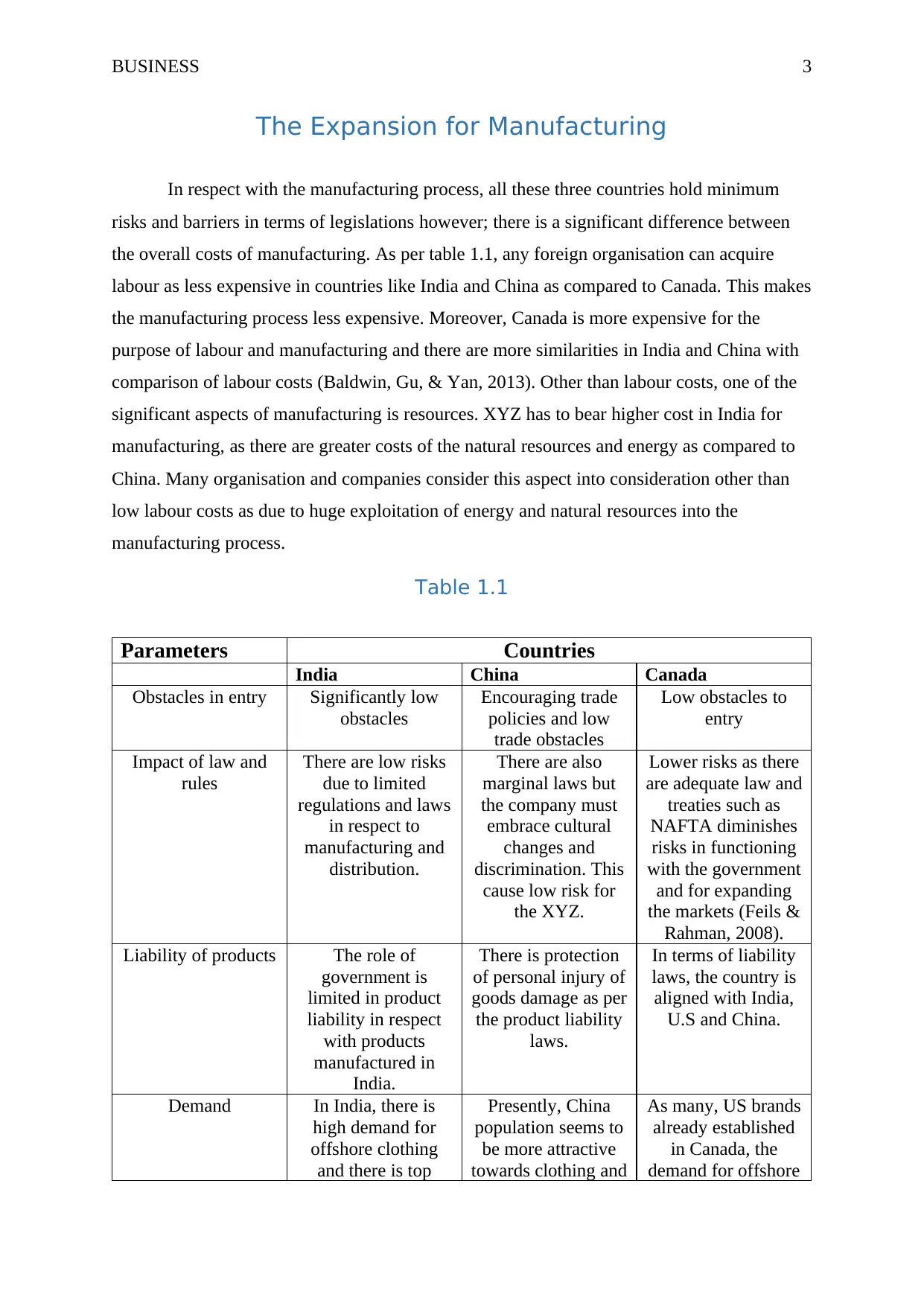
In respect with the manufacturing process, all these three countries hold minimum
risks and barriers in terms of legislations however; there is a significant difference between
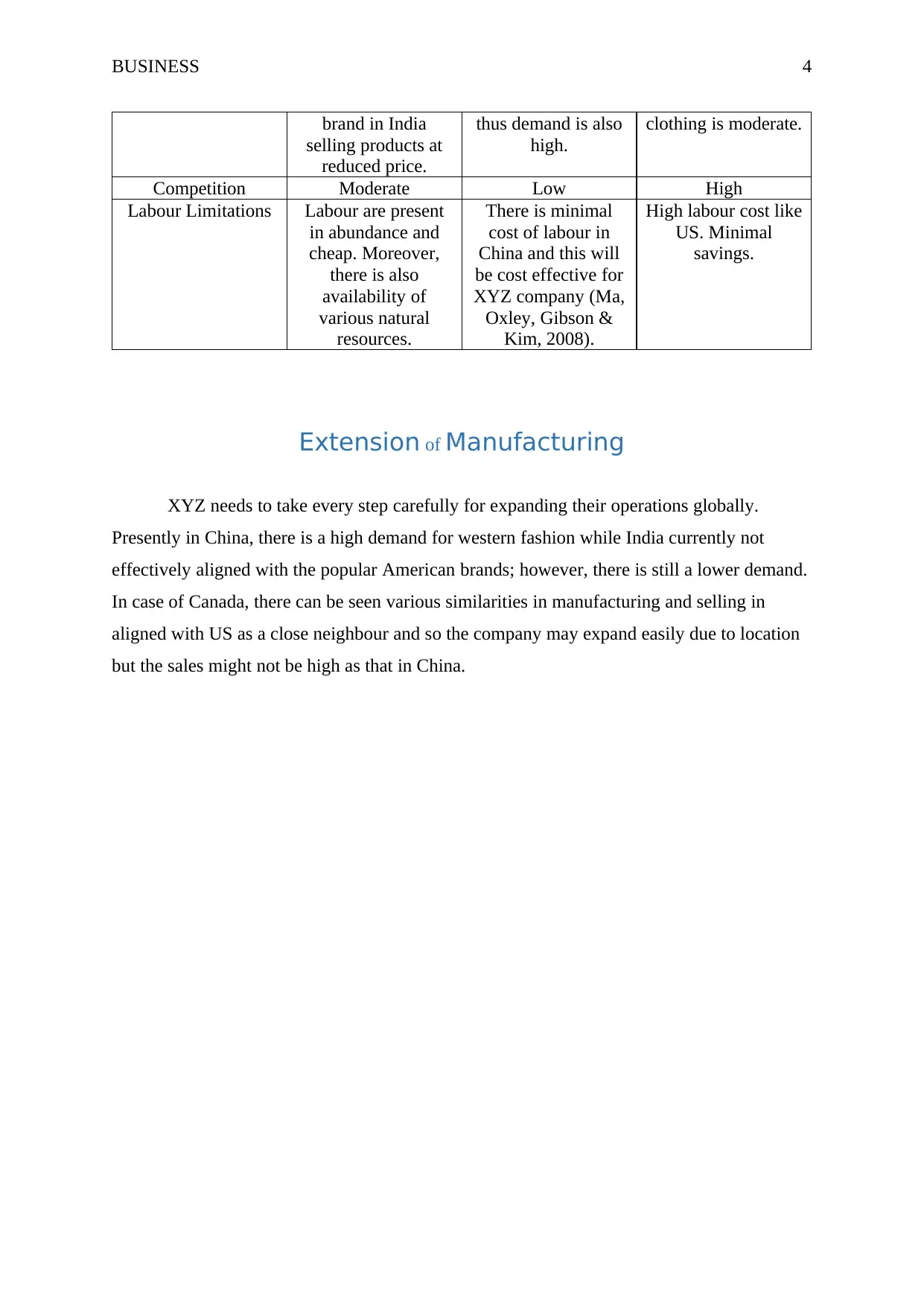
the overall costs of manufacturing. As per table 1.1, any foreign organisation can acquire
labour as less expensive in countries like India and China as compared to Canada. This makes
the manufacturing process less expensive. Moreover, Canada is more expensive for the
purpose of labour and manufacturing and there are more similarities in India and China with
comparison of labour costs (Baldwin, Gu, & Yan, 2013). Other than labour costs, one of the
significant aspects of manufacturing is resources. XYZ has to bear higher cost in India for
manufacturing, as there are greater costs of the natural resources and energy as compared to
China. Many organisation and companies consider this aspect into consideration other than
low labour costs as due to huge exploitation of energy and natural resources into the
manufacturing process.
Table 1.1
Parameters Countries
India China Canada
Obstacles in entry Significantly low
obstacles
Encouraging trade
policies and low
trade obstacles
Low obstacles to
entry
Impact of law and
rules
There are low risks
due to limited
regulations and laws
in respect to
manufacturing and
distribution.
There are also
marginal laws but
the company must
embrace cultural
changes and
discrimination. This
cause low risk for
the XYZ.
Lower risks as there
are adequate law and
treaties such as
NAFTA diminishes
risks in functioning
with the government
and for expanding
the markets (Feils &
Rahman, 2008).
Liability of products The role of
government is
limited in product
liability in respect
with products
manufactured in
India.
There is protection
of personal injury of
goods damage as per
the product liability
laws.
In terms of liability
laws, the country is
aligned with India,
U.S and China.
Demand In India, there is
high demand for
offshore clothing
and there is top
Presently, China
population seems to
be more attractive
towards clothing and
As many, US brands
already established
in Canada, the
demand for offshore
The Expansion for Manufacturing
In respect with the manufacturing process, all these three countries hold minimum
risks and barriers in terms of legislations however; there is a significant difference between
the overall costs of manufacturing. As per table 1.1, any foreign organisation can acquire
labour as less expensive in countries like India and China as compared to Canada. This makes
the manufacturing process less expensive. Moreover, Canada is more expensive for the
purpose of labour and manufacturing and there are more similarities in India and China with
comparison of labour costs (Baldwin, Gu, & Yan, 2013). Other than labour costs, one of the
significant aspects of manufacturing is resources. XYZ has to bear higher cost in India for
manufacturing, as there are greater costs of the natural resources and energy as compared to
China. Many organisation and companies consider this aspect into consideration other than
low labour costs as due to huge exploitation of energy and natural resources into the
manufacturing process.
Table 1.1
Parameters Countries
India China Canada
Obstacles in entry Significantly low
obstacles
Encouraging trade
policies and low
trade obstacles
Low obstacles to
entry
Impact of law and
rules
There are low risks
due to limited
regulations and laws
in respect to
manufacturing and
distribution.
There are also
marginal laws but
the company must
embrace cultural
changes and
discrimination. This
cause low risk for
the XYZ.
Lower risks as there
are adequate law and
treaties such as
NAFTA diminishes
risks in functioning
with the government
and for expanding
the markets (Feils &
Rahman, 2008).
Liability of products The role of
government is
limited in product
liability in respect
with products
manufactured in
India.
There is protection
of personal injury of
goods damage as per
the product liability
laws.
In terms of liability
laws, the country is
aligned with India,
U.S and China.
Demand In India, there is
high demand for
offshore clothing
and there is top
Presently, China
population seems to
be more attractive
towards clothing and
As many, US brands
already established
in Canada, the
demand for offshore
Paraphrase This Document
Need a fresh take? Get an instant paraphrase of this document with our AI Paraphraser

BUSINESS 4
brand in India
selling products at
reduced price.
thus demand is also
high.
clothing is moderate.
Competition Moderate Low High
Labour Limitations Labour are present
in abundance and
cheap. Moreover,
there is also
availability of
various natural
resources.
There is minimal
cost of labour in
China and this will
be cost effective for
XYZ company (Ma,
Oxley, Gibson &
Kim, 2008).
High labour cost like
US. Minimal
savings.
Extension of Manufacturing
XYZ needs to take every step carefully for expanding their operations globally.
Presently in China, there is a high demand for western fashion while India currently not
effectively aligned with the popular American brands; however, there is still a lower demand.
In case of Canada, there can be seen various similarities in manufacturing and selling in
aligned with US as a close neighbour and so the company may expand easily due to location
but the sales might not be high as that in China.
brand in India
selling products at
reduced price.
thus demand is also
high.
clothing is moderate.
Competition Moderate Low High
Labour Limitations Labour are present
in abundance and
cheap. Moreover,
there is also
availability of
various natural
resources.
There is minimal
cost of labour in
China and this will
be cost effective for
XYZ company (Ma,
Oxley, Gibson &
Kim, 2008).
High labour cost like
US. Minimal
savings.
Extension of Manufacturing
XYZ needs to take every step carefully for expanding their operations globally.
Presently in China, there is a high demand for western fashion while India currently not
effectively aligned with the popular American brands; however, there is still a lower demand.
In case of Canada, there can be seen various similarities in manufacturing and selling in
aligned with US as a close neighbour and so the company may expand easily due to location
but the sales might not be high as that in China.

BUSINESS 5
Conclusion
Globalisation is a key aspect to any company for expanding their operations into
international markets; however, it is also important to determine which market needs to be
entered. It can effectively be done by recognising the profitability and risks in terms of
manufacturing and selling of products into foreign markets. Hence, it can be said that China
will be the wiser market for XYZ for the manufacturing of clothing products. The reason is
that of cheap labours, high intention of population towards western clothing and availability
of adequate natural resources, and flexible regulations.
Conclusion
Globalisation is a key aspect to any company for expanding their operations into
international markets; however, it is also important to determine which market needs to be
entered. It can effectively be done by recognising the profitability and risks in terms of
manufacturing and selling of products into foreign markets. Hence, it can be said that China
will be the wiser market for XYZ for the manufacturing of clothing products. The reason is
that of cheap labours, high intention of population towards western clothing and availability
of adequate natural resources, and flexible regulations.
⊘ This is a preview!⊘
Do you want full access?
Subscribe today to unlock all pages.

Trusted by 1+ million students worldwide

BUSINESS 6
References
Baldwin, J. R., Gu, W., & Yan, B. (2013). Export growth, capacity utilization, and
productivity growth: evidence from the Canadian manufacturing plants. Review of
Income and Wealth, 59(4), 665-688.
Contractor, F. J., Kumar, V., Kundu, S. K., & Pedersen, T. (2010). Reconceptualizing the
firm in a world of outsourcing and offshoring: The organizational and geographical
relocation of high‐value company functions. Journal of Management Studies, 47(8),
1417-1433.
Feils, D. J., & Rahman, M. (2008). Regional economic integration and foreign direct
investment: The case of NAFTA. Management International Review, 48(2), 147-163.
Gao, G. Y., Murray, J. Y., Kotabe, M., & Lu, J. (2010). A “strategy tripod” perspective on
export behaviors: Evidence from domestic and foreign firms based in an emerging
economy. Journal of International Business Studies, 41(3), 377-396.
Ma, H., Oxley, L., Gibson, J., & Kim, B. (2008). China's energy economy: Technical change,
factor demand and interfactor/interfuel substitution. Energy Economics, 30(5), 2167-
2183.
References
Baldwin, J. R., Gu, W., & Yan, B. (2013). Export growth, capacity utilization, and
productivity growth: evidence from the Canadian manufacturing plants. Review of
Income and Wealth, 59(4), 665-688.
Contractor, F. J., Kumar, V., Kundu, S. K., & Pedersen, T. (2010). Reconceptualizing the
firm in a world of outsourcing and offshoring: The organizational and geographical
relocation of high‐value company functions. Journal of Management Studies, 47(8),
1417-1433.
Feils, D. J., & Rahman, M. (2008). Regional economic integration and foreign direct
investment: The case of NAFTA. Management International Review, 48(2), 147-163.
Gao, G. Y., Murray, J. Y., Kotabe, M., & Lu, J. (2010). A “strategy tripod” perspective on
export behaviors: Evidence from domestic and foreign firms based in an emerging
economy. Journal of International Business Studies, 41(3), 377-396.
Ma, H., Oxley, L., Gibson, J., & Kim, B. (2008). China's energy economy: Technical change,
factor demand and interfactor/interfuel substitution. Energy Economics, 30(5), 2167-
2183.
1 out of 7
Related Documents
Your All-in-One AI-Powered Toolkit for Academic Success.
+13062052269
info@desklib.com
Available 24*7 on WhatsApp / Email
Unlock your academic potential
Copyright © 2020–2025 A2Z Services. All Rights Reserved. Developed and managed by ZUCOL.