Theories and Global Practices in Marketing: New Zealand Implications
VerifiedAdded on 2024/06/11
|13
|3220
|431
Essay
AI Summary
This essay provides a comprehensive analysis of the evolving marketing landscape, focusing on the emergence of relationship marketing, the impact of digital technologies, and the changes brought about by the COVID-19 pandemic. It examines current trends such as influencer marketing, personalization, and sustainability, and explores how these global practices and advanced theories can be applied within the unique business context of New Zealand. The essay emphasizes the importance of adapting to digital transformation, leveraging data-driven insights, and prioritizing customer relationships for businesses to remain competitive and relevant in the New Zealand market, while also considering the nation's cultural traits, competitive environment, and regulatory structure.
Student ID – 22301437
1
1

Paraphrase This Document
Need a fresh take? Get an instant paraphrase of this document with our AI Paraphraser
Student ID – 22301437
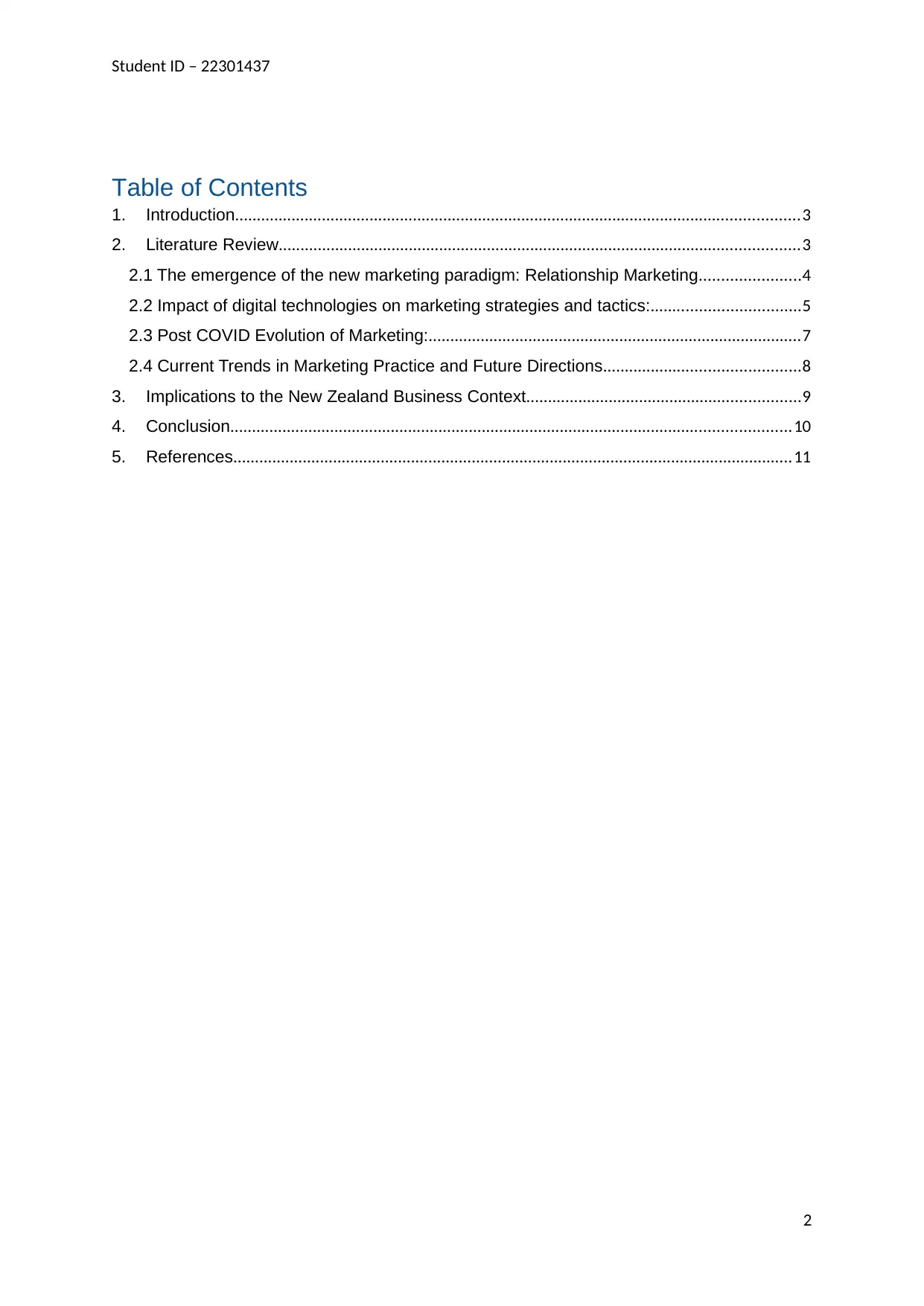
Table of Contents
1. Introduction..................................................................................................................................3
2. Literature Review........................................................................................................................3
2.1 The emergence of the new marketing paradigm: Relationship Marketing.......................4
2.2 Impact of digital technologies on marketing strategies and tactics:..................................5
2.3 Post COVID Evolution of Marketing:......................................................................................7
2.4 Current Trends in Marketing Practice and Future Directions.............................................8
3. Implications to the New Zealand Business Context...............................................................9
4. Conclusion.................................................................................................................................10
5. References.................................................................................................................................11
2
Table of Contents
1. Introduction..................................................................................................................................3
2. Literature Review........................................................................................................................3
2.1 The emergence of the new marketing paradigm: Relationship Marketing.......................4
2.2 Impact of digital technologies on marketing strategies and tactics:..................................5
2.3 Post COVID Evolution of Marketing:......................................................................................7
2.4 Current Trends in Marketing Practice and Future Directions.............................................8
3. Implications to the New Zealand Business Context...............................................................9
4. Conclusion.................................................................................................................................10
5. References.................................................................................................................................11
2
Student ID – 22301437
Theories and Global Practices in Marketing:
Current trends and their implications in the New Zealand context
1. Introduction
The field of marketing has undergone a remarkable transformation throughout its
history, and this evolution has accelerated over the past few decades. The marketing
landscape is in a perpetual state of flux, primarily driven by several pivotal factors
that have not only reshaped the way businesses engage with consumers but have
also redefined the fundamental strategies and approaches employed in promoting
their products and services. This essay aims to provide a comprehensive overview of
the ever-changing marketing landscape, focusing on critical aspects such as the
emergence of the new marketing paradigm which is also known as Relationship
Marketing, the profound impact of digital technologies on marketing strategies and
tactics, and the paradigm shift in the wake of the COVID-19 pandemic. Furthermore,
it delves into contemporary digital marketing trends and future directions. It also
involves exploration of the implications of these advanced theories and global
marketing practices in the unique context of New Zealand's business environment.
2. Literature Review
Across the globe, opportunities in the foreign market caused many business hubs to
expand quickly during the 1980s. In response to changing customer demands and
improvements in technology, some co-operatives grew, while others merged to form
businesses operating on an international level (Douglas & Craig, 1992). Global trade
has emerged as a result of the globalization of the world, despite the fact that
"technology" has been transforming and creating a bridge between countries and
3
Theories and Global Practices in Marketing:
Current trends and their implications in the New Zealand context
1. Introduction
The field of marketing has undergone a remarkable transformation throughout its
history, and this evolution has accelerated over the past few decades. The marketing
landscape is in a perpetual state of flux, primarily driven by several pivotal factors
that have not only reshaped the way businesses engage with consumers but have
also redefined the fundamental strategies and approaches employed in promoting
their products and services. This essay aims to provide a comprehensive overview of
the ever-changing marketing landscape, focusing on critical aspects such as the
emergence of the new marketing paradigm which is also known as Relationship
Marketing, the profound impact of digital technologies on marketing strategies and
tactics, and the paradigm shift in the wake of the COVID-19 pandemic. Furthermore,
it delves into contemporary digital marketing trends and future directions. It also
involves exploration of the implications of these advanced theories and global
marketing practices in the unique context of New Zealand's business environment.
2. Literature Review
Across the globe, opportunities in the foreign market caused many business hubs to
expand quickly during the 1980s. In response to changing customer demands and
improvements in technology, some co-operatives grew, while others merged to form
businesses operating on an international level (Douglas & Craig, 1992). Global trade
has emerged as a result of the globalization of the world, despite the fact that
"technology" has been transforming and creating a bridge between countries and
3
⊘ This is a preview!⊘
Do you want full access?
Subscribe today to unlock all pages.

Trusted by 1+ million students worldwide
Student ID – 22301437
regions for decades. For businesses looking to expand internationally, globalization
has become a crucial factor (Douglas & Craig, 1992). People all over the world have
different eating habits, communication styles, and religious beliefs. Instead of
implementing standard operations, which can be a disastrous mistake, companies
must devise unique marketing strategies to break through this barrier and succeed in
the global market. This is where Relationship Marketing comes into the picture. The
term “Relationship Marketing” has been derived from the service marketing industry,
and has become a popular trend in modern business. According to Grönroos
(1994d), Relationship marketing is a way in which companies establish, maintain and
enhance relationships with their customers and partners for profit under a common
objective. The concept of Relationship Marketing represents a pivotal shift in the field
of marketing, emphasizing the importance of building and sustaining long-term
relationships with customers. Grönroos (1994d). To critically examine this paradigm
and its implications in the New Zealand context, let’s explore into relevant literature
to understand its foundations and development.
2.1 The emergence of the new marketing paradigm: Relationship Marketing
The emergence of Relationship Marketing can be traced back to the works of
influential scholars such as Leonard Berry, Evert Gummesson, and Robert Lusch
(Grove et al., 2003). Their contributions laid the theoretical groundwork for this
paradigm shift. The fundamental principles of Relationship Marketing include trust,
commitment, reciprocity, and customer loyalty. These principles have evolved to
encompass both B2C and B2B marketing contexts (Rafiq & Ahmed, 1995b).
Relationship Marketing is characterized by a focus on mutual value creation and
long-term customer engagement, moving beyond the transactional nature of
traditional marketing (Sheth & Parvatiyar, 1995b).
4
regions for decades. For businesses looking to expand internationally, globalization
has become a crucial factor (Douglas & Craig, 1992). People all over the world have
different eating habits, communication styles, and religious beliefs. Instead of
implementing standard operations, which can be a disastrous mistake, companies
must devise unique marketing strategies to break through this barrier and succeed in
the global market. This is where Relationship Marketing comes into the picture. The
term “Relationship Marketing” has been derived from the service marketing industry,
and has become a popular trend in modern business. According to Grönroos
(1994d), Relationship marketing is a way in which companies establish, maintain and
enhance relationships with their customers and partners for profit under a common
objective. The concept of Relationship Marketing represents a pivotal shift in the field
of marketing, emphasizing the importance of building and sustaining long-term
relationships with customers. Grönroos (1994d). To critically examine this paradigm
and its implications in the New Zealand context, let’s explore into relevant literature
to understand its foundations and development.
2.1 The emergence of the new marketing paradigm: Relationship Marketing
The emergence of Relationship Marketing can be traced back to the works of
influential scholars such as Leonard Berry, Evert Gummesson, and Robert Lusch
(Grove et al., 2003). Their contributions laid the theoretical groundwork for this
paradigm shift. The fundamental principles of Relationship Marketing include trust,
commitment, reciprocity, and customer loyalty. These principles have evolved to
encompass both B2C and B2B marketing contexts (Rafiq & Ahmed, 1995b).
Relationship Marketing is characterized by a focus on mutual value creation and
long-term customer engagement, moving beyond the transactional nature of
traditional marketing (Sheth & Parvatiyar, 1995b).
4
Paraphrase This Document
Need a fresh take? Get an instant paraphrase of this document with our AI Paraphraser
Student ID – 22301437
Relationship marketing places the customer at the center of marketing strategies.
Strategically, this means that businesses need to shift from a product-centric
approach to a customer-centric one (Johanesová & Vaňová, 2020b). They must
invest in understanding their customers, their needs, preferences, and behaviors.
Strategic marketing efforts need to be built around creating experiences that
resonate with the target audience (Johanesová & Vaňová, 2020b). This will impose
market research and customer segmentation to create tailored strategies.
2.2 Impact of digital technologies on marketing strategies and tactics:
5
Impact of
Digital
technologies
on Markeing
Long-term
Customer
Value
Customer
Retention
Data-driven
Marketing
insights
Relationship
building
Personalisation
Market
Optimisation
Competitive
Advantage
Relationship marketing places the customer at the center of marketing strategies.
Strategically, this means that businesses need to shift from a product-centric
approach to a customer-centric one (Johanesová & Vaňová, 2020b). They must
invest in understanding their customers, their needs, preferences, and behaviors.
Strategic marketing efforts need to be built around creating experiences that
resonate with the target audience (Johanesová & Vaňová, 2020b). This will impose
market research and customer segmentation to create tailored strategies.
2.2 Impact of digital technologies on marketing strategies and tactics:
5
Impact of
Digital
technologies
on Markeing
Long-term
Customer
Value
Customer
Retention
Data-driven
Marketing
insights
Relationship
building
Personalisation
Market
Optimisation
Competitive
Advantage
Student ID – 22301437
The world of marketing has been rapidly transformed by digital technologies and the
internet, giving rise to what we now know as Digital Marketing Transformation
(Rosário et al., 2022). This revolution encompasses a range of strategies and tactics
that utilize digital channels to effectively reach and engage with consumers,
ultimately helping businesses achieve their marketing objectives (Rosário et al.,
2022). Strategic marketing under Relationship Marketing emphasizes on the long-
term value of customers. Businesses need to focus on strategies that maximize
customer lifetime value (Grönroos, 1994a). This means that strategic marketing must
extend beyond quick sales and consider the long-term relationships with customers.
Customer Retention on the other hand reflects the strategic focus shifts from
customer acquisition to customer retention by retaining existing customers, which is
often more cost-effective than acquiring new ones through digital marketing (Rosário
et al., 2022).
As per Sahut et al. (2019), the process of initiating or managing a business that leve
aages diverse digital facilitators to facilitate the procurement, manipulation, and disse
mination of digital data is known as "creation of digital value" in the context of digital
entrepreneurship. Strategic marketing has become data-driven in the Relationship
Marketing paradigm. Businesses collect and analyze customer data to gain insights
into their behaviors and preferences. This data-driven approach informs strategic
decisions and helps in creating tailored marketing campaigns (Sahut et al., 2019).
Here, personalization is a key strategic imperative in Relationship Marketing.
Businesses must strategically develop the capabilities to deliver highly personalized
marketing messages and offers. This involves market segmentation, automation, and
content customization to address the specific needs and preferences of different
customer segments (Rosário et al., 2022). Other metrics like customer satisfaction,
6
The world of marketing has been rapidly transformed by digital technologies and the
internet, giving rise to what we now know as Digital Marketing Transformation
(Rosário et al., 2022). This revolution encompasses a range of strategies and tactics
that utilize digital channels to effectively reach and engage with consumers,
ultimately helping businesses achieve their marketing objectives (Rosário et al.,
2022). Strategic marketing under Relationship Marketing emphasizes on the long-
term value of customers. Businesses need to focus on strategies that maximize
customer lifetime value (Grönroos, 1994a). This means that strategic marketing must
extend beyond quick sales and consider the long-term relationships with customers.
Customer Retention on the other hand reflects the strategic focus shifts from
customer acquisition to customer retention by retaining existing customers, which is
often more cost-effective than acquiring new ones through digital marketing (Rosário
et al., 2022).
As per Sahut et al. (2019), the process of initiating or managing a business that leve
aages diverse digital facilitators to facilitate the procurement, manipulation, and disse
mination of digital data is known as "creation of digital value" in the context of digital
entrepreneurship. Strategic marketing has become data-driven in the Relationship
Marketing paradigm. Businesses collect and analyze customer data to gain insights
into their behaviors and preferences. This data-driven approach informs strategic
decisions and helps in creating tailored marketing campaigns (Sahut et al., 2019).
Here, personalization is a key strategic imperative in Relationship Marketing.
Businesses must strategically develop the capabilities to deliver highly personalized
marketing messages and offers. This involves market segmentation, automation, and
content customization to address the specific needs and preferences of different
customer segments (Rosário et al., 2022). Other metrics like customer satisfaction,
6
⊘ This is a preview!⊘
Do you want full access?
Subscribe today to unlock all pages.
Trusted by 1+ million students worldwide
Student ID – 22301437
retention rates, net promoter score, and customer lifetime value become crucial for
measuring the effectiveness of marketing strategies. These metrics guide strategic
decisions and help in optimizing marketing efforts or SEO (Truong & Simmons,
2010).
Relationship Marketing provides a competitive advantage by assessing how
businesses can differentiate themselves by offering exceptional customer
experiences and maintaining strong customer relationships (Douglas & Craig, 1992).
Businesses must strategically position themselves as leaders in relationship building
to gain a competitive edge (Grönroos, 1994a). The choice of communication
channels is a strategic decision which is by selecting the right communication
channels that enable continuous and personalized interaction with customers. This
can involve email marketing, social media, mobile apps, and other digital platforms
that facilitate direct communication and engagement (Rosário et al., 2022).
2.3 Post COVID Evolution of Marketing:
More people are making their first-ever purchases online and through mobile devices
as a result of the COVID-19 pandemic, which has changed consumer behavior.
Consequently, in order to adjust to the digital revolution, South African marketers
created lucid communication and tactics (Fraser-Arnott, 2023). Marketing creates
value through a variety of methods, including identifying stakeholders, understanding
their particular and shared needs, selecting the messages to convey to them and the
platforms to do so, accepting feedback from stakeholders to ensure that their needs
and expectations are met, and assessing goods and services from the perspective of
stakeholders (Fraser-Arnott, 2023). The turmoil that ensued after the pandemic
brought about a great deal of changes in the attitudes and behaviors of retailers and
consumers alike. It has been necessary to introduce new services, new retail
7
retention rates, net promoter score, and customer lifetime value become crucial for
measuring the effectiveness of marketing strategies. These metrics guide strategic
decisions and help in optimizing marketing efforts or SEO (Truong & Simmons,
2010).
Relationship Marketing provides a competitive advantage by assessing how
businesses can differentiate themselves by offering exceptional customer
experiences and maintaining strong customer relationships (Douglas & Craig, 1992).
Businesses must strategically position themselves as leaders in relationship building
to gain a competitive edge (Grönroos, 1994a). The choice of communication
channels is a strategic decision which is by selecting the right communication
channels that enable continuous and personalized interaction with customers. This
can involve email marketing, social media, mobile apps, and other digital platforms
that facilitate direct communication and engagement (Rosário et al., 2022).
2.3 Post COVID Evolution of Marketing:
More people are making their first-ever purchases online and through mobile devices
as a result of the COVID-19 pandemic, which has changed consumer behavior.
Consequently, in order to adjust to the digital revolution, South African marketers
created lucid communication and tactics (Fraser-Arnott, 2023). Marketing creates
value through a variety of methods, including identifying stakeholders, understanding
their particular and shared needs, selecting the messages to convey to them and the
platforms to do so, accepting feedback from stakeholders to ensure that their needs
and expectations are met, and assessing goods and services from the perspective of
stakeholders (Fraser-Arnott, 2023). The turmoil that ensued after the pandemic
brought about a great deal of changes in the attitudes and behaviors of retailers and
consumers alike. It has been necessary to introduce new services, new retail
7
Paraphrase This Document
Need a fresh take? Get an instant paraphrase of this document with our AI Paraphraser
Student ID – 22301437
formats, and new trends. It is necessary to thoroughly reevaluate conventional ideas
about customer attitudes about what, how, and where to buy (Stocker et al., 2023).
A key characteristic of successful retailers is their ability to change and adapt.
According to Fraser-Arnott (2023b), during the last 24 months, there have been
worsening trends in consumer adoption of the mobile channel, the pursuit of
environmentally safe products and services, and the introduction of new regulations
that have caused supply chain disruptions to accommodate them. The marketing
environment that existed after COVID-19 is very different from the norm before 2020
(Fenitra et al., 2022). Innovation is prompted by difficulty. The COVID-19 pandemic
has forced businesses to find creative ways to engage with customers and meet
their needs (Kotler et al., 2012). Enhancing their marketing communications with AI-
based platforms such as and Microsoft Cognitive Services, Amazon Lex and Google
Assistant is becoming more and more common among businesses (Rosário et al.,
2022).
2.4 Current Trends in Marketing Practice and Future Directions
A number of trends, such as influencer marketing, personalization, and sustainability,
have become prominent in today's marketing environment. In addition to being
morally required, sustainability is a marketing tactic used to satisfy environmentally
concerned customers. Influencer marketing uses the influence of people who have a
sizable online following to market goods and services (Gordon et al., 2011).
Additionally, with customers expecting customized experiences, personalization has
emerged as a key component of successful marketing. The acceptance of digital
marketing has been acknowledged as being necessary for a comprehensive social
change and sustainability. This process comprises developing and implementing the
most recent and pertinent marketing strategies and techniques to assist businesses
8
formats, and new trends. It is necessary to thoroughly reevaluate conventional ideas
about customer attitudes about what, how, and where to buy (Stocker et al., 2023).
A key characteristic of successful retailers is their ability to change and adapt.
According to Fraser-Arnott (2023b), during the last 24 months, there have been
worsening trends in consumer adoption of the mobile channel, the pursuit of
environmentally safe products and services, and the introduction of new regulations
that have caused supply chain disruptions to accommodate them. The marketing
environment that existed after COVID-19 is very different from the norm before 2020
(Fenitra et al., 2022). Innovation is prompted by difficulty. The COVID-19 pandemic
has forced businesses to find creative ways to engage with customers and meet
their needs (Kotler et al., 2012). Enhancing their marketing communications with AI-
based platforms such as and Microsoft Cognitive Services, Amazon Lex and Google
Assistant is becoming more and more common among businesses (Rosário et al.,
2022).
2.4 Current Trends in Marketing Practice and Future Directions
A number of trends, such as influencer marketing, personalization, and sustainability,
have become prominent in today's marketing environment. In addition to being
morally required, sustainability is a marketing tactic used to satisfy environmentally
concerned customers. Influencer marketing uses the influence of people who have a
sizable online following to market goods and services (Gordon et al., 2011).
Additionally, with customers expecting customized experiences, personalization has
emerged as a key component of successful marketing. The acceptance of digital
marketing has been acknowledged as being necessary for a comprehensive social
change and sustainability. This process comprises developing and implementing the
most recent and pertinent marketing strategies and techniques to assist businesses
8
Student ID – 22301437
in adapting to the constantly changing environment (Gordon et al., 2011). Budget
and entrepreneurial preferences also have a significant impact on whether or not
business owners choose to use digital marketing (Gupta, 2020). The study also
found that having experience with digital marketing and being creative are two other
factors that increase an entrepreneur's likelihood of adopting it. Technology can have
a big impact on digital entrepreneurship since it is an enabler, a mediator, and a
byproduct of an entrepreneur's work (Filieri et al., 2021). This facilitates
entrepreneurs' ability to maintain a productive connection with their audience. In
order to effectively serve their audience, entrepreneurs in New Zealand can leverage
artificial intelligence (AI) technologies in the form of interactive chatbots. These
chatbots can solve customer issues, preserve the company's reputation, and
manage customer needs more affordably by using historical purchasing patterns
(Filieri et al., 2021).
3. Implications to the New Zealand Business Context
This essay's discussion of cutting-edge theories and international marketing
strategies has special relevance for New Zealand's distinct business environment.
The application of these marketing concepts may be influenced by the nation's
cultural traits, competitive environment, and regulatory structure. Marketing related to
causes is the primary focus in New Zealand (Chaney & Dolli, 2001c). According to
Chaney and Dolli (2001c), businesses in New Zealand must adjust to global trends
while taking into account the unique features, culture, and competition of their local
market. Globally, sustainability and ethical business practices are becoming
indispensable. Marketing campaigns that incorporate these values will benefit New
Zealand, a nation known for its breathtaking scenery and eco-friendly reputation
(Yallop & Simon, 2014).
9
in adapting to the constantly changing environment (Gordon et al., 2011). Budget
and entrepreneurial preferences also have a significant impact on whether or not
business owners choose to use digital marketing (Gupta, 2020). The study also
found that having experience with digital marketing and being creative are two other
factors that increase an entrepreneur's likelihood of adopting it. Technology can have
a big impact on digital entrepreneurship since it is an enabler, a mediator, and a
byproduct of an entrepreneur's work (Filieri et al., 2021). This facilitates
entrepreneurs' ability to maintain a productive connection with their audience. In
order to effectively serve their audience, entrepreneurs in New Zealand can leverage
artificial intelligence (AI) technologies in the form of interactive chatbots. These
chatbots can solve customer issues, preserve the company's reputation, and
manage customer needs more affordably by using historical purchasing patterns
(Filieri et al., 2021).
3. Implications to the New Zealand Business Context
This essay's discussion of cutting-edge theories and international marketing
strategies has special relevance for New Zealand's distinct business environment.
The application of these marketing concepts may be influenced by the nation's
cultural traits, competitive environment, and regulatory structure. Marketing related to
causes is the primary focus in New Zealand (Chaney & Dolli, 2001c). According to
Chaney and Dolli (2001c), businesses in New Zealand must adjust to global trends
while taking into account the unique features, culture, and competition of their local
market. Globally, sustainability and ethical business practices are becoming
indispensable. Marketing campaigns that incorporate these values will benefit New
Zealand, a nation known for its breathtaking scenery and eco-friendly reputation
(Yallop & Simon, 2014).
9
⊘ This is a preview!⊘
Do you want full access?
Subscribe today to unlock all pages.
Trusted by 1+ million students worldwide
Student ID – 22301437
Furthermore, the results showed that local market business owners decreased staff,
stepped up marketing efforts, and even saw a pay decrease in response (Morgan et
al., 2003). It was widely believed that the ability to reinvent and reposition oneself
after COVID was a prerequisite for success in business. Because labor costs were
low, businesses were more robust. This effect was also felt by businesses that
depended on knowledge to function in the industries in which they operated.
4. Conclusion
In summary, the dynamic interplay between global forces and technological
advancements is reflected in the constantly changing marketing landscape. For
businesses to remain competitive and relevant, they must comprehend and embrace
the new marketing paradigm, relationship marketing, the impact of digital
technologies, and the lessons discovered during the post-COVID marketing era.
Businesses in New Zealand can take advantage of these cutting-edge ideas while
customizing their plans to the peculiarities of their regional market. Marketing
strategies and tactics have undergone a radical change as a result of the COVID-19
pandemic. It caused a disturbance to long-standing business procedures and
required quick adjustments. In the post-pandemic marketing environment, ideas like
relationship building, remote customer engagement, digital marketing, and e-
commerce growth became essential. The pandemic brought to light the value of
flexibility and the capacity to overcome unforeseen obstacles. For future expansion,
recommendations have also been made regarding the direction and ramifications of
integrating AI into sustainable marketing strategies.
10
Furthermore, the results showed that local market business owners decreased staff,
stepped up marketing efforts, and even saw a pay decrease in response (Morgan et
al., 2003). It was widely believed that the ability to reinvent and reposition oneself
after COVID was a prerequisite for success in business. Because labor costs were
low, businesses were more robust. This effect was also felt by businesses that
depended on knowledge to function in the industries in which they operated.
4. Conclusion
In summary, the dynamic interplay between global forces and technological
advancements is reflected in the constantly changing marketing landscape. For
businesses to remain competitive and relevant, they must comprehend and embrace
the new marketing paradigm, relationship marketing, the impact of digital
technologies, and the lessons discovered during the post-COVID marketing era.
Businesses in New Zealand can take advantage of these cutting-edge ideas while
customizing their plans to the peculiarities of their regional market. Marketing
strategies and tactics have undergone a radical change as a result of the COVID-19
pandemic. It caused a disturbance to long-standing business procedures and
required quick adjustments. In the post-pandemic marketing environment, ideas like
relationship building, remote customer engagement, digital marketing, and e-
commerce growth became essential. The pandemic brought to light the value of
flexibility and the capacity to overcome unforeseen obstacles. For future expansion,
recommendations have also been made regarding the direction and ramifications of
integrating AI into sustainable marketing strategies.
10
Paraphrase This Document
Need a fresh take? Get an instant paraphrase of this document with our AI Paraphraser
Student ID – 22301437
5. References
Chaney, I., & Dolli, N. (2001c). Cause related marketing in New Zealand. Journal of
Philanthropy and Marketing, 6(2), 156–163. https://doi.org/10.1002/nvsm.143
Grönroos, C. (1994a). Quo Vadis, marketing? Toward a relationship marketing
paradigm. Journal of Marketing Management, 10(5), 347–360.
https://doi.org/10.1080/0267257x.1994.9964283
Grove, S. J., Fisk, R. P., & John, J. (2003). The future of services marketing:
forecasts from ten services experts. Journal of Services Marketing, 17(2),
107–121. https://doi.org/10.1108/08876040310467899
Gupta, N. (2020). Digital marketing: Trends, opportunities, and challenges. Asian
Journal of Management, 11(4), 434–440. https://doi.org/10.5958/2321-
5763.2020.00066.9
Johanesová, V., & Vaňová, J. (2020b). What is Relationship Marketing and How to
Use it to Connect with Your Customers. Vedecké Práce
Materiálovotechnologickej Fakulty Slovenskej Technickej Univerzity V
Bratislave so Sídlom V Trnave, 28(46), 29–35. https://doi.org/10.2478/rput-
2020-0004
Filieri, R., D’Amico, E., Destefanis, A., Paolucci, E., & Raguseo, E. (2021). Artificial
intelligence (AI) for tourism: an European-based study on successful AI
tourism start-ups. International Journal of Contemporary Hospitality
Management, 33(11), 4099–4125. https://doi.org/10.1108/ijchm-02-2021-0220
11
5. References
Chaney, I., & Dolli, N. (2001c). Cause related marketing in New Zealand. Journal of
Philanthropy and Marketing, 6(2), 156–163. https://doi.org/10.1002/nvsm.143
Grönroos, C. (1994a). Quo Vadis, marketing? Toward a relationship marketing
paradigm. Journal of Marketing Management, 10(5), 347–360.
https://doi.org/10.1080/0267257x.1994.9964283
Grove, S. J., Fisk, R. P., & John, J. (2003). The future of services marketing:
forecasts from ten services experts. Journal of Services Marketing, 17(2),
107–121. https://doi.org/10.1108/08876040310467899
Gupta, N. (2020). Digital marketing: Trends, opportunities, and challenges. Asian
Journal of Management, 11(4), 434–440. https://doi.org/10.5958/2321-
5763.2020.00066.9
Johanesová, V., & Vaňová, J. (2020b). What is Relationship Marketing and How to
Use it to Connect with Your Customers. Vedecké Práce
Materiálovotechnologickej Fakulty Slovenskej Technickej Univerzity V
Bratislave so Sídlom V Trnave, 28(46), 29–35. https://doi.org/10.2478/rput-
2020-0004
Filieri, R., D’Amico, E., Destefanis, A., Paolucci, E., & Raguseo, E. (2021). Artificial
intelligence (AI) for tourism: an European-based study on successful AI
tourism start-ups. International Journal of Contemporary Hospitality
Management, 33(11), 4099–4125. https://doi.org/10.1108/ijchm-02-2021-0220
11
Student ID – 22301437
Fisher, K. A., Tenforde, M. W., Feldstein, L. R., Lindsell, C. J., Shapiro, N. I., Files,
D. C., Gibbs, K. W., Erickson, H. L., Prekker, M. E., Steingrub, J. S., Exline,
M. C., Henning, D. J., Wilson, J. G., Brown, S. M., Peltan, I. D., Rice, T. W.,
Hager, D. N., Ginde, A. A., Talbot, H. K., . . . Marcet, P. L. (2020). Community
and Close Contact Exposures Associated with COVID-19 Among
Symptomatic Adults ≥18 Years in 11 Outpatient Health Care Facilities —
United States, July 2020. Morbidity and Mortality Weekly Report, 69(36),
1258–1264. https://doi.org/10.15585/mmwr.mm6936a5
Fraser-Arnott, M. (2023). Academic library marketing in the post-COVID world. The
Journal of Academic Librarianship, 49(4), 102744.
https://doi.org/10.1016/j.acalib.2023.102744
Kotler, P., Keller, K. L., Ang, S. H., Leong, S. M., & Tan, C. T. (2012). Marketing
management: An Asian perspective (6th ed.). Singapore: Pearson Education
South Asia. Koulouris, A., Vraimaki, E., & Koloniari, M. (2021). COVID-19 and
library social media
Morgan, N., Pritchard, A., & Piggott, R. (2003). Destination branding and the role of
the stakeholders: The case of New Zealand. Journal of Vacation Marketing,
9(3), 285–299. https://doi.org/10.1177/135676670300900307
Rafiq, M., & Ahmed, P. K. (1995). Using the 7Ps as a generic marketing mix.
Marketing Intelligence & Planning, 13(9), 4–15.
https://doi.org/10.1108/02634509510097793
Rosário, A. T., Raimundo, R., & Cruz, R. (2022). The impact of digital technologies
on marketing and communication in the tourism industry. In IGI Global
eBooks (pp. 748–760). https://doi.org/10.4018/978-1-6684-4503-7.ch037
12
Fisher, K. A., Tenforde, M. W., Feldstein, L. R., Lindsell, C. J., Shapiro, N. I., Files,
D. C., Gibbs, K. W., Erickson, H. L., Prekker, M. E., Steingrub, J. S., Exline,
M. C., Henning, D. J., Wilson, J. G., Brown, S. M., Peltan, I. D., Rice, T. W.,
Hager, D. N., Ginde, A. A., Talbot, H. K., . . . Marcet, P. L. (2020). Community
and Close Contact Exposures Associated with COVID-19 Among
Symptomatic Adults ≥18 Years in 11 Outpatient Health Care Facilities —
United States, July 2020. Morbidity and Mortality Weekly Report, 69(36),
1258–1264. https://doi.org/10.15585/mmwr.mm6936a5
Fraser-Arnott, M. (2023). Academic library marketing in the post-COVID world. The
Journal of Academic Librarianship, 49(4), 102744.
https://doi.org/10.1016/j.acalib.2023.102744
Kotler, P., Keller, K. L., Ang, S. H., Leong, S. M., & Tan, C. T. (2012). Marketing
management: An Asian perspective (6th ed.). Singapore: Pearson Education
South Asia. Koulouris, A., Vraimaki, E., & Koloniari, M. (2021). COVID-19 and
library social media
Morgan, N., Pritchard, A., & Piggott, R. (2003). Destination branding and the role of
the stakeholders: The case of New Zealand. Journal of Vacation Marketing,
9(3), 285–299. https://doi.org/10.1177/135676670300900307
Rafiq, M., & Ahmed, P. K. (1995). Using the 7Ps as a generic marketing mix.
Marketing Intelligence & Planning, 13(9), 4–15.
https://doi.org/10.1108/02634509510097793
Rosário, A. T., Raimundo, R., & Cruz, R. (2022). The impact of digital technologies
on marketing and communication in the tourism industry. In IGI Global
eBooks (pp. 748–760). https://doi.org/10.4018/978-1-6684-4503-7.ch037
12
⊘ This is a preview!⊘
Do you want full access?
Subscribe today to unlock all pages.
Trusted by 1+ million students worldwide

1 out of 13


Related Documents


Your All-in-One AI-Powered Toolkit for Academic Success.
+13062052269
info@desklib.com
Available 24*7 on WhatsApp / Email
![[object Object]](/_next/static/media/star-bottom.7253800d.svg)
Unlock your academic potential
Copyright © 2020–2026 A2Z Services. All Rights Reserved. Developed and managed by ZUCOL.