Global Marketing Management: Business Environment Analysis
VerifiedAdded on 2023/01/23
|11
|3702
|71
Report
AI Summary
This report delves into the intricacies of global marketing, exploring market audit processes, international market entry strategies, and the impact of the business environment. It examines the macro and task environments, marketing organization, and productivity audits. The report analyzes the selection and adaptation of products for international markets, emphasizing the importance of cultural understanding and lifestyle considerations. It also addresses the challenges and opportunities for small businesses in emerging markets, highlighting the use of social media for market research. Furthermore, the report discusses the characteristics of 'born global' firms, the benefits of using foreign local subsidiaries for market research, and the advantages of outsourcing fieldwork to agencies. The content provides a comprehensive overview of global marketing principles and practices, with real-world examples and strategic recommendations.

Running Head: BUSINESS ENVIRONMENT 0
Global marketing Management
Global marketing Management

Paraphrase This Document
Need a fresh take? Get an instant paraphrase of this document with our AI Paraphraser
BUSINESS ENVIRONMENT 1
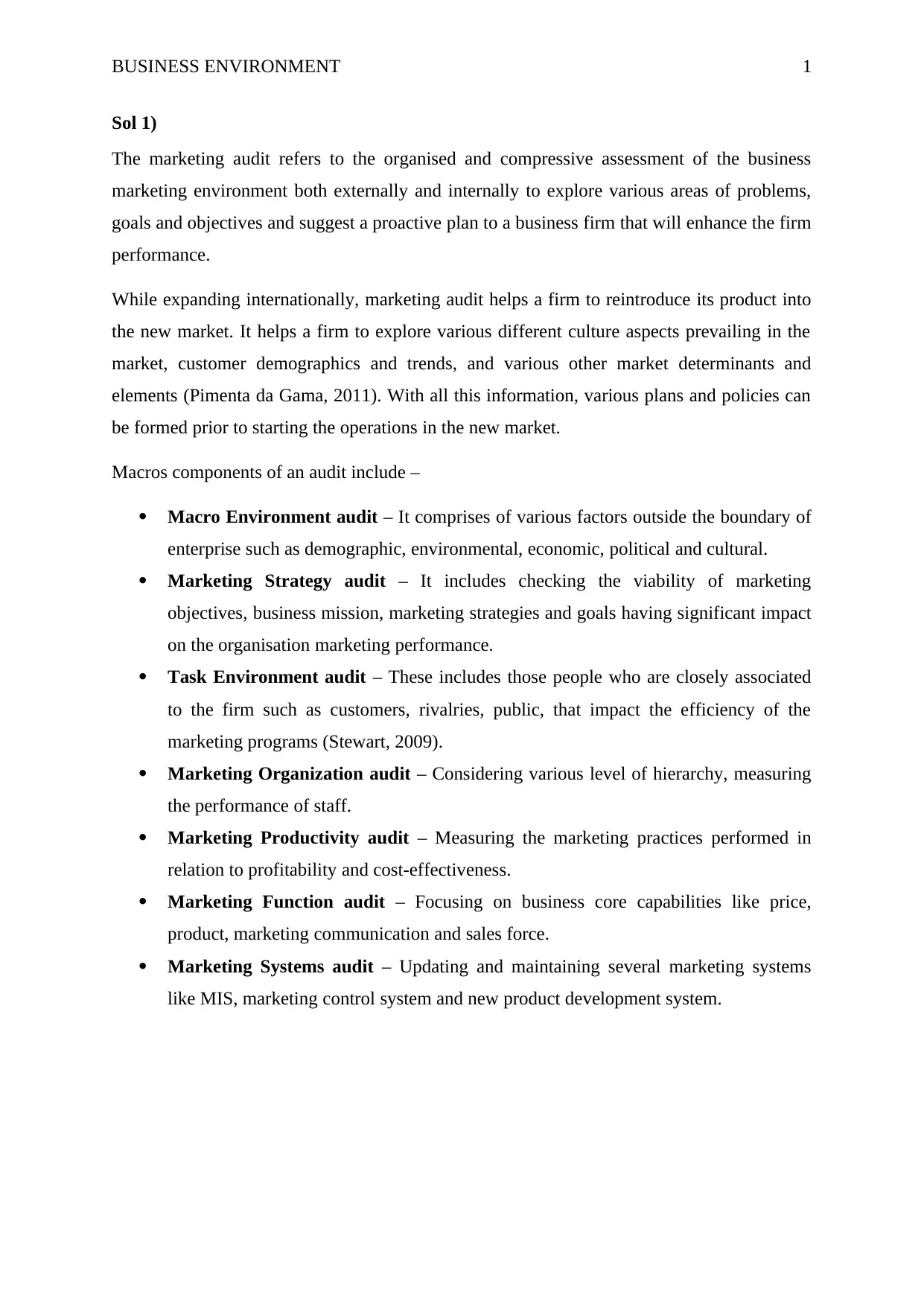
Sol 1)
The marketing audit refers to the organised and compressive assessment of the business
marketing environment both externally and internally to explore various areas of problems,
goals and objectives and suggest a proactive plan to a business firm that will enhance the firm
performance.
While expanding internationally, marketing audit helps a firm to reintroduce its product into
the new market. It helps a firm to explore various different culture aspects prevailing in the
market, customer demographics and trends, and various other market determinants and
elements (Pimenta da Gama, 2011). With all this information, various plans and policies can
be formed prior to starting the operations in the new market.
Macros components of an audit include –
Macro Environment audit – It comprises of various factors outside the boundary of
enterprise such as demographic, environmental, economic, political and cultural.
Marketing Strategy audit – It includes checking the viability of marketing
objectives, business mission, marketing strategies and goals having significant impact
on the organisation marketing performance.
Task Environment audit – These includes those people who are closely associated
to the firm such as customers, rivalries, public, that impact the efficiency of the
marketing programs (Stewart, 2009).
Marketing Organization audit – Considering various level of hierarchy, measuring
the performance of staff.
Marketing Productivity audit – Measuring the marketing practices performed in
relation to profitability and cost-effectiveness.
Marketing Function audit – Focusing on business core capabilities like price,
product, marketing communication and sales force.
Marketing Systems audit – Updating and maintaining several marketing systems
like MIS, marketing control system and new product development system.
Sol 1)
The marketing audit refers to the organised and compressive assessment of the business
marketing environment both externally and internally to explore various areas of problems,
goals and objectives and suggest a proactive plan to a business firm that will enhance the firm
performance.
While expanding internationally, marketing audit helps a firm to reintroduce its product into
the new market. It helps a firm to explore various different culture aspects prevailing in the
market, customer demographics and trends, and various other market determinants and
elements (Pimenta da Gama, 2011). With all this information, various plans and policies can
be formed prior to starting the operations in the new market.
Macros components of an audit include –
Macro Environment audit – It comprises of various factors outside the boundary of
enterprise such as demographic, environmental, economic, political and cultural.
Marketing Strategy audit – It includes checking the viability of marketing
objectives, business mission, marketing strategies and goals having significant impact
on the organisation marketing performance.
Task Environment audit – These includes those people who are closely associated
to the firm such as customers, rivalries, public, that impact the efficiency of the
marketing programs (Stewart, 2009).
Marketing Organization audit – Considering various level of hierarchy, measuring
the performance of staff.
Marketing Productivity audit – Measuring the marketing practices performed in
relation to profitability and cost-effectiveness.
Marketing Function audit – Focusing on business core capabilities like price,
product, marketing communication and sales force.
Marketing Systems audit – Updating and maintaining several marketing systems
like MIS, marketing control system and new product development system.
BUSINESS ENVIRONMENT 2
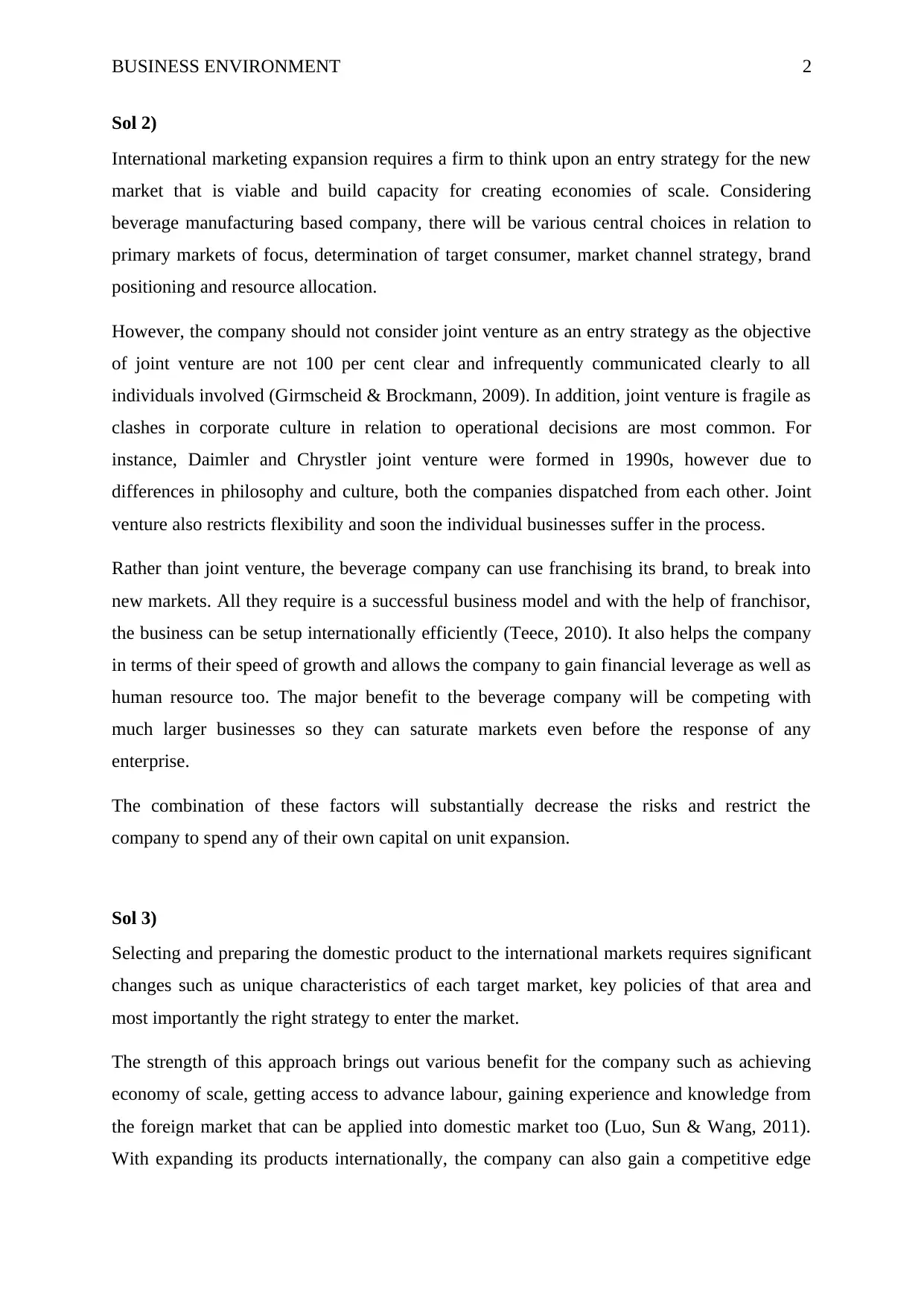
Sol 2)
International marketing expansion requires a firm to think upon an entry strategy for the new
market that is viable and build capacity for creating economies of scale. Considering
beverage manufacturing based company, there will be various central choices in relation to
primary markets of focus, determination of target consumer, market channel strategy, brand
positioning and resource allocation.
However, the company should not consider joint venture as an entry strategy as the objective
of joint venture are not 100 per cent clear and infrequently communicated clearly to all
individuals involved (Girmscheid & Brockmann, 2009). In addition, joint venture is fragile as
clashes in corporate culture in relation to operational decisions are most common. For
instance, Daimler and Chrystler joint venture were formed in 1990s, however due to
differences in philosophy and culture, both the companies dispatched from each other. Joint
venture also restricts flexibility and soon the individual businesses suffer in the process.
Rather than joint venture, the beverage company can use franchising its brand, to break into
new markets. All they require is a successful business model and with the help of franchisor,
the business can be setup internationally efficiently (Teece, 2010). It also helps the company
in terms of their speed of growth and allows the company to gain financial leverage as well as
human resource too. The major benefit to the beverage company will be competing with
much larger businesses so they can saturate markets even before the response of any
enterprise.
The combination of these factors will substantially decrease the risks and restrict the
company to spend any of their own capital on unit expansion.
Sol 3)
Selecting and preparing the domestic product to the international markets requires significant
changes such as unique characteristics of each target market, key policies of that area and
most importantly the right strategy to enter the market.
The strength of this approach brings out various benefit for the company such as achieving
economy of scale, getting access to advance labour, gaining experience and knowledge from
the foreign market that can be applied into domestic market too (Luo, Sun & Wang, 2011).
With expanding its products internationally, the company can also gain a competitive edge
Sol 2)
International marketing expansion requires a firm to think upon an entry strategy for the new
market that is viable and build capacity for creating economies of scale. Considering
beverage manufacturing based company, there will be various central choices in relation to
primary markets of focus, determination of target consumer, market channel strategy, brand
positioning and resource allocation.
However, the company should not consider joint venture as an entry strategy as the objective
of joint venture are not 100 per cent clear and infrequently communicated clearly to all
individuals involved (Girmscheid & Brockmann, 2009). In addition, joint venture is fragile as
clashes in corporate culture in relation to operational decisions are most common. For
instance, Daimler and Chrystler joint venture were formed in 1990s, however due to
differences in philosophy and culture, both the companies dispatched from each other. Joint
venture also restricts flexibility and soon the individual businesses suffer in the process.
Rather than joint venture, the beverage company can use franchising its brand, to break into
new markets. All they require is a successful business model and with the help of franchisor,
the business can be setup internationally efficiently (Teece, 2010). It also helps the company
in terms of their speed of growth and allows the company to gain financial leverage as well as
human resource too. The major benefit to the beverage company will be competing with
much larger businesses so they can saturate markets even before the response of any
enterprise.
The combination of these factors will substantially decrease the risks and restrict the
company to spend any of their own capital on unit expansion.
Sol 3)
Selecting and preparing the domestic product to the international markets requires significant
changes such as unique characteristics of each target market, key policies of that area and
most importantly the right strategy to enter the market.
The strength of this approach brings out various benefit for the company such as achieving
economy of scale, getting access to advance labour, gaining experience and knowledge from
the foreign market that can be applied into domestic market too (Luo, Sun & Wang, 2011).
With expanding its products internationally, the company can also gain a competitive edge
⊘ This is a preview!⊘
Do you want full access?
Subscribe today to unlock all pages.

Trusted by 1+ million students worldwide
BUSINESS ENVIRONMENT 3
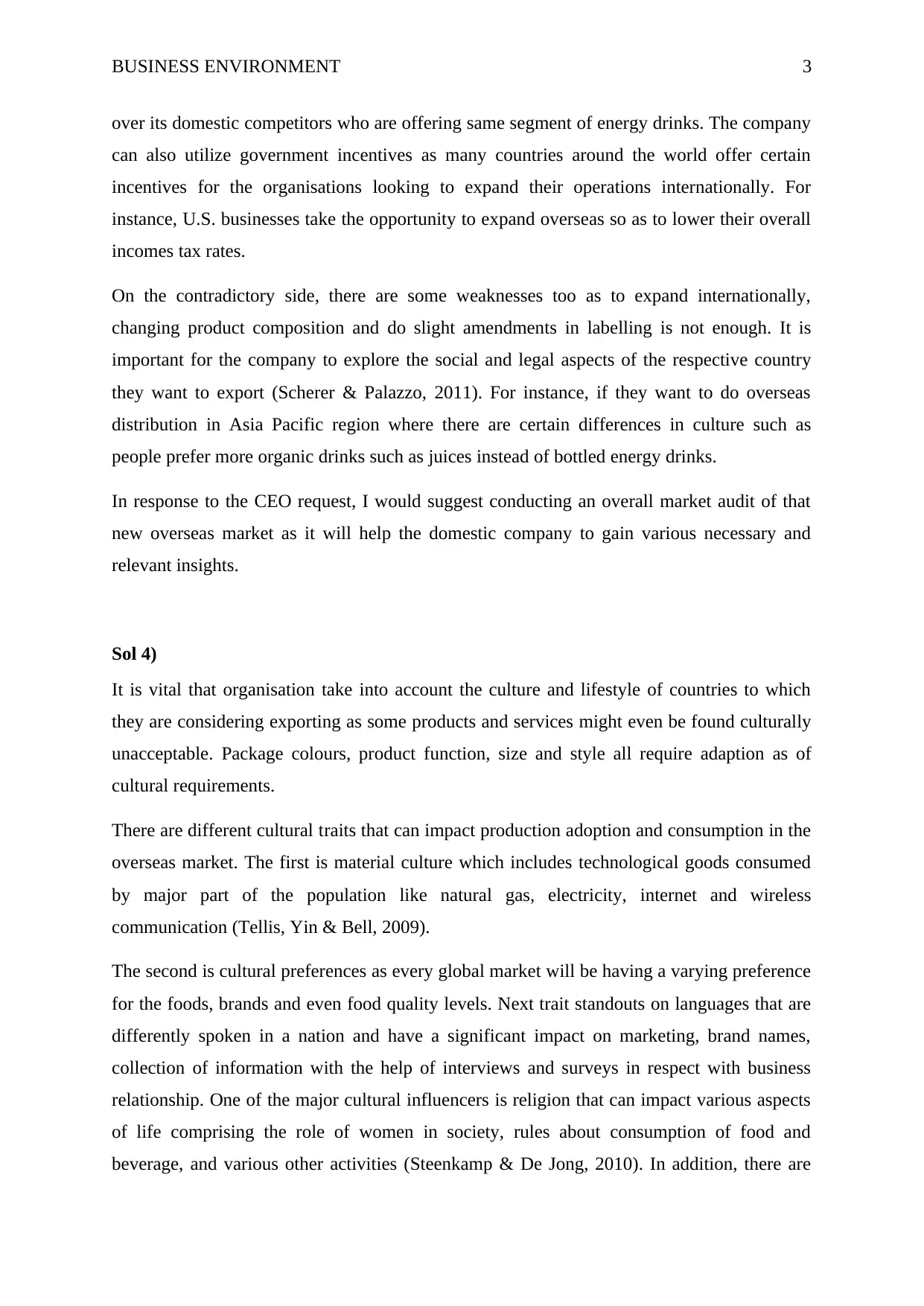
over its domestic competitors who are offering same segment of energy drinks. The company
can also utilize government incentives as many countries around the world offer certain
incentives for the organisations looking to expand their operations internationally. For
instance, U.S. businesses take the opportunity to expand overseas so as to lower their overall
incomes tax rates.
On the contradictory side, there are some weaknesses too as to expand internationally,
changing product composition and do slight amendments in labelling is not enough. It is
important for the company to explore the social and legal aspects of the respective country
they want to export (Scherer & Palazzo, 2011). For instance, if they want to do overseas
distribution in Asia Pacific region where there are certain differences in culture such as
people prefer more organic drinks such as juices instead of bottled energy drinks.
In response to the CEO request, I would suggest conducting an overall market audit of that
new overseas market as it will help the domestic company to gain various necessary and
relevant insights.
Sol 4)
It is vital that organisation take into account the culture and lifestyle of countries to which
they are considering exporting as some products and services might even be found culturally
unacceptable. Package colours, product function, size and style all require adaption as of
cultural requirements.
There are different cultural traits that can impact production adoption and consumption in the
overseas market. The first is material culture which includes technological goods consumed
by major part of the population like natural gas, electricity, internet and wireless
communication (Tellis, Yin & Bell, 2009).
The second is cultural preferences as every global market will be having a varying preference
for the foods, brands and even food quality levels. Next trait standouts on languages that are
differently spoken in a nation and have a significant impact on marketing, brand names,
collection of information with the help of interviews and surveys in respect with business
relationship. One of the major cultural influencers is religion that can impact various aspects
of life comprising the role of women in society, rules about consumption of food and
beverage, and various other activities (Steenkamp & De Jong, 2010). In addition, there are
over its domestic competitors who are offering same segment of energy drinks. The company
can also utilize government incentives as many countries around the world offer certain
incentives for the organisations looking to expand their operations internationally. For
instance, U.S. businesses take the opportunity to expand overseas so as to lower their overall
incomes tax rates.
On the contradictory side, there are some weaknesses too as to expand internationally,
changing product composition and do slight amendments in labelling is not enough. It is
important for the company to explore the social and legal aspects of the respective country
they want to export (Scherer & Palazzo, 2011). For instance, if they want to do overseas
distribution in Asia Pacific region where there are certain differences in culture such as
people prefer more organic drinks such as juices instead of bottled energy drinks.
In response to the CEO request, I would suggest conducting an overall market audit of that
new overseas market as it will help the domestic company to gain various necessary and
relevant insights.
Sol 4)
It is vital that organisation take into account the culture and lifestyle of countries to which
they are considering exporting as some products and services might even be found culturally
unacceptable. Package colours, product function, size and style all require adaption as of
cultural requirements.
There are different cultural traits that can impact production adoption and consumption in the
overseas market. The first is material culture which includes technological goods consumed
by major part of the population like natural gas, electricity, internet and wireless
communication (Tellis, Yin & Bell, 2009).
The second is cultural preferences as every global market will be having a varying preference
for the foods, brands and even food quality levels. Next trait standouts on languages that are
differently spoken in a nation and have a significant impact on marketing, brand names,
collection of information with the help of interviews and surveys in respect with business
relationship. One of the major cultural influencers is religion that can impact various aspects
of life comprising the role of women in society, rules about consumption of food and
beverage, and various other activities (Steenkamp & De Jong, 2010). In addition, there are
Paraphrase This Document
Need a fresh take? Get an instant paraphrase of this document with our AI Paraphraser
BUSINESS ENVIRONMENT 4
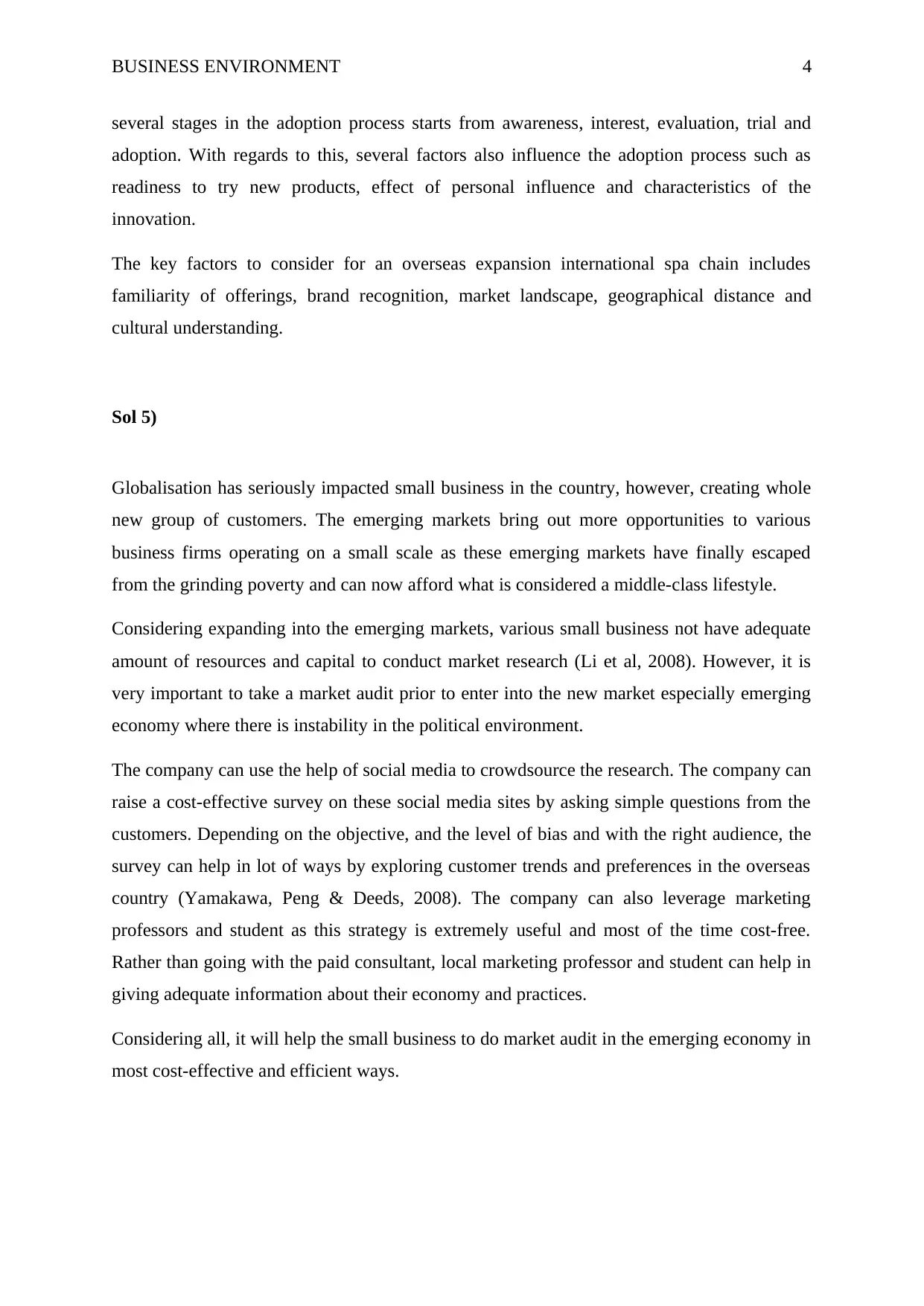
several stages in the adoption process starts from awareness, interest, evaluation, trial and
adoption. With regards to this, several factors also influence the adoption process such as
readiness to try new products, effect of personal influence and characteristics of the
innovation.
The key factors to consider for an overseas expansion international spa chain includes
familiarity of offerings, brand recognition, market landscape, geographical distance and
cultural understanding.
Sol 5)
Globalisation has seriously impacted small business in the country, however, creating whole
new group of customers. The emerging markets bring out more opportunities to various
business firms operating on a small scale as these emerging markets have finally escaped
from the grinding poverty and can now afford what is considered a middle-class lifestyle.
Considering expanding into the emerging markets, various small business not have adequate
amount of resources and capital to conduct market research (Li et al, 2008). However, it is
very important to take a market audit prior to enter into the new market especially emerging
economy where there is instability in the political environment.
The company can use the help of social media to crowdsource the research. The company can
raise a cost-effective survey on these social media sites by asking simple questions from the
customers. Depending on the objective, and the level of bias and with the right audience, the
survey can help in lot of ways by exploring customer trends and preferences in the overseas
country (Yamakawa, Peng & Deeds, 2008). The company can also leverage marketing
professors and student as this strategy is extremely useful and most of the time cost-free.
Rather than going with the paid consultant, local marketing professor and student can help in
giving adequate information about their economy and practices.
Considering all, it will help the small business to do market audit in the emerging economy in
most cost-effective and efficient ways.
several stages in the adoption process starts from awareness, interest, evaluation, trial and
adoption. With regards to this, several factors also influence the adoption process such as
readiness to try new products, effect of personal influence and characteristics of the
innovation.
The key factors to consider for an overseas expansion international spa chain includes
familiarity of offerings, brand recognition, market landscape, geographical distance and
cultural understanding.
Sol 5)
Globalisation has seriously impacted small business in the country, however, creating whole
new group of customers. The emerging markets bring out more opportunities to various
business firms operating on a small scale as these emerging markets have finally escaped
from the grinding poverty and can now afford what is considered a middle-class lifestyle.
Considering expanding into the emerging markets, various small business not have adequate
amount of resources and capital to conduct market research (Li et al, 2008). However, it is
very important to take a market audit prior to enter into the new market especially emerging
economy where there is instability in the political environment.
The company can use the help of social media to crowdsource the research. The company can
raise a cost-effective survey on these social media sites by asking simple questions from the
customers. Depending on the objective, and the level of bias and with the right audience, the
survey can help in lot of ways by exploring customer trends and preferences in the overseas
country (Yamakawa, Peng & Deeds, 2008). The company can also leverage marketing
professors and student as this strategy is extremely useful and most of the time cost-free.
Rather than going with the paid consultant, local marketing professor and student can help in
giving adequate information about their economy and practices.
Considering all, it will help the small business to do market audit in the emerging economy in
most cost-effective and efficient ways.
BUSINESS ENVIRONMENT 5
Sol 6)
Today’s small business are born global, not local. Global business competition has given
upsurge to a new international entity, the born internal firm – an organisation that embraces
upon global perspective and involved in transnational business near its inception (Freeman et
al, 2010). The major attributes of these born global firms are their knowledge-based
organisation capabilities and innovative culture. Though these corporations previously
appeared in countries that have domestic markets on a small scale, however, today they arise
from all key trading counties. Extraordinarily, most of these organisations rise to the position
of international rival in less than five years. Possibly the great example of a born global firm
is one that extents out to consumers around the domain solely through the web.
There are various sorts of risks allied with the born global firms like dynamic marketing
environment, various policies of government, and financial provision. In international market,
it is hard for any born global firm to get financial support from any big industries or
government institution (Zander et al, 2015). In addition, there are multiple dynamic
marketing environment variables such as customer preferences, market competitiveness,
product demand and supply, consumer behaviour and pricing strategies. For instance, a lot of
born global organisation in photovoltaic industry are facing a major turn point due to
vigorous business environment.
Hence, born global companies need to contemplate the risk of internationalization like
government policies and dynamic market environment.
Sol 7)
The research in marketing is a crucial aspect for the company as this will be responsible for
taking strategic decision by the top management. For instance, the research can be done to
understand the customer needs and behaviour in foreign market. In case the research task is
done by centralized approach, then the company would not be able to understand the cultural
aspect of the customer. The foreign local subsidiaries are individuals who are aware of the
Sol 6)
Today’s small business are born global, not local. Global business competition has given
upsurge to a new international entity, the born internal firm – an organisation that embraces
upon global perspective and involved in transnational business near its inception (Freeman et
al, 2010). The major attributes of these born global firms are their knowledge-based
organisation capabilities and innovative culture. Though these corporations previously
appeared in countries that have domestic markets on a small scale, however, today they arise
from all key trading counties. Extraordinarily, most of these organisations rise to the position
of international rival in less than five years. Possibly the great example of a born global firm
is one that extents out to consumers around the domain solely through the web.
There are various sorts of risks allied with the born global firms like dynamic marketing
environment, various policies of government, and financial provision. In international market,
it is hard for any born global firm to get financial support from any big industries or
government institution (Zander et al, 2015). In addition, there are multiple dynamic
marketing environment variables such as customer preferences, market competitiveness,
product demand and supply, consumer behaviour and pricing strategies. For instance, a lot of
born global organisation in photovoltaic industry are facing a major turn point due to
vigorous business environment.
Hence, born global companies need to contemplate the risk of internationalization like
government policies and dynamic market environment.
Sol 7)
The research in marketing is a crucial aspect for the company as this will be responsible for
taking strategic decision by the top management. For instance, the research can be done to
understand the customer needs and behaviour in foreign market. In case the research task is
done by centralized approach, then the company would not be able to understand the cultural
aspect of the customer. The foreign local subsidiaries are individuals who are aware of the
⊘ This is a preview!⊘
Do you want full access?
Subscribe today to unlock all pages.
Trusted by 1+ million students worldwide
BUSINESS ENVIRONMENT 6
local culture of the nation and can understand the customer of that nation better. Culture plays
most important role when it comes to the product and services marketed in a nation (Bouquet
& Birkinshaw, 2008).
For instance, in case of conducting research in China, the centralized personnel or research
team can only analyse through secondary data and even if they use primary data they need to
have a thorough understanding of language, values, beliefs, and culture of the country. If
foreign local subsidiaries are conducting the research then they do not have to spend time in
understanding the culture they can conduct primary research and understand the customers
point while interacting with them (Ambos, Andersson & Birkinshaw, 2010). Moreover, it
could be possible that the customer would be comfortable sharing ideas and giving feedback
to a local person that the foreign representative.
Therefore, it can be said that for the in-depth research in the foreign market the most
preferable choice would be foreign local subsidiaries.
Sol 8)
The fieldwork is a time-consuming task for the company. The fieldwork must be carried by
an agency because
Better management – If the company is getting the fieldwork done from the agency
then the management would focus on the major aspects or activities to in the
company. Therefore, it can be said that the company will be able to focus on the
primary activities and the area that needs to be given attention rather than conducting
the fieldwork. Moreover, through this, the risk of ignoring the important activities and
concerning area would be reduced while giving this work to an agency (Mergel,
2016).
Saving time – This would also save the time of in house employees and management
personnel. The in-house fieldwork would take the time of not only the people who are
conducting the work but also the top management to take planning and implementing
decision and them analysing the work. Moreover, the management would also need to
evaluate and control the activities in order to check if the work is done as per the
requirements and planning. The company can save the time of organization and also
local culture of the nation and can understand the customer of that nation better. Culture plays
most important role when it comes to the product and services marketed in a nation (Bouquet
& Birkinshaw, 2008).
For instance, in case of conducting research in China, the centralized personnel or research
team can only analyse through secondary data and even if they use primary data they need to
have a thorough understanding of language, values, beliefs, and culture of the country. If
foreign local subsidiaries are conducting the research then they do not have to spend time in
understanding the culture they can conduct primary research and understand the customers
point while interacting with them (Ambos, Andersson & Birkinshaw, 2010). Moreover, it
could be possible that the customer would be comfortable sharing ideas and giving feedback
to a local person that the foreign representative.
Therefore, it can be said that for the in-depth research in the foreign market the most
preferable choice would be foreign local subsidiaries.
Sol 8)
The fieldwork is a time-consuming task for the company. The fieldwork must be carried by
an agency because
Better management – If the company is getting the fieldwork done from the agency
then the management would focus on the major aspects or activities to in the
company. Therefore, it can be said that the company will be able to focus on the
primary activities and the area that needs to be given attention rather than conducting
the fieldwork. Moreover, through this, the risk of ignoring the important activities and
concerning area would be reduced while giving this work to an agency (Mergel,
2016).
Saving time – This would also save the time of in house employees and management
personnel. The in-house fieldwork would take the time of not only the people who are
conducting the work but also the top management to take planning and implementing
decision and them analysing the work. Moreover, the management would also need to
evaluate and control the activities in order to check if the work is done as per the
requirements and planning. The company can save the time of organization and also
Paraphrase This Document
Need a fresh take? Get an instant paraphrase of this document with our AI Paraphraser
BUSINESS ENVIRONMENT 7
save resources of the organization for other work that is more relevant in nature and
use in house talent for more analytical work.
Expert services – the agency through which the work would be getting done would be
doing this work for a long time. The agency would be specialized in this work and the
risk of mistakes would be reduced for the company as well. The reliability and value
of the work would increase while getting it done through the agency.
Sol 9)
Culture is considered as the most crucial element is the management of operations of a
business, with several other countries, i.e. on a global level. International marketing involves
the role and combination of varied skills and abilities of the people working from different
countries (Stahl et al, 2012). Culture has a great impact on international marketing, and it acts
as major factor in consideration to all the processes and practices. The aspect of international
business faces lots of challenges or issues in the conduct of their operations, such as
communication issues, social and other regional issues. These act as barriers to the operations
and requires managers to provide training and development.
Doing business on a global level requires an understanding of different issues, which affects
the management of resources of the organisation. In context to the language differences,
methods of production, working styles, or belief systems and values of the people working in
the organisation, culture plays a vital role. Culture of the organisation shapes the values of the
individuals working in the organisation and directs their efforts towards the attainment of a
common goal (Kalemci Tuzun & Arzu Kalemci, 2012). For example, the issue of employee
resistance and organisational conflict is considered two major barriers in international
marketing/business. In reference to these barriers, a manager is responsible to establish a
positive organisational culture in the organisation. This would motivate employees in order to
make them commit towards the organisational goals and objectives in the long-run. Hence, it
has been analysed that culture plays a predominant role and resolves all the issues and
challenges faced by the firms in international marketing.
Sol 10)
save resources of the organization for other work that is more relevant in nature and
use in house talent for more analytical work.
Expert services – the agency through which the work would be getting done would be
doing this work for a long time. The agency would be specialized in this work and the
risk of mistakes would be reduced for the company as well. The reliability and value
of the work would increase while getting it done through the agency.
Sol 9)
Culture is considered as the most crucial element is the management of operations of a
business, with several other countries, i.e. on a global level. International marketing involves
the role and combination of varied skills and abilities of the people working from different
countries (Stahl et al, 2012). Culture has a great impact on international marketing, and it acts
as major factor in consideration to all the processes and practices. The aspect of international
business faces lots of challenges or issues in the conduct of their operations, such as
communication issues, social and other regional issues. These act as barriers to the operations
and requires managers to provide training and development.
Doing business on a global level requires an understanding of different issues, which affects
the management of resources of the organisation. In context to the language differences,
methods of production, working styles, or belief systems and values of the people working in
the organisation, culture plays a vital role. Culture of the organisation shapes the values of the
individuals working in the organisation and directs their efforts towards the attainment of a
common goal (Kalemci Tuzun & Arzu Kalemci, 2012). For example, the issue of employee
resistance and organisational conflict is considered two major barriers in international
marketing/business. In reference to these barriers, a manager is responsible to establish a
positive organisational culture in the organisation. This would motivate employees in order to
make them commit towards the organisational goals and objectives in the long-run. Hence, it
has been analysed that culture plays a predominant role and resolves all the issues and
challenges faced by the firms in international marketing.
Sol 10)
BUSINESS ENVIRONMENT 8
The aspect of culture sensitiveness acts as major factor in the conduct of operations in
international businesses. Cultural competence and ethical business practice are two inter-
related concepts, which are central to the effective decision-making in an organisation
(Camarinha-Matos et al, 2009). In international marketing, culture plays an important role,
because it affects the ethics of an organisation. Ethics refers to the principles or rules that
govern the behaviour of individuals and practices of an organisation in the long-run.
Therefore, managers play a significant role in integrating the culture with the ethical practices
of the organisation, to ensure effective decision-making and achievement of goals. The
growth and success of the international business are dependent on the compliance with the
global ethical standards, which considers the interests and expectations of various
stakeholder, customers, suppliers, investors, and suppliers affecting the practices of the
organisation. Stakeholder’s satisfaction is one of the key issues which is affected by positive
outcome of cultural integration with the ethics of business organisations. International
marketing involves people from different cultural and social backgrounds, and this may lead
to the issues between the organisational members (Sinkovics, Penz & Ghauri, 2008).
Voluntary ethical standards or practices such as honesty, integrity, professionalism,
teamwork, stewardship, acts as other aspects which integrates culture of different countries.
This will further lead to enhanced growth and profitability of the business and ensure
development of employees working in the organisation. Hence, the above discussion has led
to an analysis that managers can implement strategies to ensure global harmonisation of
ethical business practices within firms.
The aspect of culture sensitiveness acts as major factor in the conduct of operations in
international businesses. Cultural competence and ethical business practice are two inter-
related concepts, which are central to the effective decision-making in an organisation
(Camarinha-Matos et al, 2009). In international marketing, culture plays an important role,
because it affects the ethics of an organisation. Ethics refers to the principles or rules that
govern the behaviour of individuals and practices of an organisation in the long-run.
Therefore, managers play a significant role in integrating the culture with the ethical practices
of the organisation, to ensure effective decision-making and achievement of goals. The
growth and success of the international business are dependent on the compliance with the
global ethical standards, which considers the interests and expectations of various
stakeholder, customers, suppliers, investors, and suppliers affecting the practices of the
organisation. Stakeholder’s satisfaction is one of the key issues which is affected by positive
outcome of cultural integration with the ethics of business organisations. International
marketing involves people from different cultural and social backgrounds, and this may lead
to the issues between the organisational members (Sinkovics, Penz & Ghauri, 2008).
Voluntary ethical standards or practices such as honesty, integrity, professionalism,
teamwork, stewardship, acts as other aspects which integrates culture of different countries.
This will further lead to enhanced growth and profitability of the business and ensure
development of employees working in the organisation. Hence, the above discussion has led
to an analysis that managers can implement strategies to ensure global harmonisation of
ethical business practices within firms.
⊘ This is a preview!⊘
Do you want full access?
Subscribe today to unlock all pages.
Trusted by 1+ million students worldwide
BUSINESS ENVIRONMENT 9
References
Ambos, T. C., Andersson, U., & Birkinshaw, J. (2010). What are the consequences of
initiative-taking in multinational subsidiaries?. Journal of International Business
Studies, 41(7), 1099-1118.
Bouquet, C., & Birkinshaw, J. (2008). Weight versus voice: How foreign subsidiaries gain
attention from corporate headquarters. Academy of Management journal, 51(3), 577-
601.
Camarinha-Matos, L. M., Afsarmanesh, H., Galeano, N., & Molina, A. (2009). Collaborative
networked organizations–Concepts and practice in manufacturing
enterprises. Computers & Industrial Engineering, 57(1), 46-60.
Freeman, S., Hutchings, K., Lazaris, M., & Zyngier, S. (2010). A model of rapid knowledge
development: The smaller born-global firm. International Business Review, 19(1), 70-
84.
Girmscheid, G., & Brockmann, C. (2009). Inter-and intraorganizational trust in international
construction joint ventures. Journal of construction engineering and
management, 136(3), 353-360.
Kalemci Tuzun, I., & Arzu Kalemci, R. (2012). Organizational and supervisory support in
relation to employee turnover intentions. Journal of Managerial Psychology, 27(5),
518-534.
Li, Y., Zhao, Y., Tan, J., & Liu, Y. (2008). Moderating effects of entrepreneurial orientation
on market orientation‐performance linkage: Evidence from Chinese small
firms. Journal of small business management, 46(1), 113-133.
Luo, Y., Sun, J., & Wang, S. L. (2011). Emerging economy copycats: Capability,
environment, and strategy. Academy of Management Perspectives, 25(2), 37-56.
Mergel, I. (2016). Agile innovation management in government: A research
agenda. Government Information Quarterly, 33(3), 516-523.
Pimenta da Gama, A. (2011). An expanded model of marketing performance. Marketing
Intelligence & Planning, 29(7), 643-661.
References
Ambos, T. C., Andersson, U., & Birkinshaw, J. (2010). What are the consequences of
initiative-taking in multinational subsidiaries?. Journal of International Business
Studies, 41(7), 1099-1118.
Bouquet, C., & Birkinshaw, J. (2008). Weight versus voice: How foreign subsidiaries gain
attention from corporate headquarters. Academy of Management journal, 51(3), 577-
601.
Camarinha-Matos, L. M., Afsarmanesh, H., Galeano, N., & Molina, A. (2009). Collaborative
networked organizations–Concepts and practice in manufacturing
enterprises. Computers & Industrial Engineering, 57(1), 46-60.
Freeman, S., Hutchings, K., Lazaris, M., & Zyngier, S. (2010). A model of rapid knowledge
development: The smaller born-global firm. International Business Review, 19(1), 70-
84.
Girmscheid, G., & Brockmann, C. (2009). Inter-and intraorganizational trust in international
construction joint ventures. Journal of construction engineering and
management, 136(3), 353-360.
Kalemci Tuzun, I., & Arzu Kalemci, R. (2012). Organizational and supervisory support in
relation to employee turnover intentions. Journal of Managerial Psychology, 27(5),
518-534.
Li, Y., Zhao, Y., Tan, J., & Liu, Y. (2008). Moderating effects of entrepreneurial orientation
on market orientation‐performance linkage: Evidence from Chinese small
firms. Journal of small business management, 46(1), 113-133.
Luo, Y., Sun, J., & Wang, S. L. (2011). Emerging economy copycats: Capability,
environment, and strategy. Academy of Management Perspectives, 25(2), 37-56.
Mergel, I. (2016). Agile innovation management in government: A research
agenda. Government Information Quarterly, 33(3), 516-523.
Pimenta da Gama, A. (2011). An expanded model of marketing performance. Marketing
Intelligence & Planning, 29(7), 643-661.
Paraphrase This Document
Need a fresh take? Get an instant paraphrase of this document with our AI Paraphraser
BUSINESS ENVIRONMENT 10
Scherer, A. G., & Palazzo, G. (2011). The new political role of business in a globalized
world: A review of a new perspective on CSR and its implications for the firm,
governance, and democracy. Journal of management studies, 48(4), 899-931.
Sinkovics, R. R., Penz, E., & Ghauri, P. N. (2008). Enhancing the trustworthiness of
qualitative research in international business. Management International
Review, 48(6), 689-714.
Stahl, G., Bjorkman, I., Farndale, E., Morris, S. S., Paauwe, J., Stiles, P., ... & Wright, P.
(2012). Six principles of effective global talent management. Sloan Management
Review, 53(2), 25-42.
Steenkamp, J. B. E., & De Jong, M. G. (2010). A global investigation into the constellation of
consumer attitudes toward global and local products. Journal of Marketing, 74(6), 18-
40.
Stewart, D. W. (2009). Marketing accountability: Linking marketing actions to financial
results. Journal of business research, 62(6), 636-643.
Teece, D. J. (2010). Business models, business strategy and innovation. Long range
planning, 43(2-3), 172-194.
Tellis, G. J., Yin, E., & Bell, S. (2009). Global consumer innovativeness: Cross-country
differences and demographic commonalities. Journal of International
Marketing, 17(2), 1-22.
Yamakawa, Y., Peng, M. W., & Deeds, D. L. (2008). What drives new ventures to
internationalize from emerging to developed economies?. Entrepreneurship theory
and practice, 32(1), 59-82.
Zander, I., McDougall-Covin, P., & Rose, E. L. (2015). Born globals and international
business: Evolution of a field of research. Journal of International Business
Studies, 46(1), 27-35.
Scherer, A. G., & Palazzo, G. (2011). The new political role of business in a globalized
world: A review of a new perspective on CSR and its implications for the firm,
governance, and democracy. Journal of management studies, 48(4), 899-931.
Sinkovics, R. R., Penz, E., & Ghauri, P. N. (2008). Enhancing the trustworthiness of
qualitative research in international business. Management International
Review, 48(6), 689-714.
Stahl, G., Bjorkman, I., Farndale, E., Morris, S. S., Paauwe, J., Stiles, P., ... & Wright, P.
(2012). Six principles of effective global talent management. Sloan Management
Review, 53(2), 25-42.
Steenkamp, J. B. E., & De Jong, M. G. (2010). A global investigation into the constellation of
consumer attitudes toward global and local products. Journal of Marketing, 74(6), 18-
40.
Stewart, D. W. (2009). Marketing accountability: Linking marketing actions to financial
results. Journal of business research, 62(6), 636-643.
Teece, D. J. (2010). Business models, business strategy and innovation. Long range
planning, 43(2-3), 172-194.
Tellis, G. J., Yin, E., & Bell, S. (2009). Global consumer innovativeness: Cross-country
differences and demographic commonalities. Journal of International
Marketing, 17(2), 1-22.
Yamakawa, Y., Peng, M. W., & Deeds, D. L. (2008). What drives new ventures to
internationalize from emerging to developed economies?. Entrepreneurship theory
and practice, 32(1), 59-82.
Zander, I., McDougall-Covin, P., & Rose, E. L. (2015). Born globals and international
business: Evolution of a field of research. Journal of International Business
Studies, 46(1), 27-35.

1 out of 11


Related Documents


Your All-in-One AI-Powered Toolkit for Academic Success.
+13062052269
info@desklib.com
Available 24*7 on WhatsApp / Email
![[object Object]](/_next/static/media/star-bottom.7253800d.svg)
Unlock your academic potential
Copyright © 2020–2026 A2Z Services. All Rights Reserved. Developed and managed by ZUCOL.