Report: Global Mobility, Career Development, and Kaka Enterprises
VerifiedAdded on 2023/04/22
|12
|3092
|383
Report
AI Summary
This report analyzes global mobility and career development models within the context of Kaka Enterprises, a New Zealand-based software firm facing challenges due to its over-reliance on expatriate employees. The report begins with an executive summary, followed by an introduction that emphasizes the significance of career development in organizational performance. It then provides background information on Kaka Enterprises and the context of the report, highlighting the company's dependence on expatriates and the resulting issues. The core of the report presents findings from the research project, examining traditional, non-traditional, and alternative career models and their implications for Kaka Enterprises. The analysis includes the strengths and weaknesses of each model in relation to the firm's current situation, and suggests the usage of alternative career models and also enhancement of gender diversity within the concerned firm which will enable the firm to address the issue under discussion here. The report concludes with recommendations for the firm to mitigate the issues it is facing and foster sustainable growth.
Running head: GLOBAL MOBILITY AND CAREER DEVELOPMENT
Global Mobility and Career Development
Name of the Student:
Name of the University:
Author’s Note:
Global Mobility and Career Development
Name of the Student:
Name of the University:
Author’s Note:

Paraphrase This Document
Need a fresh take? Get an instant paraphrase of this document with our AI Paraphraser
1GLOBAL MOBILITY AND CAREER DEVELOPMENT
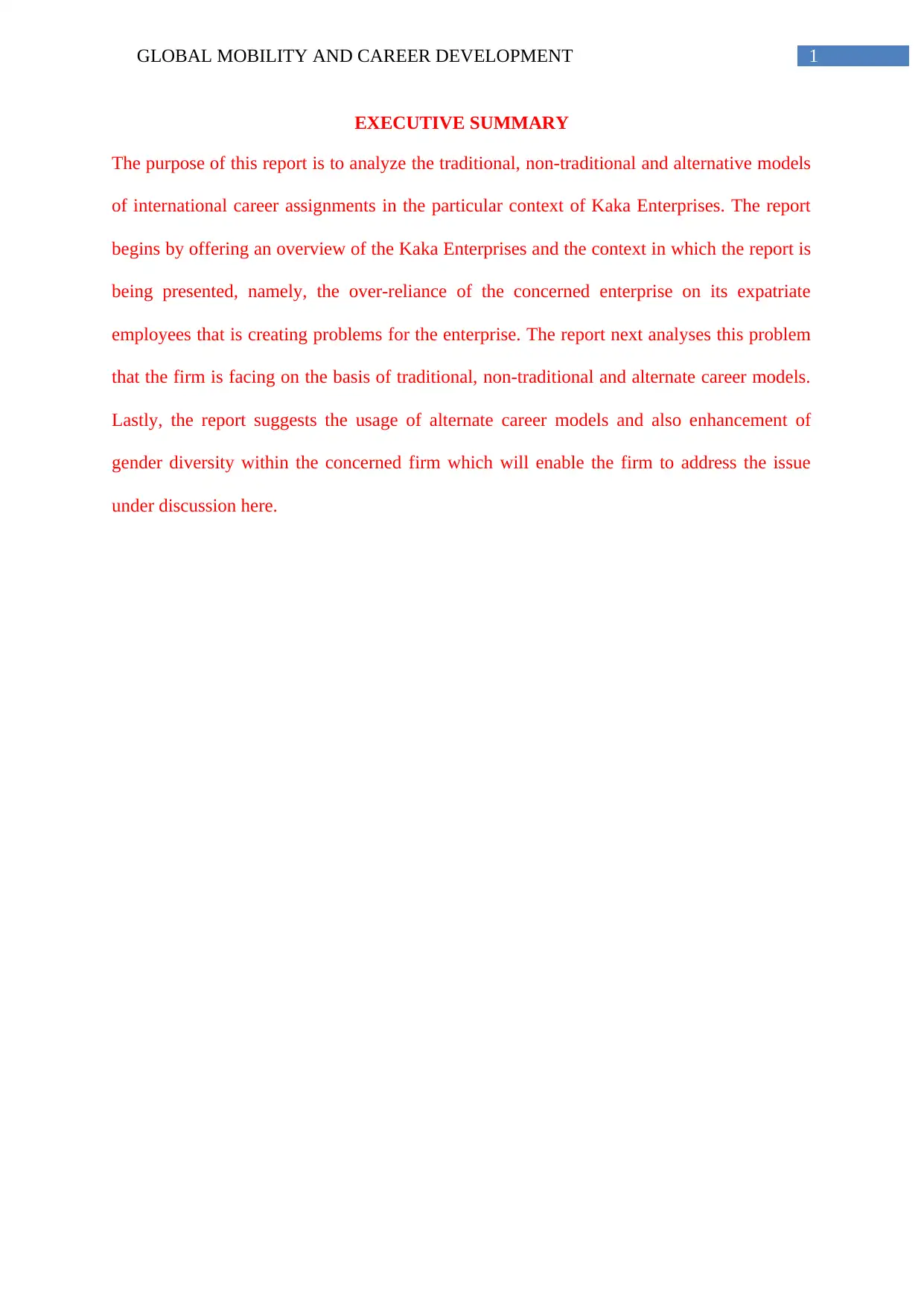
EXECUTIVE SUMMARY
The purpose of this report is to analyze the traditional, non-traditional and alternative models
of international career assignments in the particular context of Kaka Enterprises. The report
begins by offering an overview of the Kaka Enterprises and the context in which the report is
being presented, namely, the over-reliance of the concerned enterprise on its expatriate
employees that is creating problems for the enterprise. The report next analyses this problem
that the firm is facing on the basis of traditional, non-traditional and alternate career models.
Lastly, the report suggests the usage of alternate career models and also enhancement of
gender diversity within the concerned firm which will enable the firm to address the issue
under discussion here.
EXECUTIVE SUMMARY
The purpose of this report is to analyze the traditional, non-traditional and alternative models
of international career assignments in the particular context of Kaka Enterprises. The report
begins by offering an overview of the Kaka Enterprises and the context in which the report is
being presented, namely, the over-reliance of the concerned enterprise on its expatriate
employees that is creating problems for the enterprise. The report next analyses this problem
that the firm is facing on the basis of traditional, non-traditional and alternate career models.
Lastly, the report suggests the usage of alternate career models and also enhancement of
gender diversity within the concerned firm which will enable the firm to address the issue
under discussion here.
2GLOBAL MOBILITY AND CAREER DEVELOPMENT
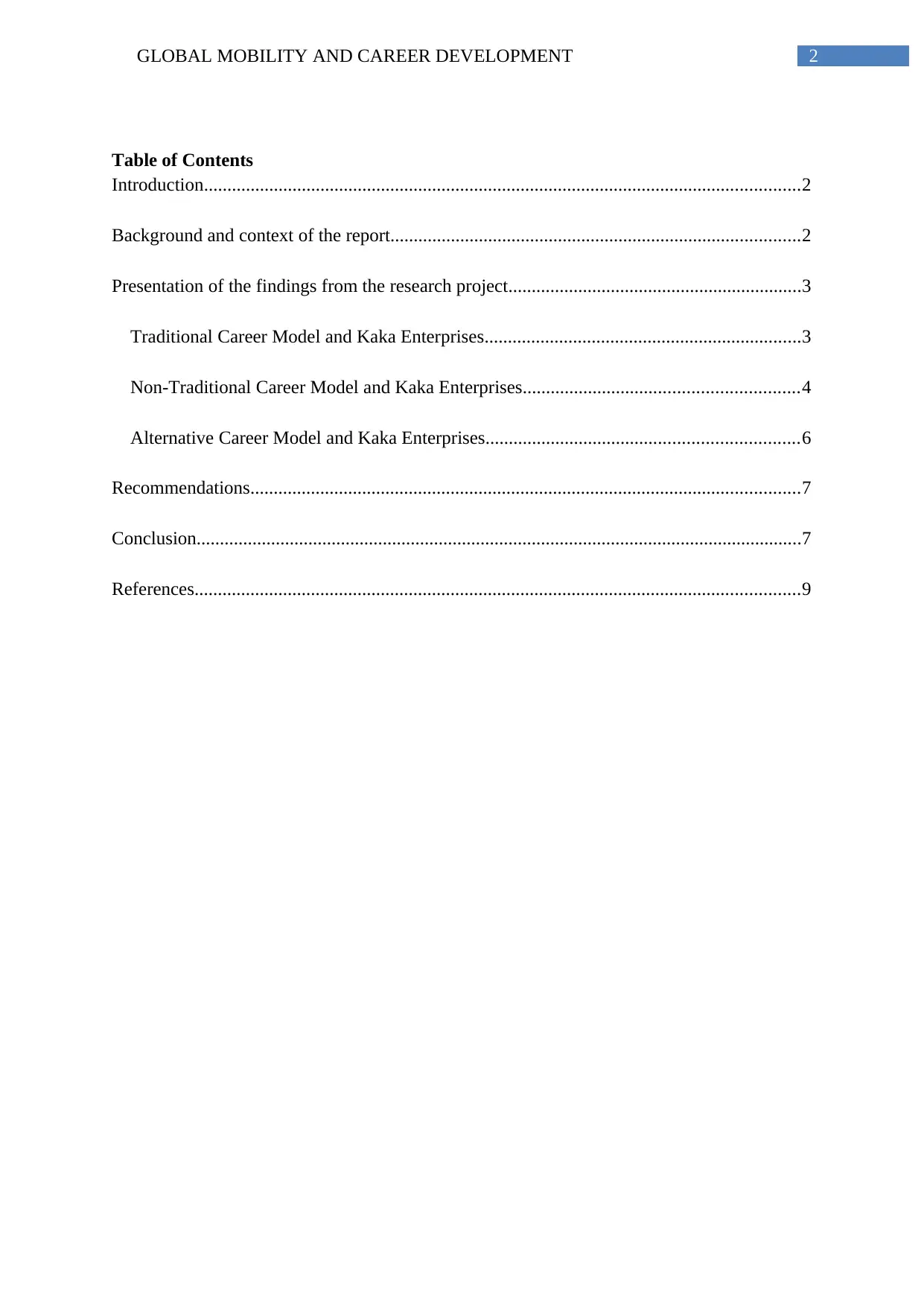
Table of Contents
Introduction................................................................................................................................2
Background and context of the report........................................................................................2
Presentation of the findings from the research project...............................................................3
Traditional Career Model and Kaka Enterprises....................................................................3
Non-Traditional Career Model and Kaka Enterprises...........................................................4
Alternative Career Model and Kaka Enterprises...................................................................6
Recommendations......................................................................................................................7
Conclusion..................................................................................................................................7
References..................................................................................................................................9
Table of Contents
Introduction................................................................................................................................2
Background and context of the report........................................................................................2
Presentation of the findings from the research project...............................................................3
Traditional Career Model and Kaka Enterprises....................................................................3
Non-Traditional Career Model and Kaka Enterprises...........................................................4
Alternative Career Model and Kaka Enterprises...................................................................6
Recommendations......................................................................................................................7
Conclusion..................................................................................................................................7
References..................................................................................................................................9
⊘ This is a preview!⊘
Do you want full access?
Subscribe today to unlock all pages.

Trusted by 1+ million students worldwide
3GLOBAL MOBILITY AND CAREER DEVELOPMENT
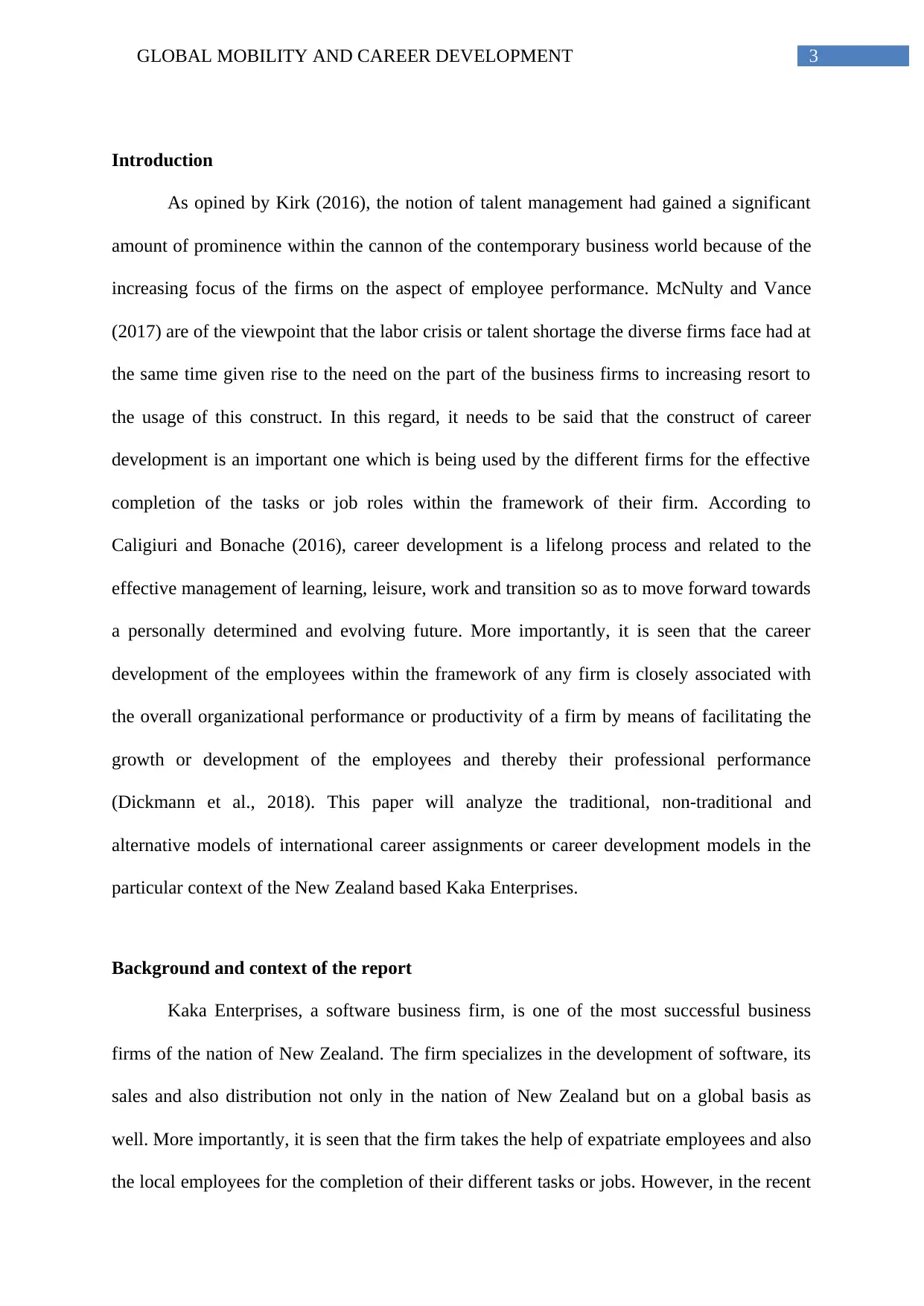
Introduction
As opined by Kirk (2016), the notion of talent management had gained a significant
amount of prominence within the cannon of the contemporary business world because of the
increasing focus of the firms on the aspect of employee performance. McNulty and Vance
(2017) are of the viewpoint that the labor crisis or talent shortage the diverse firms face had at
the same time given rise to the need on the part of the business firms to increasing resort to
the usage of this construct. In this regard, it needs to be said that the construct of career
development is an important one which is being used by the different firms for the effective
completion of the tasks or job roles within the framework of their firm. According to
Caligiuri and Bonache (2016), career development is a lifelong process and related to the
effective management of learning, leisure, work and transition so as to move forward towards
a personally determined and evolving future. More importantly, it is seen that the career
development of the employees within the framework of any firm is closely associated with
the overall organizational performance or productivity of a firm by means of facilitating the
growth or development of the employees and thereby their professional performance
(Dickmann et al., 2018). This paper will analyze the traditional, non-traditional and
alternative models of international career assignments or career development models in the
particular context of the New Zealand based Kaka Enterprises.
Background and context of the report
Kaka Enterprises, a software business firm, is one of the most successful business
firms of the nation of New Zealand. The firm specializes in the development of software, its
sales and also distribution not only in the nation of New Zealand but on a global basis as
well. More importantly, it is seen that the firm takes the help of expatriate employees and also
the local employees for the completion of their different tasks or jobs. However, in the recent
Introduction
As opined by Kirk (2016), the notion of talent management had gained a significant
amount of prominence within the cannon of the contemporary business world because of the
increasing focus of the firms on the aspect of employee performance. McNulty and Vance
(2017) are of the viewpoint that the labor crisis or talent shortage the diverse firms face had at
the same time given rise to the need on the part of the business firms to increasing resort to
the usage of this construct. In this regard, it needs to be said that the construct of career
development is an important one which is being used by the different firms for the effective
completion of the tasks or job roles within the framework of their firm. According to
Caligiuri and Bonache (2016), career development is a lifelong process and related to the
effective management of learning, leisure, work and transition so as to move forward towards
a personally determined and evolving future. More importantly, it is seen that the career
development of the employees within the framework of any firm is closely associated with
the overall organizational performance or productivity of a firm by means of facilitating the
growth or development of the employees and thereby their professional performance
(Dickmann et al., 2018). This paper will analyze the traditional, non-traditional and
alternative models of international career assignments or career development models in the
particular context of the New Zealand based Kaka Enterprises.
Background and context of the report
Kaka Enterprises, a software business firm, is one of the most successful business
firms of the nation of New Zealand. The firm specializes in the development of software, its
sales and also distribution not only in the nation of New Zealand but on a global basis as
well. More importantly, it is seen that the firm takes the help of expatriate employees and also
the local employees for the completion of their different tasks or jobs. However, in the recent
Paraphrase This Document
Need a fresh take? Get an instant paraphrase of this document with our AI Paraphraser
4GLOBAL MOBILITY AND CAREER DEVELOPMENT
times it is seen that the 90% of the work of the concerned firm is dependent on the expatriate
employees to whom the firm had to pay a higher amount of salary. This in turn is taking a toll
on the profitability of the concerned firm and also leading to the ineffective development of
career of the different employees who are a part of the concerned firm. The report, thus,
intends to analyze the current situation of the concerned firm in the particular context of the
different career development theories or models while recommending the best possible career
model to the firm for the mitigation of the issue under discussion here.
Presentation of the findings from the research project
Traditional Career Model and Kaka Enterprises
Bratton and Gold (2017) are of the viewpoint that the traditional career model is a
long-term relationship between the employees or the workers and the firm or firms that they
are working for. More importantly, as per this career model the employees and the employers
are associated in a psychological contract where in exchange for labor services in compliance
with the rules of the firm, the employees are being offered monetary compensation (Law,
2018). Furthermore, the definition of success or performance is being defined by the firm
itself and on the basis of the extent to which the concerned employees have been able to
fulfill the success or the performance criteria of the firms they are being offered rewards and
compensation. Moreover, as per this model the employment is considered to be permanent
and the employees are relieved of their employment services at the time of their retirement.
However, the employees in order to have a successful career need to comply with the rules or
the governance style of the firm and also perform as per the expectation or the standards of
the firm (Leiter, 2017). Baruch, Altman and Tung (2016) have articulated the viewpoint that
one of the major weaknesses of the traditional career model is the fact that it is largely
times it is seen that the 90% of the work of the concerned firm is dependent on the expatriate
employees to whom the firm had to pay a higher amount of salary. This in turn is taking a toll
on the profitability of the concerned firm and also leading to the ineffective development of
career of the different employees who are a part of the concerned firm. The report, thus,
intends to analyze the current situation of the concerned firm in the particular context of the
different career development theories or models while recommending the best possible career
model to the firm for the mitigation of the issue under discussion here.
Presentation of the findings from the research project
Traditional Career Model and Kaka Enterprises
Bratton and Gold (2017) are of the viewpoint that the traditional career model is a
long-term relationship between the employees or the workers and the firm or firms that they
are working for. More importantly, as per this career model the employees and the employers
are associated in a psychological contract where in exchange for labor services in compliance
with the rules of the firm, the employees are being offered monetary compensation (Law,
2018). Furthermore, the definition of success or performance is being defined by the firm
itself and on the basis of the extent to which the concerned employees have been able to
fulfill the success or the performance criteria of the firms they are being offered rewards and
compensation. Moreover, as per this model the employment is considered to be permanent
and the employees are relieved of their employment services at the time of their retirement.
However, the employees in order to have a successful career need to comply with the rules or
the governance style of the firm and also perform as per the expectation or the standards of
the firm (Leiter, 2017). Baruch, Altman and Tung (2016) have articulated the viewpoint that
one of the major weaknesses of the traditional career model is the fact that it is largely
5GLOBAL MOBILITY AND CAREER DEVELOPMENT
objective in nature and the performance as well as the success of the employees is largely
determined by the firm with which they are associated with.
The firm, Kaka Enterprises, in a succinct manner follows the traditional model of
career development wherein the expatriates and other employees in return for the services
that they render to the firm are being offered monetary rewards. More importantly, it is seen
that the employees need to comply with the rules or the norms of the concerned firm and also
the definition of success or performance is being determined by the firm itself. However, the
increasing reliance of the firm on the expatriates and less focus on the other employees is
something which is contradictory to the model under discussion here. This in turn had made
the firm completely dependent on the expatriate employees and although had to their career
development in an effective manner yet had proved to be detrimental for the other employees
of the firm. As the present situation of the firm suggests the firm is facing severe issues
because of this and in the long-term this can take a toll on the profitability as well as the
growth of the concerned firm as well. Thus, the firm would have to focus on the career
development of all employees, regardless of the fact whether they are expatriates or local
employees so as to mitigate the issues that they are facing and also to attain long-term
sustainable growth or development.
Non-Traditional Career Model and Kaka Enterprises
Shockley et al. (2016) have articulated the viewpoint that the changes in the
framework of societies as well as the organizational cultures of contemporary firms and also
the problem of resource scarcity had given rise to the non-traditional career model. As opined
by Morgenroth, Ryan and Peters (2015), one of the most important aspects of this career
model is the fact that rather than focusing on the long-term relationship between the
employers and the employees this model articulates the need for short-term relationship
between the same. More importantly, this career model encourages independent work on the
objective in nature and the performance as well as the success of the employees is largely
determined by the firm with which they are associated with.
The firm, Kaka Enterprises, in a succinct manner follows the traditional model of
career development wherein the expatriates and other employees in return for the services
that they render to the firm are being offered monetary rewards. More importantly, it is seen
that the employees need to comply with the rules or the norms of the concerned firm and also
the definition of success or performance is being determined by the firm itself. However, the
increasing reliance of the firm on the expatriates and less focus on the other employees is
something which is contradictory to the model under discussion here. This in turn had made
the firm completely dependent on the expatriate employees and although had to their career
development in an effective manner yet had proved to be detrimental for the other employees
of the firm. As the present situation of the firm suggests the firm is facing severe issues
because of this and in the long-term this can take a toll on the profitability as well as the
growth of the concerned firm as well. Thus, the firm would have to focus on the career
development of all employees, regardless of the fact whether they are expatriates or local
employees so as to mitigate the issues that they are facing and also to attain long-term
sustainable growth or development.
Non-Traditional Career Model and Kaka Enterprises
Shockley et al. (2016) have articulated the viewpoint that the changes in the
framework of societies as well as the organizational cultures of contemporary firms and also
the problem of resource scarcity had given rise to the non-traditional career model. As opined
by Morgenroth, Ryan and Peters (2015), one of the most important aspects of this career
model is the fact that rather than focusing on the long-term relationship between the
employers and the employees this model articulates the need for short-term relationship
between the same. More importantly, this career model encourages independent work on the
⊘ This is a preview!⊘
Do you want full access?
Subscribe today to unlock all pages.
Trusted by 1+ million students worldwide
6GLOBAL MOBILITY AND CAREER DEVELOPMENT
part of the employees of a particular firm and thereby the boundaries between the career
developments of the different employees of the firm are obliterated (Bakker & Demerouti,
2017). The net result of this is that the firms take very little initiatives for the career
development of the employees mainly because of the entire responsibility of the same is
being placed on the employees and also on the score of the fact that employment is generally
considered to be temporary and the employees change their jobs frequently. Furthermore, the
firms take the help of different kinds of employees as per their requirements or needs and
dispense them when the need or the requirement is over or fulfilled (Baruch, Szűcs & Gunz,
2015). Moreover, the usage of this model requires a greater amount of self-determination on
the part of the employees and is also dependent on the objectives of the firm. However, the
linear progression of the career to the next hierarchical level is not being followed and
success or the performance of the employees is measured by the firms both in objectives and
subjective terms (Vondracek, Lerner & Schulenberg, 2018). This can be attributed to the fact
that although intangible rewards like monetary compensation and others are being offered to
the employees yet the prime focus is on the intangible rewards like job satisfaction, work-life
balance and others. Morgenroth, Ryan and Peters (2015) are of the viewpoint that one of the
most important aspects of this model is the fact that this is in synchronicity with the demands
of the contemporary business world.
Kaka Enterprises, although a modern business firm and hugely dependent on the
expatriate employees, do not follows the precepts of this career model for the effective
management of the careers of the different employees who are associated with it. For
example, it is seen that although the firm tries to focus on the creation of short-term
relationship with the employees yet in the present times it is seen that the firm had become
increasingly dependent on the expatriate employees which in turn is causing various
problems for the firm presently. This even becomes evident from the fact that although the
part of the employees of a particular firm and thereby the boundaries between the career
developments of the different employees of the firm are obliterated (Bakker & Demerouti,
2017). The net result of this is that the firms take very little initiatives for the career
development of the employees mainly because of the entire responsibility of the same is
being placed on the employees and also on the score of the fact that employment is generally
considered to be temporary and the employees change their jobs frequently. Furthermore, the
firms take the help of different kinds of employees as per their requirements or needs and
dispense them when the need or the requirement is over or fulfilled (Baruch, Szűcs & Gunz,
2015). Moreover, the usage of this model requires a greater amount of self-determination on
the part of the employees and is also dependent on the objectives of the firm. However, the
linear progression of the career to the next hierarchical level is not being followed and
success or the performance of the employees is measured by the firms both in objectives and
subjective terms (Vondracek, Lerner & Schulenberg, 2018). This can be attributed to the fact
that although intangible rewards like monetary compensation and others are being offered to
the employees yet the prime focus is on the intangible rewards like job satisfaction, work-life
balance and others. Morgenroth, Ryan and Peters (2015) are of the viewpoint that one of the
most important aspects of this model is the fact that this is in synchronicity with the demands
of the contemporary business world.
Kaka Enterprises, although a modern business firm and hugely dependent on the
expatriate employees, do not follows the precepts of this career model for the effective
management of the careers of the different employees who are associated with it. For
example, it is seen that although the firm tries to focus on the creation of short-term
relationship with the employees yet in the present times it is seen that the firm had become
increasingly dependent on the expatriate employees which in turn is causing various
problems for the firm presently. This even becomes evident from the fact that although the
Paraphrase This Document
Need a fresh take? Get an instant paraphrase of this document with our AI Paraphraser
7GLOBAL MOBILITY AND CAREER DEVELOPMENT
employees are responsible for their own career growth and also the firm is required to offer
equal opportunities to all the employees for the purpose of their career development yet the
expatriate employees are the ones who have been able to attain a higher level of development.
Thus, it can be said that had the firm followed the non-traditional career model then it would
not have faced the issue that it is currently facing and would at the same time had been able
to help in the career development of all employees in a significant manner rather than just the
expatriate employees.
Alternative Career Model and Kaka Enterprises
Baruch, Altman and Tung (2016) have articulated the viewpoint that the emergence of
the alternative career models can be seen as the result of the initiative on the part of the
business firms to adjust to the changes in the business world and thereby contribute towards
the career development of their employees so that they can help in the same. As opined by
Law (2018), one of the best aspects of this model is the fact that this is in synchronicity with
the strategic goals or the firms and thereby requires the firms to invest in the career
development of the employees in likewise manner. More importantly, through the usage of
this model the performance as well as the success attained by the employees is being
determined both in an objective and subjective manner and the employees had to comply with
the rules of the firms (Kirk, 2016). Furthermore, it is seen that the focus of this model is on
the career development of all the employees of the concerned firm regardless of the fact that
whether they are expatriates or local employees. Moreover, this model of career development
becomes especially important for the firms which are facing some dilemma, issue or
undergoing some kind of change by means of offering adequate guidance or support to the
employees for the development of their career (Leiter, 2017). In the particular context of
Kaka Enterprises it is seen that the firm had devoted all its resources towards the career
development of the expatriate employees and this in turn had given rise to the situation
employees are responsible for their own career growth and also the firm is required to offer
equal opportunities to all the employees for the purpose of their career development yet the
expatriate employees are the ones who have been able to attain a higher level of development.
Thus, it can be said that had the firm followed the non-traditional career model then it would
not have faced the issue that it is currently facing and would at the same time had been able
to help in the career development of all employees in a significant manner rather than just the
expatriate employees.
Alternative Career Model and Kaka Enterprises
Baruch, Altman and Tung (2016) have articulated the viewpoint that the emergence of
the alternative career models can be seen as the result of the initiative on the part of the
business firms to adjust to the changes in the business world and thereby contribute towards
the career development of their employees so that they can help in the same. As opined by
Law (2018), one of the best aspects of this model is the fact that this is in synchronicity with
the strategic goals or the firms and thereby requires the firms to invest in the career
development of the employees in likewise manner. More importantly, through the usage of
this model the performance as well as the success attained by the employees is being
determined both in an objective and subjective manner and the employees had to comply with
the rules of the firms (Kirk, 2016). Furthermore, it is seen that the focus of this model is on
the career development of all the employees of the concerned firm regardless of the fact that
whether they are expatriates or local employees. Moreover, this model of career development
becomes especially important for the firms which are facing some dilemma, issue or
undergoing some kind of change by means of offering adequate guidance or support to the
employees for the development of their career (Leiter, 2017). In the particular context of
Kaka Enterprises it is seen that the firm had devoted all its resources towards the career
development of the expatriate employees and this in turn had given rise to the situation
8GLOBAL MOBILITY AND CAREER DEVELOPMENT
wherein the firm for the completion of 90% of their jobs had to depend on them and also
there is inadequate gender diversity within the firm. More importantly, had the firm sought to
bring about the career development of each of the employees in synchronicity with its
strategic goals or objectives it would not have faced the problems that it is facing currently.
Recommendations
Some of the most important measures that the firm Kaka Enterprises can follow for
the resolution of the issue that it is facing currently are listed below-
Use of Alternative Career Model: The use of this career model would enable the
firm to focus of the career development of all the employees of the firm rather than
just the expatriate employees. Furthermore, the effective usage of this model would
also enable the firm to synchronize the goals or the objectives of these employees
with the overall strategic goals or objectives of the entire firm itself. More
importantly, the use of this model would also enable the firm to overcome the issue of
over-reliance on the expatriate employees in an effective manner.
Promotion of gender diversity and equality: It is seen that within the framework of
the firm under discussion here there is very less gender diversity or gender equality
which in turn is likely to give rise to performance issues and also diversity issues.
Thus, by promoting gender diversity and equality the firm would not only be able to
address the diversity issues that it is currently facing but also the ones related to
gender inequality as well in an objective manner.
Conclusion
To conclude, the focus of the contemporary firms is on the aspect of employee
performance and for this they are increasingly focusing on the aspect of career development
wherein the firm for the completion of 90% of their jobs had to depend on them and also
there is inadequate gender diversity within the firm. More importantly, had the firm sought to
bring about the career development of each of the employees in synchronicity with its
strategic goals or objectives it would not have faced the problems that it is facing currently.
Recommendations
Some of the most important measures that the firm Kaka Enterprises can follow for
the resolution of the issue that it is facing currently are listed below-
Use of Alternative Career Model: The use of this career model would enable the
firm to focus of the career development of all the employees of the firm rather than
just the expatriate employees. Furthermore, the effective usage of this model would
also enable the firm to synchronize the goals or the objectives of these employees
with the overall strategic goals or objectives of the entire firm itself. More
importantly, the use of this model would also enable the firm to overcome the issue of
over-reliance on the expatriate employees in an effective manner.
Promotion of gender diversity and equality: It is seen that within the framework of
the firm under discussion here there is very less gender diversity or gender equality
which in turn is likely to give rise to performance issues and also diversity issues.
Thus, by promoting gender diversity and equality the firm would not only be able to
address the diversity issues that it is currently facing but also the ones related to
gender inequality as well in an objective manner.
Conclusion
To conclude, the focus of the contemporary firms is on the aspect of employee
performance and for this they are increasingly focusing on the aspect of career development
⊘ This is a preview!⊘
Do you want full access?
Subscribe today to unlock all pages.
Trusted by 1+ million students worldwide
9GLOBAL MOBILITY AND CAREER DEVELOPMENT
of the employees. The prominence held by the concept of ‘career development’ becomes
apparent from the plethora of career development models and theories which had gained
prominence in the present times. More importantly, these models or theories state the manner
in which the firms need to bring about the career development of their employees so as to
enhance their performance and also for the achievement of their overall strategic goals or
objectives. These aspects become evident from the above analysis of the different career
development models in the particular context of the firm Kaka Enterprise.
of the employees. The prominence held by the concept of ‘career development’ becomes
apparent from the plethora of career development models and theories which had gained
prominence in the present times. More importantly, these models or theories state the manner
in which the firms need to bring about the career development of their employees so as to
enhance their performance and also for the achievement of their overall strategic goals or
objectives. These aspects become evident from the above analysis of the different career
development models in the particular context of the firm Kaka Enterprise.
Paraphrase This Document
Need a fresh take? Get an instant paraphrase of this document with our AI Paraphraser
10GLOBAL MOBILITY AND CAREER DEVELOPMENT
References
Bakker, A. B., & Demerouti, E. (2017). Job demands–resources theory: Taking stock and
looking forward. Journal of Occupational Health Psychology, 22(3), 273.
Baruch, Y., Altman, Y., & Tung, R. L. (2016). Career mobility in a global era: Advances in
managing expatriation and repatriation. The Academy of Management Annals, 10(1),
841-889.
Baruch, Y., Szűcs, N., & Gunz, H. (2015). Career studies in search of theory: The rise and
rise of concepts. Career Development International, 20(1), 3-20.
Bratton, J., & Gold, J. (2017). Human resource management: theory and practice. Palgrave.
Caligiuri, P., & Bonache, J. (2016). Evolving and enduring challenges in global
mobility. Journal of World Business, 51(1), 127-141.
Dickmann, M., Suutari, V., Brewster, C., Mäkelä, L., Tanskanen, J., & Tornikoski, C. (2018).
The career competencies of self-initiated and assigned expatriates: assessing the
development of career capital over time. The International Journal of Human
Resource Management, 29(16), 2353-2371.
Kirk, S. (2016). Career capital in global Kaleidoscope Careers: the role of HRM. The
International Journal of Human Resource Management, 27(6), 681-697.
Law, L. (2018). Design and evaluation of a short course to address the career related
preoccupations, concerns and issues of adults from mid-life onwards. Journal of the
National Institute for Career Education and Counselling, 41(1), 10-17.
Leiter, M. P. (2017). Burnout as a developmental process: Consideration of models.
In Professional burnout (pp. 237-250). Routledge.
References
Bakker, A. B., & Demerouti, E. (2017). Job demands–resources theory: Taking stock and
looking forward. Journal of Occupational Health Psychology, 22(3), 273.
Baruch, Y., Altman, Y., & Tung, R. L. (2016). Career mobility in a global era: Advances in
managing expatriation and repatriation. The Academy of Management Annals, 10(1),
841-889.
Baruch, Y., Szűcs, N., & Gunz, H. (2015). Career studies in search of theory: The rise and
rise of concepts. Career Development International, 20(1), 3-20.
Bratton, J., & Gold, J. (2017). Human resource management: theory and practice. Palgrave.
Caligiuri, P., & Bonache, J. (2016). Evolving and enduring challenges in global
mobility. Journal of World Business, 51(1), 127-141.
Dickmann, M., Suutari, V., Brewster, C., Mäkelä, L., Tanskanen, J., & Tornikoski, C. (2018).
The career competencies of self-initiated and assigned expatriates: assessing the
development of career capital over time. The International Journal of Human
Resource Management, 29(16), 2353-2371.
Kirk, S. (2016). Career capital in global Kaleidoscope Careers: the role of HRM. The
International Journal of Human Resource Management, 27(6), 681-697.
Law, L. (2018). Design and evaluation of a short course to address the career related
preoccupations, concerns and issues of adults from mid-life onwards. Journal of the
National Institute for Career Education and Counselling, 41(1), 10-17.
Leiter, M. P. (2017). Burnout as a developmental process: Consideration of models.
In Professional burnout (pp. 237-250). Routledge.
11GLOBAL MOBILITY AND CAREER DEVELOPMENT
McNulty, Y., & Vance, C. M. (2017). Dynamic global careers: A new conceptualization of
expatriate career paths. Personnel Review, 46(2), 205-221.
Morgenroth, T., Ryan, M. K., & Peters, K. (2015). The motivational theory of role modeling:
How role models influence role aspirants’ goals. Review of General
Psychology, 19(4), 465-483.
Shockley, K. M., Ureksoy, H., Rodopman, O. B., Poteat, L. F., & Dullaghan, T. R. (2016).
Development of a new scale to measure subjective career success: A mixed‐methods
study. Journal of Organizational Behavior, 37(1), 128-153.
Vondracek, F. W., Lerner, R. M., & Schulenberg, J. E. (2018). Career development: A life-
span developmental approach. Routledge.
McNulty, Y., & Vance, C. M. (2017). Dynamic global careers: A new conceptualization of
expatriate career paths. Personnel Review, 46(2), 205-221.
Morgenroth, T., Ryan, M. K., & Peters, K. (2015). The motivational theory of role modeling:
How role models influence role aspirants’ goals. Review of General
Psychology, 19(4), 465-483.
Shockley, K. M., Ureksoy, H., Rodopman, O. B., Poteat, L. F., & Dullaghan, T. R. (2016).
Development of a new scale to measure subjective career success: A mixed‐methods
study. Journal of Organizational Behavior, 37(1), 128-153.
Vondracek, F. W., Lerner, R. M., & Schulenberg, J. E. (2018). Career development: A life-
span developmental approach. Routledge.
⊘ This is a preview!⊘
Do you want full access?
Subscribe today to unlock all pages.
Trusted by 1+ million students worldwide

1 out of 12


Related Documents


Your All-in-One AI-Powered Toolkit for Academic Success.
+13062052269
info@desklib.com
Available 24*7 on WhatsApp / Email
![[object Object]](/_next/static/media/star-bottom.7253800d.svg)
Unlock your academic potential
Copyright © 2020–2026 A2Z Services. All Rights Reserved. Developed and managed by ZUCOL.