HMG7120 Global NCD Policy Review: Prevention & Control Strategies
VerifiedAdded on 2023/06/11
|12
|3186
|429
Report
AI Summary
This report provides a comprehensive review of global policies on non-communicable diseases (NCDs) over the last decade, examining their evolution from a public health perspective. It delves into the evidence underpinning the NCD policy agenda, lessons learned in addressing NCDs, key issues that need to be addressed, and the roles of key global actors and leadership in NCD policy. The review also highlights key milestones in policy formulation and implementation, the principles and approaches used in NCD policy, the integration of NCDs in the Sustainable Development Goals (SDGs), and global targets for NCD prevention and control. It further discusses the role of global versus national policy, the importance of national policy, coordination and monitoring mechanisms, and key documents on NCD policy. The report concludes by addressing the challenges in the formation and implementation of NCD policies and offering recommendations for the way forward, emphasizing the need for improved health services and global collaboration.
NON COMMUNICABLE DISEASE
by
Course
Tutor
University
City and State
Date
by
Course
Tutor
University
City and State
Date

Paraphrase This Document
Need a fresh take? Get an instant paraphrase of this document with our AI Paraphraser
Non communicable diseases (NCDs) refers to various diseases not caused by specific disease
causing agents such as bacteria that are responsible of transferring disease from one person to
another (Waxman, 2005). NCDs are therefore not passed on readily from one person to another.
Majority of the NCDs take long to mature and progress. The most common NCDs according to
the United Nations are cardiovascular diseases such as heart attack, diabetes, respiratory diseases
such as asthma, various types of cancer especially those whose risk factors are tobacco and
alcohol. The non-communicable diseases also extends to include disabilities which are
categorized into muscoskeletal, neurovascular and mental illnesses such as dementia. Formation
and enforcement of public policies is one of the ways in which the NCDs can be controlled. This
paper provides a review of the global policies on the control and prevention of NCDs over the
last decade.
Formation of policies to prevent and manage the NCDs is important in harnessing the efforts to
control the diseases from several actors within a society. This is possible since the policy ensures
a specific focus objective towards which all efforts are geared. The policy is therefore used to
address the various risk factors that predispose a certain society to the various NCDs. Formation
of a policy also ensures that the objective is feasible with the specific population and that it also
takes into account the fact that there are high risk groups within the same community. Public
health policies also helps governments to make legislation that controls and regulates risk factors
such as tobacco and alcohol among others. Lastly, the policies formed are also important in
ensuring that the NCDs are prevention and control is done in the most cost effective way holds
Collins, et al 2013.
NCDs account for most deaths especially among the developed countries. This has burdened the
health sector in these countries and the NCDs have therefore posed serious threats to
causing agents such as bacteria that are responsible of transferring disease from one person to
another (Waxman, 2005). NCDs are therefore not passed on readily from one person to another.
Majority of the NCDs take long to mature and progress. The most common NCDs according to
the United Nations are cardiovascular diseases such as heart attack, diabetes, respiratory diseases
such as asthma, various types of cancer especially those whose risk factors are tobacco and
alcohol. The non-communicable diseases also extends to include disabilities which are
categorized into muscoskeletal, neurovascular and mental illnesses such as dementia. Formation
and enforcement of public policies is one of the ways in which the NCDs can be controlled. This
paper provides a review of the global policies on the control and prevention of NCDs over the
last decade.
Formation of policies to prevent and manage the NCDs is important in harnessing the efforts to
control the diseases from several actors within a society. This is possible since the policy ensures
a specific focus objective towards which all efforts are geared. The policy is therefore used to
address the various risk factors that predispose a certain society to the various NCDs. Formation
of a policy also ensures that the objective is feasible with the specific population and that it also
takes into account the fact that there are high risk groups within the same community. Public
health policies also helps governments to make legislation that controls and regulates risk factors
such as tobacco and alcohol among others. Lastly, the policies formed are also important in
ensuring that the NCDs are prevention and control is done in the most cost effective way holds
Collins, et al 2013.
NCDs account for most deaths especially among the developed countries. This has burdened the
health sector in these countries and the NCDs have therefore posed serious threats to
development. The fact that these diseases are preventable has raised concern on the essence of
actors outside the health realm to develop strategies that can help to prevent these diseases thus
reducing their prevalence rates. The major risk factors of these diseases include drug abuse and
addiction, lack of proper diet and a sedentary lifestyle devoid of physical exercise. While
countries are charged with formation of national policies and laws to prevent their nationals, the
international actors such as the world health organization have also developed various multi
sectoral publications that help in the continued fight to evict out these diseases.
Hawkes, and Popkin, 2015 the formation and implementation of NCD policies have faced
various challenges all over the world. Most of these challenges have been triggered by the
unequal distribution of risk factors in the various parts of the world, varied economic potential
where many poor countries have been unable to live to the standards of these policies. In some
other developed and developing countries, there has been conflict of interest where countries
have placed national goals over NCD policies and goals. In addition, due to the fact that there is
no policy that fits all countries and all sectors of the world, several states have encountered
challenges in developing and sustaining policies that help in elimination of NCDs.
WHO and other international actors have over the last decade convened meetings and
conventions to create awareness on the prevalence rates and impacts of NCDs on the economic
progress and social integration of various countries. As a result of these meetings, various
international policies to address these diseases have been formulated. For instance in 2011,
several European heads of state met and made a declaration of making policies and plans to
address these diseases. The heads of state and their representatives also committed themselves to
empower the existing policies. Following this declaration, the leaders reaffirmed their
actors outside the health realm to develop strategies that can help to prevent these diseases thus
reducing their prevalence rates. The major risk factors of these diseases include drug abuse and
addiction, lack of proper diet and a sedentary lifestyle devoid of physical exercise. While
countries are charged with formation of national policies and laws to prevent their nationals, the
international actors such as the world health organization have also developed various multi
sectoral publications that help in the continued fight to evict out these diseases.
Hawkes, and Popkin, 2015 the formation and implementation of NCD policies have faced
various challenges all over the world. Most of these challenges have been triggered by the
unequal distribution of risk factors in the various parts of the world, varied economic potential
where many poor countries have been unable to live to the standards of these policies. In some
other developed and developing countries, there has been conflict of interest where countries
have placed national goals over NCD policies and goals. In addition, due to the fact that there is
no policy that fits all countries and all sectors of the world, several states have encountered
challenges in developing and sustaining policies that help in elimination of NCDs.
WHO and other international actors have over the last decade convened meetings and
conventions to create awareness on the prevalence rates and impacts of NCDs on the economic
progress and social integration of various countries. As a result of these meetings, various
international policies to address these diseases have been formulated. For instance in 2011,
several European heads of state met and made a declaration of making policies and plans to
address these diseases. The heads of state and their representatives also committed themselves to
empower the existing policies. Following this declaration, the leaders reaffirmed their
⊘ This is a preview!⊘
Do you want full access?
Subscribe today to unlock all pages.

Trusted by 1+ million students worldwide
commitment to the declaration in June 2014 to make efforts to control NCDs not only in the
European region but also in the rest of the world argues Yusuf, Wood, Ralston, and Reddy, 2015.
The control and prevention of NCD policies have mainly advocated for multi sectoral approach.
Among the major sectors that the policies have focused on are tobacco use, lack of physical
activity, alcohol abuse and unhealthy diet. Various international, transnational and regional
organizations have undertaken efforts to ensure that the risk factors in all these sectors are
addressed. In a bid to address physical inactivity the World Confederation for Physical Therapy
(WCPT) has made significant efforts in policy formulation to prevent and control NCDs in the
world. WCPT has made recommendations regarding physical therapy to assist in the fight
against NCDs, related deaths and disability (Glasgow, and Schrecker, 2016).
WCPT supports the fight against NCDs on the basis that the diseases impacts a heavy burden or
families, nations and societies struggling to fight the NCDs. In addition, NCDs have overly been
recognized to have profound impacts on almost all countries all over the world. Lastly WCPT
recognizes that the prevention of these diseases helps to decrease the severity and the prevalence.
WCPT therefore urges organizations and governments to formulate and enforce policies that
encourage physical exercise as it is a cheap way to control the risk factors of these diseases
(Stewart, and Wild, 2017).
WCPT through the May 2015 general meeting and several other policies and guidelines has also
been in the forefront to champion for enough resources to be set aside to support physical
therapies that can help to combat NCDs (Pearce, et al 2015). In addition, equal opportunities and
rights to physical therapy for all including the mentally impaired and advocating for policies that
empower the general population to make right decisions regarding the fight against NCDs.
European region but also in the rest of the world argues Yusuf, Wood, Ralston, and Reddy, 2015.
The control and prevention of NCD policies have mainly advocated for multi sectoral approach.
Among the major sectors that the policies have focused on are tobacco use, lack of physical
activity, alcohol abuse and unhealthy diet. Various international, transnational and regional
organizations have undertaken efforts to ensure that the risk factors in all these sectors are
addressed. In a bid to address physical inactivity the World Confederation for Physical Therapy
(WCPT) has made significant efforts in policy formulation to prevent and control NCDs in the
world. WCPT has made recommendations regarding physical therapy to assist in the fight
against NCDs, related deaths and disability (Glasgow, and Schrecker, 2016).
WCPT supports the fight against NCDs on the basis that the diseases impacts a heavy burden or
families, nations and societies struggling to fight the NCDs. In addition, NCDs have overly been
recognized to have profound impacts on almost all countries all over the world. Lastly WCPT
recognizes that the prevention of these diseases helps to decrease the severity and the prevalence.
WCPT therefore urges organizations and governments to formulate and enforce policies that
encourage physical exercise as it is a cheap way to control the risk factors of these diseases
(Stewart, and Wild, 2017).
WCPT through the May 2015 general meeting and several other policies and guidelines has also
been in the forefront to champion for enough resources to be set aside to support physical
therapies that can help to combat NCDs (Pearce, et al 2015). In addition, equal opportunities and
rights to physical therapy for all including the mentally impaired and advocating for policies that
empower the general population to make right decisions regarding the fight against NCDs.
Paraphrase This Document
Need a fresh take? Get an instant paraphrase of this document with our AI Paraphraser
Finally WCTP carries out education on matters regarding NCDs to involved stakeholders who
are responsible in formulation and enforcement of policies regarding the fight against NCDs.
The main goals of NCDs policies over the last decade include reaching by at least 50 % the
number of people who are at risk of getting stroke heart attacks by providing counseling services
on diet, physical exercise and glycemic control to prevent them from developing NCDs. The
policies also aim at reducing blood pressure caused by national problems by about 25 percent.
Increasing availability of medical services and machinery in both public and private hospitals is
also a key concern in the policies.
In a broader perspective, the policies also aims at reducing drug abuse such as alcohol and
related substances, reduction of deaths due to cardiovascular diseases, cancer, diabetes and other
NCDs, reduce sedentary lifestyles through physical exercise and the intake of salt among men by
at least 30 percent. In addition the policies are also intended to bring to an end the increased
cases of obesity in the world. In order to achieve these goals, much emphasis is laid on
continuous assessment of the prevalence and trends in the spread of NCDs. This information will
then be used to evaluate the achievements of the polies and help to highlight areas where the
policy requires adjustments and modifications to suite the population needs of achieving the laid
out goals (World Health Organization, 2012).
Key to achieving the goals, the NCDs policy actors need to raise the priority of enforcing
policies that addresses the NCDs. The NCDs policy will therefore acquire the necessary support
both nationally and internationally. To ensure the fulfilment of the NCDs policy goals, nations
also need to foster political stability and good governance, partnerships and multi sectoral action.
Good governance will ensure that actors will be able to ensure quick action and response towards
are responsible in formulation and enforcement of policies regarding the fight against NCDs.
The main goals of NCDs policies over the last decade include reaching by at least 50 % the
number of people who are at risk of getting stroke heart attacks by providing counseling services
on diet, physical exercise and glycemic control to prevent them from developing NCDs. The
policies also aim at reducing blood pressure caused by national problems by about 25 percent.
Increasing availability of medical services and machinery in both public and private hospitals is
also a key concern in the policies.
In a broader perspective, the policies also aims at reducing drug abuse such as alcohol and
related substances, reduction of deaths due to cardiovascular diseases, cancer, diabetes and other
NCDs, reduce sedentary lifestyles through physical exercise and the intake of salt among men by
at least 30 percent. In addition the policies are also intended to bring to an end the increased
cases of obesity in the world. In order to achieve these goals, much emphasis is laid on
continuous assessment of the prevalence and trends in the spread of NCDs. This information will
then be used to evaluate the achievements of the polies and help to highlight areas where the
policy requires adjustments and modifications to suite the population needs of achieving the laid
out goals (World Health Organization, 2012).
Key to achieving the goals, the NCDs policy actors need to raise the priority of enforcing
policies that addresses the NCDs. The NCDs policy will therefore acquire the necessary support
both nationally and internationally. To ensure the fulfilment of the NCDs policy goals, nations
also need to foster political stability and good governance, partnerships and multi sectoral action.
Good governance will ensure that actors will be able to ensure quick action and response towards
prevention and eradication of these diseases. In addition, states should also focus on increasing
their capacity for research aimed at the control and prevention of NCDs. Finally, states are also
charged with the responsibility of strengthening health services and health care systems to enable
them to work towards meeting the policy goals.
According to Hanson, and Gluckman, (2015) the policy on prevention and control of NCDs
have focused on several principles and approaches. These principles spell out the scope and
mode of action that is adopted to in preventing and managing NCDs. One of the major principle
is a human rights approach. The principles recognize the human rights of all people in the nature
and mode of action developed in prevention and control of these diseases. The policies also have
an equity based approach to seal the gaps made by unequal distribution of risk factors,
prevalence rates and capacity for action against these NCDs. Multi sectoral action is also a
principle which focuses on an all-round approach towards fighting these diseases not only in the
national perspective but also in the global capacities. The policies also focus on a life-course
approach. This means that the policies addresses the NCDs to people at all stages of life since
most of the NCDs can be termed as lifestyle diseases.
Other principles and approaches according to Beaglehole, et al 2011 include universality of
health coverage, formulation and enhancement of strategies based on evidence and research,
empowering people and management of possible conflicts of interest. The community needs
empowerment of the efforts that they can undertake in prevention, control and eradication of
NCDs. Universality of coverage advocates for international based approaches towards the
control and prevention of NCDs. Evidence based strategies advocates for the need for research,
scientific analysis and testing of the best ways to deal with the risks and prevalence of the
diseases and management of possible conflict of interest is aimed at minimizing perceived and
their capacity for research aimed at the control and prevention of NCDs. Finally, states are also
charged with the responsibility of strengthening health services and health care systems to enable
them to work towards meeting the policy goals.
According to Hanson, and Gluckman, (2015) the policy on prevention and control of NCDs
have focused on several principles and approaches. These principles spell out the scope and
mode of action that is adopted to in preventing and managing NCDs. One of the major principle
is a human rights approach. The principles recognize the human rights of all people in the nature
and mode of action developed in prevention and control of these diseases. The policies also have
an equity based approach to seal the gaps made by unequal distribution of risk factors,
prevalence rates and capacity for action against these NCDs. Multi sectoral action is also a
principle which focuses on an all-round approach towards fighting these diseases not only in the
national perspective but also in the global capacities. The policies also focus on a life-course
approach. This means that the policies addresses the NCDs to people at all stages of life since
most of the NCDs can be termed as lifestyle diseases.
Other principles and approaches according to Beaglehole, et al 2011 include universality of
health coverage, formulation and enhancement of strategies based on evidence and research,
empowering people and management of possible conflicts of interest. The community needs
empowerment of the efforts that they can undertake in prevention, control and eradication of
NCDs. Universality of coverage advocates for international based approaches towards the
control and prevention of NCDs. Evidence based strategies advocates for the need for research,
scientific analysis and testing of the best ways to deal with the risks and prevalence of the
diseases and management of possible conflict of interest is aimed at minimizing perceived and
⊘ This is a preview!⊘
Do you want full access?
Subscribe today to unlock all pages.
Trusted by 1+ million students worldwide
sound interferences to the policy strategies of addressing these NCDs by other sectors of the
society. Lack of interference by other sectors of the society gives an upper hand to the success of
the implementation of the policies (Heasman, and Lang, 2015).
The NCD policies have been developed by the efforts of several global organizations that have
provided effective leadership and support towards the formulation and enforcement of these
policies. Among these global actors include UNDP, UNEP, UNFPA, UNICEF, UNESCO, ILO
and UNAIDS. These organizations support the NCD policy efforts in various ways. For instance
the UNDP gives support to various government departments that are not health oriented but
supports NCD policies. It also supports various ministries that plan and support NCD policies
and poverty eradication. Finally, UNDP supports the national AIDS commission in getting rid of
alcohol and other harmful drug use.
UNEP supports the international policies geared towards environmental friendly services that
help eradicate the NCDs. UNESCO aims at improving the literacy skills of the media and the
press to attain better skills of reporting and passing on information related to the NCDs. It also
supports inclusion of frameworks that educate the society on the risk factors, control and
prevention of NCDs. Lastly, it supports programs created to address NCDs through media all
over the world. ILO supports the WHO actions to safeguard women’s health, occupational safety
and related diseases. In conclusion, UNAIDS supports national AIDS commissions in
incorporating actions and strategies that support prevention and control of NCDs in their existing
HIV eradication programmes argues Alwan, et al 2010.
In the Sustainable Development Goals (SDG), NCDs are addressed in the various efforts
outlined to protect the world from extreme poverty, disease eradication and promotion of health
and wellbeing. In the SDGs, elimination of the risk factors of NCDs and other diseases is a major
society. Lack of interference by other sectors of the society gives an upper hand to the success of
the implementation of the policies (Heasman, and Lang, 2015).
The NCD policies have been developed by the efforts of several global organizations that have
provided effective leadership and support towards the formulation and enforcement of these
policies. Among these global actors include UNDP, UNEP, UNFPA, UNICEF, UNESCO, ILO
and UNAIDS. These organizations support the NCD policy efforts in various ways. For instance
the UNDP gives support to various government departments that are not health oriented but
supports NCD policies. It also supports various ministries that plan and support NCD policies
and poverty eradication. Finally, UNDP supports the national AIDS commission in getting rid of
alcohol and other harmful drug use.
UNEP supports the international policies geared towards environmental friendly services that
help eradicate the NCDs. UNESCO aims at improving the literacy skills of the media and the
press to attain better skills of reporting and passing on information related to the NCDs. It also
supports inclusion of frameworks that educate the society on the risk factors, control and
prevention of NCDs. Lastly, it supports programs created to address NCDs through media all
over the world. ILO supports the WHO actions to safeguard women’s health, occupational safety
and related diseases. In conclusion, UNAIDS supports national AIDS commissions in
incorporating actions and strategies that support prevention and control of NCDs in their existing
HIV eradication programmes argues Alwan, et al 2010.
In the Sustainable Development Goals (SDG), NCDs are addressed in the various efforts
outlined to protect the world from extreme poverty, disease eradication and promotion of health
and wellbeing. In the SDGs, elimination of the risk factors of NCDs and other diseases is a major
Paraphrase This Document
Need a fresh take? Get an instant paraphrase of this document with our AI Paraphraser
focus that also increases the attention of states towards enforcement of NCD policies. Poverty
eradication measures also helps in improving the diet of people which further supports the efforts
of the NCD policies.
Several recommendations can be made to further the fight in preventing and managing NCDs
through policy formulation and enforcement. One great recommendation is advocating for and
supporting interventions that improves health services among several countries in all regions of
the world. The main services that helps to prevent and control the NCDs being the
cardiovascular, cancer and diabetes. The governments and other involved organizations should
conduct assessment to determine the successes and failures of the NCD policies and find
alternative ways of dealing with the menace where primary interventions have failed. In the
assessment, these authorities should also examine the cost efficiency and effectiveness and
engage the public in order to ensure that there is no unnecessary spending on the policy
implementation efforts (Bloom, et al 2012).
It is also recommended that cancer screening services be increased, creation of more awareness
on the risk factors of cancer and other NCDs and formation of task forces at the local and
community levels to develop a mixed strategy approach that best fits the local and community
conditions. Finally, the organizations and nations involved in combating other disasters and
pandemics such as the HIV eradication programmes should be urged to also incorporate efforts
that support NCD policies to increase the efforts of preventing and controlling NCDs (Huckel
Schneider, Gillespie, and Thow, 2017).
In conclusion, NCDs have accounted for many deaths in almost all parts of the world. These
diseases are caused by known and controllable risk factors. It is therefore easy to prevent and
eradication measures also helps in improving the diet of people which further supports the efforts
of the NCD policies.
Several recommendations can be made to further the fight in preventing and managing NCDs
through policy formulation and enforcement. One great recommendation is advocating for and
supporting interventions that improves health services among several countries in all regions of
the world. The main services that helps to prevent and control the NCDs being the
cardiovascular, cancer and diabetes. The governments and other involved organizations should
conduct assessment to determine the successes and failures of the NCD policies and find
alternative ways of dealing with the menace where primary interventions have failed. In the
assessment, these authorities should also examine the cost efficiency and effectiveness and
engage the public in order to ensure that there is no unnecessary spending on the policy
implementation efforts (Bloom, et al 2012).
It is also recommended that cancer screening services be increased, creation of more awareness
on the risk factors of cancer and other NCDs and formation of task forces at the local and
community levels to develop a mixed strategy approach that best fits the local and community
conditions. Finally, the organizations and nations involved in combating other disasters and
pandemics such as the HIV eradication programmes should be urged to also incorporate efforts
that support NCD policies to increase the efforts of preventing and controlling NCDs (Huckel
Schneider, Gillespie, and Thow, 2017).
In conclusion, NCDs have accounted for many deaths in almost all parts of the world. These
diseases are caused by known and controllable risk factors. It is therefore easy to prevent and
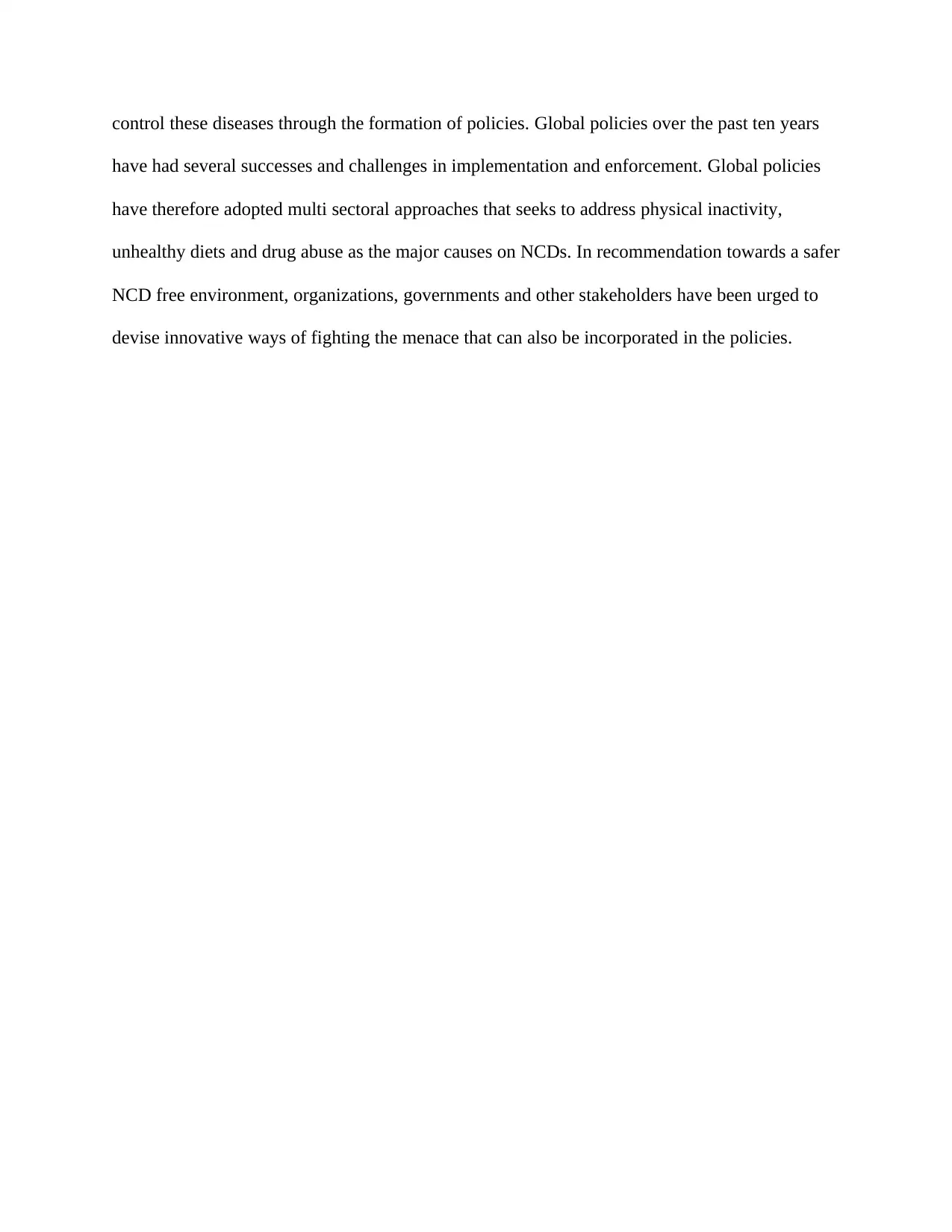
control these diseases through the formation of policies. Global policies over the past ten years
have had several successes and challenges in implementation and enforcement. Global policies
have therefore adopted multi sectoral approaches that seeks to address physical inactivity,
unhealthy diets and drug abuse as the major causes on NCDs. In recommendation towards a safer
NCD free environment, organizations, governments and other stakeholders have been urged to
devise innovative ways of fighting the menace that can also be incorporated in the policies.
have had several successes and challenges in implementation and enforcement. Global policies
have therefore adopted multi sectoral approaches that seeks to address physical inactivity,
unhealthy diets and drug abuse as the major causes on NCDs. In recommendation towards a safer
NCD free environment, organizations, governments and other stakeholders have been urged to
devise innovative ways of fighting the menace that can also be incorporated in the policies.
⊘ This is a preview!⊘
Do you want full access?
Subscribe today to unlock all pages.
Trusted by 1+ million students worldwide
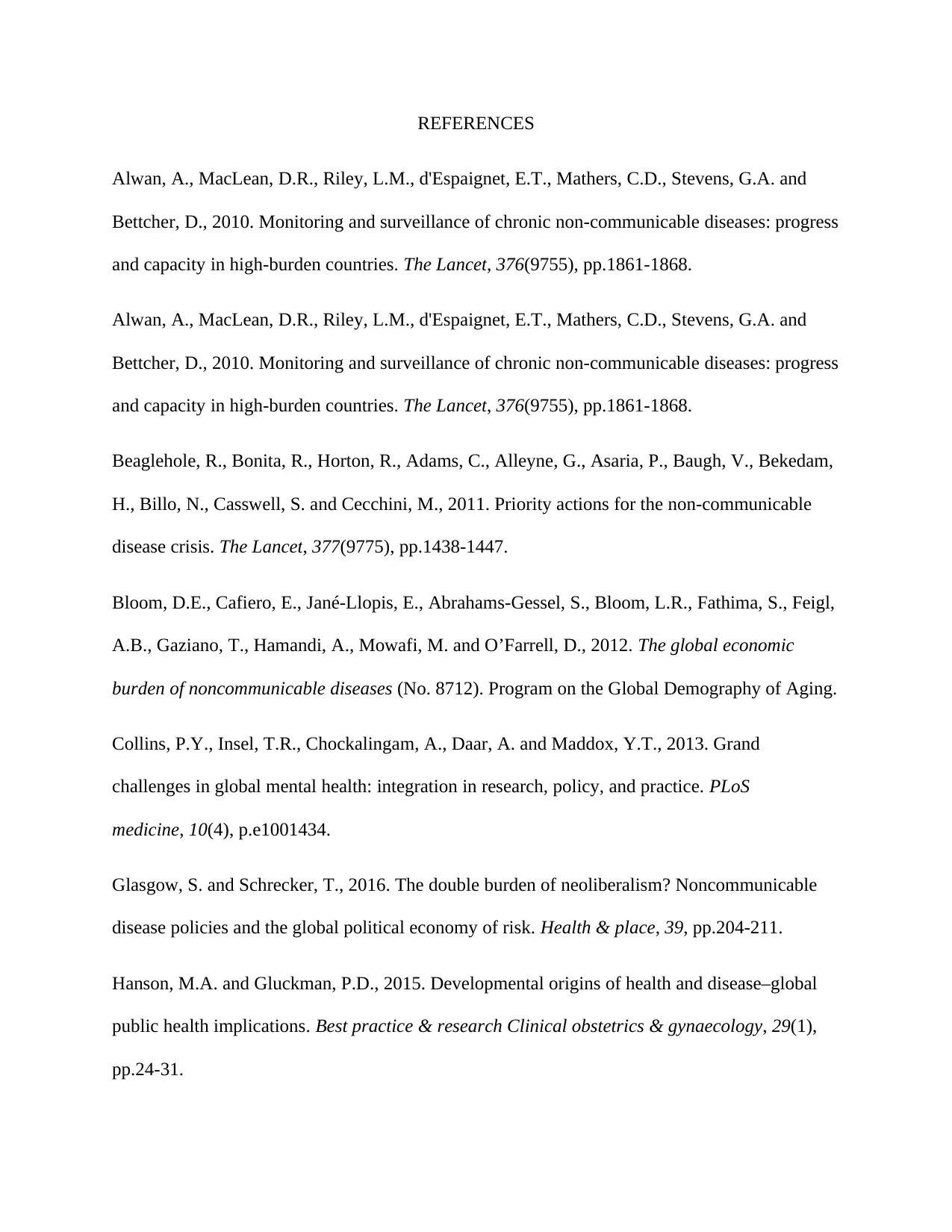
REFERENCES
Alwan, A., MacLean, D.R., Riley, L.M., d'Espaignet, E.T., Mathers, C.D., Stevens, G.A. and
Bettcher, D., 2010. Monitoring and surveillance of chronic non-communicable diseases: progress
and capacity in high-burden countries. The Lancet, 376(9755), pp.1861-1868.
Alwan, A., MacLean, D.R., Riley, L.M., d'Espaignet, E.T., Mathers, C.D., Stevens, G.A. and
Bettcher, D., 2010. Monitoring and surveillance of chronic non-communicable diseases: progress
and capacity in high-burden countries. The Lancet, 376(9755), pp.1861-1868.
Beaglehole, R., Bonita, R., Horton, R., Adams, C., Alleyne, G., Asaria, P., Baugh, V., Bekedam,
H., Billo, N., Casswell, S. and Cecchini, M., 2011. Priority actions for the non-communicable
disease crisis. The Lancet, 377(9775), pp.1438-1447.
Bloom, D.E., Cafiero, E., Jané-Llopis, E., Abrahams-Gessel, S., Bloom, L.R., Fathima, S., Feigl,
A.B., Gaziano, T., Hamandi, A., Mowafi, M. and O’Farrell, D., 2012. The global economic
burden of noncommunicable diseases (No. 8712). Program on the Global Demography of Aging.
Collins, P.Y., Insel, T.R., Chockalingam, A., Daar, A. and Maddox, Y.T., 2013. Grand
challenges in global mental health: integration in research, policy, and practice. PLoS
medicine, 10(4), p.e1001434.
Glasgow, S. and Schrecker, T., 2016. The double burden of neoliberalism? Noncommunicable
disease policies and the global political economy of risk. Health & place, 39, pp.204-211.
Hanson, M.A. and Gluckman, P.D., 2015. Developmental origins of health and disease–global
public health implications. Best practice & research Clinical obstetrics & gynaecology, 29(1),
pp.24-31.
Alwan, A., MacLean, D.R., Riley, L.M., d'Espaignet, E.T., Mathers, C.D., Stevens, G.A. and
Bettcher, D., 2010. Monitoring and surveillance of chronic non-communicable diseases: progress
and capacity in high-burden countries. The Lancet, 376(9755), pp.1861-1868.
Alwan, A., MacLean, D.R., Riley, L.M., d'Espaignet, E.T., Mathers, C.D., Stevens, G.A. and
Bettcher, D., 2010. Monitoring and surveillance of chronic non-communicable diseases: progress
and capacity in high-burden countries. The Lancet, 376(9755), pp.1861-1868.
Beaglehole, R., Bonita, R., Horton, R., Adams, C., Alleyne, G., Asaria, P., Baugh, V., Bekedam,
H., Billo, N., Casswell, S. and Cecchini, M., 2011. Priority actions for the non-communicable
disease crisis. The Lancet, 377(9775), pp.1438-1447.
Bloom, D.E., Cafiero, E., Jané-Llopis, E., Abrahams-Gessel, S., Bloom, L.R., Fathima, S., Feigl,
A.B., Gaziano, T., Hamandi, A., Mowafi, M. and O’Farrell, D., 2012. The global economic
burden of noncommunicable diseases (No. 8712). Program on the Global Demography of Aging.
Collins, P.Y., Insel, T.R., Chockalingam, A., Daar, A. and Maddox, Y.T., 2013. Grand
challenges in global mental health: integration in research, policy, and practice. PLoS
medicine, 10(4), p.e1001434.
Glasgow, S. and Schrecker, T., 2016. The double burden of neoliberalism? Noncommunicable
disease policies and the global political economy of risk. Health & place, 39, pp.204-211.
Hanson, M.A. and Gluckman, P.D., 2015. Developmental origins of health and disease–global
public health implications. Best practice & research Clinical obstetrics & gynaecology, 29(1),
pp.24-31.
Paraphrase This Document
Need a fresh take? Get an instant paraphrase of this document with our AI Paraphraser
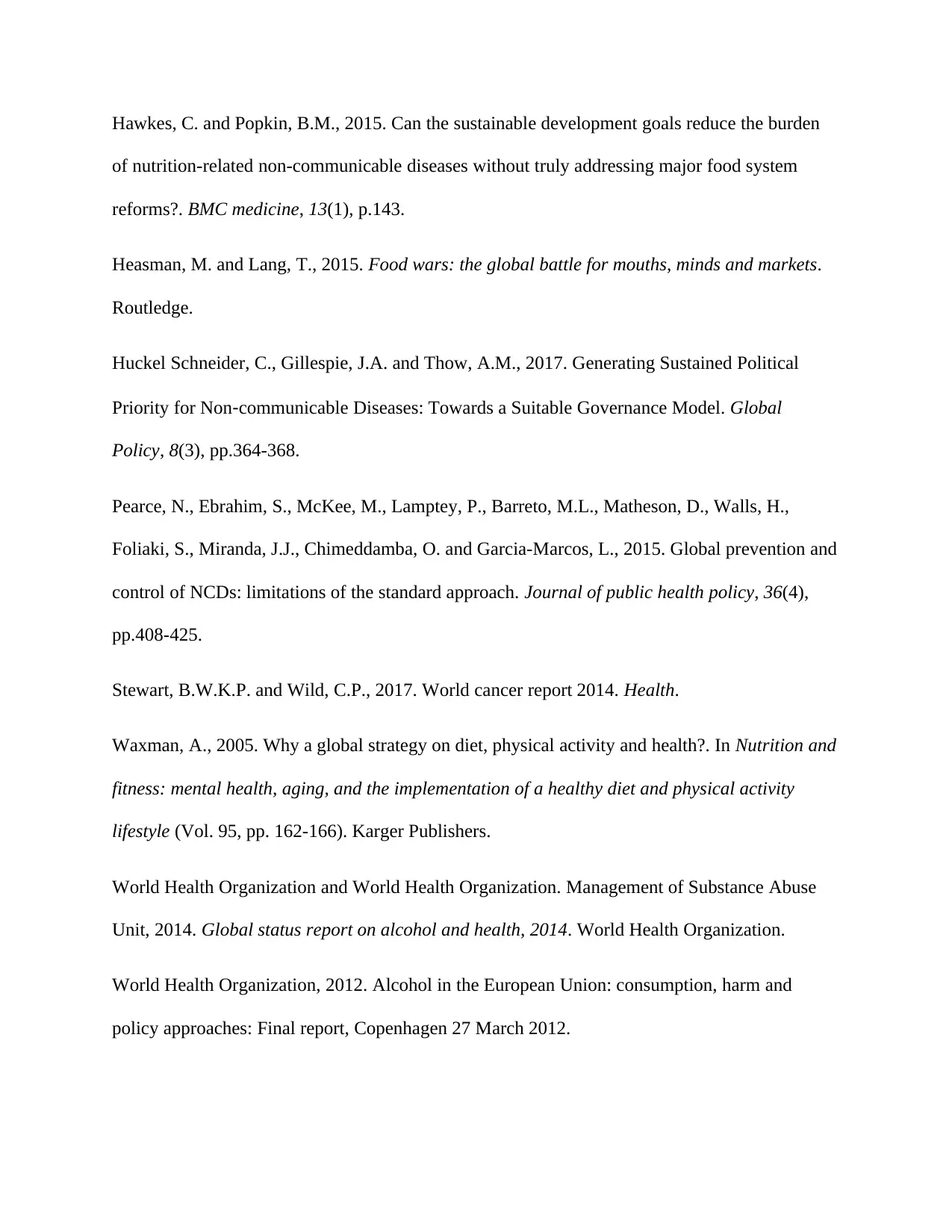
Hawkes, C. and Popkin, B.M., 2015. Can the sustainable development goals reduce the burden
of nutrition-related non-communicable diseases without truly addressing major food system
reforms?. BMC medicine, 13(1), p.143.
Heasman, M. and Lang, T., 2015. Food wars: the global battle for mouths, minds and markets.
Routledge.
Huckel Schneider, C., Gillespie, J.A. and Thow, A.M., 2017. Generating Sustained Political
Priority for Non‐communicable Diseases: Towards a Suitable Governance Model. Global
Policy, 8(3), pp.364-368.
Pearce, N., Ebrahim, S., McKee, M., Lamptey, P., Barreto, M.L., Matheson, D., Walls, H.,
Foliaki, S., Miranda, J.J., Chimeddamba, O. and Garcia-Marcos, L., 2015. Global prevention and
control of NCDs: limitations of the standard approach. Journal of public health policy, 36(4),
pp.408-425.
Stewart, B.W.K.P. and Wild, C.P., 2017. World cancer report 2014. Health.
Waxman, A., 2005. Why a global strategy on diet, physical activity and health?. In Nutrition and
fitness: mental health, aging, and the implementation of a healthy diet and physical activity
lifestyle (Vol. 95, pp. 162-166). Karger Publishers.
World Health Organization and World Health Organization. Management of Substance Abuse
Unit, 2014. Global status report on alcohol and health, 2014. World Health Organization.
World Health Organization, 2012. Alcohol in the European Union: consumption, harm and
policy approaches: Final report, Copenhagen 27 March 2012.
of nutrition-related non-communicable diseases without truly addressing major food system
reforms?. BMC medicine, 13(1), p.143.
Heasman, M. and Lang, T., 2015. Food wars: the global battle for mouths, minds and markets.
Routledge.
Huckel Schneider, C., Gillespie, J.A. and Thow, A.M., 2017. Generating Sustained Political
Priority for Non‐communicable Diseases: Towards a Suitable Governance Model. Global
Policy, 8(3), pp.364-368.
Pearce, N., Ebrahim, S., McKee, M., Lamptey, P., Barreto, M.L., Matheson, D., Walls, H.,
Foliaki, S., Miranda, J.J., Chimeddamba, O. and Garcia-Marcos, L., 2015. Global prevention and
control of NCDs: limitations of the standard approach. Journal of public health policy, 36(4),
pp.408-425.
Stewart, B.W.K.P. and Wild, C.P., 2017. World cancer report 2014. Health.
Waxman, A., 2005. Why a global strategy on diet, physical activity and health?. In Nutrition and
fitness: mental health, aging, and the implementation of a healthy diet and physical activity
lifestyle (Vol. 95, pp. 162-166). Karger Publishers.
World Health Organization and World Health Organization. Management of Substance Abuse
Unit, 2014. Global status report on alcohol and health, 2014. World Health Organization.
World Health Organization, 2012. Alcohol in the European Union: consumption, harm and
policy approaches: Final report, Copenhagen 27 March 2012.
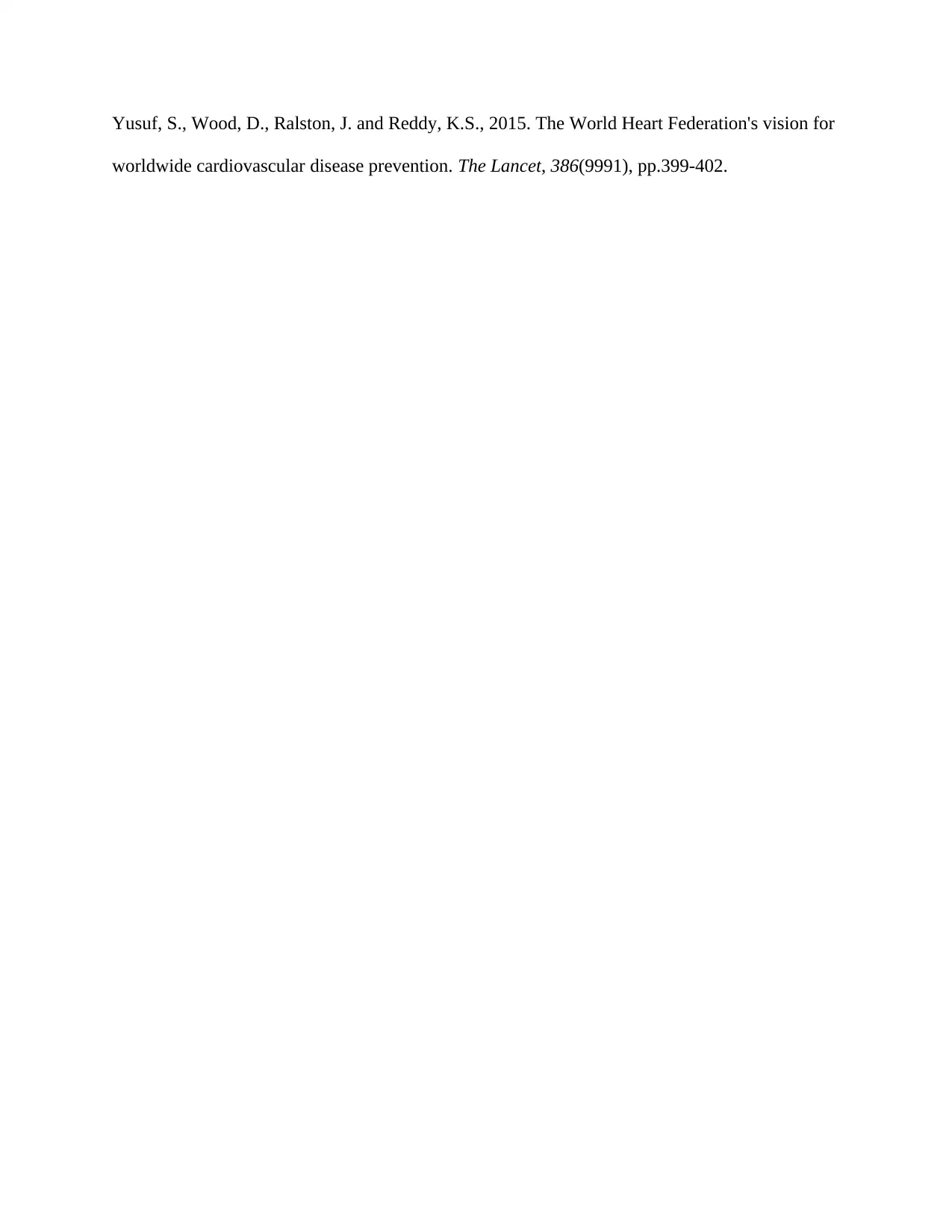
Yusuf, S., Wood, D., Ralston, J. and Reddy, K.S., 2015. The World Heart Federation's vision for
worldwide cardiovascular disease prevention. The Lancet, 386(9991), pp.399-402.
worldwide cardiovascular disease prevention. The Lancet, 386(9991), pp.399-402.
⊘ This is a preview!⊘
Do you want full access?
Subscribe today to unlock all pages.
Trusted by 1+ million students worldwide

1 out of 12


Related Documents


Your All-in-One AI-Powered Toolkit for Academic Success.
+13062052269
info@desklib.com
Available 24*7 on WhatsApp / Email
![[object Object]](/_next/static/media/star-bottom.7253800d.svg)
Unlock your academic potential
Copyright © 2020–2026 A2Z Services. All Rights Reserved. Developed and managed by ZUCOL.