MBA 7008 - Analyzing Global Organization Approach & HR Policies
VerifiedAdded on 2023/04/17
|15
|3884
|240
Report
AI Summary
This report explores the global organization approach and its impact on human resource management policies and procedures. It discusses the globalization of firms and examines multinational, international, global, and transactional strategies. The report analyzes how these strategies affect HRM, including people resourcing, human resource planning, recruitment, selection, and training & development. It further discusses the benefits and limitations of standardization strategies, highlighting the challenges and opportunities for organizations and their HRM departments. The analysis emphasizes the importance of adapting to diverse cultural workforces, managing labor rights, and maintaining productivity and quality in a global context. The report concludes by underscoring the need for effective leadership, cultural awareness, and adaptability to political uncertainties for successful global organization management.
The Global Organization Approach 0
Title: The Global Organization Approach
Assignment Name:
Student Name:
Course Name and Number:
Professor:
Date:
Title: The Global Organization Approach
Assignment Name:
Student Name:
Course Name and Number:
Professor:
Date:

Paraphrase This Document
Need a fresh take? Get an instant paraphrase of this document with our AI Paraphraser
The Global Organization Approach 1
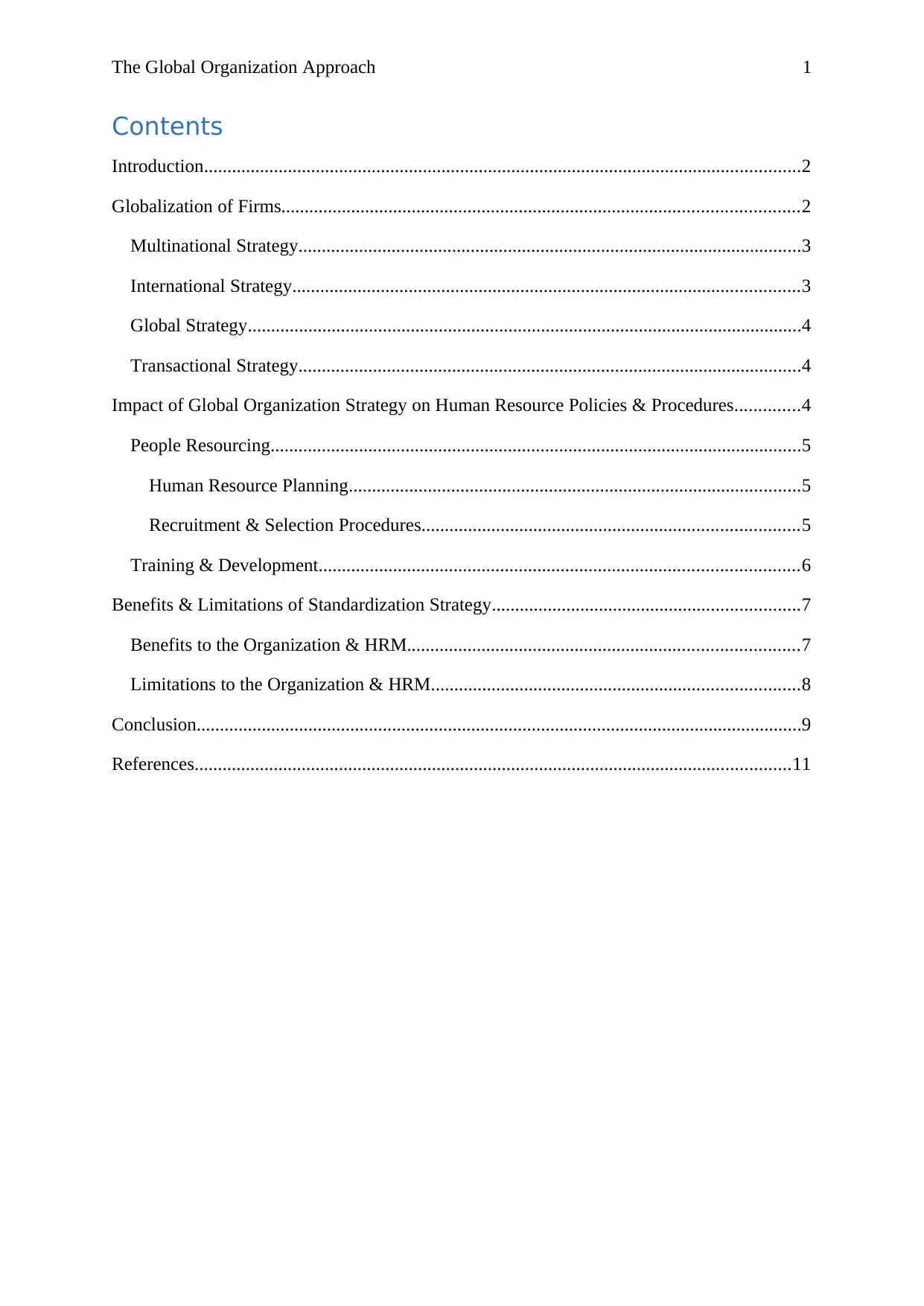
Contents
Introduction................................................................................................................................2
Globalization of Firms...............................................................................................................2
Multinational Strategy............................................................................................................3
International Strategy.............................................................................................................3
Global Strategy.......................................................................................................................4
Transactional Strategy............................................................................................................4
Impact of Global Organization Strategy on Human Resource Policies & Procedures..............4
People Resourcing..................................................................................................................5
Human Resource Planning.................................................................................................5
Recruitment & Selection Procedures.................................................................................5
Training & Development.......................................................................................................6
Benefits & Limitations of Standardization Strategy..................................................................7
Benefits to the Organization & HRM....................................................................................7
Limitations to the Organization & HRM...............................................................................8
Conclusion..................................................................................................................................9
References................................................................................................................................11
Contents
Introduction................................................................................................................................2
Globalization of Firms...............................................................................................................2
Multinational Strategy............................................................................................................3
International Strategy.............................................................................................................3
Global Strategy.......................................................................................................................4
Transactional Strategy............................................................................................................4
Impact of Global Organization Strategy on Human Resource Policies & Procedures..............4
People Resourcing..................................................................................................................5
Human Resource Planning.................................................................................................5
Recruitment & Selection Procedures.................................................................................5
Training & Development.......................................................................................................6
Benefits & Limitations of Standardization Strategy..................................................................7
Benefits to the Organization & HRM....................................................................................7
Limitations to the Organization & HRM...............................................................................8
Conclusion..................................................................................................................................9
References................................................................................................................................11
The Global Organization Approach 2
Introduction
With the globalization of businesses, the responsibilities of the organizations are
increasing to adapt to the practices which fulfill the three main objectives which are local
responsiveness, global innovation, and strategic integration. Also, it is crucial for the
organizations to adapt to the political, economic, social, and cultural environment of the host
country and should formulate strategies according to these factors. Thus, the role of human
resource management in the globalization of the organization is paramount. In this
assignment, all these different aspects have been explored. The assignment discusses the
different changes that the organization will experience in their human resource management
due to the standardization strategy. The impact of globalization on the organization’s policies
and procedures is also discussed in detail. Along with this, the new approach of the
organization Leisure Choice International (LCI), which is the Global Organization will be
provided with effective approaches which the organization can adapt to develop sustainable
management approaches. According to some of the prominent findings in this report, the four
types of strategies of the MNC strategies are global, multinational, transactional, and
international. All these different strategies provides different structures for the organization
which governs the functioning of the organization. These strategies help the human resource
department of the organization to increase the productivity and quality of the employee.
Globalization of Firms
Globalization can be defined as the transformation that is happening in the world
which is changing the self-contained countries into a world which is more integrated. With
the globalization of businesses, the organizations are expanding their focus from one country
to multiple ones. Now, with the expansion of the business into different countries, there is a
significant impact that occurs on the organization’s management and human resource
development. It is crucial for the human resource department of the organization to adhere to
the diverse cultural workforce and along with this, there is a need to hire new employees,
train them, support them and retain them, for effective implementation of the standardization
strategy. Therefore, human resource practices should be built around foreign regulations,
cultural differences, and technological development (Alharthey, 2018).
With the globalization of the organization, the human resource departments of the
organization are not restricted to small markets to hire the appropriate employees, but the
organization now has the opportunity to hire employees from all around the world. Also,
Introduction
With the globalization of businesses, the responsibilities of the organizations are
increasing to adapt to the practices which fulfill the three main objectives which are local
responsiveness, global innovation, and strategic integration. Also, it is crucial for the
organizations to adapt to the political, economic, social, and cultural environment of the host
country and should formulate strategies according to these factors. Thus, the role of human
resource management in the globalization of the organization is paramount. In this
assignment, all these different aspects have been explored. The assignment discusses the
different changes that the organization will experience in their human resource management
due to the standardization strategy. The impact of globalization on the organization’s policies
and procedures is also discussed in detail. Along with this, the new approach of the
organization Leisure Choice International (LCI), which is the Global Organization will be
provided with effective approaches which the organization can adapt to develop sustainable
management approaches. According to some of the prominent findings in this report, the four
types of strategies of the MNC strategies are global, multinational, transactional, and
international. All these different strategies provides different structures for the organization
which governs the functioning of the organization. These strategies help the human resource
department of the organization to increase the productivity and quality of the employee.
Globalization of Firms
Globalization can be defined as the transformation that is happening in the world
which is changing the self-contained countries into a world which is more integrated. With
the globalization of businesses, the organizations are expanding their focus from one country
to multiple ones. Now, with the expansion of the business into different countries, there is a
significant impact that occurs on the organization’s management and human resource
development. It is crucial for the human resource department of the organization to adhere to
the diverse cultural workforce and along with this, there is a need to hire new employees,
train them, support them and retain them, for effective implementation of the standardization
strategy. Therefore, human resource practices should be built around foreign regulations,
cultural differences, and technological development (Alharthey, 2018).
With the globalization of the organization, the human resource departments of the
organization are not restricted to small markets to hire the appropriate employees, but the
organization now has the opportunity to hire employees from all around the world. Also,
⊘ This is a preview!⊘
Do you want full access?
Subscribe today to unlock all pages.

Trusted by 1+ million students worldwide
The Global Organization Approach 3
through the effective database, the work of the human resource department has been made
both simple and effective.
But with the expansion of the organization in the global market, there are certain
challenges, which include –
Managing and handling a diverse workforce.
The pressure of labor rights.
The management of outsourcing employees.
The management of productivity and quality of work.
Adjusting to the new workforce and their different working hours (Jahanian, 2016).
There are four main forms of multinational companies. They are –
Multinational Strategy
This strategy main aim is to focus on the individual domestic market and thus,
functions in collaboration with individual and independent subsidiaries. The role of the
headquarter in managing the global business of the organization is minimal, under this
strategy. The strategy develops global efficiency and increases its revenues by developing
differentiating products and services that address the needs, demands, tastes, and preferences
of the targeted consumers. All these different approaches are governed by government rules
and regulations. By this differentiating approach, it helps the organizations to identify the
various opportunities related to the multinational flexibility (Kaufman, 2016). Thus, this
strategy is country-centric, thus, the various subsidiaries recognize the local needs of the
customers and utilize the local resources. Thus, this strategy works with the main focus of
local to local innovation.
According to the approach of Leisure Choice International (LCI) for the Global
Organization, this strategy will be helpful in fulfilling the objective of local responsiveness,
but the aspect global innovation and strategic integration will not be achieved through this
approach.
International Strategy
Under this strategy, the main focus on worldwide learning, through a well-structured
approach that utilizes the attribute of sharing worldwide innovation. The workforce functions
in a well-organized manner, with the help of an effective communication system that this
strategy helps in developing. Also, the centralization of core competencies helps in better
through the effective database, the work of the human resource department has been made
both simple and effective.
But with the expansion of the organization in the global market, there are certain
challenges, which include –
Managing and handling a diverse workforce.
The pressure of labor rights.
The management of outsourcing employees.
The management of productivity and quality of work.
Adjusting to the new workforce and their different working hours (Jahanian, 2016).
There are four main forms of multinational companies. They are –
Multinational Strategy
This strategy main aim is to focus on the individual domestic market and thus,
functions in collaboration with individual and independent subsidiaries. The role of the
headquarter in managing the global business of the organization is minimal, under this
strategy. The strategy develops global efficiency and increases its revenues by developing
differentiating products and services that address the needs, demands, tastes, and preferences
of the targeted consumers. All these different approaches are governed by government rules
and regulations. By this differentiating approach, it helps the organizations to identify the
various opportunities related to the multinational flexibility (Kaufman, 2016). Thus, this
strategy is country-centric, thus, the various subsidiaries recognize the local needs of the
customers and utilize the local resources. Thus, this strategy works with the main focus of
local to local innovation.
According to the approach of Leisure Choice International (LCI) for the Global
Organization, this strategy will be helpful in fulfilling the objective of local responsiveness,
but the aspect global innovation and strategic integration will not be achieved through this
approach.
International Strategy
Under this strategy, the main focus on worldwide learning, through a well-structured
approach that utilizes the attribute of sharing worldwide innovation. The workforce functions
in a well-organized manner, with the help of an effective communication system that this
strategy helps in developing. Also, the centralization of core competencies helps in better
Paraphrase This Document
Need a fresh take? Get an instant paraphrase of this document with our AI Paraphraser
The Global Organization Approach 4
strategic integration. Also, this is an effective strategy that can be implemented under the
circumstances of the organization faces challenges in achieving local responsiveness (Kaur,
2017).
Thus, for the organization Leisure Choice International this can be an effective
approach in becoming the Global organization.
Global Strategy
In this strategy, the main focus of the organization is on integrating the foreign
resources, with the help of an independent structure of foreign subsidiaries. The organization
will be able to attain a high level of productivity in a very cost-efficient way. Therefore, this
strategy is effective in achieving strategic integration, but the centralization of the approaches
limits the level of flexibility in the organization, also affecting the global innovation
standards. Thus, the organization also is vulnerable to currency risks and political
uncertainties (Li and Cao, 2018).
Thus, for the LCI organization, this approach will not be effective in their
Globalization approach.
Transactional Strategy
The transactional strategy can be defined as the combination of global strategy and
multinational strategy. The main focus of this strategy is on accomplishing all the strategic
goals at the same time. This strategy helps in attaining both global coordination and local
autonomy. With the help of an integrated network, this strategy helps in offering solutions to
different problems and challenges. It helps in accomplishing all the three alternatives which
are local responsiveness, global innovation, and strategic integration (Madra, 2017).
Thus, this strategy will be most appropriate for the LCI organization to attain strategic
objectives and manage human resource management effectively.
Impact of Global Organization Strategy on Human Resource Policies &
Procedures
To function in the international competitive environment, it is crucial for the human
resource management of the organization to conduct a number of important activities which
include staffing, human resource planning, training and development, performance
management, compensation, and industrial relations. Due to the different approach and their
strategic integration. Also, this is an effective strategy that can be implemented under the
circumstances of the organization faces challenges in achieving local responsiveness (Kaur,
2017).
Thus, for the organization Leisure Choice International this can be an effective
approach in becoming the Global organization.
Global Strategy
In this strategy, the main focus of the organization is on integrating the foreign
resources, with the help of an independent structure of foreign subsidiaries. The organization
will be able to attain a high level of productivity in a very cost-efficient way. Therefore, this
strategy is effective in achieving strategic integration, but the centralization of the approaches
limits the level of flexibility in the organization, also affecting the global innovation
standards. Thus, the organization also is vulnerable to currency risks and political
uncertainties (Li and Cao, 2018).
Thus, for the LCI organization, this approach will not be effective in their
Globalization approach.
Transactional Strategy
The transactional strategy can be defined as the combination of global strategy and
multinational strategy. The main focus of this strategy is on accomplishing all the strategic
goals at the same time. This strategy helps in attaining both global coordination and local
autonomy. With the help of an integrated network, this strategy helps in offering solutions to
different problems and challenges. It helps in accomplishing all the three alternatives which
are local responsiveness, global innovation, and strategic integration (Madra, 2017).
Thus, this strategy will be most appropriate for the LCI organization to attain strategic
objectives and manage human resource management effectively.
Impact of Global Organization Strategy on Human Resource Policies &
Procedures
To function in the international competitive environment, it is crucial for the human
resource management of the organization to conduct a number of important activities which
include staffing, human resource planning, training and development, performance
management, compensation, and industrial relations. Due to the different approach and their
The Global Organization Approach 5
impact, along with the additional implications of international human resource management,
the organization will face humongous challenges (Meyer and Xin, 2017).
People Resourcing
Some of the main activities involved in the process of people resourcing are human
resource planning, recruitment and selection procedures, talent planning, and international
human resource.
Human Resource Planning
The concept of human resource planning is utilized in a very generic sense for a
number of different procedures, processes, and policies too, with the main aim of managing,
motivating, rewarding, and disciplining the employee in an organization. Also, the IHRM
relates the human resource policy with the organization’s objectives, strategies, and values.
This signifies that the human resource is integrated into the organizational culture (Minbaeva
and Santangelo, 2017). This highlights another important aspect that the human resource
department does not only manages employees, but it is also responsible for developing a
responsible, flexible and diverse workforce, along with building a strong and transparent
employer and employee relationship. All these different aspects also exhibit the fact that
human resource policies are closely related to competency development in the organization.
Thus, few of the impacts of the globalization approach on the LCI organization will be on the
planning of effective approaches to motivate employees, to increase employee engagement,
and to increase the loyalty towards the organization. Thus, all these different aspects impact
the human resource policies and procedures (Natter, 2018).
Recruitment & Selection Procedures
The success and the failure of the globalization approach depend on the selection,
training, and managing of the workforce. For international staffing, a classic study proposed
by Perlmutter’s has explained three main approaches, which are geocentric, polycentric, and
ethnocentric. All these different recruitment approaches follow different human resource
practices. In the case of ethnocentric, the organization will be dominated by the nationals of
the parent company at both local and international levels. In the case of the polycentric
approach, the organization will employee nationals majorly from the host country. Whereas,
in the case of the geocentric recruitment approach, the organization focuses on employing the
best individual without giving any consent to its nationality (Park, 2016). Thus, for the
organization LCI, though, the best approach will be geocentric, as it will have the least
impact, along with the additional implications of international human resource management,
the organization will face humongous challenges (Meyer and Xin, 2017).
People Resourcing
Some of the main activities involved in the process of people resourcing are human
resource planning, recruitment and selection procedures, talent planning, and international
human resource.
Human Resource Planning
The concept of human resource planning is utilized in a very generic sense for a
number of different procedures, processes, and policies too, with the main aim of managing,
motivating, rewarding, and disciplining the employee in an organization. Also, the IHRM
relates the human resource policy with the organization’s objectives, strategies, and values.
This signifies that the human resource is integrated into the organizational culture (Minbaeva
and Santangelo, 2017). This highlights another important aspect that the human resource
department does not only manages employees, but it is also responsible for developing a
responsible, flexible and diverse workforce, along with building a strong and transparent
employer and employee relationship. All these different aspects also exhibit the fact that
human resource policies are closely related to competency development in the organization.
Thus, few of the impacts of the globalization approach on the LCI organization will be on the
planning of effective approaches to motivate employees, to increase employee engagement,
and to increase the loyalty towards the organization. Thus, all these different aspects impact
the human resource policies and procedures (Natter, 2018).
Recruitment & Selection Procedures
The success and the failure of the globalization approach depend on the selection,
training, and managing of the workforce. For international staffing, a classic study proposed
by Perlmutter’s has explained three main approaches, which are geocentric, polycentric, and
ethnocentric. All these different recruitment approaches follow different human resource
practices. In the case of ethnocentric, the organization will be dominated by the nationals of
the parent company at both local and international levels. In the case of the polycentric
approach, the organization will employee nationals majorly from the host country. Whereas,
in the case of the geocentric recruitment approach, the organization focuses on employing the
best individual without giving any consent to its nationality (Park, 2016). Thus, for the
organization LCI, though, the best approach will be geocentric, as it will have the least
⊘ This is a preview!⊘
Do you want full access?
Subscribe today to unlock all pages.
Trusted by 1+ million students worldwide
The Global Organization Approach 6
impact on the human resource policies and procedures, as the level of uncertainties will be
less.
According to all these different approaches for recruitment and selection, it is a
known fact that global and international MNC strategies utilize the ethnocentric approach, the
multinational strategy utilizes a polycentric approach, and the transactional approach utilizes
geocentric approach, this has been formulated according to the structural approach of Bartlett
and Ghoshal organizational model. Thus, the main impact on the organization’s human
resource policies and procedures happen due to cultural differences, relocation, remuneration,
and communication problems (Paulina, 2018). The international managers find it challenging
to resolve all these problems as they follow a pattern which is dominated by a certain group
of responsible for the main functions of the organization.
Training & Development
In today’s highly competitive environment, international managers identify and know
the importance of training and development of human resources in attaining competitive
advantages. Through the approaches and practices of training and development, the human
resources are able to fulfill a number of purposes which include acquiring and transfering
knowledge, maintaining effective communication coordination, effective control, and
management between the headquarters and subsidiaries, and the maintenance of foreign
subsidiaries (Roy and Srivastava, 2017). According to the requirements of the International
human resource management standards, it is important to recognize the employee’s needs and
potential, to offer them with a high level of training and to also develop better opportunities
for job satisfaction, this is necessary to fulfill the different aspects laid out by the global and
international strategy. Whereas according to the multinational and domestic strategy, the
activities and approaches for training and development happen on a local basis.
Thus, few of the crucial elements of the organization to effectively implement the
approach of Global organization is to have effective leadership. Through this, the
organization will be able to manage human resources and effectively execute different
training and development practices. Also, the other aspect which is crucial for the
organization is having a cultural awareness. It is crucial for the organization to have deep
knowledge of the culture in which the organization is entering. Also, the organization has to
get familiar with the global trends, as to incorporate it in the training and development
approaches.
impact on the human resource policies and procedures, as the level of uncertainties will be
less.
According to all these different approaches for recruitment and selection, it is a
known fact that global and international MNC strategies utilize the ethnocentric approach, the
multinational strategy utilizes a polycentric approach, and the transactional approach utilizes
geocentric approach, this has been formulated according to the structural approach of Bartlett
and Ghoshal organizational model. Thus, the main impact on the organization’s human
resource policies and procedures happen due to cultural differences, relocation, remuneration,
and communication problems (Paulina, 2018). The international managers find it challenging
to resolve all these problems as they follow a pattern which is dominated by a certain group
of responsible for the main functions of the organization.
Training & Development
In today’s highly competitive environment, international managers identify and know
the importance of training and development of human resources in attaining competitive
advantages. Through the approaches and practices of training and development, the human
resources are able to fulfill a number of purposes which include acquiring and transfering
knowledge, maintaining effective communication coordination, effective control, and
management between the headquarters and subsidiaries, and the maintenance of foreign
subsidiaries (Roy and Srivastava, 2017). According to the requirements of the International
human resource management standards, it is important to recognize the employee’s needs and
potential, to offer them with a high level of training and to also develop better opportunities
for job satisfaction, this is necessary to fulfill the different aspects laid out by the global and
international strategy. Whereas according to the multinational and domestic strategy, the
activities and approaches for training and development happen on a local basis.
Thus, few of the crucial elements of the organization to effectively implement the
approach of Global organization is to have effective leadership. Through this, the
organization will be able to manage human resources and effectively execute different
training and development practices. Also, the other aspect which is crucial for the
organization is having a cultural awareness. It is crucial for the organization to have deep
knowledge of the culture in which the organization is entering. Also, the organization has to
get familiar with the global trends, as to incorporate it in the training and development
approaches.
Paraphrase This Document
Need a fresh take? Get an instant paraphrase of this document with our AI Paraphraser
The Global Organization Approach 7
These aspects also highlight the fact that the implication of the different human
resource activities like recruitment, selection, training, and development is also due to many
political uncertainties which can be related to both local and international. The management
of the human resource in different economies, cultures, laws, and political environment post
many challenges. The political challenges arise due to the people who dominate and govern
the country (Sai, 2018). Like many of the countries are governed by the military forces,
whereas few are governed by dictators. For a new organization to venture into such political
environment can be challenging, as they have redesigned their management approaches and
also to create a niche for themselves in such countries can be extremely difficult, as they
might face many uncertainties. The political uncertainties arise due to the level of corruption
in the country, the different terrorist activities in the country, and many others. All these
affect the recruitment, selection, training and development activities of the human resource.
For an organization, the security of their employee is paramount but, under such political
instability and pressure, the organization will not be able to fulfill its prime human resource
policy (Salma and Huq Khan, 2016).
Benefits & Limitations of Standardization Strategy
With the organization Leisure Choice International (LCI) implementing the
standardization strategy of the Global Organization to develop a more efficient and effective
working environment. The organization will experience a transformation in their
management practices, especially the human resource department. The organization’s
standardization strategy will have a focus on developing a more integrated human resource
management system. Also, the organization will recognize the importance of international
managers in the globalization approach (Zheng, 2017). But, there are certain benefits and
limitations that the organization will face due to its implementation.
Benefits to the Organization & HRM.
Some of the benefits which the organization LCI will attain are –
With the globalization approach, the organization will be able to increase its revenues
with a large margin (Beer, 2017).
The organization will be able to effectively implement strategies of international
human resource management. For instance, the dual system which is practiced in the
German sites of the organization for the training and development has helped the
organization in increasing the productivity and quality of their human resources.
These aspects also highlight the fact that the implication of the different human
resource activities like recruitment, selection, training, and development is also due to many
political uncertainties which can be related to both local and international. The management
of the human resource in different economies, cultures, laws, and political environment post
many challenges. The political challenges arise due to the people who dominate and govern
the country (Sai, 2018). Like many of the countries are governed by the military forces,
whereas few are governed by dictators. For a new organization to venture into such political
environment can be challenging, as they have redesigned their management approaches and
also to create a niche for themselves in such countries can be extremely difficult, as they
might face many uncertainties. The political uncertainties arise due to the level of corruption
in the country, the different terrorist activities in the country, and many others. All these
affect the recruitment, selection, training and development activities of the human resource.
For an organization, the security of their employee is paramount but, under such political
instability and pressure, the organization will not be able to fulfill its prime human resource
policy (Salma and Huq Khan, 2016).
Benefits & Limitations of Standardization Strategy
With the organization Leisure Choice International (LCI) implementing the
standardization strategy of the Global Organization to develop a more efficient and effective
working environment. The organization will experience a transformation in their
management practices, especially the human resource department. The organization’s
standardization strategy will have a focus on developing a more integrated human resource
management system. Also, the organization will recognize the importance of international
managers in the globalization approach (Zheng, 2017). But, there are certain benefits and
limitations that the organization will face due to its implementation.
Benefits to the Organization & HRM.
Some of the benefits which the organization LCI will attain are –
With the globalization approach, the organization will be able to increase its revenues
with a large margin (Beer, 2017).
The organization will be able to effectively implement strategies of international
human resource management. For instance, the dual system which is practiced in the
German sites of the organization for the training and development has helped the
organization in increasing the productivity and quality of their human resources.
The Global Organization Approach 8
Along with this, the organization will develop a diverse working environment which
will be developed through flexible human resource policies and procedures. For
instance, in the German site, the organization takes support from external institutions
for better learning opportunities for the employees and these have been incorporated
in the company’s human resource policies (Bradt, 2016).
Along, with this, the organization also learns to identify and adjust to the local
economy, politics, and consumer preferences which later governs the organization’s
functioning. In the German outlet of the organization LCI, the company is
successfully functioning, due to its different flexible approaches (Guest, 2017).
With this standardization approach, the organization will be moving into a more
integrated approach. Till now, the organization culture has been diversified. But it is
crucial for the organization to develop an integrated approach as it is required for the
globalization of the organization. Through this integrated approach, the organization
will be able to develop a more organized working environment and will have better
control over their business, especially on the expenses. The organization also attains
more opportunities to attain competitive advantages (Czuczka, Jennen, and Buergin,
2017).
Limitations to the Organization & HRM
Some of the limitations to the organization LCI are -
The organization has to adjust to the new legislation which affects the functioning of
the organization and also their human resource management. For example, in
Germany, there are different laws for employment. Also, with the globalization, the
organization will have to fulfill the local and international laws of business. This
increases the pressure on the organization, as many of the laws restrain the
functioning of the organization (Kessler, Heron and Spilsbury, 2017).
The biggest drawback to the organization will be to adjust to the different political
ideology. For example, in Germany, the organization is functioning effectively, but
with the implications of Brexit, the organization can face huge issues in the
recruitment of employees as the European Union will introduce various new policies
(Nienaber, 2017).
The organization has to adjust to the different economies of various countries. The
organization LCI is functioning in Germany, who’s economy is considered as one of
the largest and strongest economies in the world. But according to the current
Along with this, the organization will develop a diverse working environment which
will be developed through flexible human resource policies and procedures. For
instance, in the German site, the organization takes support from external institutions
for better learning opportunities for the employees and these have been incorporated
in the company’s human resource policies (Bradt, 2016).
Along, with this, the organization also learns to identify and adjust to the local
economy, politics, and consumer preferences which later governs the organization’s
functioning. In the German outlet of the organization LCI, the company is
successfully functioning, due to its different flexible approaches (Guest, 2017).
With this standardization approach, the organization will be moving into a more
integrated approach. Till now, the organization culture has been diversified. But it is
crucial for the organization to develop an integrated approach as it is required for the
globalization of the organization. Through this integrated approach, the organization
will be able to develop a more organized working environment and will have better
control over their business, especially on the expenses. The organization also attains
more opportunities to attain competitive advantages (Czuczka, Jennen, and Buergin,
2017).
Limitations to the Organization & HRM
Some of the limitations to the organization LCI are -
The organization has to adjust to the new legislation which affects the functioning of
the organization and also their human resource management. For example, in
Germany, there are different laws for employment. Also, with the globalization, the
organization will have to fulfill the local and international laws of business. This
increases the pressure on the organization, as many of the laws restrain the
functioning of the organization (Kessler, Heron and Spilsbury, 2017).
The biggest drawback to the organization will be to adjust to the different political
ideology. For example, in Germany, the organization is functioning effectively, but
with the implications of Brexit, the organization can face huge issues in the
recruitment of employees as the European Union will introduce various new policies
(Nienaber, 2017).
The organization has to adjust to the different economies of various countries. The
organization LCI is functioning in Germany, who’s economy is considered as one of
the largest and strongest economies in the world. But according to the current
⊘ This is a preview!⊘
Do you want full access?
Subscribe today to unlock all pages.
Trusted by 1+ million students worldwide
The Global Organization Approach 9
development, the implications of Brexit will affect the economic environment of the
country. For instance, the organization human resource practices like recruitment,
selection, training, and development, all will get affected by these recent changes
(Quain, 2019).
Though the organization is offering a service which is in sync with the global trend of
leading a healthy life. But the social trends of each place is different. For example,
yoga has been originally a part of the Asian countries, but now it is practiced in the
entire world. In the same case, the organization has to develop new strategies to
address and accomplish local responsiveness. Many a times, this increases the
pressure on the human resource of the organization, which further increases due to the
competitive environment in the local and global market. Thus, to achieve this balance
between the global and local market impacts the functioning of the organization. Also,
the organization struggles to fulfill the social needs of the customers (Wright et al.,
2017).
For the organization, with the integrated approach, the level of flexibility in the
organization will also decrease. This can affect the overall working of the
organization. For instance, the organization has to adjust to the different political,
economic and social environment like the organization is adjusting to the different
implications imposed by Brexit on the German organization. But due to the integrated
approach, the organization will struggle and this can increase the challenges and
problems for LCI.
For the organization LCI, the different human resources approach highlights a number of
choices due to the new globalization approach of the organization. The convergent approach
for the organization will require fewer efforts as the organization just have to copy the
strategies of its competitor. Also, this approach requires less investment. But, the
organization requires a new set of strategies under divergent approach as the main focus of
this strategy is implement a plan, which differs from the competitors and also, helps in
attaining a competitive advantage (Zan and Deng, 2017). Therefore, for the organization, it is
crucial to identify the areas where it wants to implement a convergent strategy and also, the
areas which require divergent activities. This integrated and combined approach of
convergent and divergent will help the organization in implementing the Globalization
strategy more effectively, as it will develop a perfect balance between the local and global
approaches.
development, the implications of Brexit will affect the economic environment of the
country. For instance, the organization human resource practices like recruitment,
selection, training, and development, all will get affected by these recent changes
(Quain, 2019).
Though the organization is offering a service which is in sync with the global trend of
leading a healthy life. But the social trends of each place is different. For example,
yoga has been originally a part of the Asian countries, but now it is practiced in the
entire world. In the same case, the organization has to develop new strategies to
address and accomplish local responsiveness. Many a times, this increases the
pressure on the human resource of the organization, which further increases due to the
competitive environment in the local and global market. Thus, to achieve this balance
between the global and local market impacts the functioning of the organization. Also,
the organization struggles to fulfill the social needs of the customers (Wright et al.,
2017).
For the organization, with the integrated approach, the level of flexibility in the
organization will also decrease. This can affect the overall working of the
organization. For instance, the organization has to adjust to the different political,
economic and social environment like the organization is adjusting to the different
implications imposed by Brexit on the German organization. But due to the integrated
approach, the organization will struggle and this can increase the challenges and
problems for LCI.
For the organization LCI, the different human resources approach highlights a number of
choices due to the new globalization approach of the organization. The convergent approach
for the organization will require fewer efforts as the organization just have to copy the
strategies of its competitor. Also, this approach requires less investment. But, the
organization requires a new set of strategies under divergent approach as the main focus of
this strategy is implement a plan, which differs from the competitors and also, helps in
attaining a competitive advantage (Zan and Deng, 2017). Therefore, for the organization, it is
crucial to identify the areas where it wants to implement a convergent strategy and also, the
areas which require divergent activities. This integrated and combined approach of
convergent and divergent will help the organization in implementing the Globalization
strategy more effectively, as it will develop a perfect balance between the local and global
approaches.
Paraphrase This Document
Need a fresh take? Get an instant paraphrase of this document with our AI Paraphraser
The Global Organization Approach 10
Conclusion
The main approach of this assignment was to identify the different implications which
the organization Leisure Choice International will experience due to the new globalization
strategy that will be implemented in the organization. This move of expansion will bring
many changes in the organization’s management and human resource department. The main
objective of this assignment thus was to identify the different changes or implications on the
human resource management and also identify the new standard that the organization has to
adapt to for this globalization approach. According to the main findings in this assignment,
the organization has a polycentric and ethnocentric structure. But for the organization to
attain this standardization it is important to develop a geocentric structure. The organization
also has to adapt to a strategy that will help in better management of the workforce, thus the
transactional strategy will be most effective for the organization. It is due to this reason that
through this approach, the organization will be able to fulfill and accomplish all these global
objectives which include local responsiveness, global innovation, and strategy integration.
The other findings highlight the fact that the organization will now face bigger and more
uncertainties associated with the local and global business environment. This environment
will be impacted by the political, social and economic factors, which will affect the
functioning of the organization. These factors will impact the recruitment, selection, training,
and development process of the employees. Also, for the Globalization approach, the
organization will also have to adjust to the international human resource management
approaches. Thus, finally, this can be concluded that for the organization LCI, the main
aspect is to find a balance between local and global approaches, which will help in
developing harmony in the human resource policies, procedures, and practices of the
organization.
Conclusion
The main approach of this assignment was to identify the different implications which
the organization Leisure Choice International will experience due to the new globalization
strategy that will be implemented in the organization. This move of expansion will bring
many changes in the organization’s management and human resource department. The main
objective of this assignment thus was to identify the different changes or implications on the
human resource management and also identify the new standard that the organization has to
adapt to for this globalization approach. According to the main findings in this assignment,
the organization has a polycentric and ethnocentric structure. But for the organization to
attain this standardization it is important to develop a geocentric structure. The organization
also has to adapt to a strategy that will help in better management of the workforce, thus the
transactional strategy will be most effective for the organization. It is due to this reason that
through this approach, the organization will be able to fulfill and accomplish all these global
objectives which include local responsiveness, global innovation, and strategy integration.
The other findings highlight the fact that the organization will now face bigger and more
uncertainties associated with the local and global business environment. This environment
will be impacted by the political, social and economic factors, which will affect the
functioning of the organization. These factors will impact the recruitment, selection, training,
and development process of the employees. Also, for the Globalization approach, the
organization will also have to adjust to the international human resource management
approaches. Thus, finally, this can be concluded that for the organization LCI, the main
aspect is to find a balance between local and global approaches, which will help in
developing harmony in the human resource policies, procedures, and practices of the
organization.
The Global Organization Approach 11
References
Alharthey, D. (2018). Review on Globalization and Importance of Strategic Human Resource
Management. International Journal of Scientific Research and Management, 6(03), pp.5-10.
Beer, M. (2017). Developing strategic human resource theory and making a difference: An
action science perspective. Human Resource Management Review, 1(1), pp.5-10.
Bradt, G. (2016). Why The Fundamental Strategic Choice Is Between Converging And
Diverging. [online] Forbes.com. Available at:
https://www.forbes.com/sites/georgebradt/2016/11/23/why-the-fundamental-strategic-choice-
is-between-converging-and-diverging/#2d6a3bfbe16a [Accessed 18 Apr. 2019].
Czuczka, T., Jennen, B. and Buergin, R. (2017). Bloomberg - Are you a robot?. [online]
Bloomberg.com. Available at: https://www.bloomberg.com/news/articles/2017-11-21/how-
merkel-and-germany-got-in-a-political-pickle-quicktake-q-a [Accessed 18 Apr. 2019].
Guest, D. (2017). Human resource management and employee well-being: towards a new
analytic framework. Human Resource Management Journal, 27(1), pp.22-38.
Jahanian, R. (2016). The Impact of Globalization on Human Resource Management. Euro-
Asian Journal of Economics and Finance, 4(1), pp.20-26.
Kaufman, B. (2016). Globalization and convergence–divergence of HRM across nations:
New measures, explanatory theory, and non-standard predictions from bringing in
economics. Human Resource Management Review, 26(4), pp.338-351.
Kaur, D. (2017). Impact of Globalization on Human Resource Management - Technocreats.
[online] Technocreats.com. Available at: https://www.technocreats.com/blog/67/impact-of-
globalization-on-human-resource-management [Accessed 18 Apr. 2019].
References
Alharthey, D. (2018). Review on Globalization and Importance of Strategic Human Resource
Management. International Journal of Scientific Research and Management, 6(03), pp.5-10.
Beer, M. (2017). Developing strategic human resource theory and making a difference: An
action science perspective. Human Resource Management Review, 1(1), pp.5-10.
Bradt, G. (2016). Why The Fundamental Strategic Choice Is Between Converging And
Diverging. [online] Forbes.com. Available at:
https://www.forbes.com/sites/georgebradt/2016/11/23/why-the-fundamental-strategic-choice-
is-between-converging-and-diverging/#2d6a3bfbe16a [Accessed 18 Apr. 2019].
Czuczka, T., Jennen, B. and Buergin, R. (2017). Bloomberg - Are you a robot?. [online]
Bloomberg.com. Available at: https://www.bloomberg.com/news/articles/2017-11-21/how-
merkel-and-germany-got-in-a-political-pickle-quicktake-q-a [Accessed 18 Apr. 2019].
Guest, D. (2017). Human resource management and employee well-being: towards a new
analytic framework. Human Resource Management Journal, 27(1), pp.22-38.
Jahanian, R. (2016). The Impact of Globalization on Human Resource Management. Euro-
Asian Journal of Economics and Finance, 4(1), pp.20-26.
Kaufman, B. (2016). Globalization and convergence–divergence of HRM across nations:
New measures, explanatory theory, and non-standard predictions from bringing in
economics. Human Resource Management Review, 26(4), pp.338-351.
Kaur, D. (2017). Impact of Globalization on Human Resource Management - Technocreats.
[online] Technocreats.com. Available at: https://www.technocreats.com/blog/67/impact-of-
globalization-on-human-resource-management [Accessed 18 Apr. 2019].
⊘ This is a preview!⊘
Do you want full access?
Subscribe today to unlock all pages.
Trusted by 1+ million students worldwide

1 out of 15


Related Documents


Your All-in-One AI-Powered Toolkit for Academic Success.
+13062052269
info@desklib.com
Available 24*7 on WhatsApp / Email
![[object Object]](/_next/static/media/star-bottom.7253800d.svg)
Unlock your academic potential
Copyright © 2020–2026 A2Z Services. All Rights Reserved. Developed and managed by ZUCOL.