Accounting Theory: Impact of Global Standards on Economic Trade

Verified

Added on  2023/06/10

|6
|748
|281
Essay
AI Summary
This essay delves into the crucial role of global accounting standards in facilitating economic globalisation and international trade. It highlights the International Accounting Standards Committee's efforts in promoting standardised measures for multinational companies. The essay also contrasts principles-based and rule-based approaches in developing global accounting standards, particularly in light of accounting scandals like Enron and WorldCom. It argues that while principles-based standards offer flexibility, rule-based standards minimise manipulation and ensure accurate financial reporting. Ultimately, the essay suggests that rule-based accounting provides a more reliable framework for portraying a company's actual financial valuation.
Document Page
Running head: ACCOUNTING THEORY
Accounting Theory
Name of the Student:
Name of the University:
Authors Note:
tabler-icon-diamond-filled.svg

Paraphrase This Document

Need a fresh take? Get an instant paraphrase of this document with our AI Paraphraser
Document Page
ACCOUNTING THEORY
1
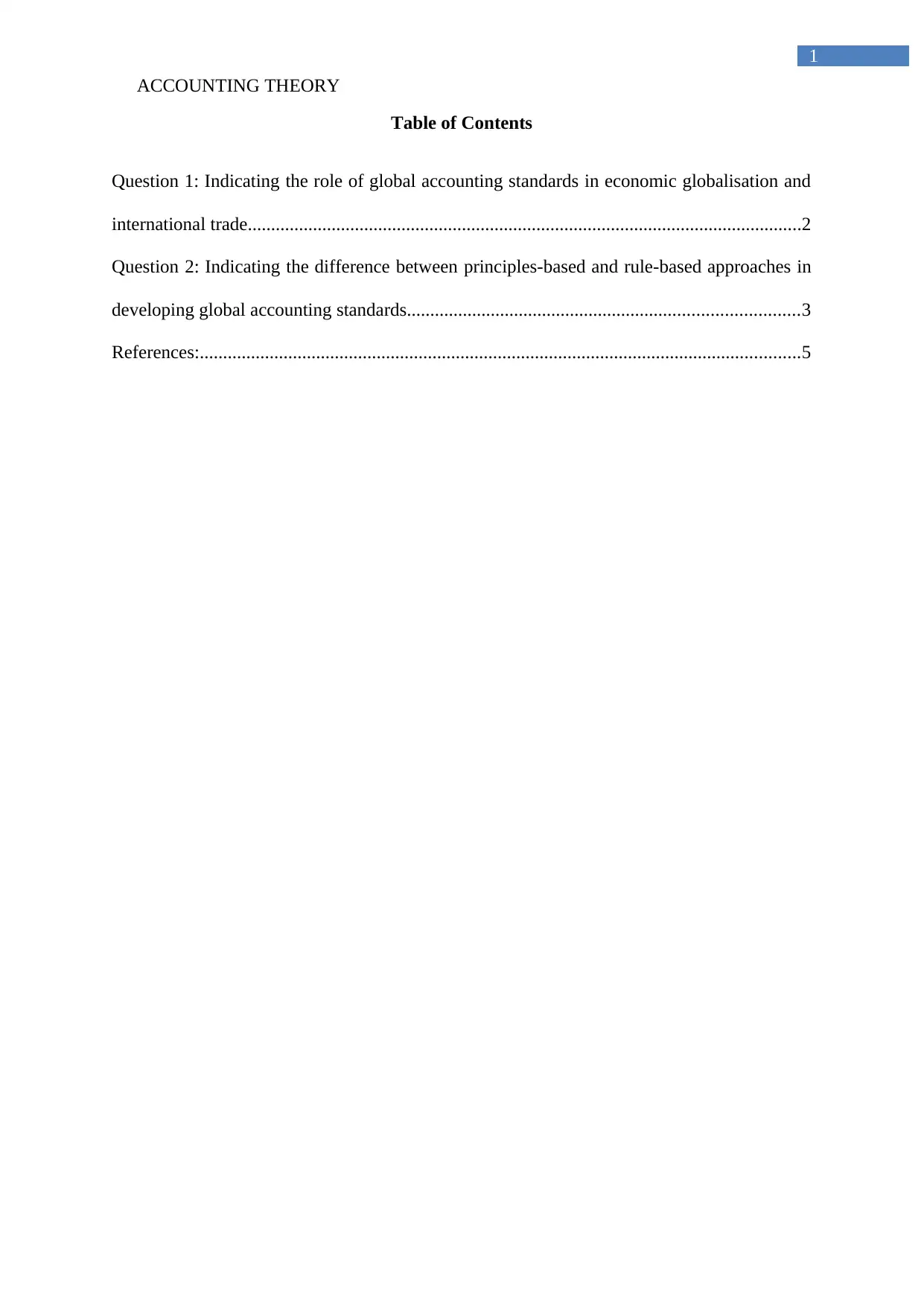
Table of Contents
Question 1: Indicating the role of global accounting standards in economic globalisation and
international trade.......................................................................................................................2
Question 2: Indicating the difference between principles-based and rule-based approaches in
developing global accounting standards....................................................................................3
References:.................................................................................................................................5
Document Page
ACCOUNTING THEORY
2
Question 1: Indicating the role of global accounting standards in economic globalisation
and international trade
There is different level of role that is conducted by the global accounting standards, in
controlling the economic globalisation and international trade. In addition, the accounting
standards are relatively different from country to country, which might indicate the use of a
global accounting standards for helping the multinational companies in smoothly conducting
their operations. The International Standard Committee was mainly formed in 1973 for
developing the global accounting standard, which supports economic globalisation and
international trade. Moreover, during 2001 the overall International Accounting Standards
Committee was formed, where convergence concept was proposed, which indicates that same
transactions should use the same accounting approach. Moreover, the Accounting Standards
Committee (IASC) was able to reconstitute the international trade and economic
globalisation, as it promoted standard measures, which could be used by companies all
around the world. The committee also prompted the use of standards for promoting the use of
national accounting standards and international standards (Christensen et al., 2016).
In addition, relevant unethical accounting practices was mainly conducted during the
period such as Enron and WorldCom, which instigated the use of a global accounting
standard that might reduce the augmentation of another unethical according standards.
Therefore, the use of international standards mainly helps in reducing the occurrence of
future scandals and portraying an adequate accounting standard for improving the projections
of their financial report.
Document Page
ACCOUNTING THEORY
3
Question 2: Indicating the difference between principles-based and rule-based
approaches in developing global accounting standards
There are major differences between principles-based and rule-based approaches,
which help in developing the global accounting standards. In addition, the differences are
mainly depicted as follows.
Rules or Principles:
The rule-based accounting standard mainly uses the different level of statements,
which needs to be prepared by the organisation. The major statements that needs to be
prepared are balance sheet, income statement and cash flow statement, where there are set of
rules that needs to be followed by the organisation in preparing the financial report. On the
other hand, the principles-based accounting standard avoids any kind of rules, as the
accountant uses general principles to guide them in their professional judgment (Lin, 2016).
Principle Reasons:
Moreover, the case regarding Enron and WorldCom cases directly indicated the
rigidity in rules, which was directly manipulating the transactions and concealing the
unfavourable information in their annual report. In addition, the principle-based accounting
measures directly provides the accountant with further manipulation scope (Lin, 2016).
Rules Rule:
The principle-based accounting statement does not have a definite rule, which
increases the change of manipulation conducted by companies in their annual report.
However, the same cannot be anticipated for the rule based accounting principles, as it uses
specific rule and regulations, which needs to be followed by the organisation in preparing
their annual report. This mainly reduces the change in manipulation that is conducted by the
tabler-icon-diamond-filled.svg

Paraphrase This Document

Need a fresh take? Get an instant paraphrase of this document with our AI Paraphraser
Document Page
ACCOUNTING THEORY
4
company in their annual report. Therefore, it could be understood that the principles based
accounting is not better than rule based accounting, as it minimise the exposure of
manipulations and forces the organisation to portray their actual financial valuation for the
fiscal year (Lin, 2016).
Document Page
ACCOUNTING THEORY
5
References:
Christensen, H. B., Nikolaev, V. V., & WITTENBERG‐MOERMAN, R. E. G. I. N. A.
(2016). Accounting information in financial contracting: The incomplete contract
theory perspective. Journal of accounting research, 54(2), 397-435.
Lin, Z. (2016). Does a Principle Based Accounting Standard Improve the Disclosure Level?
Evidence from the Adoption of IAS 19R.
chevron_up_icon
1 out of 6
circle_padding
hide_on_mobile
zoom_out_icon
[object Object]