Identifiable Dimensions to Effective Global Supply Chains: Culture
VerifiedAdded on 2020/12/07
|27
|9613
|74
Report
AI Summary
This report, prepared for the 28th International Congress of Psychology (ICP2004), investigates the critical role of culture in shaping the effectiveness of global supply chains, particularly within the context of the food industry. The research, by Susan A. Hornibrook and Pamela M. Yeow, examines how cultural differences influence perceptions of risk and impact relationships between firms in geographically and culturally diverse supply chains. The study builds upon previous work that views vertically coordinated supply chains as strategic responses to perceived risk, incorporating perspectives from various academic disciplines, including economics, management, and psychology. The authors develop a framework to analyze cross-cultural supply chain relationships, using Tesco's expansion into China as a case study. The report addresses the globalization of the food industry, supply chain management, and the application of Perceived Risk Theory, while also introducing alternative theoretical perspectives that account for cultural differences. The paper identifies areas suitable for further research regarding the consequences of culture and perceived risk on global supply chains, contributing to the supply chain literature by adopting an interdisciplinary approach and presenting a theoretical framework for the examination of the role of culture on effective supply chain management.
IDENTIFIABLE DIMENSIONS TO EFFECTIVE GLOBAL SUPPLY
CHAINS: THE ROLE OF CULTURE
SUSAN A HORNIBROOK & PAMELA M YEOW
Kent Business School
University of Kent
Parkwood Road
Canterbury, Kent CT2 7PE
United Kingdom
Telephone: (44) (0)1227 827731, (44) (0)1227 823991
Fax: (44) (0)1227 761187
Email: s.a.hornibrook@kent.ac.uk
p.m.yeow@kent.ac.uk
WORK IN PROGRESS (3)
Paper prepared for the 28th International Congress of Psychology (ICP2004) in
Beijing, China, 8-13 August 2004.
1
CHAINS: THE ROLE OF CULTURE
SUSAN A HORNIBROOK & PAMELA M YEOW
Kent Business School
University of Kent
Parkwood Road
Canterbury, Kent CT2 7PE
United Kingdom
Telephone: (44) (0)1227 827731, (44) (0)1227 823991
Fax: (44) (0)1227 761187
Email: s.a.hornibrook@kent.ac.uk
p.m.yeow@kent.ac.uk
WORK IN PROGRESS (3)
Paper prepared for the 28th International Congress of Psychology (ICP2004) in
Beijing, China, 8-13 August 2004.
1

Paraphrase This Document
Need a fresh take? Get an instant paraphrase of this document with our AI Paraphraser

ABSTRACT
2
2
1. Introduction
The continuing globalisation of food manufacturing, together with the more recent
moves towards internationalisation of major food retailers such as Tesco, Metro,
Carrefour and Wal-Mart, poses a number of significant challenges to all firms along
the supply chain.
In Europe, and particularly the UK, own brand products are a key component of
competitive strategy, and in order to guarantee food quality and safety, retailer-led
domestic vertically co-ordinated supply chains have emerged (Hornibrook and Fearne
2001). As European retailers seek growth through international expansion in order to
combat market saturation and low growth in domestic markets, the strategic
importance of own brand products and economies of scale associated with global
sourcing will become increasingly significant. In addition to food quality and safety,
a number of other critical supply chain issues including ethical and environmental
concerns are also driving closer relationships between food retailers and their first and
second tier suppliers. Given the increasing globalisation of both trade and markets for
food, and the need for closer relationships and management of the supply chain, the
impact of culture on relationships between firms in geographically and culturally
diverse supply chains becomes particularly significant.
Researchers from various academic disciplines have adopted a number of different
economic and management theoretical perspectives in order to examine supply chain
management, in particular transaction cost economics, systems theory, game theory
and channel management. This paper seeks to build on previous work that considers
vertically co-ordinated supply chains as strategic responses to perceived risk
(Hornibrook and Fearne, 2001, 2003) by examining the role of culture (Hofstede,
1980, 1994; Schein, 1985, 1990; Trompennars., 1993; Yeow, 2000, 2002; Erez and
Gati, 2004). By adopting a cross-disciplinary behavioural perspective and including a
psychological dimension, the authors seek to add to the supply chain management and
organisational behaviour literature by developing a framework for the examination of
cross cultural supply chain relationships. Given the emerging significance of China
as a potential market and source of supply for western food firms, and the different
perspectives on personal and business relationships between Asia and the West (Liu
and Wang, 1999), the paper develops a number of propositions within the framework
3
The continuing globalisation of food manufacturing, together with the more recent
moves towards internationalisation of major food retailers such as Tesco, Metro,
Carrefour and Wal-Mart, poses a number of significant challenges to all firms along
the supply chain.
In Europe, and particularly the UK, own brand products are a key component of
competitive strategy, and in order to guarantee food quality and safety, retailer-led
domestic vertically co-ordinated supply chains have emerged (Hornibrook and Fearne
2001). As European retailers seek growth through international expansion in order to
combat market saturation and low growth in domestic markets, the strategic
importance of own brand products and economies of scale associated with global
sourcing will become increasingly significant. In addition to food quality and safety,
a number of other critical supply chain issues including ethical and environmental
concerns are also driving closer relationships between food retailers and their first and
second tier suppliers. Given the increasing globalisation of both trade and markets for
food, and the need for closer relationships and management of the supply chain, the
impact of culture on relationships between firms in geographically and culturally
diverse supply chains becomes particularly significant.
Researchers from various academic disciplines have adopted a number of different
economic and management theoretical perspectives in order to examine supply chain
management, in particular transaction cost economics, systems theory, game theory
and channel management. This paper seeks to build on previous work that considers
vertically co-ordinated supply chains as strategic responses to perceived risk
(Hornibrook and Fearne, 2001, 2003) by examining the role of culture (Hofstede,
1980, 1994; Schein, 1985, 1990; Trompennars., 1993; Yeow, 2000, 2002; Erez and
Gati, 2004). By adopting a cross-disciplinary behavioural perspective and including a
psychological dimension, the authors seek to add to the supply chain management and
organisational behaviour literature by developing a framework for the examination of
cross cultural supply chain relationships. Given the emerging significance of China
as a potential market and source of supply for western food firms, and the different
perspectives on personal and business relationships between Asia and the West (Liu
and Wang, 1999), the paper develops a number of propositions within the framework
3
⊘ This is a preview!⊘
Do you want full access?
Subscribe today to unlock all pages.

Trusted by 1+ million students worldwide
to identify and discuss the impact of culture on perceptions of risk, using the example
of Tesco’s recent expansion into China as a case study. Additionally, the paper will
identify areas suitable for further research regarding the consequences of culture and
perceived risk on global supply chains.
This paper contributes to the supply chain literature in two ways. It adopts an
interdisciplinary approach to supply chain management and presents a theoretical
framework for the examination of the role of culture on effective supply chain
management. The paper is presented in four parts. The first section sets the scene by
discussing the globalisation of the food industry, supply chain management and
implications for firms. The second section critically discusses the application of
Perceived Risk Theory to supply chains, in particular the failure of the framework to
account for the effect of culture on behaviour. Other theoretical perspectives that do
take account of cultural differences are introduced in the third section, and the
proposed theoretical framework is introduced in the fourth section. Next, the
framework is tested using the example of the UK food retailer, Tesco, and their recent
expansion into China. The final part draws some conclusions and presents
recommendations for further research.
2. Supply Chain Management
2.1 Globalisation and the Food Industry
Paton and McCalman (2000:7-8) identified a number of major external changes that
all organisations are currently addressing or will have to come to terms with in the 21st
Century. These include the development of enhanced technologies and increased
competition due to world-wide historical, political and economic changes; worldwide
recognition of the increasing importance of finite resources and the environment as an
influential variable; health consciousness as a permanent trend across all age groups
and a growing awareness and concern associated with food production and
consumption throughout the developed world; changes in lifestyle trends affecting the
way people view work, purchases, leisure time and society; changes in the workplace
creating a need for non-traditional employees; and the crucial role of knowledge and
people to the competitive well being of organisations.
4
of Tesco’s recent expansion into China as a case study. Additionally, the paper will
identify areas suitable for further research regarding the consequences of culture and
perceived risk on global supply chains.
This paper contributes to the supply chain literature in two ways. It adopts an
interdisciplinary approach to supply chain management and presents a theoretical
framework for the examination of the role of culture on effective supply chain
management. The paper is presented in four parts. The first section sets the scene by
discussing the globalisation of the food industry, supply chain management and
implications for firms. The second section critically discusses the application of
Perceived Risk Theory to supply chains, in particular the failure of the framework to
account for the effect of culture on behaviour. Other theoretical perspectives that do
take account of cultural differences are introduced in the third section, and the
proposed theoretical framework is introduced in the fourth section. Next, the
framework is tested using the example of the UK food retailer, Tesco, and their recent
expansion into China. The final part draws some conclusions and presents
recommendations for further research.
2. Supply Chain Management
2.1 Globalisation and the Food Industry
Paton and McCalman (2000:7-8) identified a number of major external changes that
all organisations are currently addressing or will have to come to terms with in the 21st
Century. These include the development of enhanced technologies and increased
competition due to world-wide historical, political and economic changes; worldwide
recognition of the increasing importance of finite resources and the environment as an
influential variable; health consciousness as a permanent trend across all age groups
and a growing awareness and concern associated with food production and
consumption throughout the developed world; changes in lifestyle trends affecting the
way people view work, purchases, leisure time and society; changes in the workplace
creating a need for non-traditional employees; and the crucial role of knowledge and
people to the competitive well being of organisations.
4
Paraphrase This Document
Need a fresh take? Get an instant paraphrase of this document with our AI Paraphraser
In addition to the above general changes, the food industry has been subject to a
number of specific environmental changes that have affected and driven international
and global activity. Drivers of the increase of cross border trade in agricultural and
food products include the reduction of national tariffs and non-tariff barriers (WTO,
2003), standardisation of food safety and quality standards (WHO, 2003), consumer
demand, and firm strategic behaviour (Fearne et al, 2001). As a result, the food
industry has become interdependent and global, instead of simply international
(Varzakas and Jukes, 1997). Globalisation is not just limited to the range of a firm’s
activities across geographical markets, but also the extent of contractual co-operation
with other firms (Mattsson, 2003). As a consequence, actions, events and decisions
taken in one part of the world will have a significant impact on individuals and
communities in other, more distant, parts of the earth (McGrew, 1992). Globalisation
therefore, has implications for those firms such as multinational food manufacturers
and more recently European retailers, whose commercial reputation and success
depends upon branded products sourced and produced by suppliers who may operate
under different environmental conditions.
The drive for more consistent eating quality has become a competitive strategy
amongst UK food retailers to gain market share through improved margins and
customer loyalty (IGD 2003), and has led to various attempts at marketing
differentiated retail branded products sourced through retailer-led co-ordinated supply
chains. Own brands, as defined by Davis (1992) are positioned as niche, high quality
products sold at a premium price, supported by strong technical and quality control
involvement from the retailer. UK retailers do not produce own brand products but
delegate the task of production to a small number of large suppliers, with whom they
develop close relationships. Such businesses that participate in co-ordinated
relationships remain distinct in the legal sense, but in other respects, extend their
influence beyond their organisational boundaries. The structure of the UK retailing
sector is such that market power is a feature, with multiple retailers able to impose
their requirements very effectively on the supply chain (Northern, 2000). However,
the economic benefits resulting from the success of own brands are offset by an
increase in the level of risk for those retailers who invest in own brand products. The
more detailed their requirements and instructions to their upstream suppliers, the more
5
number of specific environmental changes that have affected and driven international
and global activity. Drivers of the increase of cross border trade in agricultural and
food products include the reduction of national tariffs and non-tariff barriers (WTO,
2003), standardisation of food safety and quality standards (WHO, 2003), consumer
demand, and firm strategic behaviour (Fearne et al, 2001). As a result, the food
industry has become interdependent and global, instead of simply international
(Varzakas and Jukes, 1997). Globalisation is not just limited to the range of a firm’s
activities across geographical markets, but also the extent of contractual co-operation
with other firms (Mattsson, 2003). As a consequence, actions, events and decisions
taken in one part of the world will have a significant impact on individuals and
communities in other, more distant, parts of the earth (McGrew, 1992). Globalisation
therefore, has implications for those firms such as multinational food manufacturers
and more recently European retailers, whose commercial reputation and success
depends upon branded products sourced and produced by suppliers who may operate
under different environmental conditions.
The drive for more consistent eating quality has become a competitive strategy
amongst UK food retailers to gain market share through improved margins and
customer loyalty (IGD 2003), and has led to various attempts at marketing
differentiated retail branded products sourced through retailer-led co-ordinated supply
chains. Own brands, as defined by Davis (1992) are positioned as niche, high quality
products sold at a premium price, supported by strong technical and quality control
involvement from the retailer. UK retailers do not produce own brand products but
delegate the task of production to a small number of large suppliers, with whom they
develop close relationships. Such businesses that participate in co-ordinated
relationships remain distinct in the legal sense, but in other respects, extend their
influence beyond their organisational boundaries. The structure of the UK retailing
sector is such that market power is a feature, with multiple retailers able to impose
their requirements very effectively on the supply chain (Northern, 2000). However,
the economic benefits resulting from the success of own brands are offset by an
increase in the level of risk for those retailers who invest in own brand products. The
more detailed their requirements and instructions to their upstream suppliers, the more
5
they are held responsible for the safety and quality of the end product by both
regulators and consumers. By delegating the task to upstream suppliers, the need for
control, communication and information is paramount in order to protect the retailers’
reputation and market share.
Supply chain management is therefore seen as crucial by UK retailers, particularly in
relation to maintaining food quality and safety. In the UK, consumers have become
increasingly concerned about food safety and quality issues, particularly those risks
that have potentially severe consequences, and are little understood, such as nvCJD.
However, other emerging and high profile issues that may impact upon brand image
and reputation are beginning to attract interest by supply chain researchers and
practitioners. These areas include environmental issues such as pollution, resource
depletion and waste management, as well as ethical issues (New, 2004b) relating to
labour and human rights, employment practices, bribery and corruption, and corporate
governance. In today’s challenging global markets, the management of relationships
are viewed as a key element of successful supply chains (Christopher, 2004).
2.2 Theoretical Roots and Approaches
The concept of Supply Chain Management (SCM) has developed over time from
having an intra-organisational focus on logistics to becoming focused on wider inter-
organisational issues. Although practitioners and academics use the term widely, there
is no universally agreed definition (Dubois et al, 2004). The main tensions arise
between those who adopt a functional perspective and view SCM as an overall term
for logistics - managing the flow of materials and products from source to user - with
the focus on operational issues. Others view SCM as a management philosophy
concerned with the management of supply and demand across traditional boundaries –
functional, organisational and relational – and recognises that by doing so,
organisations will gain commercial benefits (New, 1996). This research recognises the
latter approach, in which the scope of SCM is defined as wider than that of logistics,
is driven by the need to develop competitive advantage for all firms in the supply
chain, and involves collaboration across functional, organisational and individual
boundaries. The emphasis is on key supply chain-wide business processes across the
whole supply chain, including customers and consumers (customer relationship
management, demand management, order fulfilment, manufacturing flow
6
regulators and consumers. By delegating the task to upstream suppliers, the need for
control, communication and information is paramount in order to protect the retailers’
reputation and market share.
Supply chain management is therefore seen as crucial by UK retailers, particularly in
relation to maintaining food quality and safety. In the UK, consumers have become
increasingly concerned about food safety and quality issues, particularly those risks
that have potentially severe consequences, and are little understood, such as nvCJD.
However, other emerging and high profile issues that may impact upon brand image
and reputation are beginning to attract interest by supply chain researchers and
practitioners. These areas include environmental issues such as pollution, resource
depletion and waste management, as well as ethical issues (New, 2004b) relating to
labour and human rights, employment practices, bribery and corruption, and corporate
governance. In today’s challenging global markets, the management of relationships
are viewed as a key element of successful supply chains (Christopher, 2004).
2.2 Theoretical Roots and Approaches
The concept of Supply Chain Management (SCM) has developed over time from
having an intra-organisational focus on logistics to becoming focused on wider inter-
organisational issues. Although practitioners and academics use the term widely, there
is no universally agreed definition (Dubois et al, 2004). The main tensions arise
between those who adopt a functional perspective and view SCM as an overall term
for logistics - managing the flow of materials and products from source to user - with
the focus on operational issues. Others view SCM as a management philosophy
concerned with the management of supply and demand across traditional boundaries –
functional, organisational and relational – and recognises that by doing so,
organisations will gain commercial benefits (New, 1996). This research recognises the
latter approach, in which the scope of SCM is defined as wider than that of logistics,
is driven by the need to develop competitive advantage for all firms in the supply
chain, and involves collaboration across functional, organisational and individual
boundaries. The emphasis is on key supply chain-wide business processes across the
whole supply chain, including customers and consumers (customer relationship
management, demand management, order fulfilment, manufacturing flow
6
⊘ This is a preview!⊘
Do you want full access?
Subscribe today to unlock all pages.
Trusted by 1+ million students worldwide
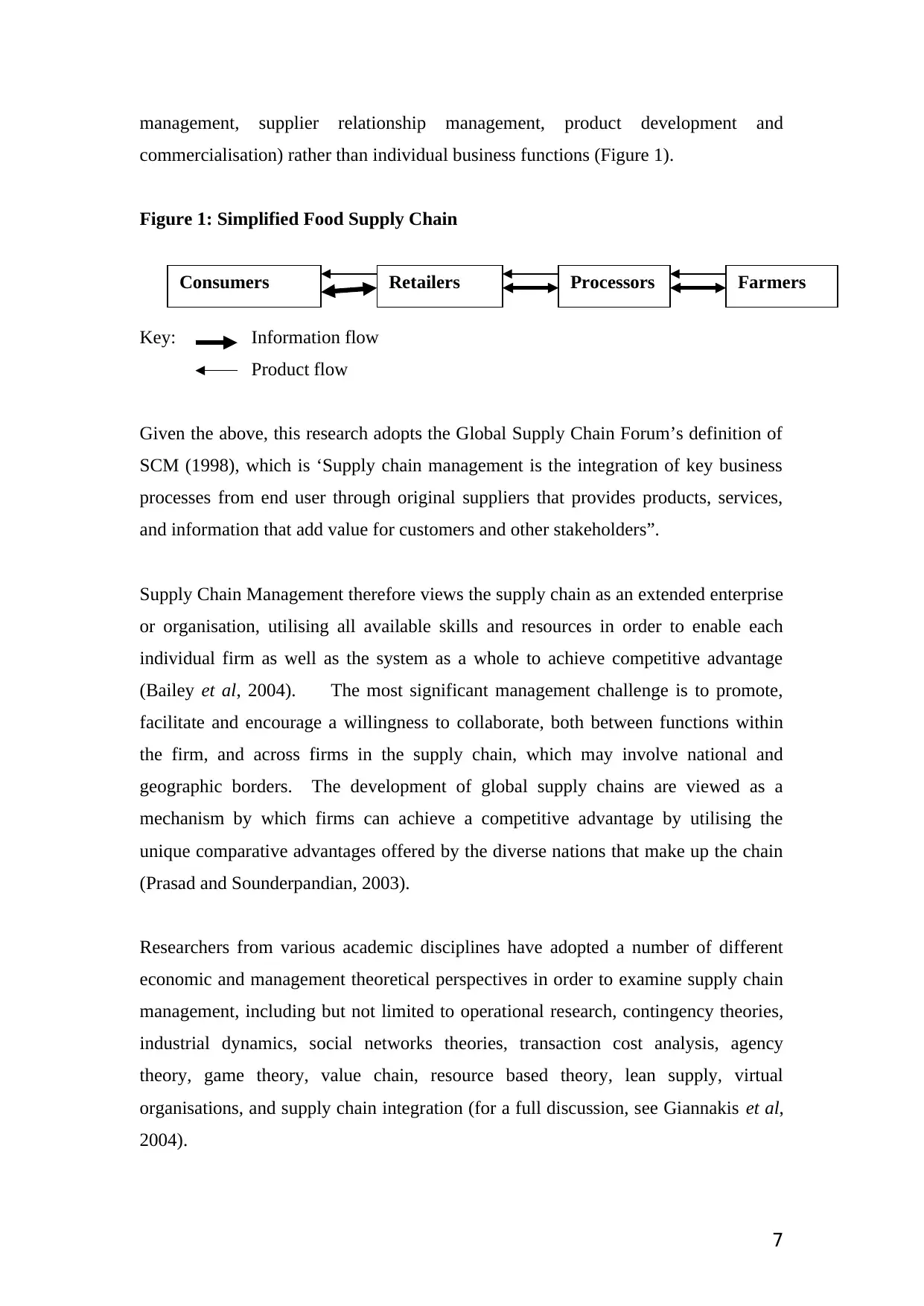
management, supplier relationship management, product development and
commercialisation) rather than individual business functions (Figure 1).
Figure 1: Simplified Food Supply Chain
Key: Information flow
Product flow
Given the above, this research adopts the Global Supply Chain Forum’s definition of
SCM (1998), which is ‘Supply chain management is the integration of key business
processes from end user through original suppliers that provides products, services,
and information that add value for customers and other stakeholders”.
Supply Chain Management therefore views the supply chain as an extended enterprise
or organisation, utilising all available skills and resources in order to enable each
individual firm as well as the system as a whole to achieve competitive advantage
(Bailey et al, 2004). The most significant management challenge is to promote,
facilitate and encourage a willingness to collaborate, both between functions within
the firm, and across firms in the supply chain, which may involve national and
geographic borders. The development of global supply chains are viewed as a
mechanism by which firms can achieve a competitive advantage by utilising the
unique comparative advantages offered by the diverse nations that make up the chain
(Prasad and Sounderpandian, 2003).
Researchers from various academic disciplines have adopted a number of different
economic and management theoretical perspectives in order to examine supply chain
management, including but not limited to operational research, contingency theories,
industrial dynamics, social networks theories, transaction cost analysis, agency
theory, game theory, value chain, resource based theory, lean supply, virtual
organisations, and supply chain integration (for a full discussion, see Giannakis et al,
2004).
7
Consumers Retailers Processors Farmers
commercialisation) rather than individual business functions (Figure 1).
Figure 1: Simplified Food Supply Chain
Key: Information flow
Product flow
Given the above, this research adopts the Global Supply Chain Forum’s definition of
SCM (1998), which is ‘Supply chain management is the integration of key business
processes from end user through original suppliers that provides products, services,
and information that add value for customers and other stakeholders”.
Supply Chain Management therefore views the supply chain as an extended enterprise
or organisation, utilising all available skills and resources in order to enable each
individual firm as well as the system as a whole to achieve competitive advantage
(Bailey et al, 2004). The most significant management challenge is to promote,
facilitate and encourage a willingness to collaborate, both between functions within
the firm, and across firms in the supply chain, which may involve national and
geographic borders. The development of global supply chains are viewed as a
mechanism by which firms can achieve a competitive advantage by utilising the
unique comparative advantages offered by the diverse nations that make up the chain
(Prasad and Sounderpandian, 2003).
Researchers from various academic disciplines have adopted a number of different
economic and management theoretical perspectives in order to examine supply chain
management, including but not limited to operational research, contingency theories,
industrial dynamics, social networks theories, transaction cost analysis, agency
theory, game theory, value chain, resource based theory, lean supply, virtual
organisations, and supply chain integration (for a full discussion, see Giannakis et al,
2004).
7
Consumers Retailers Processors Farmers
Paraphrase This Document
Need a fresh take? Get an instant paraphrase of this document with our AI Paraphraser
Critics of the operational perspective adopted by economists, sociologists and
organisational theorists have noted the need to adopt a multidisciplinary approach
(Nassimbeni, 2004; Harland et al, 2004) and have called for different ways to
conceptualise the problems faced by manufacturers, retailers and distributors (New,
2004). In the UK, a series of high profile food safety and quality incidents, changes
in both public and private regulation of the market, and the greater exposure to the
risks of product failure for retail brands have increased risk for all stakeholders.
Supply chains operating across geographic and national borders will encounter
increased cultural and ethnic diversity in comparison to domestically based supply
chains, which in turn will affect the risks associated with food safety and quality, and
consequent consumer and organisational behaviour. From a theoretical perspective,
the risk perceptions of both consumers and organisations (Zwart and Mollenkopf,
2000, Yeung and Morris 2001) and the impact of culture on such perceptions cannot
be ignored when examining global supply chain behaviour.
3. Perceived Risk Theory
Different interpretations and approaches to risk can be identified in the literature.
Scientists and policy makers in western societies view risk objectively, assuming that
the probabilities and consequences of adverse events can be identified and quantified.
This notion is rejected by many social scientists, who argue instead that such a view is
incomplete at best and misleading at worst, and that risk “does not exist “out there”,
independent of our minds and cultures, waiting to be measured” (Slovic, 2002:4).
The focus of the approach in the sociology and psychology literature is therefore on
the effects of perceptions of risk on individual behaviour.
Initial research into consumer behaviour began in the 1960’s, informed by theory
borrowed from social and clinical psychology, anthropology and sociology (Cox,
1967). Perceived Risk Theory (Cox, 1967; Bauer, 1967; Dowling and Staelin, 1994)
asserts that consumers perceive risk in a buying situation because the resultant
consequences cannot be known in advance, and that some such consequences are
likely to be unpleasant. Researchers note that risk perception is shaped more by the
severity of the consequences than the probability of occurrence (Slovic, Fischoff,
Lichenstein, 1980; Diamond, 1988; Mitchell, 1998). The theory also notes that the
consequences from a purchase can be divided into various types of loss: performance,
8
organisational theorists have noted the need to adopt a multidisciplinary approach
(Nassimbeni, 2004; Harland et al, 2004) and have called for different ways to
conceptualise the problems faced by manufacturers, retailers and distributors (New,
2004). In the UK, a series of high profile food safety and quality incidents, changes
in both public and private regulation of the market, and the greater exposure to the
risks of product failure for retail brands have increased risk for all stakeholders.
Supply chains operating across geographic and national borders will encounter
increased cultural and ethnic diversity in comparison to domestically based supply
chains, which in turn will affect the risks associated with food safety and quality, and
consequent consumer and organisational behaviour. From a theoretical perspective,
the risk perceptions of both consumers and organisations (Zwart and Mollenkopf,
2000, Yeung and Morris 2001) and the impact of culture on such perceptions cannot
be ignored when examining global supply chain behaviour.
3. Perceived Risk Theory
Different interpretations and approaches to risk can be identified in the literature.
Scientists and policy makers in western societies view risk objectively, assuming that
the probabilities and consequences of adverse events can be identified and quantified.
This notion is rejected by many social scientists, who argue instead that such a view is
incomplete at best and misleading at worst, and that risk “does not exist “out there”,
independent of our minds and cultures, waiting to be measured” (Slovic, 2002:4).
The focus of the approach in the sociology and psychology literature is therefore on
the effects of perceptions of risk on individual behaviour.
Initial research into consumer behaviour began in the 1960’s, informed by theory
borrowed from social and clinical psychology, anthropology and sociology (Cox,
1967). Perceived Risk Theory (Cox, 1967; Bauer, 1967; Dowling and Staelin, 1994)
asserts that consumers perceive risk in a buying situation because the resultant
consequences cannot be known in advance, and that some such consequences are
likely to be unpleasant. Researchers note that risk perception is shaped more by the
severity of the consequences than the probability of occurrence (Slovic, Fischoff,
Lichenstein, 1980; Diamond, 1988; Mitchell, 1998). The theory also notes that the
consequences from a purchase can be divided into various types of loss: performance,
8
psychosocial, physical, financial and time (Mitchell, 1998). Performance risk can be
viewed in two ways: either as a surrogate measure for overall risk in that the product
results in a combination of other losses (Mitchell, 1998) or does not perform as
expected (Sweeney, Soutar, Johnson, 1999; Schiffman and Kanuk, 1994). Financial
risk is defined as a net financial loss, physical risk relates to the possible danger or
harm to the individual or to others, time risk is associated with the loss of time and
effort associated with achieving satisfaction with a purchase. Psychosocial risk
relates to possible loss of self-image or self-concept as a result of a purchase or use
(Murray and Schlacter, 1990) or social embarrassment (Schiffman and Kanuk, 1994).
The overall level of perceived risk is viewed as the sum of the attributes’ perceived
risk levels, with the degree of risk perceived varying by individual consumer,
depending on risk tolerance and wealth level, both of which impact upon the ability to
absorb a loss. If perceived risk exceeds the tolerable degree of the individual level,
then this triggers the motivation for risk-reducing behaviour. Such perceptions of risk
can be reduced through various risk reducing strategies, including increasing
information and reducing the consequences.
Theoretical debate on the possible impact of organisation’s perceptions of risk on
complete supply chains has only recently emerged (Christopher, 2004; New, 2004;
Lamming, Caldwell and Phillips, 2004, Hornibrook, 2002). In addition to consumers,
the impact of perceived risk on a purchase decision could also be extended to
business-to-business sourcing situations (Mitchell, 1998). Peters and Venkatesan
(1973) confirm that organisational buyers are affected by many of the same variables
that affect consumers, including perceived risk, an observation also supported by
March and Shapira (1987), Mitchell (1998) and Greatorex, Mitchell and Cunliffe
(1992). Generally, empirical research has focused on the perceived risk and risk
handling strategies of industrial buyers associated with choosing a supplier (Puto,
Patton and King, 1985; Hawes and Barnhouse, 1987; Greatorex, Mitchell and
Cunliffe, 1992). Most recently, Perceived Risk Theory has been utilised, using a
supply chain methodology, to examine vertically co-ordinated supply chains
comprising consumers, retailers, processors and farmers in the UK food industry.
Supply chain management is therefore viewed as a strategy to manage perceived risk,
for both consumers and organisations at different stages in the supply chain
(Hornibrook and Fearne, 2001, 2003).
9
viewed in two ways: either as a surrogate measure for overall risk in that the product
results in a combination of other losses (Mitchell, 1998) or does not perform as
expected (Sweeney, Soutar, Johnson, 1999; Schiffman and Kanuk, 1994). Financial
risk is defined as a net financial loss, physical risk relates to the possible danger or
harm to the individual or to others, time risk is associated with the loss of time and
effort associated with achieving satisfaction with a purchase. Psychosocial risk
relates to possible loss of self-image or self-concept as a result of a purchase or use
(Murray and Schlacter, 1990) or social embarrassment (Schiffman and Kanuk, 1994).
The overall level of perceived risk is viewed as the sum of the attributes’ perceived
risk levels, with the degree of risk perceived varying by individual consumer,
depending on risk tolerance and wealth level, both of which impact upon the ability to
absorb a loss. If perceived risk exceeds the tolerable degree of the individual level,
then this triggers the motivation for risk-reducing behaviour. Such perceptions of risk
can be reduced through various risk reducing strategies, including increasing
information and reducing the consequences.
Theoretical debate on the possible impact of organisation’s perceptions of risk on
complete supply chains has only recently emerged (Christopher, 2004; New, 2004;
Lamming, Caldwell and Phillips, 2004, Hornibrook, 2002). In addition to consumers,
the impact of perceived risk on a purchase decision could also be extended to
business-to-business sourcing situations (Mitchell, 1998). Peters and Venkatesan
(1973) confirm that organisational buyers are affected by many of the same variables
that affect consumers, including perceived risk, an observation also supported by
March and Shapira (1987), Mitchell (1998) and Greatorex, Mitchell and Cunliffe
(1992). Generally, empirical research has focused on the perceived risk and risk
handling strategies of industrial buyers associated with choosing a supplier (Puto,
Patton and King, 1985; Hawes and Barnhouse, 1987; Greatorex, Mitchell and
Cunliffe, 1992). Most recently, Perceived Risk Theory has been utilised, using a
supply chain methodology, to examine vertically co-ordinated supply chains
comprising consumers, retailers, processors and farmers in the UK food industry.
Supply chain management is therefore viewed as a strategy to manage perceived risk,
for both consumers and organisations at different stages in the supply chain
(Hornibrook and Fearne, 2001, 2003).
9
⊘ This is a preview!⊘
Do you want full access?
Subscribe today to unlock all pages.
Trusted by 1+ million students worldwide
The above describes a number of theoretical approaches, in particular Perceived Risk
Theory, to describe and explain supply chain behaviour. However, a number of
criticisms and limitations can be noted regarding current theory in general, and
Perceived Risk Theory in particular.
Perceived Risk theory makes some attempt to acknowledge the context and history of
actions and behaviour. However, although culture is identified as one determinant of
risk perception (Joffe, 2003, Slovic, 2002), the theory does not include the role of
culture in determining risk perception and the subsequent influence on risk reducing
behaviour. Additionally, the theory adopts individual dimensions of loss (physical,
time, financial, psychosocial, performance) that may only be appropriate in western
societies and may be limited in its scope for understanding global supply chains that
span different countries and cultures. Previous empirical research has been limited to
small, domestically orientated supply chains in the UK.
One of the main criticisms of both normative and descriptive research into supply
chains is that the prevailing SCM literature tends to use theoretical assumptions that
simplify the complex reality of interconnecting relationships between a host of
different actors (Dubois et al, 2004). Most research occurs at the dyad, limited
attempts have been made to examine relationships along product supply chains
(Hornibrook, 2002), and more recently, interest has extended to links among supply
chains (Dubois et al 2004). However, the dominant paradigm has been the
Newtonian style in which an idealised world is constructed in the form of an abstract
model, in order to approximate the behaviour of real objects (Tsoukas, 1998); to
examine and then to predict future behaviour without taking account of context and
history. The focus is on linear relationships, the organisation as a machine, agents as
objects, generalisability, observation, and universal laws.
Given that supply chains are extremely complex (Cox, 1999; Christopher, 2004;
Dubois et al, 2004), the use of oversimplified linear models and a Newtonian
perspective would seem to be inappropriate. Globalisation of firms and markets
involves reorganisation and confrontation between cultures, both at the organisational
and the national level (Mattsson, 2003). The need to understand the role of culture on
10
Theory, to describe and explain supply chain behaviour. However, a number of
criticisms and limitations can be noted regarding current theory in general, and
Perceived Risk Theory in particular.
Perceived Risk theory makes some attempt to acknowledge the context and history of
actions and behaviour. However, although culture is identified as one determinant of
risk perception (Joffe, 2003, Slovic, 2002), the theory does not include the role of
culture in determining risk perception and the subsequent influence on risk reducing
behaviour. Additionally, the theory adopts individual dimensions of loss (physical,
time, financial, psychosocial, performance) that may only be appropriate in western
societies and may be limited in its scope for understanding global supply chains that
span different countries and cultures. Previous empirical research has been limited to
small, domestically orientated supply chains in the UK.
One of the main criticisms of both normative and descriptive research into supply
chains is that the prevailing SCM literature tends to use theoretical assumptions that
simplify the complex reality of interconnecting relationships between a host of
different actors (Dubois et al, 2004). Most research occurs at the dyad, limited
attempts have been made to examine relationships along product supply chains
(Hornibrook, 2002), and more recently, interest has extended to links among supply
chains (Dubois et al 2004). However, the dominant paradigm has been the
Newtonian style in which an idealised world is constructed in the form of an abstract
model, in order to approximate the behaviour of real objects (Tsoukas, 1998); to
examine and then to predict future behaviour without taking account of context and
history. The focus is on linear relationships, the organisation as a machine, agents as
objects, generalisability, observation, and universal laws.
Given that supply chains are extremely complex (Cox, 1999; Christopher, 2004;
Dubois et al, 2004), the use of oversimplified linear models and a Newtonian
perspective would seem to be inappropriate. Globalisation of firms and markets
involves reorganisation and confrontation between cultures, both at the organisational
and the national level (Mattsson, 2003). The need to understand the role of culture on
10
Paraphrase This Document
Need a fresh take? Get an instant paraphrase of this document with our AI Paraphraser
the effective management of different supply chain issues is highlighted by a number
of observers (Mattsson, 2003; Robertson and Crittenden, 2003; Prasad and
Sounderpandian, 2003; Weaver, 2001; Schneider & Barsoux, 2003).
4. Culture and Globalisation
Globalisation can be defined as the process by which cultures influence one another
and become more alike through trade, immigration and the exchange of information
and ideas. As such, the reach of globalisation extends to every part of the world, but
cultures differ greatly in how much they have been affected by it with considerable
variations within regions and within countries (Arnett, 2002). Culture comprises
divergent behaviours, norms and expectations and is fluid across space and time
(Ettlinger, 2003) and can be viewed as the patterns of cognitions and behaviour shared
by a group which evolve and becomes manifest in continuous processes of social
interaction. As beliefs and attitudes are important determinants of perceived risk,
interdisciplinary research is required to investigate the role of culture in determining
perceived risk, and the consequent influence of culture on organisational behaviour
and global supply chains.
Much work has been done in the importance in considering notions of culture in terms
of global organisations, virtual or otherwise (e.g. Schein, 1989, 1990; Hofstede, 1980,
1994; Hampden-Turner & Trompennars, 1993; Trompenaars, 1993), particularly
addressing the classification of cultural patterns. Alongside such work, a continuing
debate has been conducted regarding a) the appropriate level of analysis, as culture
level analysis reflects central tendencies for a country but does not predict individual
behaviour, and b) that differences in cultural patterns should be identified through
behaviour or values (Dahl, 2004).
Hofstede carried out large cross-cultural studies and identified five dimensions of
differences or traits between national cultures. These were labelled power-distance,
uncertainty avoidance, individualism-collectivism, masculinity-femininity and
long-term/short-term orientation. Power-distance indicates the extent to which a
society accepts that power is distributed unequally, with high power distance cultures
accepting inequality and respect for social status and class; low power distance
societies are more likely to value equality. Uncertainty avoidance indicates the extent
11
of observers (Mattsson, 2003; Robertson and Crittenden, 2003; Prasad and
Sounderpandian, 2003; Weaver, 2001; Schneider & Barsoux, 2003).
4. Culture and Globalisation
Globalisation can be defined as the process by which cultures influence one another
and become more alike through trade, immigration and the exchange of information
and ideas. As such, the reach of globalisation extends to every part of the world, but
cultures differ greatly in how much they have been affected by it with considerable
variations within regions and within countries (Arnett, 2002). Culture comprises
divergent behaviours, norms and expectations and is fluid across space and time
(Ettlinger, 2003) and can be viewed as the patterns of cognitions and behaviour shared
by a group which evolve and becomes manifest in continuous processes of social
interaction. As beliefs and attitudes are important determinants of perceived risk,
interdisciplinary research is required to investigate the role of culture in determining
perceived risk, and the consequent influence of culture on organisational behaviour
and global supply chains.
Much work has been done in the importance in considering notions of culture in terms
of global organisations, virtual or otherwise (e.g. Schein, 1989, 1990; Hofstede, 1980,
1994; Hampden-Turner & Trompennars, 1993; Trompenaars, 1993), particularly
addressing the classification of cultural patterns. Alongside such work, a continuing
debate has been conducted regarding a) the appropriate level of analysis, as culture
level analysis reflects central tendencies for a country but does not predict individual
behaviour, and b) that differences in cultural patterns should be identified through
behaviour or values (Dahl, 2004).
Hofstede carried out large cross-cultural studies and identified five dimensions of
differences or traits between national cultures. These were labelled power-distance,
uncertainty avoidance, individualism-collectivism, masculinity-femininity and
long-term/short-term orientation. Power-distance indicates the extent to which a
society accepts that power is distributed unequally, with high power distance cultures
accepting inequality and respect for social status and class; low power distance
societies are more likely to value equality. Uncertainty avoidance indicates the extent
11
to which people in a society feel threatened by ambiguous or unpredictable
circumstances. Individualism/collectivism represents the degree that cultures vary in
their emphasis on individualistic or collectivistic views of social life and personal
identity, and the degree to which they value group ties, which may be loose or strong.
Societies also range in characteristics that are associated with masculinity and
femininity, with members of masculine cultures viewing the world in terms of
winners and losers and feminine cultures discouraging the notion of competition. The
final dimension is the extent to which societies have different time horizons, either
long term or short term, and whether they value the past or are more future orientated.
Other researchers have added to these cultural dimensions (Kluckhohn and
Strodtbeck, 1961….etc)
Although there been accolades to his work, there have also been many criticisms. One
major problem with Hofstede’s approach is methodological. Cray and Mallory (1998)
write that the use of aggregated national data can be misleading when applying
societal characteristics to individual behaviour because there can be considerable
variance in the degree to which individuals adhere to any set of values. Others (cf.
Dorfman & Howell, 1988; Goodstein, 1981; Hunt, 1981; Robinson, 1983;
Sondergaard, 1994) have also criticised his scales in terms of their validity and
usefulness of their four dimensions at the individual level of analysis. It was argued
that it is not possible to discuss the impact of cultures on organisational structures if
all the data originates from the same study (Tayeb, 1988), with Hunt (1981:62)
questioning whether Hofstede was “studying the culture of the Japanese or the French
or the British or Malaysian executive or the culture of a multinational firm”. A
further criticism is that underlying values are derived from a measurement instrument
in which the focus is on the ultimate goal state, therefore the resultant underlying
values are frequently the result of very little data (Dahl, 2004).
A different approach in developing a framework in which to understand cultural
differences has been adopted by Schwartz (1992, 1994), who clearly distinguishes
between individual level analysis and culture level analysis in comparison to the work
of Hofstede and others (Dahl, 2004). This approach develops parallel sets of concepts
applicable to different levels of analysis, ie at the individual level and at the culture
level. Using data from more than 60,000 located in 63 countries, Schwartz derived
12
circumstances. Individualism/collectivism represents the degree that cultures vary in
their emphasis on individualistic or collectivistic views of social life and personal
identity, and the degree to which they value group ties, which may be loose or strong.
Societies also range in characteristics that are associated with masculinity and
femininity, with members of masculine cultures viewing the world in terms of
winners and losers and feminine cultures discouraging the notion of competition. The
final dimension is the extent to which societies have different time horizons, either
long term or short term, and whether they value the past or are more future orientated.
Other researchers have added to these cultural dimensions (Kluckhohn and
Strodtbeck, 1961….etc)
Although there been accolades to his work, there have also been many criticisms. One
major problem with Hofstede’s approach is methodological. Cray and Mallory (1998)
write that the use of aggregated national data can be misleading when applying
societal characteristics to individual behaviour because there can be considerable
variance in the degree to which individuals adhere to any set of values. Others (cf.
Dorfman & Howell, 1988; Goodstein, 1981; Hunt, 1981; Robinson, 1983;
Sondergaard, 1994) have also criticised his scales in terms of their validity and
usefulness of their four dimensions at the individual level of analysis. It was argued
that it is not possible to discuss the impact of cultures on organisational structures if
all the data originates from the same study (Tayeb, 1988), with Hunt (1981:62)
questioning whether Hofstede was “studying the culture of the Japanese or the French
or the British or Malaysian executive or the culture of a multinational firm”. A
further criticism is that underlying values are derived from a measurement instrument
in which the focus is on the ultimate goal state, therefore the resultant underlying
values are frequently the result of very little data (Dahl, 2004).
A different approach in developing a framework in which to understand cultural
differences has been adopted by Schwartz (1992, 1994), who clearly distinguishes
between individual level analysis and culture level analysis in comparison to the work
of Hofstede and others (Dahl, 2004). This approach develops parallel sets of concepts
applicable to different levels of analysis, ie at the individual level and at the culture
level. Using data from more than 60,000 located in 63 countries, Schwartz derived
12
⊘ This is a preview!⊘
Do you want full access?
Subscribe today to unlock all pages.
Trusted by 1+ million students worldwide

1 out of 27


Your All-in-One AI-Powered Toolkit for Academic Success.
+13062052269
info@desklib.com
Available 24*7 on WhatsApp / Email
![[object Object]](/_next/static/media/star-bottom.7253800d.svg)
Unlock your academic potential
Copyright © 2020–2026 A2Z Services. All Rights Reserved. Developed and managed by ZUCOL.