Impact of Managing Global Teams in Organizations: A Report
VerifiedAdded on 2020/02/24
|12
|2077
|220
Report
AI Summary
This report investigates the impact of global teams within organizations, addressing their management and effectiveness in a globalized business environment. It begins with an introduction outlining the objectives, scope, and a comprehensive literature review that explores cultural diversity, the advantages of global teams, and their role in international business. The report then presents justification for the research, followed by primary and secondary research questions. It details the research design and methodology, including qualitative and quantitative approaches, sample size, and data collection methods. The expected conclusions focus on the evolving role of virtual communication and its impact on global teams, emphasizing the importance of adapting to technological advancements. The report also addresses issues of reliability, validity, and research limitations, concluding with a list of references. This report is a comprehensive analysis for anyone studying global team management.
RUNNING HEAD: MANAGING GLOBAL TEAM IN ORGANIZATION 1
MANAGING GLOBAL TEAM IN ORGANIZATION
Student Name
Institute Name
MANAGING GLOBAL TEAM IN ORGANIZATION
Student Name
Institute Name

Paraphrase This Document
Need a fresh take? Get an instant paraphrase of this document with our AI Paraphraser
MANAGING GLOBAL TEAM IN ORGANIZATION 2
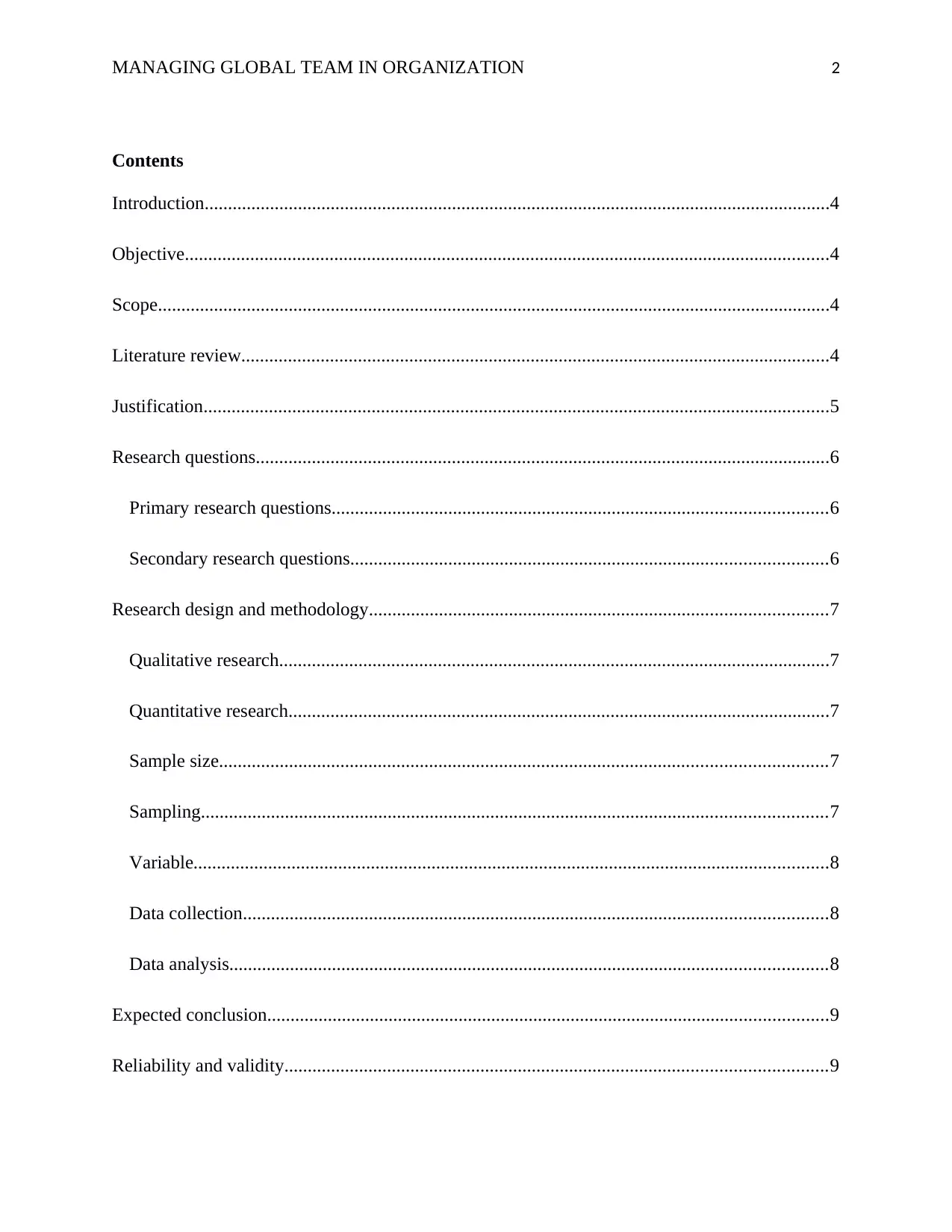
Contents
Introduction......................................................................................................................................4
Objective..........................................................................................................................................4
Scope................................................................................................................................................4
Literature review..............................................................................................................................4
Justification......................................................................................................................................5
Research questions...........................................................................................................................6
Primary research questions..........................................................................................................6
Secondary research questions......................................................................................................6
Research design and methodology..................................................................................................7
Qualitative research......................................................................................................................7
Quantitative research....................................................................................................................7
Sample size..................................................................................................................................7
Sampling......................................................................................................................................7
Variable........................................................................................................................................8
Data collection.............................................................................................................................8
Data analysis................................................................................................................................8
Expected conclusion........................................................................................................................9
Reliability and validity....................................................................................................................9
Contents
Introduction......................................................................................................................................4
Objective..........................................................................................................................................4
Scope................................................................................................................................................4
Literature review..............................................................................................................................4
Justification......................................................................................................................................5
Research questions...........................................................................................................................6
Primary research questions..........................................................................................................6
Secondary research questions......................................................................................................6
Research design and methodology..................................................................................................7
Qualitative research......................................................................................................................7
Quantitative research....................................................................................................................7
Sample size..................................................................................................................................7
Sampling......................................................................................................................................7
Variable........................................................................................................................................8
Data collection.............................................................................................................................8
Data analysis................................................................................................................................8
Expected conclusion........................................................................................................................9
Reliability and validity....................................................................................................................9

MANAGING GLOBAL TEAM IN ORGANIZATION 3
Research limitations.........................................................................................................................9
Reference.......................................................................................................................................10
Research limitations.........................................................................................................................9
Reference.......................................................................................................................................10
⊘ This is a preview!⊘
Do you want full access?
Subscribe today to unlock all pages.

Trusted by 1+ million students worldwide
MANAGING GLOBAL TEAM IN ORGANIZATION 4
Introduction
Every company working on global platform has their competitive advantage which relies on
coordinating with the resources of the company along with handling the different dimensions of
the data. As an outcome of the rise in global business environment, number of companies are on
the way of building team globally and consists of people from different countries (Pirkkalainen
and Pawlowski, 2014).
Objective
The objective of the report is to understand the impact of global team in organizations in the
present time and how it can be effectively managed in long run.
Scope
Right from the starting of transition in globalization, all the issues of business have been a
concern now. Companies are slowing addressing number of challenges of globalization by
properly undertaking the traditional methods of operations (Nahavandi, 2016). This is why,
there is rise in business environment globally and many organizations are now focusing on
building a global team.
Literature review
Culture base diversity can be discussed in two ways. The first way is when the team is managed
in right manner so that it helps the company to increase the level of performance. In second way,
when it is neglected, the culture based diversity will decrease the level of performance. The
overall advantages of utilizing the ability of global team are primarily because of globalization
Introduction
Every company working on global platform has their competitive advantage which relies on
coordinating with the resources of the company along with handling the different dimensions of
the data. As an outcome of the rise in global business environment, number of companies are on
the way of building team globally and consists of people from different countries (Pirkkalainen
and Pawlowski, 2014).
Objective
The objective of the report is to understand the impact of global team in organizations in the
present time and how it can be effectively managed in long run.
Scope
Right from the starting of transition in globalization, all the issues of business have been a
concern now. Companies are slowing addressing number of challenges of globalization by
properly undertaking the traditional methods of operations (Nahavandi, 2016). This is why,
there is rise in business environment globally and many organizations are now focusing on
building a global team.
Literature review
Culture base diversity can be discussed in two ways. The first way is when the team is managed
in right manner so that it helps the company to increase the level of performance. In second way,
when it is neglected, the culture based diversity will decrease the level of performance. The
overall advantages of utilizing the ability of global team are primarily because of globalization
Paraphrase This Document
Need a fresh take? Get an instant paraphrase of this document with our AI Paraphraser
MANAGING GLOBAL TEAM IN ORGANIZATION 5
that is based on continuous struggle to look for different opportunities that are sometimes
inherent in other parts of the world (Ellison et al., 2015). There are number of international teams
that make sure that companies deal with the need of particular market. It is apparent that global
teams can assist the company in developing association with global consumers. In addition,
multinational companies also create a research and development team on global level in order to
gain maximum advantages from number of experts that are not present in one specific location
however they are present in different corners of the world. Still there are other organizations as
well that develop an international team specifically for one functional area like sales and
marketing or also have number of representatives of that specific operation from all across the
world that are collaborative in diverse teams. This also makes sure that companies also gain
advantage from diverse different viewpoints. It is obvious that people in global team actually
related to different background and thought process and every member of this kind of
multicultural group bring some unique or distinct king of opinions and techniques to address the
problems. There are number of diverse group of people that are actually expected to have a broad
base for knowledge along with expertise and approaches than a common group of people. The
group performance by different kind of group is also better than this common group since they
carry the aim for a collection of different approaches at their disposal (Gibson et al., 2014). As an
outcome, these groups are widely exposed to newer methods in order to address the issues and
diverse situations. As per the perspective of manager, people from different kind of culture work
together in team.
Justification
The issue while managing the international team impact fully identifies with different causes of
cultural based conflicts and in order to interfere in methods that are actually both that can get
that is based on continuous struggle to look for different opportunities that are sometimes
inherent in other parts of the world (Ellison et al., 2015). There are number of international teams
that make sure that companies deal with the need of particular market. It is apparent that global
teams can assist the company in developing association with global consumers. In addition,
multinational companies also create a research and development team on global level in order to
gain maximum advantages from number of experts that are not present in one specific location
however they are present in different corners of the world. Still there are other organizations as
well that develop an international team specifically for one functional area like sales and
marketing or also have number of representatives of that specific operation from all across the
world that are collaborative in diverse teams. This also makes sure that companies also gain
advantage from diverse different viewpoints. It is obvious that people in global team actually
related to different background and thought process and every member of this kind of
multicultural group bring some unique or distinct king of opinions and techniques to address the
problems. There are number of diverse group of people that are actually expected to have a broad
base for knowledge along with expertise and approaches than a common group of people. The
group performance by different kind of group is also better than this common group since they
carry the aim for a collection of different approaches at their disposal (Gibson et al., 2014). As an
outcome, these groups are widely exposed to newer methods in order to address the issues and
diverse situations. As per the perspective of manager, people from different kind of culture work
together in team.
Justification
The issue while managing the international team impact fully identifies with different causes of
cultural based conflicts and in order to interfere in methods that are actually both that can get
MANAGING GLOBAL TEAM IN ORGANIZATION 6
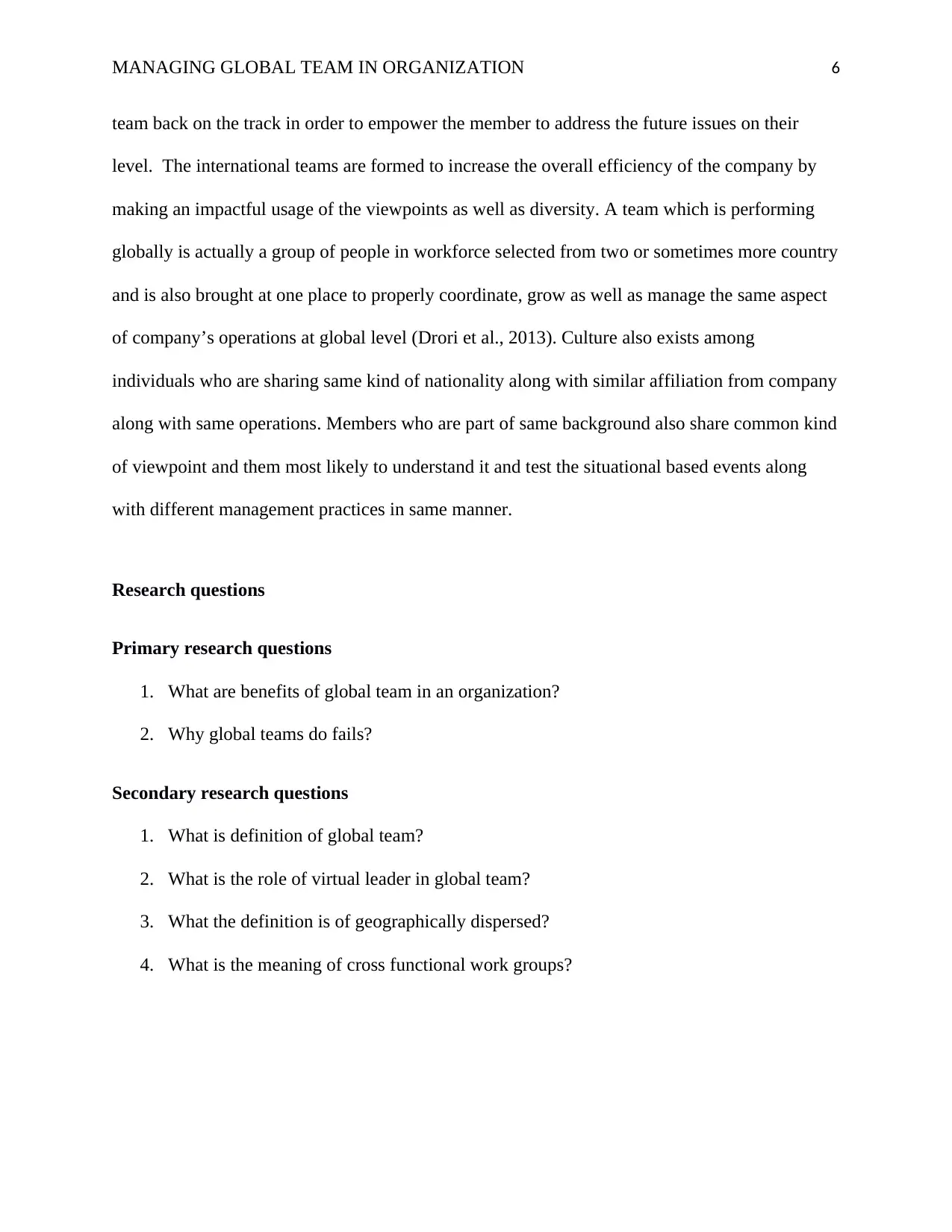
team back on the track in order to empower the member to address the future issues on their
level. The international teams are formed to increase the overall efficiency of the company by
making an impactful usage of the viewpoints as well as diversity. A team which is performing
globally is actually a group of people in workforce selected from two or sometimes more country
and is also brought at one place to properly coordinate, grow as well as manage the same aspect
of company’s operations at global level (Drori et al., 2013). Culture also exists among
individuals who are sharing same kind of nationality along with similar affiliation from company
along with same operations. Members who are part of same background also share common kind
of viewpoint and them most likely to understand it and test the situational based events along
with different management practices in same manner.
Research questions
Primary research questions
1. What are benefits of global team in an organization?
2. Why global teams do fails?
Secondary research questions
1. What is definition of global team?
2. What is the role of virtual leader in global team?
3. What the definition is of geographically dispersed?
4. What is the meaning of cross functional work groups?
team back on the track in order to empower the member to address the future issues on their
level. The international teams are formed to increase the overall efficiency of the company by
making an impactful usage of the viewpoints as well as diversity. A team which is performing
globally is actually a group of people in workforce selected from two or sometimes more country
and is also brought at one place to properly coordinate, grow as well as manage the same aspect
of company’s operations at global level (Drori et al., 2013). Culture also exists among
individuals who are sharing same kind of nationality along with similar affiliation from company
along with same operations. Members who are part of same background also share common kind
of viewpoint and them most likely to understand it and test the situational based events along
with different management practices in same manner.
Research questions
Primary research questions
1. What are benefits of global team in an organization?
2. Why global teams do fails?
Secondary research questions
1. What is definition of global team?
2. What is the role of virtual leader in global team?
3. What the definition is of geographically dispersed?
4. What is the meaning of cross functional work groups?
⊘ This is a preview!⊘
Do you want full access?
Subscribe today to unlock all pages.
Trusted by 1+ million students worldwide
MANAGING GLOBAL TEAM IN ORGANIZATION 7
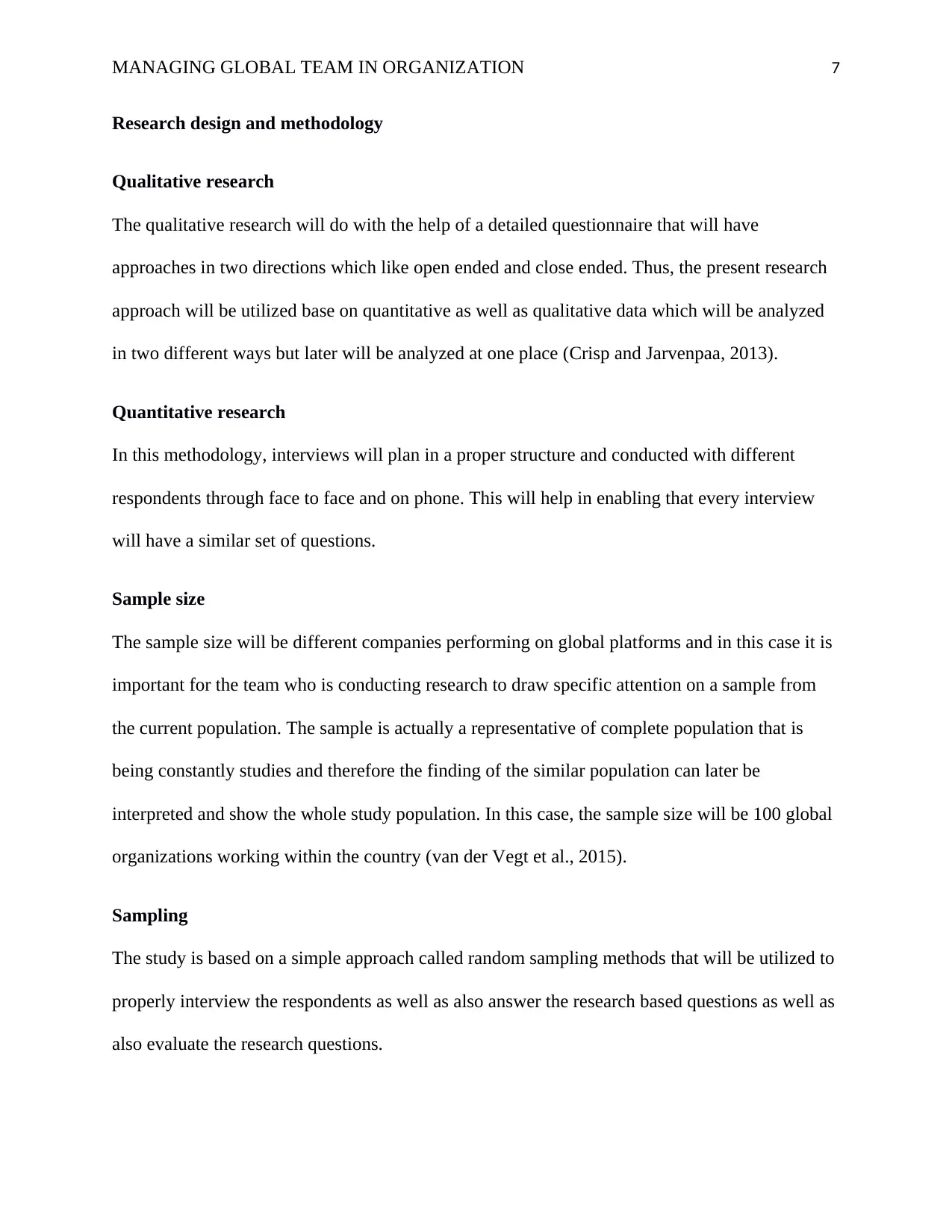
Research design and methodology
Qualitative research
The qualitative research will do with the help of a detailed questionnaire that will have
approaches in two directions which like open ended and close ended. Thus, the present research
approach will be utilized base on quantitative as well as qualitative data which will be analyzed
in two different ways but later will be analyzed at one place (Crisp and Jarvenpaa, 2013).
Quantitative research
In this methodology, interviews will plan in a proper structure and conducted with different
respondents through face to face and on phone. This will help in enabling that every interview
will have a similar set of questions.
Sample size
The sample size will be different companies performing on global platforms and in this case it is
important for the team who is conducting research to draw specific attention on a sample from
the current population. The sample is actually a representative of complete population that is
being constantly studies and therefore the finding of the similar population can later be
interpreted and show the whole study population. In this case, the sample size will be 100 global
organizations working within the country (van der Vegt et al., 2015).
Sampling
The study is based on a simple approach called random sampling methods that will be utilized to
properly interview the respondents as well as also answer the research based questions as well as
also evaluate the research questions.
Research design and methodology
Qualitative research
The qualitative research will do with the help of a detailed questionnaire that will have
approaches in two directions which like open ended and close ended. Thus, the present research
approach will be utilized base on quantitative as well as qualitative data which will be analyzed
in two different ways but later will be analyzed at one place (Crisp and Jarvenpaa, 2013).
Quantitative research
In this methodology, interviews will plan in a proper structure and conducted with different
respondents through face to face and on phone. This will help in enabling that every interview
will have a similar set of questions.
Sample size
The sample size will be different companies performing on global platforms and in this case it is
important for the team who is conducting research to draw specific attention on a sample from
the current population. The sample is actually a representative of complete population that is
being constantly studies and therefore the finding of the similar population can later be
interpreted and show the whole study population. In this case, the sample size will be 100 global
organizations working within the country (van der Vegt et al., 2015).
Sampling
The study is based on a simple approach called random sampling methods that will be utilized to
properly interview the respondents as well as also answer the research based questions as well as
also evaluate the research questions.
Paraphrase This Document
Need a fresh take? Get an instant paraphrase of this document with our AI Paraphraser
MANAGING GLOBAL TEAM IN ORGANIZATION 8
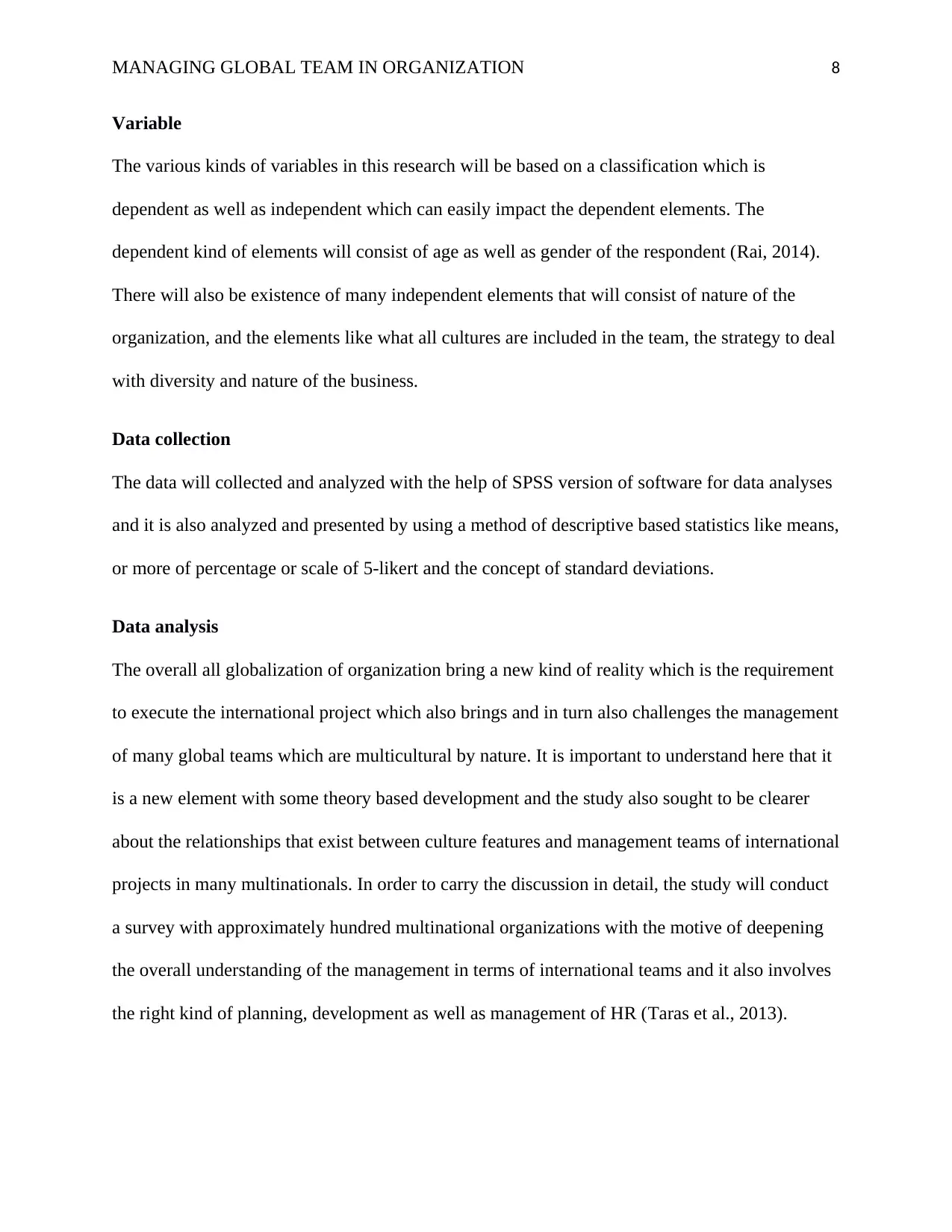
Variable
The various kinds of variables in this research will be based on a classification which is
dependent as well as independent which can easily impact the dependent elements. The
dependent kind of elements will consist of age as well as gender of the respondent (Rai, 2014).
There will also be existence of many independent elements that will consist of nature of the
organization, and the elements like what all cultures are included in the team, the strategy to deal
with diversity and nature of the business.
Data collection
The data will collected and analyzed with the help of SPSS version of software for data analyses
and it is also analyzed and presented by using a method of descriptive based statistics like means,
or more of percentage or scale of 5-likert and the concept of standard deviations.
Data analysis
The overall all globalization of organization bring a new kind of reality which is the requirement
to execute the international project which also brings and in turn also challenges the management
of many global teams which are multicultural by nature. It is important to understand here that it
is a new element with some theory based development and the study also sought to be clearer
about the relationships that exist between culture features and management teams of international
projects in many multinationals. In order to carry the discussion in detail, the study will conduct
a survey with approximately hundred multinational organizations with the motive of deepening
the overall understanding of the management in terms of international teams and it also involves
the right kind of planning, development as well as management of HR (Taras et al., 2013).
Variable
The various kinds of variables in this research will be based on a classification which is
dependent as well as independent which can easily impact the dependent elements. The
dependent kind of elements will consist of age as well as gender of the respondent (Rai, 2014).
There will also be existence of many independent elements that will consist of nature of the
organization, and the elements like what all cultures are included in the team, the strategy to deal
with diversity and nature of the business.
Data collection
The data will collected and analyzed with the help of SPSS version of software for data analyses
and it is also analyzed and presented by using a method of descriptive based statistics like means,
or more of percentage or scale of 5-likert and the concept of standard deviations.
Data analysis
The overall all globalization of organization bring a new kind of reality which is the requirement
to execute the international project which also brings and in turn also challenges the management
of many global teams which are multicultural by nature. It is important to understand here that it
is a new element with some theory based development and the study also sought to be clearer
about the relationships that exist between culture features and management teams of international
projects in many multinationals. In order to carry the discussion in detail, the study will conduct
a survey with approximately hundred multinational organizations with the motive of deepening
the overall understanding of the management in terms of international teams and it also involves
the right kind of planning, development as well as management of HR (Taras et al., 2013).
MANAGING GLOBAL TEAM IN ORGANIZATION 9
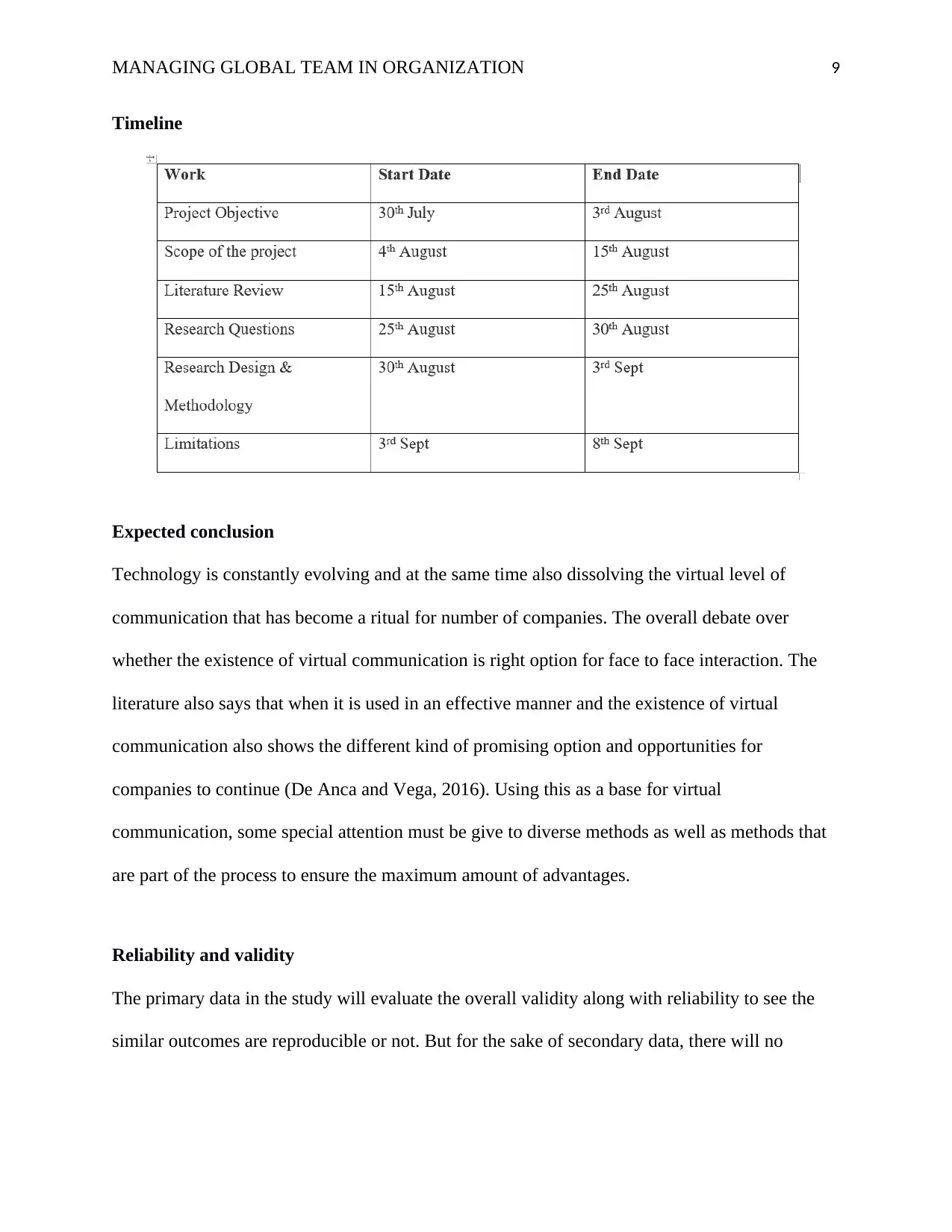
Timeline
Expected conclusion
Technology is constantly evolving and at the same time also dissolving the virtual level of
communication that has become a ritual for number of companies. The overall debate over
whether the existence of virtual communication is right option for face to face interaction. The
literature also says that when it is used in an effective manner and the existence of virtual
communication also shows the different kind of promising option and opportunities for
companies to continue (De Anca and Vega, 2016). Using this as a base for virtual
communication, some special attention must be give to diverse methods as well as methods that
are part of the process to ensure the maximum amount of advantages.
Reliability and validity
The primary data in the study will evaluate the overall validity along with reliability to see the
similar outcomes are reproducible or not. But for the sake of secondary data, there will no
Timeline
Expected conclusion
Technology is constantly evolving and at the same time also dissolving the virtual level of
communication that has become a ritual for number of companies. The overall debate over
whether the existence of virtual communication is right option for face to face interaction. The
literature also says that when it is used in an effective manner and the existence of virtual
communication also shows the different kind of promising option and opportunities for
companies to continue (De Anca and Vega, 2016). Using this as a base for virtual
communication, some special attention must be give to diverse methods as well as methods that
are part of the process to ensure the maximum amount of advantages.
Reliability and validity
The primary data in the study will evaluate the overall validity along with reliability to see the
similar outcomes are reproducible or not. But for the sake of secondary data, there will no
⊘ This is a preview!⊘
Do you want full access?
Subscribe today to unlock all pages.
Trusted by 1+ million students worldwide
MANAGING GLOBAL TEAM IN ORGANIZATION 10
requirement of carrying out the evaluation since the data will already be published as well as
signed when passed (De Anca and Vega, 2016).
Research limitations
There are number of data that will be used here but some information is confidential for the
company and therefore companies may not be very collaborative while sharing data and this
could lead to discrepancy of outcome (De Anca and Vega, 2016). There are number of
respondents who can be considered in this research and some of them sound business companies.
requirement of carrying out the evaluation since the data will already be published as well as
signed when passed (De Anca and Vega, 2016).
Research limitations
There are number of data that will be used here but some information is confidential for the
company and therefore companies may not be very collaborative while sharing data and this
could lead to discrepancy of outcome (De Anca and Vega, 2016). There are number of
respondents who can be considered in this research and some of them sound business companies.
Paraphrase This Document
Need a fresh take? Get an instant paraphrase of this document with our AI Paraphraser
MANAGING GLOBAL TEAM IN ORGANIZATION 11
Reference
Crisp, C.B. and Jarvenpaa, S.L., 2013. Swift trust in global virtual teams. Journal of Personnel
Psychology.
De Anca, C. and Vega, A.V., 2016. Managing diversity in the global organization: Creating new
Business values. Springer.
Drori, G.S., Höllerer, M.A. and Walgenbach, P. eds., 2013. Global themes and local variations
in organization and management: Perspectives on glocalization. Routledge.
Ellison, N.B., Gibbs, J.L. and Weber, M.S., 2015. The use of enterprise social network sites for
knowledge sharing in distributed organizations: The role of organizational
affordances. American Behavioral Scientist, 59(1), pp.103-123.
Gibson, C.B., Huang, L., Kirkman, B.L. and Shapiro, D.L., 2014. Where global and virtual meet:
The value of examining the intersection of these elements in twenty-first-century teams. Annu.
Rev. Organ. Psychol. Organ. Behav., 1(1), pp.217-244.
Nahavandi, A., 2016. The Art and Science of Leadership -Global Edition. Pearson.
Pirkkalainen, H. and Pawlowski, J.M., 2014. Global social knowledge management–
understanding barriers for global workers utilizing social software. Computers in Human
Behavior, 30, pp.637-647.
Rai, A., 2014. Global Organizational Behaviour Research Essay Managing and Motivating
Multicultural Teams Lecturer-Dr. Romie Littrell.
Reference
Crisp, C.B. and Jarvenpaa, S.L., 2013. Swift trust in global virtual teams. Journal of Personnel
Psychology.
De Anca, C. and Vega, A.V., 2016. Managing diversity in the global organization: Creating new
Business values. Springer.
Drori, G.S., Höllerer, M.A. and Walgenbach, P. eds., 2013. Global themes and local variations
in organization and management: Perspectives on glocalization. Routledge.
Ellison, N.B., Gibbs, J.L. and Weber, M.S., 2015. The use of enterprise social network sites for
knowledge sharing in distributed organizations: The role of organizational
affordances. American Behavioral Scientist, 59(1), pp.103-123.
Gibson, C.B., Huang, L., Kirkman, B.L. and Shapiro, D.L., 2014. Where global and virtual meet:
The value of examining the intersection of these elements in twenty-first-century teams. Annu.
Rev. Organ. Psychol. Organ. Behav., 1(1), pp.217-244.
Nahavandi, A., 2016. The Art and Science of Leadership -Global Edition. Pearson.
Pirkkalainen, H. and Pawlowski, J.M., 2014. Global social knowledge management–
understanding barriers for global workers utilizing social software. Computers in Human
Behavior, 30, pp.637-647.
Rai, A., 2014. Global Organizational Behaviour Research Essay Managing and Motivating
Multicultural Teams Lecturer-Dr. Romie Littrell.

MANAGING GLOBAL TEAM IN ORGANIZATION 12
Taras, V., Caprar, D.V., Rottig, D., Sarala, R.M., Zakaria, N., Zhao, F., Jiménez, A., Wankel, C.,
Lei, W.S., Minor, M.S. and Bryła, P., 2013. A global classroom? Evaluating the effectiveness of
global virtual collaboration as a teaching tool in management education. Academy of
Management Learning & Education, 12(3), pp.414-435.
van der Vegt, G.S., Essens, P., Wahlström, M. and George, G., 2015. Managing risk and
resilience. Academy of Management Journal, 58(4), pp.971-980.
Taras, V., Caprar, D.V., Rottig, D., Sarala, R.M., Zakaria, N., Zhao, F., Jiménez, A., Wankel, C.,
Lei, W.S., Minor, M.S. and Bryła, P., 2013. A global classroom? Evaluating the effectiveness of
global virtual collaboration as a teaching tool in management education. Academy of
Management Learning & Education, 12(3), pp.414-435.
van der Vegt, G.S., Essens, P., Wahlström, M. and George, G., 2015. Managing risk and
resilience. Academy of Management Journal, 58(4), pp.971-980.
⊘ This is a preview!⊘
Do you want full access?
Subscribe today to unlock all pages.
Trusted by 1+ million students worldwide

1 out of 12


Related Documents


Your All-in-One AI-Powered Toolkit for Academic Success.
+13062052269
info@desklib.com
Available 24*7 on WhatsApp / Email
![[object Object]](/_next/static/media/star-bottom.7253800d.svg)
Unlock your academic potential
Copyright © 2020–2026 A2Z Services. All Rights Reserved. Developed and managed by ZUCOL.