Global Tourism: Destinations, Trends, Challenges and Development
VerifiedAdded on 2022/12/27
|16
|4176
|1
Report
AI Summary
This report provides a comprehensive overview of global tourism, examining its nature, trends, and significance in the modern world. It delves into the characteristics of both tourist-generating and receiving areas, exploring the reasons behind the growth of global tourism in these regions. The report highlights emerging tourist destinations and their relationship with the destination life cycle, providing examples such as Colombia, Montenegro, Madagascar, and Sri Lanka. It also discusses the roles and responsibilities of international organizations in developing global tourism, emphasizing the importance of sustainable practices. Finally, the report addresses significant threats, issues, and challenges facing the global tourism sector, offering insights into the future of the industry. The report includes statistical data, illustrations, and a detailed analysis of various tourism markets, providing a valuable resource for understanding the complexities and opportunities within the global tourism landscape.
Global Tourism
Destinations
Destinations

Paraphrase This Document
Need a fresh take? Get an instant paraphrase of this document with our AI Paraphraser
Table of Contents
INTRODUCTION ..........................................................................................................................1
MAIN BODY...................................................................................................................................1
P1 Overview of Nature and Trends of Global tourism...........................................................1
P2 Characteristics of Tourists Generating and Receiving areas.............................................3
P3 Reasons for growth of Global Tourism generating and receiving areas of world............5
P4 Emerging tourist destinations and relation with destination life cycle.............................5
P5 Roles and responsibilities of International organisation in Developing Global tourism. .8
P6 Significance of Threats, Issues and Challenges before Global tourism..........................10
CONCLUSION..............................................................................................................................12
REFERENCES..............................................................................................................................13
Books and Journals...............................................................................................................13
Online...................................................................................................................................13
INTRODUCTION ..........................................................................................................................1
MAIN BODY...................................................................................................................................1
P1 Overview of Nature and Trends of Global tourism...........................................................1
P2 Characteristics of Tourists Generating and Receiving areas.............................................3
P3 Reasons for growth of Global Tourism generating and receiving areas of world............5
P4 Emerging tourist destinations and relation with destination life cycle.............................5
P5 Roles and responsibilities of International organisation in Developing Global tourism. .8
P6 Significance of Threats, Issues and Challenges before Global tourism..........................10
CONCLUSION..............................................................................................................................12
REFERENCES..............................................................................................................................13
Books and Journals...............................................................................................................13
Online...................................................................................................................................13

⊘ This is a preview!⊘
Do you want full access?
Subscribe today to unlock all pages.

Trusted by 1+ million students worldwide
INTRODUCTION
Global tourism and its growth is of utmost importance in many ways and many walks of
to people and society as a whole. The sector have many social, economic and political
significances inherited in it. Therefore, considering its significance and integration with
development, United Nations have made growth of Tourism as part of Millennium and
Sustainable development goals, to be achieved through collaborations and equal participation of
all stakeholders responsibly (Tang and Tan, 2018). Though, it is very clear that tourism services
are meaningless without considering tourist destinations. Tourist destinations are those places
who consolidate needs and demands of tourists. Destinations have specific features which then
helps in attracting people.
In this report, a discussion on growth of tourism, current statistics and trends in global
tourism and types and features of destinations is made. Report also made discussion on key
destinations of tourism growth in different parts of world. This is followed by role of
International organisation of tourism development and potential threats posed over growth of this
sector.
MAIN BODY
P1 Overview of Nature and Trends of Global tourism
Tourism is one of the most rapid growing industry in modern world. The industry is
significant in terms of developing economy of countries by way of GDP contributions and many
associated developments in economy and by exchange of people and culture between countries
across the world. Tourism is one industry through which entire world seems to be one roof for all
people irrespective of any geographical boundaries and linguistic and ethnic differences. The
direct contribution of Tourism industry is 3.6% in World's GDP and indirect contribution stands
at 10.3% which marks significance of this industry in global economy. Considering associated
factors to GDP contributions. Travel and Tourism industry provides 3% of total employment
opportunities consolidating 77 million people around the globe. These statistics relates to direct
employment opportunities whereas, indirect employment opportunities provided by this sector
consolidates 8.7% of total employment in world. Taking more facts directly from viewpoint of
economy, this industry represents 12% of total exports in world (Trends in Current Global
Tourism, 2021).
1
Global tourism and its growth is of utmost importance in many ways and many walks of
to people and society as a whole. The sector have many social, economic and political
significances inherited in it. Therefore, considering its significance and integration with
development, United Nations have made growth of Tourism as part of Millennium and
Sustainable development goals, to be achieved through collaborations and equal participation of
all stakeholders responsibly (Tang and Tan, 2018). Though, it is very clear that tourism services
are meaningless without considering tourist destinations. Tourist destinations are those places
who consolidate needs and demands of tourists. Destinations have specific features which then
helps in attracting people.
In this report, a discussion on growth of tourism, current statistics and trends in global
tourism and types and features of destinations is made. Report also made discussion on key
destinations of tourism growth in different parts of world. This is followed by role of
International organisation of tourism development and potential threats posed over growth of this
sector.
MAIN BODY
P1 Overview of Nature and Trends of Global tourism
Tourism is one of the most rapid growing industry in modern world. The industry is
significant in terms of developing economy of countries by way of GDP contributions and many
associated developments in economy and by exchange of people and culture between countries
across the world. Tourism is one industry through which entire world seems to be one roof for all
people irrespective of any geographical boundaries and linguistic and ethnic differences. The
direct contribution of Tourism industry is 3.6% in World's GDP and indirect contribution stands
at 10.3% which marks significance of this industry in global economy. Considering associated
factors to GDP contributions. Travel and Tourism industry provides 3% of total employment
opportunities consolidating 77 million people around the globe. These statistics relates to direct
employment opportunities whereas, indirect employment opportunities provided by this sector
consolidates 8.7% of total employment in world. Taking more facts directly from viewpoint of
economy, this industry represents 12% of total exports in world (Trends in Current Global
Tourism, 2021).
1
Paraphrase This Document
Need a fresh take? Get an instant paraphrase of this document with our AI Paraphraser
The markets consolidated in Travel and Tourism industry are of varied range. Markets
served in this industry can also be said reasons behind fast growth of this industry. Markets in
this range include Long-haul travels, Neighbouring country tourism, rural and ethnic tourism,
health holidays, cultural tourism, ecotourism, spiritualism, sports and adventure holidays, coastal
tourism and crews are some of the finest markets that attracts million of tourists every year in
this industry. Looking at vivid markets available in this industry, it is worth to be noticed that
some of these markets may have develop in recent decades or more in last century like markets
of sports and adventure tourism and health tourism etc. Whereas, markets of spiritual tourism,
trade, educational tourism and many more have historical significances as well, derived from
their mentions in ancient texts. From looking at Geographical point of view, trends in current
global tourism shows remarkable rise in Asian tourism, mostly from East Asian countries.
Another prominent facts pointed in current developments that there is a significant rise in young
age tourists, mostly for taking a break from increased stressful professional lives. Number of
students and aspirational job seekers' tourism is also worth noticing, but their travel is mostly
consolidated in advanced countries like USA and European countries.
2
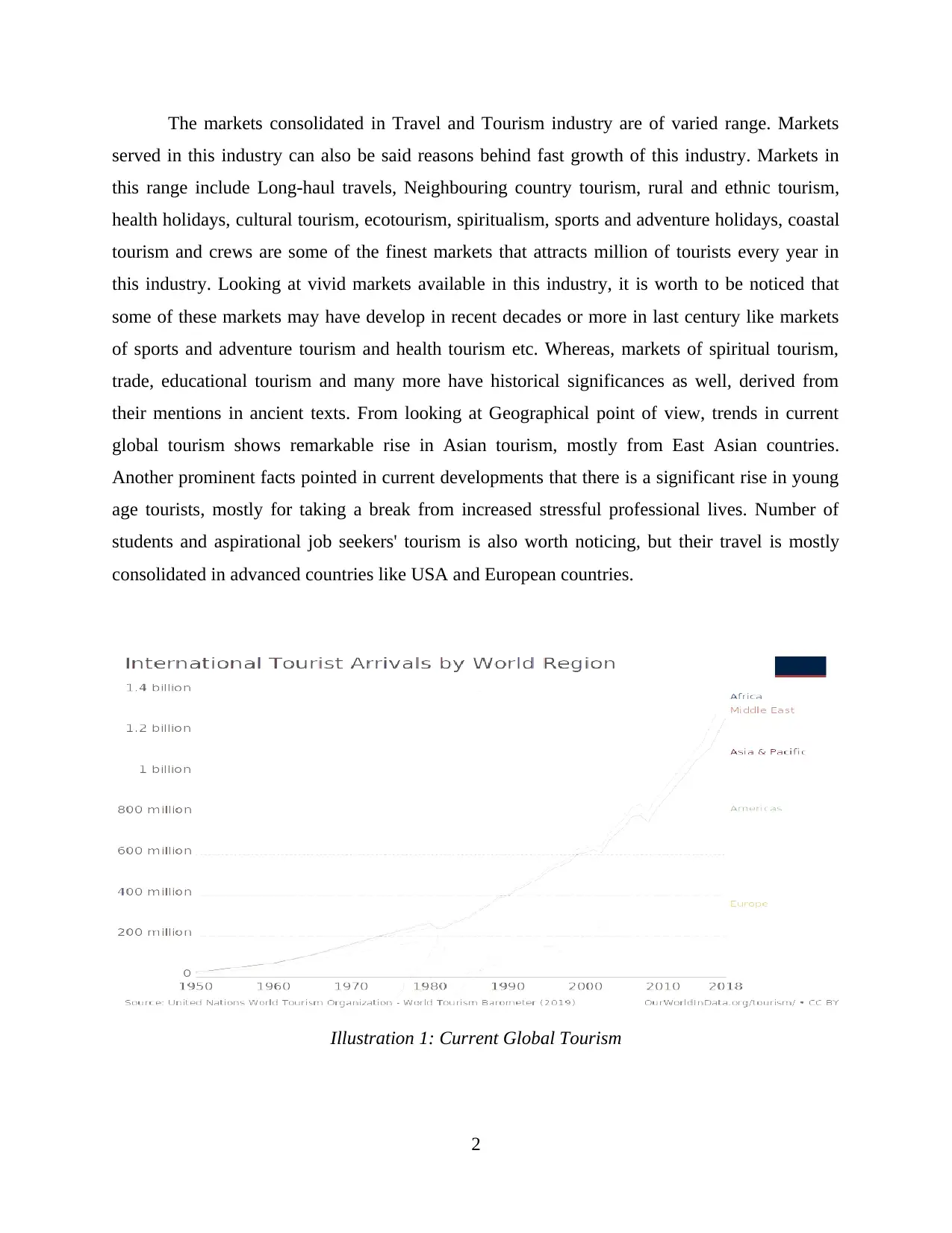
Illustration 1: Current Global Tourism
served in this industry can also be said reasons behind fast growth of this industry. Markets in
this range include Long-haul travels, Neighbouring country tourism, rural and ethnic tourism,
health holidays, cultural tourism, ecotourism, spiritualism, sports and adventure holidays, coastal
tourism and crews are some of the finest markets that attracts million of tourists every year in
this industry. Looking at vivid markets available in this industry, it is worth to be noticed that
some of these markets may have develop in recent decades or more in last century like markets
of sports and adventure tourism and health tourism etc. Whereas, markets of spiritual tourism,
trade, educational tourism and many more have historical significances as well, derived from
their mentions in ancient texts. From looking at Geographical point of view, trends in current
global tourism shows remarkable rise in Asian tourism, mostly from East Asian countries.
Another prominent facts pointed in current developments that there is a significant rise in young
age tourists, mostly for taking a break from increased stressful professional lives. Number of
students and aspirational job seekers' tourism is also worth noticing, but their travel is mostly
consolidated in advanced countries like USA and European countries.
2
Illustration 1: Current Global Tourism
The above statistics shows robust growth in Travel and tourism industry by way of arrival
of tourists in different countries of world that has huge potential to serve interests of people. The
numbers can be seen constantly rising since 1950. The increase after 1950's can be attributed to
fact of Decolonisation wave that hit world after 1950 and many countries earlier colonies became
sovereign. Their citizens started travelling across countries serving their own as well as National
interests. Continuing prosperity in tourism is giving recognition to many other trends in
following years employment and economic growth, better infrastructure, liberalization of air
transport and growth of Public-Private-Partnership in this domain.
P2 Characteristics of Tourists Generating and Receiving areas
Tourists generating areas are those from where people wish travel to different parts of
world and they are seen motivated by many reasons. However, considering tourists generating
areas it can be noted that there are no any specific countries from which people travel and from
which people do not (Smith, 2018). Almost from all the countries in world, people are seen
travelling across borders. Their motivation to travel are seen by way of different type of tourism
market. Although there are many countries through which tourists are likely to travel most, in a
range of countries, compared to tourists from other countries. In this way these countries become
tourists generating areas and to countries they travel become tourists receiving areas. Key
characteristics possessed by each type of regions are discussed in report.
Tourists Generating Areas
These countries represents homes of tourists. To which these tourists have many
emotional sentiments attached. Although particular geographical location of their home
becomes irrelevant when they travel to other countries and only their National identity
stays of matter. Home countries are places where journey of tourists begins and end as
well.
These areas are representatives of major tourism provider markets as many number of
tourists travels out of these countries.
Since these countries have huge potential of offering tourists, these countries provide
market for countries who have huge potential to serve as tourist destinations like
Switzerland, France, Spain, and Many North African countries (Sandberg, 2017).
3
of tourists in different countries of world that has huge potential to serve interests of people. The
numbers can be seen constantly rising since 1950. The increase after 1950's can be attributed to
fact of Decolonisation wave that hit world after 1950 and many countries earlier colonies became
sovereign. Their citizens started travelling across countries serving their own as well as National
interests. Continuing prosperity in tourism is giving recognition to many other trends in
following years employment and economic growth, better infrastructure, liberalization of air
transport and growth of Public-Private-Partnership in this domain.
P2 Characteristics of Tourists Generating and Receiving areas
Tourists generating areas are those from where people wish travel to different parts of
world and they are seen motivated by many reasons. However, considering tourists generating
areas it can be noted that there are no any specific countries from which people travel and from
which people do not (Smith, 2018). Almost from all the countries in world, people are seen
travelling across borders. Their motivation to travel are seen by way of different type of tourism
market. Although there are many countries through which tourists are likely to travel most, in a
range of countries, compared to tourists from other countries. In this way these countries become
tourists generating areas and to countries they travel become tourists receiving areas. Key
characteristics possessed by each type of regions are discussed in report.
Tourists Generating Areas
These countries represents homes of tourists. To which these tourists have many
emotional sentiments attached. Although particular geographical location of their home
becomes irrelevant when they travel to other countries and only their National identity
stays of matter. Home countries are places where journey of tourists begins and end as
well.
These areas are representatives of major tourism provider markets as many number of
tourists travels out of these countries.
Since these countries have huge potential of offering tourists, these countries provide
market for countries who have huge potential to serve as tourist destinations like
Switzerland, France, Spain, and Many North African countries (Sandberg, 2017).
3
⊘ This is a preview!⊘
Do you want full access?
Subscribe today to unlock all pages.
Trusted by 1+ million students worldwide
Also, these countries have better infrastructure and transportation facilities to support
movement of their people to countries of their choice. Also better connectivity facility are
seen to various parts of the world.
Learning from needs of their citizens that motivates them to travel across borders, theese
countries also will to develop themselves so they can cater their citizen's needs in national
boundaries only.
These countries becomes origin of major travelling as well as trade routes of world.
Tourists receiving areas
These places have features of attraction that are not possessed by any other countries.
These features can be in terms of natural aesthetics or historical and cultural
significances.
Tourism market of these countries is well developed and organised to meet different
demands of tourists coming there. Hospitality industry, restaurants, regional connectivity
and public transport, local markets, recreational facilities and services etc. are sort of
ways in which these areas meet demands of tourists (Rodríguez-Díaz and Pulido-
Fernández, 2020).
Areas with high potential to attract tourist marks good share in GDP of that country and
have credit to attract large foreign currencies in country.
Growth of these areas also supports growth in nearby areas as well. For example,
Santiago De Compostela, a spiritual centre of Christianity in Spain, have helped
development of neighbourhood areas as well as entire route connecting all nearby
spiritual centres have became popular as Camino De Santiago.
Intensive marketing systems are seen in these areas for attracting more and more tourists
from different corners of world and reaching out areas where no one has reached, in
support of growth of tourism.
Therefore, Tourists generating areas and Tourists receiving possess their individual
characteristics, and both together are credited for driving Global tourism continuously over new
heights.
4
movement of their people to countries of their choice. Also better connectivity facility are
seen to various parts of the world.
Learning from needs of their citizens that motivates them to travel across borders, theese
countries also will to develop themselves so they can cater their citizen's needs in national
boundaries only.
These countries becomes origin of major travelling as well as trade routes of world.
Tourists receiving areas
These places have features of attraction that are not possessed by any other countries.
These features can be in terms of natural aesthetics or historical and cultural
significances.
Tourism market of these countries is well developed and organised to meet different
demands of tourists coming there. Hospitality industry, restaurants, regional connectivity
and public transport, local markets, recreational facilities and services etc. are sort of
ways in which these areas meet demands of tourists (Rodríguez-Díaz and Pulido-
Fernández, 2020).
Areas with high potential to attract tourist marks good share in GDP of that country and
have credit to attract large foreign currencies in country.
Growth of these areas also supports growth in nearby areas as well. For example,
Santiago De Compostela, a spiritual centre of Christianity in Spain, have helped
development of neighbourhood areas as well as entire route connecting all nearby
spiritual centres have became popular as Camino De Santiago.
Intensive marketing systems are seen in these areas for attracting more and more tourists
from different corners of world and reaching out areas where no one has reached, in
support of growth of tourism.
Therefore, Tourists generating areas and Tourists receiving possess their individual
characteristics, and both together are credited for driving Global tourism continuously over new
heights.
4
Paraphrase This Document
Need a fresh take? Get an instant paraphrase of this document with our AI Paraphraser
P3 Reasons for growth of Global Tourism generating and receiving areas of world
Be it any region from where tourists begins their journey for a specific motivation, called
Tourist generating areas or any region to which tourists head their journey, called Tourists
receiving areas, have certain reasons behind their development. Report have attempted to
mention few of these reasons to help understanding growth of regions in their particular type.
Tourists Generating areas
Foremost reason could be lack of development in tourism sector.
Insufficient tourist spots in that region.
Insufficient educational and career opportunities in region. Tourists have particular motivation to move to other location, like health purpose, job
purpose, adventure, spiritualism and other sort of tourism market.
Tourists receiving areas
Developed tourism markets, like Thailand and USA.
Opportunities in education and career growth, like USA, UK, China, Japan and South
Korea.
High aesthetics of Natural and Cultural beauty, Adventure spots or other tourism markets,
like Switzerland, Nepal and Montenegro.
Historical significance for people of neighbourhood countries. This reason mainly lead to
migration issues.
Many of the reasons in this context for development of a region in particular type are
historical and natural, whereas some are man-made to achieve growth and competency in
tourism.
P4 Emerging tourist destinations and relation with destination life cycle
Destination life cycle is cycle of survival or life of a tourist destination which explains
how a tourist destination gets acknowledged by tourists, develops to become attractive tourists
market and then eventually gets exhausted for tourists (Peeters, 2018). The cycle identifies
different stages that a tourist destination passes from. This life cycle is pervasive. It was
proposed by Butler in 1980 as Tourism area Life cycle and later adopted by Miller and Gallucci
in 2004.
5
Be it any region from where tourists begins their journey for a specific motivation, called
Tourist generating areas or any region to which tourists head their journey, called Tourists
receiving areas, have certain reasons behind their development. Report have attempted to
mention few of these reasons to help understanding growth of regions in their particular type.
Tourists Generating areas
Foremost reason could be lack of development in tourism sector.
Insufficient tourist spots in that region.
Insufficient educational and career opportunities in region. Tourists have particular motivation to move to other location, like health purpose, job
purpose, adventure, spiritualism and other sort of tourism market.
Tourists receiving areas
Developed tourism markets, like Thailand and USA.
Opportunities in education and career growth, like USA, UK, China, Japan and South
Korea.
High aesthetics of Natural and Cultural beauty, Adventure spots or other tourism markets,
like Switzerland, Nepal and Montenegro.
Historical significance for people of neighbourhood countries. This reason mainly lead to
migration issues.
Many of the reasons in this context for development of a region in particular type are
historical and natural, whereas some are man-made to achieve growth and competency in
tourism.
P4 Emerging tourist destinations and relation with destination life cycle
Destination life cycle is cycle of survival or life of a tourist destination which explains
how a tourist destination gets acknowledged by tourists, develops to become attractive tourists
market and then eventually gets exhausted for tourists (Peeters, 2018). The cycle identifies
different stages that a tourist destination passes from. This life cycle is pervasive. It was
proposed by Butler in 1980 as Tourism area Life cycle and later adopted by Miller and Gallucci
in 2004.
5
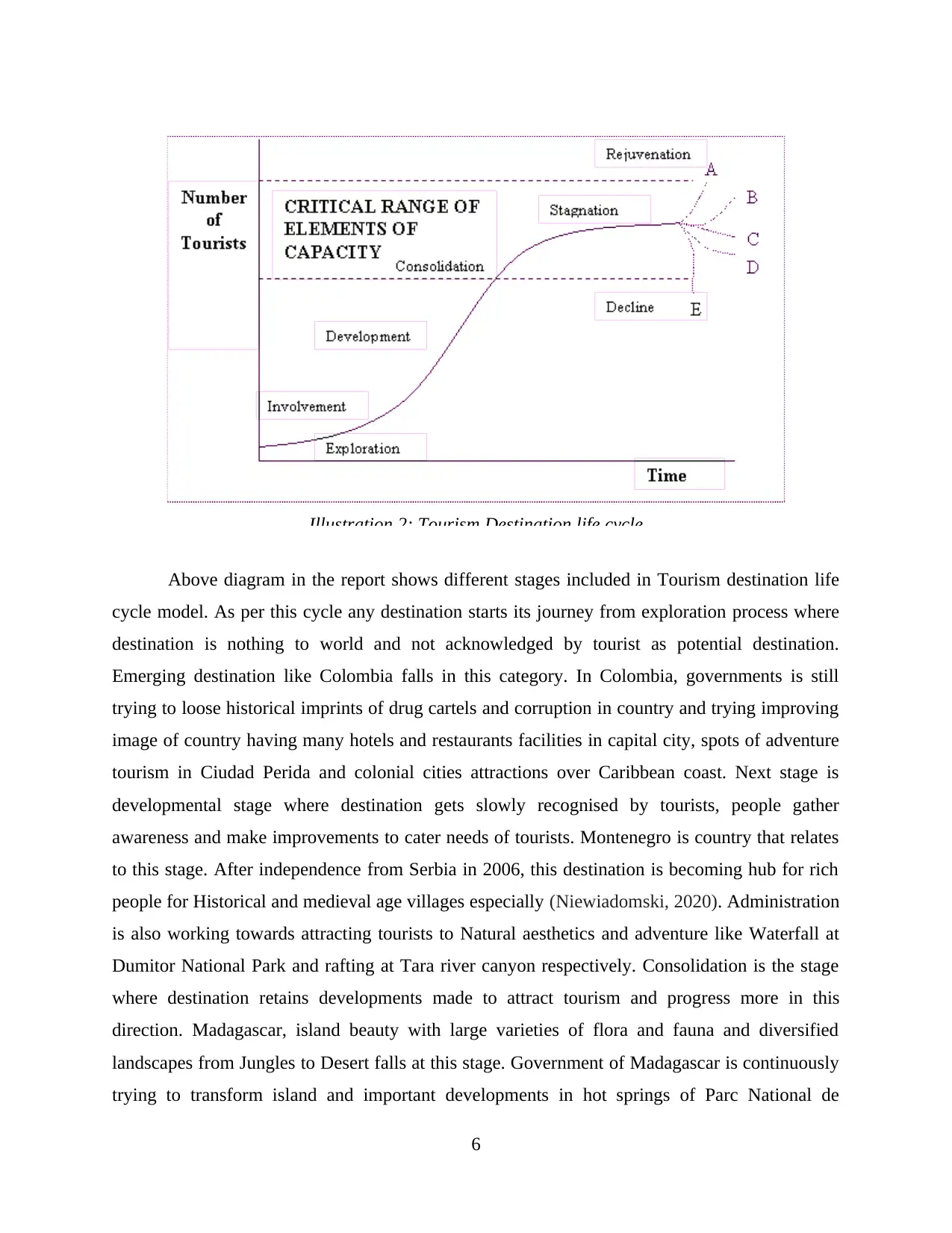
Above diagram in the report shows different stages included in Tourism destination life
cycle model. As per this cycle any destination starts its journey from exploration process where
destination is nothing to world and not acknowledged by tourist as potential destination.
Emerging destination like Colombia falls in this category. In Colombia, governments is still
trying to loose historical imprints of drug cartels and corruption in country and trying improving
image of country having many hotels and restaurants facilities in capital city, spots of adventure
tourism in Ciudad Perida and colonial cities attractions over Caribbean coast. Next stage is
developmental stage where destination gets slowly recognised by tourists, people gather
awareness and make improvements to cater needs of tourists. Montenegro is country that relates
to this stage. After independence from Serbia in 2006, this destination is becoming hub for rich
people for Historical and medieval age villages especially (Niewiadomski, 2020). Administration
is also working towards attracting tourists to Natural aesthetics and adventure like Waterfall at
Dumitor National Park and rafting at Tara river canyon respectively. Consolidation is the stage
where destination retains developments made to attract tourism and progress more in this
direction. Madagascar, island beauty with large varieties of flora and fauna and diversified
landscapes from Jungles to Desert falls at this stage. Government of Madagascar is continuously
trying to transform island and important developments in hot springs of Parc National de
6
Illustration 2: Tourism Destination life cycle
cycle model. As per this cycle any destination starts its journey from exploration process where
destination is nothing to world and not acknowledged by tourist as potential destination.
Emerging destination like Colombia falls in this category. In Colombia, governments is still
trying to loose historical imprints of drug cartels and corruption in country and trying improving
image of country having many hotels and restaurants facilities in capital city, spots of adventure
tourism in Ciudad Perida and colonial cities attractions over Caribbean coast. Next stage is
developmental stage where destination gets slowly recognised by tourists, people gather
awareness and make improvements to cater needs of tourists. Montenegro is country that relates
to this stage. After independence from Serbia in 2006, this destination is becoming hub for rich
people for Historical and medieval age villages especially (Niewiadomski, 2020). Administration
is also working towards attracting tourists to Natural aesthetics and adventure like Waterfall at
Dumitor National Park and rafting at Tara river canyon respectively. Consolidation is the stage
where destination retains developments made to attract tourism and progress more in this
direction. Madagascar, island beauty with large varieties of flora and fauna and diversified
landscapes from Jungles to Desert falls at this stage. Government of Madagascar is continuously
trying to transform island and important developments in hot springs of Parc National de
6
Illustration 2: Tourism Destination life cycle
⊘ This is a preview!⊘
Do you want full access?
Subscribe today to unlock all pages.
Trusted by 1+ million students worldwide
Ranomafana and many other sites. Next stage is of Stagnation, where destination reaches its
carrying capacity of tourists mainly due to social and environmental limits. Sri Lanka, island
country rich in history, culture and customs pertains top this stage. Sri Lanka is now stepping to
preserve its natural vegetation and wildlife species and progressing more towards economic
developments by joining hands with its South Asian partners, India and China. Last stages in
cycle are Rejuvenation where destination seeks to revive itself helped by technological
developments, Decline towards when due to unsustainable development and congestion
destination is becomes less preferable to tourists, like Thailand, Nepal and some European
countries and Decline, here destination lose its value totally, this mainly happens due to either
Natural or Man made disaster (Higgins-Desbiolles and et.al., 2019).
7
carrying capacity of tourists mainly due to social and environmental limits. Sri Lanka, island
country rich in history, culture and customs pertains top this stage. Sri Lanka is now stepping to
preserve its natural vegetation and wildlife species and progressing more towards economic
developments by joining hands with its South Asian partners, India and China. Last stages in
cycle are Rejuvenation where destination seeks to revive itself helped by technological
developments, Decline towards when due to unsustainable development and congestion
destination is becomes less preferable to tourists, like Thailand, Nepal and some European
countries and Decline, here destination lose its value totally, this mainly happens due to either
Natural or Man made disaster (Higgins-Desbiolles and et.al., 2019).
7
Paraphrase This Document
Need a fresh take? Get an instant paraphrase of this document with our AI Paraphraser
P5 Roles and responsibilities of International organisation in Developing Global tourism
It is necessary to manage and develop tourism in way that it should be sustainable
covering interests of all. Therefore, organisations at international level were needed to monitor
growth of tourism in this order (Higgins-Desbiolles, 2020). International organisations for
tourism development monitor impacts of tourism development and take necessary steps for
promoting tourism responsibly, connecting and coordinating with different allied business.
Report have discussed roles and responsibilities of few important international tourism
development organisations.
World Tourism organisation- World Tourism organisation (UNWTO) is the forerunner
organisation in promoting tourism across the globe. The organisation is a specialised agency of
United Nation responsible for sustainable, responsible and competitive tourism sector.
It is role of UNWTO to advocate tourism and make it forth as part of National and
International policies and bring all countries at similar level playing field, so that no one
is left behind (Gössling, 2021).
For improving competitiveness in tourism sector globally, UNWTO is responsible to
create knowledge in this sector and share it between all participants equally, so that its
benefits can be availed by everyone.
Organisation aim to offer excellence of knowledge in sector.
Developing opportunities of Marketing and promotion for different players in sector
across all countries, in planned and equal manner is also responsibility of UNWTO.
For sustainable development of tourism UNWTO is responsible to make optimal and
equitable use of environmental resources, with a view to sustain resources for future
generations as well (Gillen and Mostafanezhad, 2019).
Organisation also aim at reducing poverty through economic contributions of this sector.
UNWTO has role to engage different agencies of government, civil society, academia
and research institutions, private, regional and National level tourism organisations
continuously, in support of fulfilling its roles.
Tourism is part of Millennium development goals and as specialised agency of United
Nations, UNWTO becomes more accountable towards its accomplishment.
Pacific Asia Travel Association- PATA is responsible for development and growth of Tourism
in Pacific region, among its member countries. Pacific region includes countries of South-East
8
It is necessary to manage and develop tourism in way that it should be sustainable
covering interests of all. Therefore, organisations at international level were needed to monitor
growth of tourism in this order (Higgins-Desbiolles, 2020). International organisations for
tourism development monitor impacts of tourism development and take necessary steps for
promoting tourism responsibly, connecting and coordinating with different allied business.
Report have discussed roles and responsibilities of few important international tourism
development organisations.
World Tourism organisation- World Tourism organisation (UNWTO) is the forerunner
organisation in promoting tourism across the globe. The organisation is a specialised agency of
United Nation responsible for sustainable, responsible and competitive tourism sector.
It is role of UNWTO to advocate tourism and make it forth as part of National and
International policies and bring all countries at similar level playing field, so that no one
is left behind (Gössling, 2021).
For improving competitiveness in tourism sector globally, UNWTO is responsible to
create knowledge in this sector and share it between all participants equally, so that its
benefits can be availed by everyone.
Organisation aim to offer excellence of knowledge in sector.
Developing opportunities of Marketing and promotion for different players in sector
across all countries, in planned and equal manner is also responsibility of UNWTO.
For sustainable development of tourism UNWTO is responsible to make optimal and
equitable use of environmental resources, with a view to sustain resources for future
generations as well (Gillen and Mostafanezhad, 2019).
Organisation also aim at reducing poverty through economic contributions of this sector.
UNWTO has role to engage different agencies of government, civil society, academia
and research institutions, private, regional and National level tourism organisations
continuously, in support of fulfilling its roles.
Tourism is part of Millennium development goals and as specialised agency of United
Nations, UNWTO becomes more accountable towards its accomplishment.
Pacific Asia Travel Association- PATA is responsible for development and growth of Tourism
in Pacific region, among its member countries. Pacific region includes countries of South-East
8
Asia including India. These countries have huge potential in spiritual, cultural, luxurious, cruise
and island tourism especially (Fang, 2020). For its member countries, PATA conducts research
studies on tourism and organise tourism promotion program. Also, it is responsible for their
economic development through Tourism sector.
European Travel Commission- Commission is representative of National Tourism organisation
of European countries. It aims at making Europe a sustainable Tourist destination. Roles of ETC
includes exchange of knowledge and expertise between member National Tourism organisations,
promote and open marketing and other opportunities of prosperity and provide industries
partners and other stakeholders with relevant and updated statistics of inbound tourism in
Europe.
United federation of Travel Agents Association- UFTAA was established after merger of two
large tourism organisations IFTA and UOTAA. Role of this association is offer its members
necessary statistics and data related to global tourism along with professional and technical
advices. It supports its members in securing significant position in Global tourism industry. It
consolidates interests of Travel agents association and bring them before concerned bodies at
National and International levels. More roles of this association is to work as information and
investigation centre.
Though, all these international bodies are operating independent and possess roles and
responsibilities of their own. But at times, when required they collaborate with each other in
fulfilling common goals pertaining to Global tourism development.
9
and island tourism especially (Fang, 2020). For its member countries, PATA conducts research
studies on tourism and organise tourism promotion program. Also, it is responsible for their
economic development through Tourism sector.
European Travel Commission- Commission is representative of National Tourism organisation
of European countries. It aims at making Europe a sustainable Tourist destination. Roles of ETC
includes exchange of knowledge and expertise between member National Tourism organisations,
promote and open marketing and other opportunities of prosperity and provide industries
partners and other stakeholders with relevant and updated statistics of inbound tourism in
Europe.
United federation of Travel Agents Association- UFTAA was established after merger of two
large tourism organisations IFTA and UOTAA. Role of this association is offer its members
necessary statistics and data related to global tourism along with professional and technical
advices. It supports its members in securing significant position in Global tourism industry. It
consolidates interests of Travel agents association and bring them before concerned bodies at
National and International levels. More roles of this association is to work as information and
investigation centre.
Though, all these international bodies are operating independent and possess roles and
responsibilities of their own. But at times, when required they collaborate with each other in
fulfilling common goals pertaining to Global tourism development.
9
⊘ This is a preview!⊘
Do you want full access?
Subscribe today to unlock all pages.
Trusted by 1+ million students worldwide

1 out of 16


Related Documents


Your All-in-One AI-Powered Toolkit for Academic Success.
+13062052269
info@desklib.com
Available 24*7 on WhatsApp / Email
![[object Object]](/_next/static/media/star-bottom.7253800d.svg)
Unlock your academic potential
Copyright © 2020–2026 A2Z Services. All Rights Reserved. Developed and managed by ZUCOL.