Case Study on Climate Change Economics: Analysis and Solutions
VerifiedAdded on 2020/02/24
|15
|3410
|127
Case Study
AI Summary
This economics case study examines the controversial arguments surrounding climate change, particularly focusing on Sir Nicholas Stern's report and the debate over immediate costs versus future consequences. It delves into the rising levels of carbon dioxide (CO2) and its impact, highlighting the potential consequences of global warming, including rising temperatures, sea level rise, and health risks. The study explores market failures related to greenhouse gas emissions and proposes solutions such as replacing fossil fuels with natural gas, improving energy efficiency, shifting demand to lower-energy products, planting trees, and geologic carbon sequestration. It also analyzes the consumption discount rate and its implications for climate change policies. The case study emphasizes the need for government intervention and regulations, such as carbon taxes and cap-and-trade systems, to mitigate climate change and ensure a sustainable future. The study underscores the urgency of addressing climate change, urging immediate action to avoid severe consequences in the coming decades.

Running head: ECONOMICS CASE STUDY
Economics case study
Name
Institution Affiliation
Economics case study
Name
Institution Affiliation

Paraphrase This Document
Need a fresh take? Get an instant paraphrase of this document with our AI Paraphraser
ECONOMICS CASE STUDY 2
Summary
Sir Nicholas Stern made some controversial arguments in the United Kingdom report on
climate change. He suggested that instead of paying the high price of global warming in the
future, were are better off suffering some fairly modest costs today (Arrow, 2011). Although
some people found this argument reasonable, others prefer to go along with the claim that
because there is no a substantial explanation of the effects of global warming, any measures
taken to reduce the release of carbon dioxide (CO2) could never be effective. The discounting of
both the futurity and uncertainty is necessary; however, different pieces of evidence such as the
fact that the levels of CO2 in the atmosphere has significantly risen to 480 parts per million
(ppm) today from the 280 ppm it was at during the industrial revolution have made futurity a
priority. Although the consumption discount rate is high, still we must reduce the risks of a
possible climate change even with the incurred costs because its consequences might surpass our
capabilities.
Consequences of climate change, market failure and possible solutions to global
warming
In the last century, the levels of carbon dioxide in the atmosphere has significantly risen
due to the greenhouse gasses emitted by corporations because they have been operating in more
or less “laissez faire” markets. “laissez faire” markets have they own advantages but in this case,
governments need to get involved and take actions quickly to stop the speed at which the
concentration of carbon dioxide in the atmosphere is increasing before we find ourselves in a
situation that will rival any catastrophic situation in the past and future including the worst case
of a nuclear explosion you can imagine. It is in our best interest to take measures that will
reduce the emission of CO2 at this stage instead of ignoring all the warnings, pretending that
Summary
Sir Nicholas Stern made some controversial arguments in the United Kingdom report on
climate change. He suggested that instead of paying the high price of global warming in the
future, were are better off suffering some fairly modest costs today (Arrow, 2011). Although
some people found this argument reasonable, others prefer to go along with the claim that
because there is no a substantial explanation of the effects of global warming, any measures
taken to reduce the release of carbon dioxide (CO2) could never be effective. The discounting of
both the futurity and uncertainty is necessary; however, different pieces of evidence such as the
fact that the levels of CO2 in the atmosphere has significantly risen to 480 parts per million
(ppm) today from the 280 ppm it was at during the industrial revolution have made futurity a
priority. Although the consumption discount rate is high, still we must reduce the risks of a
possible climate change even with the incurred costs because its consequences might surpass our
capabilities.
Consequences of climate change, market failure and possible solutions to global
warming
In the last century, the levels of carbon dioxide in the atmosphere has significantly risen
due to the greenhouse gasses emitted by corporations because they have been operating in more
or less “laissez faire” markets. “laissez faire” markets have they own advantages but in this case,
governments need to get involved and take actions quickly to stop the speed at which the
concentration of carbon dioxide in the atmosphere is increasing before we find ourselves in a
situation that will rival any catastrophic situation in the past and future including the worst case
of a nuclear explosion you can imagine. It is in our best interest to take measures that will
reduce the emission of CO2 at this stage instead of ignoring all the warnings, pretending that
ECONOMICS CASE STUDY 3
everything is normal and facing the full consequences of global warming in the future and what
is worse is that these consequences do not manifest themselves at once so that we can recoup and
with them; they occur gradually and last a long time, living us off balance, not knowing what to
do. People are still not alarmed; even after hearing that if the levels of CO2 go from where they
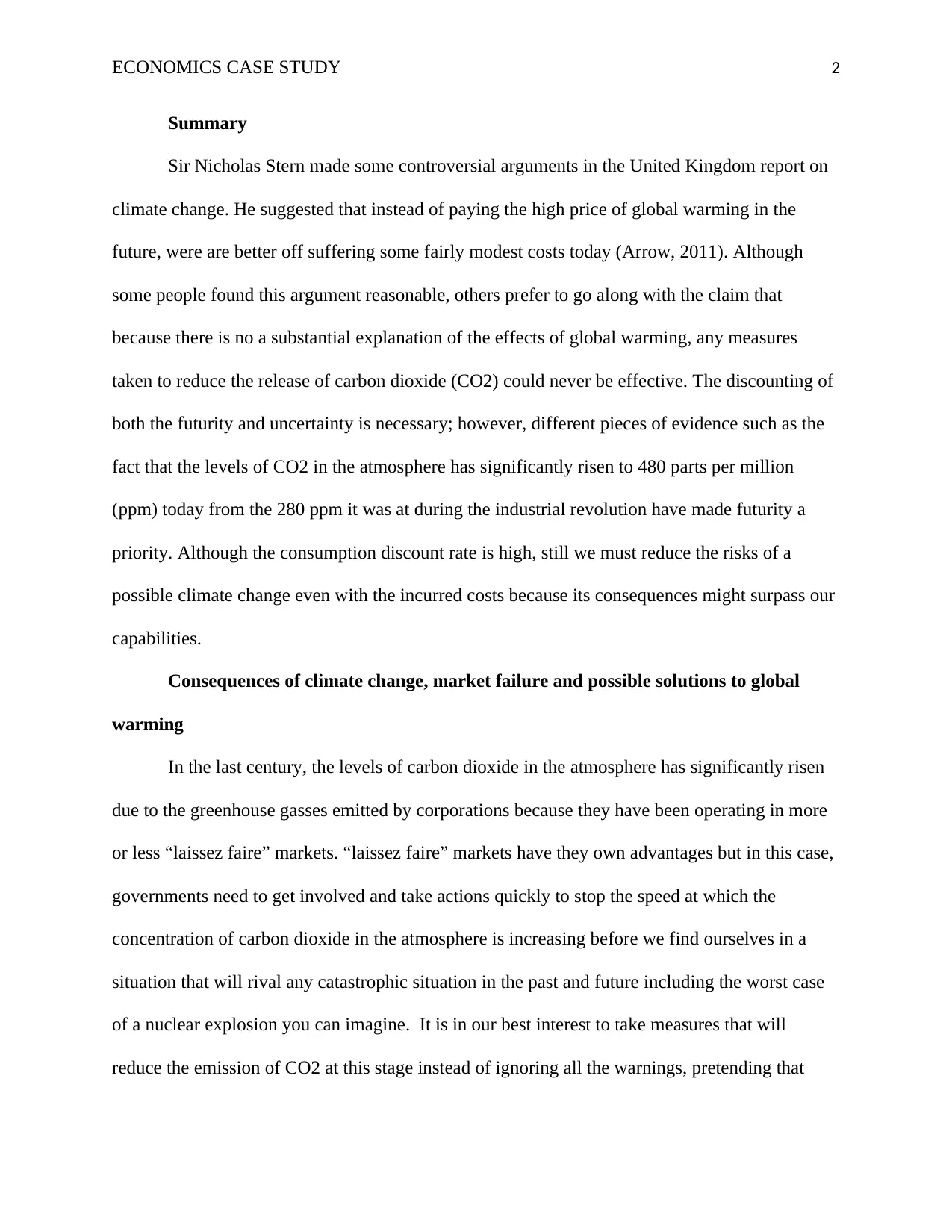
are currently at 480 ppm and reach a concentration of 550 ppm, the world's temperature will see
a 2 degrees increase at a minimum and if still our governments and corporations do not take
serious measures, then at the turn of the century, things will take a catastrophic turn if the levels
of CO2 will tripled which will possibly raise the world’s temperature to more than 5 degrees
centigrade; something that should not happen so quickly.
Figure 1: Global Avarage Temperature
When a change of this magnitude occurs too fast, it will bring with it serious
consequences. Out of all the greenhouses produced in globally, carbon dioxide has the highest
emission, and if this continues to rise, people in agriculture will be the first to suffer great
everything is normal and facing the full consequences of global warming in the future and what
is worse is that these consequences do not manifest themselves at once so that we can recoup and
with them; they occur gradually and last a long time, living us off balance, not knowing what to
do. People are still not alarmed; even after hearing that if the levels of CO2 go from where they
are currently at 480 ppm and reach a concentration of 550 ppm, the world's temperature will see
a 2 degrees increase at a minimum and if still our governments and corporations do not take
serious measures, then at the turn of the century, things will take a catastrophic turn if the levels
of CO2 will tripled which will possibly raise the world’s temperature to more than 5 degrees
centigrade; something that should not happen so quickly.
Figure 1: Global Avarage Temperature
When a change of this magnitude occurs too fast, it will bring with it serious
consequences. Out of all the greenhouses produced in globally, carbon dioxide has the highest
emission, and if this continues to rise, people in agriculture will be the first to suffer great
⊘ This is a preview!⊘
Do you want full access?
Subscribe today to unlock all pages.

Trusted by 1+ million students worldwide
ECONOMICS CASE STUDY 4
economic lossless as the harvests will considerably reduce. Islands such as the Maldives and the
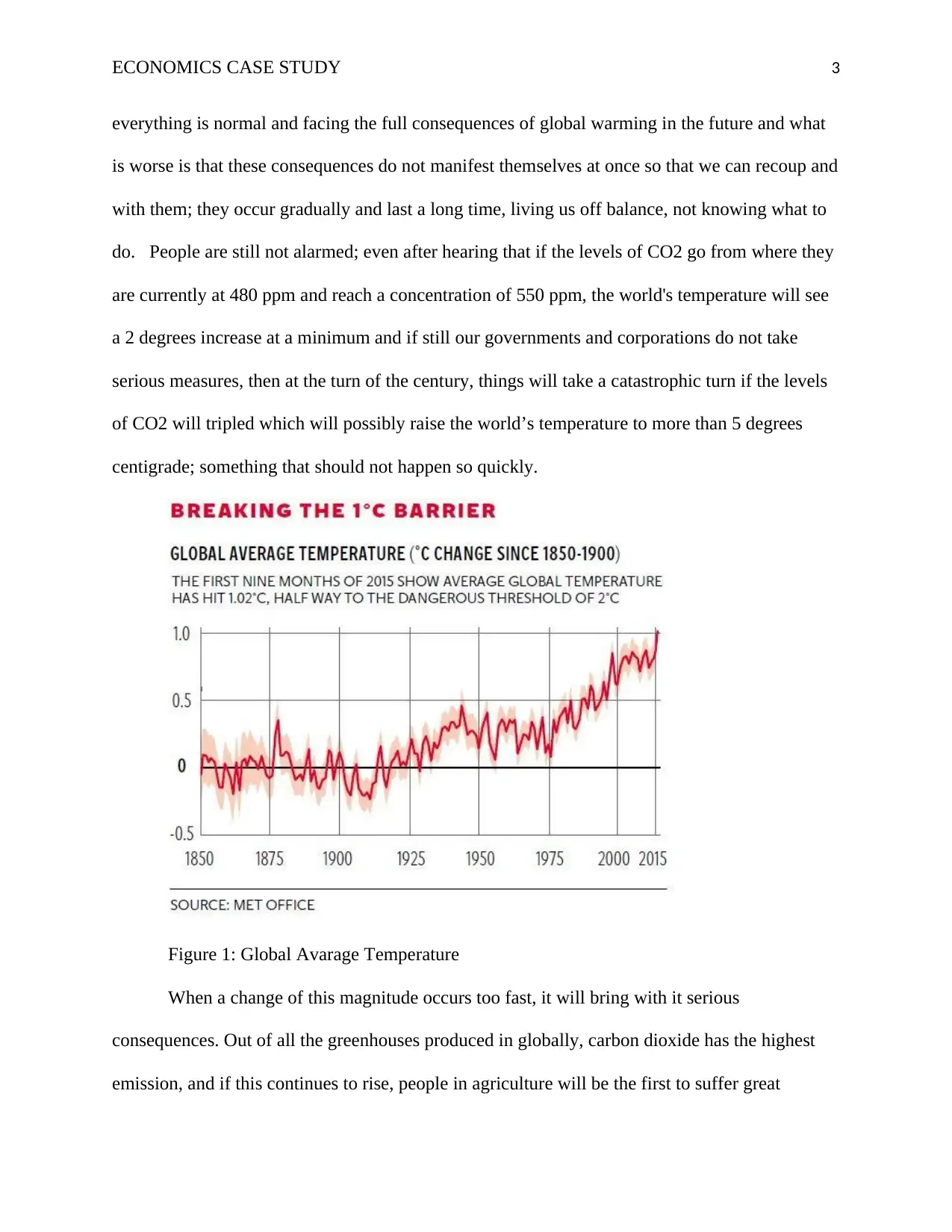
Marshall Islands are also in danger of extinction as the rise in temperature will increase sea
levels meaning that the volume of water in oceans will go up (Crugnale, 2016). Further, the rise
in sea levels could cost Bangladesh most of its territory; but well since usually developing
countries are not usually deemed very important by most leaders, powerful countries such as the
United States will also be affected by the increased water volumes in oceans because Manhattan
could also sink (New York Magazine, 2016).
Figure 2: Sea Level Rise by Century
(Climate Central, n.d.)
With more than 5 degrees centigrade rise in temperature, the ice sheets Greenland and
West Antarctic won’t be able to survive as they will melt quickly and then collapse. Severe
storms will also be the norm as high temperatures augment their energy. The marine ecosystems
will also be at risk due to the high emissions of carbon dioxide and upon absorption causing the
economic lossless as the harvests will considerably reduce. Islands such as the Maldives and the
Marshall Islands are also in danger of extinction as the rise in temperature will increase sea
levels meaning that the volume of water in oceans will go up (Crugnale, 2016). Further, the rise
in sea levels could cost Bangladesh most of its territory; but well since usually developing
countries are not usually deemed very important by most leaders, powerful countries such as the
United States will also be affected by the increased water volumes in oceans because Manhattan
could also sink (New York Magazine, 2016).
Figure 2: Sea Level Rise by Century
(Climate Central, n.d.)
With more than 5 degrees centigrade rise in temperature, the ice sheets Greenland and
West Antarctic won’t be able to survive as they will melt quickly and then collapse. Severe
storms will also be the norm as high temperatures augment their energy. The marine ecosystems
will also be at risk due to the high emissions of carbon dioxide and upon absorption causing the
Paraphrase This Document
Need a fresh take? Get an instant paraphrase of this document with our AI Paraphraser
ECONOMICS CASE STUDY 5
acid level in oceans to rise. This will put the livelihood of many people in peril as the death of
coral reefs will mean the death of many industries such the oyster and lobster industries.
The wildlife will also be affected due to the change in weather patterns that will change
the vegetation where most animals live; climate change will prove to be too much for them and
one by one they will start vanishing. This would be very unfortunate because it is cruel to
deprive anyone of the right to learn and see some of the great animals we have today, for
example, polar bears who will die because of the melting Arctic ice. If nothing is done, we will
be facing some of these consequences as soon as in the next four decades. In the next forty years,
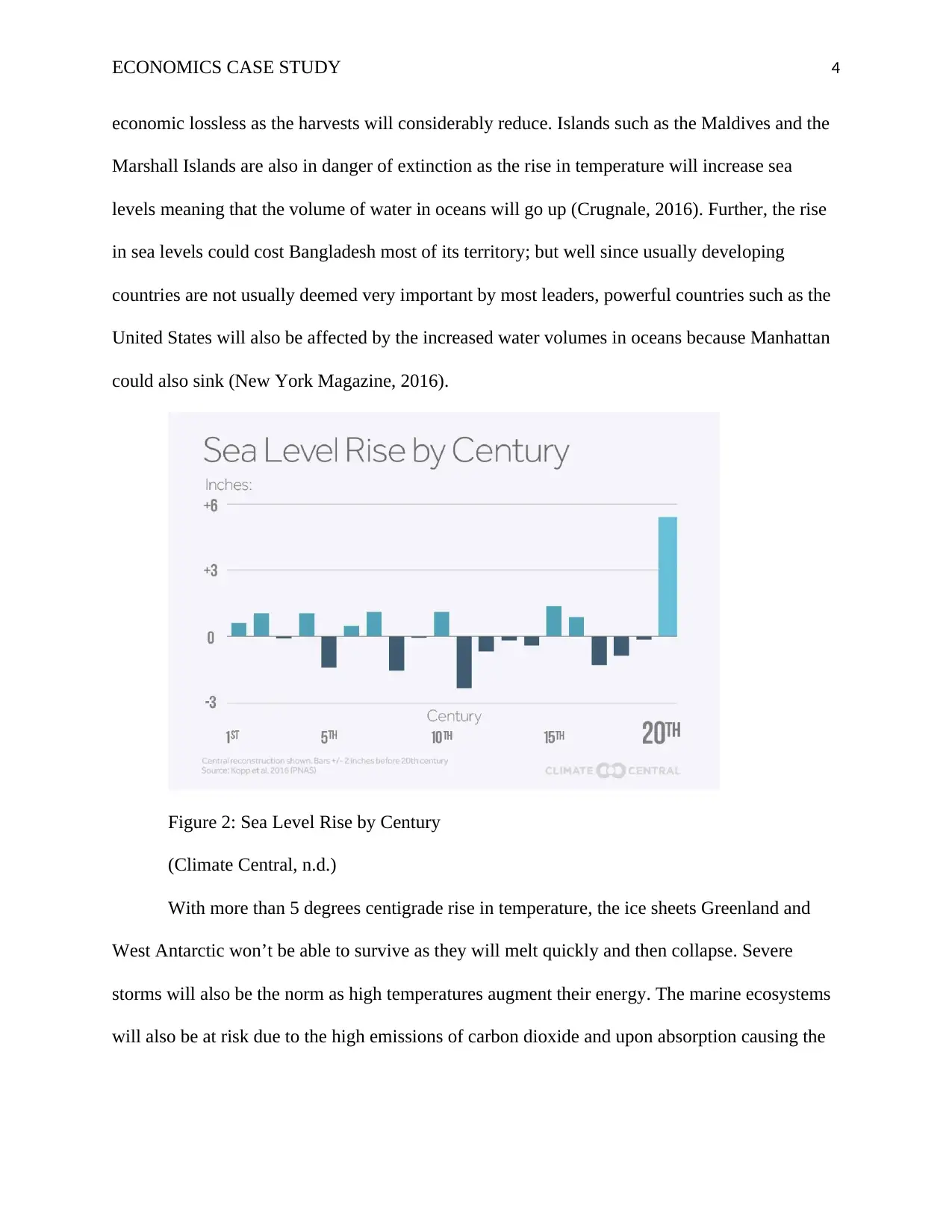
our health won’t be thriving either as the fast manner in which climate is changing will increase
cases of malnutrition, diarrheal diseases as well as vector-borne diseases like malaria among
others. Most of us will still be alive, so we cannot continue to live so irresponsibly.
Figure 3: Impact of Climate Change on Human Health
(Center for Disease Control and Prevention, n.d.)
acid level in oceans to rise. This will put the livelihood of many people in peril as the death of
coral reefs will mean the death of many industries such the oyster and lobster industries.
The wildlife will also be affected due to the change in weather patterns that will change
the vegetation where most animals live; climate change will prove to be too much for them and
one by one they will start vanishing. This would be very unfortunate because it is cruel to
deprive anyone of the right to learn and see some of the great animals we have today, for
example, polar bears who will die because of the melting Arctic ice. If nothing is done, we will
be facing some of these consequences as soon as in the next four decades. In the next forty years,
our health won’t be thriving either as the fast manner in which climate is changing will increase
cases of malnutrition, diarrheal diseases as well as vector-borne diseases like malaria among
others. Most of us will still be alive, so we cannot continue to live so irresponsibly.
Figure 3: Impact of Climate Change on Human Health
(Center for Disease Control and Prevention, n.d.)
ECONOMICS CASE STUDY 6
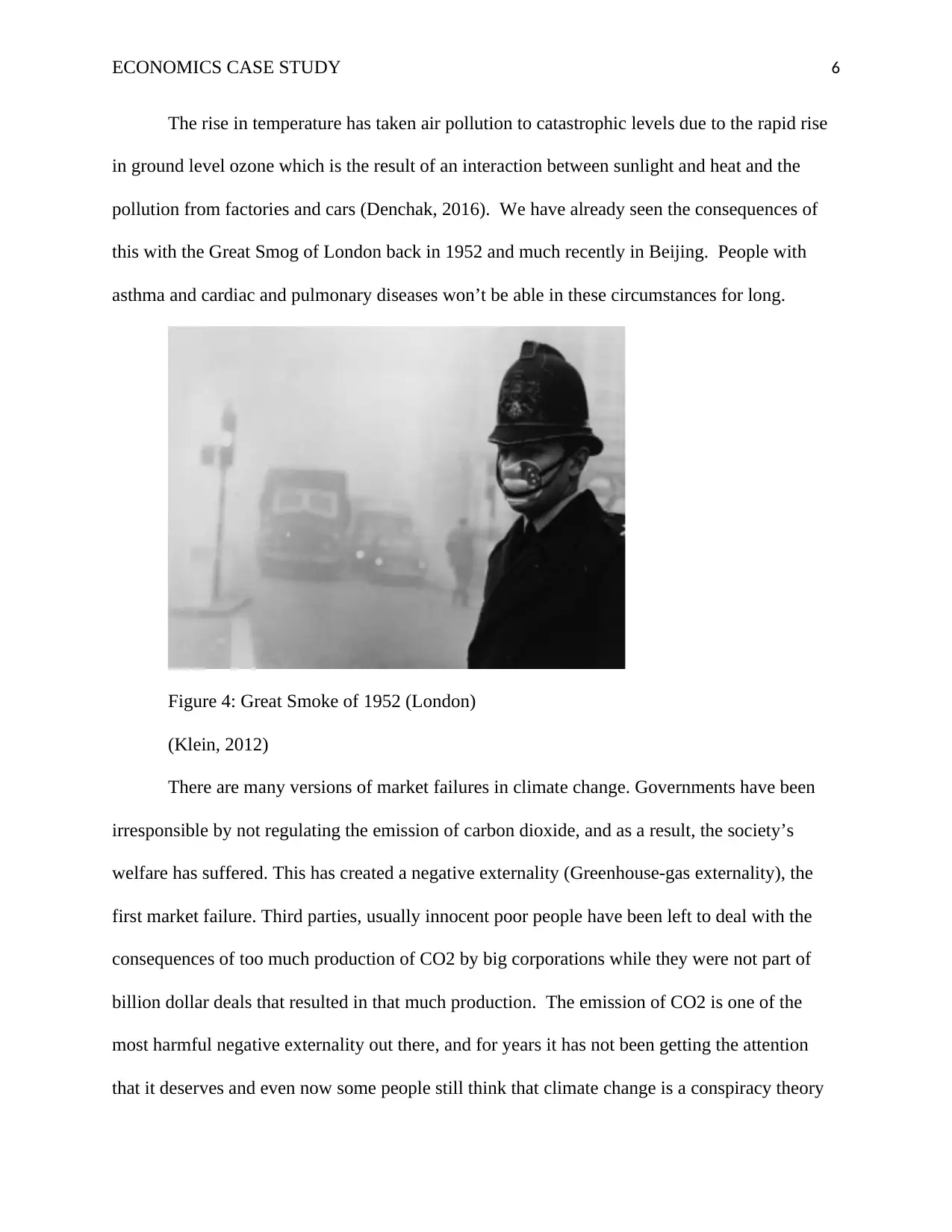
The rise in temperature has taken air pollution to catastrophic levels due to the rapid rise
in ground level ozone which is the result of an interaction between sunlight and heat and the
pollution from factories and cars (Denchak, 2016). We have already seen the consequences of
this with the Great Smog of London back in 1952 and much recently in Beijing. People with
asthma and cardiac and pulmonary diseases won’t be able in these circumstances for long.
Figure 4: Great Smoke of 1952 (London)
(Klein, 2012)
There are many versions of market failures in climate change. Governments have been
irresponsible by not regulating the emission of carbon dioxide, and as a result, the society’s
welfare has suffered. This has created a negative externality (Greenhouse-gas externality), the
first market failure. Third parties, usually innocent poor people have been left to deal with the
consequences of too much production of CO2 by big corporations while they were not part of
billion dollar deals that resulted in that much production. The emission of CO2 is one of the
most harmful negative externality out there, and for years it has not been getting the attention
that it deserves and even now some people still think that climate change is a conspiracy theory
The rise in temperature has taken air pollution to catastrophic levels due to the rapid rise
in ground level ozone which is the result of an interaction between sunlight and heat and the
pollution from factories and cars (Denchak, 2016). We have already seen the consequences of
this with the Great Smog of London back in 1952 and much recently in Beijing. People with
asthma and cardiac and pulmonary diseases won’t be able in these circumstances for long.
Figure 4: Great Smoke of 1952 (London)
(Klein, 2012)
There are many versions of market failures in climate change. Governments have been
irresponsible by not regulating the emission of carbon dioxide, and as a result, the society’s
welfare has suffered. This has created a negative externality (Greenhouse-gas externality), the
first market failure. Third parties, usually innocent poor people have been left to deal with the
consequences of too much production of CO2 by big corporations while they were not part of
billion dollar deals that resulted in that much production. The emission of CO2 is one of the
most harmful negative externality out there, and for years it has not been getting the attention
that it deserves and even now some people still think that climate change is a conspiracy theory
⊘ This is a preview!⊘
Do you want full access?
Subscribe today to unlock all pages.
Trusted by 1+ million students worldwide
ECONOMICS CASE STUDY 7
to slow development and make people pay more tax. Governments need to intervene to resolve
the Greenhouse-gas externality and imposes regulations on the overproduction of CO2 because
most of these big corporations won't do anything to solve this issue as what binds to the climate
change problem are their ethics and not economic ties which make their commitment weak.
The management of the production of greenhouse gases has not been effective and strict
measures need to be taken to avoid harsh consequences in the future. There are various steps that
could be taken to slow down climate change. Replacing coal and petroleum with natural gas is
one of them; using natural gas could considerably reduce the production of greenhouse gases,
specifically CO2, cutting emissions by nearly 50 percent even as more countries develop (Center
for Climate and Energy Solutions, 2013). But, the replacement needs to be done carefully and
other sources such as the wind, nuclear and solar need to be combined with the usage of natural
gas as it also emits greenhouse gas because it is a fossil fuel.
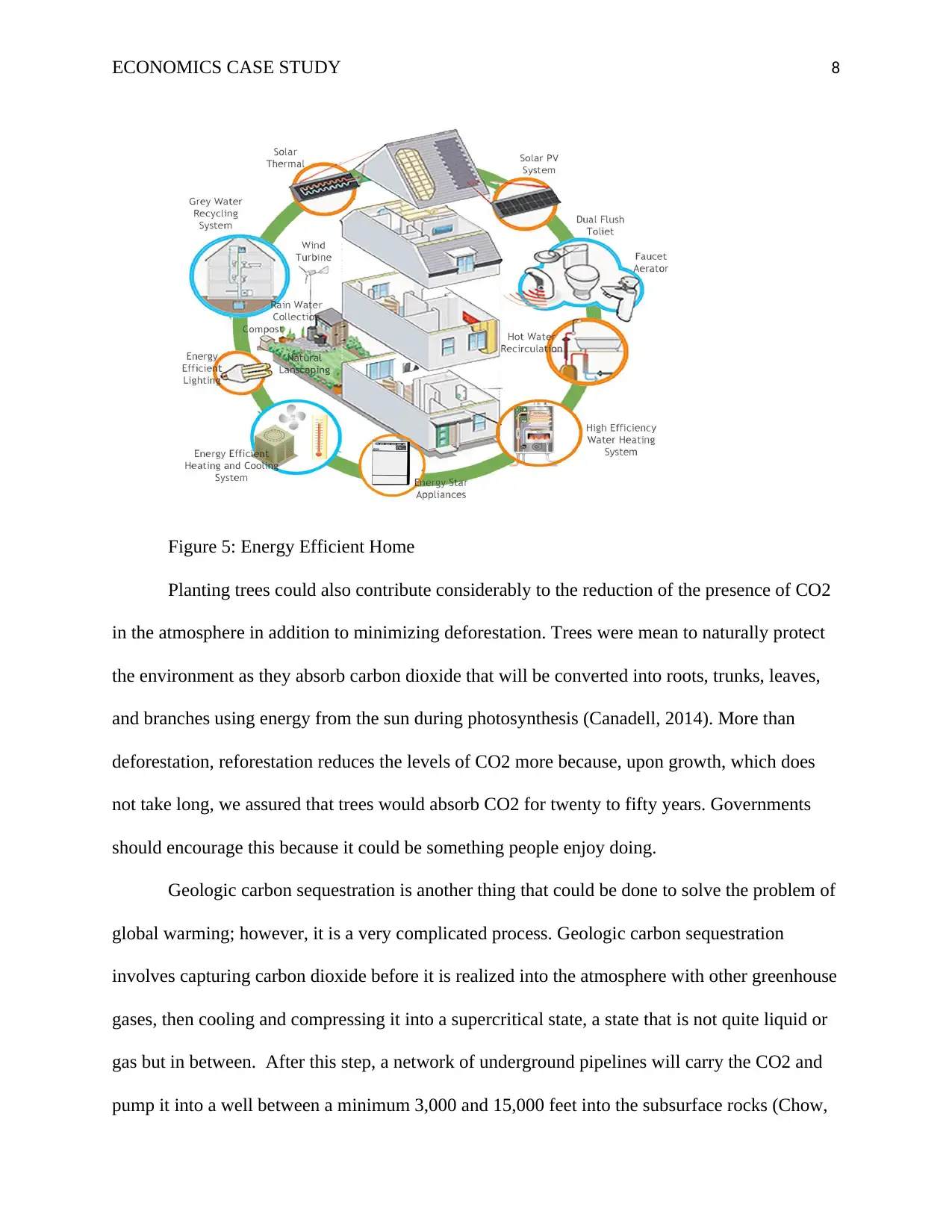
Another thing that could is developing technologies that are more energy efficient in the
production of goods and services both on the supply and demand side. Concerning supply,
technologies to better recover heat and minimize the production of too much heat could be
developed, in addition to technologies that will facilitate clean coal processes including boilers,
and steam and air turbines. Regarding demand, companies need to develop efficient technologies
especially those that consumers use for a long period such as air conditioners, industrial dryers
and other domestic appliances (United Nations Industrial Development Organization, n.d.).
Another solution for climate change involves shifting demand to products that have lower
energy intensity. This could be done by counseling and education consumers on the types of
products that will allow them to use less energy and manage their energy consumption.
to slow development and make people pay more tax. Governments need to intervene to resolve
the Greenhouse-gas externality and imposes regulations on the overproduction of CO2 because
most of these big corporations won't do anything to solve this issue as what binds to the climate
change problem are their ethics and not economic ties which make their commitment weak.
The management of the production of greenhouse gases has not been effective and strict
measures need to be taken to avoid harsh consequences in the future. There are various steps that
could be taken to slow down climate change. Replacing coal and petroleum with natural gas is
one of them; using natural gas could considerably reduce the production of greenhouse gases,
specifically CO2, cutting emissions by nearly 50 percent even as more countries develop (Center
for Climate and Energy Solutions, 2013). But, the replacement needs to be done carefully and
other sources such as the wind, nuclear and solar need to be combined with the usage of natural
gas as it also emits greenhouse gas because it is a fossil fuel.
Another thing that could is developing technologies that are more energy efficient in the
production of goods and services both on the supply and demand side. Concerning supply,
technologies to better recover heat and minimize the production of too much heat could be
developed, in addition to technologies that will facilitate clean coal processes including boilers,
and steam and air turbines. Regarding demand, companies need to develop efficient technologies
especially those that consumers use for a long period such as air conditioners, industrial dryers
and other domestic appliances (United Nations Industrial Development Organization, n.d.).
Another solution for climate change involves shifting demand to products that have lower
energy intensity. This could be done by counseling and education consumers on the types of
products that will allow them to use less energy and manage their energy consumption.
Paraphrase This Document
Need a fresh take? Get an instant paraphrase of this document with our AI Paraphraser
ECONOMICS CASE STUDY 8
Figure 5: Energy Efficient Home
Planting trees could also contribute considerably to the reduction of the presence of CO2
in the atmosphere in addition to minimizing deforestation. Trees were mean to naturally protect
the environment as they absorb carbon dioxide that will be converted into roots, trunks, leaves,
and branches using energy from the sun during photosynthesis (Canadell, 2014). More than
deforestation, reforestation reduces the levels of CO2 more because, upon growth, which does
not take long, we assured that trees would absorb CO2 for twenty to fifty years. Governments
should encourage this because it could be something people enjoy doing.
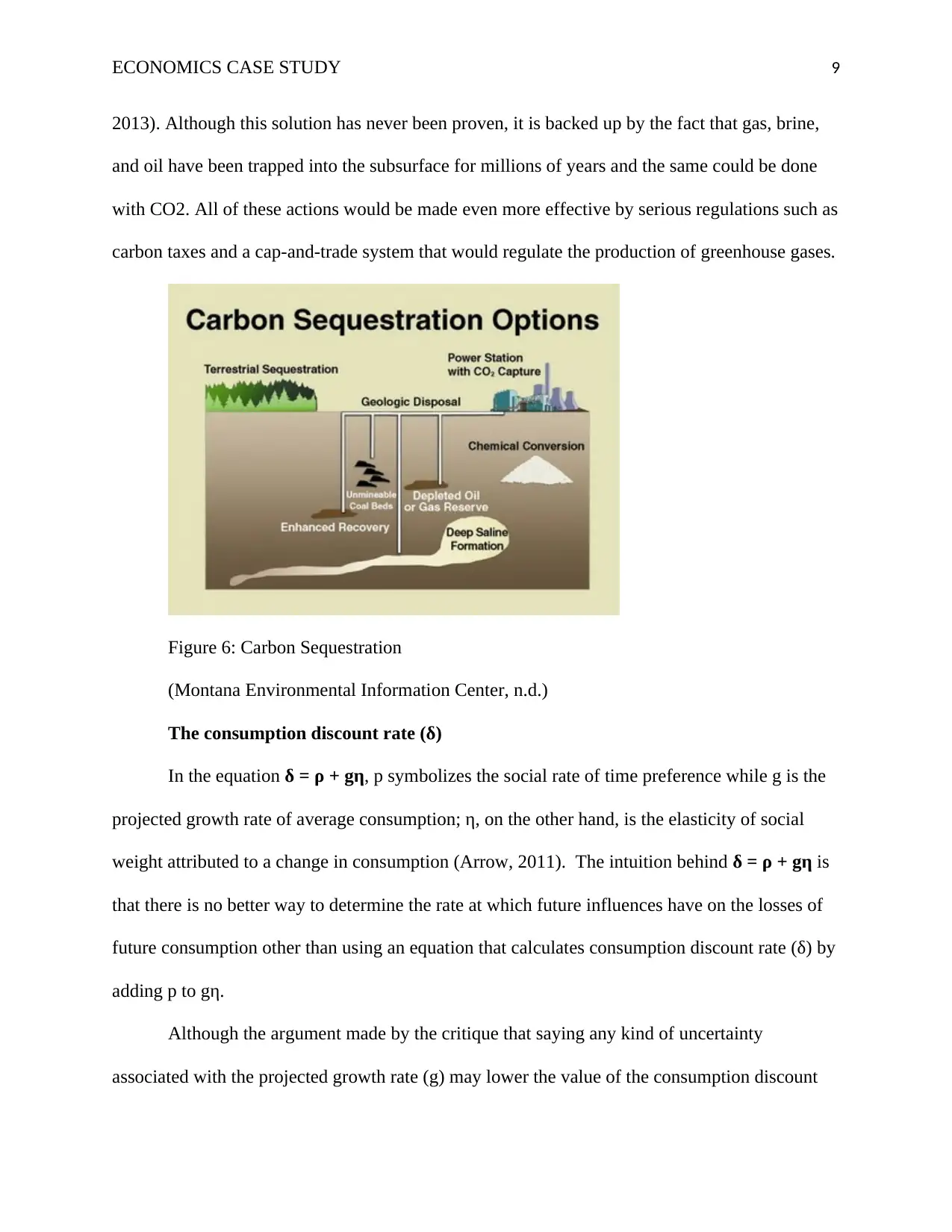
Geologic carbon sequestration is another thing that could be done to solve the problem of
global warming; however, it is a very complicated process. Geologic carbon sequestration
involves capturing carbon dioxide before it is realized into the atmosphere with other greenhouse
gases, then cooling and compressing it into a supercritical state, a state that is not quite liquid or
gas but in between. After this step, a network of underground pipelines will carry the CO2 and
pump it into a well between a minimum 3,000 and 15,000 feet into the subsurface rocks (Chow,
Figure 5: Energy Efficient Home
Planting trees could also contribute considerably to the reduction of the presence of CO2
in the atmosphere in addition to minimizing deforestation. Trees were mean to naturally protect
the environment as they absorb carbon dioxide that will be converted into roots, trunks, leaves,
and branches using energy from the sun during photosynthesis (Canadell, 2014). More than
deforestation, reforestation reduces the levels of CO2 more because, upon growth, which does
not take long, we assured that trees would absorb CO2 for twenty to fifty years. Governments
should encourage this because it could be something people enjoy doing.
Geologic carbon sequestration is another thing that could be done to solve the problem of
global warming; however, it is a very complicated process. Geologic carbon sequestration
involves capturing carbon dioxide before it is realized into the atmosphere with other greenhouse
gases, then cooling and compressing it into a supercritical state, a state that is not quite liquid or
gas but in between. After this step, a network of underground pipelines will carry the CO2 and
pump it into a well between a minimum 3,000 and 15,000 feet into the subsurface rocks (Chow,
ECONOMICS CASE STUDY 9
2013). Although this solution has never been proven, it is backed up by the fact that gas, brine,
and oil have been trapped into the subsurface for millions of years and the same could be done
with CO2. All of these actions would be made even more effective by serious regulations such as
carbon taxes and a cap-and-trade system that would regulate the production of greenhouse gases.
Figure 6: Carbon Sequestration
(Montana Environmental Information Center, n.d.)
The consumption discount rate (δ)
In the equation δ = ρ + gη, p symbolizes the social rate of time preference while g is the
projected growth rate of average consumption; η, on the other hand, is the elasticity of social
weight attributed to a change in consumption (Arrow, 2011). The intuition behind δ = ρ + gη is
that there is no better way to determine the rate at which future influences have on the losses of
future consumption other than using an equation that calculates consumption discount rate (δ) by
adding p to gη.
Although the argument made by the critique that saying any kind of uncertainty
associated with the projected growth rate (g) may lower the value of the consumption discount
2013). Although this solution has never been proven, it is backed up by the fact that gas, brine,
and oil have been trapped into the subsurface for millions of years and the same could be done
with CO2. All of these actions would be made even more effective by serious regulations such as
carbon taxes and a cap-and-trade system that would regulate the production of greenhouse gases.
Figure 6: Carbon Sequestration
(Montana Environmental Information Center, n.d.)
The consumption discount rate (δ)
In the equation δ = ρ + gη, p symbolizes the social rate of time preference while g is the
projected growth rate of average consumption; η, on the other hand, is the elasticity of social
weight attributed to a change in consumption (Arrow, 2011). The intuition behind δ = ρ + gη is
that there is no better way to determine the rate at which future influences have on the losses of
future consumption other than using an equation that calculates consumption discount rate (δ) by
adding p to gη.
Although the argument made by the critique that saying any kind of uncertainty
associated with the projected growth rate (g) may lower the value of the consumption discount
⊘ This is a preview!⊘
Do you want full access?
Subscribe today to unlock all pages.
Trusted by 1+ million students worldwide
ECONOMICS CASE STUDY 10
rate (δ) is a common belief, I disagree with it because it is suggesting that it is a certainty that at
a specific time in the future the human race will be destroyed and as a result the growth rate of
average consumption will come to a standstill but, this is impossible as no one has been able to
prove that the when the extinction of the human race is going to occur, how it will happen or if it
is something that is even going to become a reality ((Vermeylen, 2013). Governments have used
the benefit-cost analysis of climate change the wrong way. Instead of taking it as a necessary
value-laden instrument to examine the significances of the different stands people have on global
warming, they have used it as a tool to create policies that will pacify various stakeholders
especially business owners.
A higher value of consumption discount rate (δ) means that consumers are not willing to
incur the costs of avoiding the effects of climate change that may happen more than a century
from now today(Moxnes, 2014) as a result, having lower consumption discount rate (δ) puts the
economy at an advantage. The willingness to pay the price today damages that may be felt in the
century to come causes a significant growth in the economy. The current growth rate will see an
increase of 1.3 percent yearly from 1.2 percent by the time we reach 2200 (Arrow, 2011). This
increase will occur due to a 13.8 percent upsurge in the gross national product (GNP). While the
critique may argue that GNP is not the best tool to use to measure progress, it determines
expense, effort and monetary flow. There is no better tool to evaluate consumption without
ignoring certain important nonmonetary and monetary factors such as the environmental
damages that have to be fixed with money other than the GNP. It is always a good sign when the
GNP goes high because it indicates that more people have a job that pays them well; as a result,
they can spend money.
Consumption discount rate (δ) for Australia
rate (δ) is a common belief, I disagree with it because it is suggesting that it is a certainty that at
a specific time in the future the human race will be destroyed and as a result the growth rate of
average consumption will come to a standstill but, this is impossible as no one has been able to
prove that the when the extinction of the human race is going to occur, how it will happen or if it
is something that is even going to become a reality ((Vermeylen, 2013). Governments have used
the benefit-cost analysis of climate change the wrong way. Instead of taking it as a necessary
value-laden instrument to examine the significances of the different stands people have on global
warming, they have used it as a tool to create policies that will pacify various stakeholders
especially business owners.
A higher value of consumption discount rate (δ) means that consumers are not willing to
incur the costs of avoiding the effects of climate change that may happen more than a century
from now today(Moxnes, 2014) as a result, having lower consumption discount rate (δ) puts the
economy at an advantage. The willingness to pay the price today damages that may be felt in the
century to come causes a significant growth in the economy. The current growth rate will see an
increase of 1.3 percent yearly from 1.2 percent by the time we reach 2200 (Arrow, 2011). This
increase will occur due to a 13.8 percent upsurge in the gross national product (GNP). While the
critique may argue that GNP is not the best tool to use to measure progress, it determines
expense, effort and monetary flow. There is no better tool to evaluate consumption without
ignoring certain important nonmonetary and monetary factors such as the environmental
damages that have to be fixed with money other than the GNP. It is always a good sign when the
GNP goes high because it indicates that more people have a job that pays them well; as a result,
they can spend money.
Consumption discount rate (δ) for Australia
Paraphrase This Document
Need a fresh take? Get an instant paraphrase of this document with our AI Paraphraser
ECONOMICS CASE STUDY 11
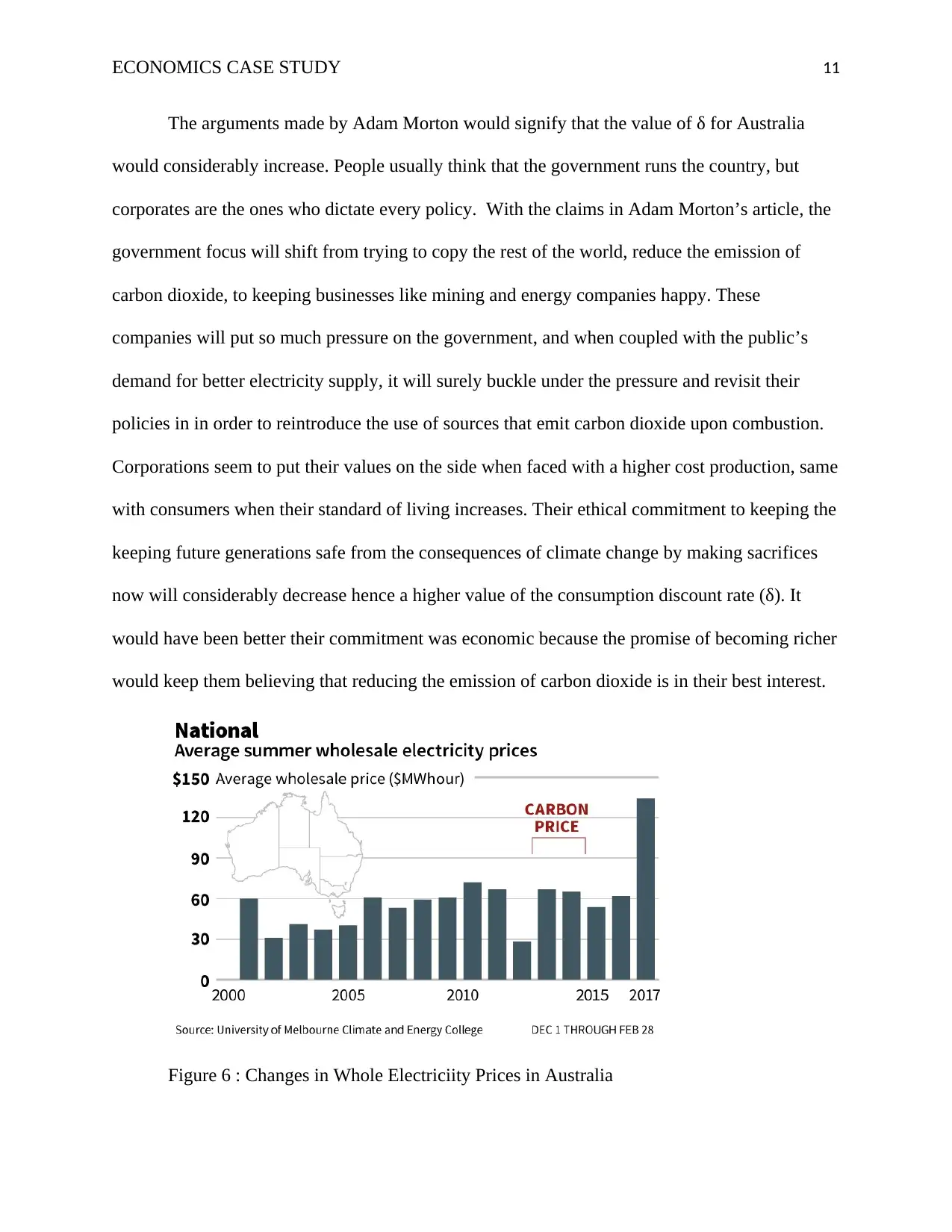
The arguments made by Adam Morton would signify that the value of δ for Australia
would considerably increase. People usually think that the government runs the country, but
corporates are the ones who dictate every policy. With the claims in Adam Morton’s article, the
government focus will shift from trying to copy the rest of the world, reduce the emission of
carbon dioxide, to keeping businesses like mining and energy companies happy. These
companies will put so much pressure on the government, and when coupled with the public’s
demand for better electricity supply, it will surely buckle under the pressure and revisit their
policies in in order to reintroduce the use of sources that emit carbon dioxide upon combustion.
Corporations seem to put their values on the side when faced with a higher cost production, same
with consumers when their standard of living increases. Their ethical commitment to keeping the
keeping future generations safe from the consequences of climate change by making sacrifices
now will considerably decrease hence a higher value of the consumption discount rate (δ). It
would have been better their commitment was economic because the promise of becoming richer
would keep them believing that reducing the emission of carbon dioxide is in their best interest.
Figure 6 : Changes in Whole Electriciity Prices in Australia
The arguments made by Adam Morton would signify that the value of δ for Australia
would considerably increase. People usually think that the government runs the country, but
corporates are the ones who dictate every policy. With the claims in Adam Morton’s article, the
government focus will shift from trying to copy the rest of the world, reduce the emission of
carbon dioxide, to keeping businesses like mining and energy companies happy. These
companies will put so much pressure on the government, and when coupled with the public’s
demand for better electricity supply, it will surely buckle under the pressure and revisit their
policies in in order to reintroduce the use of sources that emit carbon dioxide upon combustion.
Corporations seem to put their values on the side when faced with a higher cost production, same
with consumers when their standard of living increases. Their ethical commitment to keeping the
keeping future generations safe from the consequences of climate change by making sacrifices
now will considerably decrease hence a higher value of the consumption discount rate (δ). It
would have been better their commitment was economic because the promise of becoming richer
would keep them believing that reducing the emission of carbon dioxide is in their best interest.
Figure 6 : Changes in Whole Electriciity Prices in Australia
ECONOMICS CASE STUDY 12
Consumption discount rate (δ) for the world
The United States’ withdrawal from the Paris Climate Accord would increase the
consumption discount rate (δ) for the world because although many people would prefer it if it
were not the case, the country has a lot of pull, and its exit minimizes the importance of climate
change in the eyes of other nations even if they don't admit it. Although President Trump
claimed that the Paris Climate Accord wouldn't make much difference in the emission of carbon
dioxide, the stipulations of the Accord would ensure that the globe’s temperature is kept below 2
degrees which will take the temperature from dangerous to moderate levels in the future
(McGrath, 2017). The United States helps a lot developing countries in their efforts of reducing
the emission of carbon dioxide; its exit puts those countries at a great disadvantage. This will
make them start to rethink their reasons for wanting to decelerate the heating of the globe
especially as they do not contribute to it as much as a country like the United States who is
responsible for 15% of the world’s emission of CO2. They might start to think that Donald
Trump is doing them a favor by disclosing that these efforts to stop climate change are just a way
to slow development. There is no way to decrease the value of consumption discount rate (δ)
because the propriety of an important social planner like the U.S. President Donald Trump is not
to guarantee and uphold human welfare; he has always been upfront regarding his opinions on
global warming. Solving the issue of global warming is very challenging. Countries are driven
by their moral to slow climate change and unfortunately that is not strong enough to keep them
committed especially since a super power like the U.S, who is supposed to be the moral leader,
does not see the importance of putting restrictions on the emission of greenhouse gasses and
keeping funding organizations who want to do so like the U.N. Green Climate Fund (McGrath,
Consumption discount rate (δ) for the world
The United States’ withdrawal from the Paris Climate Accord would increase the
consumption discount rate (δ) for the world because although many people would prefer it if it
were not the case, the country has a lot of pull, and its exit minimizes the importance of climate
change in the eyes of other nations even if they don't admit it. Although President Trump
claimed that the Paris Climate Accord wouldn't make much difference in the emission of carbon
dioxide, the stipulations of the Accord would ensure that the globe’s temperature is kept below 2
degrees which will take the temperature from dangerous to moderate levels in the future
(McGrath, 2017). The United States helps a lot developing countries in their efforts of reducing
the emission of carbon dioxide; its exit puts those countries at a great disadvantage. This will
make them start to rethink their reasons for wanting to decelerate the heating of the globe
especially as they do not contribute to it as much as a country like the United States who is
responsible for 15% of the world’s emission of CO2. They might start to think that Donald
Trump is doing them a favor by disclosing that these efforts to stop climate change are just a way
to slow development. There is no way to decrease the value of consumption discount rate (δ)
because the propriety of an important social planner like the U.S. President Donald Trump is not
to guarantee and uphold human welfare; he has always been upfront regarding his opinions on
global warming. Solving the issue of global warming is very challenging. Countries are driven
by their moral to slow climate change and unfortunately that is not strong enough to keep them
committed especially since a super power like the U.S, who is supposed to be the moral leader,
does not see the importance of putting restrictions on the emission of greenhouse gasses and
keeping funding organizations who want to do so like the U.N. Green Climate Fund (McGrath,
⊘ This is a preview!⊘
Do you want full access?
Subscribe today to unlock all pages.
Trusted by 1+ million students worldwide

1 out of 15


Related Documents


Your All-in-One AI-Powered Toolkit for Academic Success.
+13062052269
info@desklib.com
Available 24*7 on WhatsApp / Email
![[object Object]](/_next/static/media/star-bottom.7253800d.svg)
Unlock your academic potential
Copyright © 2020–2026 A2Z Services. All Rights Reserved. Developed and managed by ZUCOL.