The Impact of Globalisation on Amazon's Business Functions: A Study
VerifiedAdded on 2023/01/18
|22
|6923
|44
Report
AI Summary
This report examines the multifaceted impacts of globalization on Amazon Inc., focusing on its operations, marketing, human resources, and accounting functions. The research begins with an executive summary, followed by an introduction to globalization and its effects on businesses, setting the aim and objectives of the study. The report employs a project management approach, including a detailed project plan, work breakdown structure, and Gantt chart. Secondary research provides a comprehensive literature review on globalization's effects, while primary research involves a survey to gather data on Amazon's specific experiences. The findings from both research methods are analyzed and discussed, leading to conclusions and recommendations for Amazon, along with a personal reflection on the research process. The report highlights globalization's influence on operational strategies, marketing, HR, and accounting, emphasizing the need for businesses to adapt and innovate in a competitive global environment.

THE IMPACT OF GLOBALISATION ON THE OPERATIONS,
MARKETING, HR & ACCOUNTING FUNCTIONS OF AMAZON
MARKETING, HR & ACCOUNTING FUNCTIONS OF AMAZON

Paraphrase This Document
Need a fresh take? Get an instant paraphrase of this document with our AI Paraphraser
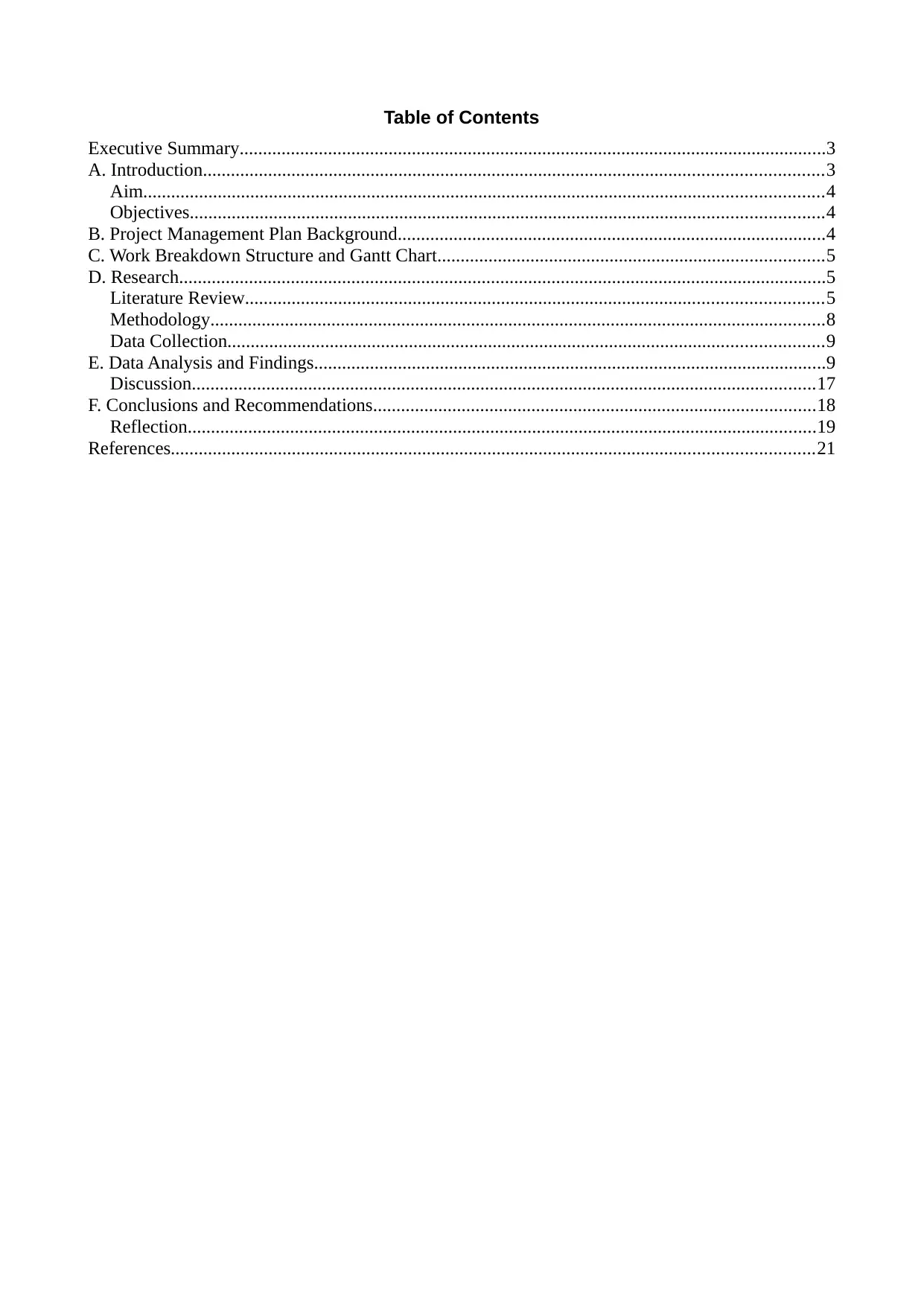
Table of Contents
Executive Summary..............................................................................................................................3
A. Introduction.....................................................................................................................................3
Aim..................................................................................................................................................4
Objectives........................................................................................................................................4
B. Project Management Plan Background............................................................................................4
C. Work Breakdown Structure and Gantt Chart...................................................................................5
D. Research...........................................................................................................................................5
Literature Review............................................................................................................................5
Methodology....................................................................................................................................8
Data Collection................................................................................................................................9
E. Data Analysis and Findings..............................................................................................................9
Discussion......................................................................................................................................17
F. Conclusions and Recommendations...............................................................................................18
Reflection.......................................................................................................................................19
References..........................................................................................................................................21
Executive Summary..............................................................................................................................3
A. Introduction.....................................................................................................................................3
Aim..................................................................................................................................................4
Objectives........................................................................................................................................4
B. Project Management Plan Background............................................................................................4
C. Work Breakdown Structure and Gantt Chart...................................................................................5
D. Research...........................................................................................................................................5
Literature Review............................................................................................................................5
Methodology....................................................................................................................................8
Data Collection................................................................................................................................9
E. Data Analysis and Findings..............................................................................................................9
Discussion......................................................................................................................................17
F. Conclusions and Recommendations...............................................................................................18
Reflection.......................................................................................................................................19
References..........................................................................................................................................21
Executive Summary
This paper investigated the positive impacts that globalisation has on businesses; using secondary
research, the benefits of globalisation to businesses were determined to be diverse, including
improved operational performance, diversity, competition resulting in greater competitiveness,
better HR performance, and the use of global financial reporting and accounting standards. The
literature review also found that globalisation has also affected the structure and organisation of
businesses, global sourcing, scanning, economies of scale, learning, and R&D. The research aimed
at determining how globalisation has positively impacted Amazon in terms of operations,
marketing, HR, and accounting using primary research. The survey findings are consistent with
secondary research findings; globalisation has benefited Amazon in terms of operational efficiency,
HR performance, better marketing, and accounting. However, the firm needs to improve on its
diversification even as it continues to expand. Operational performance also needs improving in
terms of customer delivery. The research objectives were met especially because of the use of
project management techniques in undertaking the project
A. Introduction
Globalization refers to a process through which business organizations start operations in an
international scale or develop international influence. Globalization also alludes to the increasing
interdependence of the world’s cultures, economies, and populations, due to cross border trade and
exchange of goods and services, investment flows, technology, information, and people. Countries
and regional blocs have developed economic partnerships to facilitate such movements over many
years; however, technological advances and population growth in the last half a century has
accelerated this process. Globalisation has become a main factor and leading concept in business in
the past few decades and it is a phenomenon that affects business life, the economy, the
environment, and society in different ways. Almost all corporations have been impacted by these
changes and effects wrought about by globalization. The changes brought about by globalisation are
related mostly to increased competition and rapid changes in information transfer and technology
(Peterson Institute for International Economics, 2019). According to Katerina and Aneta (2014),
the impacts of globalization include increased competition, greater awareness to customer needs,
location flexibility, and economies of scale. This paper will focus its discussions on the effects of
globalisation on the operations, marketing, human resources (HR), and accounting operations of
Amazon. Globalisation has effects on several aspects of a business; it impacts the operational
strategies of an organisation in ways that are both positive and negative (Cullinane, 2011). The
marketing and marketing strategies are also affected by globalisation due to increased competition,
This paper investigated the positive impacts that globalisation has on businesses; using secondary
research, the benefits of globalisation to businesses were determined to be diverse, including
improved operational performance, diversity, competition resulting in greater competitiveness,
better HR performance, and the use of global financial reporting and accounting standards. The
literature review also found that globalisation has also affected the structure and organisation of
businesses, global sourcing, scanning, economies of scale, learning, and R&D. The research aimed
at determining how globalisation has positively impacted Amazon in terms of operations,
marketing, HR, and accounting using primary research. The survey findings are consistent with
secondary research findings; globalisation has benefited Amazon in terms of operational efficiency,
HR performance, better marketing, and accounting. However, the firm needs to improve on its
diversification even as it continues to expand. Operational performance also needs improving in
terms of customer delivery. The research objectives were met especially because of the use of
project management techniques in undertaking the project
A. Introduction
Globalization refers to a process through which business organizations start operations in an
international scale or develop international influence. Globalization also alludes to the increasing
interdependence of the world’s cultures, economies, and populations, due to cross border trade and
exchange of goods and services, investment flows, technology, information, and people. Countries
and regional blocs have developed economic partnerships to facilitate such movements over many
years; however, technological advances and population growth in the last half a century has
accelerated this process. Globalisation has become a main factor and leading concept in business in
the past few decades and it is a phenomenon that affects business life, the economy, the
environment, and society in different ways. Almost all corporations have been impacted by these
changes and effects wrought about by globalization. The changes brought about by globalisation are
related mostly to increased competition and rapid changes in information transfer and technology
(Peterson Institute for International Economics, 2019). According to Katerina and Aneta (2014),
the impacts of globalization include increased competition, greater awareness to customer needs,
location flexibility, and economies of scale. This paper will focus its discussions on the effects of
globalisation on the operations, marketing, human resources (HR), and accounting operations of
Amazon. Globalisation has effects on several aspects of a business; it impacts the operational
strategies of an organisation in ways that are both positive and negative (Cullinane, 2011). The
marketing and marketing strategies are also affected by globalisation due to increased competition,
⊘ This is a preview!⊘
Do you want full access?
Subscribe today to unlock all pages.

Trusted by 1+ million students worldwide
greater awareness, and opportunities available in new and unique markets (Yu, Byun and Lee,
2013). When businesses expand their operations into new markets and countries, it significantly
affects human resource management as they must adapt to new thinking and cultures. Further,
accounting is an object as well as an instrument in globalisation, according to Hopper, Lassou and
Soobaroyen (2017).
This research will first introduce the topic and then define the aims and objectives of the research.
This will be followed by the development of a project plan, followed by a Gantt chart and a work
breakdown structure to illustrate the planning and execution of the project. Following this is a
description of how the research is conducted, including a detailed review of literature (secondary
research) and data collection through primary research. The research findings are discussed and
conclusions and practical recommendations made. Finally, a reflection of the entire research
undertaking is discussed.
Aim
The aim of this research is to use project management methodologies and techniques to conduct
research on how globalization affects various aspects of Amazon Inc by conducting secondary
research and using this to frame the research problem and conduct primary research. The findings
from the primary research are then analyzed and discussed and recommendations made; a reflection
on the conduct of the entire research will be discussed at the end.
Objectives
The first objective of this research is to develop a suitable project management plan consisting of a
project plan, a work breakdown structure, and a Gantt chart to ensure the project is undertaken in a
smart manner
The second objective is to conduct secondary data and use this information to frame a primary data
collection exercise, analyze the data, and generate useful findings
The third objective is to give recommendations to Amazon, based on the findings and to undertake a
personal reflection on how the research was conducted.
B. Project Management Plan Background
Amazon Inc is an American multinational company headquartered in Seattle, Washington whose
business focus is in cloud computing, electronic commerce, artificial intelligence (AI) and digital
streaming. Amazon is the largest e-commerce market lace in the world as well as being the largest
cloud computing platform and AI assistant provider based on market share and revenues. In the
USA, it is the second largest employer and it has 40 subsidiaries with a global reach. At present, the
company has a reach of 58 countries (Alaimo, 2018) and it reaches the largest international online
2013). When businesses expand their operations into new markets and countries, it significantly
affects human resource management as they must adapt to new thinking and cultures. Further,
accounting is an object as well as an instrument in globalisation, according to Hopper, Lassou and
Soobaroyen (2017).
This research will first introduce the topic and then define the aims and objectives of the research.
This will be followed by the development of a project plan, followed by a Gantt chart and a work
breakdown structure to illustrate the planning and execution of the project. Following this is a
description of how the research is conducted, including a detailed review of literature (secondary
research) and data collection through primary research. The research findings are discussed and
conclusions and practical recommendations made. Finally, a reflection of the entire research
undertaking is discussed.
Aim
The aim of this research is to use project management methodologies and techniques to conduct
research on how globalization affects various aspects of Amazon Inc by conducting secondary
research and using this to frame the research problem and conduct primary research. The findings
from the primary research are then analyzed and discussed and recommendations made; a reflection
on the conduct of the entire research will be discussed at the end.
Objectives
The first objective of this research is to develop a suitable project management plan consisting of a
project plan, a work breakdown structure, and a Gantt chart to ensure the project is undertaken in a
smart manner
The second objective is to conduct secondary data and use this information to frame a primary data
collection exercise, analyze the data, and generate useful findings
The third objective is to give recommendations to Amazon, based on the findings and to undertake a
personal reflection on how the research was conducted.
B. Project Management Plan Background
Amazon Inc is an American multinational company headquartered in Seattle, Washington whose
business focus is in cloud computing, electronic commerce, artificial intelligence (AI) and digital
streaming. Amazon is the largest e-commerce market lace in the world as well as being the largest
cloud computing platform and AI assistant provider based on market share and revenues. In the
USA, it is the second largest employer and it has 40 subsidiaries with a global reach. At present, the
company has a reach of 58 countries (Alaimo, 2018) and it reaches the largest international online
Paraphrase This Document
Need a fresh take? Get an instant paraphrase of this document with our AI Paraphraser
population of 1.2 billion people, from its 12 global sites that span the biggest E-Commerce markets
globally (Goodsall, 2016).
C. Work Breakdown Structure and Gantt Chart
The WBS was developed following the research aim and objectives and the tasks needed to be
covered in this research. The WBS is attached in Annexe I and from the WBS, a Gantt chart was
developed using Open Project TM project management software as shown in Annexe II. The
development of the Gantt Chart and the WBS follow the PMBOK guidelines ; this was important to
ensure control of the project, available resources, and ensure the objectives f the project were fully
attained (Roseke, 2018).
D. Research
This project is undertaken employing both secondary research through a detailed review of
literature and primary research that entails conducting a survey using a well prepared questionnaire.
Literature Review
While countries have always traded and exchanged goods and services, the 21st Century has
witnessed a rapid increase in globalisation; companies such as car manufacturers now have
disparate divisions involved in manufacturing, research and development, testing, and marketing
spread out across several countries. The global economy continues to integrated further and even
national economies are not being left behind in the globalisation craze. Almost everything is a click
a way; the advancements in technology, especially computing and the Internet has greatly enhanced
globalisation and this has changed the dynamics of how organizations do business (Gopinath and
Ricard, 2013). In the globalisation phenomena, some businesses have found new ways of profiting
while quite a number have not managed to survive and suffered natural deaths. Businesses have
been affected by globalisation in several ways, including competition, consumer knowledge, and
technological innovation (Halabi, 2017). Globalisation has also affected the structure and
organisation of businesses as a way to remain competitive and adjust to changing global business
environment and consumer demands. It is vital that businesses adopt the right organizational
structure to enhance communication, improve customer satisfaction, and improve product
development. As a result of globalisation, managerial roles are also changing to boost value creation
within the business through better planning, organising, directing, coordinating, and controlling of
decisions and business activities (Thompson, 2017; Lim and Tsutsui, 2011).
The impacts of globalisation on business operations are both negative and positive; however,
globalisation can be used by businesses as an operations strategy with respect to global sourcing,
globally (Goodsall, 2016).
C. Work Breakdown Structure and Gantt Chart
The WBS was developed following the research aim and objectives and the tasks needed to be
covered in this research. The WBS is attached in Annexe I and from the WBS, a Gantt chart was
developed using Open Project TM project management software as shown in Annexe II. The
development of the Gantt Chart and the WBS follow the PMBOK guidelines ; this was important to
ensure control of the project, available resources, and ensure the objectives f the project were fully
attained (Roseke, 2018).
D. Research
This project is undertaken employing both secondary research through a detailed review of
literature and primary research that entails conducting a survey using a well prepared questionnaire.
Literature Review
While countries have always traded and exchanged goods and services, the 21st Century has
witnessed a rapid increase in globalisation; companies such as car manufacturers now have
disparate divisions involved in manufacturing, research and development, testing, and marketing
spread out across several countries. The global economy continues to integrated further and even
national economies are not being left behind in the globalisation craze. Almost everything is a click
a way; the advancements in technology, especially computing and the Internet has greatly enhanced
globalisation and this has changed the dynamics of how organizations do business (Gopinath and
Ricard, 2013). In the globalisation phenomena, some businesses have found new ways of profiting
while quite a number have not managed to survive and suffered natural deaths. Businesses have
been affected by globalisation in several ways, including competition, consumer knowledge, and
technological innovation (Halabi, 2017). Globalisation has also affected the structure and
organisation of businesses as a way to remain competitive and adjust to changing global business
environment and consumer demands. It is vital that businesses adopt the right organizational
structure to enhance communication, improve customer satisfaction, and improve product
development. As a result of globalisation, managerial roles are also changing to boost value creation
within the business through better planning, organising, directing, coordinating, and controlling of
decisions and business activities (Thompson, 2017; Lim and Tsutsui, 2011).
The impacts of globalisation on business operations are both negative and positive; however,
globalisation can be used by businesses as an operations strategy with respect to global sourcing,
scanning, economies of scale, learning, and R&D (research and development). For any business, a
bigger skills base can be created through global sourcing since the business can access skills that
would otherwise be unavailable locally. The impact of globalisation on company supply chain
management and sourcing is multi faceted. The business is able to acquire critical supplies, labor,
and materials efficiently from overseas locations or other countries. The company benefits from
getting high quality raw materials from overseas locations at a low cos and more efficiently and the
production mechanism for the raw materials can be at very low costs in the sourcing countries.
Businesses can now consolidate some of their core operations such as marketing or finances in a
country that provides them the best advantages in terms of taxes and access to wider markets.
Globalization also impacts company operations in the context of economies of scale especially if
specialization is involved. As a business becomes bigger with operations in different locations, it
becomes advantageous and practical to further sub-divide business processes. This has the benefit
of increasing its productivity. Globalization enhances a company’s ability to better plan and control
its global inventory.
The objective of planning and controlling is to ensure effective and efficient running of operations
of services and products as desired. Further, planning and control helps minimize risk and
uncertainty and enable the business have a clear view of forecasting for the future. Global
operations will enable a business better plan for inventory and control its inventory in order to
overcome the uncertainties of global operations. In a study to determine the effects of globalization
on manufacturing operations of firms in industrial districts and industries and how this influenced
diversification and specialization in manufacturing decisions, Puig, Marques and Ghauri (2009)
found that globalisation has a tendency to diminish sub-sector and district effects over time. The
researchers also established that globalisation positively impacts specialization, that in turn
positively impacts diversification and productivity, enhancing business growth. Sengül, Alpkan and
Eren (2015) investigated the effects of globalisation n operational performance of SMEs (Small and
medium enterprises) in Turkey. The study determined that different aspects of globalisation
positively affected the technological change, competitive intensity, and cost pressure performance in
the SMEs. Further, it helped the SMEs identify and take advantage f new opportunities and
improved operational performance in the context of cost reductions, improvements in quality, speed
of delivery, and business flexibility. Globalization places greater demands on a business and this in
turn forces the business to become more innovation and improve quality through total quality
management (TQM).
Globalization creates threats and opportunities for businesses; it also results in increased
competition, forcing businesses to be more innovative. Market opportunities from globalisation
pertain to increased investment and trade potential, increased market potential, and increased access
bigger skills base can be created through global sourcing since the business can access skills that
would otherwise be unavailable locally. The impact of globalisation on company supply chain
management and sourcing is multi faceted. The business is able to acquire critical supplies, labor,
and materials efficiently from overseas locations or other countries. The company benefits from
getting high quality raw materials from overseas locations at a low cos and more efficiently and the
production mechanism for the raw materials can be at very low costs in the sourcing countries.
Businesses can now consolidate some of their core operations such as marketing or finances in a
country that provides them the best advantages in terms of taxes and access to wider markets.
Globalization also impacts company operations in the context of economies of scale especially if
specialization is involved. As a business becomes bigger with operations in different locations, it
becomes advantageous and practical to further sub-divide business processes. This has the benefit
of increasing its productivity. Globalization enhances a company’s ability to better plan and control
its global inventory.
The objective of planning and controlling is to ensure effective and efficient running of operations
of services and products as desired. Further, planning and control helps minimize risk and
uncertainty and enable the business have a clear view of forecasting for the future. Global
operations will enable a business better plan for inventory and control its inventory in order to
overcome the uncertainties of global operations. In a study to determine the effects of globalization
on manufacturing operations of firms in industrial districts and industries and how this influenced
diversification and specialization in manufacturing decisions, Puig, Marques and Ghauri (2009)
found that globalisation has a tendency to diminish sub-sector and district effects over time. The
researchers also established that globalisation positively impacts specialization, that in turn
positively impacts diversification and productivity, enhancing business growth. Sengül, Alpkan and
Eren (2015) investigated the effects of globalisation n operational performance of SMEs (Small and
medium enterprises) in Turkey. The study determined that different aspects of globalisation
positively affected the technological change, competitive intensity, and cost pressure performance in
the SMEs. Further, it helped the SMEs identify and take advantage f new opportunities and
improved operational performance in the context of cost reductions, improvements in quality, speed
of delivery, and business flexibility. Globalization places greater demands on a business and this in
turn forces the business to become more innovation and improve quality through total quality
management (TQM).
Globalization creates threats and opportunities for businesses; it also results in increased
competition, forcing businesses to be more innovative. Market opportunities from globalisation
pertain to increased investment and trade potential, increased market potential, and increased access
⊘ This is a preview!⊘
Do you want full access?
Subscribe today to unlock all pages.
Trusted by 1+ million students worldwide
to resources. As audiences and markets expand as a result of globalisation, competition equally
increases and the increased competition makes it important for a business’ products or services to
stand out. Customers are aware of the numerous options and opportunities they have and with
increased technology, it is easy for consumers to search for the best products in a more targeted
manner. As such, consumers able to sift through several different products and brands and so
businesses are forced to make their products stand out through creative advertising and marketing,
overall improving its marketing approaches and strategies. To counter the effects of increased
advertising and promotional campaigns, businesses are compelled to become more efficient. To
penetrate tricky markets, firms often enter into strategic alliances as a form of lateral partnerships
especially if the firms are competitors. Marketing alliances enables the firm to take advantage of the
head-start the partner firm has in a specific market, enabling the company and its products to
penetrate and acquire new customers in an otherwise new market that would present challenges in
direct entry in the context of marketing strategies and gaining market share. The firms are able to
coordinate marketing activities, resulting in superior market performance in the context of market
share, sales, and profitability (Gabrielsson, Gabrielsson and Seppälä, 2012).
When a business expands its operations across borders, globalisation has a significant impact on
human resources development, management, and performance. Globalization results in impacts to
various functions within an organization; executives have to learn and understand different cultures
as regulatory requirements while existing employees fear replacing by cheaper labor from overseas.
The HR department must effectively manage its local and abroad human resources and among the
positive aspects that globalisation has on HR is redefining the HR professionals’ role within a
multinational organization. Rather than dealing with minutia that is involved in administering
employees, such as employee payroll and benefits that are increasingly getting outsourced, the HR
professionals are involved in a greater role in the business in the context of being involved in
strategic planning. They are also involved in developing better programs for training and improving
the workforce. The company / business also benefits a great deal from a wider talent pool as they
can recruit beyond their borders; globalisation means forms are no longer physically bound within
its country or region when seeking the best talent in a global market. This is especially so in the
high skill executive job categories where often, there is a wide gap between demand and supply.
Globalisation almost always results in workforce diversity; businesses hire staff in the countries
they have expanded to or operate in, creating cultural, racial, ethnic, and sometimes religious
diversity. One advantage to this for the business is that it can create a sound knowledge base using
in-house talent sourced from the country/ region it operates: this results in smoother integration for
the organization into foreign markets and cultures (Martin, 2014). workforce diversity implies
difference and similarities in the employees in terms of gender, age, cultural background, race,
increases and the increased competition makes it important for a business’ products or services to
stand out. Customers are aware of the numerous options and opportunities they have and with
increased technology, it is easy for consumers to search for the best products in a more targeted
manner. As such, consumers able to sift through several different products and brands and so
businesses are forced to make their products stand out through creative advertising and marketing,
overall improving its marketing approaches and strategies. To counter the effects of increased
advertising and promotional campaigns, businesses are compelled to become more efficient. To
penetrate tricky markets, firms often enter into strategic alliances as a form of lateral partnerships
especially if the firms are competitors. Marketing alliances enables the firm to take advantage of the
head-start the partner firm has in a specific market, enabling the company and its products to
penetrate and acquire new customers in an otherwise new market that would present challenges in
direct entry in the context of marketing strategies and gaining market share. The firms are able to
coordinate marketing activities, resulting in superior market performance in the context of market
share, sales, and profitability (Gabrielsson, Gabrielsson and Seppälä, 2012).
When a business expands its operations across borders, globalisation has a significant impact on
human resources development, management, and performance. Globalization results in impacts to
various functions within an organization; executives have to learn and understand different cultures
as regulatory requirements while existing employees fear replacing by cheaper labor from overseas.
The HR department must effectively manage its local and abroad human resources and among the
positive aspects that globalisation has on HR is redefining the HR professionals’ role within a
multinational organization. Rather than dealing with minutia that is involved in administering
employees, such as employee payroll and benefits that are increasingly getting outsourced, the HR
professionals are involved in a greater role in the business in the context of being involved in
strategic planning. They are also involved in developing better programs for training and improving
the workforce. The company / business also benefits a great deal from a wider talent pool as they
can recruit beyond their borders; globalisation means forms are no longer physically bound within
its country or region when seeking the best talent in a global market. This is especially so in the
high skill executive job categories where often, there is a wide gap between demand and supply.
Globalisation almost always results in workforce diversity; businesses hire staff in the countries
they have expanded to or operate in, creating cultural, racial, ethnic, and sometimes religious
diversity. One advantage to this for the business is that it can create a sound knowledge base using
in-house talent sourced from the country/ region it operates: this results in smoother integration for
the organization into foreign markets and cultures (Martin, 2014). workforce diversity implies
difference and similarities in the employees in terms of gender, age, cultural background, race,
Paraphrase This Document
Need a fresh take? Get an instant paraphrase of this document with our AI Paraphraser
physical disabilities/ abilities, religion and sexual orientation. People differ not only in terms of
these references (such as gender and age), but also in terms of their psychological and social
characteristics as well as their prejudices and perspectives. Diversity in the workplace results in a
heterogeneous workplace and this is a necessity for any company venturing into overseas markets
or regions. Diversity in the workplace is a strength for any organization and can increase
productivity because it harnesses different perspectives and views, as well as talents, resulting in
rich ideas that solve existing issues and identify further opportunities for exploitation (Saxena,
2014). Ellison and Mullin (2014) also found that workplaces that have greater gender heterogeneity
had greater social goods and resulted in improved workplace performance. Badgett, Durso, Kastanis
and Mallory (2013), in studying performance in LGBT supportive workplaces found that sch
diversity resulted in greater employee commitment, greater disclosure, and there was less
discrimination at the workplace, while co-worker relationships were improved. Further, such
workplaces increased innovation and creativity at the workplace as well. Businesses that venture
into global operations also benefit greatly from cost-effective labor; in the developed world, labor
costs can be prohibitive, while venturing into overseas markets to engage in production where labor
costs are comparatively lower result in significant labor savings and greater competitiveness. Such
labor is usually equally skilled, or even more highly skilled and specialized than labor found locally,
greatly benefiting the business in terms of quality products and services and competitive prices
(Goto and Endo, 2013).
Globalisation also has a positive effect on financial accounting as businesses have to prepare and
present their financial information in a relevant, accessible, timely, understandable, comparable, and
reliable manner. This is because when firms go global, they are bound to adopt global financial
reporting standards and use of global components in reporting. These components include use of
information technology and harmonizing accounting standards, resulting in improved financial
reporting quality (Jayeoba, 2010). The accounting standards are also improved through
improvements in auditing technology and increased bureaucracy as a result of globalisation further
ensures strict controls on accounting and reporting standards (Baskerville and Hay, 2010). The
preceding passages illustrate that globalisation has positive effects, based on peer reviewed and
other scholarly sources used during the literature review, on businesses, despite there being adverse
effects as well, such as increased complexities in managing human resources and operational
management.
Methodology
This research adopted a mixed methods research involving the use of both secondary and primary
data collection and a pragmatic research approach. Secondary data collection was used in
these references (such as gender and age), but also in terms of their psychological and social
characteristics as well as their prejudices and perspectives. Diversity in the workplace results in a
heterogeneous workplace and this is a necessity for any company venturing into overseas markets
or regions. Diversity in the workplace is a strength for any organization and can increase
productivity because it harnesses different perspectives and views, as well as talents, resulting in
rich ideas that solve existing issues and identify further opportunities for exploitation (Saxena,
2014). Ellison and Mullin (2014) also found that workplaces that have greater gender heterogeneity
had greater social goods and resulted in improved workplace performance. Badgett, Durso, Kastanis
and Mallory (2013), in studying performance in LGBT supportive workplaces found that sch
diversity resulted in greater employee commitment, greater disclosure, and there was less
discrimination at the workplace, while co-worker relationships were improved. Further, such
workplaces increased innovation and creativity at the workplace as well. Businesses that venture
into global operations also benefit greatly from cost-effective labor; in the developed world, labor
costs can be prohibitive, while venturing into overseas markets to engage in production where labor
costs are comparatively lower result in significant labor savings and greater competitiveness. Such
labor is usually equally skilled, or even more highly skilled and specialized than labor found locally,
greatly benefiting the business in terms of quality products and services and competitive prices
(Goto and Endo, 2013).
Globalisation also has a positive effect on financial accounting as businesses have to prepare and
present their financial information in a relevant, accessible, timely, understandable, comparable, and
reliable manner. This is because when firms go global, they are bound to adopt global financial
reporting standards and use of global components in reporting. These components include use of
information technology and harmonizing accounting standards, resulting in improved financial
reporting quality (Jayeoba, 2010). The accounting standards are also improved through
improvements in auditing technology and increased bureaucracy as a result of globalisation further
ensures strict controls on accounting and reporting standards (Baskerville and Hay, 2010). The
preceding passages illustrate that globalisation has positive effects, based on peer reviewed and
other scholarly sources used during the literature review, on businesses, despite there being adverse
effects as well, such as increased complexities in managing human resources and operational
management.
Methodology
This research adopted a mixed methods research involving the use of both secondary and primary
data collection and a pragmatic research approach. Secondary data collection was used in
undertaking the literature review and in giving a background of this study as well as a brief
background of the company under study. The primary research method was applied in collecting
data on the thematic areas of this study and in order to meet the research aim and objectives. The
research adopted the use of self administered questionnaires with Likert Scale multiple choice
responses; the goal was to make it easy for the respondents to provide answers and fully answer the
research questionnaire. The questions were developed and then pre-tested to ensure their reliability
and validity; the pretested questions were further improved before being administered. The
pragmatic research approach entails the use of both qualitative and quantitative methods, depending
on which is most applicable for a given situation.
Data Collection
Data was collected after pretesting the questions through the use of a questionnaire; the
questionnaire is an instrument of research that consists of a series of questions that are used to elicit
responses from respondents. The participants for the research were randomly chosen and the
questionnaire administered using an online questionnaire tool (Google Forms) where a link to the
questionnaire was sent to the respondents to answer the questions by ticking the choices they felt
were most appropriate for each question. The respondents were given a fortnight in which to fully
respond to the research questions and fifty respondents correctly filled the research questionnaire
within the desired period. The results are attached in Annex III (attached)
E. Data Analysis and Findings
The collected data was analyzed graphically as well as descriptively as shown in the following
sections;
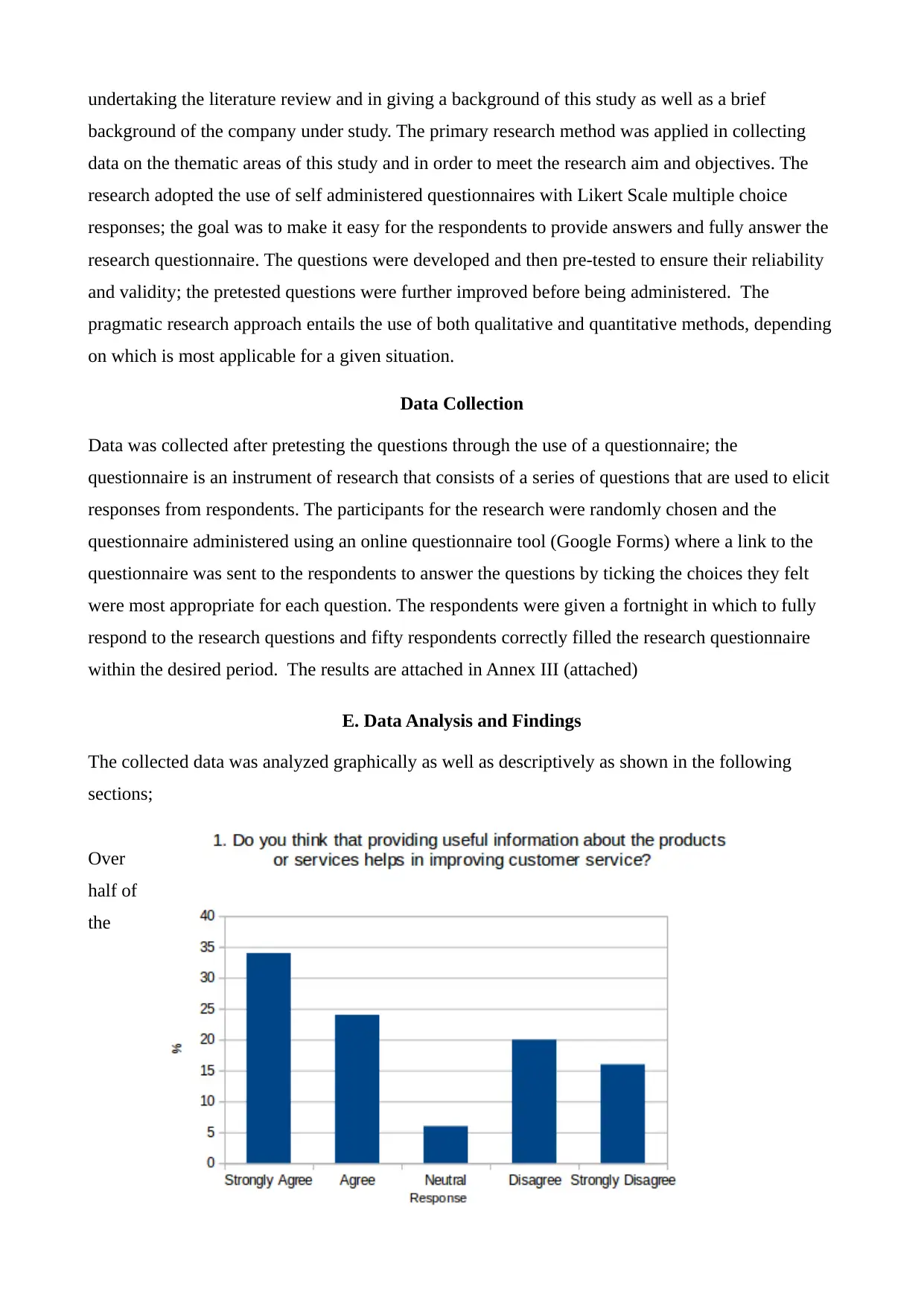
Over
half of
the
background of the company under study. The primary research method was applied in collecting
data on the thematic areas of this study and in order to meet the research aim and objectives. The
research adopted the use of self administered questionnaires with Likert Scale multiple choice
responses; the goal was to make it easy for the respondents to provide answers and fully answer the
research questionnaire. The questions were developed and then pre-tested to ensure their reliability
and validity; the pretested questions were further improved before being administered. The
pragmatic research approach entails the use of both qualitative and quantitative methods, depending
on which is most applicable for a given situation.
Data Collection
Data was collected after pretesting the questions through the use of a questionnaire; the
questionnaire is an instrument of research that consists of a series of questions that are used to elicit
responses from respondents. The participants for the research were randomly chosen and the
questionnaire administered using an online questionnaire tool (Google Forms) where a link to the
questionnaire was sent to the respondents to answer the questions by ticking the choices they felt
were most appropriate for each question. The respondents were given a fortnight in which to fully
respond to the research questions and fifty respondents correctly filled the research questionnaire
within the desired period. The results are attached in Annex III (attached)
E. Data Analysis and Findings
The collected data was analyzed graphically as well as descriptively as shown in the following
sections;
Over
half of
the
⊘ This is a preview!⊘
Do you want full access?
Subscribe today to unlock all pages.
Trusted by 1+ million students worldwide
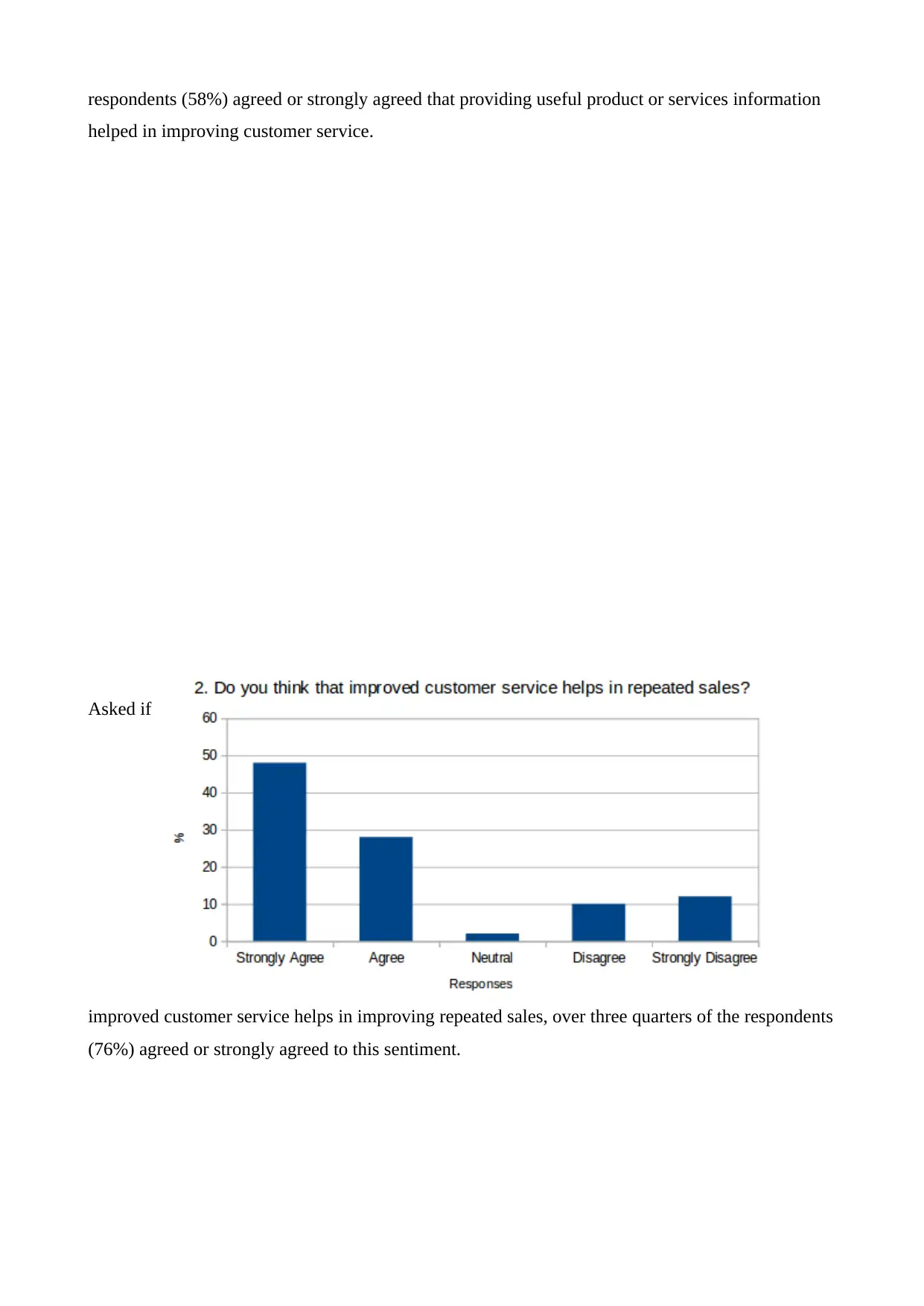
respondents (58%) agreed or strongly agreed that providing useful product or services information
helped in improving customer service.
Asked if
improved customer service helps in improving repeated sales, over three quarters of the respondents
(76%) agreed or strongly agreed to this sentiment.
helped in improving customer service.
Asked if
improved customer service helps in improving repeated sales, over three quarters of the respondents
(76%) agreed or strongly agreed to this sentiment.
Paraphrase This Document
Need a fresh take? Get an instant paraphrase of this document with our AI Paraphraser
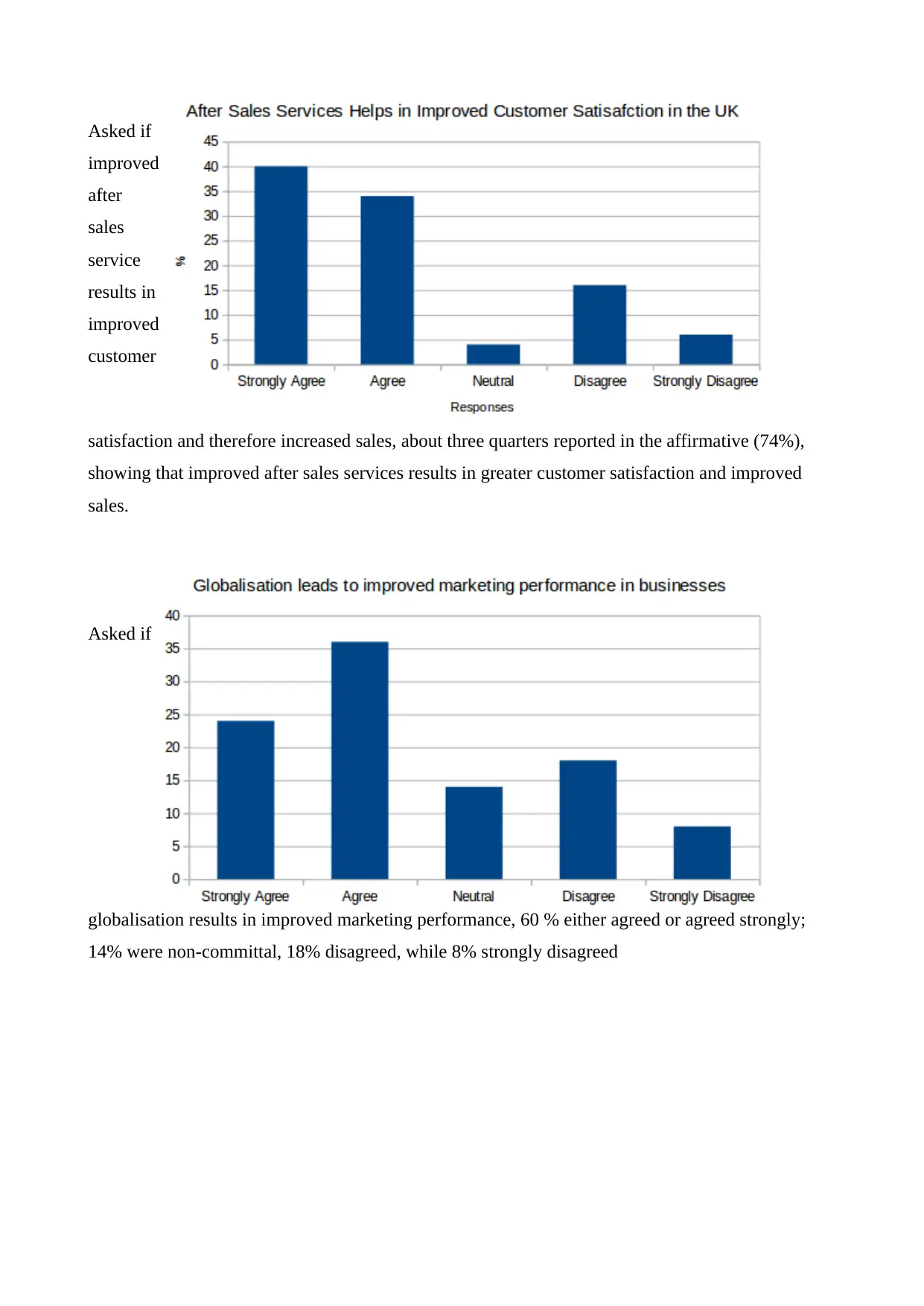
Asked if
improved
after
sales
service
results in
improved
customer
satisfaction and therefore increased sales, about three quarters reported in the affirmative (74%),
showing that improved after sales services results in greater customer satisfaction and improved
sales.
Asked if
globalisation results in improved marketing performance, 60 % either agreed or agreed strongly;
14% were non-committal, 18% disagreed, while 8% strongly disagreed
improved
after
sales
service
results in
improved
customer
satisfaction and therefore increased sales, about three quarters reported in the affirmative (74%),
showing that improved after sales services results in greater customer satisfaction and improved
sales.
Asked if
globalisation results in improved marketing performance, 60 % either agreed or agreed strongly;
14% were non-committal, 18% disagreed, while 8% strongly disagreed
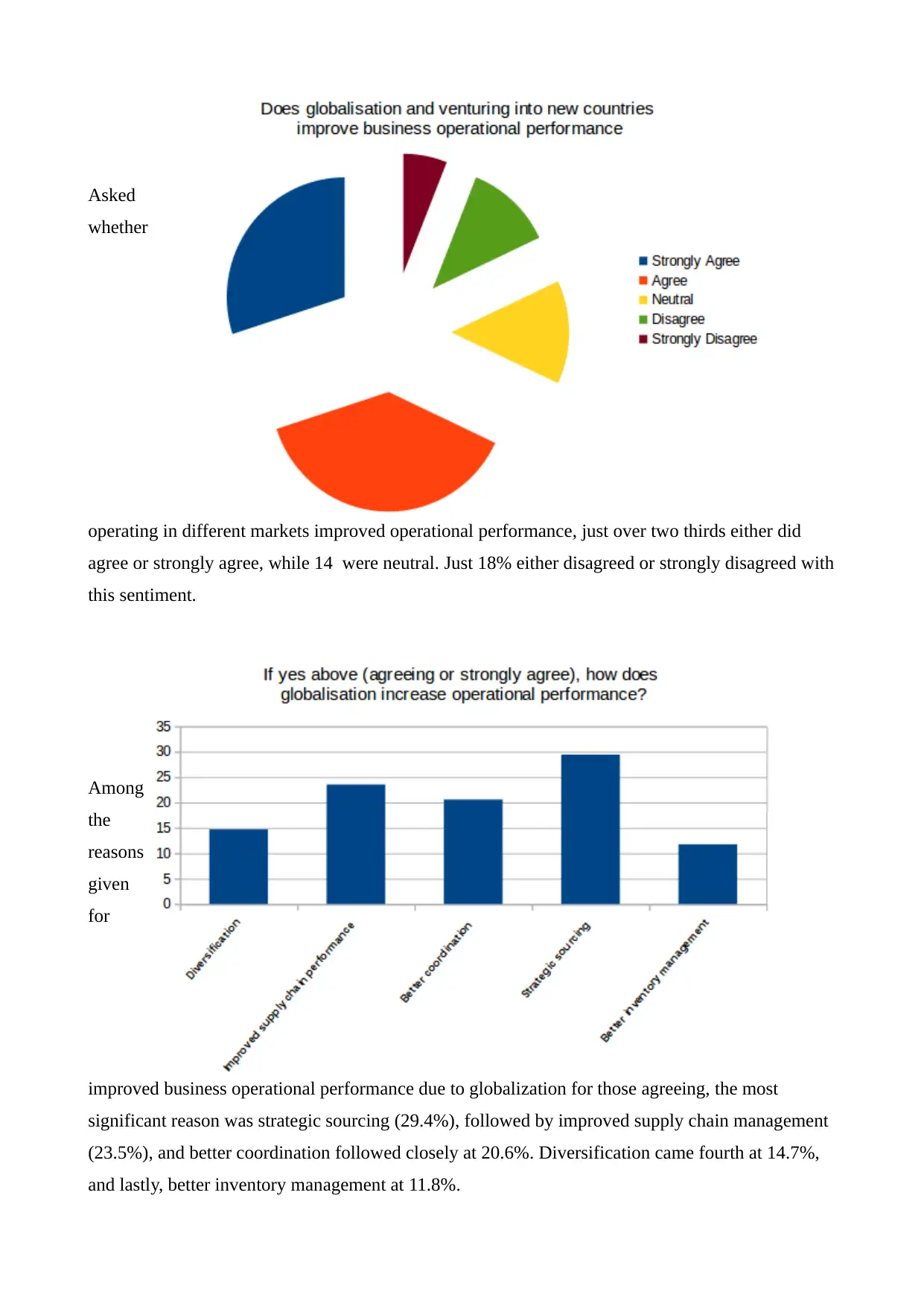
Asked
whether
operating in different markets improved operational performance, just over two thirds either did
agree or strongly agree, while 14 were neutral. Just 18% either disagreed or strongly disagreed with
this sentiment.
Among
the
reasons
given
for
improved business operational performance due to globalization for those agreeing, the most
significant reason was strategic sourcing (29.4%), followed by improved supply chain management
(23.5%), and better coordination followed closely at 20.6%. Diversification came fourth at 14.7%,
and lastly, better inventory management at 11.8%.
whether
operating in different markets improved operational performance, just over two thirds either did
agree or strongly agree, while 14 were neutral. Just 18% either disagreed or strongly disagreed with
this sentiment.
Among
the
reasons
given
for
improved business operational performance due to globalization for those agreeing, the most
significant reason was strategic sourcing (29.4%), followed by improved supply chain management
(23.5%), and better coordination followed closely at 20.6%. Diversification came fourth at 14.7%,
and lastly, better inventory management at 11.8%.
⊘ This is a preview!⊘
Do you want full access?
Subscribe today to unlock all pages.
Trusted by 1+ million students worldwide

1 out of 22


Related Documents


Your All-in-One AI-Powered Toolkit for Academic Success.
+13062052269
info@desklib.com
Available 24*7 on WhatsApp / Email
![[object Object]](/_next/static/media/star-bottom.7253800d.svg)
Unlock your academic potential
Copyright © 2020–2026 A2Z Services. All Rights Reserved. Developed and managed by ZUCOL.