Research Report: Globalisation Impact on Consumer Behaviour at M&S
VerifiedAdded on 2023/04/23
|58
|14306
|90
Report
AI Summary
This report examines the impact of globalisation on consumer behaviour, using Marks & Spencer (M&S) PLC as a case study. It explores the relationship between globalisation and changes in consumer behaviour, drawing upon a critical literature review that provides in-depth knowledge of globalisation's influence. The research employs a mixed-method analysis, including a sequential explanatory design to achieve triangulation. Findings indicate a significant positive correlation between globalisation and consumer behaviour. The report concludes with recommendations based on the findings, while acknowledging the limitation of a relatively small sample size. Further research is suggested to enhance the results. Desklib provides access to similar solved assignments and resources for students.
Running head: RESEARCH PAPER
To analyse the impact of globalisation on customer behaviour within a Multi-National
Company (MNC) - “A study on Marks & Spencer (M&S) PLC.”
Name of the student
Name of the university
Author note
To analyse the impact of globalisation on customer behaviour within a Multi-National
Company (MNC) - “A study on Marks & Spencer (M&S) PLC.”
Name of the student
Name of the university
Author note

Paraphrase This Document
Need a fresh take? Get an instant paraphrase of this document with our AI Paraphraser
1RESEARCH PAPER
Acknowledgement
First and foremost, I would like to thank my supervisors, Prof. …, who supported me through
this research with their patience, knowledge, and understanding. I could not have wished for
better, highly qualified and approachable supervisor. He is so patient and supportive
throughout our session, particularly his one-to-one support.
I would like to thank my family. They were always supporting me and encouraging me with
their best wishes.
I would also like to thank my lecturers, non-academic staffs and my distinguished classmates
for their kind support and appreciation toward me throughout this program.
Acknowledgement
First and foremost, I would like to thank my supervisors, Prof. …, who supported me through
this research with their patience, knowledge, and understanding. I could not have wished for
better, highly qualified and approachable supervisor. He is so patient and supportive
throughout our session, particularly his one-to-one support.
I would like to thank my family. They were always supporting me and encouraging me with
their best wishes.
I would also like to thank my lecturers, non-academic staffs and my distinguished classmates
for their kind support and appreciation toward me throughout this program.
2RESEARCH PAPER
Abstract
This report had examined the impact of globalisation on the consumer behaviour. Marks &
Spencer had been chosen as the case study in the research. The major aim of the research was
to examine the relationship between the variables and understand the key changes in the
consumer behaviour. The critical literature review had provided in depth knowledge on
globalisation and its influence on consumer behaviour. The gap in the previous literature had
been examined and the research had progressed as per the gap. The research methods has
been developed based on the objectives where mixed method analysis had been performed to
accomplish significant results. The mixed method analysis consisted of using a sequential
explanatory design which facilitated in achieving triangulation in the research. The findings
of the research has clearly shown that there has been significant impact of globalisation on
the consumer behaviour where majority of the elements has shown strong positive
correlation. The research had provided valid conclusion and recommendation based on the
findings in the research. The major limitation of the study was that the sample size used in
relatively small and further research could have been conducted to provide better results.
Abstract
This report had examined the impact of globalisation on the consumer behaviour. Marks &
Spencer had been chosen as the case study in the research. The major aim of the research was
to examine the relationship between the variables and understand the key changes in the
consumer behaviour. The critical literature review had provided in depth knowledge on
globalisation and its influence on consumer behaviour. The gap in the previous literature had
been examined and the research had progressed as per the gap. The research methods has
been developed based on the objectives where mixed method analysis had been performed to
accomplish significant results. The mixed method analysis consisted of using a sequential
explanatory design which facilitated in achieving triangulation in the research. The findings
of the research has clearly shown that there has been significant impact of globalisation on
the consumer behaviour where majority of the elements has shown strong positive
correlation. The research had provided valid conclusion and recommendation based on the
findings in the research. The major limitation of the study was that the sample size used in
relatively small and further research could have been conducted to provide better results.
⊘ This is a preview!⊘
Do you want full access?
Subscribe today to unlock all pages.

Trusted by 1+ million students worldwide
3RESEARCH PAPER
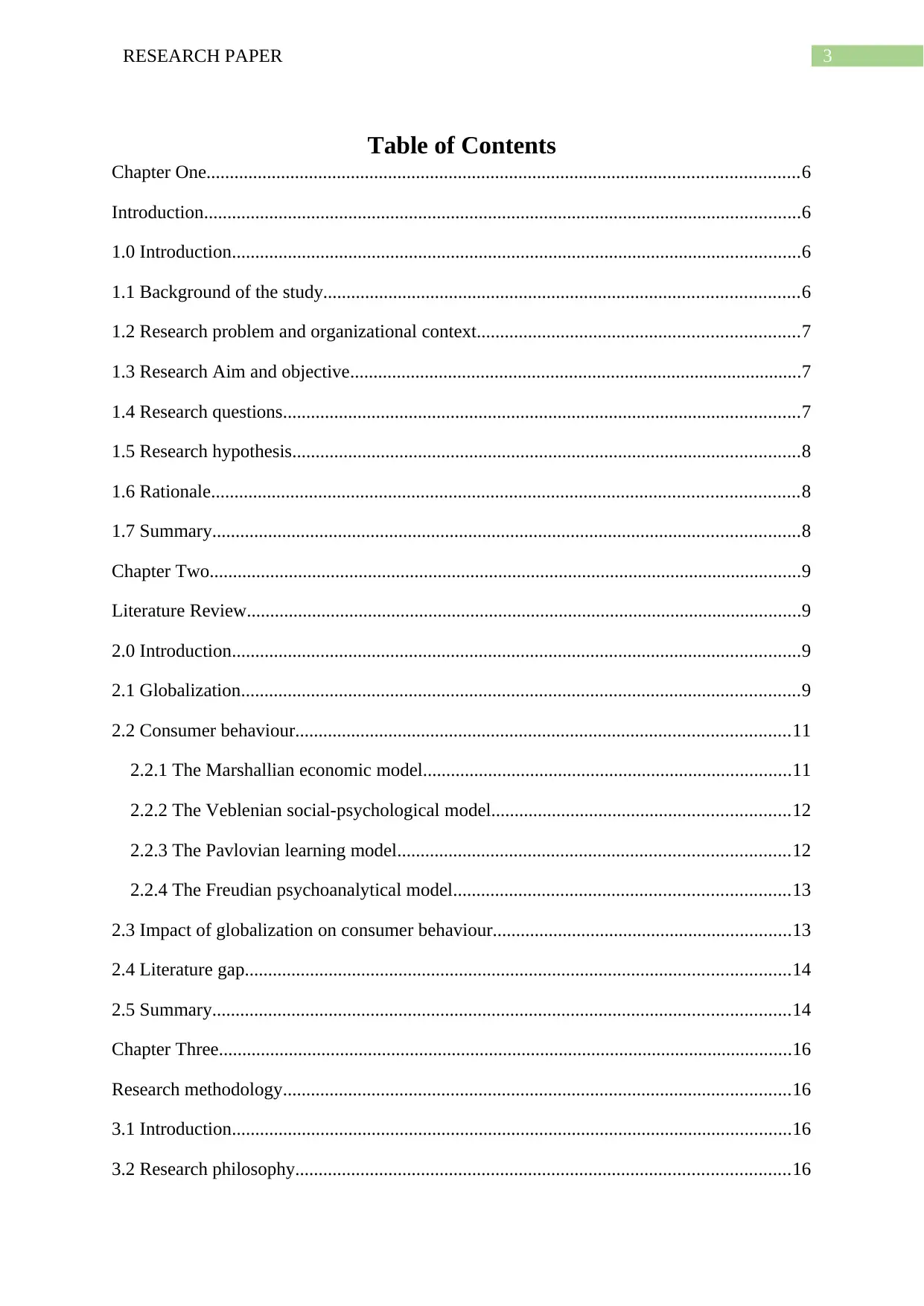
Table of Contents
Chapter One...............................................................................................................................6
Introduction................................................................................................................................6
1.0 Introduction..........................................................................................................................6
1.1 Background of the study......................................................................................................6
1.2 Research problem and organizational context.....................................................................7
1.3 Research Aim and objective.................................................................................................7
1.4 Research questions...............................................................................................................7
1.5 Research hypothesis.............................................................................................................8
1.6 Rationale..............................................................................................................................8
1.7 Summary..............................................................................................................................8
Chapter Two...............................................................................................................................9
Literature Review.......................................................................................................................9
2.0 Introduction..........................................................................................................................9
2.1 Globalization........................................................................................................................9
2.2 Consumer behaviour..........................................................................................................11
2.2.1 The Marshallian economic model...............................................................................11
2.2.2 The Veblenian social-psychological model................................................................12
2.2.3 The Pavlovian learning model....................................................................................12
2.2.4 The Freudian psychoanalytical model........................................................................13
2.3 Impact of globalization on consumer behaviour................................................................13
2.4 Literature gap.....................................................................................................................14
2.5 Summary............................................................................................................................14
Chapter Three...........................................................................................................................16
Research methodology.............................................................................................................16
3.1 Introduction........................................................................................................................16
3.2 Research philosophy..........................................................................................................16
Table of Contents
Chapter One...............................................................................................................................6
Introduction................................................................................................................................6
1.0 Introduction..........................................................................................................................6
1.1 Background of the study......................................................................................................6
1.2 Research problem and organizational context.....................................................................7
1.3 Research Aim and objective.................................................................................................7
1.4 Research questions...............................................................................................................7
1.5 Research hypothesis.............................................................................................................8
1.6 Rationale..............................................................................................................................8
1.7 Summary..............................................................................................................................8
Chapter Two...............................................................................................................................9
Literature Review.......................................................................................................................9
2.0 Introduction..........................................................................................................................9
2.1 Globalization........................................................................................................................9
2.2 Consumer behaviour..........................................................................................................11
2.2.1 The Marshallian economic model...............................................................................11
2.2.2 The Veblenian social-psychological model................................................................12
2.2.3 The Pavlovian learning model....................................................................................12
2.2.4 The Freudian psychoanalytical model........................................................................13
2.3 Impact of globalization on consumer behaviour................................................................13
2.4 Literature gap.....................................................................................................................14
2.5 Summary............................................................................................................................14
Chapter Three...........................................................................................................................16
Research methodology.............................................................................................................16
3.1 Introduction........................................................................................................................16
3.2 Research philosophy..........................................................................................................16
Paraphrase This Document
Need a fresh take? Get an instant paraphrase of this document with our AI Paraphraser
4RESEARCH PAPER
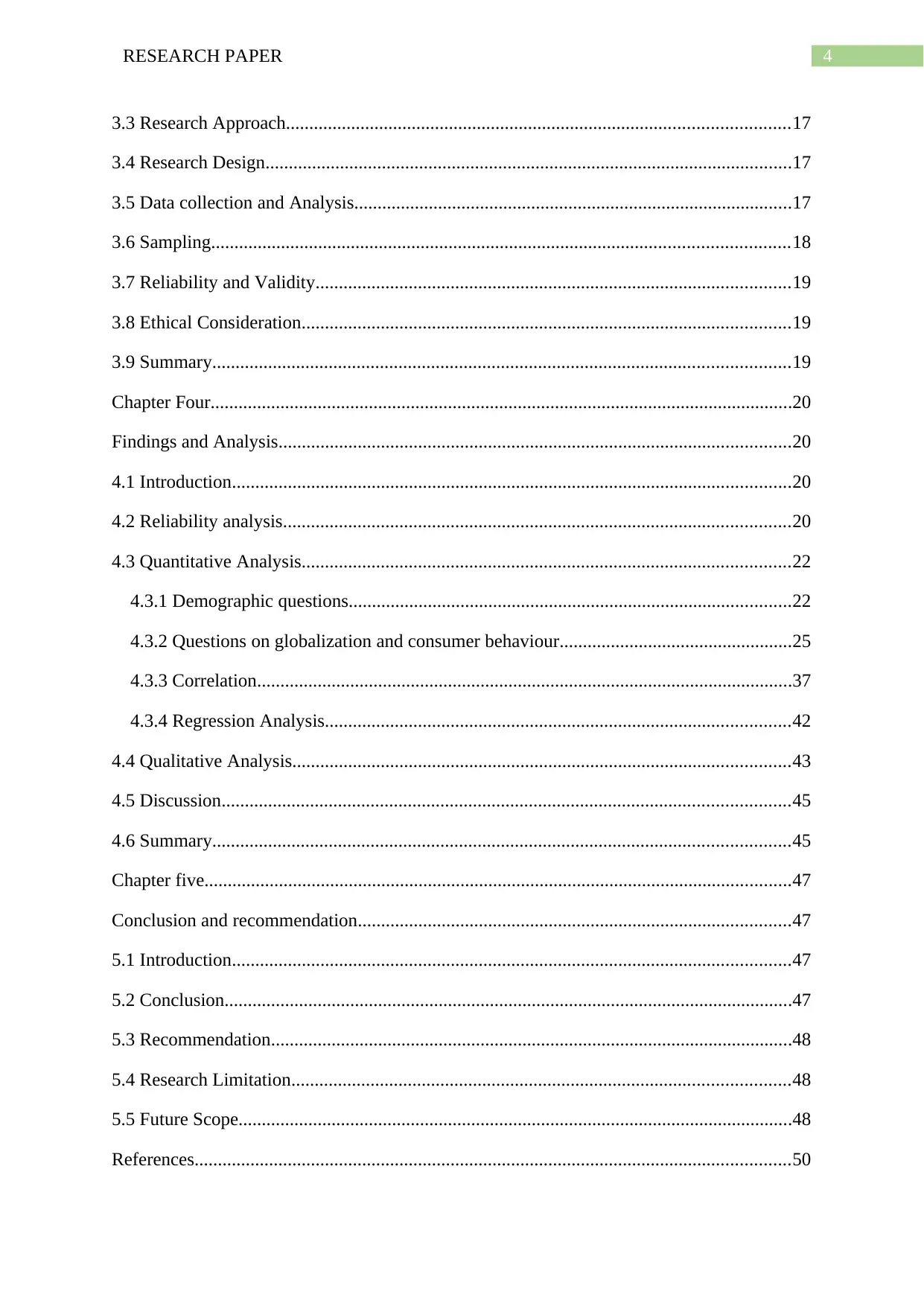
3.3 Research Approach............................................................................................................17
3.4 Research Design.................................................................................................................17
3.5 Data collection and Analysis..............................................................................................17
3.6 Sampling............................................................................................................................18
3.7 Reliability and Validity......................................................................................................19
3.8 Ethical Consideration.........................................................................................................19
3.9 Summary............................................................................................................................19
Chapter Four.............................................................................................................................20
Findings and Analysis..............................................................................................................20
4.1 Introduction........................................................................................................................20
4.2 Reliability analysis.............................................................................................................20
4.3 Quantitative Analysis.........................................................................................................22
4.3.1 Demographic questions...............................................................................................22
4.3.2 Questions on globalization and consumer behaviour..................................................25
4.3.3 Correlation...................................................................................................................37
4.3.4 Regression Analysis....................................................................................................42
4.4 Qualitative Analysis...........................................................................................................43
4.5 Discussion..........................................................................................................................45
4.6 Summary............................................................................................................................45
Chapter five..............................................................................................................................47
Conclusion and recommendation.............................................................................................47
5.1 Introduction........................................................................................................................47
5.2 Conclusion..........................................................................................................................47
5.3 Recommendation................................................................................................................48
5.4 Research Limitation...........................................................................................................48
5.5 Future Scope.......................................................................................................................48
References................................................................................................................................50
3.3 Research Approach............................................................................................................17
3.4 Research Design.................................................................................................................17
3.5 Data collection and Analysis..............................................................................................17
3.6 Sampling............................................................................................................................18
3.7 Reliability and Validity......................................................................................................19
3.8 Ethical Consideration.........................................................................................................19
3.9 Summary............................................................................................................................19
Chapter Four.............................................................................................................................20
Findings and Analysis..............................................................................................................20
4.1 Introduction........................................................................................................................20
4.2 Reliability analysis.............................................................................................................20
4.3 Quantitative Analysis.........................................................................................................22
4.3.1 Demographic questions...............................................................................................22
4.3.2 Questions on globalization and consumer behaviour..................................................25
4.3.3 Correlation...................................................................................................................37
4.3.4 Regression Analysis....................................................................................................42
4.4 Qualitative Analysis...........................................................................................................43
4.5 Discussion..........................................................................................................................45
4.6 Summary............................................................................................................................45
Chapter five..............................................................................................................................47
Conclusion and recommendation.............................................................................................47
5.1 Introduction........................................................................................................................47
5.2 Conclusion..........................................................................................................................47
5.3 Recommendation................................................................................................................48
5.4 Research Limitation...........................................................................................................48
5.5 Future Scope.......................................................................................................................48
References................................................................................................................................50

5RESEARCH PAPER
Appendices...............................................................................................................................54
Appendix..................................................................................................................................54
Appendices...............................................................................................................................54
Appendix..................................................................................................................................54
⊘ This is a preview!⊘
Do you want full access?
Subscribe today to unlock all pages.
Trusted by 1+ million students worldwide
6RESEARCH PAPER
CHAPTER ONE
INTRODUCTION
1.0 INTRODUCTION
Globalization has changed the ways companies operate in the global market due to the
increase in free trade and technological advancement. The perception of the consumers have
changed dramatically over the past centuries. The living standards of the consumers have
improved in global context which makes the people strive for the best product that meets
their specific needs. This has increased the level of competition in the global market and
companies are facing difficulty in keeping up with the change in nature of consumer
behaviour. This research has utilized Marks & Spencer (M&S) PLC as a case study to
examine the ways the company is being affected due to the change in behaviour of the
consumers. The retail industry in the United Kingdom is highly competitive and saturated
which poses added issues for the business entity.
1.1 BACKGROUND OF THE STUDY
Marks & Spencer (M&S) PLC is one of the major retailers in Britain. The company
has it’s headquarter in Westminster, London. The organization sells luxury food products,
clothes and home products. The company has almost 1000 stores all across United Kingdom
out of which more than 600 stores only sells food products (Marksandspencer.com 2019).
The company has been facing issues in the past decade where there has been significant
decrease in the sales of their clothing. On the contrary, they have seen increase in the sale in
the food department. The company has been planning to make a radical change which is
expected to close more than 100 stores all over United Kingdom (Brinded 2018).
The global marketplace has been equipped with global communication which has
made the market open and competitive. Contemporary trends in the global market suggests
that majority of the companies are integrating strategies that are customer centric due to the
increase in market competition. Globalization has provided the small scale companies with
the opportunity to have a wider reach by using digital market (Fedorenko 2018). However, it
has provided opportunities to the retail companies to explore new markets but it is essential to
be aware of the culture and preferences of the consumers for success. Consumer preferences
CHAPTER ONE
INTRODUCTION
1.0 INTRODUCTION
Globalization has changed the ways companies operate in the global market due to the
increase in free trade and technological advancement. The perception of the consumers have
changed dramatically over the past centuries. The living standards of the consumers have
improved in global context which makes the people strive for the best product that meets
their specific needs. This has increased the level of competition in the global market and
companies are facing difficulty in keeping up with the change in nature of consumer
behaviour. This research has utilized Marks & Spencer (M&S) PLC as a case study to
examine the ways the company is being affected due to the change in behaviour of the
consumers. The retail industry in the United Kingdom is highly competitive and saturated
which poses added issues for the business entity.
1.1 BACKGROUND OF THE STUDY
Marks & Spencer (M&S) PLC is one of the major retailers in Britain. The company
has it’s headquarter in Westminster, London. The organization sells luxury food products,
clothes and home products. The company has almost 1000 stores all across United Kingdom
out of which more than 600 stores only sells food products (Marksandspencer.com 2019).
The company has been facing issues in the past decade where there has been significant
decrease in the sales of their clothing. On the contrary, they have seen increase in the sale in
the food department. The company has been planning to make a radical change which is
expected to close more than 100 stores all over United Kingdom (Brinded 2018).
The global marketplace has been equipped with global communication which has
made the market open and competitive. Contemporary trends in the global market suggests
that majority of the companies are integrating strategies that are customer centric due to the
increase in market competition. Globalization has provided the small scale companies with
the opportunity to have a wider reach by using digital market (Fedorenko 2018). However, it
has provided opportunities to the retail companies to explore new markets but it is essential to
be aware of the culture and preferences of the consumers for success. Consumer preferences
Paraphrase This Document
Need a fresh take? Get an instant paraphrase of this document with our AI Paraphraser
7RESEARCH PAPER
have been changing quite rapidly where companies have to be flexible and adaptive to be at
par with the fast changing nature goods and services (Hardley 2018).
1.2 RESEARCH PROBLEM AND ORGANIZATIONAL CONTEXT
Marks & Spencer (M&S) Plc has been going significant decline in the past decade
where consumers are disappointed and criticised them for their clothing ranges and
overpriced food products. Marks & Spencer (M&S) Plc has announced that would be closing
100 of their stores all over United Kingdom by the end of 2022 (Gilliland 2018). The retail
sales of the company have decreased to 1.9% form 4.7% in the year of 2017 (Gilliland 2018).
It has been quite difficult for Marks & Spencer (M&S) to compete with global clothing
brands and food retail brands due to their convenience and price. Lack of digital innovation is
another critical issue where the ecommerce offerings are not descent when compared to the
other major retailers in the market. The usability and design is quite average which shows
that the company has been quite slow in coping with the change in market trends and
globalization (Gilliland 2018). Moreover, the company is just doing enough to hold on their
business but drastic changes are required so that the company can compete with other
companies like Tesco and GAP. This research has addressed these issues which reflect that
Marks & Spencer (M&S) has not been able to keep up with the global changes and the
research would examine the impact of these factors on the operations of the company.
1.3 RESEARCH AIM AND OBJECTIVE
The major aim of the research to evaluate the impact of globalization on the behaviour
of the consumers in Marks & Spencer (M&S) PLC. The research has identified the different
elements of globalisation that is critical for the retail industry. The impact of these factors on
the behaviour of the consumers has been examined to recommend suitable strategies. These
strategies can be used by the organization to cope up with the changes in consumer
preferences.
To evaluate the different element of consumer behaviour
To analyse the impact of globalisation on the consumer behaviour in Marks &
Spencer (M&S) PLC
To recommend suitable strategies to cope up with the change
have been changing quite rapidly where companies have to be flexible and adaptive to be at
par with the fast changing nature goods and services (Hardley 2018).
1.2 RESEARCH PROBLEM AND ORGANIZATIONAL CONTEXT
Marks & Spencer (M&S) Plc has been going significant decline in the past decade
where consumers are disappointed and criticised them for their clothing ranges and
overpriced food products. Marks & Spencer (M&S) Plc has announced that would be closing
100 of their stores all over United Kingdom by the end of 2022 (Gilliland 2018). The retail
sales of the company have decreased to 1.9% form 4.7% in the year of 2017 (Gilliland 2018).
It has been quite difficult for Marks & Spencer (M&S) to compete with global clothing
brands and food retail brands due to their convenience and price. Lack of digital innovation is
another critical issue where the ecommerce offerings are not descent when compared to the
other major retailers in the market. The usability and design is quite average which shows
that the company has been quite slow in coping with the change in market trends and
globalization (Gilliland 2018). Moreover, the company is just doing enough to hold on their
business but drastic changes are required so that the company can compete with other
companies like Tesco and GAP. This research has addressed these issues which reflect that
Marks & Spencer (M&S) has not been able to keep up with the global changes and the
research would examine the impact of these factors on the operations of the company.
1.3 RESEARCH AIM AND OBJECTIVE
The major aim of the research to evaluate the impact of globalization on the behaviour
of the consumers in Marks & Spencer (M&S) PLC. The research has identified the different
elements of globalisation that is critical for the retail industry. The impact of these factors on
the behaviour of the consumers has been examined to recommend suitable strategies. These
strategies can be used by the organization to cope up with the changes in consumer
preferences.
To evaluate the different element of consumer behaviour
To analyse the impact of globalisation on the consumer behaviour in Marks &
Spencer (M&S) PLC
To recommend suitable strategies to cope up with the change
8RESEARCH PAPER
1.4 RESEARCH QUESTIONS
How does globalization impact behaviour of the consumers in Marks & Spencer
(M&S) PLC?
What are the different element of consumer behaviour?
1.5 RESEARCH HYPOTHESIS
H0: There is no impact of globalisation on the consumer behaviour in Marks & Spencer
(M&S) PLC
H1: There is significant impact of globalisation on the consumer behaviour in Marks &
Spencer (M&S) PLC
1.6 RATIONALE
This topic has been chosen for the research as globalization is one of the significant
changes in the past decades that has been responsible in shaping the changes in the modern
business environment. The initiation point of all the companies has been globalization which
led to significant changes in consumer preferences and business strategies. This topic has
significant importance in the modern business environment and provides a greater
opportunity to gain knowledge on the changing nature of consumers. Marks & Spencer
(M&S) Plc has been facing issues for the past decade which resulted in the decrease in profit
margin and sales volumes. The research has been conducted to highlight the major impact of
globalization on the company and provide recommendations on how the management can
bring about a significant change. Moreover, the research has facilitated in developing
problem solving and analytical skills required for working in modern business sector.
1.7 SUMMARY
This chapter has provided a detail description of the purpose, objective and reasons
for conducting this research. The research question has been formulated based on the
objective and scope of the research. The research hypothesis has been develop to establish the
relationship between globalization and consumer behaviour. This chapter depicts the scope of
the research project and the areas to be covered. The next chapter has critically evaluated past
peer reviewed journals and articles to identify the gap in past researches and develop a
conceptual framework for this study.
1.4 RESEARCH QUESTIONS
How does globalization impact behaviour of the consumers in Marks & Spencer
(M&S) PLC?
What are the different element of consumer behaviour?
1.5 RESEARCH HYPOTHESIS
H0: There is no impact of globalisation on the consumer behaviour in Marks & Spencer
(M&S) PLC
H1: There is significant impact of globalisation on the consumer behaviour in Marks &
Spencer (M&S) PLC
1.6 RATIONALE
This topic has been chosen for the research as globalization is one of the significant
changes in the past decades that has been responsible in shaping the changes in the modern
business environment. The initiation point of all the companies has been globalization which
led to significant changes in consumer preferences and business strategies. This topic has
significant importance in the modern business environment and provides a greater
opportunity to gain knowledge on the changing nature of consumers. Marks & Spencer
(M&S) Plc has been facing issues for the past decade which resulted in the decrease in profit
margin and sales volumes. The research has been conducted to highlight the major impact of
globalization on the company and provide recommendations on how the management can
bring about a significant change. Moreover, the research has facilitated in developing
problem solving and analytical skills required for working in modern business sector.
1.7 SUMMARY
This chapter has provided a detail description of the purpose, objective and reasons
for conducting this research. The research question has been formulated based on the
objective and scope of the research. The research hypothesis has been develop to establish the
relationship between globalization and consumer behaviour. This chapter depicts the scope of
the research project and the areas to be covered. The next chapter has critically evaluated past
peer reviewed journals and articles to identify the gap in past researches and develop a
conceptual framework for this study.
⊘ This is a preview!⊘
Do you want full access?
Subscribe today to unlock all pages.
Trusted by 1+ million students worldwide
9RESEARCH PAPER
CHAPTER TWO
LITERATURE REVIEW
2.0 INTRODUCTION
There has been significant increase in cross border operations due to the advent of
globalization. A quantum outflow and inflow of services and goods shows the magnitude of
increase in free trade all over the world. Globalization has increased the opportunities for
even smaller companies that are competing at the same scale with the multinational
companies. This has also increased the number of options a consumer has before making a
purchase (Cleveland et al. 2016). Moreover, the improvement and web 2.0 have provided the
opportunity access good and services for different parts of the world. This chapter has
critically evaluated the past literatures that have addressed the topic of globalisation and its
impact on the consumer behaviour. The analysis of the past literature has facilitated in
understanding the progression from the first stage of globalization to the current scenario in
the global market.
2.1 GLOBALIZATION
Sobol, Cleveland and Laroche (2018) states that globalization can be defined as the
phenomenon which has led to spontaneous and historical liberalization. It has facilitated in
integrating labour force, markets, capital, information and technology into a global market
which is interdependent in nature. According to Cleveland et al. (2016), globalization is the
process of integrating both regional and national market into a single global market which
results in the unification and penetration of the political, cultural and economic spheres.
Cleveland, Laroche and Takahashi (2015) highlighted five types of flows in the global
market; mediascapes (flow of communication and ideas), ideascapes (flow of political ideas
or ideologies), ethnoscapes (flow of foreign students, migrants and tourists), finanscapes
(flow of capital and money) and technoscapes (flow of technology). On the other hand, Khan
et al. (2015) opined that globalization can be broken down into various elements such as the
economy, community, governments and cross country borders. This signifies that increase in
openness and liberalization of the market due to the elimination of trade barriers in both
services and goods. This also resulted in the development of an international financial market
which is integrated.
CHAPTER TWO
LITERATURE REVIEW
2.0 INTRODUCTION
There has been significant increase in cross border operations due to the advent of
globalization. A quantum outflow and inflow of services and goods shows the magnitude of
increase in free trade all over the world. Globalization has increased the opportunities for
even smaller companies that are competing at the same scale with the multinational
companies. This has also increased the number of options a consumer has before making a
purchase (Cleveland et al. 2016). Moreover, the improvement and web 2.0 have provided the
opportunity access good and services for different parts of the world. This chapter has
critically evaluated the past literatures that have addressed the topic of globalisation and its
impact on the consumer behaviour. The analysis of the past literature has facilitated in
understanding the progression from the first stage of globalization to the current scenario in
the global market.
2.1 GLOBALIZATION
Sobol, Cleveland and Laroche (2018) states that globalization can be defined as the
phenomenon which has led to spontaneous and historical liberalization. It has facilitated in
integrating labour force, markets, capital, information and technology into a global market
which is interdependent in nature. According to Cleveland et al. (2016), globalization is the
process of integrating both regional and national market into a single global market which
results in the unification and penetration of the political, cultural and economic spheres.
Cleveland, Laroche and Takahashi (2015) highlighted five types of flows in the global
market; mediascapes (flow of communication and ideas), ideascapes (flow of political ideas
or ideologies), ethnoscapes (flow of foreign students, migrants and tourists), finanscapes
(flow of capital and money) and technoscapes (flow of technology). On the other hand, Khan
et al. (2015) opined that globalization can be broken down into various elements such as the
economy, community, governments and cross country borders. This signifies that increase in
openness and liberalization of the market due to the elimination of trade barriers in both
services and goods. This also resulted in the development of an international financial market
which is integrated.
Paraphrase This Document
Need a fresh take? Get an instant paraphrase of this document with our AI Paraphraser
10RESEARCH PAPER
As stated by Kaharuddin et al. (2017), globalization has contributed mainly to the
homogenization of different types of consumptions. There has been significant changes in
the lifestyle of different social and age groups and there has been significant reduction in the
role of the local traditions in changing the consumer behaviour. As stated by Mokyr, Vickers
and Ziebarth (2015), there has been significant increase in population, technological boom,
economic growth and expansion of cites after the industrial revolutions in the 19th century.
However, there was not equal benefit for all the parties where some became richer and there
were who became poorer. Globalization changed everything for population from all over the
world where they were able to communicate on a global scale and they were able to move
beyond their local network. Cui (2016) states that the lives of the consumers have been made
simpler due to the fast information connections and technology has been connected to the
individuals. On the other hand, Verschaeve, Delputte and Orbie (2016) explained that there
is re-birth of the local industry due to the rapid increase in flow of foreign direct investments
from the markets. The increase in competition has made the local consumers aware of the
fact that it is essential to analyse the behaviours of the consumers in order to retain existing
and acquiring new potential consumers. Globalization can be considered as a new reality for
the commercial market as it results in integration of technology and products to facilitate
trade in local and international markets (Teece 2014). The homogeneity in the market has
made the consumer prefer products and services that are standardized in nature. This has
enhanced the rivalry among the companies to a different level.
() states that the key milestone in the fashion industry was the change in the
expressions were not random and casual but was systematic and constant. Human population
has been moving towards a trend that crosses the threshold of modernity. Caleca (2014)
stated that modernization broke the general traditions where European supremacy and
centrality reduced. The radical change in the global market are characterised by increase in
pace of the changes, institution nature and global interconnection is the scope of change.
However, this does not mean that there was end to the traditional fashion but there has been
radical change in the production and consumption cycles (Caleca 2014). Moreover, another
significant change in the industry is the decisive and remarkable presence of experts that are
able to access the change in the fashion needs of the consumers and responsible for the
success of the major global corporations. () states that the modernity of the fashion industry is
evident from the changes in fashion and there is has been significant change in the past two
decade. The term globalisation has carried implications of intensified flow of money,
As stated by Kaharuddin et al. (2017), globalization has contributed mainly to the
homogenization of different types of consumptions. There has been significant changes in
the lifestyle of different social and age groups and there has been significant reduction in the
role of the local traditions in changing the consumer behaviour. As stated by Mokyr, Vickers
and Ziebarth (2015), there has been significant increase in population, technological boom,
economic growth and expansion of cites after the industrial revolutions in the 19th century.
However, there was not equal benefit for all the parties where some became richer and there
were who became poorer. Globalization changed everything for population from all over the
world where they were able to communicate on a global scale and they were able to move
beyond their local network. Cui (2016) states that the lives of the consumers have been made
simpler due to the fast information connections and technology has been connected to the
individuals. On the other hand, Verschaeve, Delputte and Orbie (2016) explained that there
is re-birth of the local industry due to the rapid increase in flow of foreign direct investments
from the markets. The increase in competition has made the local consumers aware of the
fact that it is essential to analyse the behaviours of the consumers in order to retain existing
and acquiring new potential consumers. Globalization can be considered as a new reality for
the commercial market as it results in integration of technology and products to facilitate
trade in local and international markets (Teece 2014). The homogeneity in the market has
made the consumer prefer products and services that are standardized in nature. This has
enhanced the rivalry among the companies to a different level.
() states that the key milestone in the fashion industry was the change in the
expressions were not random and casual but was systematic and constant. Human population
has been moving towards a trend that crosses the threshold of modernity. Caleca (2014)
stated that modernization broke the general traditions where European supremacy and
centrality reduced. The radical change in the global market are characterised by increase in
pace of the changes, institution nature and global interconnection is the scope of change.
However, this does not mean that there was end to the traditional fashion but there has been
radical change in the production and consumption cycles (Caleca 2014). Moreover, another
significant change in the industry is the decisive and remarkable presence of experts that are
able to access the change in the fashion needs of the consumers and responsible for the
success of the major global corporations. () states that the modernity of the fashion industry is
evident from the changes in fashion and there is has been significant change in the past two
decade. The term globalisation has carried implications of intensified flow of money,
11RESEARCH PAPER
information, technology, money, people, images and goods. However, it does not essential
develop uniformity and fashion industry has been one of the reasons for driving the different
fluxes of globalisation. This is evident from the development of the different fashion
categories and fast fashion industries. Dunford et al. (2016) states that globalization has
enabled a consumer to purchase a European brand product, designed by a designer in Latin
America and produces in Southern Africa. This clearly signifies the extent of globalization in
the global market.
2.2 CONSUMER BEHAVIOUR
Consumer behaviour identification and consumer centricity has become the major
mantra for all the successful companies in the world. Cohen, Prayag and Moital (2014) states
that consumer behaviour can be defined as the process by which customers decide whether,
when, what, how, from and where to purchase services and goods. On the contrary, Wikström
(2014) provided a different definition by stating that it is the behaviour a customer displays
which searching, using, evaluating, purchasing and discarding of services and products. This
indicates the consumer behaviour determines the way consumers determines the way
individuals want to invest their available on items related to consumption. Therefore, it is
study of identify where, when, why and how many times consumers making a purchase. Lu,
Chan H.H. and Chang (2015) stated that there are mainly two different consumer types,
organizational and personal consumers. Personal consumers purchase products for house
hold purposes and organizational consumers purchase products to operate an organization.
According to Cohen, Prayag and Moital (2014), consumer behaviour is comparative a
newer field of study which is a reason that majority of the theoretical approach is taken from
the sociology, social psychology, psychology, economics and anthropology. The advent of
marketing orientation resulted in the increase of marketing concepts where the companies are
aiming to understand the needs of the consumers and marketing their products to address
particular specific needs. This was a drastic change from the product orientation and selling
orientation. Evens and Van Damme (2016) states that different models of human behaviour
has been used to understand the purchasing the behaviour of the consumers. The different
models of human behaviour caters to different scenarios so can relate to different instances of
purchasing behaviour of the consumers. The reason for rationality among the human beings
while making a purchase decision can be understood by different human behavioural models.
information, technology, money, people, images and goods. However, it does not essential
develop uniformity and fashion industry has been one of the reasons for driving the different
fluxes of globalisation. This is evident from the development of the different fashion
categories and fast fashion industries. Dunford et al. (2016) states that globalization has
enabled a consumer to purchase a European brand product, designed by a designer in Latin
America and produces in Southern Africa. This clearly signifies the extent of globalization in
the global market.
2.2 CONSUMER BEHAVIOUR
Consumer behaviour identification and consumer centricity has become the major
mantra for all the successful companies in the world. Cohen, Prayag and Moital (2014) states
that consumer behaviour can be defined as the process by which customers decide whether,
when, what, how, from and where to purchase services and goods. On the contrary, Wikström
(2014) provided a different definition by stating that it is the behaviour a customer displays
which searching, using, evaluating, purchasing and discarding of services and products. This
indicates the consumer behaviour determines the way consumers determines the way
individuals want to invest their available on items related to consumption. Therefore, it is
study of identify where, when, why and how many times consumers making a purchase. Lu,
Chan H.H. and Chang (2015) stated that there are mainly two different consumer types,
organizational and personal consumers. Personal consumers purchase products for house
hold purposes and organizational consumers purchase products to operate an organization.
According to Cohen, Prayag and Moital (2014), consumer behaviour is comparative a
newer field of study which is a reason that majority of the theoretical approach is taken from
the sociology, social psychology, psychology, economics and anthropology. The advent of
marketing orientation resulted in the increase of marketing concepts where the companies are
aiming to understand the needs of the consumers and marketing their products to address
particular specific needs. This was a drastic change from the product orientation and selling
orientation. Evens and Van Damme (2016) states that different models of human behaviour
has been used to understand the purchasing the behaviour of the consumers. The different
models of human behaviour caters to different scenarios so can relate to different instances of
purchasing behaviour of the consumers. The reason for rationality among the human beings
while making a purchase decision can be understood by different human behavioural models.
⊘ This is a preview!⊘
Do you want full access?
Subscribe today to unlock all pages.
Trusted by 1+ million students worldwide

1 out of 58


Related Documents


Your All-in-One AI-Powered Toolkit for Academic Success.
+13062052269
info@desklib.com
Available 24*7 on WhatsApp / Email
![[object Object]](/_next/static/media/star-bottom.7253800d.svg)
Unlock your academic potential
Copyright © 2020–2026 A2Z Services. All Rights Reserved. Developed and managed by ZUCOL.