A Comparative Analysis of Globalization Perspectives: Report

Verified

Added on  2023/04/23

|4
|473
|175
Report
AI Summary
This report provides a comparative analysis of two prominent perspectives on globalization: liberalism and Marxism. It begins by defining globalization as the expansion of Western culture and its impact on international markets. The liberalist perspective, viewed as an extension of market-led modernization, emphasizes the human desire for political liberty and economic welfare, facilitating the interconnection of humanity. Conversely, the Marxist perspective focuses on the exploitation of workers within capitalist systems, viewing globalization as a consequence of capitalist development and profit accumulation. The report highlights the contrasting viewpoints, presenting the core arguments and implications of each perspective, and concludes by acknowledging the value of both approaches in understanding the complexities of globalization.
Document Page
Running head: GLOBALISATION PERSPECTIVES
GLOBALISATION PERSPECTIVES
Name of the Student
Name of the University
Author Note
tabler-icon-diamond-filled.svg

Paraphrase This Document

Need a fresh take? Get an instant paraphrase of this document with our AI Paraphraser
Document Page
1GLOBALISATION PERSPECTIVES
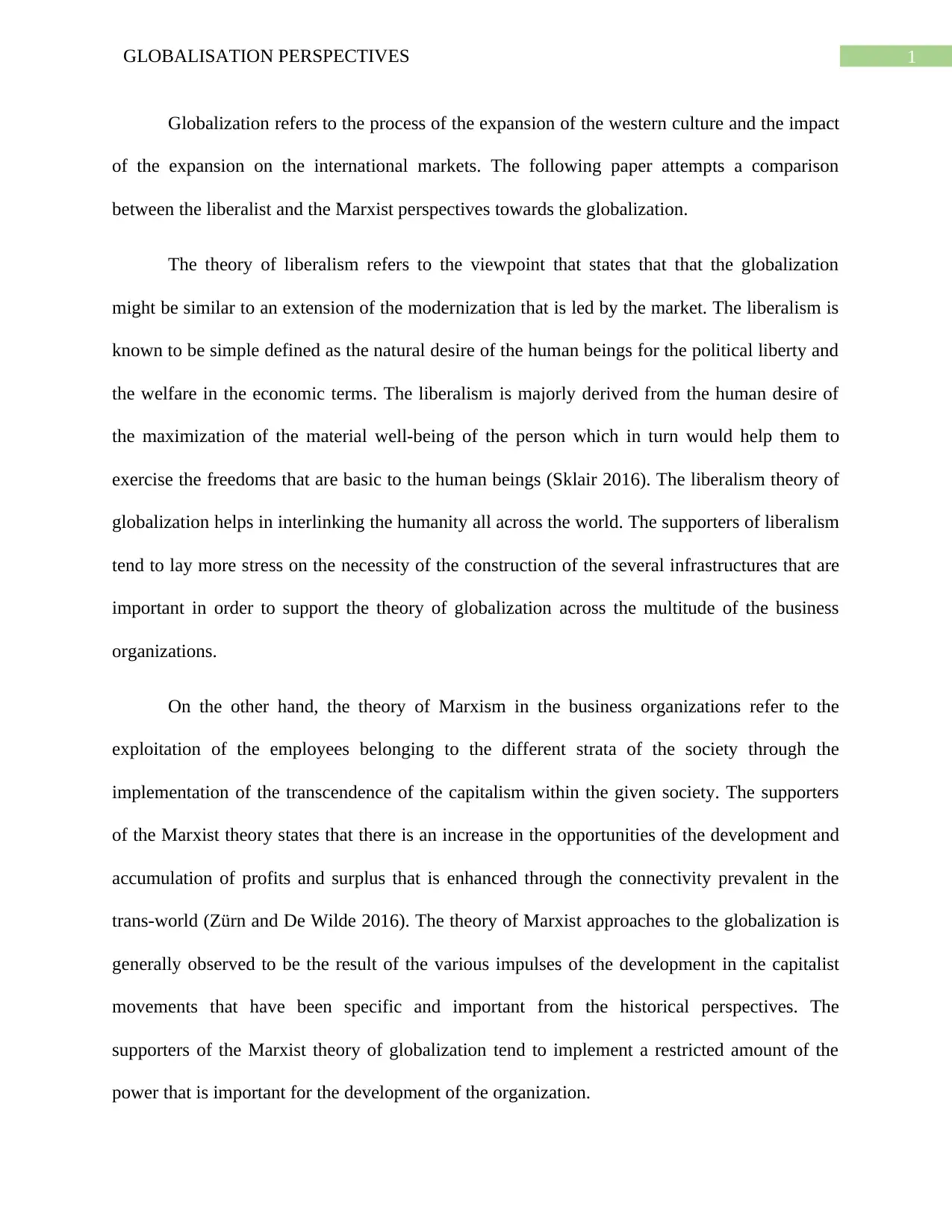
Globalization refers to the process of the expansion of the western culture and the impact
of the expansion on the international markets. The following paper attempts a comparison
between the liberalist and the Marxist perspectives towards the globalization.
The theory of liberalism refers to the viewpoint that states that that the globalization
might be similar to an extension of the modernization that is led by the market. The liberalism is
known to be simple defined as the natural desire of the human beings for the political liberty and
the welfare in the economic terms. The liberalism is majorly derived from the human desire of
the maximization of the material well-being of the person which in turn would help them to
exercise the freedoms that are basic to the human beings (Sklair 2016). The liberalism theory of
globalization helps in interlinking the humanity all across the world. The supporters of liberalism
tend to lay more stress on the necessity of the construction of the several infrastructures that are
important in order to support the theory of globalization across the multitude of the business
organizations.
On the other hand, the theory of Marxism in the business organizations refer to the
exploitation of the employees belonging to the different strata of the society through the
implementation of the transcendence of the capitalism within the given society. The supporters
of the Marxist theory states that there is an increase in the opportunities of the development and
accumulation of profits and surplus that is enhanced through the connectivity prevalent in the
trans-world (Zürn and De Wilde 2016). The theory of Marxist approaches to the globalization is
generally observed to be the result of the various impulses of the development in the capitalist
movements that have been specific and important from the historical perspectives. The
supporters of the Marxist theory of globalization tend to implement a restricted amount of the
power that is important for the development of the organization.
Document Page
2GLOBALISATION PERSPECTIVES
In lieu of the above discussion it might be stated that there are various perspectives to the
concept of globalization. The approaches that are discussed in this case both contribute to the
proper understanding of the concept from different viewpoints.
Document Page
3GLOBALISATION PERSPECTIVES
References
Sklair, L., 2016. The Transnational capitalist class, social movements, and alternatives to
capitalist globalization. International Critical Thought, 6(3), pp.329-341.
Zürn, M. and De Wilde, P., 2016. Debating globalization: cosmopolitanism and
communitarianism as political ideologies. Journal of Political Ideologies, 21(3), pp.280-301.
chevron_up_icon
1 out of 4
circle_padding
hide_on_mobile
zoom_out_icon
[object Object]