Global Business Management Report: Strategies for Apple and Huawei
VerifiedAdded on 2022/11/09
|12
|2665
|308
Report
AI Summary
This report delves into the multifaceted impact of globalization on contemporary business management. It examines how global strategies influence organizational culture and structure, considering ethical and environmental factors. The report analyzes the effects of globalization on decision-making processes within Apple and Huawei, two prominent multinational corporations. It explores how these companies adapt their strategies to diverse global markets, considering cultural differences and market responsiveness. The analysis includes an assessment of the decision-making models employed by each company and proposes recommendations for improving their current strategies. The report also discusses the challenges faced by both companies, such as ethical issues and stakeholder management, and suggests approaches for overcoming these obstacles. Furthermore, the report addresses the importance of local responsiveness, ethical standards, and effective planning in achieving long-term business sustainability in a globalized environment.
Running head: GLOBAL BUSINESS MANAGEMENT
Global business management
Name of the student
Name of the university
Author note
Global business management
Name of the student
Name of the university
Author note

Paraphrase This Document
Need a fresh take? Get an instant paraphrase of this document with our AI Paraphraser
1GLOBAL BUSINESS MANAGEMENT
Table of Contents
Introduction......................................................................................................................................2
Impact of global strategies on the organizational culture................................................................2
Impact of globalization on the decision making process.................................................................5
Determination of the current strategies............................................................................................7
Conclusion.......................................................................................................................................9
Reference.......................................................................................................................................10
Table of Contents
Introduction......................................................................................................................................2
Impact of global strategies on the organizational culture................................................................2
Impact of globalization on the decision making process.................................................................5
Determination of the current strategies............................................................................................7
Conclusion.......................................................................................................................................9
Reference.......................................................................................................................................10
2GLOBAL BUSINESS MANAGEMENT
Introduction
In the current global business state of affairs, the decision making and the internal
management process is different to that of the traditional approach. This is due to the reason that
in the current time, global factors and diversity play an important role for the contemporary
business organizations along with the differences in the cultural factors. Thus, there are different
models being used by the modern day managers in order to have the effectiveness and efficiency
in the business management process (Roh, Hong and Min 2014). In the case of multinationals, it
is important to find the perfect balance between the global integration and local responsiveness
extent and accordingly the global strategies should be designed.
This report will discuss about the impact of the global strategies on the organizational
culture and structure along with the impact on the ethical and environmental issues. In addition,
this report will also discuss about the impact of the globalization on the decision making process
of the two selected organizations, which are Apple and Huawei. On the basis of the identified
factors, this report will recommended about how the current strategies of these two organizations
can get improved and more effective.
Impact of global strategies on the organizational culture
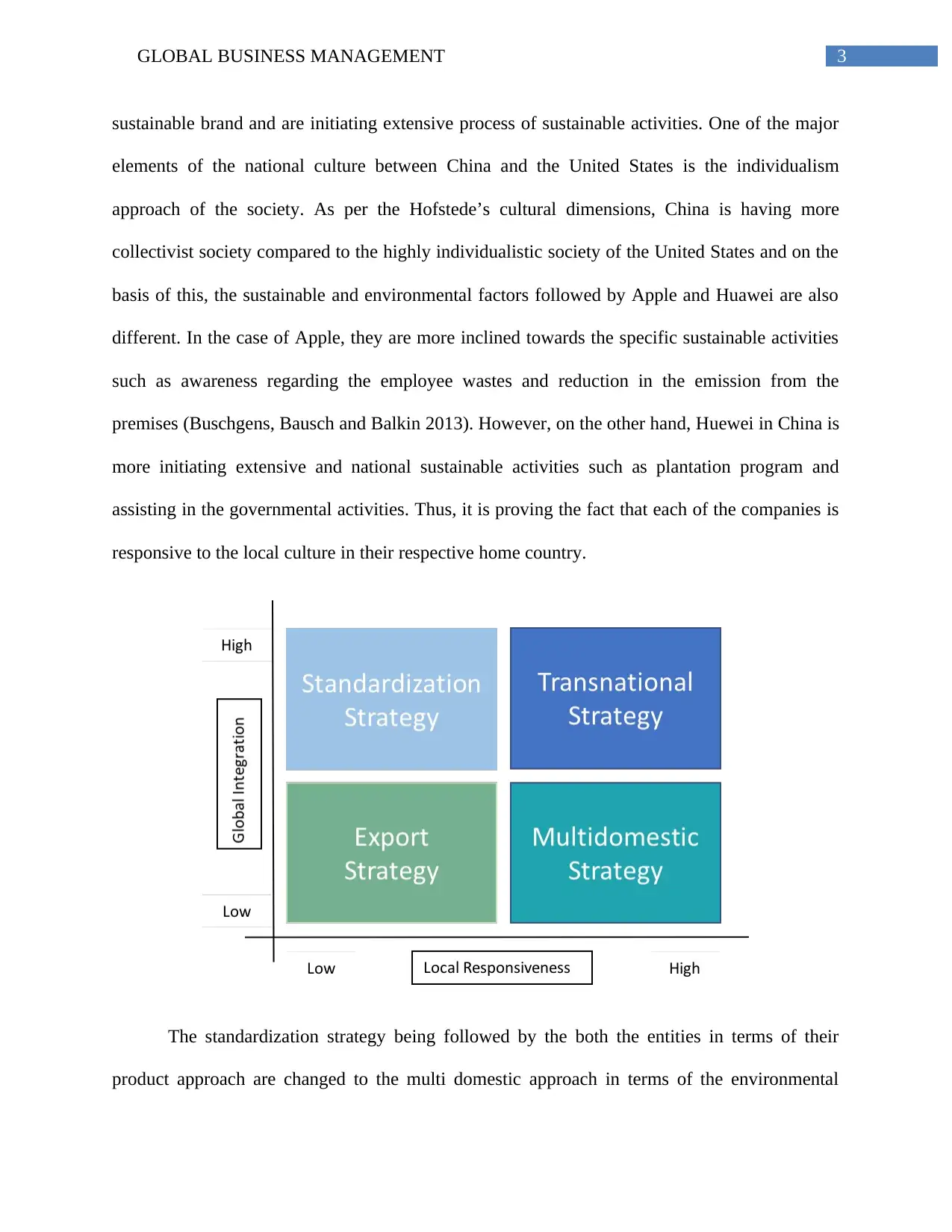
According to the economic integration and national responsiveness matrix, there are
majorly four options left with the global business in terms of operating in the global market.
However, it should also be noted that the global strategic option for the particular business is
dependent on the approach of them. In terms of the environmental factors, different countries are
having different sets of cultural intent and different companies are having different approach
towards it (Hogan and Coote 2014). However, both Apple and Huewei are known for being a
Introduction
In the current global business state of affairs, the decision making and the internal
management process is different to that of the traditional approach. This is due to the reason that
in the current time, global factors and diversity play an important role for the contemporary
business organizations along with the differences in the cultural factors. Thus, there are different
models being used by the modern day managers in order to have the effectiveness and efficiency
in the business management process (Roh, Hong and Min 2014). In the case of multinationals, it
is important to find the perfect balance between the global integration and local responsiveness
extent and accordingly the global strategies should be designed.
This report will discuss about the impact of the global strategies on the organizational
culture and structure along with the impact on the ethical and environmental issues. In addition,
this report will also discuss about the impact of the globalization on the decision making process
of the two selected organizations, which are Apple and Huawei. On the basis of the identified
factors, this report will recommended about how the current strategies of these two organizations
can get improved and more effective.
Impact of global strategies on the organizational culture
According to the economic integration and national responsiveness matrix, there are
majorly four options left with the global business in terms of operating in the global market.
However, it should also be noted that the global strategic option for the particular business is
dependent on the approach of them. In terms of the environmental factors, different countries are
having different sets of cultural intent and different companies are having different approach
towards it (Hogan and Coote 2014). However, both Apple and Huewei are known for being a
⊘ This is a preview!⊘
Do you want full access?
Subscribe today to unlock all pages.

Trusted by 1+ million students worldwide
3GLOBAL BUSINESS MANAGEMENT
sustainable brand and are initiating extensive process of sustainable activities. One of the major
elements of the national culture between China and the United States is the individualism
approach of the society. As per the Hofstede’s cultural dimensions, China is having more
collectivist society compared to the highly individualistic society of the United States and on the
basis of this, the sustainable and environmental factors followed by Apple and Huawei are also
different. In the case of Apple, they are more inclined towards the specific sustainable activities
such as awareness regarding the employee wastes and reduction in the emission from the
premises (Buschgens, Bausch and Balkin 2013). However, on the other hand, Huewei in China is
more initiating extensive and national sustainable activities such as plantation program and
assisting in the governmental activities. Thus, it is proving the fact that each of the companies is
responsive to the local culture in their respective home country.
The standardization strategy being followed by the both the entities in terms of their
product approach are changed to the multi domestic approach in terms of the environmental
sustainable brand and are initiating extensive process of sustainable activities. One of the major
elements of the national culture between China and the United States is the individualism
approach of the society. As per the Hofstede’s cultural dimensions, China is having more
collectivist society compared to the highly individualistic society of the United States and on the
basis of this, the sustainable and environmental factors followed by Apple and Huawei are also
different. In the case of Apple, they are more inclined towards the specific sustainable activities
such as awareness regarding the employee wastes and reduction in the emission from the
premises (Buschgens, Bausch and Balkin 2013). However, on the other hand, Huewei in China is
more initiating extensive and national sustainable activities such as plantation program and
assisting in the governmental activities. Thus, it is proving the fact that each of the companies is
responsive to the local culture in their respective home country.
The standardization strategy being followed by the both the entities in terms of their
product approach are changed to the multi domestic approach in terms of the environmental
Paraphrase This Document
Need a fresh take? Get an instant paraphrase of this document with our AI Paraphraser
4GLOBAL BUSINESS MANAGEMENT
factors. In addition, it is also identified that global strategies are also having impact on the
organizational structure of both the companies. This is due to the reason that organizational
structure is designed on the basis of the local cultural factors. According to the Hofstede’s
cultural dimension, power distance between China and the United States is different, which
refers to the fact that Chinese society is more inclined towards power, authorities and inequalities
unlike the American society, which is more liberal and flexible. On the basis of this approach,
Huawei is having more hierarchical structure compared to the horizontal structure of Apple. For
example, the distance between the top level managers and the low level employees is more in
Huawei compared to that in Apple (Choo 2013). However, on the other hand, it should also be
noted that Apple is having their operation in China as well where the hierarchical order is
followed. This denotes that Apple is locally responsive and they are following multi domestic
strategy in terms of their organizational structure in both home and host country. Hence, in terms
of the environmental factors, strategies are initiated in bottom up approach in the case of Apple
in their home country while the same is initiated in the top down approach in China, which is
also denoting their high level of market responsiveness (Awadh and Alyahya 2013).
As per the organizational culture, Huawei is having hierarchical culture in their global
operations whereas Apple is having clan culture in their global operation. This is due to the
reason that the level of centralization of Apple is low compared to that in Huawei. With the help
of the hierarchical culture in the global operations, Huawei is following their home country
culture and as per the above matrix, it can be denoted as standardization strategy. However, in
the case of Apple, they are following clan culture as per their home market culture but are
presented in more responsive approach in different countries (Nica 2013). Thus, they are
following transnational strategy where the core elements and values of their culture are same
factors. In addition, it is also identified that global strategies are also having impact on the
organizational structure of both the companies. This is due to the reason that organizational
structure is designed on the basis of the local cultural factors. According to the Hofstede’s
cultural dimension, power distance between China and the United States is different, which
refers to the fact that Chinese society is more inclined towards power, authorities and inequalities
unlike the American society, which is more liberal and flexible. On the basis of this approach,
Huawei is having more hierarchical structure compared to the horizontal structure of Apple. For
example, the distance between the top level managers and the low level employees is more in
Huawei compared to that in Apple (Choo 2013). However, on the other hand, it should also be
noted that Apple is having their operation in China as well where the hierarchical order is
followed. This denotes that Apple is locally responsive and they are following multi domestic
strategy in terms of their organizational structure in both home and host country. Hence, in terms
of the environmental factors, strategies are initiated in bottom up approach in the case of Apple
in their home country while the same is initiated in the top down approach in China, which is
also denoting their high level of market responsiveness (Awadh and Alyahya 2013).
As per the organizational culture, Huawei is having hierarchical culture in their global
operations whereas Apple is having clan culture in their global operation. This is due to the
reason that the level of centralization of Apple is low compared to that in Huawei. With the help
of the hierarchical culture in the global operations, Huawei is following their home country
culture and as per the above matrix, it can be denoted as standardization strategy. However, in
the case of Apple, they are following clan culture as per their home market culture but are
presented in more responsive approach in different countries (Nica 2013). Thus, they are
following transnational strategy where the core elements and values of their culture are same
5GLOBAL BUSINESS MANAGEMENT
across the world but are implemented in more locally responsive form. This local responsiveness
strategy of both the companies is helping in meeting the different environmental and ethical
standards in different countries. In the recent time, Huawei faced the ethical issue by facing the
ban in business in the United States, which further strains the importance for local
responsiveness (Clauss 2017). Huawei in this case, followed their standardized approach in
meeting the ethical standards of the United States and failed.
Impact of globalization on the decision making process
Emergence of globalization is also having impacts on the decision making process as
well due to the reason that the current process in the decision making is more diverse and
complex with the involvement of the various global factors. For example, prior to the emergence
of globalization, decision making process was more unified with the involvement of the few
national business factors. However, with the introduction of the global trends, thus unified
process got diverse and more global factors got involved. Both Apple and Huawei are global
multinationals and have their business in different countries (Schmoldt et al. 2013). Thus, the
decision making process for them cannot be done only on the basis of their home country trends.
For example, Apple can have decision making process only on the basis of the trends and
patterns in the United States rather they have to consider all the diverse factors in their different
foreign markets. Thus, the core approach of the decision making process got changed after the
emergence of globalization. One of the major examples of impact of globalization on the
decision making process is the product strategy of Apple. They are selling only the top and
newly introduced models in the American and other western countries while on the other hand,
they are locally manufacturing the older models in the Indian market. This is on the basis of the
across the world but are implemented in more locally responsive form. This local responsiveness
strategy of both the companies is helping in meeting the different environmental and ethical
standards in different countries. In the recent time, Huawei faced the ethical issue by facing the
ban in business in the United States, which further strains the importance for local
responsiveness (Clauss 2017). Huawei in this case, followed their standardized approach in
meeting the ethical standards of the United States and failed.
Impact of globalization on the decision making process
Emergence of globalization is also having impacts on the decision making process as
well due to the reason that the current process in the decision making is more diverse and
complex with the involvement of the various global factors. For example, prior to the emergence
of globalization, decision making process was more unified with the involvement of the few
national business factors. However, with the introduction of the global trends, thus unified
process got diverse and more global factors got involved. Both Apple and Huawei are global
multinationals and have their business in different countries (Schmoldt et al. 2013). Thus, the
decision making process for them cannot be done only on the basis of their home country trends.
For example, Apple can have decision making process only on the basis of the trends and
patterns in the United States rather they have to consider all the diverse factors in their different
foreign markets. Thus, the core approach of the decision making process got changed after the
emergence of globalization. One of the major examples of impact of globalization on the
decision making process is the product strategy of Apple. They are selling only the top and
newly introduced models in the American and other western countries while on the other hand,
they are locally manufacturing the older models in the Indian market. This is on the basis of the
⊘ This is a preview!⊘
Do you want full access?
Subscribe today to unlock all pages.
Trusted by 1+ million students worldwide
6GLOBAL BUSINESS MANAGEMENT
diverse global factors relevant due to the imposition of globalization (Garcia-Penalvo and Conde
2014).
According to Mintzberg, there are majorly three options available for the contemporary
business entities in terms of the decision making process and each of them is effective in
different business situations. Though Huawei and Apple operating in the same business sector,
they still are facing the different business situations. Moreover, they are following different
organizational cultures based on which, the decision making process should be designed. In the
case of Huawei, entrepreneurial model of decision making will be the most effective due to the
reason that they are following hierarchical culture in the organization (Negulescu 2014). Thus,
the power distance is more and top level managers are the key authorities in the decision making
process. With the help of the entrepreneurial mode of decision making, Huawei will be able to
maintain their existing organizational culture and decisions can be made more radical and bold
without many complexities.
On the other hand, it is recommended that Adaptive mode of decision making process
will be more effective for Apple due to the reason that they are already enjoying the market
leadership status in the global market and is known for their innovative approach. Thus, it is
important for them to ensure the long term business sustainability and viability rather than
having aggressive business approach. With the help of the adaptive mode of decision making
process, strategy will be designed on the basis of their existing problems and thus the issues for
Apple can be solved and in addition to their existing innovative approach, market leadership
status can be maintained (Liu et al. 2016). The existing clan culture followed in Apple will also
be favorable for following the adaptive mode of decision making process because identification
diverse global factors relevant due to the imposition of globalization (Garcia-Penalvo and Conde
2014).
According to Mintzberg, there are majorly three options available for the contemporary
business entities in terms of the decision making process and each of them is effective in
different business situations. Though Huawei and Apple operating in the same business sector,
they still are facing the different business situations. Moreover, they are following different
organizational cultures based on which, the decision making process should be designed. In the
case of Huawei, entrepreneurial model of decision making will be the most effective due to the
reason that they are following hierarchical culture in the organization (Negulescu 2014). Thus,
the power distance is more and top level managers are the key authorities in the decision making
process. With the help of the entrepreneurial mode of decision making, Huawei will be able to
maintain their existing organizational culture and decisions can be made more radical and bold
without many complexities.
On the other hand, it is recommended that Adaptive mode of decision making process
will be more effective for Apple due to the reason that they are already enjoying the market
leadership status in the global market and is known for their innovative approach. Thus, it is
important for them to ensure the long term business sustainability and viability rather than
having aggressive business approach. With the help of the adaptive mode of decision making
process, strategy will be designed on the basis of their existing problems and thus the issues for
Apple can be solved and in addition to their existing innovative approach, market leadership
status can be maintained (Liu et al. 2016). The existing clan culture followed in Apple will also
be favorable for following the adaptive mode of decision making process because identification
Paraphrase This Document
Need a fresh take? Get an instant paraphrase of this document with our AI Paraphraser
7GLOBAL BUSINESS MANAGEMENT
of the existing issues and designing strategies on the basis of that will be involved different
stakeholders across different levels and clan culture is the most accurate choice for this.
Lastly, it is recommended that planning mode of decision making process will also be
effective for both Huawei and Apple. This is due to the reason that both the entities are operating
in complex business situations and thus they are having the need for effective planning process
in having the most feasible alternatives. For example, in the current changing business
environment, it is important for the entities to have the information of the change on periodical
basis and strategize accordingly. This can made possible with the help of the planning mode of
decision making. Planning process can be initiated both in the case of hierarchical and clan
organizational culture and thus it is applicable for Huawei and Apple.
Determination of the current strategies
Even though both Apple and Huawei are following different decision making process and
they are largely being successful in their global operations, a few issues are also identified. For
example, due to the adaptive decision making process of Apple, they are having different
approaches in different countries and the core values are getting diluted. For example, Apple is
positioned as innovative and utilitarian brand in the market of the United States while on the
other hand; it is positioned as the premium and high end brand in the developing and Asian
markets. These positioning statuses are being made according to the local issues and market
factors but diluted the global branding of Apple. On the other hand, the entrepreneurial decision
making strategy of Huawei is facing issues in terms of locating the ground level issues. For
example, facing the ban in the United States is mainly due to the non compliance of their
business process with that of the US standards.
of the existing issues and designing strategies on the basis of that will be involved different
stakeholders across different levels and clan culture is the most accurate choice for this.
Lastly, it is recommended that planning mode of decision making process will also be
effective for both Huawei and Apple. This is due to the reason that both the entities are operating
in complex business situations and thus they are having the need for effective planning process
in having the most feasible alternatives. For example, in the current changing business
environment, it is important for the entities to have the information of the change on periodical
basis and strategize accordingly. This can made possible with the help of the planning mode of
decision making. Planning process can be initiated both in the case of hierarchical and clan
organizational culture and thus it is applicable for Huawei and Apple.
Determination of the current strategies
Even though both Apple and Huawei are following different decision making process and
they are largely being successful in their global operations, a few issues are also identified. For
example, due to the adaptive decision making process of Apple, they are having different
approaches in different countries and the core values are getting diluted. For example, Apple is
positioned as innovative and utilitarian brand in the market of the United States while on the
other hand; it is positioned as the premium and high end brand in the developing and Asian
markets. These positioning statuses are being made according to the local issues and market
factors but diluted the global branding of Apple. On the other hand, the entrepreneurial decision
making strategy of Huawei is facing issues in terms of locating the ground level issues. For
example, facing the ban in the United States is mainly due to the non compliance of their
business process with that of the US standards.
8GLOBAL BUSINESS MANAGEMENT
It is recommended that the global strategies of both Huawei and Apple should be based
on the importance of different stakeholders. This is due to the reason that in the decision making
process, effective management of the internal and external stakeholder is important. In the
previous section, it is already recommended that planning mode of decision making process
should be followed by both the organizations and in this mode, determination of each of the
stakeholders is important for gathering the information. One of the most important stakeholders
is the customers. They are having least interest in the organizational process but having high
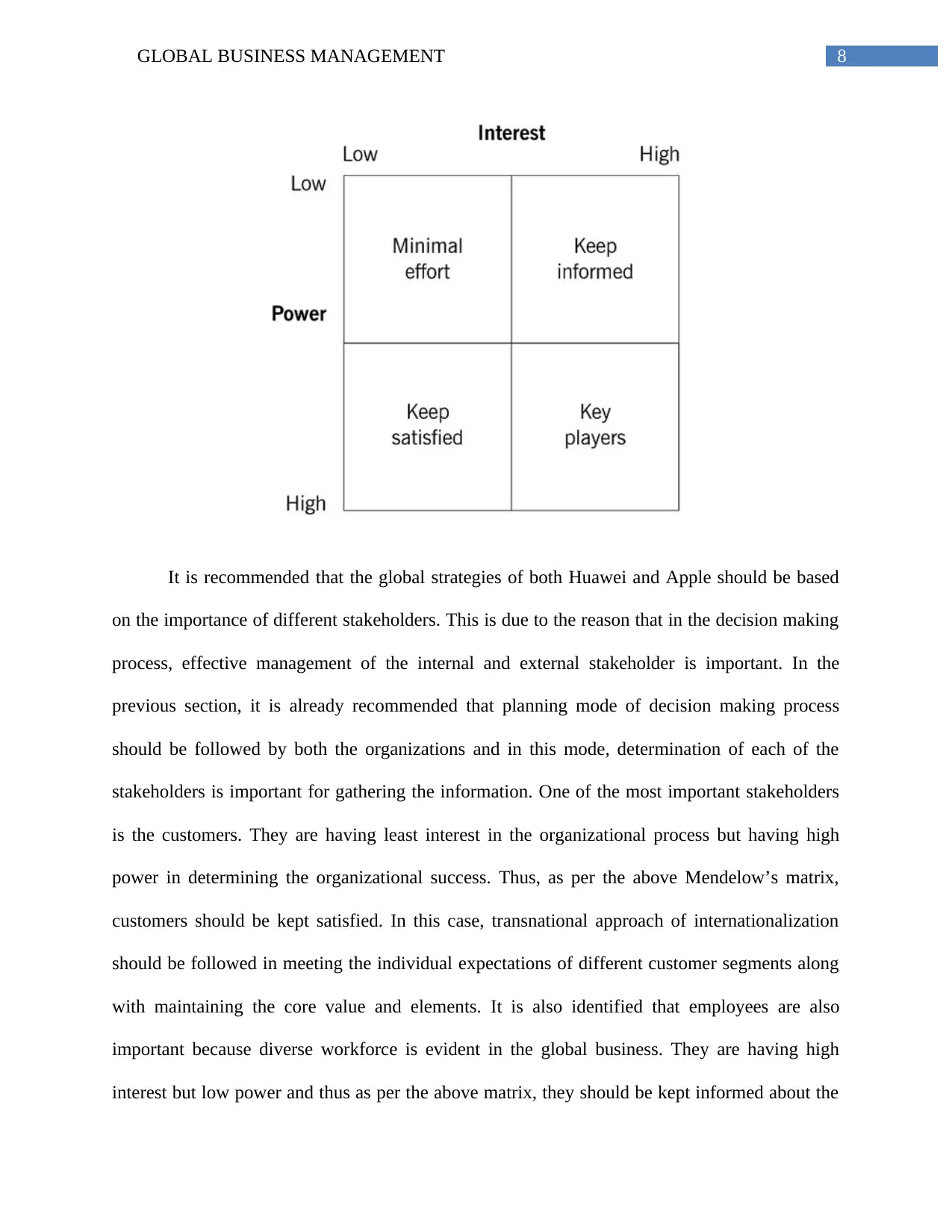
power in determining the organizational success. Thus, as per the above Mendelow’s matrix,
customers should be kept satisfied. In this case, transnational approach of internationalization
should be followed in meeting the individual expectations of different customer segments along
with maintaining the core value and elements. It is also identified that employees are also
important because diverse workforce is evident in the global business. They are having high
interest but low power and thus as per the above matrix, they should be kept informed about the
It is recommended that the global strategies of both Huawei and Apple should be based
on the importance of different stakeholders. This is due to the reason that in the decision making
process, effective management of the internal and external stakeholder is important. In the
previous section, it is already recommended that planning mode of decision making process
should be followed by both the organizations and in this mode, determination of each of the
stakeholders is important for gathering the information. One of the most important stakeholders
is the customers. They are having least interest in the organizational process but having high
power in determining the organizational success. Thus, as per the above Mendelow’s matrix,
customers should be kept satisfied. In this case, transnational approach of internationalization
should be followed in meeting the individual expectations of different customer segments along
with maintaining the core value and elements. It is also identified that employees are also
important because diverse workforce is evident in the global business. They are having high
interest but low power and thus as per the above matrix, they should be kept informed about the
⊘ This is a preview!⊘
Do you want full access?
Subscribe today to unlock all pages.
Trusted by 1+ million students worldwide
9GLOBAL BUSINESS MANAGEMENT
changes in the organization. Planning process will be more effective if the employees can be kept
informed as they will work accordingly.
Conclusion
This report concludes that globalization and global business trends are having number of
impacts on the management process. In this report, management process of both Huawei and
Apple is analyzed and different factors are identified. It is identified that both are following local
market responsive approach in terms of their organizational culture and structure. It is
recommended that the planning mode of decision making process will be beneficial for both the
entities in the long term.
changes in the organization. Planning process will be more effective if the employees can be kept
informed as they will work accordingly.
Conclusion
This report concludes that globalization and global business trends are having number of
impacts on the management process. In this report, management process of both Huawei and
Apple is analyzed and different factors are identified. It is identified that both are following local
market responsive approach in terms of their organizational culture and structure. It is
recommended that the planning mode of decision making process will be beneficial for both the
entities in the long term.
Paraphrase This Document
Need a fresh take? Get an instant paraphrase of this document with our AI Paraphraser
10GLOBAL BUSINESS MANAGEMENT
Reference
Awadh, A.M. and Alyahya, M.S., 2013. Impact of organizational culture on employee
performance. International review of management and business research, 2(1), p.168.
Büschgens, T., Bausch, A. and Balkin, D.B., 2013. Organizational culture and innovation: A
meta‐analytic review. Journal of product innovation management, 30(4), pp.763-781.
Choo, C.W., 2013. Information culture and organizational effectiveness. International Journal of
Information Management, 33(5), pp.775-779.
Clauss, T., 2017. Measuring business model innovation: conceptualization, scale development,
and proof of performance. R&D Management, 47(3), pp.385-403.
García-Peñalvo, F.J. and Conde, M.Á., 2014. Using informal learning for business decision
making and knowledge management. Journal of Business Research, 67(5), pp.686-691.
Hogan, S.J. and Coote, L.V., 2014. Organizational culture, innovation, and performance: A test
of Schein's model. Journal of Business Research, 67(8), pp.1609-1621.
Liu, H.C., You, J.X., Li, P. and Su, Q., 2016. Failure mode and effect analysis under uncertainty:
An integrated multiple criteria decision making approach. IEEE Transactions on
Reliability, 65(3), pp.1380-1392.
Negulescu, O., 2014. Using a decision-making process model in strategic management. Review
of General Management, 19(1), pp.111-123.
Nica, E., 2013. Organizational culture in the public sector. Economics, Management, and
Financial Markets, 8(2), pp.179-184.
Reference
Awadh, A.M. and Alyahya, M.S., 2013. Impact of organizational culture on employee
performance. International review of management and business research, 2(1), p.168.
Büschgens, T., Bausch, A. and Balkin, D.B., 2013. Organizational culture and innovation: A
meta‐analytic review. Journal of product innovation management, 30(4), pp.763-781.
Choo, C.W., 2013. Information culture and organizational effectiveness. International Journal of
Information Management, 33(5), pp.775-779.
Clauss, T., 2017. Measuring business model innovation: conceptualization, scale development,
and proof of performance. R&D Management, 47(3), pp.385-403.
García-Peñalvo, F.J. and Conde, M.Á., 2014. Using informal learning for business decision
making and knowledge management. Journal of Business Research, 67(5), pp.686-691.
Hogan, S.J. and Coote, L.V., 2014. Organizational culture, innovation, and performance: A test
of Schein's model. Journal of Business Research, 67(8), pp.1609-1621.
Liu, H.C., You, J.X., Li, P. and Su, Q., 2016. Failure mode and effect analysis under uncertainty:
An integrated multiple criteria decision making approach. IEEE Transactions on
Reliability, 65(3), pp.1380-1392.
Negulescu, O., 2014. Using a decision-making process model in strategic management. Review
of General Management, 19(1), pp.111-123.
Nica, E., 2013. Organizational culture in the public sector. Economics, Management, and
Financial Markets, 8(2), pp.179-184.
11GLOBAL BUSINESS MANAGEMENT
Roh, J., Hong, P. and Min, H., 2014. Implementation of a responsive supply chain strategy in
global complexity: The case of manufacturing firms. International Journal of Production
Economics, 147, pp.198-210.
Schmoldt, D., Kangas, J., Mendoza, G.A. and Pesonen, M. eds., 2013. The analytic hierarchy
process in natural resource and environmental decision making (Vol. 3). Springer Science &
Business Media.
Roh, J., Hong, P. and Min, H., 2014. Implementation of a responsive supply chain strategy in
global complexity: The case of manufacturing firms. International Journal of Production
Economics, 147, pp.198-210.
Schmoldt, D., Kangas, J., Mendoza, G.A. and Pesonen, M. eds., 2013. The analytic hierarchy
process in natural resource and environmental decision making (Vol. 3). Springer Science &
Business Media.
⊘ This is a preview!⊘
Do you want full access?
Subscribe today to unlock all pages.
Trusted by 1+ million students worldwide

1 out of 12


Related Documents


Your All-in-One AI-Powered Toolkit for Academic Success.
+13062052269
info@desklib.com
Available 24*7 on WhatsApp / Email
![[object Object]](/_next/static/media/star-bottom.7253800d.svg)
Unlock your academic potential
Copyright © 2020–2026 A2Z Services. All Rights Reserved. Developed and managed by ZUCOL.