Globalization's Impact on Dairy
VerifiedAdded on 2019/10/31
|17
|3967
|232
Report
AI Summary
This report investigates the impact of globalization on New Zealand's dairy industry. It begins by defining globalization and exploring relevant theories (Marxist and Liberalist perspectives). The report then examines the current global dairy market situation, highlighting New Zealand's role as a major exporter. Key factors influencing New Zealand's dairy industry, such as the Dairy Industry Restructuring Act (DIRA) and the New Zealand-China Free Trade Agreement, are analyzed. The positive and negative impacts of globalization on the industry are discussed, including increased production and export opportunities versus environmental concerns and health implications. The methodology section details the research approach (deductive), design (descriptive/analytical), strategy (survey and interviews), sampling methods, data analysis techniques, and ethical considerations. The report concludes with a time horizon for the research activities.
Running head: GLOBALIZATION AND ITS IMPACT ON DIARY INDUSTRIES
GLOBALIZATION AND ITS IMPACT ON DIARY INDUSTRIES
Name of the Student:
Name of the University:
Author note:
GLOBALIZATION AND ITS IMPACT ON DIARY INDUSTRIES
Name of the Student:
Name of the University:
Author note:

Paraphrase This Document
Need a fresh take? Get an instant paraphrase of this document with our AI Paraphraser
1GLOBALIZATION AND ITS IMPACT ON DIARY INDUSTRIES
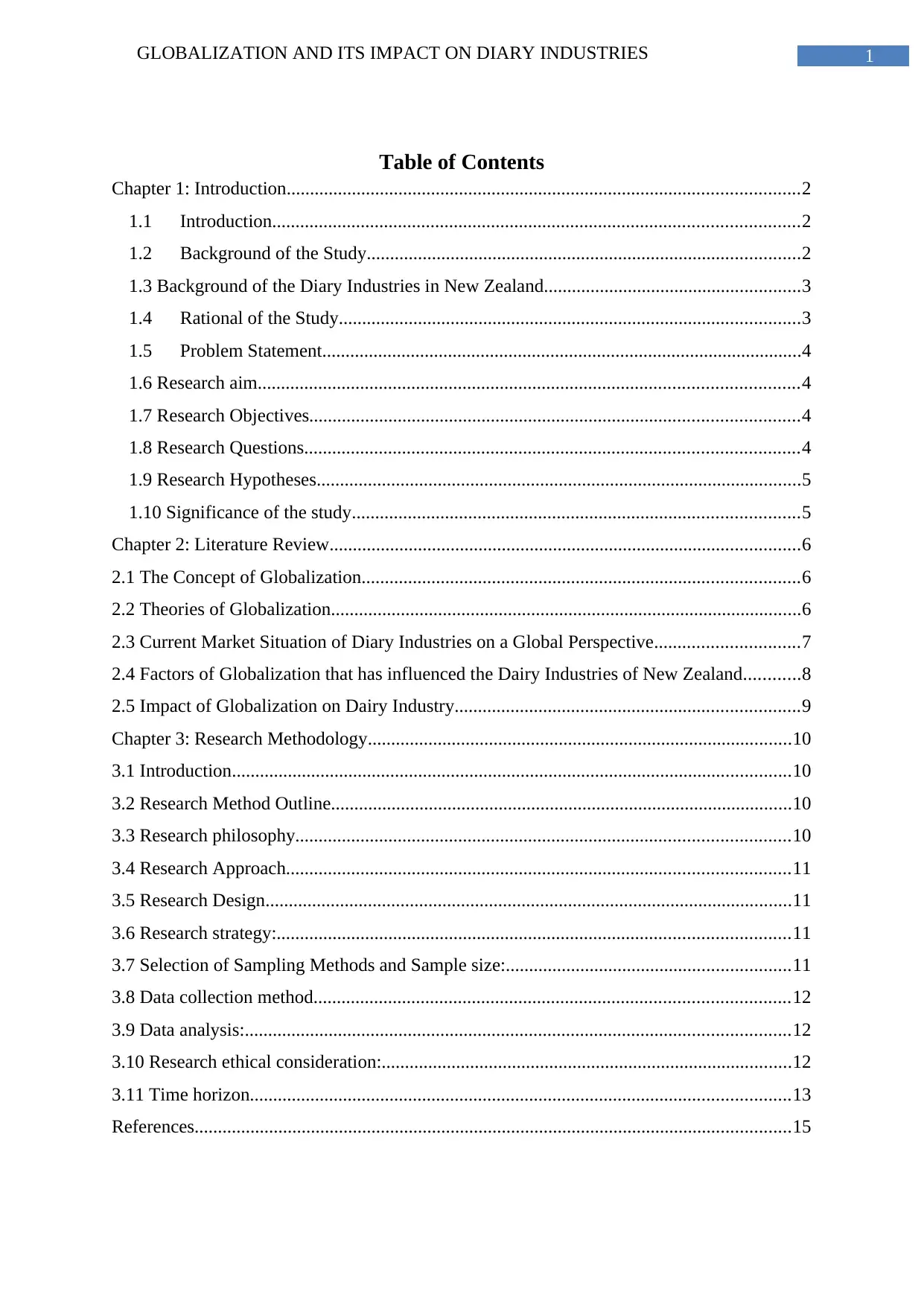
Table of Contents
Chapter 1: Introduction..............................................................................................................2
1.1 Introduction.................................................................................................................2
1.2 Background of the Study.............................................................................................2
1.3 Background of the Diary Industries in New Zealand.......................................................3
1.4 Rational of the Study...................................................................................................3
1.5 Problem Statement.......................................................................................................4
1.6 Research aim....................................................................................................................4
1.7 Research Objectives.........................................................................................................4
1.8 Research Questions..........................................................................................................4
1.9 Research Hypotheses........................................................................................................5
1.10 Significance of the study................................................................................................5
Chapter 2: Literature Review.....................................................................................................6
2.1 The Concept of Globalization..............................................................................................6
2.2 Theories of Globalization.....................................................................................................6
2.3 Current Market Situation of Diary Industries on a Global Perspective...............................7
2.4 Factors of Globalization that has influenced the Dairy Industries of New Zealand............8
2.5 Impact of Globalization on Dairy Industry..........................................................................9
Chapter 3: Research Methodology...........................................................................................10
3.1 Introduction........................................................................................................................10
3.2 Research Method Outline...................................................................................................10
3.3 Research philosophy..........................................................................................................10
3.4 Research Approach............................................................................................................11
3.5 Research Design.................................................................................................................11
3.6 Research strategy:..............................................................................................................11
3.7 Selection of Sampling Methods and Sample size:.............................................................11
3.8 Data collection method......................................................................................................12
3.9 Data analysis:.....................................................................................................................12
3.10 Research ethical consideration:........................................................................................12
3.11 Time horizon....................................................................................................................13
References................................................................................................................................15
Table of Contents
Chapter 1: Introduction..............................................................................................................2
1.1 Introduction.................................................................................................................2
1.2 Background of the Study.............................................................................................2
1.3 Background of the Diary Industries in New Zealand.......................................................3
1.4 Rational of the Study...................................................................................................3
1.5 Problem Statement.......................................................................................................4
1.6 Research aim....................................................................................................................4
1.7 Research Objectives.........................................................................................................4
1.8 Research Questions..........................................................................................................4
1.9 Research Hypotheses........................................................................................................5
1.10 Significance of the study................................................................................................5
Chapter 2: Literature Review.....................................................................................................6
2.1 The Concept of Globalization..............................................................................................6
2.2 Theories of Globalization.....................................................................................................6
2.3 Current Market Situation of Diary Industries on a Global Perspective...............................7
2.4 Factors of Globalization that has influenced the Dairy Industries of New Zealand............8
2.5 Impact of Globalization on Dairy Industry..........................................................................9
Chapter 3: Research Methodology...........................................................................................10
3.1 Introduction........................................................................................................................10
3.2 Research Method Outline...................................................................................................10
3.3 Research philosophy..........................................................................................................10
3.4 Research Approach............................................................................................................11
3.5 Research Design.................................................................................................................11
3.6 Research strategy:..............................................................................................................11
3.7 Selection of Sampling Methods and Sample size:.............................................................11
3.8 Data collection method......................................................................................................12
3.9 Data analysis:.....................................................................................................................12
3.10 Research ethical consideration:........................................................................................12
3.11 Time horizon....................................................................................................................13
References................................................................................................................................15

2GLOBALIZATION AND ITS IMPACT ON DIARY INDUSTRIES
⊘ This is a preview!⊘
Do you want full access?
Subscribe today to unlock all pages.

Trusted by 1+ million students worldwide
3GLOBALIZATION AND ITS IMPACT ON DIARY INDUSTRIES
Chapter 1: Introduction
1.1 Introduction
Globalization is a process that helps businesses and organizations to develop an
international operation or influence on the global economy and to reach beyond the local and
national markets and arrive at to the international markets (Beck, 2015). The effect of
globalization is increasing global trade and integration of domestic or local economy,
industry as well as culture around the globe. The integration has been possible due to
technological advancement, transportation, communication flexibility, and increase
capabilities of the world trade (Roberts, Hite & Chorev, 2014).
Globalization has its effect on the New Zealand’s economy and industries as well. New
Zealand is the eighth largest milk producer in the world and produces 2.2% of the world diary
production (Dcanz.com, 2017). The aim of the research proposal is to understand the impact
of globalization on the diary industries in New Zealand.
1.2 Background of the Study
New Zealand uses globalization policies to increase its diary marketing on the
international periphery and in that way, it has been increasing the economic scenario of the
state. The exposure for the industries to the global competition has aim to grow, innovate and
consolidate with time and it has diversified its exports around or even more than hundred
global markets. However, later on due to restructuring of the dairy industries, state regulatory
act and the transactional corporation has shaped and influenced on the pattern of the
economic globalization in New Zealand (Dcanz.com, 2017). However, if the New Zealand
uses the strategies of global economy on its diary industries the effect would be more flouring
business and economy in those industries.
Chapter 1: Introduction
1.1 Introduction
Globalization is a process that helps businesses and organizations to develop an
international operation or influence on the global economy and to reach beyond the local and
national markets and arrive at to the international markets (Beck, 2015). The effect of
globalization is increasing global trade and integration of domestic or local economy,
industry as well as culture around the globe. The integration has been possible due to
technological advancement, transportation, communication flexibility, and increase
capabilities of the world trade (Roberts, Hite & Chorev, 2014).
Globalization has its effect on the New Zealand’s economy and industries as well. New
Zealand is the eighth largest milk producer in the world and produces 2.2% of the world diary
production (Dcanz.com, 2017). The aim of the research proposal is to understand the impact
of globalization on the diary industries in New Zealand.
1.2 Background of the Study
New Zealand uses globalization policies to increase its diary marketing on the
international periphery and in that way, it has been increasing the economic scenario of the
state. The exposure for the industries to the global competition has aim to grow, innovate and
consolidate with time and it has diversified its exports around or even more than hundred
global markets. However, later on due to restructuring of the dairy industries, state regulatory
act and the transactional corporation has shaped and influenced on the pattern of the
economic globalization in New Zealand (Dcanz.com, 2017). However, if the New Zealand
uses the strategies of global economy on its diary industries the effect would be more flouring
business and economy in those industries.
Paraphrase This Document
Need a fresh take? Get an instant paraphrase of this document with our AI Paraphraser
4GLOBALIZATION AND ITS IMPACT ON DIARY INDUSTRIES
1.3 Background of the Diary Industries in New Zealand
Diary is the part of New Zealand’s heritage and history. The first export of the butter and
cheese has started in 1842 to its closest neighboring country Australia and subsequently
Britain (Cgge.aag.org, 2017). The diary processing industry first was established in New
Zealand around 1875. In 1882, the first refrigerated butter was exported by shipping. From
this time onwards, the diary industries have followed a growth path. The Dairy industry
Restructuring Act in 2001 has influenced the industries’ regulatory framework and been
contributing to the growth of the industries (Dcanz.com, 2017). In New Zealand, the local
farmers or the farmers’ cooperatives process most milk; however, the industry has been
becoming increasingly diverse due to globalization and resulting in increased number of local
and multinational or global diary industries, which are operating actively in New Zealand.
1.4 Rational of the Study
The issue of the research is the globalization and its impact on diary industries in New
Zealand. This has been become an issue due to overall growth of technological advancement,
transportation and communication flexibility and increase capabilities of the world trade,
which resulted in globalization (Beck, 2015). New Zealand was known in the world for its
dairy products and shares a heritage. In the context of globalization, the New Zealand’s diary
industries have the influence and impact.
The recent data is stating that New Zealand exports almost 95% of its diary
production and the top markets are United States, China, United Arab Emirates, Japan and
Australia (Cgge.aag.org, 2017). As the number of markets and international export have been
increasing for New Zealand’s Diary industries due to globalization, this has been become an
issue now.
1.3 Background of the Diary Industries in New Zealand
Diary is the part of New Zealand’s heritage and history. The first export of the butter and
cheese has started in 1842 to its closest neighboring country Australia and subsequently
Britain (Cgge.aag.org, 2017). The diary processing industry first was established in New
Zealand around 1875. In 1882, the first refrigerated butter was exported by shipping. From
this time onwards, the diary industries have followed a growth path. The Dairy industry
Restructuring Act in 2001 has influenced the industries’ regulatory framework and been
contributing to the growth of the industries (Dcanz.com, 2017). In New Zealand, the local
farmers or the farmers’ cooperatives process most milk; however, the industry has been
becoming increasingly diverse due to globalization and resulting in increased number of local
and multinational or global diary industries, which are operating actively in New Zealand.
1.4 Rational of the Study
The issue of the research is the globalization and its impact on diary industries in New
Zealand. This has been become an issue due to overall growth of technological advancement,
transportation and communication flexibility and increase capabilities of the world trade,
which resulted in globalization (Beck, 2015). New Zealand was known in the world for its
dairy products and shares a heritage. In the context of globalization, the New Zealand’s diary
industries have the influence and impact.
The recent data is stating that New Zealand exports almost 95% of its diary
production and the top markets are United States, China, United Arab Emirates, Japan and
Australia (Cgge.aag.org, 2017). As the number of markets and international export have been
increasing for New Zealand’s Diary industries due to globalization, this has been become an
issue now.
5GLOBALIZATION AND ITS IMPACT ON DIARY INDUSTRIES
The research will focus on the impact of globalization on the diary industries in New
Zealand and how this impact has helped in the economy of New Zealand, what are the factors
of globalization for the impact and how New Zealand has integrated those factors for the
global marketing. The research will also provide scope for the future study regarding this
topic.
1.5 Problem Statement
The problem that arises with the impact of globalization on the New Zealand’s diary
industries is that it should look into the competitive factors in the global markets as other
companies from the same industry are also exposing.
1.6 Research aim
The research aims at evaluating the impact of globalization on the diary industries in
New Zealand.
1.7 Research Objectives
The objectives are,
To analysis, the important factors of globalization that influence the diary industries
in New Zealand.
To measure the result of the impact of globalization on diary industries in New
Zealand.
To provide recommendation to the diary industries for maintaining and improvement
in the context of globalization.
1.8 Research Questions
The research questions are as followed,
The research will focus on the impact of globalization on the diary industries in New
Zealand and how this impact has helped in the economy of New Zealand, what are the factors
of globalization for the impact and how New Zealand has integrated those factors for the
global marketing. The research will also provide scope for the future study regarding this
topic.
1.5 Problem Statement
The problem that arises with the impact of globalization on the New Zealand’s diary
industries is that it should look into the competitive factors in the global markets as other
companies from the same industry are also exposing.
1.6 Research aim
The research aims at evaluating the impact of globalization on the diary industries in
New Zealand.
1.7 Research Objectives
The objectives are,
To analysis, the important factors of globalization that influence the diary industries
in New Zealand.
To measure the result of the impact of globalization on diary industries in New
Zealand.
To provide recommendation to the diary industries for maintaining and improvement
in the context of globalization.
1.8 Research Questions
The research questions are as followed,
⊘ This is a preview!⊘
Do you want full access?
Subscribe today to unlock all pages.
Trusted by 1+ million students worldwide
6GLOBALIZATION AND ITS IMPACT ON DIARY INDUSTRIES
Research Question 1: What are the important factors of globalization that influence
the diary industries in New Zealand?
Research Question 2: What are the results of the impact of globalization on diary
industries in New Zealand?
Research Question 3: How to improve and maintain the diary industry in New
Zealand from the perspective of globalization?
1.9 Research Hypotheses
H0 : Globalization does not have any impact on the diary industries in New Zealand.
H1 : Globalization has impact on the diary industries in New Zealand.
1.10 Significance of the study
This study will help the diary industries to understand the factors and findings of the
impact of globalization on the industries in New Zealand. Moreover, this research will
provide a path to the industrialists for future aspect of operating the business removing the
challenges of the global impact on the industry.
Research Question 1: What are the important factors of globalization that influence
the diary industries in New Zealand?
Research Question 2: What are the results of the impact of globalization on diary
industries in New Zealand?
Research Question 3: How to improve and maintain the diary industry in New
Zealand from the perspective of globalization?
1.9 Research Hypotheses
H0 : Globalization does not have any impact on the diary industries in New Zealand.
H1 : Globalization has impact on the diary industries in New Zealand.
1.10 Significance of the study
This study will help the diary industries to understand the factors and findings of the
impact of globalization on the industries in New Zealand. Moreover, this research will
provide a path to the industrialists for future aspect of operating the business removing the
challenges of the global impact on the industry.
Paraphrase This Document
Need a fresh take? Get an instant paraphrase of this document with our AI Paraphraser
7GLOBALIZATION AND ITS IMPACT ON DIARY INDUSTRIES
Chapter 2: Literature Review
2.1 The Concept of Globalization
The concept of globalization is not new; rather people from different parts of the
world bought and sold materials across the borders. However, due to technological and policy
development in recent years, the cross border trade has reached into a new economic
development. The new concept of globalization can be stated like this: it is a procedure of
integration and interaction among people, organizations and governments beyond political
boundaries and driven by global trade and economic investment (Beck, 2015). The growth in
the information technology has aided the process of globalization. Chorev has used some
adjectives to describe the term in today’s world; those are the farther, cheaper, faster and
deeper (Roberts, Hite & Chorev, 2014).
However, the opponents of globalization assert that due to free market policy in
globalization it has benefitted the western world’s multinational organizations that have been
exploiting the local enterprises, common people and local cultures (Beck, 2015). Therefore,
resistance to globalization has taken shape at Governmental levels that are trying to manage
the current flow of labors, goods, capital and ideas in globalization.
2.2 Theories of Globalization
Marxist Theory of Globalization
The globalization theory from the Marxists’ point of view can be described. The
Marxists has accepted the fact that globalization happed due to improvement of connectivity
that enhances the opportunities of surplus accumulation and profit making. They stated that
globalization is the result of capitalist development that is historically specific in nature and
Chapter 2: Literature Review
2.1 The Concept of Globalization
The concept of globalization is not new; rather people from different parts of the
world bought and sold materials across the borders. However, due to technological and policy
development in recent years, the cross border trade has reached into a new economic
development. The new concept of globalization can be stated like this: it is a procedure of
integration and interaction among people, organizations and governments beyond political
boundaries and driven by global trade and economic investment (Beck, 2015). The growth in
the information technology has aided the process of globalization. Chorev has used some
adjectives to describe the term in today’s world; those are the farther, cheaper, faster and
deeper (Roberts, Hite & Chorev, 2014).
However, the opponents of globalization assert that due to free market policy in
globalization it has benefitted the western world’s multinational organizations that have been
exploiting the local enterprises, common people and local cultures (Beck, 2015). Therefore,
resistance to globalization has taken shape at Governmental levels that are trying to manage
the current flow of labors, goods, capital and ideas in globalization.
2.2 Theories of Globalization
Marxist Theory of Globalization
The globalization theory from the Marxists’ point of view can be described. The
Marxists has accepted the fact that globalization happed due to improvement of connectivity
that enhances the opportunities of surplus accumulation and profit making. They stated that
globalization is the result of capitalist development that is historically specific in nature and
8GLOBALIZATION AND ITS IMPACT ON DIARY INDUSTRIES
due the development the United States is dominating and in the position of Hegemony in the
global market (Scott, 2013). The west-focused cultural dominance is present in the world.
The globalization has not reduced the class struggle and accumulation of capital, which is the
central focus of the Marxism (Hovden & Keene, 2016).
Liberalist Theory of Globalization
From the perspective of liberalism, the globalization is the process led by market
extension of modernization. Liberalism stresses on the necessity to construct institutional
infrastructure for supporting globalization. They state that the process of globalization is the
result of human desire that has come naturally for political liberty and economic welfare
(Hovden & Keene, 2016). The growth in connectivity due to globalization has increased the
material well-being and exercise of basic freedom of the human beings, which would
eventually interlink the humanity across the globe. The process of globalization lead to the
technical standardization, guarantees of the property rights, inter-state administrative
harmonization and inter-lingual communication improvement (Hovden & Keene, 2016).
2.3 Current Market Situation of Diary Industries on a Global Perspective
The highest amount of milk is produced from India on the global basis; however,
domestic consumption of the diary products is major occurrence in India (Shortt & O'Brien,
2016). It is Europe, which is in the second position, followed by United States of America,
New Zealand and Australia. Europe, United States of America, New Zealand and Australia
are the largest exporters of the dairy products in the world. New Zealand was the biggest
exporter in 2015. It has exported around 500,000 Tons of table butter. Europe was in the
second position among the exporters, exporting 185,000 Tons of table butter. Russia, Mexico
and China are the largest importers of the dairy products internationally (Gould, 2012).
due the development the United States is dominating and in the position of Hegemony in the
global market (Scott, 2013). The west-focused cultural dominance is present in the world.
The globalization has not reduced the class struggle and accumulation of capital, which is the
central focus of the Marxism (Hovden & Keene, 2016).
Liberalist Theory of Globalization
From the perspective of liberalism, the globalization is the process led by market
extension of modernization. Liberalism stresses on the necessity to construct institutional
infrastructure for supporting globalization. They state that the process of globalization is the
result of human desire that has come naturally for political liberty and economic welfare
(Hovden & Keene, 2016). The growth in connectivity due to globalization has increased the
material well-being and exercise of basic freedom of the human beings, which would
eventually interlink the humanity across the globe. The process of globalization lead to the
technical standardization, guarantees of the property rights, inter-state administrative
harmonization and inter-lingual communication improvement (Hovden & Keene, 2016).
2.3 Current Market Situation of Diary Industries on a Global Perspective
The highest amount of milk is produced from India on the global basis; however,
domestic consumption of the diary products is major occurrence in India (Shortt & O'Brien,
2016). It is Europe, which is in the second position, followed by United States of America,
New Zealand and Australia. Europe, United States of America, New Zealand and Australia
are the largest exporters of the dairy products in the world. New Zealand was the biggest
exporter in 2015. It has exported around 500,000 Tons of table butter. Europe was in the
second position among the exporters, exporting 185,000 Tons of table butter. Russia, Mexico
and China are the largest importers of the dairy products internationally (Gould, 2012).
⊘ This is a preview!⊘
Do you want full access?
Subscribe today to unlock all pages.
Trusted by 1+ million students worldwide
9GLOBALIZATION AND ITS IMPACT ON DIARY INDUSTRIES
The international dairy market can be divided into 17 product segments: Fluid Milk,
Flavored Milk, UHT Milk, Table Butter, Cream, Ghee, Skimmed Milk Powder, Anhydrous
Milk Fat, Whole Milk Powder, Casein Powder, Whey Protein, Lactose Powder, Yogurt,
Cheese, Cottage Cheese, Probiotic Dairy Products and Ice Cream. Asia is the biggest
consumer of the fluid milk, which is the largest dairy product segment (Idfa.org, 2017).
According to the World Diary Situation Report published by International Dairy
Federation in 2016 the challenges faced by the diary industry are price hike of milk, which
was the problem faced by dairy industry for the past two years; however, the price is now low
(Idfa.org, 2017). The global demand is increasing day-by-day due dairy consumption growth
with the world population growth.
2.4 Factors of Globalization that has influenced the Dairy Industries of New Zealand
New Zealand is one of the major dairy exporter and producer in the world. As the
international demand for the dairy products is increasing, it has cast a positive effect on New
Zealand’s dairy industry, making it a trading zone, which is beneficial for the farmers,
producers and national economy. The Dairy Industry Restructuring Act (DIRA), which has
been passed in 2001, has influenced effectively the global dairy business in New Zealand
(Legislation.govt.nz, 2017). It has authorized the sole establishment of the Fonterra, which is
a multinational co-operation of New Zealand. It is the sixth largest dairy cooperation in the
world and world’s biggest exporter (Bodie, 2013). Fonterra’s business policy includes New
Zealand, Australia and 50 other countries.
Another issue that has influenced the dairy industries in New Zealand is New
Zealand-China Free Trade Agreement, which has enabled the dairy export of New Zealand to
China. In 2014, New Zealand has exported 40% of its total production to china (Mfat.govt.nz,
2017).
The international dairy market can be divided into 17 product segments: Fluid Milk,
Flavored Milk, UHT Milk, Table Butter, Cream, Ghee, Skimmed Milk Powder, Anhydrous
Milk Fat, Whole Milk Powder, Casein Powder, Whey Protein, Lactose Powder, Yogurt,
Cheese, Cottage Cheese, Probiotic Dairy Products and Ice Cream. Asia is the biggest
consumer of the fluid milk, which is the largest dairy product segment (Idfa.org, 2017).
According to the World Diary Situation Report published by International Dairy
Federation in 2016 the challenges faced by the diary industry are price hike of milk, which
was the problem faced by dairy industry for the past two years; however, the price is now low
(Idfa.org, 2017). The global demand is increasing day-by-day due dairy consumption growth
with the world population growth.
2.4 Factors of Globalization that has influenced the Dairy Industries of New Zealand
New Zealand is one of the major dairy exporter and producer in the world. As the
international demand for the dairy products is increasing, it has cast a positive effect on New
Zealand’s dairy industry, making it a trading zone, which is beneficial for the farmers,
producers and national economy. The Dairy Industry Restructuring Act (DIRA), which has
been passed in 2001, has influenced effectively the global dairy business in New Zealand
(Legislation.govt.nz, 2017). It has authorized the sole establishment of the Fonterra, which is
a multinational co-operation of New Zealand. It is the sixth largest dairy cooperation in the
world and world’s biggest exporter (Bodie, 2013). Fonterra’s business policy includes New
Zealand, Australia and 50 other countries.
Another issue that has influenced the dairy industries in New Zealand is New
Zealand-China Free Trade Agreement, which has enabled the dairy export of New Zealand to
China. In 2014, New Zealand has exported 40% of its total production to china (Mfat.govt.nz,
2017).
Paraphrase This Document
Need a fresh take? Get an instant paraphrase of this document with our AI Paraphraser
10GLOBALIZATION AND ITS IMPACT ON DIARY INDUSTRIES
Other common issues of globalization that has cast impact on New Zealand’s dairy
industries are communication flexibility due to advancement of technology and transport. The
Fonterra Cooperatives in New Zealand exports more than 100 sites other than New Zealand
in the world (Hirst, Thompson & Bromley, 2015). In this particular case of Fonterra, it has
been possible to explore the global market of dairy business due to impact of globalization
that has allowed flexible communication and transportation.
2.5 Impact of Globalization on Dairy Industry
Due to globalization, the total production of the dairy industry has been increasing
with more demand from domestic and international markets. Even, the current situation is
like that the demand is more than the production, however, the traditional sources for
supplying the dairy products cannot fulfill the demand, therefore more production is required
(Damron & Damron, 2013). It can be assumed that Brazil, Ukraine, which is the low-cost and
new supply centers of the dairy products will dominate the market in recent years if there is
lesser supply than the demand.
On the contrary, the negative impact of globalization on the dairy industries is it has
started to crate environment pollution on the major produced countries. Milk is produced
majorly from cows and buffalos. The waste of cows and buffalos create environment
pollution (Glover et al., 2014). Due to effect of globalization on the dairy industry, there is
more need for milk production around the world and to fulfill this demand some growth
hormones are injected to the animals, which has adverse effect on human health. However,
Japan, the European Union, Australia, Canada and New Zealand have banned the growth
hormone’s use from this concern (Damron & Damron, 2013).
Other common issues of globalization that has cast impact on New Zealand’s dairy
industries are communication flexibility due to advancement of technology and transport. The
Fonterra Cooperatives in New Zealand exports more than 100 sites other than New Zealand
in the world (Hirst, Thompson & Bromley, 2015). In this particular case of Fonterra, it has
been possible to explore the global market of dairy business due to impact of globalization
that has allowed flexible communication and transportation.
2.5 Impact of Globalization on Dairy Industry
Due to globalization, the total production of the dairy industry has been increasing
with more demand from domestic and international markets. Even, the current situation is
like that the demand is more than the production, however, the traditional sources for
supplying the dairy products cannot fulfill the demand, therefore more production is required
(Damron & Damron, 2013). It can be assumed that Brazil, Ukraine, which is the low-cost and
new supply centers of the dairy products will dominate the market in recent years if there is
lesser supply than the demand.
On the contrary, the negative impact of globalization on the dairy industries is it has
started to crate environment pollution on the major produced countries. Milk is produced
majorly from cows and buffalos. The waste of cows and buffalos create environment
pollution (Glover et al., 2014). Due to effect of globalization on the dairy industry, there is
more need for milk production around the world and to fulfill this demand some growth
hormones are injected to the animals, which has adverse effect on human health. However,
Japan, the European Union, Australia, Canada and New Zealand have banned the growth
hormone’s use from this concern (Damron & Damron, 2013).
11GLOBALIZATION AND ITS IMPACT ON DIARY INDUSTRIES
Chapter 3: Research Methodology
3.1 Introduction
Research methodology is a method through which a researcher can design his
research in a suitable manner (Flick, 2015). The third chapter of the dissertation is Research
Methodology. It concerns with the various methodology that the researcher has undertaken to
conduct his research.
3.2 Research Method Outline
For accomplish this specific study, the researcher has employed with various tools,
which have assisted him to get his results in a satisfactory form. The researcher has chosen
Marxism and Liberalism as his research philosophy. Deductive method would be his research
approach. The approach would help the researcher to concentrate on the existing theories
related to his research. The research design would be descriptive or analytical design method
(Flick, 2015). For the research strategy, the researcher has chosen survey method and
interview procedure.
3.3 Research philosophy
Research philosophy is a series of opinions. The two research philosophies are the
Marxism and Liberalism. These philosophies would help the researcher to expand the
characteristics of the study by implementing an extensive analysis of those various theories.
Marxism helps to identify the problem of the study whereas Liberalism helps to identify the
positive side and advantages of the research study. This method would assist the researcher to
inspect the present market condition, which in return would give the wider perspective for
conducting the research process.
Chapter 3: Research Methodology
3.1 Introduction
Research methodology is a method through which a researcher can design his
research in a suitable manner (Flick, 2015). The third chapter of the dissertation is Research
Methodology. It concerns with the various methodology that the researcher has undertaken to
conduct his research.
3.2 Research Method Outline
For accomplish this specific study, the researcher has employed with various tools,
which have assisted him to get his results in a satisfactory form. The researcher has chosen
Marxism and Liberalism as his research philosophy. Deductive method would be his research
approach. The approach would help the researcher to concentrate on the existing theories
related to his research. The research design would be descriptive or analytical design method
(Flick, 2015). For the research strategy, the researcher has chosen survey method and
interview procedure.
3.3 Research philosophy
Research philosophy is a series of opinions. The two research philosophies are the
Marxism and Liberalism. These philosophies would help the researcher to expand the
characteristics of the study by implementing an extensive analysis of those various theories.
Marxism helps to identify the problem of the study whereas Liberalism helps to identify the
positive side and advantages of the research study. This method would assist the researcher to
inspect the present market condition, which in return would give the wider perspective for
conducting the research process.
⊘ This is a preview!⊘
Do you want full access?
Subscribe today to unlock all pages.
Trusted by 1+ million students worldwide

1 out of 17


Related Documents


Your All-in-One AI-Powered Toolkit for Academic Success.
+13062052269
info@desklib.com
Available 24*7 on WhatsApp / Email
![[object Object]](/_next/static/media/star-bottom.7253800d.svg)
Unlock your academic potential
Copyright © 2020–2026 A2Z Services. All Rights Reserved. Developed and managed by ZUCOL.