A Detailed Report: Globalization and the Telecommunication Industry
VerifiedAdded on 2020/12/18
|10
|3091
|151
Report
AI Summary
This report provides a comprehensive analysis of globalization's impact on the telecommunication industry. It begins with an introduction to globalization and its effects on the sector, emphasizing market integration and external environmental factors. The report explores the benefits and challenges of globalization, focusing on increased competition, technological advancements, and the changing lifestyles of individuals. It examines the evolution of the telecommunication industry, highlighting the role of companies like Vodafone and their strategies for adapting to global changes. The report also discusses the external environmental factors affecting the industry, including political, economic, and socio-cultural influences, utilizing PESTLE analysis to assess their impact on business operations and customer experiences. The study concludes by emphasizing the importance of adapting to technological trends, understanding local markets, and the need for international strategies to remain competitive. The report underscores the significance of service innovation, global competitive strategies, and the potential for growth in both industrialized and developing nations, concluding with the importance of global competitive strategies for the telecommunication industry.
GLOBALIZATION IN
TELECOMMUNICATION
TELECOMMUNICATION

Paraphrase This Document
Need a fresh take? Get an instant paraphrase of this document with our AI Paraphraser
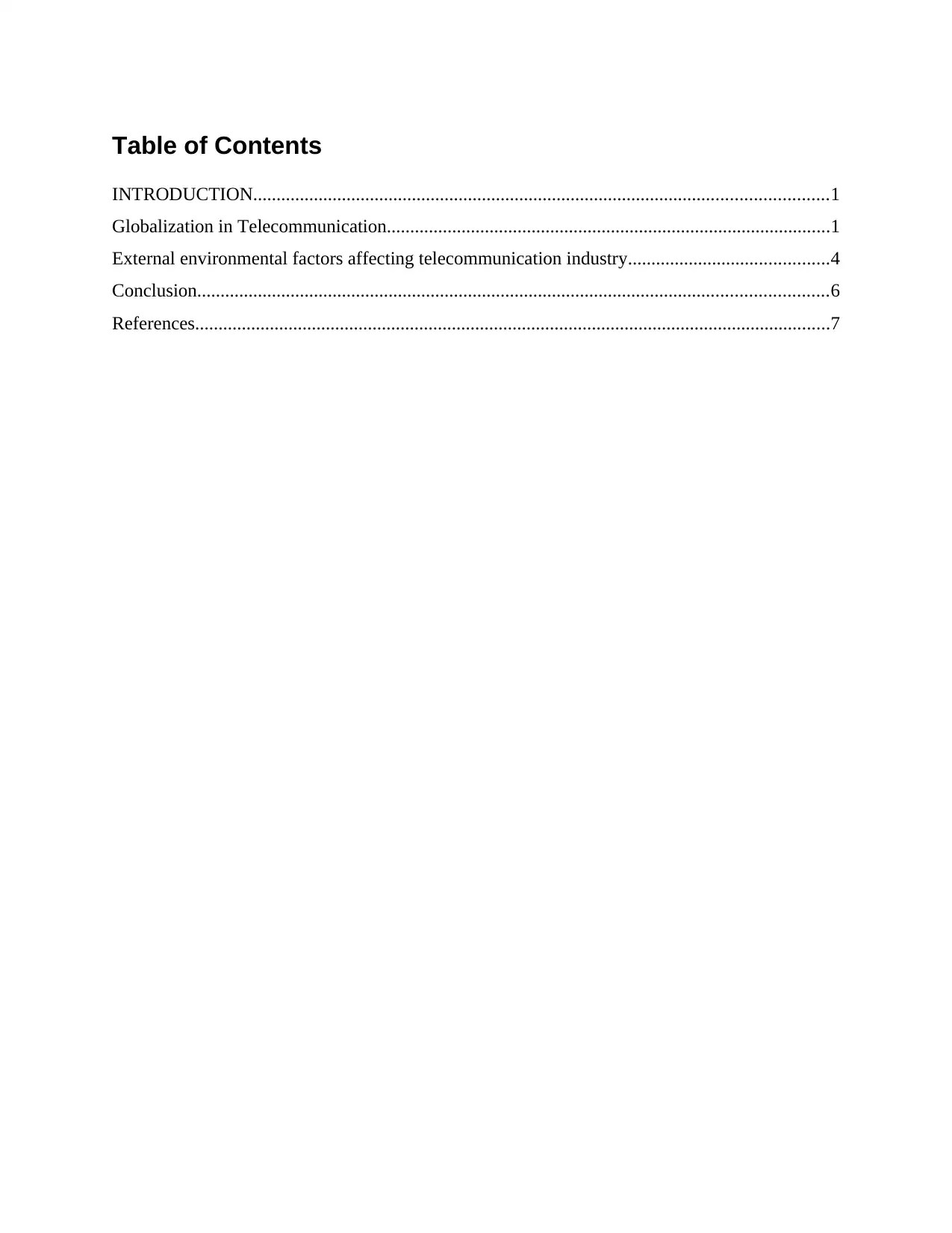
Table of Contents
INTRODUCTION...........................................................................................................................1
Globalization in Telecommunication...............................................................................................1
External environmental factors affecting telecommunication industry...........................................4
Conclusion.......................................................................................................................................6
References........................................................................................................................................7
INTRODUCTION...........................................................................................................................1
Globalization in Telecommunication...............................................................................................1
External environmental factors affecting telecommunication industry...........................................4
Conclusion.......................................................................................................................................6
References........................................................................................................................................7
INTRODUCTION
Globalization refers to process of integration of market in a global economy, where all
world is been considered as one market. Globalisation has much impact on the success of
telecommunication industry and also impacts individuals on the use of telecommunication.
Various external environmental factors have influence over the telecommunication industry.
Globalization in Telecommunication
Globalisation refers to integration and interaction of markets, peoples, governments,
companies in the global economy. Globalisation is having whole global market as a single big
market (Pieterse, 2015). Due to communication and transportation advancements globalisation
has developed widely. Globalisation has many benefits, such as Access to larger market,
Worldwide access to cheap raw material's sources, Avoidance of regulations, Increase in flow of
inward investment between countries, etc.
Globalisation has an impact over each and every aspects of an individual's life. From
their language, transportation, lifestyles, etc., it affects each individual differently on their
different factors like location, culture, education, income, etc. Due to globalisation in
telecommunication industry an individual can have a wide range of product to choose from. If as
an individual not satisfied by the services provided by a particular telecommunication company,
can easily switch from one to another. Through globalisation there are many companies to
choose from, and can choose the best who provide competitive offers to their customers (van de
Kaa and Greeven, 2017). With globalisation world class companies with world class services are
offering their services to customers at a competitive level. Due to which we get the best
telecommunication services from world's top leading companies, with advanced technologies
and innovations at low prices. Globalisation have provided benefit of best services at low cost to
their customers, due to increase in competition in telecommunication market. Lifestyles of
individuals have changed and more employment opportunities are been generated in
telecommunication industry due to globalisation. It opened a way to digitalize the whole nation
as more and more companies have set up they would try to increase their customer base for
which they provide more at less price, which is been affordable by each and every person in
society. Due to which individuals who would not use internet services in their mobiles will use
as they get it at low prices.
1
Globalization refers to process of integration of market in a global economy, where all
world is been considered as one market. Globalisation has much impact on the success of
telecommunication industry and also impacts individuals on the use of telecommunication.
Various external environmental factors have influence over the telecommunication industry.
Globalization in Telecommunication
Globalisation refers to integration and interaction of markets, peoples, governments,
companies in the global economy. Globalisation is having whole global market as a single big
market (Pieterse, 2015). Due to communication and transportation advancements globalisation
has developed widely. Globalisation has many benefits, such as Access to larger market,
Worldwide access to cheap raw material's sources, Avoidance of regulations, Increase in flow of
inward investment between countries, etc.
Globalisation has an impact over each and every aspects of an individual's life. From
their language, transportation, lifestyles, etc., it affects each individual differently on their
different factors like location, culture, education, income, etc. Due to globalisation in
telecommunication industry an individual can have a wide range of product to choose from. If as
an individual not satisfied by the services provided by a particular telecommunication company,
can easily switch from one to another. Through globalisation there are many companies to
choose from, and can choose the best who provide competitive offers to their customers (van de
Kaa and Greeven, 2017). With globalisation world class companies with world class services are
offering their services to customers at a competitive level. Due to which we get the best
telecommunication services from world's top leading companies, with advanced technologies
and innovations at low prices. Globalisation have provided benefit of best services at low cost to
their customers, due to increase in competition in telecommunication market. Lifestyles of
individuals have changed and more employment opportunities are been generated in
telecommunication industry due to globalisation. It opened a way to digitalize the whole nation
as more and more companies have set up they would try to increase their customer base for
which they provide more at less price, which is been affordable by each and every person in
society. Due to which individuals who would not use internet services in their mobiles will use
as they get it at low prices.
1
⊘ This is a preview!⊘
Do you want full access?
Subscribe today to unlock all pages.

Trusted by 1+ million students worldwide
Under globalisation it also has a huge impact on the evolution of telecommunication
industry. As there is a constant change and development in communication and information
technologies. Telecommunication sector for adopting opportunities they have implemented many
ways to shape the process of changes globally. As the telecommunication sector have developed
it has increased the amount of cross country flow of information, satisfying the demands of
customer for world class telecom services, low transactional costs, etc (Saafein and Shaykhian,
2014). Since 1880 telecommunication industry have experienced many changes. During half of
20th century, telecommunication sector has become a stable comparative industry worldwide.
Vodafone is one of the leading mobile telecommunication company throughout the globe,
with significant presence over Europe, Asia Pacific, United States, Middle East and Africa. It
was a start-up company of UK in 1984, and now became world's leading telecom company and
have a strong presence in European countries.
As globalisation been implemented in telecommunication industry, it has increased
competition for Vodafone. Globalisation has a significant impact for restructuring of Vodafone
as new technological development like digitalization and mobile telecommunication have been
constantly changing and developing. Rapid flow of information, across borders and boundaries
of nations, time, space have revealed breakthrough in technologies of telecommunication
industry. Due to globalisation, government also privatised government or state owned
telecommunication companies to enter into competition and for establishing independent
regulatory bodies. Due to globalisation new products and services for telecommunication sectors
have been introduced in the market, for facing their competition. For maintaining their position
or place in the competition Vodafone have implemented and adopted new capabilities, business
and resources for their existence in global market (Dunning, 2014). For expanding and
increasing their market base Vodafone have allied with other companies of other nations and
industries in search of potential markets as to reach large population, have a strong presence in
the market, reducing the pressure of competition and to have a greater control over
telecommunication industry. Because of new competition from globalisation, speed in transfer of
information has become important for Vodafone group to improve and sustain their position in
the global market. Vodafone has also made partnership with other telecommunication companies
for exploring new markets and opportunities at low investment, as they are less expensive and
much flexible for setting up. The key for overall telecommunication industry's growth is
2
industry. As there is a constant change and development in communication and information
technologies. Telecommunication sector for adopting opportunities they have implemented many
ways to shape the process of changes globally. As the telecommunication sector have developed
it has increased the amount of cross country flow of information, satisfying the demands of
customer for world class telecom services, low transactional costs, etc (Saafein and Shaykhian,
2014). Since 1880 telecommunication industry have experienced many changes. During half of
20th century, telecommunication sector has become a stable comparative industry worldwide.
Vodafone is one of the leading mobile telecommunication company throughout the globe,
with significant presence over Europe, Asia Pacific, United States, Middle East and Africa. It
was a start-up company of UK in 1984, and now became world's leading telecom company and
have a strong presence in European countries.
As globalisation been implemented in telecommunication industry, it has increased
competition for Vodafone. Globalisation has a significant impact for restructuring of Vodafone
as new technological development like digitalization and mobile telecommunication have been
constantly changing and developing. Rapid flow of information, across borders and boundaries
of nations, time, space have revealed breakthrough in technologies of telecommunication
industry. Due to globalisation, government also privatised government or state owned
telecommunication companies to enter into competition and for establishing independent
regulatory bodies. Due to globalisation new products and services for telecommunication sectors
have been introduced in the market, for facing their competition. For maintaining their position
or place in the competition Vodafone have implemented and adopted new capabilities, business
and resources for their existence in global market (Dunning, 2014). For expanding and
increasing their market base Vodafone have allied with other companies of other nations and
industries in search of potential markets as to reach large population, have a strong presence in
the market, reducing the pressure of competition and to have a greater control over
telecommunication industry. Because of new competition from globalisation, speed in transfer of
information has become important for Vodafone group to improve and sustain their position in
the global market. Vodafone has also made partnership with other telecommunication companies
for exploring new markets and opportunities at low investment, as they are less expensive and
much flexible for setting up. The key for overall telecommunication industry's growth is
2
Paraphrase This Document
Need a fresh take? Get an instant paraphrase of this document with our AI Paraphraser
liberalizing telecommunication industries and rapid technological advances are two main
characteristics of global telecommunication industry. Due to globalisation, the global
telecommunication's nature have evolved from nation to nation, bilateral framework to a
multilateral, multinational company structure.
After globalisation many telecommunication industry including Vodafone group were
have to develop international strategies. With international strategies Vodafone was able to enter
markets beyond boundaries, can able to use foreign resources and to construct or develop
production, R&D and supply facilities outside their country. By adopting external strategies like
partnership with a local company, acquisition of an existing firm help them to access existing
infrastructure and establish their market position in new market or area and contacting and
building relations with locals. For developing the core and complementing activities of Vodafone
it is required for adopting those strategies. As foreign companies have lack of knowledge of
markets and needs of customers, government regulations, local conditions for operations, most of
them prefer to enter through partnership and through mergers and acquisitions. Due to the lack of
common global applied legal framework and difference in cultures International
telecommunication companies like Vodafone have to deal a lot. As the regulatory framework are
crucial and complex nature of service exchange in telecommunication market it is necessary to
have such differences. The cost of transaction is lessened and facilitate quick reactions for
grabbing new business opportunities globalisation in telecommunication sector is needed.
Globalised telecommunication will have major impact on both industrialized and developing
nations' development rate and growth rate. Importance of service innovation and new
competitors, establishing network are depended on global competitive strategies (Gërqina, 2015).
Globalisation also gives an opportunity for diversifying or scattering their risks. In
relation to general and political risks, telecommunication industry growth and development rate
may differentiate from one country to another. Telecommunication has high potentials as there
are many growth opportunities around globe as it brings value for customers from different
cultures and backgrounds. Globalisation has shaped telecommunication industry in such that it
transports informations at high speeds due to which the concept of virtual world have come true
(Stiglitz, 2016). Telecommunication has gone through a technological revolution which created a
fresh market and new supply system and changed institutional and corporate relationships for
more public control. Customer usage pattern is been impacted by the advent of satellites,
3
characteristics of global telecommunication industry. Due to globalisation, the global
telecommunication's nature have evolved from nation to nation, bilateral framework to a
multilateral, multinational company structure.
After globalisation many telecommunication industry including Vodafone group were
have to develop international strategies. With international strategies Vodafone was able to enter
markets beyond boundaries, can able to use foreign resources and to construct or develop
production, R&D and supply facilities outside their country. By adopting external strategies like
partnership with a local company, acquisition of an existing firm help them to access existing
infrastructure and establish their market position in new market or area and contacting and
building relations with locals. For developing the core and complementing activities of Vodafone
it is required for adopting those strategies. As foreign companies have lack of knowledge of
markets and needs of customers, government regulations, local conditions for operations, most of
them prefer to enter through partnership and through mergers and acquisitions. Due to the lack of
common global applied legal framework and difference in cultures International
telecommunication companies like Vodafone have to deal a lot. As the regulatory framework are
crucial and complex nature of service exchange in telecommunication market it is necessary to
have such differences. The cost of transaction is lessened and facilitate quick reactions for
grabbing new business opportunities globalisation in telecommunication sector is needed.
Globalised telecommunication will have major impact on both industrialized and developing
nations' development rate and growth rate. Importance of service innovation and new
competitors, establishing network are depended on global competitive strategies (Gërqina, 2015).
Globalisation also gives an opportunity for diversifying or scattering their risks. In
relation to general and political risks, telecommunication industry growth and development rate
may differentiate from one country to another. Telecommunication has high potentials as there
are many growth opportunities around globe as it brings value for customers from different
cultures and backgrounds. Globalisation has shaped telecommunication industry in such that it
transports informations at high speeds due to which the concept of virtual world have come true
(Stiglitz, 2016). Telecommunication has gone through a technological revolution which created a
fresh market and new supply system and changed institutional and corporate relationships for
more public control. Customer usage pattern is been impacted by the advent of satellites,
3
computers, digital switching, fibre optics and new form of wireless communications. As there is
integration of telecommunication usage beyond national boundaries, comparable changes are
been taking place on global market and separates from local and national communication. It is
been estimated that total phone traffic is doubled every five years for sustaining this growth
promoting world trade through reducing tariff and trade restrictions by agreements like GATT
and NAFTA.
External environmental factors affecting telecommunication industry
Vodafone Group plc one of British Multinational telecommunication company with
headquarter in London, UK. It is partnered in 1984 between Racal Electronics plc and Millicon
Inc. to form Vodafone to provide mobile telecommunication services and finally established as
independent company in 1991. It has over 75 million 4g customers all over the world.
As Vodafone is a global company, there are few external factors that affects the success
of the company. For determining the external environmental factors affecting telecommunication
is been studied through PESTLE analysis. The first factor we consider is political factors that
affects Vodafone in globalisation scenario. Political factors have much influence, as it has to
operate and develop their infrastructure in different states and nations. For which they have to
follow the laws and regulations of the nation or country in which they are operating. There are
direct impact of the country's peace of state and political instability on the functioning and
operations of company. If there is restriction on telecommunication sector them it would be
difficult for organisation to establish in that certain country (Fares, 2015). It becomes a tough
task for company to establish their infrastructure for network as it became war prone area due to
instability in politics. For example when conflicts in Europe have emerged it effected the whole
company. Political factor would also affect me as an individual, Due to political restrictions I
would not be able to avail services of global service providers. Due to which I can't enjoy
benefits of perfect competition, where because of industrial rivalry, get better services and offers
at low prices.
Next factor that affects company is economic factors. Economic is a very much important
factor that is been considered for determining the factors affecting the company, like Vodafone.
The chances for the company is higher for expanding its business and establishing its new unit in
a new place, if the state or nation is also developing higher. The people or citizen of a nation
4
integration of telecommunication usage beyond national boundaries, comparable changes are
been taking place on global market and separates from local and national communication. It is
been estimated that total phone traffic is doubled every five years for sustaining this growth
promoting world trade through reducing tariff and trade restrictions by agreements like GATT
and NAFTA.
External environmental factors affecting telecommunication industry
Vodafone Group plc one of British Multinational telecommunication company with
headquarter in London, UK. It is partnered in 1984 between Racal Electronics plc and Millicon
Inc. to form Vodafone to provide mobile telecommunication services and finally established as
independent company in 1991. It has over 75 million 4g customers all over the world.
As Vodafone is a global company, there are few external factors that affects the success
of the company. For determining the external environmental factors affecting telecommunication
is been studied through PESTLE analysis. The first factor we consider is political factors that
affects Vodafone in globalisation scenario. Political factors have much influence, as it has to
operate and develop their infrastructure in different states and nations. For which they have to
follow the laws and regulations of the nation or country in which they are operating. There are
direct impact of the country's peace of state and political instability on the functioning and
operations of company. If there is restriction on telecommunication sector them it would be
difficult for organisation to establish in that certain country (Fares, 2015). It becomes a tough
task for company to establish their infrastructure for network as it became war prone area due to
instability in politics. For example when conflicts in Europe have emerged it effected the whole
company. Political factor would also affect me as an individual, Due to political restrictions I
would not be able to avail services of global service providers. Due to which I can't enjoy
benefits of perfect competition, where because of industrial rivalry, get better services and offers
at low prices.
Next factor that affects company is economic factors. Economic is a very much important
factor that is been considered for determining the factors affecting the company, like Vodafone.
The chances for the company is higher for expanding its business and establishing its new unit in
a new place, if the state or nation is also developing higher. The people or citizen of a nation
4
⊘ This is a preview!⊘
Do you want full access?
Subscribe today to unlock all pages.
Trusted by 1+ million students worldwide
have more income if there is good GDP of the country, due to which they are more capable of
adopting the latest communication technologies and innovations. Inflation, interest rates, taxes,
etc., are some economic factors that affects business of telecommunication industry
(Lebesmuehlbacher, 2016). Customers who live in rural areas and small towns are mostly
affected. As it is expensive to establish towers and other resources, due to low population and
less demand. Economic factor drive prices based on location, amount of population or customers
in an area and telecommunication services needs. Because of global uncertainty in economical
factor, company have to regularly change their strategies to face overall economic crisis. The
effect of Brexit have also impacted on the telecommunication industry. Charges of mobile
roaming have gone up, in effect of Brexit. High cost of spectrum faced by telecommunication
industry causes trouble for them. Introduction of unlimited bundled usage pack due to lack of
effective regulations have caused the telecom industry to face severe financial stress. Due to
instability in economy, I was not able to purchase high cost services provided by various network
providers. As charges of mobile roaming have gone high, I am unable to get better service while
at roaming or outside country.
The other factor that influence telecommunication sector is socio-cultural factors. Social
factors' impact is based on the culture and belief of local people where company is been
operating. Telecommunication has become an important part of an average person's life.
Vodafone can improves their market presence and customer loyalty by focusing on providing
high quality of services to customers. Company must show flexibility in their policies regarding
to local culture for success of the organisation. Vodafone have changed their policies and
preferences regarding local social and cultural factors of place or nation where they are
operating. This has benefited me for availing different mobile network products or services, that
focuses on culture in which I live.
For its innovations and latest technologies, Vodafone have become famous in the world.
Mission of Vodafone is to always follow the latest or future trends in communicational and
technological sphere. Due to globalisation there are many competitors and rivals for Vodafone as
they are coming up with the latest trends and technologies or innovation before Vodafone at
cheap prices. Before launching any product or services company has to keep in view that they
are producing most related technology and keeping in view make policies and features of the
product. Company should follow fundamentals and focus on latest technological trends and
5
adopting the latest communication technologies and innovations. Inflation, interest rates, taxes,
etc., are some economic factors that affects business of telecommunication industry
(Lebesmuehlbacher, 2016). Customers who live in rural areas and small towns are mostly
affected. As it is expensive to establish towers and other resources, due to low population and
less demand. Economic factor drive prices based on location, amount of population or customers
in an area and telecommunication services needs. Because of global uncertainty in economical
factor, company have to regularly change their strategies to face overall economic crisis. The
effect of Brexit have also impacted on the telecommunication industry. Charges of mobile
roaming have gone up, in effect of Brexit. High cost of spectrum faced by telecommunication
industry causes trouble for them. Introduction of unlimited bundled usage pack due to lack of
effective regulations have caused the telecom industry to face severe financial stress. Due to
instability in economy, I was not able to purchase high cost services provided by various network
providers. As charges of mobile roaming have gone high, I am unable to get better service while
at roaming or outside country.
The other factor that influence telecommunication sector is socio-cultural factors. Social
factors' impact is based on the culture and belief of local people where company is been
operating. Telecommunication has become an important part of an average person's life.
Vodafone can improves their market presence and customer loyalty by focusing on providing
high quality of services to customers. Company must show flexibility in their policies regarding
to local culture for success of the organisation. Vodafone have changed their policies and
preferences regarding local social and cultural factors of place or nation where they are
operating. This has benefited me for availing different mobile network products or services, that
focuses on culture in which I live.
For its innovations and latest technologies, Vodafone have become famous in the world.
Mission of Vodafone is to always follow the latest or future trends in communicational and
technological sphere. Due to globalisation there are many competitors and rivals for Vodafone as
they are coming up with the latest trends and technologies or innovation before Vodafone at
cheap prices. Before launching any product or services company has to keep in view that they
are producing most related technology and keeping in view make policies and features of the
product. Company should follow fundamentals and focus on latest technological trends and
5
Paraphrase This Document
Need a fresh take? Get an instant paraphrase of this document with our AI Paraphraser
become a technology driven company. For more telecom development it is required for more
investments for having a technological advancement (Shelepov, 2014). Due to latest innovations
and advanced technologies due to globalisation, I can get up to dated services from different
service providers. Speed of internet browsing have increased which would facilitate in many
personal or professional activities or work.
Telecommunication industry is been impacted by the legislation or legal issues or factors.
Vodafone has to consider issues related to like copy and pirated issues. Company have to face
many penalties when they broke or avoids any legal matter that are been implemented by
government or regulatory authorities. Taxes implied by the governments of different country can
be an issue for organisation as they have to pay a huge amount of taxes for their products or
services. Companies have to talk for settle tax row with the government. Which could affect their
operations and pricing policies. If legislation or law of a certain country puts restrictions on
certain telecommunication business or company from entering the country it could cause issue
for company to expand their business (Ephraim, 2014). If employees are not payed well in
company it would cause them to leave organisation which could cause leakage of ideas and
innovations. To prevent this they have to follow the rules and laws of legislation to increase their
customers and for having a positive image in market by having the trust of customers. As tax
rates on global companies have been raised, I have to beer the extra amount of implemented tax.
Certain restrictions on some company have affected my choice of selecting from more wider
service providers.
Environment also plays an important role in impacting the telecommunication industry.
With growth in globalisation, customers and people have become more ethical and socially
responsible. Customers want their brand to be a helping hand in for the betterment of society and
the nation. Environment factors like climate changes, global warming, etc., can affect the reach
of telecommunication products to their customers. Company have to adapt changes that occurs
due to the change in the environment. Working conditions of organisation must be good and
attractive for individuals or persons to come and work with them. A global telecommunication
company like Vodafone is very much dynamic in nature. Many telecommunication industry have
made their vision of zero harm environment safety cultures. An organisation should always
consider previously mentioned facts and analysis for sustain in the market and expand their
network (Lane, 2017). As companies are engaged in different CSR activities, it would indirectly
6
investments for having a technological advancement (Shelepov, 2014). Due to latest innovations
and advanced technologies due to globalisation, I can get up to dated services from different
service providers. Speed of internet browsing have increased which would facilitate in many
personal or professional activities or work.
Telecommunication industry is been impacted by the legislation or legal issues or factors.
Vodafone has to consider issues related to like copy and pirated issues. Company have to face
many penalties when they broke or avoids any legal matter that are been implemented by
government or regulatory authorities. Taxes implied by the governments of different country can
be an issue for organisation as they have to pay a huge amount of taxes for their products or
services. Companies have to talk for settle tax row with the government. Which could affect their
operations and pricing policies. If legislation or law of a certain country puts restrictions on
certain telecommunication business or company from entering the country it could cause issue
for company to expand their business (Ephraim, 2014). If employees are not payed well in
company it would cause them to leave organisation which could cause leakage of ideas and
innovations. To prevent this they have to follow the rules and laws of legislation to increase their
customers and for having a positive image in market by having the trust of customers. As tax
rates on global companies have been raised, I have to beer the extra amount of implemented tax.
Certain restrictions on some company have affected my choice of selecting from more wider
service providers.
Environment also plays an important role in impacting the telecommunication industry.
With growth in globalisation, customers and people have become more ethical and socially
responsible. Customers want their brand to be a helping hand in for the betterment of society and
the nation. Environment factors like climate changes, global warming, etc., can affect the reach
of telecommunication products to their customers. Company have to adapt changes that occurs
due to the change in the environment. Working conditions of organisation must be good and
attractive for individuals or persons to come and work with them. A global telecommunication
company like Vodafone is very much dynamic in nature. Many telecommunication industry have
made their vision of zero harm environment safety cultures. An organisation should always
consider previously mentioned facts and analysis for sustain in the market and expand their
network (Lane, 2017). As companies are engaged in different CSR activities, it would indirectly
6
benefit me as, person living or residing in society or community. They would come up with new
innovations to reduce harmful radiations from mobile network, which would affect my health.
These above mentioned external factors are major ingredients for the success of the
company, this act as a clear agenda company should follow to avoid failure. It is essential for the
development and implementing strategies accordingly, on the basis of external environmental
factors.
Conclusion
It can be concluded that globalisation have a great influence over the telecommunication
industry and have impact on each and every individual. Globalisation has a huge impact on the
evolution of telecommunication industry. Due to globalisation, telecommunication sector have
developed it has increased the amount of cross country flow of information, satisfying the
demands of customer for world class telecom services at low transactional costs. There are
various external environmental factors which have their impact over the success of the
organisation.
7
innovations to reduce harmful radiations from mobile network, which would affect my health.
These above mentioned external factors are major ingredients for the success of the
company, this act as a clear agenda company should follow to avoid failure. It is essential for the
development and implementing strategies accordingly, on the basis of external environmental
factors.
Conclusion
It can be concluded that globalisation have a great influence over the telecommunication
industry and have impact on each and every individual. Globalisation has a huge impact on the
evolution of telecommunication industry. Due to globalisation, telecommunication sector have
developed it has increased the amount of cross country flow of information, satisfying the
demands of customer for world class telecom services at low transactional costs. There are
various external environmental factors which have their impact over the success of the
organisation.
7
⊘ This is a preview!⊘
Do you want full access?
Subscribe today to unlock all pages.
Trusted by 1+ million students worldwide
References
Books and Journals
Dunning, J.H., 2014. The Globalization of Business (Routledge Revivals): The Challenge of the
1990s. Routledge.
Ephraim, P.E., 2014. John Hoberman, Age of Globalization. International Journal of
Communication, 8, p.3.
Fares, A., 2015. Emerging cellular technologies and the future.
Gërqina, B., 2015. THE IMPACT OF INFORMATIC AND TELECOMMUNICATION
TECHNOLOGY IN GLOBALIZATION (Doctoral dissertation).
Lane, J.E., 2017. Globalization and Politics: Promises and Dangers. Routledge.
Lebesmuehlbacher, T., 2016. Globalization and Technology Diffusion: The Case of Mobile
Phones.
Pieterse, J.N., 2015. Globalization and culture: Global mélange. Rowman & Littlefield.
Saafein, O. and Shaykhian, G.A., 2014. Factors affecting virtual team performance in
telecommunication support environment. Telematics and Informatics, 31(3), pp.459-462.
Shelepov, V.G., 2014. Development of information economy in the age of globalization. Actual
problems of international relations, 1(106).
Stiglitz, J., 2016. Globalization and its new discontents. Project Syndicate, 5(8).
van de Kaa, G. and Greeven, M.J., 2017. Mobile telecommunication standardization in Japan,
China, the United States, and Europe: a comparison of regulatory and industrial
regimes. Telecommunication Systems, 65(1), pp.181-192.
8
Books and Journals
Dunning, J.H., 2014. The Globalization of Business (Routledge Revivals): The Challenge of the
1990s. Routledge.
Ephraim, P.E., 2014. John Hoberman, Age of Globalization. International Journal of
Communication, 8, p.3.
Fares, A., 2015. Emerging cellular technologies and the future.
Gërqina, B., 2015. THE IMPACT OF INFORMATIC AND TELECOMMUNICATION
TECHNOLOGY IN GLOBALIZATION (Doctoral dissertation).
Lane, J.E., 2017. Globalization and Politics: Promises and Dangers. Routledge.
Lebesmuehlbacher, T., 2016. Globalization and Technology Diffusion: The Case of Mobile
Phones.
Pieterse, J.N., 2015. Globalization and culture: Global mélange. Rowman & Littlefield.
Saafein, O. and Shaykhian, G.A., 2014. Factors affecting virtual team performance in
telecommunication support environment. Telematics and Informatics, 31(3), pp.459-462.
Shelepov, V.G., 2014. Development of information economy in the age of globalization. Actual
problems of international relations, 1(106).
Stiglitz, J., 2016. Globalization and its new discontents. Project Syndicate, 5(8).
van de Kaa, G. and Greeven, M.J., 2017. Mobile telecommunication standardization in Japan,
China, the United States, and Europe: a comparison of regulatory and industrial
regimes. Telecommunication Systems, 65(1), pp.181-192.
8

1 out of 10


Related Documents


Your All-in-One AI-Powered Toolkit for Academic Success.
+13062052269
info@desklib.com
Available 24*7 on WhatsApp / Email
![[object Object]](/_next/static/media/star-bottom.7253800d.svg)
Unlock your academic potential
Copyright © 2020–2026 A2Z Services. All Rights Reserved. Developed and managed by ZUCOL.