Holmes Institute HA3032 Auditing Report: Gold Mountain Ltd Analysis
VerifiedAdded on  2023/06/04
|26
|3883
|473
Report
AI Summary
This report provides a comprehensive analysis of the auditing procedures applied to Gold Mountain Ltd, an Australian-based corporation listed on the ASX and operating in the mineral exploration and development sector. The executive summary outlines the audit's objective, which is to assess the company's financial activities and ensure compliance with relevant accounting standards and regulations, including those defined by the ASX. The report delves into the key business risks faced by Gold Mountain, categorized into operating, environmental, and economic risks, as well as market conditions, and their potential impact on the company's financial state and market value. An audit risk model, incorporating inherent risk, control risk, and detection risk, is applied to guide the audit process, along with a detailed examination of audit work steps including analytical procedures, sampling plans and substantive testing. The report also presents the audit procedures and findings related to various asset and liability accounts. The ultimate goal of the audit is to provide stakeholders with reliable information for informed decision-making, with the report concluding with an opinion on the fairness of Gold Mountain's financial statements.

1
Auditing: Gold Mountain Ltd
Paraphrase This Document
Need a fresh take? Get an instant paraphrase of this document with our AI Paraphraser

2
Executive Summary
Audit refers to an objective assessment of financial activities and performance of a firm, which is
carried out to ensure that all the information and records are in confirmation with the relevant
accounting principles and standards. The audit report is helpful for the stakeholders such as
investors, creditors, bankers, government, and for the entire society for the purpose of making an
intelligent decision. This report analyses the statement of authenticity of an Australian-based
corporation Gold Mountain Ltd which is listed in ASX, and deals in mineral exploration and
development sector (Gold Mountain Limited, 2016). For the purpose, the audit is conducted to
evaluate the nature of business risk through a procedure of substantive and control tests, in
accordance with the Auditing Regulations of Australia, and guidelines defined by ASX. The
report has found that Gold Mountain adheres to all the statutory obligations while recording and
maintaining the financial documents. It was also observed that the firm is performing well but
the internal controls are not much strong that needs to be taken into consideration by the auditor
while preparing the audit report and giving opinion on that.
Executive Summary
Audit refers to an objective assessment of financial activities and performance of a firm, which is
carried out to ensure that all the information and records are in confirmation with the relevant
accounting principles and standards. The audit report is helpful for the stakeholders such as
investors, creditors, bankers, government, and for the entire society for the purpose of making an
intelligent decision. This report analyses the statement of authenticity of an Australian-based
corporation Gold Mountain Ltd which is listed in ASX, and deals in mineral exploration and
development sector (Gold Mountain Limited, 2016). For the purpose, the audit is conducted to
evaluate the nature of business risk through a procedure of substantive and control tests, in
accordance with the Auditing Regulations of Australia, and guidelines defined by ASX. The
report has found that Gold Mountain adheres to all the statutory obligations while recording and
maintaining the financial documents. It was also observed that the firm is performing well but
the internal controls are not much strong that needs to be taken into consideration by the auditor
while preparing the audit report and giving opinion on that.

3
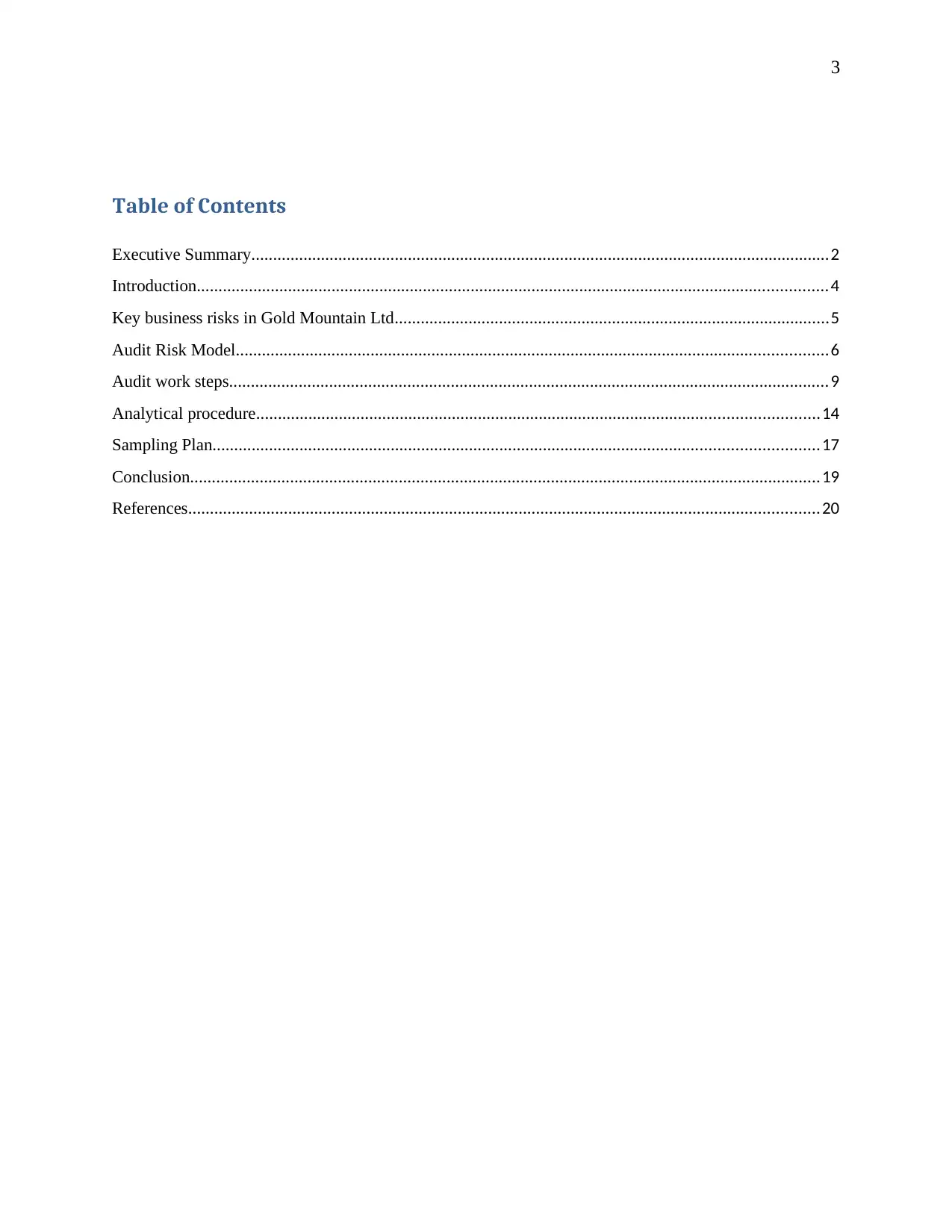
Table of Contents
Executive Summary.....................................................................................................................................2
Introduction.................................................................................................................................................4
Key business risks in Gold Mountain Ltd....................................................................................................5
Audit Risk Model........................................................................................................................................6
Audit work steps..........................................................................................................................................9
Analytical procedure.................................................................................................................................14
Sampling Plan...........................................................................................................................................17
Conclusion.................................................................................................................................................19
References.................................................................................................................................................20
Table of Contents
Executive Summary.....................................................................................................................................2
Introduction.................................................................................................................................................4
Key business risks in Gold Mountain Ltd....................................................................................................5
Audit Risk Model........................................................................................................................................6
Audit work steps..........................................................................................................................................9
Analytical procedure.................................................................................................................................14
Sampling Plan...........................................................................................................................................17
Conclusion.................................................................................................................................................19
References.................................................................................................................................................20
⊘ This is a preview!⊘
Do you want full access?
Subscribe today to unlock all pages.

Trusted by 1+ million students worldwide

4
Introduction
The following report is prepared with an aim to obtain an understanding of the auditing
procedures in context to an organization listed on Australian Security Exchange. The report
contains the required auditing steps and audit program for Gold Mountain Ltd that is principally
engaged in extracting and developing a range of highly valuable mineralized zones across the
Australia. In order to perform assessment of audit risk for the company, the key business risks
have been examined. The report also discusses the analytical procedures for determining the
financial health of Gold Mountain for the last three consecutive years, by computing ratios and
metrics. In addition to this, the audit risk model is also applied to the company for identifying the
materiality, and degree of detection and inherent risks. A comprehensive series of audit steps
have also been adopted, along with the preparation of a sampling plan for the effective testing of
material misstatement.
Introduction
The following report is prepared with an aim to obtain an understanding of the auditing
procedures in context to an organization listed on Australian Security Exchange. The report
contains the required auditing steps and audit program for Gold Mountain Ltd that is principally
engaged in extracting and developing a range of highly valuable mineralized zones across the
Australia. In order to perform assessment of audit risk for the company, the key business risks
have been examined. The report also discusses the analytical procedures for determining the
financial health of Gold Mountain for the last three consecutive years, by computing ratios and
metrics. In addition to this, the audit risk model is also applied to the company for identifying the
materiality, and degree of detection and inherent risks. A comprehensive series of audit steps
have also been adopted, along with the preparation of a sampling plan for the effective testing of
material misstatement.
Paraphrase This Document
Need a fresh take? Get an instant paraphrase of this document with our AI Paraphraser

5
Key business risks in Gold Mountain Ltd
A risk is an integral element of any business whether it is operating at a small or large level.
Business risks refer to those unpredictable events which can cause a substantial loss to a
company, including the failure of business (Gold Mountain Limited, 2017). In context of Gold
Mountain Ltd, there exist general as well as some specific risks associated with its operations,
which are largely not in the control of the Company and its Directors. The Business risks in Gold
Mountain are mentioned below, which have the potential to affect the future the market value of
the Company’s shares, and its entire financial state.
Operating Risks
The operations of Gold Mountain are affected by numerous risks. These include inability to
locate mineral deposits, letdown of predicted grades in mining, operational and procedural
complications, sovereign risks, problems in operating plant and tools, automatic failure or plant
collapse, unexpected metallurgical risks increasing extraction costs, industrial accidents and
clashes, and sudden rise in the costs of spare parts, consumables, plant and machinery.
Environmental Risks
The activities of the Gold Mountain are bound by the Australian laws and guidelines of Papua
New Guinea concerning the environment. Since the firm deal in exploration and mining projects,
the Company’s business is expected to have an impact on the ecology through pollution, and soil
degradation (Gold Mountain Limited, 2016). Thus, the company is bound to conduct its activities
by adhering to the established environmental standards.
Key business risks in Gold Mountain Ltd
A risk is an integral element of any business whether it is operating at a small or large level.
Business risks refer to those unpredictable events which can cause a substantial loss to a
company, including the failure of business (Gold Mountain Limited, 2017). In context of Gold
Mountain Ltd, there exist general as well as some specific risks associated with its operations,
which are largely not in the control of the Company and its Directors. The Business risks in Gold
Mountain are mentioned below, which have the potential to affect the future the market value of
the Company’s shares, and its entire financial state.
Operating Risks
The operations of Gold Mountain are affected by numerous risks. These include inability to
locate mineral deposits, letdown of predicted grades in mining, operational and procedural
complications, sovereign risks, problems in operating plant and tools, automatic failure or plant
collapse, unexpected metallurgical risks increasing extraction costs, industrial accidents and
clashes, and sudden rise in the costs of spare parts, consumables, plant and machinery.
Environmental Risks
The activities of the Gold Mountain are bound by the Australian laws and guidelines of Papua
New Guinea concerning the environment. Since the firm deal in exploration and mining projects,
the Company’s business is expected to have an impact on the ecology through pollution, and soil
degradation (Gold Mountain Limited, 2016). Thus, the company is bound to conduct its activities
by adhering to the established environmental standards.

6
Economic Risks
The economic risks of Gold Mountain include General economic surroundings, fluctuations in
the inflation and interest rates, changes in currency exchange rates affecting the firm’s
exploration and production functions, along with its ability to subsidize these activities.
Market conditions
Irrespective of the Gold Mountain’s operating performance, the share market also affects the
value of its listed securities. These risks include general economic position, changes in investor
attitude towards a particular market sector, the demand and supply of capital, establishment of
tax reform or new law, and terrorism or other warfare.
In order to identify the significant risks in the misstatement of financial accounts of the company
and issue fair opinion, the auditor should consider and analyze all the related business risks of
the company, as required by ISA 315.
Audit Risk Model
Audit risk model refers to a concept that consists of inherent risk, control risk, and detection risk,
assisting the auditor in applying the suitable auditing procedures for transactions revealed in the
client’s financial statements. In context of Gold Mountain, this model is applied with respect to
three elements namely IR, CR, DR (Lenz, and Hahn, 2015). Inherent risk indicates the risk
occurred due to complicated transaction when there is no internal controls in the company, while
control risk signifies the risk of unrecognizing and non-prevention of major error or fraud timely
by the existing internal control system (Gold Mountain Limited, 2017). On the other hand,
Economic Risks
The economic risks of Gold Mountain include General economic surroundings, fluctuations in
the inflation and interest rates, changes in currency exchange rates affecting the firm’s
exploration and production functions, along with its ability to subsidize these activities.
Market conditions
Irrespective of the Gold Mountain’s operating performance, the share market also affects the
value of its listed securities. These risks include general economic position, changes in investor
attitude towards a particular market sector, the demand and supply of capital, establishment of
tax reform or new law, and terrorism or other warfare.
In order to identify the significant risks in the misstatement of financial accounts of the company
and issue fair opinion, the auditor should consider and analyze all the related business risks of
the company, as required by ISA 315.
Audit Risk Model
Audit risk model refers to a concept that consists of inherent risk, control risk, and detection risk,
assisting the auditor in applying the suitable auditing procedures for transactions revealed in the
client’s financial statements. In context of Gold Mountain, this model is applied with respect to
three elements namely IR, CR, DR (Lenz, and Hahn, 2015). Inherent risk indicates the risk
occurred due to complicated transaction when there is no internal controls in the company, while
control risk signifies the risk of unrecognizing and non-prevention of major error or fraud timely
by the existing internal control system (Gold Mountain Limited, 2017). On the other hand,
⊘ This is a preview!⊘
Do you want full access?
Subscribe today to unlock all pages.

Trusted by 1+ million students worldwide

7
detection risk is the risk that the auditor would fail to point out a misstatement existing in any
transaction or account balance.
For auditing the financial statements of Golden Mountain, the auditor would apply the audit risk
model in the following steps:
1. Establishing a planned audit risk level for every type of transaction such as bills payables,
investments, cash, etc.
2. Assessing the degree of CR and IR in the view of business risks, and other risks imposing due
to any misstatement (Gold Mountain Limited, 2016).
3. Resolving the audit risk equation for the required level of audit risk (AR).
4. The result could either be qualitative or quantitative, and the auditor has the right to give
qualified opinion in case he finds greater risk level.
detection risk is the risk that the auditor would fail to point out a misstatement existing in any
transaction or account balance.
For auditing the financial statements of Golden Mountain, the auditor would apply the audit risk
model in the following steps:
1. Establishing a planned audit risk level for every type of transaction such as bills payables,
investments, cash, etc.
2. Assessing the degree of CR and IR in the view of business risks, and other risks imposing due
to any misstatement (Gold Mountain Limited, 2016).
3. Resolving the audit risk equation for the required level of audit risk (AR).
4. The result could either be qualitative or quantitative, and the auditor has the right to give
qualified opinion in case he finds greater risk level.
Paraphrase This Document
Need a fresh take? Get an instant paraphrase of this document with our AI Paraphraser

8
The formula for Audit Risk Model is:
AR = IR x CR x DR
Outcome: The following table shows the results of AR model for Gold Mountain Ltd, along
with the needed audit evidences, on the basis of the Annual Report 217:
AR IR CR Planned audit
risk
Need of audit
evidence
Sales and
Receivables
Maximum
(80%)
Maximum
(94%)
Minimum
(2%)
Minimum MAXIMUM
Purchases and
payments
Minimum
(30%)
Minimum
(40%)
Maximum
(6%)
Maximum MINIMUM
Inventory or
Stock
Minimum
(40%)
Maximum
(6%)
Medium Medium MEDIUM
Implication: The implication from above is that inherent risk is not required to be set at a
maximum automatically in order to reduce the likelihood that risk aspects will be reviewed
independently. As an alternative, the auditor needs to be competent enough to make collective
measurements of the risks to effectively decide the degree of substantive test (Rashidfarokhi et
al., 2018).
The formula for Audit Risk Model is:
AR = IR x CR x DR
Outcome: The following table shows the results of AR model for Gold Mountain Ltd, along
with the needed audit evidences, on the basis of the Annual Report 217:
AR IR CR Planned audit
risk
Need of audit
evidence
Sales and
Receivables
Maximum
(80%)
Maximum
(94%)
Minimum
(2%)
Minimum MAXIMUM
Purchases and
payments
Minimum
(30%)
Minimum
(40%)
Maximum
(6%)
Maximum MINIMUM
Inventory or
Stock
Minimum
(40%)
Maximum
(6%)
Medium Medium MEDIUM
Implication: The implication from above is that inherent risk is not required to be set at a
maximum automatically in order to reduce the likelihood that risk aspects will be reviewed
independently. As an alternative, the auditor needs to be competent enough to make collective
measurements of the risks to effectively decide the degree of substantive test (Rashidfarokhi et
al., 2018).

9
Audit work steps
In order to conduct audit program in Gold Mountain Ltd, the auditor would require to discover
the business risks first in order to analyze the company's response to those risks, and gather
evidence of their implementation (Shariman et al., 2017). Then after, the auditor would review
the risk of major misstatement for the purpose of determining the required audit procedures. The
assessment of the errors and frauds in financial statements would also be done by the auditor. For
recognizing the type of misstatement, the auditor would find out:
The variation between the amount, presentation or classification of the constituents of financial
statement accounts, and Australian Auditing principles:
ï‚· The exclusion of any item in financial statement, or account,
ï‚· A disclosure note in financial statement that is not shown in accord to Australian
Auditing principles.
After the above steps, the auditor would collect the required and reliable audit evidences in the
Gold Mountain in order to arrive at accurate conclusions. Since one method to gather evidences
does not fit in all situations, therefore the auditor would require exercising professional care
while selecting the method or combination of methods according to the type of risk and audit
tasks. For this purpose, the auditor would carry out:
ï‚· Analytical procedures: to see the difference between the amounts recorded in company's
accounts and the 'should be' amounts.
ï‚· Confirmations: to ask for verifying management assertions.
Audit work steps
In order to conduct audit program in Gold Mountain Ltd, the auditor would require to discover
the business risks first in order to analyze the company's response to those risks, and gather
evidence of their implementation (Shariman et al., 2017). Then after, the auditor would review
the risk of major misstatement for the purpose of determining the required audit procedures. The
assessment of the errors and frauds in financial statements would also be done by the auditor. For
recognizing the type of misstatement, the auditor would find out:
The variation between the amount, presentation or classification of the constituents of financial
statement accounts, and Australian Auditing principles:
ï‚· The exclusion of any item in financial statement, or account,
ï‚· A disclosure note in financial statement that is not shown in accord to Australian
Auditing principles.
After the above steps, the auditor would collect the required and reliable audit evidences in the
Gold Mountain in order to arrive at accurate conclusions. Since one method to gather evidences
does not fit in all situations, therefore the auditor would require exercising professional care
while selecting the method or combination of methods according to the type of risk and audit
tasks. For this purpose, the auditor would carry out:
ï‚· Analytical procedures: to see the difference between the amounts recorded in company's
accounts and the 'should be' amounts.
ï‚· Confirmations: to ask for verifying management assertions.
⊘ This is a preview!⊘
Do you want full access?
Subscribe today to unlock all pages.

Trusted by 1+ million students worldwide

10
ï‚· Scrutinize the records: to ask the company for relevant papers and compile with
management assertions
ï‚· Observation: monitoring the activities of company's staff and managers to gain an
understanding of their jobs and related processes (Hossain eta l., 2017).
ï‚· Recalculation: to confirm the accuracy of mathematical calculations in company's
financial records.
ï‚· Re-performance: to conduct Companies accounting and internal control system ensuring
that the applicable rules are complied with effectively.
ï‚· Scanning: to monitor the transactions recorded on the general ledger or reports.
ï‚· Client tour: examining to ensure the existence of all assets and liabilities in the balance
sheet.
Account
balance
Amount in ($AUD
thousand)
Assertions Audit procedures
Assets:
1. Accounts
Receivables
115.4 Existence, Accuracy,
Rights and Obligations,
1.Obtain and monitor
bank documents
2. Carrying out of tests
of bank reconciliation,
and matching.
2. Cash at 2693.3 Subsistence, Recording, 1. outline the journal
ï‚· Scrutinize the records: to ask the company for relevant papers and compile with
management assertions
ï‚· Observation: monitoring the activities of company's staff and managers to gain an
understanding of their jobs and related processes (Hossain eta l., 2017).
ï‚· Recalculation: to confirm the accuracy of mathematical calculations in company's
financial records.
ï‚· Re-performance: to conduct Companies accounting and internal control system ensuring
that the applicable rules are complied with effectively.
ï‚· Scanning: to monitor the transactions recorded on the general ledger or reports.
ï‚· Client tour: examining to ensure the existence of all assets and liabilities in the balance
sheet.
Account
balance
Amount in ($AUD
thousand)
Assertions Audit procedures
Assets:
1. Accounts
Receivables
115.4 Existence, Accuracy,
Rights and Obligations,
1.Obtain and monitor
bank documents
2. Carrying out of tests
of bank reconciliation,
and matching.
2. Cash at 2693.3 Subsistence, Recording, 1. outline the journal
Paraphrase This Document
Need a fresh take? Get an instant paraphrase of this document with our AI Paraphraser

11
bank Valuation and ledger accounts
2. Compute and
compare the balances
3. Net
property,
plant and
equipment
108.6 Existence, Disclosure 1. check the physical
inventory
2. Analyze the value of
each item
4.
Investments
500.6 Occurrence,
Correctness,
Presentation and
Disclosure,
Completeness
1. Scrutinize the check
register
2. Compare with the
respective invoices
5. Intangible
assets
6005 Presentation and
Disclosure,
Completeness
1. Compared with the
entire financial
statements
Liabilities:
1. Accounts
payable
108.4 Occurrence, ,
Valuation,
Completeness
1. account balances
checked which are
prepared by the
management
bank Valuation and ledger accounts
2. Compute and
compare the balances
3. Net
property,
plant and
equipment
108.6 Existence, Disclosure 1. check the physical
inventory
2. Analyze the value of
each item
4.
Investments
500.6 Occurrence,
Correctness,
Presentation and
Disclosure,
Completeness
1. Scrutinize the check
register
2. Compare with the
respective invoices
5. Intangible
assets
6005 Presentation and
Disclosure,
Completeness
1. Compared with the
entire financial
statements
Liabilities:
1. Accounts
payable
108.4 Occurrence, ,
Valuation,
Completeness
1. account balances
checked which are
prepared by the
management

12
2. The ledger accounts
are reconciled
2.
Miscellaneous
Current
Liabilities
17.6 Recording, Disclosure,
Presentation
1. Examine loan
confirmations
2. Conducting test
reconciliation process
3. Retained
earnings
(7521.4) Recording, Valuation,
Rights and Obligations,
1. Take verification
from the accountable
officer
2. look into the nominal
accounts
4. Total
Shareholders'
Equity
12,420.9 Recording, Disclosure,
Presentation
1.Analyzed from
different trade
transactions from
5.
Accumulated
Minority
Interest
0.1 Occurrence, ,
Valuation,
Completeness
1. Verified with
different bank
statements and financial
statements
2. The ledger accounts
are reconciled
2.
Miscellaneous
Current
Liabilities
17.6 Recording, Disclosure,
Presentation
1. Examine loan
confirmations
2. Conducting test
reconciliation process
3. Retained
earnings
(7521.4) Recording, Valuation,
Rights and Obligations,
1. Take verification
from the accountable
officer
2. look into the nominal
accounts
4. Total
Shareholders'
Equity
12,420.9 Recording, Disclosure,
Presentation
1.Analyzed from
different trade
transactions from
5.
Accumulated
Minority
Interest
0.1 Occurrence, ,
Valuation,
Completeness
1. Verified with
different bank
statements and financial
statements
⊘ This is a preview!⊘
Do you want full access?
Subscribe today to unlock all pages.

Trusted by 1+ million students worldwide
1 out of 26
Related Documents
Your All-in-One AI-Powered Toolkit for Academic Success.
 +13062052269
info@desklib.com
Available 24*7 on WhatsApp / Email
Unlock your academic potential
Copyright © 2020–2026 A2Z Services. All Rights Reserved. Developed and managed by ZUCOL.