Economics for Business: Gold Prices and Externalities Report
VerifiedAdded on 2020/01/15
|12
|3635
|433
Report
AI Summary
This report delves into the economics of business, examining the factors influencing gold prices and the negative externalities associated with personal car use. The first section analyzes the key determinants of gold prices, including market demand, supply, the value of the US dollar, central bank reserves, and inflation rates. It explores how these factors interact to affect the precious metal's value. The second section focuses on negative externalities arising from personal car use, discussing the physical effects on traffic and infrastructure, environmental issues such as pollution, and the economic consequences. The report highlights the impact of increased car usage on the environment and the economy, offering a comprehensive overview of these interconnected economic concepts.
Economics for business

Paraphrase This Document
Need a fresh take? Get an instant paraphrase of this document with our AI Paraphraser
TABLE OF CONTENTS
INTRODUCTION...........................................................................................................................1
TASK 1............................................................................................................................................1
1 Main factors in determining the price of gold..........................................................................1
2. Negative externalities arises from the personal use of car......................................................4
CONCLUSION................................................................................................................................8
REFERENCES................................................................................................................................9
INTRODUCTION...........................................................................................................................1
TASK 1............................................................................................................................................1
1 Main factors in determining the price of gold..........................................................................1
2. Negative externalities arises from the personal use of car......................................................4
CONCLUSION................................................................................................................................8
REFERENCES................................................................................................................................9
INTRODUCTION
Economics of business is the study of economic theories and concepts to analyze the
factors that are affecting the organizational structure of business enterprises and the
interrelationship between price, labor, market and the forces that affect them. Due to high
yielding returns, gold investment has been the popular investment since the inception of
transaction of goods due to its economic and cultural significance (Neumark and Wascher,
2006). The fluctuating tendency of prices of Gold makes the future gold investors and the
consumers with the need for different purposes such as for jewelry, medical purposes,
electronics, chemical purposes as well as technological advancements makes the watch on the
process of Gold. Many factors affect the prices of Gold. The report throws light on the
determinants of Gold prices. In another part, the degree and domain of negative externalities
arising from the personal use of car is explained. Further, it also discusses the ways to
accommodate the negative externalities.
TASK 1
1 Main factors in determining the price of gold
Trading and investment of Gold is exercised for many purposes. Volatility of the
speculation and change in the volume of investments leads to the fluctuation of prices of Gold.
Gold has been used in varied reasons from the personal consumption to the technological reasons
and for creation of value (Caravle, 2002). Major factors determining the determination and
changes of Gold prices are:
1. Demand in the market: Fundamental factor that affects the prices of Gold significantly is
the demand of Gold. The demand of Gold has been for different purposes like as a
possession and a sign of status, as the basis of investment products in different forms and
as a store of value. Besides these conventional uses, the scope is widened to other areas
as well such as medical and technological purposes (Henderson, 2014). When demand
exceeds the availability or the supply of Gold, it brings inflation in the prices of Gold. Adornment: Gold jewelry has been recognized for the universal acceptance and the
epitome of beauty and social status. It has been the dominant area for the demand of Gold
having the share of 50% in the world’s Gold demand. India, China and USA are the
largest consumers of gold jewelry. The demand in this sector is consistent with the
1
Economics of business is the study of economic theories and concepts to analyze the
factors that are affecting the organizational structure of business enterprises and the
interrelationship between price, labor, market and the forces that affect them. Due to high
yielding returns, gold investment has been the popular investment since the inception of
transaction of goods due to its economic and cultural significance (Neumark and Wascher,
2006). The fluctuating tendency of prices of Gold makes the future gold investors and the
consumers with the need for different purposes such as for jewelry, medical purposes,
electronics, chemical purposes as well as technological advancements makes the watch on the
process of Gold. Many factors affect the prices of Gold. The report throws light on the
determinants of Gold prices. In another part, the degree and domain of negative externalities
arising from the personal use of car is explained. Further, it also discusses the ways to
accommodate the negative externalities.
TASK 1
1 Main factors in determining the price of gold
Trading and investment of Gold is exercised for many purposes. Volatility of the
speculation and change in the volume of investments leads to the fluctuation of prices of Gold.
Gold has been used in varied reasons from the personal consumption to the technological reasons
and for creation of value (Caravle, 2002). Major factors determining the determination and
changes of Gold prices are:
1. Demand in the market: Fundamental factor that affects the prices of Gold significantly is
the demand of Gold. The demand of Gold has been for different purposes like as a
possession and a sign of status, as the basis of investment products in different forms and
as a store of value. Besides these conventional uses, the scope is widened to other areas
as well such as medical and technological purposes (Henderson, 2014). When demand
exceeds the availability or the supply of Gold, it brings inflation in the prices of Gold. Adornment: Gold jewelry has been recognized for the universal acceptance and the
epitome of beauty and social status. It has been the dominant area for the demand of Gold
having the share of 50% in the world’s Gold demand. India, China and USA are the
largest consumers of gold jewelry. The demand in this sector is consistent with the
1
⊘ This is a preview!⊘
Do you want full access?
Subscribe today to unlock all pages.

Trusted by 1+ million students worldwide
sustained base demand but it rises considerably at the time of seasons and festivals such
as Chinese New Year or at Diwali time in India (Pesaran and Pesaran, 2010). This is the
peak season for the demand of gold and consequently, the prices also increase
exorbitantly.
Investment and speculation: Accounting one third of the Gold demand and Investment in
Gold is the significant tool in stabilizing the returns and protecting capital. Institutions
and private investors invest in Gold through exchange traded funds, bullions or coins. It
helped them in better risk management and capital preservation.
Medical industry and technology: The utility purpose of Gold has been evolved from the
monetary exchanges to the use in medical and technological purposes (Andrés and Arce,
2012). Due to high resistance and thermal conductivity, its uses have been emerged such
as for medical uses as stents or in cutting-edge technology or nanotechnology. This
causes jump in demand and raises the prices of Gold.
2. Supply in the market: Another component of the market forces that play crucial role in
determination of price of Gold is the supply and production around the globe.
Fluctuations in both the factors create disequilibrium in the market (Snowdon and Vane,
2005). Gold in market is supplied from the production or the recycling of existing Gold.
Supply get affected by the following three sources:
Production: 60% of the production of Gold is from the mines. The fluctuation in volume
affects the prices of Gold globally. The changes in volume can be due to government
policies, regulations from the legislative of international bodies such as the environmental
groups. Sometimes, it inhibits the extractions or processing that creates shortage in the
2
as Chinese New Year or at Diwali time in India (Pesaran and Pesaran, 2010). This is the
peak season for the demand of gold and consequently, the prices also increase
exorbitantly.
Investment and speculation: Accounting one third of the Gold demand and Investment in
Gold is the significant tool in stabilizing the returns and protecting capital. Institutions
and private investors invest in Gold through exchange traded funds, bullions or coins. It
helped them in better risk management and capital preservation.
Medical industry and technology: The utility purpose of Gold has been evolved from the
monetary exchanges to the use in medical and technological purposes (Andrés and Arce,
2012). Due to high resistance and thermal conductivity, its uses have been emerged such
as for medical uses as stents or in cutting-edge technology or nanotechnology. This
causes jump in demand and raises the prices of Gold.
2. Supply in the market: Another component of the market forces that play crucial role in
determination of price of Gold is the supply and production around the globe.
Fluctuations in both the factors create disequilibrium in the market (Snowdon and Vane,
2005). Gold in market is supplied from the production or the recycling of existing Gold.
Supply get affected by the following three sources:
Production: 60% of the production of Gold is from the mines. The fluctuation in volume
affects the prices of Gold globally. The changes in volume can be due to government
policies, regulations from the legislative of international bodies such as the environmental
groups. Sometimes, it inhibits the extractions or processing that creates shortage in the
2
Paraphrase This Document
Need a fresh take? Get an instant paraphrase of this document with our AI Paraphraser
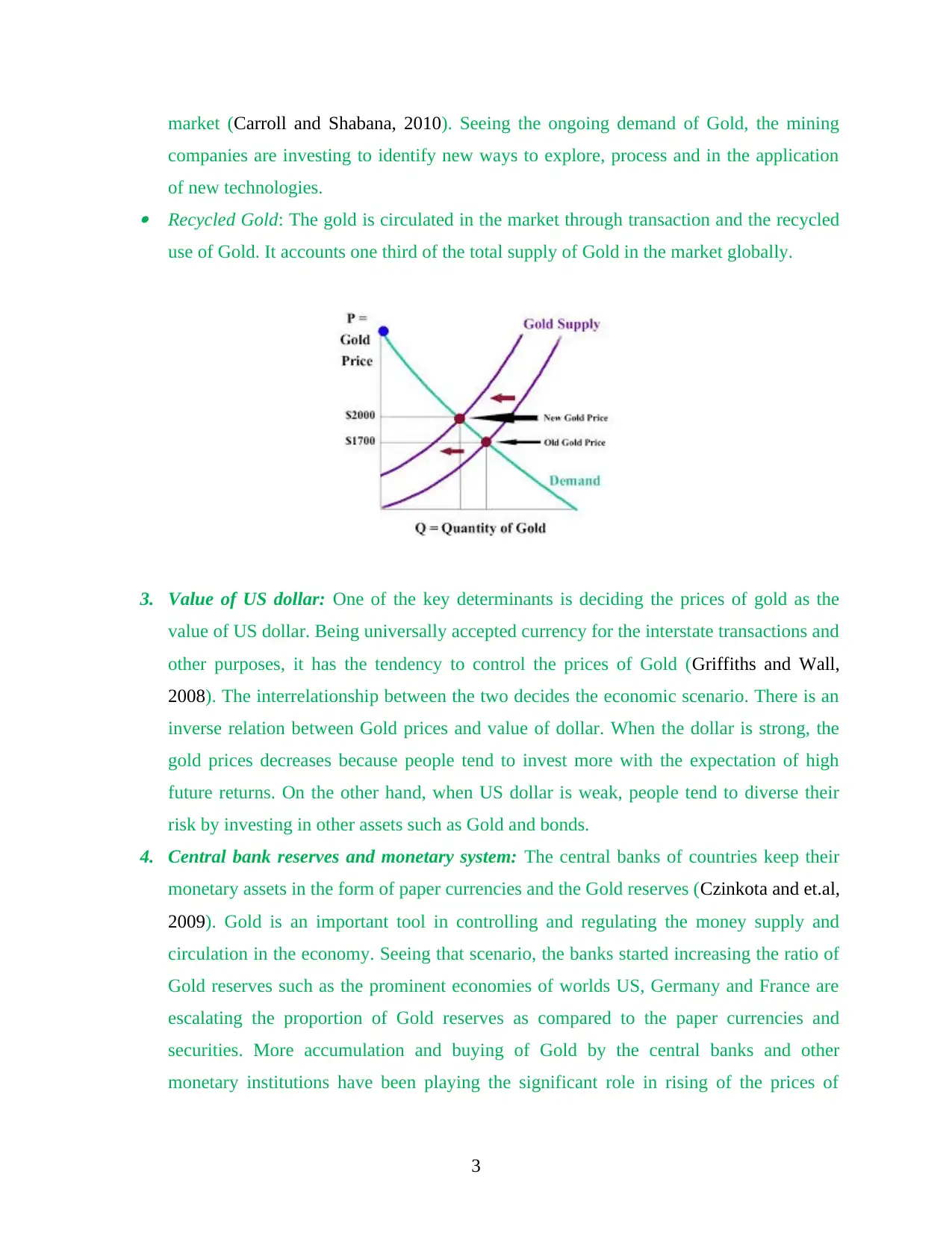
market (Carroll and Shabana, 2010). Seeing the ongoing demand of Gold, the mining
companies are investing to identify new ways to explore, process and in the application
of new technologies. Recycled Gold: The gold is circulated in the market through transaction and the recycled
use of Gold. It accounts one third of the total supply of Gold in the market globally.
3. Value of US dollar: One of the key determinants is deciding the prices of gold as the
value of US dollar. Being universally accepted currency for the interstate transactions and
other purposes, it has the tendency to control the prices of Gold (Griffiths and Wall,
2008). The interrelationship between the two decides the economic scenario. There is an
inverse relation between Gold prices and value of dollar. When the dollar is strong, the
gold prices decreases because people tend to invest more with the expectation of high
future returns. On the other hand, when US dollar is weak, people tend to diverse their
risk by investing in other assets such as Gold and bonds.
4. Central bank reserves and monetary system: The central banks of countries keep their
monetary assets in the form of paper currencies and the Gold reserves (Czinkota and et.al,
2009). Gold is an important tool in controlling and regulating the money supply and
circulation in the economy. Seeing that scenario, the banks started increasing the ratio of
Gold reserves such as the prominent economies of worlds US, Germany and France are
escalating the proportion of Gold reserves as compared to the paper currencies and
securities. More accumulation and buying of Gold by the central banks and other
monetary institutions have been playing the significant role in rising of the prices of
3
companies are investing to identify new ways to explore, process and in the application
of new technologies. Recycled Gold: The gold is circulated in the market through transaction and the recycled
use of Gold. It accounts one third of the total supply of Gold in the market globally.
3. Value of US dollar: One of the key determinants is deciding the prices of gold as the
value of US dollar. Being universally accepted currency for the interstate transactions and
other purposes, it has the tendency to control the prices of Gold (Griffiths and Wall,
2008). The interrelationship between the two decides the economic scenario. There is an
inverse relation between Gold prices and value of dollar. When the dollar is strong, the
gold prices decreases because people tend to invest more with the expectation of high
future returns. On the other hand, when US dollar is weak, people tend to diverse their
risk by investing in other assets such as Gold and bonds.
4. Central bank reserves and monetary system: The central banks of countries keep their
monetary assets in the form of paper currencies and the Gold reserves (Czinkota and et.al,
2009). Gold is an important tool in controlling and regulating the money supply and
circulation in the economy. Seeing that scenario, the banks started increasing the ratio of
Gold reserves such as the prominent economies of worlds US, Germany and France are
escalating the proportion of Gold reserves as compared to the paper currencies and
securities. More accumulation and buying of Gold by the central banks and other
monetary institutions have been playing the significant role in rising of the prices of
3
Gold.The bank buys gold at the time of recession and conversely, it sells the gold assets
to control and regulate the money supply and circulation in the economy (Lambert,
2015). This is an indispensable tool used by the central banks to stabilize the economic
condition of country.
5. Inflation rate and Economic fluctuations: Inflation rate is the key determinant of
economic situation of country and the value of domestic currency. With the increase in
rate of inflation, the economic stability decreases. The change in inflation trickles down
the increase in the prices of other goods (Neumark and Wascher, 2006). With the unrest
in international political scenario and the monetary system, the prices of Gold changes.
The rise in inflation rate increases the prices of Gold. At the time of economic recession,
the actual and expected returns from the investments, equities and real estate decreases.
Hence, it increases the interest in the investment in Gold and bullion. Gold has been
recognized as the safe heaven due to unique feature of capital protection. Due to this
quality of gold, the investment increases at the time of financial crises (Why are House
Prices So High?, 2015). Government also adopts this method to stabilize the economic
situation of country.
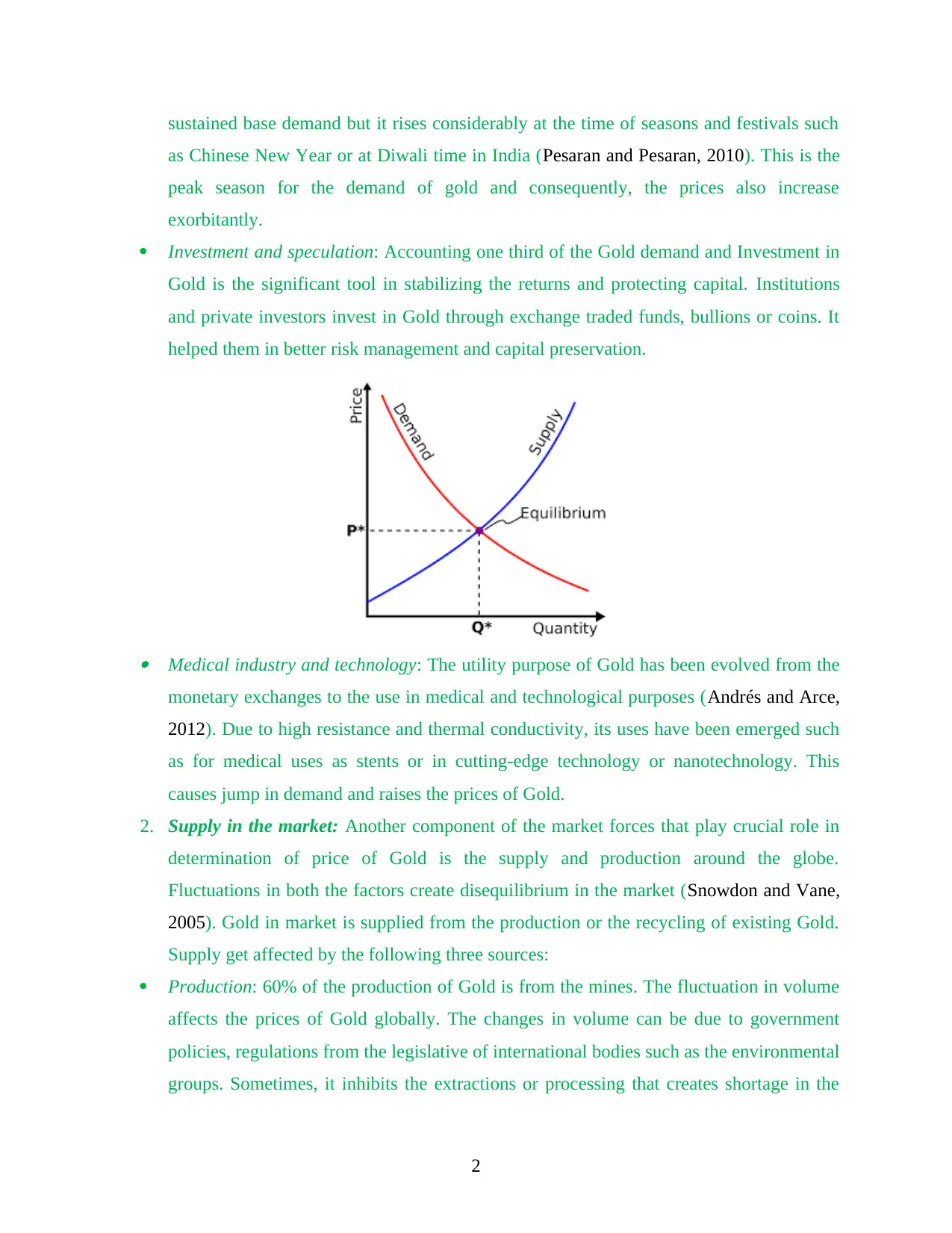
The above mentioned factors of demand and supply of Gold, global economic scenario
and value of central money US dollar are the determinants of the price of this prestigious metal.
The equilibrium of demand and supply of Gold is stabled only for short duration of time else it
fluctuates between the increased sully and escalated demand. With the increased demand for
different purposes such as it is fashioned into the jewelry, used to protect the wealth of nations,
or as an effective tool for the risk management in the capital and financial portfolios. The self-
balanced nature of gold has increased its prominence in global economic market. Further, the
supply is affected by the various factors such the production of different volume and the
relatedness with the intensity of demand (Henderson, 2014). The equilibrium is built due to these
two forces but it gets disturbed at the time of peak seasons or extremities. Moreover, with the
above demand and supply analysis it is inferred that Gold has been the crucial factor in the
global economic system.
2. Negative externalities arises from the personal use of car.
Negative externalities refer to the loss incurred indirectly by the third part with the result
of the production or consumption of any good. The negative effect imposed on the unrelated
4
to control and regulate the money supply and circulation in the economy (Lambert,
2015). This is an indispensable tool used by the central banks to stabilize the economic
condition of country.
5. Inflation rate and Economic fluctuations: Inflation rate is the key determinant of
economic situation of country and the value of domestic currency. With the increase in
rate of inflation, the economic stability decreases. The change in inflation trickles down
the increase in the prices of other goods (Neumark and Wascher, 2006). With the unrest
in international political scenario and the monetary system, the prices of Gold changes.
The rise in inflation rate increases the prices of Gold. At the time of economic recession,
the actual and expected returns from the investments, equities and real estate decreases.
Hence, it increases the interest in the investment in Gold and bullion. Gold has been
recognized as the safe heaven due to unique feature of capital protection. Due to this
quality of gold, the investment increases at the time of financial crises (Why are House
Prices So High?, 2015). Government also adopts this method to stabilize the economic
situation of country.
The above mentioned factors of demand and supply of Gold, global economic scenario
and value of central money US dollar are the determinants of the price of this prestigious metal.
The equilibrium of demand and supply of Gold is stabled only for short duration of time else it
fluctuates between the increased sully and escalated demand. With the increased demand for
different purposes such as it is fashioned into the jewelry, used to protect the wealth of nations,
or as an effective tool for the risk management in the capital and financial portfolios. The self-
balanced nature of gold has increased its prominence in global economic market. Further, the
supply is affected by the various factors such the production of different volume and the
relatedness with the intensity of demand (Henderson, 2014). The equilibrium is built due to these
two forces but it gets disturbed at the time of peak seasons or extremities. Moreover, with the
above demand and supply analysis it is inferred that Gold has been the crucial factor in the
global economic system.
2. Negative externalities arises from the personal use of car.
Negative externalities refer to the loss incurred indirectly by the third part with the result
of the production or consumption of any good. The negative effect imposed on the unrelated
4
⊘ This is a preview!⊘
Do you want full access?
Subscribe today to unlock all pages.
Trusted by 1+ million students worldwide
third party is explained in detail specifically in the context of environmental economics (Pesaran
and Pesaran, 2010). The negative externalities results in the market failure as the externalities
occur outside the market. In the case of externalities, Individuals fails to measure the actual cost
incurred on the other group of individual and no appropriate compensation is paid.
Externalities are measured in terms of the social costs and social benefits.
Social cost = private costs + external costs.
When there is the divergence between the social costs and the private costs, Externalities
exists. Negative externalities exist when the social cost exceeds private cost and the market
failure happens as producer doesn’t take into account the external costs (Choudhury and Hoque,
2004). Market failure occurs due to negative externalities due to the following ways:
Negative Externalities arises from the spillover an effect arises from the production and
consumption of the goods.
It lies outside the transactions occur in market.
With reference to the personal use of car, the negative externalizes arises in many areas
(Fujita and Thisse, 2013). The use of personal car induces negative effects in many aspects such
as economic, environment, and policing, pricing, infrastructure. The points are explained in
detail.
1. Physical effects: The personal usage of cars has been increasing in the considerable ways. It
imparts the significant impact on the following areas.
o Traffic volume: The willing to use the personal cars due to the personal benefits
or as the sign of the social status it directly imparts the effect transport by
increasing the volume in the same proportion (Neumark and Wascher, 2006).
o Infrastructure: The road network and the infrastructure of the transport get
affected. With increase in number with such a speed demands the early repairmen
and renovation.
o Vehicle stock: It increases the density of vehicles per square km which creates
inconvenience in different perspectives such as parking, security, maintenance and
other related.
o Multiplier effect: The use of personal car increases with the multiplier effect.
When the buying of individual cars induced, the company’s manufacturing cars
get motivated and inspired to build automobiles with more improved versions and
5
and Pesaran, 2010). The negative externalities results in the market failure as the externalities
occur outside the market. In the case of externalities, Individuals fails to measure the actual cost
incurred on the other group of individual and no appropriate compensation is paid.
Externalities are measured in terms of the social costs and social benefits.
Social cost = private costs + external costs.
When there is the divergence between the social costs and the private costs, Externalities
exists. Negative externalities exist when the social cost exceeds private cost and the market
failure happens as producer doesn’t take into account the external costs (Choudhury and Hoque,
2004). Market failure occurs due to negative externalities due to the following ways:
Negative Externalities arises from the spillover an effect arises from the production and
consumption of the goods.
It lies outside the transactions occur in market.
With reference to the personal use of car, the negative externalizes arises in many areas
(Fujita and Thisse, 2013). The use of personal car induces negative effects in many aspects such
as economic, environment, and policing, pricing, infrastructure. The points are explained in
detail.
1. Physical effects: The personal usage of cars has been increasing in the considerable ways. It
imparts the significant impact on the following areas.
o Traffic volume: The willing to use the personal cars due to the personal benefits
or as the sign of the social status it directly imparts the effect transport by
increasing the volume in the same proportion (Neumark and Wascher, 2006).
o Infrastructure: The road network and the infrastructure of the transport get
affected. With increase in number with such a speed demands the early repairmen
and renovation.
o Vehicle stock: It increases the density of vehicles per square km which creates
inconvenience in different perspectives such as parking, security, maintenance and
other related.
o Multiplier effect: The use of personal car increases with the multiplier effect.
When the buying of individual cars induced, the company’s manufacturing cars
get motivated and inspired to build automobiles with more improved versions and
5
Paraphrase This Document
Need a fresh take? Get an instant paraphrase of this document with our AI Paraphraser
designs (Schumacher, 2011). That again induces the use of car. The companies
come with better composition, features and patterns and that further increases the
demand of the cars for personal uses.
2. Environmental issues: The negative externalities arise from the personal use of car is
significantly in the environment or the atmosphere. The personal use of car increases the
number of vehicles in each family and the hence the density increases. The atmosphere and
the environment of the vicinity becomes the crucial target of the use (Caravle, 2002). It
enhances the pollution with the increased emission of harmful gases and affluent. The
increased volume of these harmful gases such as the CO2, nitrogen oxides, and sulfur
oxides prominently results in the destruction and damage of the environment that results
into the Ill health of the people living that area, social disruption, pollution, and on large
scale it escalates to acid rain and global warming. As in the recent report, it was found that
Beijing and Delhi are the most polluted cities of the world. And through market research it
was inferred that the increased consumption of car in the considerable amount is the major
factor behind this (Fujita and Thisse, 2013).
3. Economic causes: The negative externalities raised due to the personal use of car have the
significant impact on the economic scenario of the co0untry due to the direct impact of
some areas.
o Prices: With the increases in the volume of the number of cars usage, the price of
cars hikes to the level of sky. The automobiles companies keep their prices high to
earn more and more profits. The sectors hold the major share in the GDP. It
increases the import quantum of the countries in the significant way which results
in the deficit in the balance of payments (Andrés and Arce, 2012).
o Financing: The major issues arise with the financing in the industry. To match
up with the increasing demand of the cars and automobiles, the supply has to be
increased in the similar ratio. But due to the low pace of growth of supply the
prices get increases which results in the rise of inflation rate. Further, it demands
the increased pace of investments in the big amount.
o Regulations and policies: The increased number of automobiles and personal car
induces the Government to take steps towards stabilizing the issues such as in
environment, personal consumption, and other related which indirectly affects the
6
come with better composition, features and patterns and that further increases the
demand of the cars for personal uses.
2. Environmental issues: The negative externalities arise from the personal use of car is
significantly in the environment or the atmosphere. The personal use of car increases the
number of vehicles in each family and the hence the density increases. The atmosphere and
the environment of the vicinity becomes the crucial target of the use (Caravle, 2002). It
enhances the pollution with the increased emission of harmful gases and affluent. The
increased volume of these harmful gases such as the CO2, nitrogen oxides, and sulfur
oxides prominently results in the destruction and damage of the environment that results
into the Ill health of the people living that area, social disruption, pollution, and on large
scale it escalates to acid rain and global warming. As in the recent report, it was found that
Beijing and Delhi are the most polluted cities of the world. And through market research it
was inferred that the increased consumption of car in the considerable amount is the major
factor behind this (Fujita and Thisse, 2013).
3. Economic causes: The negative externalities raised due to the personal use of car have the
significant impact on the economic scenario of the co0untry due to the direct impact of
some areas.
o Prices: With the increases in the volume of the number of cars usage, the price of
cars hikes to the level of sky. The automobiles companies keep their prices high to
earn more and more profits. The sectors hold the major share in the GDP. It
increases the import quantum of the countries in the significant way which results
in the deficit in the balance of payments (Andrés and Arce, 2012).
o Financing: The major issues arise with the financing in the industry. To match
up with the increasing demand of the cars and automobiles, the supply has to be
increased in the similar ratio. But due to the low pace of growth of supply the
prices get increases which results in the rise of inflation rate. Further, it demands
the increased pace of investments in the big amount.
o Regulations and policies: The increased number of automobiles and personal car
induces the Government to take steps towards stabilizing the issues such as in
environment, personal consumption, and other related which indirectly affects the
6
third unrelated party (Snowdon and Vane, 2005). For instance, the policies
imposed by government to regulate the use of cars, creates inconvenience for the
countrymen in proceeding their functioning.
4. Other effects:
o Apart from the above mentioned effects, the negative externalities have more
widened area. The increased use of personal cars leads to the escalation of the number
of accidents as the road infrastructure is not changing in the similar pattern and
proportion.
o With the increase in the number of personal cars, the major problem arises is of the
resources depletion (Lambert, 2015).
o Waste riffle: The automobiles' industry occupies the major share in creating the waste
amount. This increases the refill issues such as waste disposal and the refill
management.
o It leads to the social disruption as the increased number of vehicles on the road
hinders the smooth transport of the country and disrupts the movement from one
place to other.
To accommodate the negative externalities raised by the personal use of car,
Government, legislative bodies, international organizations and other non-profit organizations
has laid some rules and regulations (Czinkota and et.al, 2009). Further, the bodies are also
adopting some other methods to resolve the negative externalities and reduce the negative effect
of the personal use of cars.
The methods are explained below:
1. Taxes and tariffs: The foremost and the impactful method adopted by the Government
and other bodies are by imposing the high taxes and tariffs on the automobiles. The taxes
and tariffs are imposed on different grounds:
2. Exports and imports: The fundamental way to address the issue and accommodate the
negative externalities is by imposing taxes on cars at the entry and exit from the nation
that is taxes and tariffs on exports and the custom duties on imports (Carroll and Shabana,
2010). Further, by imposing the import quotas that is limiting the quantity of imports, the
number of vehicles can be managed.
7
imposed by government to regulate the use of cars, creates inconvenience for the
countrymen in proceeding their functioning.
4. Other effects:
o Apart from the above mentioned effects, the negative externalities have more
widened area. The increased use of personal cars leads to the escalation of the number
of accidents as the road infrastructure is not changing in the similar pattern and
proportion.
o With the increase in the number of personal cars, the major problem arises is of the
resources depletion (Lambert, 2015).
o Waste riffle: The automobiles' industry occupies the major share in creating the waste
amount. This increases the refill issues such as waste disposal and the refill
management.
o It leads to the social disruption as the increased number of vehicles on the road
hinders the smooth transport of the country and disrupts the movement from one
place to other.
To accommodate the negative externalities raised by the personal use of car,
Government, legislative bodies, international organizations and other non-profit organizations
has laid some rules and regulations (Czinkota and et.al, 2009). Further, the bodies are also
adopting some other methods to resolve the negative externalities and reduce the negative effect
of the personal use of cars.
The methods are explained below:
1. Taxes and tariffs: The foremost and the impactful method adopted by the Government
and other bodies are by imposing the high taxes and tariffs on the automobiles. The taxes
and tariffs are imposed on different grounds:
2. Exports and imports: The fundamental way to address the issue and accommodate the
negative externalities is by imposing taxes on cars at the entry and exit from the nation
that is taxes and tariffs on exports and the custom duties on imports (Carroll and Shabana,
2010). Further, by imposing the import quotas that is limiting the quantity of imports, the
number of vehicles can be managed.
7
⊘ This is a preview!⊘
Do you want full access?
Subscribe today to unlock all pages.
Trusted by 1+ million students worldwide
3. Congestion tolls: The taxes and tariffs are imposed on the vehicles for the increased
congestion of traffic on the roads. The toll taxes get increased in the significant ways to
reduce the number of trips and turns by the cars.
4. Charging for accident risks: The recently introduced taxes by the Government are the
fees charged for the increased number of accidents (Griffiths and Wall, 2008). This step
is adopted by the Government and the legislative bodies after considering the fact that the
number of deaths in many countries is due to the large number of accidents happening on
high ways and roads.
Fuel economy policies: The government has imposed the rules and regulations with respect to
the fuel economy. The instructions are made to the company’s manufacturing automobiles
regarding the fuel economy that is the capacity it emits fuels is to be limited up to the extent
specified. This induces the owners to raise the prices of the cars and automobiles (Neumark and
Wascher, 2006).
The government adopted certain unconventional methods such as introducing the
movement of cars with odd number and even number of car on alternative days, entry of
the high fuel emitting cars and vehicles in the city after a fixed time of the day and other
related.
The awareness about the increased negative externalities raised from the increased
personal use of car is exercised through the various means such as promotions,
advertisements, the creative methods such as vialing on the social media networks and
public exposure of the results and inferences of the market research.
CONCLUSION
From the above analysis made with respect to the increased negative externalities raised
due to the increased personal use of car has the significant harmful impact on the many areas
such as the environment, economic scenario, the pricing and policies of the Government and
legislative bodies. Further, the methods adopted by the government to accommodate the
externalities proved to be impactful in considerable way such as the imposition of various taxes
and tariffs on the cars reduce the consumption with effect of increased prices and further the
raised awareness about the harmful impact results in the minimized use.
8
congestion of traffic on the roads. The toll taxes get increased in the significant ways to
reduce the number of trips and turns by the cars.
4. Charging for accident risks: The recently introduced taxes by the Government are the
fees charged for the increased number of accidents (Griffiths and Wall, 2008). This step
is adopted by the Government and the legislative bodies after considering the fact that the
number of deaths in many countries is due to the large number of accidents happening on
high ways and roads.
Fuel economy policies: The government has imposed the rules and regulations with respect to
the fuel economy. The instructions are made to the company’s manufacturing automobiles
regarding the fuel economy that is the capacity it emits fuels is to be limited up to the extent
specified. This induces the owners to raise the prices of the cars and automobiles (Neumark and
Wascher, 2006).
The government adopted certain unconventional methods such as introducing the
movement of cars with odd number and even number of car on alternative days, entry of
the high fuel emitting cars and vehicles in the city after a fixed time of the day and other
related.
The awareness about the increased negative externalities raised from the increased
personal use of car is exercised through the various means such as promotions,
advertisements, the creative methods such as vialing on the social media networks and
public exposure of the results and inferences of the market research.
CONCLUSION
From the above analysis made with respect to the increased negative externalities raised
due to the increased personal use of car has the significant harmful impact on the many areas
such as the environment, economic scenario, the pricing and policies of the Government and
legislative bodies. Further, the methods adopted by the government to accommodate the
externalities proved to be impactful in considerable way such as the imposition of various taxes
and tariffs on the cars reduce the consumption with effect of increased prices and further the
raised awareness about the harmful impact results in the minimized use.
8
Paraphrase This Document
Need a fresh take? Get an instant paraphrase of this document with our AI Paraphraser
REFERENCES
Books and journals
Andrés, J. and Arce, O., 2012. Banking Competition, Housing Prices and Macroeconomic
Stability. The Economic Journal. 122(565). Pp. 1346-1372.
Caravle, G., 2002. Equilibrium and Economic Theory. Routledge.
Carroll, A. B. and Shabana, K. M., 2010. The business case for corporate social responsibility: a
review of concepts, research and practice. International Journal of Management Reviews.
12(1). pp. 85-105
Choudhury, A. M. and Hoque, Z. M., 2004. Ethics and economic theory. International Journal
of Social Economics. 31(8). pp.790 – 807.
Czinkota, M. R. and et.al., 2009. International business (Vol. 4). Dryden Press.
Fujita, M. and Thisse, J. F., 2013. Economics of agglomeration: Cities, industrial location, and
globalization. Cambridge university press.
Griffiths, A. and Wall, S., 2008. Economics for business and management, financial times
prentice hall
Henderson, J. V., 2014. Economic theory and the cities. Academic Press.
Himmelberg, C., Mayer, C. and Sinai, T., 2005. Assessing high house prices: Bubbles,
fundamentals, and misperceptions. National Bureau of Economic Research.
Neumark, D. and Wascher, W., 2006. Minimum wages and employment: A review of evidence
from the new minimum wage research (No. w12663). National Bureau of Economic
Research.
Pesaran, B. and Pesaran, M. H. 2010. Time Series Econometrics Using Microfit 5.0: A User's
Manual. Oxford University Press, Inc..
Schumacher, E. F., 2011. Small is beautiful: a study of economics as if people mattered. Random
House.
Snowdon, B. and Vane, H. R., 2005. Modern macroeconomics: its origins, development and
current state. Edward Elgar Publishing.
Online
Lambert, S., 2015. What next for house prices? House prices rise across the UK but the London
market has caught a chill. [Online]. Available through: <
9
Books and journals
Andrés, J. and Arce, O., 2012. Banking Competition, Housing Prices and Macroeconomic
Stability. The Economic Journal. 122(565). Pp. 1346-1372.
Caravle, G., 2002. Equilibrium and Economic Theory. Routledge.
Carroll, A. B. and Shabana, K. M., 2010. The business case for corporate social responsibility: a
review of concepts, research and practice. International Journal of Management Reviews.
12(1). pp. 85-105
Choudhury, A. M. and Hoque, Z. M., 2004. Ethics and economic theory. International Journal
of Social Economics. 31(8). pp.790 – 807.
Czinkota, M. R. and et.al., 2009. International business (Vol. 4). Dryden Press.
Fujita, M. and Thisse, J. F., 2013. Economics of agglomeration: Cities, industrial location, and
globalization. Cambridge university press.
Griffiths, A. and Wall, S., 2008. Economics for business and management, financial times
prentice hall
Henderson, J. V., 2014. Economic theory and the cities. Academic Press.
Himmelberg, C., Mayer, C. and Sinai, T., 2005. Assessing high house prices: Bubbles,
fundamentals, and misperceptions. National Bureau of Economic Research.
Neumark, D. and Wascher, W., 2006. Minimum wages and employment: A review of evidence
from the new minimum wage research (No. w12663). National Bureau of Economic
Research.
Pesaran, B. and Pesaran, M. H. 2010. Time Series Econometrics Using Microfit 5.0: A User's
Manual. Oxford University Press, Inc..
Schumacher, E. F., 2011. Small is beautiful: a study of economics as if people mattered. Random
House.
Snowdon, B. and Vane, H. R., 2005. Modern macroeconomics: its origins, development and
current state. Edward Elgar Publishing.
Online
Lambert, S., 2015. What next for house prices? House prices rise across the UK but the London
market has caught a chill. [Online]. Available through: <
9
http://www.thisismoney.co.uk/money/mortgageshome/article-1671748/House-prices-
What-expect-news-predictions.html>. [Accessed on 16th December 2015].
Why are House Prices So High?, 2015. [Online]. Available through: <
http://www.positivemoney.org/issues/house-prices/>. [Accessed on 16th December 2015].
10
What-expect-news-predictions.html>. [Accessed on 16th December 2015].
Why are House Prices So High?, 2015. [Online]. Available through: <
http://www.positivemoney.org/issues/house-prices/>. [Accessed on 16th December 2015].
10
⊘ This is a preview!⊘
Do you want full access?
Subscribe today to unlock all pages.
Trusted by 1+ million students worldwide

1 out of 12


Related Documents


Your All-in-One AI-Powered Toolkit for Academic Success.
+13062052269
info@desklib.com
Available 24*7 on WhatsApp / Email
![[object Object]](/_next/static/media/star-bottom.7253800d.svg)
Unlock your academic potential
Copyright © 2020–2026 A2Z Services. All Rights Reserved. Developed and managed by ZUCOL.