Exploring the Concept of Good Faith within the English Legal System
VerifiedAdded on 2023/04/20
|40
|12889
|60
Essay
AI Summary
This essay examines the extent to which English law considers the concept of good faith, tracing its origins from Roman law to modern applications. It differentiates between subjective and objective good faith, highlighting the traditional reluctance of English law to embrace the latter while noting its recent introduction in statutes. The essay discusses good faith as a standard of behavior in international and community law, as well as recent codification proposals. It analyzes landmark cases to illustrate the scope and limitations of good faith within the English legal system, addressing implied duties on contracting parties and the potential for express duties. The paper also acknowledges the criticisms surrounding the principle of good faith, such as the potential for judicial discretion and activism. Desklib provides access to this essay and a wealth of other academic resources for students.
Running head: TO WHAT EXTENT ENGLISH LAW CONSIDER THE CONCEPT OF GOOD
FAITH?
TO WHAT EXTENT ENGLISH LAW CONSIDER THE CONCEPT OF GOOD FAITH?
Name of the Student:
Name of the University:
Author Note:
FAITH?
TO WHAT EXTENT ENGLISH LAW CONSIDER THE CONCEPT OF GOOD FAITH?
Name of the Student:
Name of the University:
Author Note:

Paraphrase This Document
Need a fresh take? Get an instant paraphrase of this document with our AI Paraphraser
1
TO WHAT EXTENT ENGLISH LAW CONSIDER THE CONCEPT OF GOOD FAITH?
Acknowledgement
Sincere and heartfelt thanks to all of those who have helped, motivated and encouraged me for
conducting this study. I am indebted to my supervisor ……………………. whose guidance,
advice and patience have been immeasurable. My sincere thanks to all the staff and students,
whose continuous support have made this thesis possible.
I would like to thank the participants in the study: students, teachers and Local Education
Authorities, for the time and help given throughout. Without their participation, this research
would not have been possible. In this context, I am also thankful to them, whose research work
helped me to execute this paper well.
Finally, I thank my family, for whose mental support has helped me to complete this research
paper. Thank you
TO WHAT EXTENT ENGLISH LAW CONSIDER THE CONCEPT OF GOOD FAITH?
Acknowledgement
Sincere and heartfelt thanks to all of those who have helped, motivated and encouraged me for
conducting this study. I am indebted to my supervisor ……………………. whose guidance,
advice and patience have been immeasurable. My sincere thanks to all the staff and students,
whose continuous support have made this thesis possible.
I would like to thank the participants in the study: students, teachers and Local Education
Authorities, for the time and help given throughout. Without their participation, this research
would not have been possible. In this context, I am also thankful to them, whose research work
helped me to execute this paper well.
Finally, I thank my family, for whose mental support has helped me to complete this research
paper. Thank you
2
TO WHAT EXTENT ENGLISH LAW CONSIDER THE CONCEPT OF GOOD FAITH?
Abstract
In this present research topic, the concept of good faith is being discussed in reference to
its relation to the English law mainly. The origin of this particular doctrine of good faith is also
analyzed in this article. In this article the main focus is on the application of doctrine of good
faith in the English law. It is analyzed in reference to some landmark cases where the scope,
application, extent and its limitation are discussed.
This research topic also discusses about the historical perspective of good faith in relation
to Roman law, medieval law and scenario of 19th century. Apart from this, its scope in
international law is also discussed. The article also deals with the current codification proposals
in respect of the principle of good faith.
TO WHAT EXTENT ENGLISH LAW CONSIDER THE CONCEPT OF GOOD FAITH?
Abstract
In this present research topic, the concept of good faith is being discussed in reference to
its relation to the English law mainly. The origin of this particular doctrine of good faith is also
analyzed in this article. In this article the main focus is on the application of doctrine of good
faith in the English law. It is analyzed in reference to some landmark cases where the scope,
application, extent and its limitation are discussed.
This research topic also discusses about the historical perspective of good faith in relation
to Roman law, medieval law and scenario of 19th century. Apart from this, its scope in
international law is also discussed. The article also deals with the current codification proposals
in respect of the principle of good faith.
⊘ This is a preview!⊘
Do you want full access?
Subscribe today to unlock all pages.

Trusted by 1+ million students worldwide
3
TO WHAT EXTENT ENGLISH LAW CONSIDER THE CONCEPT OF GOOD FAITH?
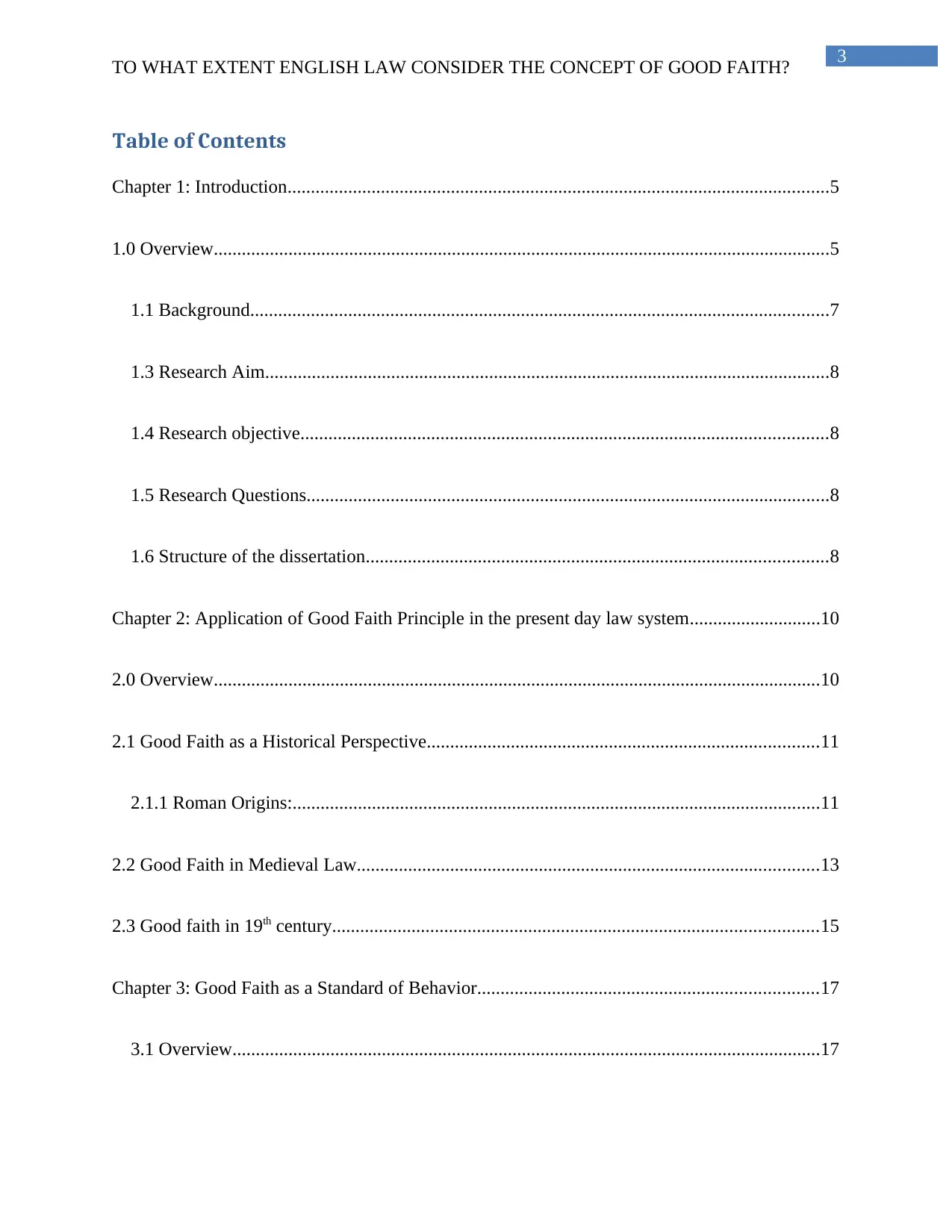
Table of Contents
Chapter 1: Introduction....................................................................................................................5
1.0 Overview....................................................................................................................................5
1.1 Background............................................................................................................................7
1.3 Research Aim.........................................................................................................................8
1.4 Research objective.................................................................................................................8
1.5 Research Questions................................................................................................................8
1.6 Structure of the dissertation...................................................................................................8
Chapter 2: Application of Good Faith Principle in the present day law system............................10
2.0 Overview..................................................................................................................................10
2.1 Good Faith as a Historical Perspective....................................................................................11
2.1.1 Roman Origins:.................................................................................................................11
2.2 Good Faith in Medieval Law...................................................................................................13
2.3 Good faith in 19th century........................................................................................................15
Chapter 3: Good Faith as a Standard of Behavior.........................................................................17
3.1 Overview..............................................................................................................................17
TO WHAT EXTENT ENGLISH LAW CONSIDER THE CONCEPT OF GOOD FAITH?
Table of Contents
Chapter 1: Introduction....................................................................................................................5
1.0 Overview....................................................................................................................................5
1.1 Background............................................................................................................................7
1.3 Research Aim.........................................................................................................................8
1.4 Research objective.................................................................................................................8
1.5 Research Questions................................................................................................................8
1.6 Structure of the dissertation...................................................................................................8
Chapter 2: Application of Good Faith Principle in the present day law system............................10
2.0 Overview..................................................................................................................................10
2.1 Good Faith as a Historical Perspective....................................................................................11
2.1.1 Roman Origins:.................................................................................................................11
2.2 Good Faith in Medieval Law...................................................................................................13
2.3 Good faith in 19th century........................................................................................................15
Chapter 3: Good Faith as a Standard of Behavior.........................................................................17
3.1 Overview..............................................................................................................................17
Paraphrase This Document
Need a fresh take? Get an instant paraphrase of this document with our AI Paraphraser
4
TO WHAT EXTENT ENGLISH LAW CONSIDER THE CONCEPT OF GOOD FAITH?
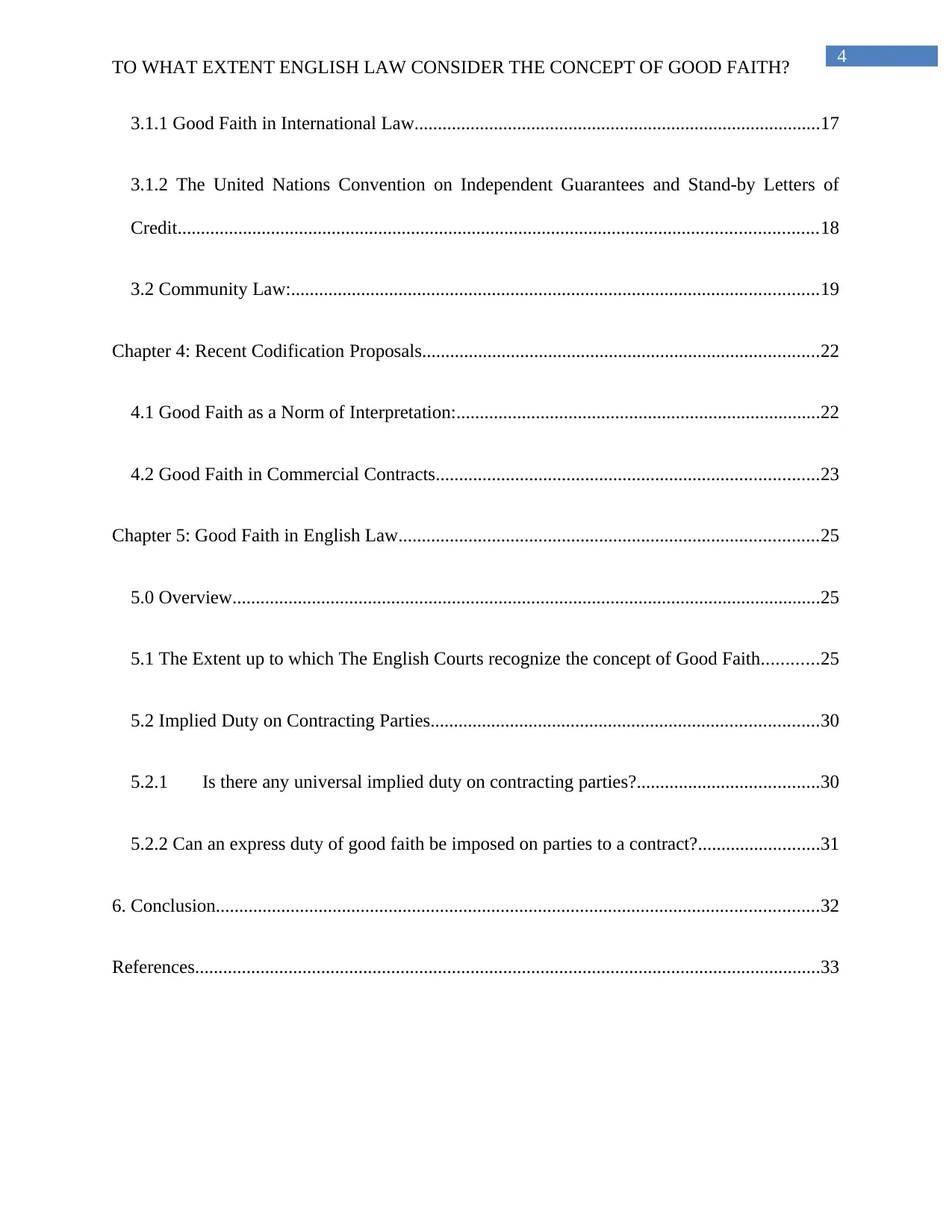
3.1.1 Good Faith in International Law.......................................................................................17
3.1.2 The United Nations Convention on Independent Guarantees and Stand-by Letters of
Credit.........................................................................................................................................18
3.2 Community Law:.................................................................................................................19
Chapter 4: Recent Codification Proposals.....................................................................................22
4.1 Good Faith as a Norm of Interpretation:..............................................................................22
4.2 Good Faith in Commercial Contracts..................................................................................23
Chapter 5: Good Faith in English Law..........................................................................................25
5.0 Overview..............................................................................................................................25
5.1 The Extent up to which The English Courts recognize the concept of Good Faith............25
5.2 Implied Duty on Contracting Parties...................................................................................30
5.2.1 Is there any universal implied duty on contracting parties?.......................................30
5.2.2 Can an express duty of good faith be imposed on parties to a contract?..........................31
6. Conclusion.................................................................................................................................32
References......................................................................................................................................33
TO WHAT EXTENT ENGLISH LAW CONSIDER THE CONCEPT OF GOOD FAITH?
3.1.1 Good Faith in International Law.......................................................................................17
3.1.2 The United Nations Convention on Independent Guarantees and Stand-by Letters of
Credit.........................................................................................................................................18
3.2 Community Law:.................................................................................................................19
Chapter 4: Recent Codification Proposals.....................................................................................22
4.1 Good Faith as a Norm of Interpretation:..............................................................................22
4.2 Good Faith in Commercial Contracts..................................................................................23
Chapter 5: Good Faith in English Law..........................................................................................25
5.0 Overview..............................................................................................................................25
5.1 The Extent up to which The English Courts recognize the concept of Good Faith............25
5.2 Implied Duty on Contracting Parties...................................................................................30
5.2.1 Is there any universal implied duty on contracting parties?.......................................30
5.2.2 Can an express duty of good faith be imposed on parties to a contract?..........................31
6. Conclusion.................................................................................................................................32
References......................................................................................................................................33

5
TO WHAT EXTENT ENGLISH LAW CONSIDER THE CONCEPT OF GOOD FAITH?
TO WHAT EXTENT ENGLISH LAW CONSIDER THE CONCEPT OF GOOD FAITH?
⊘ This is a preview!⊘
Do you want full access?
Subscribe today to unlock all pages.
Trusted by 1+ million students worldwide
6
TO WHAT EXTENT ENGLISH LAW CONSIDER THE CONCEPT OF GOOD FAITH?
Chapter 1: Introduction
1.0 Overview
The topic of the research of this dissertation is whether the concept of good faith is
applicable to the English law. To understand it, it is important to analyze the concept of good
faith in detail. Good faith acts like a blanket clause in the domain of Civil law where the court
develops the standard of honest and fair behavior of the parties and the courts in the law of
duties, especially in the contract law, property law and to certain extent to the other fields of law
as held by ANSARI, ALI, and HOSEIN DEHGHANI1. The term good faith depicts that this term
runs through a number of concepts. Most of the European civil codes consists a provision of
general good faith. In addition to this, some codes have particular rules in respect of which
reference is made to the good faith concept as depicted by Sale2. Plus, there are many specific
rules in the respective codes where special applicability of good faith is observed.
In most of the systems of civil law, there lies a distinction between objective good faith
and subjective good faith as stated by Griffin, Patrick B. 3 According to Langford, Rosemary
Teele, and Ian Ramsa, subjective good faith is generally said to be defined as a subjective form
of state of mind; neither knowing nor having the need to know certain fact or event4. Its
relevance is generally observed in the property law. On the other hand, as per Barroso, Lucas
Abreu, and Laio Portes Sthel, in objective good faith, the concept usually refers to the rules and
1 ANSARI, ALI, and HOSEIN DEHGHANI. "GOOD FAITH IN PROCEDURE LAW." (2017): 109-133.
2 Sale, Hillary A. "Fiduciary Law and Good Faith." (2018).
3 Griffin, Patrick B. "The Notion of Good Faith in Common Law and Civil Law Contract Law." (2018).
4 Langford, Rosemary Teele, and Ian Ramsay. "Directors' Duty to Act in the Interests of the Company: Subjective or
Objective?." Journal of Business Law (2015): 173-182.
TO WHAT EXTENT ENGLISH LAW CONSIDER THE CONCEPT OF GOOD FAITH?
Chapter 1: Introduction
1.0 Overview
The topic of the research of this dissertation is whether the concept of good faith is
applicable to the English law. To understand it, it is important to analyze the concept of good
faith in detail. Good faith acts like a blanket clause in the domain of Civil law where the court
develops the standard of honest and fair behavior of the parties and the courts in the law of
duties, especially in the contract law, property law and to certain extent to the other fields of law
as held by ANSARI, ALI, and HOSEIN DEHGHANI1. The term good faith depicts that this term
runs through a number of concepts. Most of the European civil codes consists a provision of
general good faith. In addition to this, some codes have particular rules in respect of which
reference is made to the good faith concept as depicted by Sale2. Plus, there are many specific
rules in the respective codes where special applicability of good faith is observed.
In most of the systems of civil law, there lies a distinction between objective good faith
and subjective good faith as stated by Griffin, Patrick B. 3 According to Langford, Rosemary
Teele, and Ian Ramsa, subjective good faith is generally said to be defined as a subjective form
of state of mind; neither knowing nor having the need to know certain fact or event4. Its
relevance is generally observed in the property law. On the other hand, as per Barroso, Lucas
Abreu, and Laio Portes Sthel, in objective good faith, the concept usually refers to the rules and
1 ANSARI, ALI, and HOSEIN DEHGHANI. "GOOD FAITH IN PROCEDURE LAW." (2017): 109-133.
2 Sale, Hillary A. "Fiduciary Law and Good Faith." (2018).
3 Griffin, Patrick B. "The Notion of Good Faith in Common Law and Civil Law Contract Law." (2018).
4 Langford, Rosemary Teele, and Ian Ramsay. "Directors' Duty to Act in the Interests of the Company: Subjective or
Objective?." Journal of Business Law (2015): 173-182.
Paraphrase This Document
Need a fresh take? Get an instant paraphrase of this document with our AI Paraphraser
7
TO WHAT EXTENT ENGLISH LAW CONSIDER THE CONCEPT OF GOOD FAITH?
norms regulating the conduct of the parties in a contract where the contracting parties must act
according to or contrary to good faith5. The English law traditionally does not recognize the
concept of objective good faith. But, recently it has introduced it in its statute.
Objective good faith is the standard of behavior for the parties to a contract as
held by Tosato, Andrea6. According to McMeel, contract law with its essential criteria makes an
attempt to allocate risk and put forward the pre contractual, contractual and post contractual
obligations and risks in the way parties concerned would have fixed had they referred the issue
ex ante during the formation of the contract7. But because of the features of specific case, the
applicability of these legal rules can be said to impose unintentional and illogical results in the
individual cases. Though the black letter rule generally leads to expected results, but sometimes
it may result in the opposite direction. In those cases, the principle of good faith permits the court
to retract from the black letter rules of contract law. When the courts find that application and
result of the legal rule in a particular case to be unreasonable, it can depart from the good faith
principle. The courts have the discretion to apply flexibility to law if it is observed that
unforeseen conditions convert fairness into dishonesty. This allows adaptability to new situations
but saves the cost of transactions of the parties also. as the parties are aware of the fact that the
courts have the discretion to intervene and make suitable changes, the parties will be more
cautious while implementing contract, thus making it less expensive and defensive steps of the
parties to be less as discussed by Freire, Paula Vaz8.
5 Barroso, Lucas Abreu, and Laio Portes Sthel. "The Role of Objective Good Faith in Current Contract Law: For a
General Duty of Inter Partes Cooperation and Solidarity." J. Civ. L. Stud. 8 (2015): 187.
6 Tosato, Andrea. "Commercial agency and the duty to act in good faith." Oxford Journal of Legal Studies 36.3
(2016): 661-695.
7 McMeel, Gerard. "Foucault’s Pendulum: Text, Context and Good Faith in Contract Law." Current Legal
Problems 70.1 (2017): 365-397.
8 Freire, Paula Vaz. "Good Faith in contractual law: A “law and economics” perspective." (2016).
TO WHAT EXTENT ENGLISH LAW CONSIDER THE CONCEPT OF GOOD FAITH?
norms regulating the conduct of the parties in a contract where the contracting parties must act
according to or contrary to good faith5. The English law traditionally does not recognize the
concept of objective good faith. But, recently it has introduced it in its statute.
Objective good faith is the standard of behavior for the parties to a contract as
held by Tosato, Andrea6. According to McMeel, contract law with its essential criteria makes an
attempt to allocate risk and put forward the pre contractual, contractual and post contractual
obligations and risks in the way parties concerned would have fixed had they referred the issue
ex ante during the formation of the contract7. But because of the features of specific case, the
applicability of these legal rules can be said to impose unintentional and illogical results in the
individual cases. Though the black letter rule generally leads to expected results, but sometimes
it may result in the opposite direction. In those cases, the principle of good faith permits the court
to retract from the black letter rules of contract law. When the courts find that application and
result of the legal rule in a particular case to be unreasonable, it can depart from the good faith
principle. The courts have the discretion to apply flexibility to law if it is observed that
unforeseen conditions convert fairness into dishonesty. This allows adaptability to new situations
but saves the cost of transactions of the parties also. as the parties are aware of the fact that the
courts have the discretion to intervene and make suitable changes, the parties will be more
cautious while implementing contract, thus making it less expensive and defensive steps of the
parties to be less as discussed by Freire, Paula Vaz8.
5 Barroso, Lucas Abreu, and Laio Portes Sthel. "The Role of Objective Good Faith in Current Contract Law: For a
General Duty of Inter Partes Cooperation and Solidarity." J. Civ. L. Stud. 8 (2015): 187.
6 Tosato, Andrea. "Commercial agency and the duty to act in good faith." Oxford Journal of Legal Studies 36.3
(2016): 661-695.
7 McMeel, Gerard. "Foucault’s Pendulum: Text, Context and Good Faith in Contract Law." Current Legal
Problems 70.1 (2017): 365-397.
8 Freire, Paula Vaz. "Good Faith in contractual law: A “law and economics” perspective." (2016).
8
TO WHAT EXTENT ENGLISH LAW CONSIDER THE CONCEPT OF GOOD FAITH?
However, like everything has both positive and negative impacts, the principle of good
faith also has some loopholes and hence is subjected to criticism as mentioned by Mitchell,
Andrew D., and Tania Voon9. The main disadvantage is it gives ample scope of using discretion
by the court, which has the chance to be misused by importing ideology like totalitarian ideology
in the contract law or by allowing the judges to use their opinions excessively. The second one is
that it may encourage judicial activism when the judicial system creates the law in a proactive
manner such that it may replace the parliament. The third factor that can be considered in this
regard is that the principle of good faith can be used inappropriately to disperse the wealth from
the rich party to the poor by adopting the deep pocket approach. Finally, the court that interfere
into the contract may not as outsiders have the intimation for acting reliably in the interest of the
parties who are honest even when they have the best intention to do so.
1.1 Background
The concept of good faith has its origin in the Roman period as said by Visser, Daniel10.
Even today, writing of Cicero on good faith written almost 2000 years ago has same relevancy as
if it is written today. It is similar to the modern concept of opportunist behavior which has been
recently developed by the Economists. According to Hogg, Martin A, the notion ‘good faith’ has
a very wide meaning11. They depict all the honest aspects of a good conscience without
scrupulousness that may turn selflessness to sacrifice. The law tries to eliminate from contract,
dishonest transactions, frauds, misrepresentations, malice, and tricky action that under the
disguise of skill and prudence enjoys advantages of simplicity and ignorance.
9 Mitchell, Andrew D., and Tania Voon. "Conclusion: Good Faith and International Economic Law." (2015).
10 Visser, Daniel. "Anticipation in Roman Law." Handbook of Anticipation: Theoretical and Applied Aspects of the
Use of Future in Decision Making (2017): 1-18.
11 Hogg, Martin A. "The Implication of Terms-in-Fact: Good Faith, Contextualism, and Interpretation." Geo. Wash.
L. Rev. 85 (2017): 1660.
TO WHAT EXTENT ENGLISH LAW CONSIDER THE CONCEPT OF GOOD FAITH?
However, like everything has both positive and negative impacts, the principle of good
faith also has some loopholes and hence is subjected to criticism as mentioned by Mitchell,
Andrew D., and Tania Voon9. The main disadvantage is it gives ample scope of using discretion
by the court, which has the chance to be misused by importing ideology like totalitarian ideology
in the contract law or by allowing the judges to use their opinions excessively. The second one is
that it may encourage judicial activism when the judicial system creates the law in a proactive
manner such that it may replace the parliament. The third factor that can be considered in this
regard is that the principle of good faith can be used inappropriately to disperse the wealth from
the rich party to the poor by adopting the deep pocket approach. Finally, the court that interfere
into the contract may not as outsiders have the intimation for acting reliably in the interest of the
parties who are honest even when they have the best intention to do so.
1.1 Background
The concept of good faith has its origin in the Roman period as said by Visser, Daniel10.
Even today, writing of Cicero on good faith written almost 2000 years ago has same relevancy as
if it is written today. It is similar to the modern concept of opportunist behavior which has been
recently developed by the Economists. According to Hogg, Martin A, the notion ‘good faith’ has
a very wide meaning11. They depict all the honest aspects of a good conscience without
scrupulousness that may turn selflessness to sacrifice. The law tries to eliminate from contract,
dishonest transactions, frauds, misrepresentations, malice, and tricky action that under the
disguise of skill and prudence enjoys advantages of simplicity and ignorance.
9 Mitchell, Andrew D., and Tania Voon. "Conclusion: Good Faith and International Economic Law." (2015).
10 Visser, Daniel. "Anticipation in Roman Law." Handbook of Anticipation: Theoretical and Applied Aspects of the
Use of Future in Decision Making (2017): 1-18.
11 Hogg, Martin A. "The Implication of Terms-in-Fact: Good Faith, Contextualism, and Interpretation." Geo. Wash.
L. Rev. 85 (2017): 1660.
⊘ This is a preview!⊘
Do you want full access?
Subscribe today to unlock all pages.
Trusted by 1+ million students worldwide
9
TO WHAT EXTENT ENGLISH LAW CONSIDER THE CONCEPT OF GOOD FAITH?
1.3 Research Aim
The objective of this study is to analyze whether the English law considers the concept of
good faith. In addition to this, it is also aimed to determine the extent to which English law
considers the good faith principle.
1.4 Research objective
The objectives of the present research study are:
To find out whether the English law considers the concept of good faith.
To find out the extent up to which the concept of good faith is considered by the English
law.
1.5 Research Questions
The following are the most significant research questions:
Whether the concept of good faith is considered by the English law?
To what extent, the English law considers the concept of good faith?
1.6 Structure of the dissertation
This research paper would be divided into the following chapters, namely:
a) Introduction and Objectives
b) Concept of good faith in present law system
c) Critical analysis of the present law system related to good faith
d) Proposals for reform of the present law system
e) The Law in United Kingdom relation to good faith
TO WHAT EXTENT ENGLISH LAW CONSIDER THE CONCEPT OF GOOD FAITH?
1.3 Research Aim
The objective of this study is to analyze whether the English law considers the concept of
good faith. In addition to this, it is also aimed to determine the extent to which English law
considers the good faith principle.
1.4 Research objective
The objectives of the present research study are:
To find out whether the English law considers the concept of good faith.
To find out the extent up to which the concept of good faith is considered by the English
law.
1.5 Research Questions
The following are the most significant research questions:
Whether the concept of good faith is considered by the English law?
To what extent, the English law considers the concept of good faith?
1.6 Structure of the dissertation
This research paper would be divided into the following chapters, namely:
a) Introduction and Objectives
b) Concept of good faith in present law system
c) Critical analysis of the present law system related to good faith
d) Proposals for reform of the present law system
e) The Law in United Kingdom relation to good faith
Paraphrase This Document
Need a fresh take? Get an instant paraphrase of this document with our AI Paraphraser
10
TO WHAT EXTENT ENGLISH LAW CONSIDER THE CONCEPT OF GOOD FAITH?
f) Conclusion
The first chapter deals with the introduction and objectives. It gives an idea of the
research topic in the precise manner. It also gives a sketch of the research overview, background,
questions, aims, objectives as well as the detailed structure of the paper.
The second chapter deals with the present day law system that applies the concept of
good faith. Apart from this, this particular chapter also deals with good faith as a historical
perspective, that is, origin of good faith and its presence in the historic period.
The third chapter provides provisions related to good faith as a standard of behavior in
international law and community law.
The fourth chapter deals with recent codification proposals in respect to good faith as a
rule of interpretation and the scope and application of good faith in contractual law.
The fifth chapter says about the presence of good faith in English law and the extent of its
application in it. It also focuses on implied duty on the parties to a contract. It also throws light
on the concept of universal implied duty on the contracting parties and whether an express duty
of good faith can be imposed upon such parties to the contract. Lastly, in the conclusion, it is
seen the application of the concept of good faith in the English law and its extent.
TO WHAT EXTENT ENGLISH LAW CONSIDER THE CONCEPT OF GOOD FAITH?
f) Conclusion
The first chapter deals with the introduction and objectives. It gives an idea of the
research topic in the precise manner. It also gives a sketch of the research overview, background,
questions, aims, objectives as well as the detailed structure of the paper.
The second chapter deals with the present day law system that applies the concept of
good faith. Apart from this, this particular chapter also deals with good faith as a historical
perspective, that is, origin of good faith and its presence in the historic period.
The third chapter provides provisions related to good faith as a standard of behavior in
international law and community law.
The fourth chapter deals with recent codification proposals in respect to good faith as a
rule of interpretation and the scope and application of good faith in contractual law.
The fifth chapter says about the presence of good faith in English law and the extent of its
application in it. It also focuses on implied duty on the parties to a contract. It also throws light
on the concept of universal implied duty on the contracting parties and whether an express duty
of good faith can be imposed upon such parties to the contract. Lastly, in the conclusion, it is
seen the application of the concept of good faith in the English law and its extent.
11
TO WHAT EXTENT ENGLISH LAW CONSIDER THE CONCEPT OF GOOD FAITH?
Chapter 2: Application of Good Faith Principle in the present day law system
2.0 Overview
This chapter discusses about the concept of good faith and the extent of its application in
the present day law system. The terminology of the good faith has not been defined anywhere
clearly. Since it is a very wide and vague term, it is very difficult to give it a positive, precise and
unequivocal meaning. It is seen that the terms ‘good faith’ and ‘fairness’ are being used
synonymously and interchangeably. An analysis made by Kavalski, Emilian., of the common
Acquis Communautaire and Acquis International reveals that these two terms are
interchangeable12. However, their difference is observed in the comparative law which makes an
attempt to distinguish the two terms. From this point of view, it is seen that they cannot be used
as synonyms. From the reading of Acquis International and Acquis Communautaire together
with comparative law, it is clear that the expressions ‘good faith and fair dealing’ are just
translated to ‘good faith’ in the French law.
The study of the term ‘good faith’ shows that this notion appears in a number of concepts
as declared by Sale, Hillary A13. Firstly, it appears that a number of system acknowledges that
the concept of good faith applies to the law of obligations usually and not only to the contract
law. Besides this, good faith is sometimes applicable to private law too. It is observed that it is
also found in the family law, property law and the laws operating in the field of wills and gifts.
The fact that it is applicable in so many fields is not confined to the French, Belgian or even
Quebec law. In Netherlands, for instance, good faith has application in laws of inheritance,
12Kavalski, Emilian. "The normative dimension of EU-China relations: Acquis Communautaire vs
Guanxi." Routledge Handbook on EU-China Relations. London: Routledge (2018).
13 Sale, Hillary A. "Fiduciary Law and Good Faith." (2018).
TO WHAT EXTENT ENGLISH LAW CONSIDER THE CONCEPT OF GOOD FAITH?
Chapter 2: Application of Good Faith Principle in the present day law system
2.0 Overview
This chapter discusses about the concept of good faith and the extent of its application in
the present day law system. The terminology of the good faith has not been defined anywhere
clearly. Since it is a very wide and vague term, it is very difficult to give it a positive, precise and
unequivocal meaning. It is seen that the terms ‘good faith’ and ‘fairness’ are being used
synonymously and interchangeably. An analysis made by Kavalski, Emilian., of the common
Acquis Communautaire and Acquis International reveals that these two terms are
interchangeable12. However, their difference is observed in the comparative law which makes an
attempt to distinguish the two terms. From this point of view, it is seen that they cannot be used
as synonyms. From the reading of Acquis International and Acquis Communautaire together
with comparative law, it is clear that the expressions ‘good faith and fair dealing’ are just
translated to ‘good faith’ in the French law.
The study of the term ‘good faith’ shows that this notion appears in a number of concepts
as declared by Sale, Hillary A13. Firstly, it appears that a number of system acknowledges that
the concept of good faith applies to the law of obligations usually and not only to the contract
law. Besides this, good faith is sometimes applicable to private law too. It is observed that it is
also found in the family law, property law and the laws operating in the field of wills and gifts.
The fact that it is applicable in so many fields is not confined to the French, Belgian or even
Quebec law. In Netherlands, for instance, good faith has application in laws of inheritance,
12Kavalski, Emilian. "The normative dimension of EU-China relations: Acquis Communautaire vs
Guanxi." Routledge Handbook on EU-China Relations. London: Routledge (2018).
13 Sale, Hillary A. "Fiduciary Law and Good Faith." (2018).
⊘ This is a preview!⊘
Do you want full access?
Subscribe today to unlock all pages.
Trusted by 1+ million students worldwide

1 out of 40


Related Documents


Your All-in-One AI-Powered Toolkit for Academic Success.
+13062052269
info@desklib.com
Available 24*7 on WhatsApp / Email
![[object Object]](/_next/static/media/star-bottom.7253800d.svg)
Unlock your academic potential
Copyright © 2020–2026 A2Z Services. All Rights Reserved. Developed and managed by ZUCOL.