Strategic Use of Information Technology: Google's Business Model
VerifiedAdded on 2021/08/23
|32
|12724
|29
Report
AI Summary
This report examines Google's strategic use of information technology, focusing on its business model and market position. It delves into Google's early history, the evolution of search engines, and the competitive landscape of the online search industry. The report analyzes Google's business model, emphasizing its online advertising revenue generation through AdWords. It also explores Google's strategies for maintaining market dominance, including product diversification, acquisitions, and targeted advertising. Furthermore, the report highlights key products and services, such as AdWords and Google Analytics, and discusses Google's expansion into new advertising mediums like radio and print. Overall, the report provides a comprehensive analysis of Google's strategic IT implementations and its impact on its business success.
UC Irvine
I.T. in Business
Title
Strategic Use of Information Technology - Google
Permalink
https://escholarship.org/uc/item/0nj460xn
Authors
Chen, Rex
Lam, Oisze
Kraemer, Kenneth
Publication Date
2007-02-01
eScholarship.org Powered by the California Digital Library
University of California
I.T. in Business
Title
Strategic Use of Information Technology - Google
Permalink
https://escholarship.org/uc/item/0nj460xn
Authors
Chen, Rex
Lam, Oisze
Kraemer, Kenneth
Publication Date
2007-02-01
eScholarship.org Powered by the California Digital Library
University of California

Paraphrase This Document
Need a fresh take? Get an instant paraphrase of this document with our AI Paraphraser
2
INTRODUCTION
Arguably the most popular search engine available today, Google is widely known for its
unparalleled search engine technology, embodied in the web page ranking algorithm, PageRank i
and running on an efficient distributed computer system. In fact, the verb “to Google” has
ingrained itself in the vernacular as a synonym of “[performing] a web search.”1 The key to
Google’s success has been its strategic use of both software and hardware information
technologies. The IT infrastructure behind the search engine includes huge storage databases
and numerous server farms to produce significant computational processing power. These
critical IT components are distributed across multiple independent computers that provide
parallel computing resources. This architecture has allowed Google’s business to reach a market
capital over $100 billion and become one of the most respected and admirable companies in the
world.
MARKET ENVIRONMENTS
Search Engine
Internet search engines were first developed in the early 1990s to facilitate the sharing of
information among researchers. The original effort to develop a tool for information search
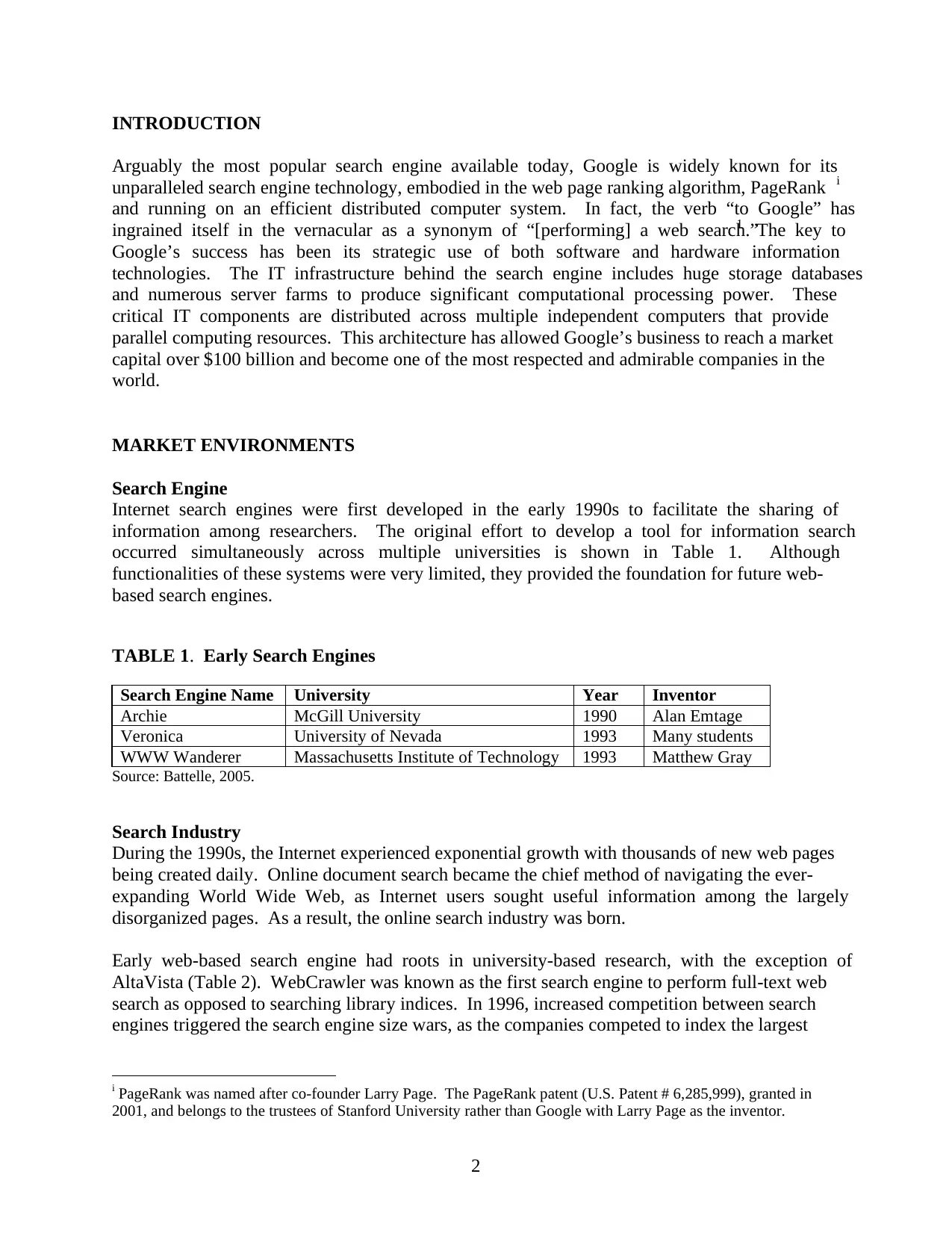
occurred simultaneously across multiple universities is shown in Table 1. Although
functionalities of these systems were very limited, they provided the foundation for future web-
based search engines.
TABLE 1. Early Search Engines
Search Engine Name University Year Inventor
Archie McGill University 1990 Alan Emtage
Veronica University of Nevada 1993 Many students
WWW Wanderer Massachusetts Institute of Technology 1993 Matthew Gray
Source: Battelle, 2005.
Search Industry
During the 1990s, the Internet experienced exponential growth with thousands of new web pages
being created daily. Online document search became the chief method of navigating the ever-
expanding World Wide Web, as Internet users sought useful information among the largely
disorganized pages. As a result, the online search industry was born.
Early web-based search engine had roots in university-based research, with the exception of
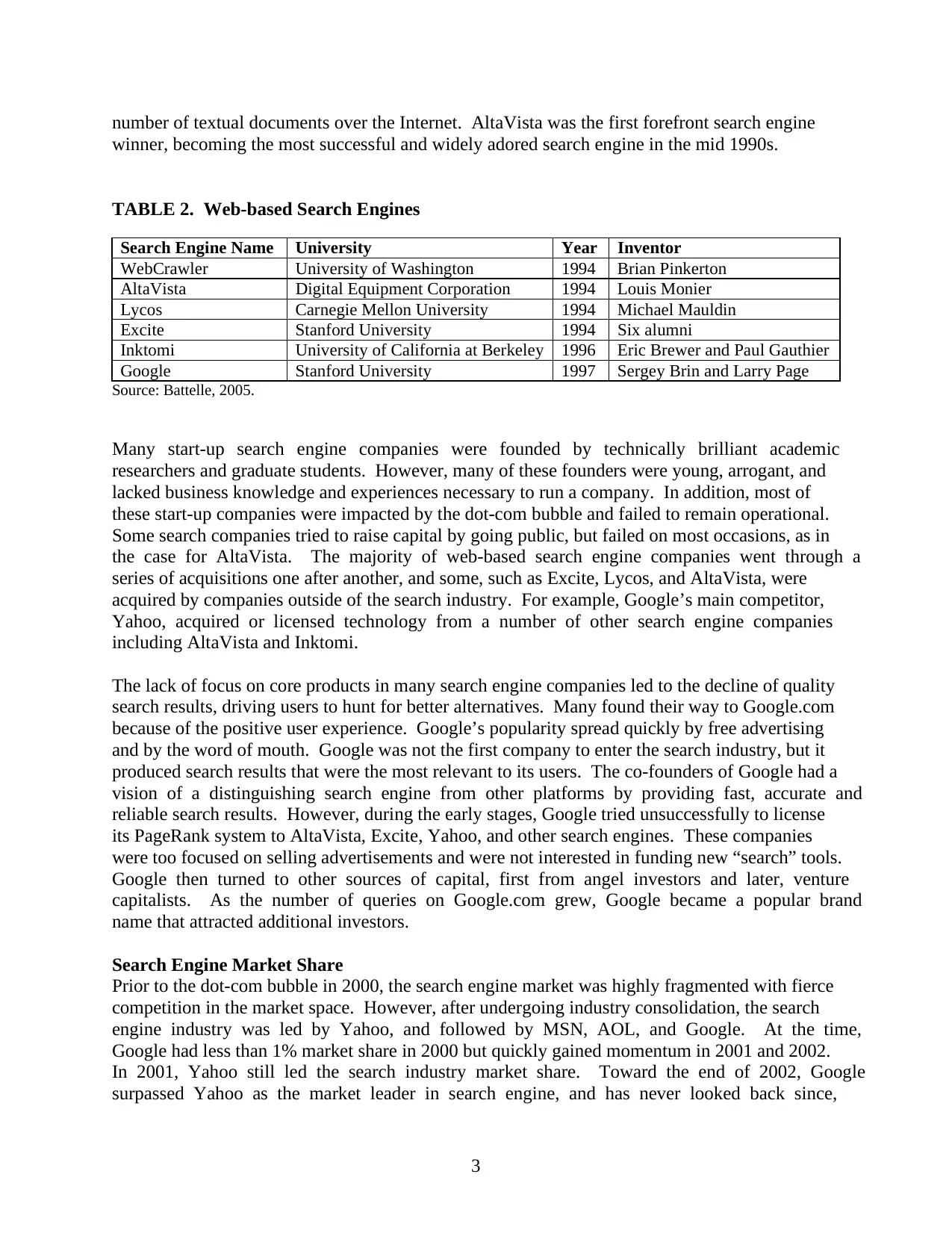
AltaVista (Table 2). WebCrawler was known as the first search engine to perform full-text web
search as opposed to searching library indices. In 1996, increased competition between search
engines triggered the search engine size wars, as the companies competed to index the largest
i PageRank was named after co-founder Larry Page. The PageRank patent (U.S. Patent # 6,285,999), granted in
2001, and belongs to the trustees of Stanford University rather than Google with Larry Page as the inventor.
INTRODUCTION
Arguably the most popular search engine available today, Google is widely known for its
unparalleled search engine technology, embodied in the web page ranking algorithm, PageRank i
and running on an efficient distributed computer system. In fact, the verb “to Google” has
ingrained itself in the vernacular as a synonym of “[performing] a web search.”1 The key to
Google’s success has been its strategic use of both software and hardware information
technologies. The IT infrastructure behind the search engine includes huge storage databases
and numerous server farms to produce significant computational processing power. These
critical IT components are distributed across multiple independent computers that provide
parallel computing resources. This architecture has allowed Google’s business to reach a market
capital over $100 billion and become one of the most respected and admirable companies in the
world.
MARKET ENVIRONMENTS
Search Engine
Internet search engines were first developed in the early 1990s to facilitate the sharing of
information among researchers. The original effort to develop a tool for information search
occurred simultaneously across multiple universities is shown in Table 1. Although
functionalities of these systems were very limited, they provided the foundation for future web-
based search engines.
TABLE 1. Early Search Engines
Search Engine Name University Year Inventor
Archie McGill University 1990 Alan Emtage
Veronica University of Nevada 1993 Many students
WWW Wanderer Massachusetts Institute of Technology 1993 Matthew Gray
Source: Battelle, 2005.
Search Industry
During the 1990s, the Internet experienced exponential growth with thousands of new web pages
being created daily. Online document search became the chief method of navigating the ever-
expanding World Wide Web, as Internet users sought useful information among the largely
disorganized pages. As a result, the online search industry was born.
Early web-based search engine had roots in university-based research, with the exception of
AltaVista (Table 2). WebCrawler was known as the first search engine to perform full-text web
search as opposed to searching library indices. In 1996, increased competition between search
engines triggered the search engine size wars, as the companies competed to index the largest
i PageRank was named after co-founder Larry Page. The PageRank patent (U.S. Patent # 6,285,999), granted in
2001, and belongs to the trustees of Stanford University rather than Google with Larry Page as the inventor.
⊘ This is a preview!⊘
Do you want full access?
Subscribe today to unlock all pages.

Trusted by 1+ million students worldwide
3
number of textual documents over the Internet. AltaVista was the first forefront search engine
winner, becoming the most successful and widely adored search engine in the mid 1990s.
TABLE 2. Web-based Search Engines
Search Engine Name University Year Inventor
WebCrawler University of Washington 1994 Brian Pinkerton
AltaVista Digital Equipment Corporation 1994 Louis Monier
Lycos Carnegie Mellon University 1994 Michael Mauldin
Excite Stanford University 1994 Six alumni
Inktomi University of California at Berkeley 1996 Eric Brewer and Paul Gauthier
Google Stanford University 1997 Sergey Brin and Larry Page
Source: Battelle, 2005.
Many start-up search engine companies were founded by technically brilliant academic
researchers and graduate students. However, many of these founders were young, arrogant, and
lacked business knowledge and experiences necessary to run a company. In addition, most of
these start-up companies were impacted by the dot-com bubble and failed to remain operational.
Some search companies tried to raise capital by going public, but failed on most occasions, as in
the case for AltaVista. The majority of web-based search engine companies went through a
series of acquisitions one after another, and some, such as Excite, Lycos, and AltaVista, were
acquired by companies outside of the search industry. For example, Google’s main competitor,
Yahoo, acquired or licensed technology from a number of other search engine companies
including AltaVista and Inktomi.
The lack of focus on core products in many search engine companies led to the decline of quality
search results, driving users to hunt for better alternatives. Many found their way to Google.com
because of the positive user experience. Google’s popularity spread quickly by free advertising
and by the word of mouth. Google was not the first company to enter the search industry, but it
produced search results that were the most relevant to its users. The co-founders of Google had a
vision of a distinguishing search engine from other platforms by providing fast, accurate and
reliable search results. However, during the early stages, Google tried unsuccessfully to license
its PageRank system to AltaVista, Excite, Yahoo, and other search engines. These companies
were too focused on selling advertisements and were not interested in funding new “search” tools.
Google then turned to other sources of capital, first from angel investors and later, venture
capitalists. As the number of queries on Google.com grew, Google became a popular brand
name that attracted additional investors.
Search Engine Market Share
Prior to the dot-com bubble in 2000, the search engine market was highly fragmented with fierce
competition in the market space. However, after undergoing industry consolidation, the search
engine industry was led by Yahoo, and followed by MSN, AOL, and Google. At the time,
Google had less than 1% market share in 2000 but quickly gained momentum in 2001 and 2002.
In 2001, Yahoo still led the search industry market share. Toward the end of 2002, Google
surpassed Yahoo as the market leader in search engine, and has never looked back since,
number of textual documents over the Internet. AltaVista was the first forefront search engine
winner, becoming the most successful and widely adored search engine in the mid 1990s.
TABLE 2. Web-based Search Engines
Search Engine Name University Year Inventor
WebCrawler University of Washington 1994 Brian Pinkerton
AltaVista Digital Equipment Corporation 1994 Louis Monier
Lycos Carnegie Mellon University 1994 Michael Mauldin
Excite Stanford University 1994 Six alumni
Inktomi University of California at Berkeley 1996 Eric Brewer and Paul Gauthier
Google Stanford University 1997 Sergey Brin and Larry Page
Source: Battelle, 2005.
Many start-up search engine companies were founded by technically brilliant academic
researchers and graduate students. However, many of these founders were young, arrogant, and
lacked business knowledge and experiences necessary to run a company. In addition, most of
these start-up companies were impacted by the dot-com bubble and failed to remain operational.
Some search companies tried to raise capital by going public, but failed on most occasions, as in
the case for AltaVista. The majority of web-based search engine companies went through a
series of acquisitions one after another, and some, such as Excite, Lycos, and AltaVista, were
acquired by companies outside of the search industry. For example, Google’s main competitor,
Yahoo, acquired or licensed technology from a number of other search engine companies
including AltaVista and Inktomi.
The lack of focus on core products in many search engine companies led to the decline of quality
search results, driving users to hunt for better alternatives. Many found their way to Google.com
because of the positive user experience. Google’s popularity spread quickly by free advertising
and by the word of mouth. Google was not the first company to enter the search industry, but it
produced search results that were the most relevant to its users. The co-founders of Google had a
vision of a distinguishing search engine from other platforms by providing fast, accurate and
reliable search results. However, during the early stages, Google tried unsuccessfully to license
its PageRank system to AltaVista, Excite, Yahoo, and other search engines. These companies
were too focused on selling advertisements and were not interested in funding new “search” tools.
Google then turned to other sources of capital, first from angel investors and later, venture
capitalists. As the number of queries on Google.com grew, Google became a popular brand
name that attracted additional investors.
Search Engine Market Share
Prior to the dot-com bubble in 2000, the search engine market was highly fragmented with fierce
competition in the market space. However, after undergoing industry consolidation, the search
engine industry was led by Yahoo, and followed by MSN, AOL, and Google. At the time,
Google had less than 1% market share in 2000 but quickly gained momentum in 2001 and 2002.
In 2001, Yahoo still led the search industry market share. Toward the end of 2002, Google
surpassed Yahoo as the market leader in search engine, and has never looked back since,
Paraphrase This Document
Need a fresh take? Get an instant paraphrase of this document with our AI Paraphraser
4
claiming more than 50% of the market for the past three years (Table 3). As of 2006, major
players in the search industry market include Google, Yahoo, and MSN, with Google
maintaining its market dominance.
TABLE 3. Search Engine Market Share
Company 2004 2005 2006
Google 57.81% 63.16% 66.63%
Yahoo! 18.24% 16.51% 14.74%
MSN 13.83% 12.06% 10.92%
AOL 0.68% 3.81% 3.93%
Ask Jeeves 1.24% 1.13% 1.31%
Others 8.20% 3.33% 2.47%
Source: Netapplications.com, statistical data
GOOGLE’S BUSINESS MODEL AND STRATEGY
Business Model
Since its beginning as a research project from two Computer Science doctorate students at
Stanford University, Google has continued to follow its mission “to organize the world's
information and make it universally accessible and useful.” 2 From Google’s founding in 1997
until 2000, the company did not have a well-defined business model to generate revenues. In
2001, Google’s two co-founders hired Eric Schmidt, the chairman and CEO of Novell and
former CTO at Sun Microsystems, as the new CEO of Google to help drive the effort in creating
a business model for Google.
With new management leadership, Google created a core business in online advertising, enabled
by the millions of users using its search engine everyday. Revenue generation and profit growth
in online advertising came from both Google’s search engine homepage and partner websites
that display Google sponsored advertisements. Google created a cost-per-click pricing scheme
for sponsored advertisements such that advertisers only pay a base fee, and for the number of
referrals to their site.
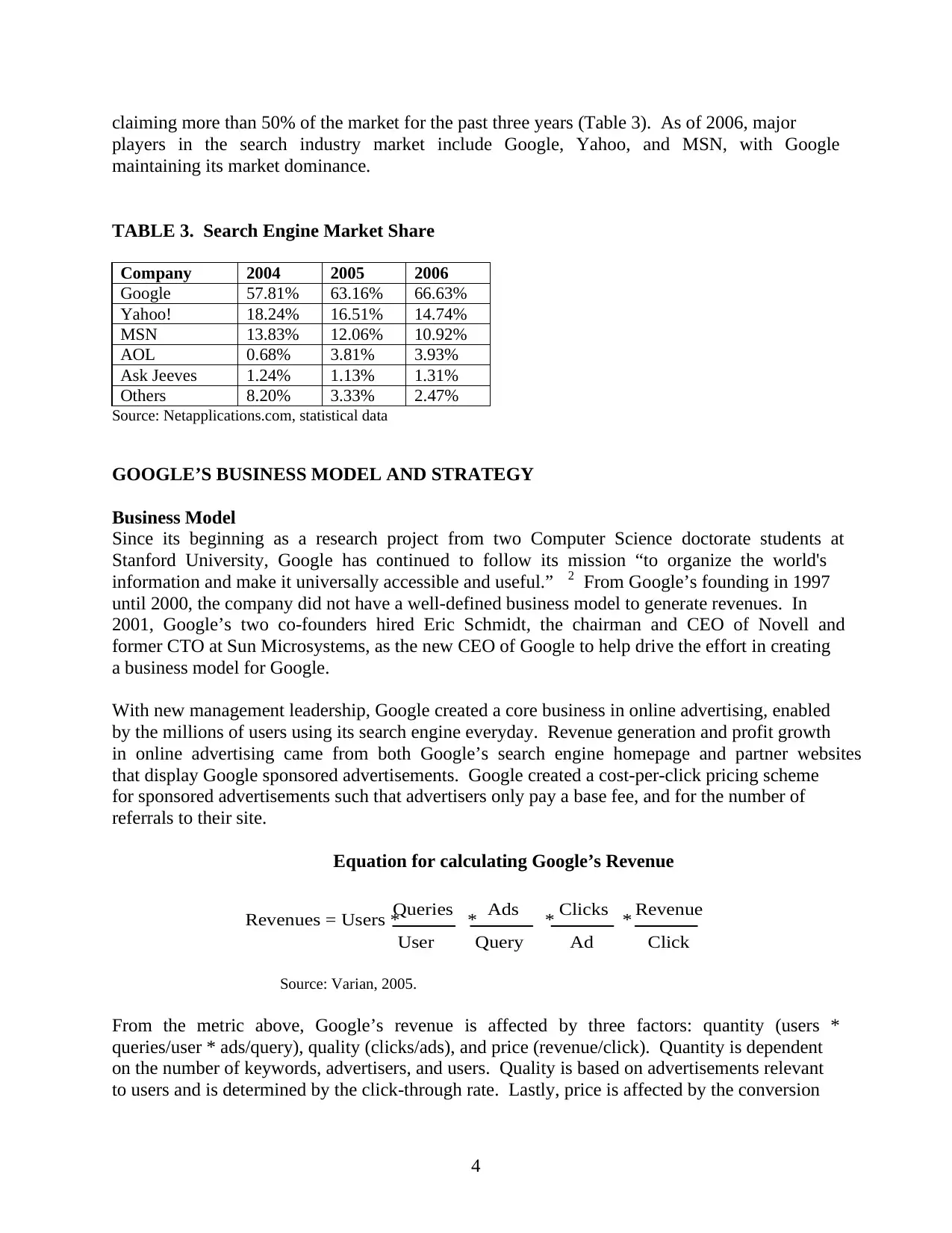
Equation for calculating Google’s Revenue
Revenues = Users * * * *
Queries
User
Ads
Query
Clicks
Ad
Revenue
Click
Source: Varian, 2005.
From the metric above, Google’s revenue is affected by three factors: quantity (users *
queries/user * ads/query), quality (clicks/ads), and price (revenue/click). Quantity is dependent
on the number of keywords, advertisers, and users. Quality is based on advertisements relevant
to users and is determined by the click-through rate. Lastly, price is affected by the conversion
claiming more than 50% of the market for the past three years (Table 3). As of 2006, major
players in the search industry market include Google, Yahoo, and MSN, with Google
maintaining its market dominance.
TABLE 3. Search Engine Market Share
Company 2004 2005 2006
Google 57.81% 63.16% 66.63%
Yahoo! 18.24% 16.51% 14.74%
MSN 13.83% 12.06% 10.92%
AOL 0.68% 3.81% 3.93%
Ask Jeeves 1.24% 1.13% 1.31%
Others 8.20% 3.33% 2.47%
Source: Netapplications.com, statistical data
GOOGLE’S BUSINESS MODEL AND STRATEGY
Business Model
Since its beginning as a research project from two Computer Science doctorate students at
Stanford University, Google has continued to follow its mission “to organize the world's
information and make it universally accessible and useful.” 2 From Google’s founding in 1997
until 2000, the company did not have a well-defined business model to generate revenues. In
2001, Google’s two co-founders hired Eric Schmidt, the chairman and CEO of Novell and
former CTO at Sun Microsystems, as the new CEO of Google to help drive the effort in creating
a business model for Google.
With new management leadership, Google created a core business in online advertising, enabled
by the millions of users using its search engine everyday. Revenue generation and profit growth
in online advertising came from both Google’s search engine homepage and partner websites
that display Google sponsored advertisements. Google created a cost-per-click pricing scheme
for sponsored advertisements such that advertisers only pay a base fee, and for the number of
referrals to their site.
Equation for calculating Google’s Revenue
Revenues = Users * * * *
Queries
User
Ads
Query
Clicks
Ad
Revenue
Click
Source: Varian, 2005.
From the metric above, Google’s revenue is affected by three factors: quantity (users *
queries/user * ads/query), quality (clicks/ads), and price (revenue/click). Quantity is dependent
on the number of keywords, advertisers, and users. Quality is based on advertisements relevant
to users and is determined by the click-through rate. Lastly, price is affected by the conversion
5
probability between the click-through rate and the consumers actually purchasing products or
services on the advertiser’s site.
The ability for advertisers to determine the value per click can be computed using Google’s
conversion tracking or internal tool to calculate online advertising retention rate. Furthermore,
advertisers can bid on the maximum price they are willing to pay per click for their specific
advertisements. Minimal value of the bid starts from $0.01 cost-per-click with an upper limit of
$100. To control costs, advertisers can set an upper bound dollar limit they are willing to spend
for online marketing. Once cost-per-click reaches the budget limit set by the advertiser, their
advertisements are taken offline.
Business Strategy
Google is generally secretive about its business strategy, but it is evident that Google is building
the foundation for all of its products and services under the central theme of leveraging advanced
search technology and personalized advertising. For example, Google’s popular web-based
email service called GMail, allows users to store and search old emails rapidly using text search
integrated into the email client and then placing sponsored advertisements on the side based upon
email content a user is currently reading. The GMail client is also able to identify email contents
in which it can link information onto Google Maps and track packages from UPS and USPS.
Existing search results are primarily textual-based. More advanced search technologies will
allow users to search for other information besides textual data, such as multimedia content (e.g.
audio, image, video). To maintain its reputation as a forefront technology leader and innovator,
Google has been aggressively acquiring software start-up companies that can be easily integrated
into its existing solutions, and can instantaneously gain visibility through Google’s leverage.
However, this strategy of growing through small acquisitions is also used by Yahoo, one of
Google’s major competitors, although the underlying methodology of the acquisitions is different.
Yahoo’s acquisitions have been focused on acquiring search technology companies having
specialized search functionalities. For example, Yahoo acquired Inktomi, Overture, and Stata
Labs to perform web search, locating advertiser key words, and retrieval of Yahoo email client,
respectively. Yahoo has a group of search technologies for different products and services, while
Google has only one search technology.
Over time with greater competition, an online advertising network may be commoditized and
Google will need to develop new business models to entice new customers and enhance
relationships with existing ones for customer lock-ins (Elgin, 2004). For existing customers,
Google has Advanced Tools & Reporting to support sophisticated advertisers, and Google plans
to tighten integration with other Google related products in advertising. Since Q4 of 2005,
Google is offering Google Analytics as a free service. Google Analytics, formerly called Urchin,
is a web-based service that provides log analysis and web statistics that lets advertisers know
about their visitors and how they interact with their site. Google Analytics is integrated with
AdWords and allows advertisers to optimize their keywords so they can better target resources
for their marketing campaigns and deliver higher return on investment. This has served well for
many small and medium size businesses using AdWords as the primary marketing tool for
reaching to the customers.
probability between the click-through rate and the consumers actually purchasing products or
services on the advertiser’s site.
The ability for advertisers to determine the value per click can be computed using Google’s
conversion tracking or internal tool to calculate online advertising retention rate. Furthermore,
advertisers can bid on the maximum price they are willing to pay per click for their specific
advertisements. Minimal value of the bid starts from $0.01 cost-per-click with an upper limit of
$100. To control costs, advertisers can set an upper bound dollar limit they are willing to spend
for online marketing. Once cost-per-click reaches the budget limit set by the advertiser, their
advertisements are taken offline.
Business Strategy
Google is generally secretive about its business strategy, but it is evident that Google is building
the foundation for all of its products and services under the central theme of leveraging advanced
search technology and personalized advertising. For example, Google’s popular web-based
email service called GMail, allows users to store and search old emails rapidly using text search
integrated into the email client and then placing sponsored advertisements on the side based upon
email content a user is currently reading. The GMail client is also able to identify email contents
in which it can link information onto Google Maps and track packages from UPS and USPS.
Existing search results are primarily textual-based. More advanced search technologies will
allow users to search for other information besides textual data, such as multimedia content (e.g.
audio, image, video). To maintain its reputation as a forefront technology leader and innovator,
Google has been aggressively acquiring software start-up companies that can be easily integrated
into its existing solutions, and can instantaneously gain visibility through Google’s leverage.
However, this strategy of growing through small acquisitions is also used by Yahoo, one of
Google’s major competitors, although the underlying methodology of the acquisitions is different.
Yahoo’s acquisitions have been focused on acquiring search technology companies having
specialized search functionalities. For example, Yahoo acquired Inktomi, Overture, and Stata
Labs to perform web search, locating advertiser key words, and retrieval of Yahoo email client,
respectively. Yahoo has a group of search technologies for different products and services, while
Google has only one search technology.
Over time with greater competition, an online advertising network may be commoditized and
Google will need to develop new business models to entice new customers and enhance
relationships with existing ones for customer lock-ins (Elgin, 2004). For existing customers,
Google has Advanced Tools & Reporting to support sophisticated advertisers, and Google plans
to tighten integration with other Google related products in advertising. Since Q4 of 2005,
Google is offering Google Analytics as a free service. Google Analytics, formerly called Urchin,
is a web-based service that provides log analysis and web statistics that lets advertisers know
about their visitors and how they interact with their site. Google Analytics is integrated with
AdWords and allows advertisers to optimize their keywords so they can better target resources
for their marketing campaigns and deliver higher return on investment. This has served well for
many small and medium size businesses using AdWords as the primary marketing tool for
reaching to the customers.
⊘ This is a preview!⊘
Do you want full access?
Subscribe today to unlock all pages.
Trusted by 1+ million students worldwide
6
Google has begun targeting its vertical sales in advertising to focus on Fortune 1,000 companies,
where they have only captured one-forth of the market share. 3 Fortune 500 companies have not
caught on as quickly using online marketing, and have relied more on traditional marketing
techniques. However, according to a study conducted by Advertising Age, “Nearly half of the
chief marketing officers at Fortune 500 companies said they plan to increase their online
advertising budgets by 30% in 2006.” 4 Out of the $250 billion dollar advertising industry in the
United States alone, only $11 billion is spent online with about $5 billion attributed to search
advertising where Google has 79% of the market share. To reach new markets faster, Google is
expanding its advertising business beyond online marketing to other mediums, including radio
and print. Google has already exhibited some efforts to diversify its advertising business by
acquiring dMarc Broadcasting in January 2006, a company that develops a unique automated-
radio–advertising-selling process between radio stations and advertisers (Perez, 2006). Google
plans to integrate its AdWords platform with dMarc’s software that automates the buying and
placing of radio advertisements. Google is also experimenting with integrating its AdWords
platform with print media by running classified advertisements for its AdWords customers
through a limited trial in PC Magazine, Maximum PC, Budget Living, and the Chicago Sun
Times (Hoover, 2006).
GOOGLE’S PRODUCTS AND SERVICES
Key Product and Services
Online advertising is Google’s core product and accounts for 90% of the company’s revenue.
AdWords, a cost-per-click pricing scheme, was a result of Google’s newly formed business
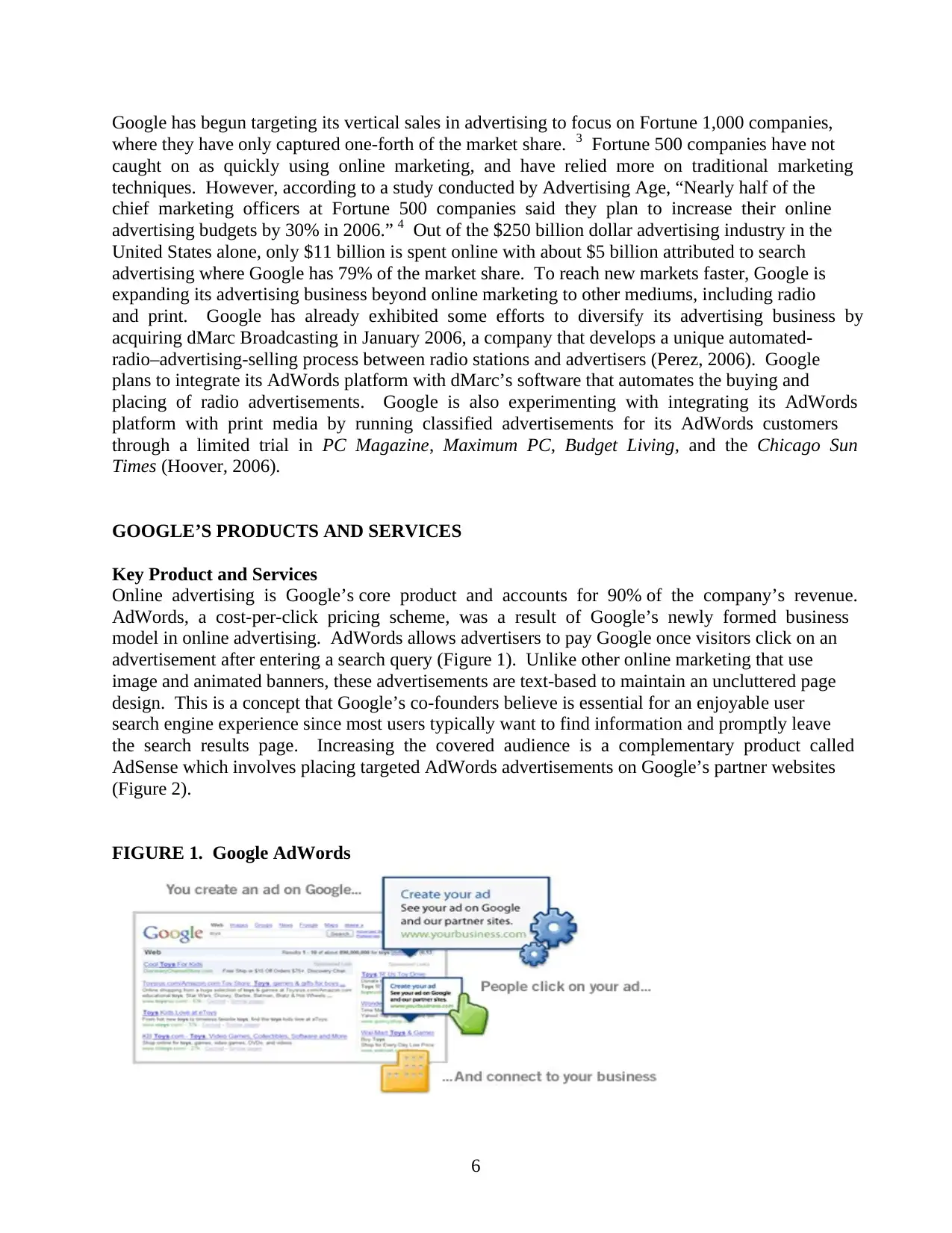
model in online advertising. AdWords allows advertisers to pay Google once visitors click on an
advertisement after entering a search query (Figure 1). Unlike other online marketing that use
image and animated banners, these advertisements are text-based to maintain an uncluttered page
design. This is a concept that Google’s co-founders believe is essential for an enjoyable user
search engine experience since most users typically want to find information and promptly leave
the search results page. Increasing the covered audience is a complementary product called
AdSense which involves placing targeted AdWords advertisements on Google’s partner websites
(Figure 2).
FIGURE 1. Google AdWords
Google has begun targeting its vertical sales in advertising to focus on Fortune 1,000 companies,
where they have only captured one-forth of the market share. 3 Fortune 500 companies have not
caught on as quickly using online marketing, and have relied more on traditional marketing
techniques. However, according to a study conducted by Advertising Age, “Nearly half of the
chief marketing officers at Fortune 500 companies said they plan to increase their online
advertising budgets by 30% in 2006.” 4 Out of the $250 billion dollar advertising industry in the
United States alone, only $11 billion is spent online with about $5 billion attributed to search
advertising where Google has 79% of the market share. To reach new markets faster, Google is
expanding its advertising business beyond online marketing to other mediums, including radio
and print. Google has already exhibited some efforts to diversify its advertising business by
acquiring dMarc Broadcasting in January 2006, a company that develops a unique automated-
radio–advertising-selling process between radio stations and advertisers (Perez, 2006). Google
plans to integrate its AdWords platform with dMarc’s software that automates the buying and
placing of radio advertisements. Google is also experimenting with integrating its AdWords
platform with print media by running classified advertisements for its AdWords customers
through a limited trial in PC Magazine, Maximum PC, Budget Living, and the Chicago Sun
Times (Hoover, 2006).
GOOGLE’S PRODUCTS AND SERVICES
Key Product and Services
Online advertising is Google’s core product and accounts for 90% of the company’s revenue.
AdWords, a cost-per-click pricing scheme, was a result of Google’s newly formed business
model in online advertising. AdWords allows advertisers to pay Google once visitors click on an
advertisement after entering a search query (Figure 1). Unlike other online marketing that use
image and animated banners, these advertisements are text-based to maintain an uncluttered page
design. This is a concept that Google’s co-founders believe is essential for an enjoyable user
search engine experience since most users typically want to find information and promptly leave
the search results page. Increasing the covered audience is a complementary product called
AdSense which involves placing targeted AdWords advertisements on Google’s partner websites
(Figure 2).
FIGURE 1. Google AdWords
Paraphrase This Document
Need a fresh take? Get an instant paraphrase of this document with our AI Paraphraser
7
FIGURE 2.. Google AdSense
FIGURE 3. Google Toolbar Plug-in for Web Browser
Other Google Products and Services
Besides online advertising services, Google leverages its search technology into a number of
other search related services. One of these services is a product search website called Froogle.
Froogle allows online shoppers the basis to search for product categories and brands, access to
product reviews, and compare item prices. The use of search was further expanded beyond
finding content on web pages to assist users to search for imagery information such as maps and
satellite overlays through Google Earth. A similar concept was developed in a location-based
service called Google Local in which users can search for nearby locations such as the closest
coffee shop which will be labeled on a map displaying the shops in the surrounding area. Other
search related services offered by Google that have gained popularity among users include an
image search: Google Images, a searchable email client: GMail, a desktop file search tool:
Google Desktop, and a web-based video streaming tool: Google Video. As the number of
Google search queries increased, Google expanded their search accessibility by offering a
Google search toolbar that users can download as a plug-in to many standard web browsers such
as Internet Explorer and Mozilla Firefox (Figure 3). Many of the products and services Google
develops depend on advertisements to generate revenues, but some such as Google Images,
Google Earth, and Google SketchUp do not.
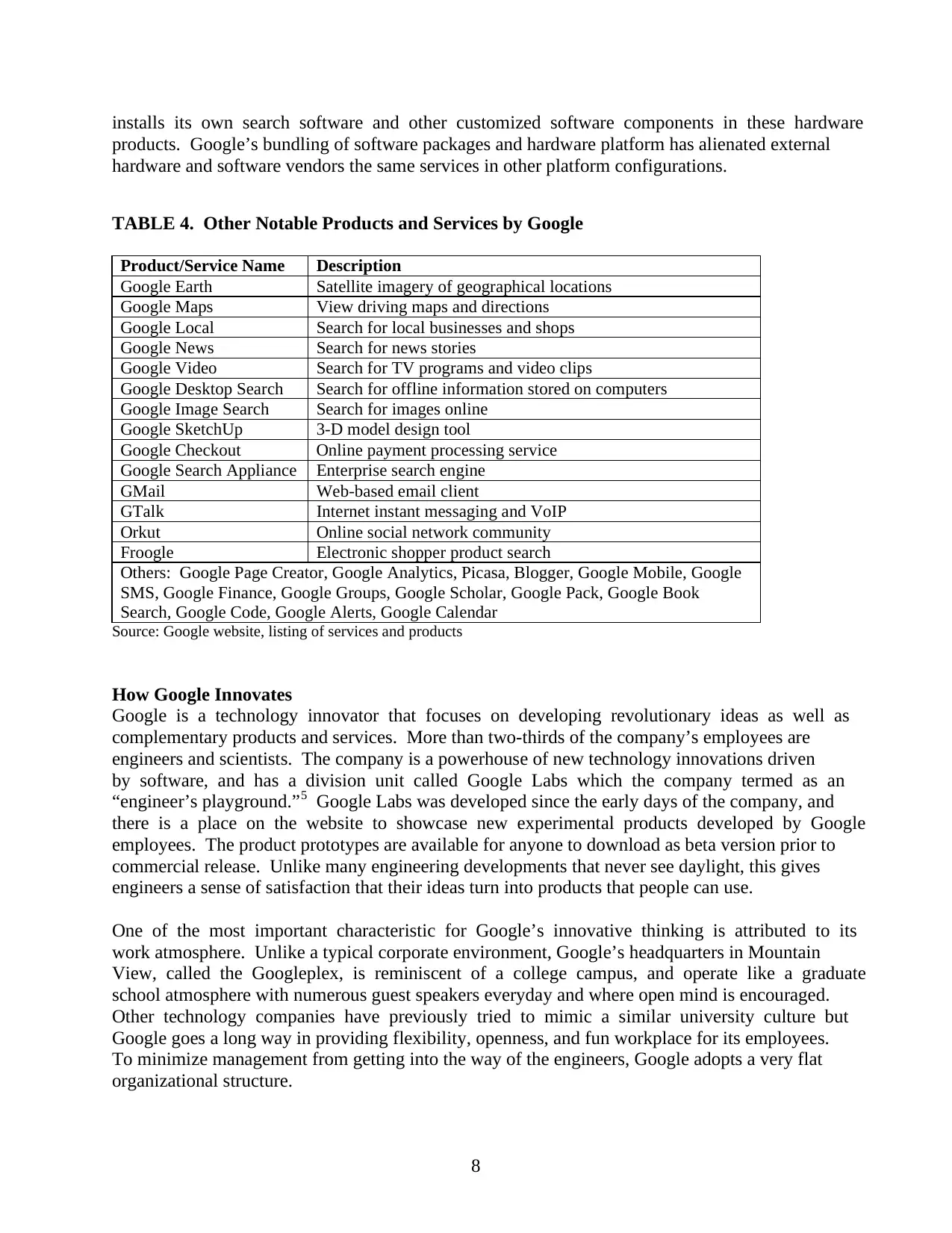
The only hardware equipment that Google sells to date is a standalone search product solution
for the enterprise market. A listing of products and services offered by Google is shown in Table
4. The product offers corporate employees, partners, and customers to easily find information
and product solutions through their internal networks. These products are known as Google
Mini and Google Search Appliance, depending on the documents index capacity. Google pre-
FIGURE 2.. Google AdSense
FIGURE 3. Google Toolbar Plug-in for Web Browser
Other Google Products and Services
Besides online advertising services, Google leverages its search technology into a number of
other search related services. One of these services is a product search website called Froogle.
Froogle allows online shoppers the basis to search for product categories and brands, access to
product reviews, and compare item prices. The use of search was further expanded beyond
finding content on web pages to assist users to search for imagery information such as maps and
satellite overlays through Google Earth. A similar concept was developed in a location-based
service called Google Local in which users can search for nearby locations such as the closest
coffee shop which will be labeled on a map displaying the shops in the surrounding area. Other
search related services offered by Google that have gained popularity among users include an
image search: Google Images, a searchable email client: GMail, a desktop file search tool:
Google Desktop, and a web-based video streaming tool: Google Video. As the number of
Google search queries increased, Google expanded their search accessibility by offering a
Google search toolbar that users can download as a plug-in to many standard web browsers such
as Internet Explorer and Mozilla Firefox (Figure 3). Many of the products and services Google
develops depend on advertisements to generate revenues, but some such as Google Images,
Google Earth, and Google SketchUp do not.
The only hardware equipment that Google sells to date is a standalone search product solution
for the enterprise market. A listing of products and services offered by Google is shown in Table
4. The product offers corporate employees, partners, and customers to easily find information
and product solutions through their internal networks. These products are known as Google
Mini and Google Search Appliance, depending on the documents index capacity. Google pre-
8
installs its own search software and other customized software components in these hardware
products. Google’s bundling of software packages and hardware platform has alienated external
hardware and software vendors the same services in other platform configurations.
TABLE 4. Other Notable Products and Services by Google
Product/Service Name Description
Google Earth Satellite imagery of geographical locations
Google Maps View driving maps and directions
Google Local Search for local businesses and shops
Google News Search for news stories
Google Video Search for TV programs and video clips
Google Desktop Search Search for offline information stored on computers
Google Image Search Search for images online
Google SketchUp 3-D model design tool
Google Checkout Online payment processing service
Google Search Appliance Enterprise search engine
GMail Web-based email client
GTalk Internet instant messaging and VoIP
Orkut Online social network community
Froogle Electronic shopper product search
Others: Google Page Creator, Google Analytics, Picasa, Blogger, Google Mobile, Google
SMS, Google Finance, Google Groups, Google Scholar, Google Pack, Google Book
Search, Google Code, Google Alerts, Google Calendar
Source: Google website, listing of services and products
How Google Innovates
Google is a technology innovator that focuses on developing revolutionary ideas as well as
complementary products and services. More than two-thirds of the company’s employees are
engineers and scientists. The company is a powerhouse of new technology innovations driven
by software, and has a division unit called Google Labs which the company termed as an
“engineer’s playground.”5 Google Labs was developed since the early days of the company, and
there is a place on the website to showcase new experimental products developed by Google
employees. The product prototypes are available for anyone to download as beta version prior to
commercial release. Unlike many engineering developments that never see daylight, this gives
engineers a sense of satisfaction that their ideas turn into products that people can use.
One of the most important characteristic for Google’s innovative thinking is attributed to its
work atmosphere. Unlike a typical corporate environment, Google’s headquarters in Mountain
View, called the Googleplex, is reminiscent of a college campus, and operate like a graduate
school atmosphere with numerous guest speakers everyday and where open mind is encouraged.
Other technology companies have previously tried to mimic a similar university culture but
Google goes a long way in providing flexibility, openness, and fun workplace for its employees.
To minimize management from getting into the way of the engineers, Google adopts a very flat
organizational structure.
installs its own search software and other customized software components in these hardware
products. Google’s bundling of software packages and hardware platform has alienated external
hardware and software vendors the same services in other platform configurations.
TABLE 4. Other Notable Products and Services by Google
Product/Service Name Description
Google Earth Satellite imagery of geographical locations
Google Maps View driving maps and directions
Google Local Search for local businesses and shops
Google News Search for news stories
Google Video Search for TV programs and video clips
Google Desktop Search Search for offline information stored on computers
Google Image Search Search for images online
Google SketchUp 3-D model design tool
Google Checkout Online payment processing service
Google Search Appliance Enterprise search engine
GMail Web-based email client
GTalk Internet instant messaging and VoIP
Orkut Online social network community
Froogle Electronic shopper product search
Others: Google Page Creator, Google Analytics, Picasa, Blogger, Google Mobile, Google
SMS, Google Finance, Google Groups, Google Scholar, Google Pack, Google Book
Search, Google Code, Google Alerts, Google Calendar
Source: Google website, listing of services and products
How Google Innovates
Google is a technology innovator that focuses on developing revolutionary ideas as well as
complementary products and services. More than two-thirds of the company’s employees are
engineers and scientists. The company is a powerhouse of new technology innovations driven
by software, and has a division unit called Google Labs which the company termed as an
“engineer’s playground.”5 Google Labs was developed since the early days of the company, and
there is a place on the website to showcase new experimental products developed by Google
employees. The product prototypes are available for anyone to download as beta version prior to
commercial release. Unlike many engineering developments that never see daylight, this gives
engineers a sense of satisfaction that their ideas turn into products that people can use.
One of the most important characteristic for Google’s innovative thinking is attributed to its
work atmosphere. Unlike a typical corporate environment, Google’s headquarters in Mountain
View, called the Googleplex, is reminiscent of a college campus, and operate like a graduate
school atmosphere with numerous guest speakers everyday and where open mind is encouraged.
Other technology companies have previously tried to mimic a similar university culture but
Google goes a long way in providing flexibility, openness, and fun workplace for its employees.
To minimize management from getting into the way of the engineers, Google adopts a very flat
organizational structure.
⊘ This is a preview!⊘
Do you want full access?
Subscribe today to unlock all pages.
Trusted by 1+ million students worldwide
9
Google engineer Joe Beda praised the positive atmosphere inside the Google headquarters: “The
intrapersonal environment at Google is very energizing. When someone comes up with a new
idea, the most common response is excitement and a brainstorming session.” 6 Google
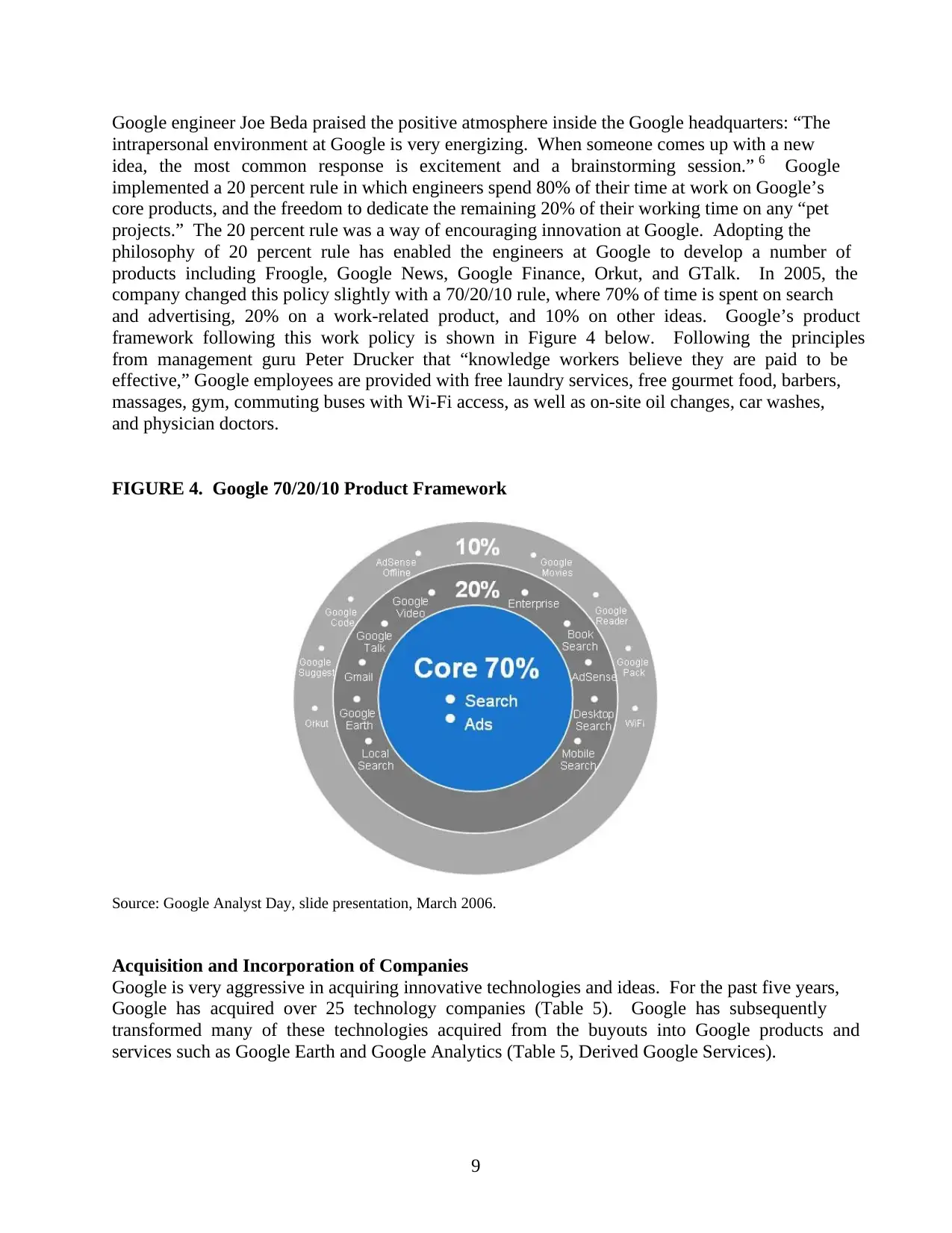
implemented a 20 percent rule in which engineers spend 80% of their time at work on Google’s
core products, and the freedom to dedicate the remaining 20% of their working time on any “pet
projects.” The 20 percent rule was a way of encouraging innovation at Google. Adopting the
philosophy of 20 percent rule has enabled the engineers at Google to develop a number of
products including Froogle, Google News, Google Finance, Orkut, and GTalk. In 2005, the
company changed this policy slightly with a 70/20/10 rule, where 70% of time is spent on search
and advertising, 20% on a work-related product, and 10% on other ideas. Google’s product
framework following this work policy is shown in Figure 4 below. Following the principles
from management guru Peter Drucker that “knowledge workers believe they are paid to be
effective,” Google employees are provided with free laundry services, free gourmet food, barbers,
massages, gym, commuting buses with Wi-Fi access, as well as on-site oil changes, car washes,
and physician doctors.
FIGURE 4. Google 70/20/10 Product Framework
Source: Google Analyst Day, slide presentation, March 2006.
Acquisition and Incorporation of Companies
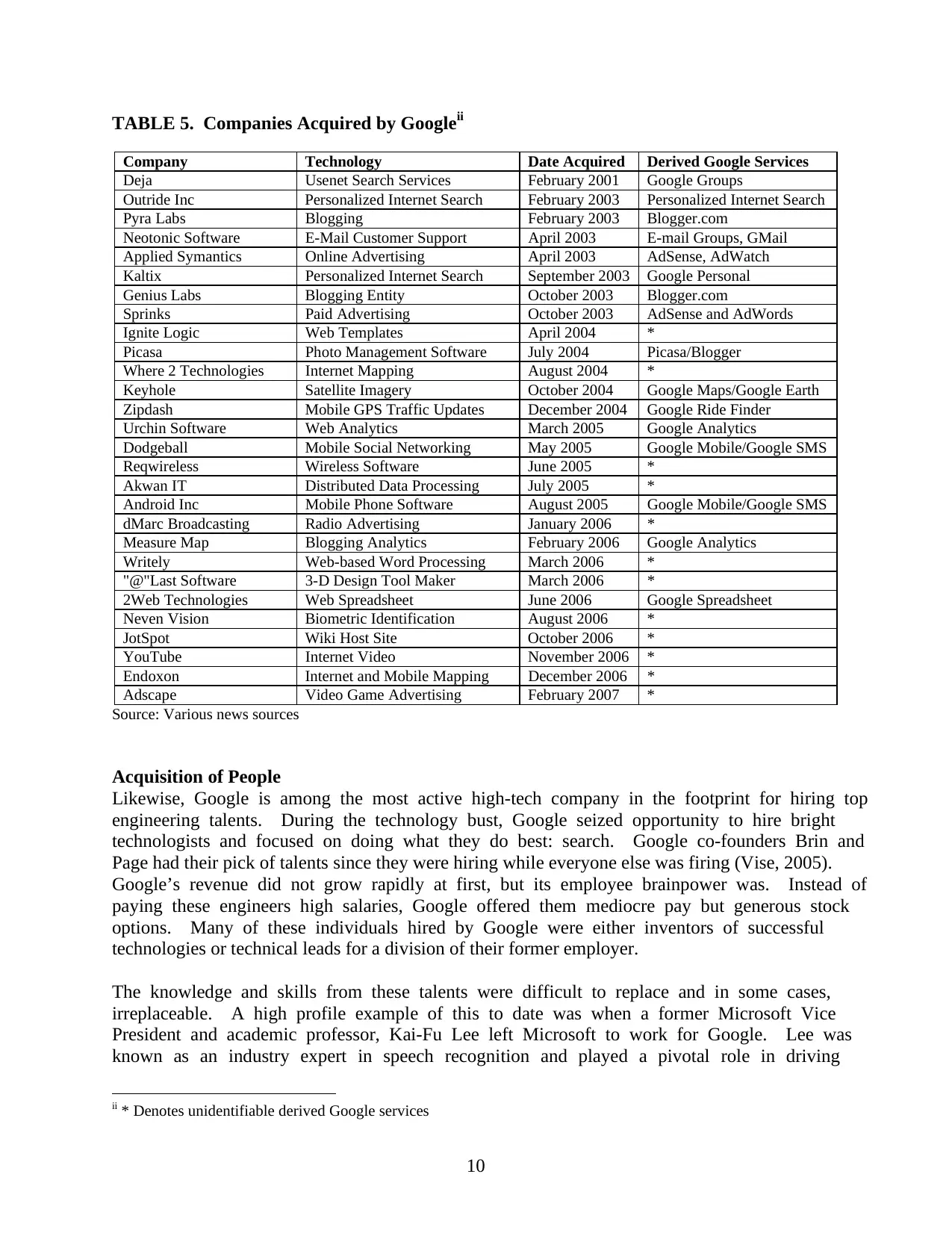
Google is very aggressive in acquiring innovative technologies and ideas. For the past five years,
Google has acquired over 25 technology companies (Table 5). Google has subsequently
transformed many of these technologies acquired from the buyouts into Google products and
services such as Google Earth and Google Analytics (Table 5, Derived Google Services).
Google engineer Joe Beda praised the positive atmosphere inside the Google headquarters: “The
intrapersonal environment at Google is very energizing. When someone comes up with a new
idea, the most common response is excitement and a brainstorming session.” 6 Google
implemented a 20 percent rule in which engineers spend 80% of their time at work on Google’s
core products, and the freedom to dedicate the remaining 20% of their working time on any “pet
projects.” The 20 percent rule was a way of encouraging innovation at Google. Adopting the
philosophy of 20 percent rule has enabled the engineers at Google to develop a number of
products including Froogle, Google News, Google Finance, Orkut, and GTalk. In 2005, the
company changed this policy slightly with a 70/20/10 rule, where 70% of time is spent on search
and advertising, 20% on a work-related product, and 10% on other ideas. Google’s product
framework following this work policy is shown in Figure 4 below. Following the principles
from management guru Peter Drucker that “knowledge workers believe they are paid to be
effective,” Google employees are provided with free laundry services, free gourmet food, barbers,
massages, gym, commuting buses with Wi-Fi access, as well as on-site oil changes, car washes,
and physician doctors.
FIGURE 4. Google 70/20/10 Product Framework
Source: Google Analyst Day, slide presentation, March 2006.
Acquisition and Incorporation of Companies
Google is very aggressive in acquiring innovative technologies and ideas. For the past five years,
Google has acquired over 25 technology companies (Table 5). Google has subsequently
transformed many of these technologies acquired from the buyouts into Google products and
services such as Google Earth and Google Analytics (Table 5, Derived Google Services).
Paraphrase This Document
Need a fresh take? Get an instant paraphrase of this document with our AI Paraphraser
10
TABLE 5. Companies Acquired by Googleii
Company Technology Date Acquired Derived Google Services
Deja Usenet Search Services February 2001 Google Groups
Outride Inc Personalized Internet Search February 2003 Personalized Internet Search
Pyra Labs Blogging February 2003 Blogger.com
Neotonic Software E-Mail Customer Support April 2003 E-mail Groups, GMail
Applied Symantics Online Advertising April 2003 AdSense, AdWatch
Kaltix Personalized Internet Search September 2003 Google Personal
Genius Labs Blogging Entity October 2003 Blogger.com
Sprinks Paid Advertising October 2003 AdSense and AdWords
Ignite Logic Web Templates April 2004 *
Picasa Photo Management Software July 2004 Picasa/Blogger
Where 2 Technologies Internet Mapping August 2004 *
Keyhole Satellite Imagery October 2004 Google Maps/Google Earth
Zipdash Mobile GPS Traffic Updates December 2004 Google Ride Finder
Urchin Software Web Analytics March 2005 Google Analytics
Dodgeball Mobile Social Networking May 2005 Google Mobile/Google SMS
Reqwireless Wireless Software June 2005 *
Akwan IT Distributed Data Processing July 2005 *
Android Inc Mobile Phone Software August 2005 Google Mobile/Google SMS
dMarc Broadcasting Radio Advertising January 2006 *
Measure Map Blogging Analytics February 2006 Google Analytics
Writely Web-based Word Processing March 2006 *
"@"Last Software 3-D Design Tool Maker March 2006 *
2Web Technologies Web Spreadsheet June 2006 Google Spreadsheet
Neven Vision Biometric Identification August 2006 *
JotSpot Wiki Host Site October 2006 *
YouTube Internet Video November 2006 *
Endoxon Internet and Mobile Mapping December 2006 *
Adscape Video Game Advertising February 2007 *
Source: Various news sources
Acquisition of People
Likewise, Google is among the most active high-tech company in the footprint for hiring top
engineering talents. During the technology bust, Google seized opportunity to hire bright
technologists and focused on doing what they do best: search. Google co-founders Brin and
Page had their pick of talents since they were hiring while everyone else was firing (Vise, 2005).
Google’s revenue did not grow rapidly at first, but its employee brainpower was. Instead of
paying these engineers high salaries, Google offered them mediocre pay but generous stock
options. Many of these individuals hired by Google were either inventors of successful
technologies or technical leads for a division of their former employer.
The knowledge and skills from these talents were difficult to replace and in some cases,
irreplaceable. A high profile example of this to date was when a former Microsoft Vice
President and academic professor, Kai-Fu Lee left Microsoft to work for Google. Lee was
known as an industry expert in speech recognition and played a pivotal role in driving
ii * Denotes unidentifiable derived Google services
TABLE 5. Companies Acquired by Googleii
Company Technology Date Acquired Derived Google Services
Deja Usenet Search Services February 2001 Google Groups
Outride Inc Personalized Internet Search February 2003 Personalized Internet Search
Pyra Labs Blogging February 2003 Blogger.com
Neotonic Software E-Mail Customer Support April 2003 E-mail Groups, GMail
Applied Symantics Online Advertising April 2003 AdSense, AdWatch
Kaltix Personalized Internet Search September 2003 Google Personal
Genius Labs Blogging Entity October 2003 Blogger.com
Sprinks Paid Advertising October 2003 AdSense and AdWords
Ignite Logic Web Templates April 2004 *
Picasa Photo Management Software July 2004 Picasa/Blogger
Where 2 Technologies Internet Mapping August 2004 *
Keyhole Satellite Imagery October 2004 Google Maps/Google Earth
Zipdash Mobile GPS Traffic Updates December 2004 Google Ride Finder
Urchin Software Web Analytics March 2005 Google Analytics
Dodgeball Mobile Social Networking May 2005 Google Mobile/Google SMS
Reqwireless Wireless Software June 2005 *
Akwan IT Distributed Data Processing July 2005 *
Android Inc Mobile Phone Software August 2005 Google Mobile/Google SMS
dMarc Broadcasting Radio Advertising January 2006 *
Measure Map Blogging Analytics February 2006 Google Analytics
Writely Web-based Word Processing March 2006 *
"@"Last Software 3-D Design Tool Maker March 2006 *
2Web Technologies Web Spreadsheet June 2006 Google Spreadsheet
Neven Vision Biometric Identification August 2006 *
JotSpot Wiki Host Site October 2006 *
YouTube Internet Video November 2006 *
Endoxon Internet and Mobile Mapping December 2006 *
Adscape Video Game Advertising February 2007 *
Source: Various news sources
Acquisition of People
Likewise, Google is among the most active high-tech company in the footprint for hiring top
engineering talents. During the technology bust, Google seized opportunity to hire bright
technologists and focused on doing what they do best: search. Google co-founders Brin and
Page had their pick of talents since they were hiring while everyone else was firing (Vise, 2005).
Google’s revenue did not grow rapidly at first, but its employee brainpower was. Instead of
paying these engineers high salaries, Google offered them mediocre pay but generous stock
options. Many of these individuals hired by Google were either inventors of successful
technologies or technical leads for a division of their former employer.
The knowledge and skills from these talents were difficult to replace and in some cases,
irreplaceable. A high profile example of this to date was when a former Microsoft Vice
President and academic professor, Kai-Fu Lee left Microsoft to work for Google. Lee was
known as an industry expert in speech recognition and played a pivotal role in driving
ii * Denotes unidentifiable derived Google services
11
Microsoft’s China strategy. Microsoft feared this was not only a loss of talent, but a leakage of
critical confidential information which resulted in a legal battle against Google for a one year
non-competitive agreement signed by Lee. The case was settled between Microsoft and Google
with the court judge placing a temporary restraining order for the type of projects Lee can work
on at Google. Lee effectively started working for Google without further delay.
Various news surfacing in the technology industry estimates that over 100 former Microsoft
employees to date have left their former employers and opted-out to work for Google instead. If
this estimated figure is fairly accurate, approximately 1.76% of Google’s total employee pool
would be ex-Microsoft workers.iii Among the complaints, these former Microsoft employees
criticized that there were duplicate efforts within the company and more time spent on
maintaining software at Microsoft instead of innovating new product ideas. Google has hired
many notable technologists which include technology industry legends and young guru
programmers (Table 6).
Working at Google is not only attractive in the industry, but is equally enticing from many of
those in academia. In fact, many university professors have opted out from their academic career
track of getting tenureship to work for Google. For example, in December 2005, Andrew Moore,
Professor of Computer Science at Carnegie Mellon University and an expert in data mining and
artificial intelligence, decided to join Google and lead Google’s new Pittsburgh engineering
office.7
To ensure the quality of its workers at Google, the employment screening process has become
one of most rigorous among all technology companies, comparable to Microsoft, and perhaps
even more difficult. Applicants are asked to solve complex technical questions from at least half
a dozen interviewers. Google is very careful in their recruiting and their hiring process is based
on a committee hearing everyone’s feedback (Schmidt & Varian, 2005). An entire interview
process at Google can take several months before a decision is made.
iii As of December 31st, 2005, there are 5,680 full-time employees. Calculation for 1.76% (~100 / 5680).
Microsoft’s China strategy. Microsoft feared this was not only a loss of talent, but a leakage of
critical confidential information which resulted in a legal battle against Google for a one year
non-competitive agreement signed by Lee. The case was settled between Microsoft and Google
with the court judge placing a temporary restraining order for the type of projects Lee can work
on at Google. Lee effectively started working for Google without further delay.
Various news surfacing in the technology industry estimates that over 100 former Microsoft
employees to date have left their former employers and opted-out to work for Google instead. If
this estimated figure is fairly accurate, approximately 1.76% of Google’s total employee pool
would be ex-Microsoft workers.iii Among the complaints, these former Microsoft employees
criticized that there were duplicate efforts within the company and more time spent on
maintaining software at Microsoft instead of innovating new product ideas. Google has hired
many notable technologists which include technology industry legends and young guru
programmers (Table 6).
Working at Google is not only attractive in the industry, but is equally enticing from many of
those in academia. In fact, many university professors have opted out from their academic career
track of getting tenureship to work for Google. For example, in December 2005, Andrew Moore,
Professor of Computer Science at Carnegie Mellon University and an expert in data mining and
artificial intelligence, decided to join Google and lead Google’s new Pittsburgh engineering
office.7
To ensure the quality of its workers at Google, the employment screening process has become
one of most rigorous among all technology companies, comparable to Microsoft, and perhaps
even more difficult. Applicants are asked to solve complex technical questions from at least half
a dozen interviewers. Google is very careful in their recruiting and their hiring process is based
on a committee hearing everyone’s feedback (Schmidt & Varian, 2005). An entire interview
process at Google can take several months before a decision is made.
iii As of December 31st, 2005, there are 5,680 full-time employees. Calculation for 1.76% (~100 / 5680).
⊘ This is a preview!⊘
Do you want full access?
Subscribe today to unlock all pages.
Trusted by 1+ million students worldwide

1 out of 32


Related Documents


Your All-in-One AI-Powered Toolkit for Academic Success.
+13062052269
info@desklib.com
Available 24*7 on WhatsApp / Email
![[object Object]](/_next/static/media/star-bottom.7253800d.svg)
Unlock your academic potential
Copyright © 2020–2026 A2Z Services. All Rights Reserved. Developed and managed by ZUCOL.