Google's Ethical Shift: Examining the Removal of 'Don't Be Evil' Motto
VerifiedAdded on 2023/04/22
|10
|3497
|473
Essay
AI Summary
This essay examines the ethical implications of Google's decision to remove its famous 'Don't Be Evil' motto when it transformed into Alphabet Inc. in 2015. The essay argues that removing the motto could negatively affect Google's image, as the public perceived the company as an ideal organization committed to ethical practices. It explores the reasons behind the removal, including the shift to the tagline 'do the right things,' and analyzes the potential impact on employee behavior, public perception, and the company's commitment to user privacy. The essay also discusses Google's revenue streams, controversies related to user data, and the relationship between the motto and the company's work culture, ultimately questioning whether the removal signifies a softening stance on ethical misconduct.
Running Head: Ethics and Governance
Introduction
When Google transformed in Alphabet Inc., in 2015, the company released a new code of
conduct and removed the old motto of Google "Don't be evil." The old motto of the company
was first released in 2004, when Google went public. The motto of the company shows a
reply for those people who criticise the company for its involvement in unethical practices
(Valinsky, 2015). During the analysis of the essay, I will argue that removing the motto will
affect the image of the Google because people knew the company as an ideal organisation,
which believes in ethical practices. It has been argued that changing the motto in Google’s
code of conduct affects the public image of the company because people are focusing on the
wrong side of the change. It has been said by the individuals that if Google is bringing change
in the motto then it shows that company is going to do something unethical. It is examined
that Google’s decision to change its motto definitely changes the perception of people. It can
be said that changing the motto of company effect the emotional state of employees. The
change in employee’s behaviour resulted in unethical practices in the organisation as well.
Thus, it is evaluated that the approach of changing the motto of Google negatively affects the
perception level of the individuals.
Why the Alphabet remove the motto of Google?
‘Don't be evil' was the famous phrase in Google's corporate philosophy which was part of
Google's code of conduct. However, very silently Google removes this phrase from their code
of conduct, which was from the starting of the code of conduct documents. Company also
repeat this phrase two times in the first two paragraphs. Since 2000, Google’s motto was
“Don’t be evil,” but when Google came under the new parent company ‘Alphabet’ and
changed the motto and adjusted the tag line with “do the right things” (Archer, 2018).
However, Google retained its motto until late April and early May 2018. Alphabet and its
subsidiary company defined that they should do the right thing, which is based on the law.
People in the organisation should treat each other with respect and honour.
However, it has been argued that if people are already practicing ethical practices in the
organisation then why company removed its motto. Both Alphabet and Google stated in their
‘code of conduct’ documents that all employees are expected to follow the ethical practices
and failure to do so can be resulted in disciplinary action against those employees who
involved in such unethical practices. If company inspires its employees to work ethically and
Introduction
When Google transformed in Alphabet Inc., in 2015, the company released a new code of
conduct and removed the old motto of Google "Don't be evil." The old motto of the company
was first released in 2004, when Google went public. The motto of the company shows a
reply for those people who criticise the company for its involvement in unethical practices
(Valinsky, 2015). During the analysis of the essay, I will argue that removing the motto will
affect the image of the Google because people knew the company as an ideal organisation,
which believes in ethical practices. It has been argued that changing the motto in Google’s
code of conduct affects the public image of the company because people are focusing on the
wrong side of the change. It has been said by the individuals that if Google is bringing change
in the motto then it shows that company is going to do something unethical. It is examined
that Google’s decision to change its motto definitely changes the perception of people. It can
be said that changing the motto of company effect the emotional state of employees. The
change in employee’s behaviour resulted in unethical practices in the organisation as well.
Thus, it is evaluated that the approach of changing the motto of Google negatively affects the
perception level of the individuals.
Why the Alphabet remove the motto of Google?
‘Don't be evil' was the famous phrase in Google's corporate philosophy which was part of
Google's code of conduct. However, very silently Google removes this phrase from their code
of conduct, which was from the starting of the code of conduct documents. Company also
repeat this phrase two times in the first two paragraphs. Since 2000, Google’s motto was
“Don’t be evil,” but when Google came under the new parent company ‘Alphabet’ and
changed the motto and adjusted the tag line with “do the right things” (Archer, 2018).
However, Google retained its motto until late April and early May 2018. Alphabet and its
subsidiary company defined that they should do the right thing, which is based on the law.
People in the organisation should treat each other with respect and honour.
However, it has been argued that if people are already practicing ethical practices in the
organisation then why company removed its motto. Both Alphabet and Google stated in their
‘code of conduct’ documents that all employees are expected to follow the ethical practices
and failure to do so can be resulted in disciplinary action against those employees who
involved in such unethical practices. If company inspires its employees to work ethically and

Paraphrase This Document
Need a fresh take? Get an instant paraphrase of this document with our AI Paraphraser
Ethics and Governance
1
legally then there was no need to change this motto. It has been also argued that Google is
somewhere involved in unethical practices and required change in its motto. Thus, it is one of
the major reasons that show the mentality of Google, because it spread a wrong message in
the mind of other people as well.
Google and ethical practices
The Google Code of Conduct provides the way and determines the ethical guidelines for the
company and its people to put Google’s values into practice. The main purpose behind the
phrase “Don’t be evil” is to avoid unethical business conducts in Google. The code of
conduct ensures that every work of the company will be, and should be done according to the
greatest possible moral and ethical standards (Martin, 2017). The major emphasis behind
altering the motto of Google was to set a high standard of business practices with the highest
possible ethical business conducts. However, company was also focusing on retaining and
attracting loyal users by changing. The main intention behind changing the motto was to help
the company to hire skilful and talented people. However, it can be argued that change in
motto presented a wrong image of Google in the mind of job seekers. Other emphasis that
was on building and providing superb quality products and services to the users, but it will be
meaningless if people will not trust on the company.
Fig. 1 Annual Revenue of Google (Source: Statista, 2019)
1
legally then there was no need to change this motto. It has been also argued that Google is
somewhere involved in unethical practices and required change in its motto. Thus, it is one of
the major reasons that show the mentality of Google, because it spread a wrong message in
the mind of other people as well.
Google and ethical practices
The Google Code of Conduct provides the way and determines the ethical guidelines for the
company and its people to put Google’s values into practice. The main purpose behind the
phrase “Don’t be evil” is to avoid unethical business conducts in Google. The code of
conduct ensures that every work of the company will be, and should be done according to the
greatest possible moral and ethical standards (Martin, 2017). The major emphasis behind
altering the motto of Google was to set a high standard of business practices with the highest
possible ethical business conducts. However, company was also focusing on retaining and
attracting loyal users by changing. The main intention behind changing the motto was to help
the company to hire skilful and talented people. However, it can be argued that change in
motto presented a wrong image of Google in the mind of job seekers. Other emphasis that
was on building and providing superb quality products and services to the users, but it will be
meaningless if people will not trust on the company.
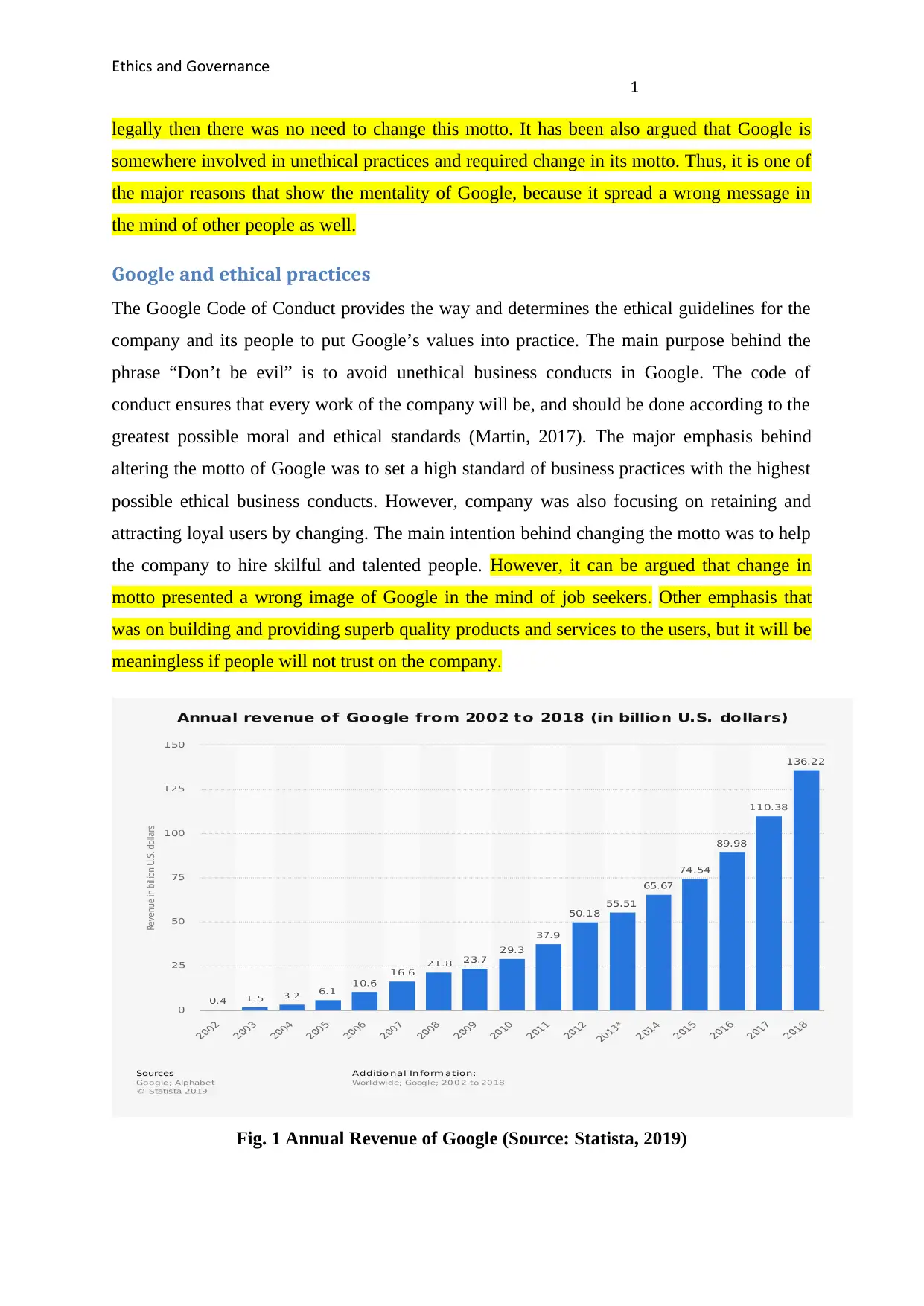
Fig. 1 Annual Revenue of Google (Source: Statista, 2019)
Ethics and Governance
2
It can be clearly seen in the Graph that the revenue of Google is increasing tremendously
from 2015 to 2018. It can be said from the above graph that changing the motto could not
affect the revenue of the company rather it helps the company to increase its revenue. The
growth of the company is still 21% per annum. It means we can say that changing the motto
affect the perception of people but not affect the revenue growth of the company.
Google mines and packet the personal search information and convert it in a data profile for
advertisers to follow the Google users on the internet and show them annoying advertisement.
However, the one thing is considerable that removing the motto of Google has not stopped to
guide the organisational culture, because if people in the organisation already believe in the
ethical work practices, they will not lack in their ethical standards.
Relation between Google and controversies related to breaching the User's
privacy issues
In an interview to ‘Playboy,’ Larry Page, who is a co-founder of Google, stated that the motto
of Google "Don't be evil" forces people for doing good things in the organisation and always
do the right thing. Eventually, the motto of the company is the easiest way to express the
thinking of company by a small tagline "Don't be evil.” I think we can say that motto of the
company attracts and aware users that Google does not believe in any unethical way of doing
business or doing something that people personally do not like (Lee, 2016).
Ethical mottos and statements of Google are the matter of public discourse and there are
numbers of IT companies shows the motto to display their ethical thinking and practices with
the people. Especially, Google and Alphabet are two big companies that are known for it. The
motto of Google functions in the moral space and urge people to work within the ethical
boundaries and contextual moral judgement. In contrary to this, it can be said that there are
many ethical issues that Google is facing from last few years. It leads to the gradual
increment in the cases related to ethical complications and thus these cases are subject to
political scrutiny and social importance rather than ethnicity and moral space of the company
(Carbone, 2018).
However, many people ask a question, whether Google will always do the right things as its
motto- the answer is, it has not and it will not. Actually, it can be argued that Google have
thirst for the personal information and company utilise this information for the ads and other
things. When the Internet users are searching for a query on the search engine like Google,
2
It can be clearly seen in the Graph that the revenue of Google is increasing tremendously
from 2015 to 2018. It can be said from the above graph that changing the motto could not
affect the revenue of the company rather it helps the company to increase its revenue. The
growth of the company is still 21% per annum. It means we can say that changing the motto
affect the perception of people but not affect the revenue growth of the company.
Google mines and packet the personal search information and convert it in a data profile for
advertisers to follow the Google users on the internet and show them annoying advertisement.
However, the one thing is considerable that removing the motto of Google has not stopped to
guide the organisational culture, because if people in the organisation already believe in the
ethical work practices, they will not lack in their ethical standards.
Relation between Google and controversies related to breaching the User's
privacy issues
In an interview to ‘Playboy,’ Larry Page, who is a co-founder of Google, stated that the motto
of Google "Don't be evil" forces people for doing good things in the organisation and always
do the right thing. Eventually, the motto of the company is the easiest way to express the
thinking of company by a small tagline "Don't be evil.” I think we can say that motto of the
company attracts and aware users that Google does not believe in any unethical way of doing
business or doing something that people personally do not like (Lee, 2016).
Ethical mottos and statements of Google are the matter of public discourse and there are
numbers of IT companies shows the motto to display their ethical thinking and practices with
the people. Especially, Google and Alphabet are two big companies that are known for it. The
motto of Google functions in the moral space and urge people to work within the ethical
boundaries and contextual moral judgement. In contrary to this, it can be said that there are
many ethical issues that Google is facing from last few years. It leads to the gradual
increment in the cases related to ethical complications and thus these cases are subject to
political scrutiny and social importance rather than ethnicity and moral space of the company
(Carbone, 2018).
However, many people ask a question, whether Google will always do the right things as its
motto- the answer is, it has not and it will not. Actually, it can be argued that Google have
thirst for the personal information and company utilise this information for the ads and other
things. When the Internet users are searching for a query on the search engine like Google,
⊘ This is a preview!⊘
Do you want full access?
Subscribe today to unlock all pages.

Trusted by 1+ million students worldwide
Ethics and Governance
3
people does not care about their personal and secret information that should be secret (Basu,
2015). It resulted in the greatest threat to privacy concern ever known. It is all known that
99% of Google’s revenue comes from the selling of information to the advertisement
companies and from selling ads to its users that target the user interests. Thus, it can be said
that changing the motto is definitely a risky approach because people had already some bad
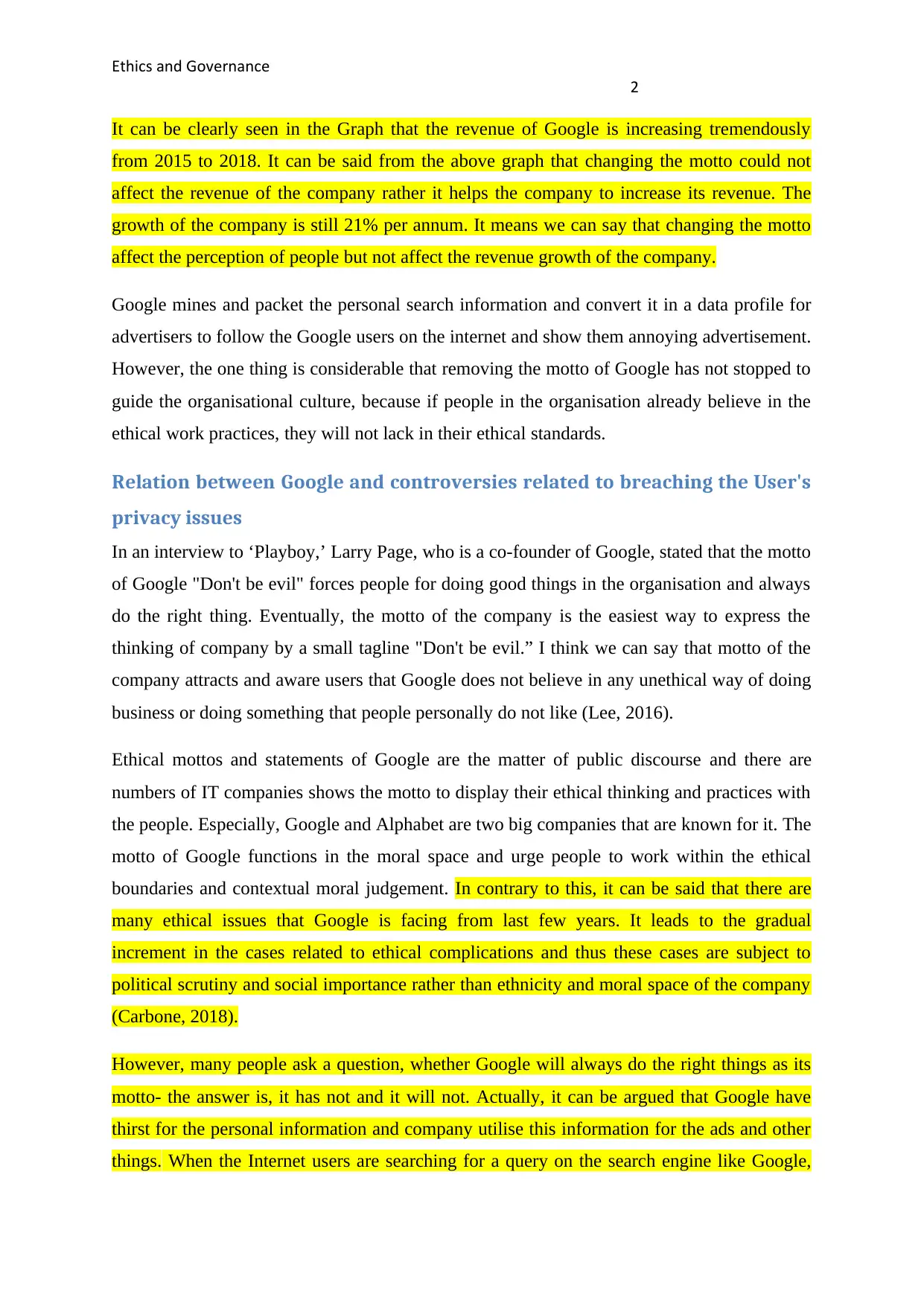
perception about the company. It can be seen in the Fig. 3 that most of the revenue part of
Google is connected with Google ads that they displayed on the site. This income is generally
collected by spying the personal information of Google users and Google used these personal
data to sell other companies for the advertisers. It can be seen in the Fig. 3 that most of the
revenue part of Google is connected with Google ads that they displayed on the site. This
income is generally collected by spying the personal information of Google users and Google
used these personal data to sell other companies for the advertisers.
Fig. 3 (Source: CBS News, 2012)
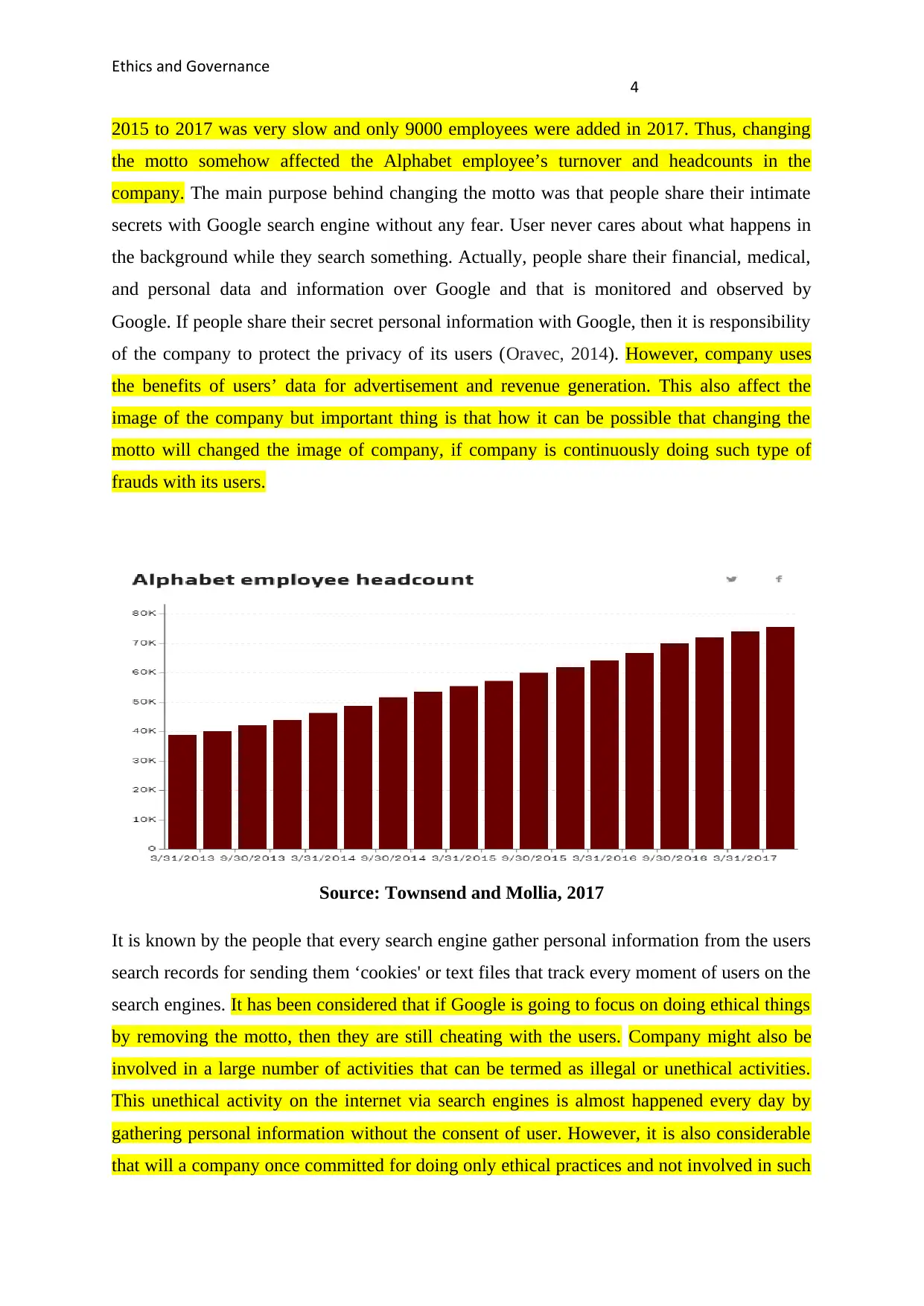
The employee’s turnover was also affected because of this change. It can be clearly said that
the employment was affected in Alphabet as well. The increase in employee headcount from
3
people does not care about their personal and secret information that should be secret (Basu,
2015). It resulted in the greatest threat to privacy concern ever known. It is all known that
99% of Google’s revenue comes from the selling of information to the advertisement
companies and from selling ads to its users that target the user interests. Thus, it can be said
that changing the motto is definitely a risky approach because people had already some bad
perception about the company. It can be seen in the Fig. 3 that most of the revenue part of
Google is connected with Google ads that they displayed on the site. This income is generally
collected by spying the personal information of Google users and Google used these personal
data to sell other companies for the advertisers. It can be seen in the Fig. 3 that most of the
revenue part of Google is connected with Google ads that they displayed on the site. This
income is generally collected by spying the personal information of Google users and Google
used these personal data to sell other companies for the advertisers.
Fig. 3 (Source: CBS News, 2012)
The employee’s turnover was also affected because of this change. It can be clearly said that
the employment was affected in Alphabet as well. The increase in employee headcount from
Paraphrase This Document
Need a fresh take? Get an instant paraphrase of this document with our AI Paraphraser
Ethics and Governance
4
2015 to 2017 was very slow and only 9000 employees were added in 2017. Thus, changing
the motto somehow affected the Alphabet employee’s turnover and headcounts in the
company. The main purpose behind changing the motto was that people share their intimate
secrets with Google search engine without any fear. User never cares about what happens in
the background while they search something. Actually, people share their financial, medical,
and personal data and information over Google and that is monitored and observed by
Google. If people share their secret personal information with Google, then it is responsibility
of the company to protect the privacy of its users (Oravec, 2014). However, company uses
the benefits of users’ data for advertisement and revenue generation. This also affect the
image of the company but important thing is that how it can be possible that changing the
motto will changed the image of company, if company is continuously doing such type of
frauds with its users.
Source: Townsend and Mollia, 2017
It is known by the people that every search engine gather personal information from the users
search records for sending them ‘cookies' or text files that track every moment of users on the
search engines. It has been considered that if Google is going to focus on doing ethical things
by removing the motto, then they are still cheating with the users. Company might also be
involved in a large number of activities that can be termed as illegal or unethical activities.
This unethical activity on the internet via search engines is almost happened every day by
gathering personal information without the consent of user. However, it is also considerable
that will a company once committed for doing only ethical practices and not involved in such
4
2015 to 2017 was very slow and only 9000 employees were added in 2017. Thus, changing
the motto somehow affected the Alphabet employee’s turnover and headcounts in the
company. The main purpose behind changing the motto was that people share their intimate
secrets with Google search engine without any fear. User never cares about what happens in
the background while they search something. Actually, people share their financial, medical,
and personal data and information over Google and that is monitored and observed by
Google. If people share their secret personal information with Google, then it is responsibility
of the company to protect the privacy of its users (Oravec, 2014). However, company uses
the benefits of users’ data for advertisement and revenue generation. This also affect the
image of the company but important thing is that how it can be possible that changing the
motto will changed the image of company, if company is continuously doing such type of
frauds with its users.
Source: Townsend and Mollia, 2017
It is known by the people that every search engine gather personal information from the users
search records for sending them ‘cookies' or text files that track every moment of users on the
search engines. It has been considered that if Google is going to focus on doing ethical things
by removing the motto, then they are still cheating with the users. Company might also be
involved in a large number of activities that can be termed as illegal or unethical activities.
This unethical activity on the internet via search engines is almost happened every day by
gathering personal information without the consent of user. However, it is also considerable
that will a company once committed for doing only ethical practices and not involved in such
Ethics and Governance
5
practices which are against the law, then why company needs to change its motto if
everything was going all right.
Relationship between Google motto and their work culture that how it
inspire Google to do ethical thing in the organisation
Google claims the intention of their motto is to prevent any unethical operation or practice in
the organisation. Further, they aim to implement internationally recognized standards for
protecting the privacy right of users that is globally acceptable (Oravec, 2018). However,
there were several unethical activities that happen in last few years that negatively affect the
image of Google. It can be said, Google's ‘code of conducts' includes that company care
about the user's privacy, security, and freedom of expression. However, people do not trust
upon the company because their personal information is not secure and protected by Google.
However, the same thing claimed by a social networking site ‘Facebook' (Bogenschneider
and Heilmeier, 2016). ‘Facebook’ Company was failed to protect the personal information of
its own users because of the ‘Cambridge Analytica’. This company stole the personal
information of Facebook users in last year. Thus, protecting the privacy of users is a great
challenge for the company. Although, Google inspires its employees about ethical practices
in the organisation and performs every activity under the law.
However, the motto of Google was displaying the things that company never indulged in any
unethical practices. However, the company also urge people to raise their voice if they found
anything unethical in the company and contact the ‘Legal or Ethics & Compliance
Department’ of Google. People can ask or file complains in this department about their
problems and what are the alternative solutions available for solution (Grogan and Brett,
2017). It can be argued that motto shows the intention of the company and company says that
they will not involve in any unethical activities, and suddenly if company remove the tagline,
it means somewhere the company shows its negative intentions. Thus, it can be said that
changing the motto is really a risky approach of Google because it negative changed the
mentality of people.
The monopoly of Google in the Europe and Asia
According to a Google representative, who told the Wall Street Journal that Alphabet
Company has its own code of conducts, which ensures that company continue promotes the
great values and compliances. Google always believe and apply those practices, which serves
the best to Google users. However ‘Don’t be evil” was more than that which inspires
5
practices which are against the law, then why company needs to change its motto if
everything was going all right.
Relationship between Google motto and their work culture that how it
inspire Google to do ethical thing in the organisation
Google claims the intention of their motto is to prevent any unethical operation or practice in
the organisation. Further, they aim to implement internationally recognized standards for
protecting the privacy right of users that is globally acceptable (Oravec, 2018). However,
there were several unethical activities that happen in last few years that negatively affect the
image of Google. It can be said, Google's ‘code of conducts' includes that company care
about the user's privacy, security, and freedom of expression. However, people do not trust
upon the company because their personal information is not secure and protected by Google.
However, the same thing claimed by a social networking site ‘Facebook' (Bogenschneider
and Heilmeier, 2016). ‘Facebook’ Company was failed to protect the personal information of
its own users because of the ‘Cambridge Analytica’. This company stole the personal
information of Facebook users in last year. Thus, protecting the privacy of users is a great
challenge for the company. Although, Google inspires its employees about ethical practices
in the organisation and performs every activity under the law.
However, the motto of Google was displaying the things that company never indulged in any
unethical practices. However, the company also urge people to raise their voice if they found
anything unethical in the company and contact the ‘Legal or Ethics & Compliance
Department’ of Google. People can ask or file complains in this department about their
problems and what are the alternative solutions available for solution (Grogan and Brett,
2017). It can be argued that motto shows the intention of the company and company says that
they will not involve in any unethical activities, and suddenly if company remove the tagline,
it means somewhere the company shows its negative intentions. Thus, it can be said that
changing the motto is really a risky approach of Google because it negative changed the
mentality of people.
The monopoly of Google in the Europe and Asia
According to a Google representative, who told the Wall Street Journal that Alphabet
Company has its own code of conducts, which ensures that company continue promotes the
great values and compliances. Google always believe and apply those practices, which serves
the best to Google users. However ‘Don’t be evil” was more than that which inspires
⊘ This is a preview!⊘
Do you want full access?
Subscribe today to unlock all pages.
Trusted by 1+ million students worldwide
Ethics and Governance
6
Google’s people towards the ethical practices in the organisation. According to a statement
given by David A. Vise in the article “The Google Story” in 2008, company presents itself as
a famous enterprise that believes in ethical practices with the motto of ‘Don’t be evil’
(Conger, 2018).
When Google has become the part of Alphabet its main focus was shifted from search to
innovative activities such as Google X labs. It further leads to a change in people thinking
that Google’s main motto has been changed and moved a bit further into the fine print
(Jennifer Stob, 2014). Some people thinks that Google's ideology and the ‘three-word’
clarion call out-dated, especially when Google was involved in some controversies in last few
years (Freedman, 2014). However, Richard Waters said in an interview of Financial Times
that Google is a powerful and wealthy organisation that stimulated bitterness and brought a
repercussion, especially in Europe and Asia. Thus, the company is under investigation that
how it practices as a monopoly power in the internet search. It was blamed by many
administrative agencies that Google alleged with monopolistic market operations in the
‘search engine' on the Internet and doing some controversial privacy practices in China and
some European countries (Cuthbertson, 2018). From the above analysis, it can be argued that
these statements show how Google claims that they believe in ethical practices when they are
aligned with the number of controversial issues related to user privacy and security. From
removing the motto and showing that we are ethical, they cannot prove themselves as an
ethical organisation until they do so. Therefore, some people do not believe that by changing
the motto of the organisation, Google is not doing any unethical practices in the future.
Conclusion
In conclusion, it can be said that Google applies its motto for providing unbiased access of
information to its users under the law. Google also ensures that there should be ethical
practices within and outside of the organisation. Changing in motto shows the ethical view
and Google’s intentions for doing the right thing in the organisation, but it backfires. Google
was involved in some misconducts and controversies when it was blamed for misuse of
personal data. Google was also aligned with breaching the law related to the right of privacy
of the users and sell the personal information to advertisement companies. After these
incidents, removing the old motto of Google "Don't be evil" somehow affected the perception
of people that why Google/Alphabet did these things, if everything was going all right in the
business. However, the real thing is that it affected the reputation of company and it was
6
Google’s people towards the ethical practices in the organisation. According to a statement
given by David A. Vise in the article “The Google Story” in 2008, company presents itself as
a famous enterprise that believes in ethical practices with the motto of ‘Don’t be evil’
(Conger, 2018).
When Google has become the part of Alphabet its main focus was shifted from search to
innovative activities such as Google X labs. It further leads to a change in people thinking
that Google’s main motto has been changed and moved a bit further into the fine print
(Jennifer Stob, 2014). Some people thinks that Google's ideology and the ‘three-word’
clarion call out-dated, especially when Google was involved in some controversies in last few
years (Freedman, 2014). However, Richard Waters said in an interview of Financial Times
that Google is a powerful and wealthy organisation that stimulated bitterness and brought a
repercussion, especially in Europe and Asia. Thus, the company is under investigation that
how it practices as a monopoly power in the internet search. It was blamed by many
administrative agencies that Google alleged with monopolistic market operations in the
‘search engine' on the Internet and doing some controversial privacy practices in China and
some European countries (Cuthbertson, 2018). From the above analysis, it can be argued that
these statements show how Google claims that they believe in ethical practices when they are
aligned with the number of controversial issues related to user privacy and security. From
removing the motto and showing that we are ethical, they cannot prove themselves as an
ethical organisation until they do so. Therefore, some people do not believe that by changing
the motto of the organisation, Google is not doing any unethical practices in the future.
Conclusion
In conclusion, it can be said that Google applies its motto for providing unbiased access of
information to its users under the law. Google also ensures that there should be ethical
practices within and outside of the organisation. Changing in motto shows the ethical view
and Google’s intentions for doing the right thing in the organisation, but it backfires. Google
was involved in some misconducts and controversies when it was blamed for misuse of
personal data. Google was also aligned with breaching the law related to the right of privacy
of the users and sell the personal information to advertisement companies. After these
incidents, removing the old motto of Google "Don't be evil" somehow affected the perception
of people that why Google/Alphabet did these things, if everything was going all right in the
business. However, the real thing is that it affected the reputation of company and it was
Paraphrase This Document
Need a fresh take? Get an instant paraphrase of this document with our AI Paraphraser
Ethics and Governance
7
definitely a risky approach to change the motto. Google still believes in "do the right things"
which is now the new motto in Google’s code of conducts, but changing the old motto was
definitely a risky approach for the company because it spread wrong message to the
individuals.
7
definitely a risky approach to change the motto. Google still believes in "do the right things"
which is now the new motto in Google’s code of conducts, but changing the old motto was
definitely a risky approach for the company because it spread wrong message to the
individuals.
Ethics and Governance
8
References
Archer, J. (2018) Google removes 'Don’t be evil' from its code of conduct [online]. Available
from: https://www.telegraph.co.uk/technology/2018/05/21/google-removes-dont-evil-code-
conduct/ [Accessed: 21/02/2019].
Basu, T. (2015) New Google Parent Company Drops 'Don't Be Evil' Motto [online].
Available from: http://time.com/4060575/alphabet-google-dont-be-evil/ [Accessed:
21/02/2019].
Bogenschneider, B.N. and Heilmeier, R. (2016) Google's Alphabet Soup in Delaware. Hous.
Bus. & Tax LJ, 16, p.1.
Carbone, C. (2018) Google revises the code of conduct, removes ‘Don't be evil' [online].
Available from: https://nypost.com/2018/05/22/google-revises-code-of-conduct-removes-
dont-be-evil/ [Accessed: 21/02/2019].
CBS News (2012) Why Google Can't Afford for Advertising Partners To Be Too Successful
[online]. Available from: https://www.cbsnews.com/news/why-google-cant-afford-for-
advertising-partners-to-be-too-successful/ [Accessed: 13/03/2019].
Conger, K. (2018) Google Removes 'Don't Be Evil' Clause from Its Code of Conduct
[online]. Available from: https://www.gizmodo.com.au/2018/05/google-removes-dont-be-
evil-clause-from-its-code-of-conduct/ [Accessed: 22/02/2019].
Cuthbertson, A. (2018) Google quietly removes ‘Don’t be evil’ preface from code of conduct
[online]. Available from:
https://www.independent.co.uk/life-style/gadgets-and-tech/news/google-dont-be-evil-code-
conduct-removed-alphabet-a8361276.html [Accessed: 22/02/201].
Freedman, G. (2014) Google™ versus Me™: Who Owns the Rights to My Digital
DNA?. Policy Futures in Education, 12(4), pp.482-490.
Grogan, C. and Brett, J. (2017) Google and the government of China: A case study in cross-
cultural negotiations. Kellogg School of Management Cases, 14(6), pp.1-15.
8
References
Archer, J. (2018) Google removes 'Don’t be evil' from its code of conduct [online]. Available
from: https://www.telegraph.co.uk/technology/2018/05/21/google-removes-dont-evil-code-
conduct/ [Accessed: 21/02/2019].
Basu, T. (2015) New Google Parent Company Drops 'Don't Be Evil' Motto [online].
Available from: http://time.com/4060575/alphabet-google-dont-be-evil/ [Accessed:
21/02/2019].
Bogenschneider, B.N. and Heilmeier, R. (2016) Google's Alphabet Soup in Delaware. Hous.
Bus. & Tax LJ, 16, p.1.
Carbone, C. (2018) Google revises the code of conduct, removes ‘Don't be evil' [online].
Available from: https://nypost.com/2018/05/22/google-revises-code-of-conduct-removes-
dont-be-evil/ [Accessed: 21/02/2019].
CBS News (2012) Why Google Can't Afford for Advertising Partners To Be Too Successful
[online]. Available from: https://www.cbsnews.com/news/why-google-cant-afford-for-
advertising-partners-to-be-too-successful/ [Accessed: 13/03/2019].
Conger, K. (2018) Google Removes 'Don't Be Evil' Clause from Its Code of Conduct
[online]. Available from: https://www.gizmodo.com.au/2018/05/google-removes-dont-be-
evil-clause-from-its-code-of-conduct/ [Accessed: 22/02/2019].
Cuthbertson, A. (2018) Google quietly removes ‘Don’t be evil’ preface from code of conduct
[online]. Available from:
https://www.independent.co.uk/life-style/gadgets-and-tech/news/google-dont-be-evil-code-
conduct-removed-alphabet-a8361276.html [Accessed: 22/02/201].
Freedman, G. (2014) Google™ versus Me™: Who Owns the Rights to My Digital
DNA?. Policy Futures in Education, 12(4), pp.482-490.
Grogan, C. and Brett, J. (2017) Google and the government of China: A case study in cross-
cultural negotiations. Kellogg School of Management Cases, 14(6), pp.1-15.
⊘ This is a preview!⊘
Do you want full access?
Subscribe today to unlock all pages.
Trusted by 1+ million students worldwide
Ethics and Governance
9
Jennifer Stob (2014) Evil is as Evil Does [online]. Available from:
https://www.tandfonline.com/doi/full/10.1080/13534645.2014.865326?
scroll=top&needAccess=true [Access date: 22/02/2019].
Lee, N. (2016) To Google or Not to Google. Google It, (pp. 3-52). New York, NY: Springer,
Martin, K. (2017) Google, Inc., in China. Darden Business Publishing Cases, 14(6), pp.1-19.
Oravec, J.A. (2014) Mottos and ethical statements of Internet-based organizations:
Implications for corporate social responsibility. International Journal of Civic Engagement
and Social Change, 1(2), pp. 37-53.
Oravec, J.A. (2018) “Don't Be Evil” and Beyond for High Tech Organizations: Ethical
Statements and Mottos (and Responsibility). Handbook of Research on Civic Engagement
and Social Change in Contemporary Society, 16(7), pp. 220-237.
Townsend, T. and Mollia, R. (2017) Google is still growing 21 percent — and its cloud
segment is growing even faster [online]. Available from:
https://www.recode.net/2017/7/24/16020840/alphabet-google-business-stock-earnings-
growth-cloud-revenue-profits-q2-2017 [Accessed: 13/03/2019].
Valinsky, J. (2015) Under Alphabet, Google ditches ‘don’t be evil’ motto for ‘do the right
thing’ [online]. Available from: https://digiday.com/marketing/alphabet-google-ditches-dont-
evil-motto-right-thing/ [Accessed: 22/02/2019].
9
Jennifer Stob (2014) Evil is as Evil Does [online]. Available from:
https://www.tandfonline.com/doi/full/10.1080/13534645.2014.865326?
scroll=top&needAccess=true [Access date: 22/02/2019].
Lee, N. (2016) To Google or Not to Google. Google It, (pp. 3-52). New York, NY: Springer,
Martin, K. (2017) Google, Inc., in China. Darden Business Publishing Cases, 14(6), pp.1-19.
Oravec, J.A. (2014) Mottos and ethical statements of Internet-based organizations:
Implications for corporate social responsibility. International Journal of Civic Engagement
and Social Change, 1(2), pp. 37-53.
Oravec, J.A. (2018) “Don't Be Evil” and Beyond for High Tech Organizations: Ethical
Statements and Mottos (and Responsibility). Handbook of Research on Civic Engagement
and Social Change in Contemporary Society, 16(7), pp. 220-237.
Townsend, T. and Mollia, R. (2017) Google is still growing 21 percent — and its cloud
segment is growing even faster [online]. Available from:
https://www.recode.net/2017/7/24/16020840/alphabet-google-business-stock-earnings-
growth-cloud-revenue-profits-q2-2017 [Accessed: 13/03/2019].
Valinsky, J. (2015) Under Alphabet, Google ditches ‘don’t be evil’ motto for ‘do the right
thing’ [online]. Available from: https://digiday.com/marketing/alphabet-google-ditches-dont-
evil-motto-right-thing/ [Accessed: 22/02/2019].

1 out of 10


Related Documents


Your All-in-One AI-Powered Toolkit for Academic Success.
+13062052269
info@desklib.com
Available 24*7 on WhatsApp / Email
![[object Object]](/_next/static/media/star-bottom.7253800d.svg)
Unlock your academic potential
Copyright © 2020–2026 A2Z Services. All Rights Reserved. Developed and managed by ZUCOL.