Accountability: Traditional vs. Contemporary Approaches to Governance

Verified

Added on  2021/09/18

|25
|1814
|78
Essay
AI Summary
This essay by Ferdous Arfina Osman, Ph.D, explores the multifaceted concept of accountability in governance. It defines accountability as answerability for assigned tasks and duties, highlighting its importance in preventing corruption and ensuring effective public resource allocation. The essay discusses various forms of accountability, including horizontal, vertical, financial, political/democratic, and performance accountability. It examines the shift from traditional top-down approaches to network governance, analyzing the complexities and challenges that arise in this context. Furthermore, it delves into democratic, market, and administrative accountability within governance networks, alongside traditional and recent approaches. The analysis covers the evolution of accountability, its shift from inputs and processes to outputs and results, and the challenges posed by new directions, such as performance measurement and outsourcing. The essay underscores the need for a balanced approach that prioritizes both efficiency and democratic principles, ultimately emphasizing that the public should have the final judgment on public accountability.
Document Page
Ferdous Arfina Osman Ph.D
University of Dhaka
tabler-icon-diamond-filled.svg

Paraphrase This Document

Need a fresh take? Get an instant paraphrase of this document with our AI Paraphraser
Document Page
In general, accountability means someone's
answerability to someone else for carrying out assigned
tasks or activities
Accountability means having obligation to answer
questions regarding decisions or actions.
In general, accountability involves the power of one
actor to make demands upon another to provide
information about, or justification for his/her actions
Document Page
Public accountability implies the answerability of public officials
(both elected and appointed) to the public for accomplishing their
assigned tasks or duties and for their behavior and action.
Absence of accountability may result into the rise of corruption
through –
misallocation of public resources;
failure of public resources to attain desired outcomes;
weak performance by service providers ;
lack of awareness in part of the service beneficiaries to
"…avail themselves of services"
(WB, 2004).
Document Page
Broadly, based on the reporting relationship,
accountability takes two forms:
Horizontal Accountability: Routine answerability
taking place within agencies through reporting
relationships and through interactions
Vertical accountability(between government and
citizens/ hierarchical accountability within the
organization): answerability relates directly to
transparency
tabler-icon-diamond-filled.svg

Paraphrase This Document

Need a fresh take? Get an instant paraphrase of this document with our AI Paraphraser
Document Page
Based on the nature of answerability,accountability
takes the following forms:
i) Financial Accountability: Examination of
compliance of officials and agencies with laws,
regulations, and procedures for the transparent
allocation, expenditure, and reporting of financial
resources
Ii) Political/democratic accountability:
responsiveness to citizens and the fulfillment of
public trust
Iii) Performance accountability: accounting for
performance in the light of agreed-upon
performance targets. Its focus is on the services,
outputs and results of public agencies and
programs.
Document Page
Current complex society needs a shift from a traditional top-
down way of problem solving to a more horizontal cooperative
approach, called network
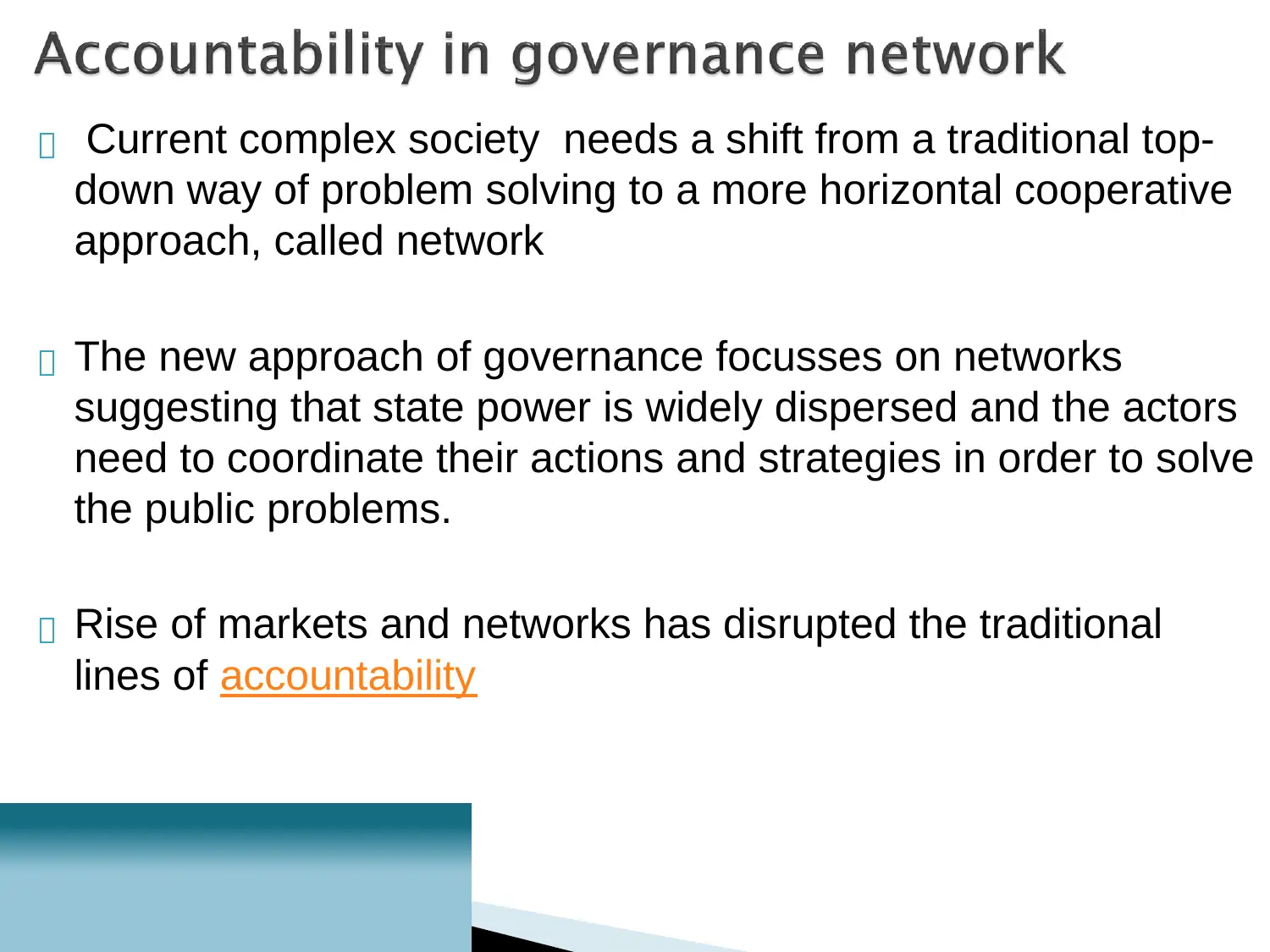
The new approach of governance focusses on networks
suggesting that state power is widely dispersed and the actors
need to coordinate their actions and strategies in order to solve
the public problems.
Rise of markets and networks has disrupted the traditional
lines of accountability
Document Page
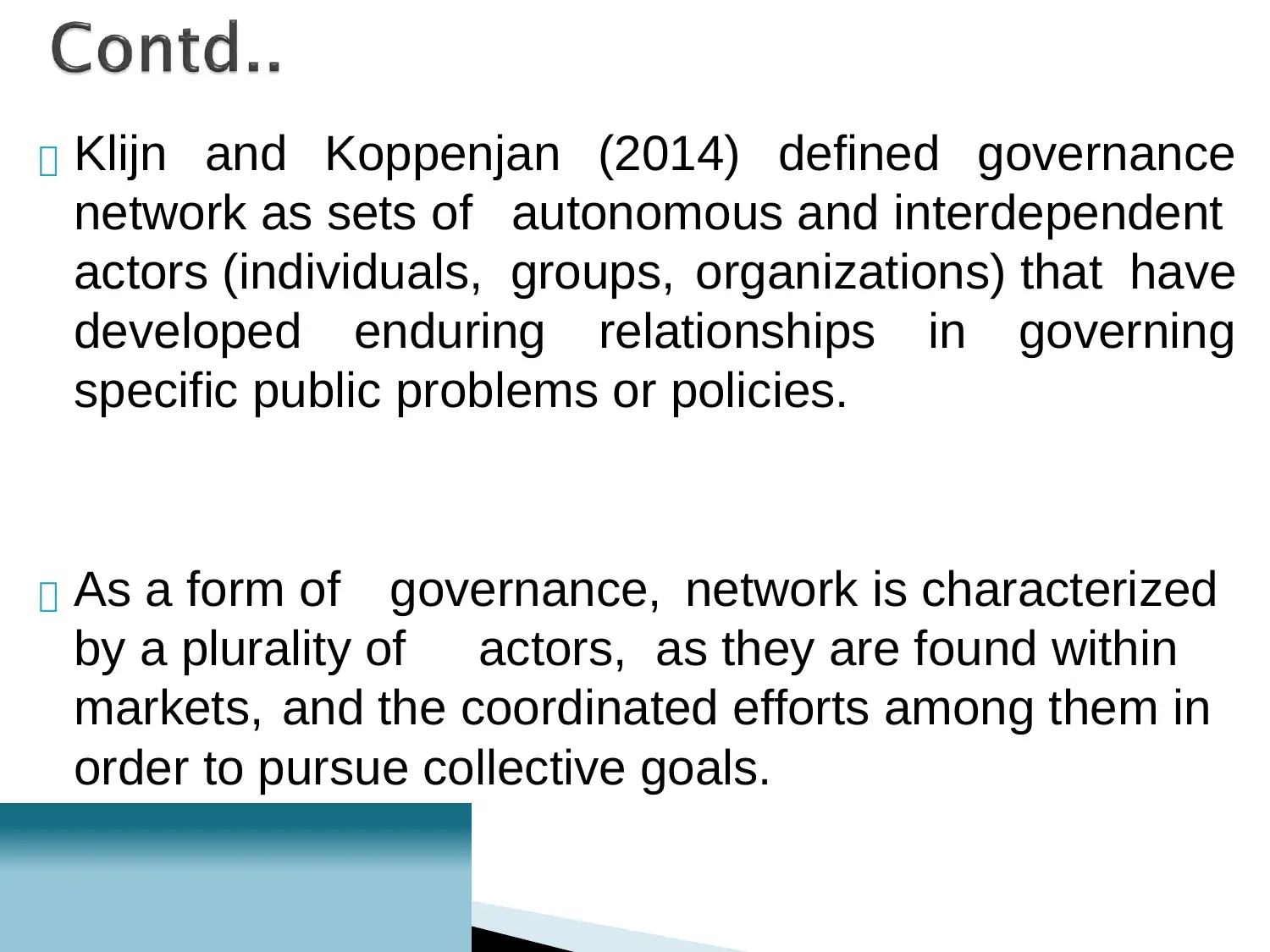
Klijn and Koppenjan (2014) defined governance
network as sets of autonomous and interdependent
actors (individuals, groups, organizations) that have
developed enduring relationships in governing
specific public problems or policies.
As a form of governance, network is characterized
by a plurality of actors, as they are found within
markets, and the coordinated efforts among them in
order to pursue collective goals.
tabler-icon-diamond-filled.svg

Paraphrase This Document

Need a fresh take? Get an instant paraphrase of this document with our AI Paraphraser
Document Page
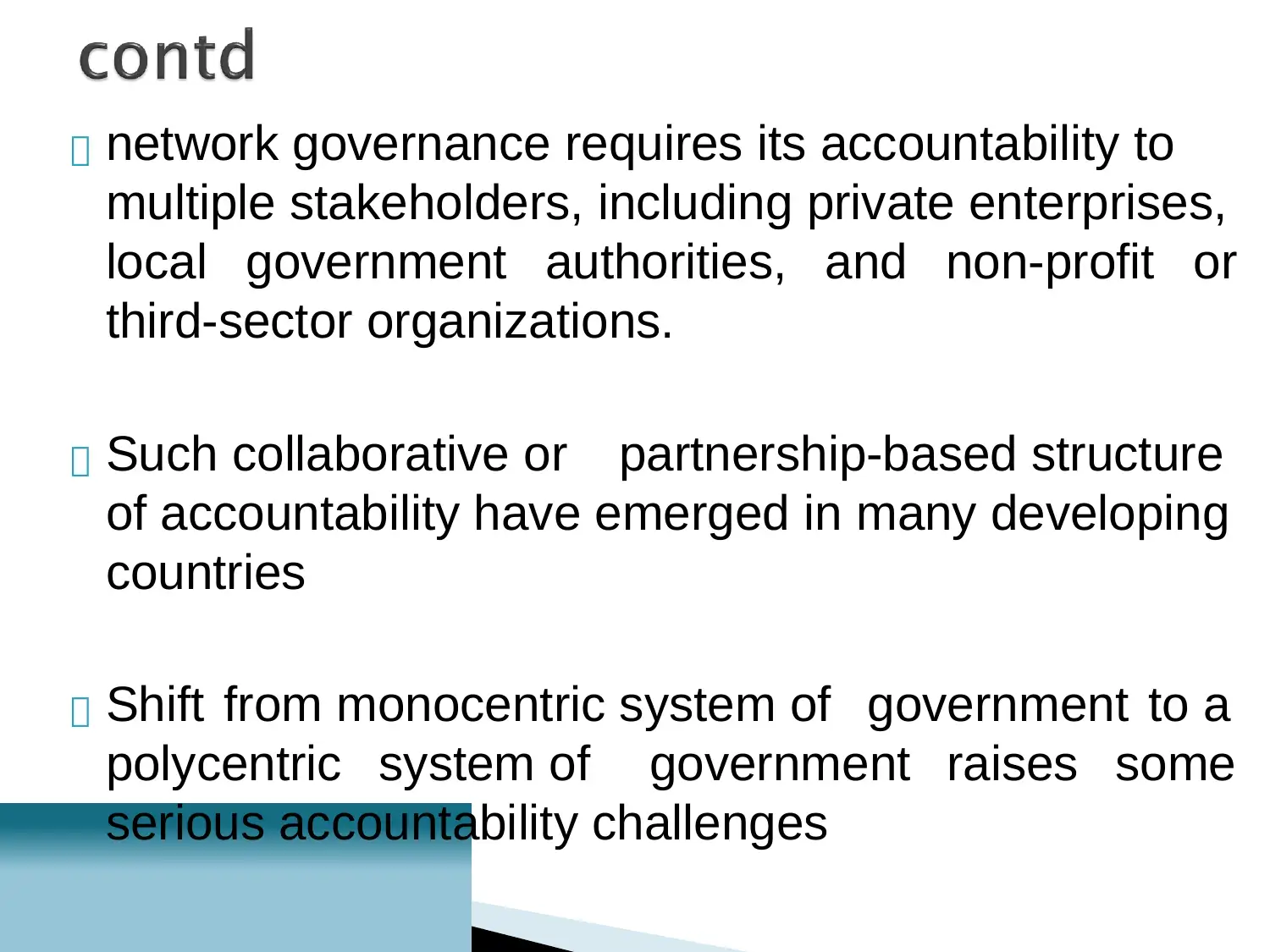
network governance requires its accountability to
multiple stakeholders, including private enterprises,
local government authorities, and non-profit or
third-sector organizations.
Such collaborative or partnership-based structure
of accountability have emerged in many developing
countries
Shift from monocentric system of government to a
polycentric system of government raises some
serious accountability challenges
Document Page
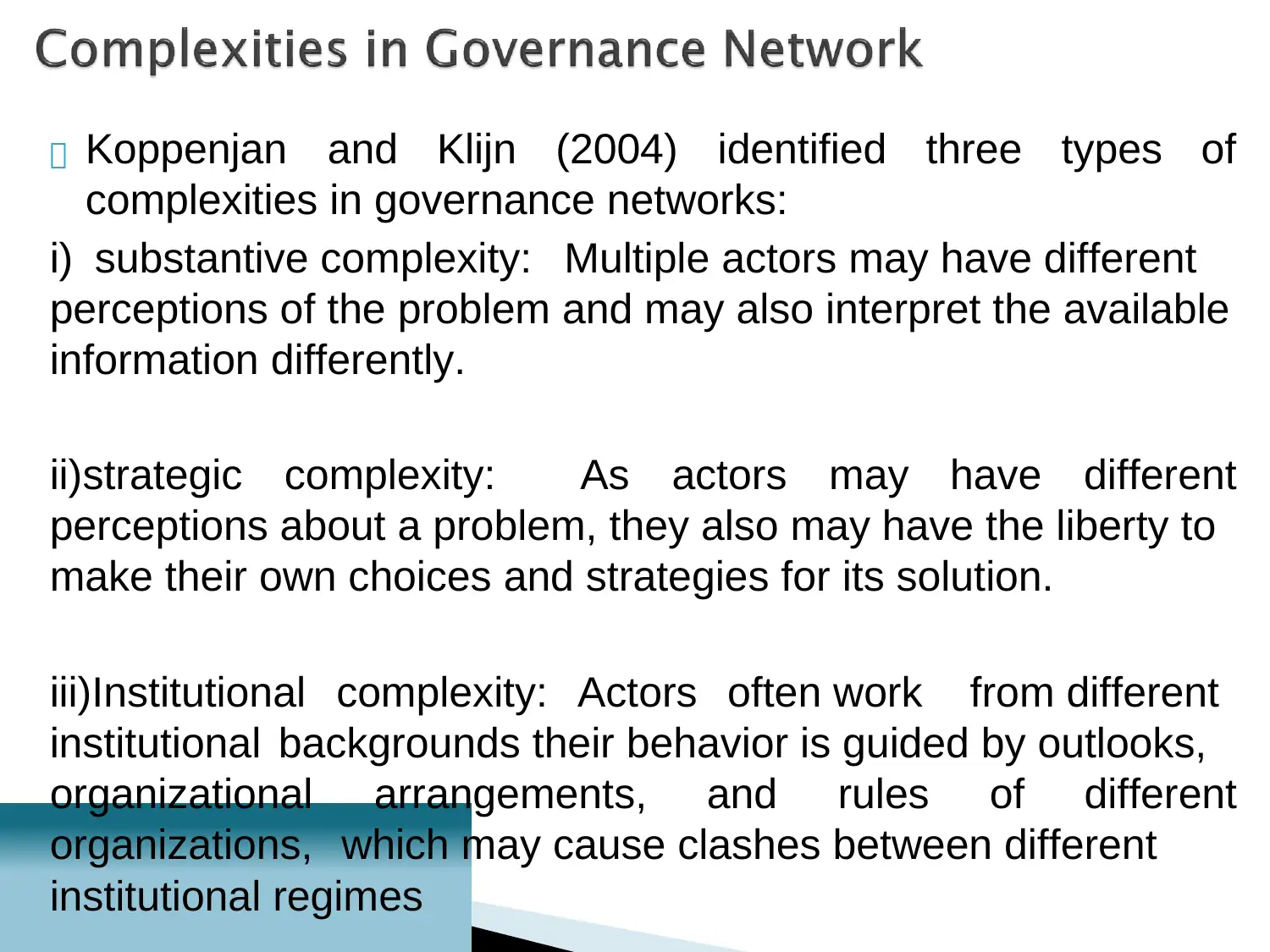
Koppenjan and Klijn (2004) identified three types of
complexities in governance networks:
i) substantive complexity: Multiple actors may have different
perceptions of the problem and may also interpret the available
information differently.
ii)strategic complexity: As actors may have different
perceptions about a problem, they also may have the liberty to
make their own choices and strategies for its solution.
iii)Institutional complexity: Actors often work from different
institutional backgrounds their behavior is guided by outlooks,
organizational arrangements, and rules of different
organizations, which may cause clashes between different
institutional regimes
Document Page
Accountability takes three forms within
governance networks
i) democratic
ii) market
iii)administrative
tabler-icon-diamond-filled.svg

Paraphrase This Document

Need a fresh take? Get an instant paraphrase of this document with our AI Paraphraser
Document Page
In democratic systems political accountability may be
framed as democratic accountability through which
both citizens and the representatives they elect serve
as the actors to whom accountability must be
rendered
Laws, regulations, citizen rights are the standards to
hold public bureaucracies accountable.
In fact, accountability is considered as a basic "human
right".
Accordingly, accountability allows the citizens to claim
their rights and at the same time, accountability
mechanisms can play an effective role to prevent
corruption which will allow the state to move towards
development (WB, 2011).
Document Page
Market accountability has two components:
i) shareholder accountability:in privately owned
business, owners have to maximize profit,
accountability calls for the alignment of
performance measures with profitability
Ii) consumer accountability:market competition is
the central mode. Ability of consumers to choose
between alternatives, competing goods and
services
In a competitive market, the main mechanism of
responsiveness is customer choice, the capacity of
consumer to exit to the alternative providers
chevron_up_icon
1 out of 25
circle_padding
hide_on_mobile
zoom_out_icon
[object Object]