Government Policies and the Port of Tauranga: An Economic Analysis

Verified

Added on  2022/11/29

|23
|5456
|378
Report
AI Summary
This report delves into the effects of government policies on the Port of Tauranga and the broader New Zealand economy. It examines three key government initiatives: Auckland's 10-year transport project, the Tolaga Bay innovation program, and venture capital funding. The report analyzes these policies through macroeconomic theories, including the AD-AS model, IS curve, and Phillips curve, to assess their impacts on GDP, employment, and inflation. It also discusses the Port's contribution to New Zealand's GDP and relevant economic indicators. The analysis covers fiscal and monetary policies, focusing on how government spending and investment influence economic growth, productivity, and consumer welfare. The report concludes with an overview of the policies and the Port's role in the national economy, highlighting the relationship between government actions and economic outcomes. The report includes an introduction, policy discussion, theoretical aspects, economic impact analysis, GDP contribution, and an examination of international economic changes affecting the port. The report provides a comprehensive understanding of how government policies influence the Port of Tauranga and the overall economic landscape of New Zealand.
Document Page
Running head: GOVERNMENT POLICIES AND PORT OF TAURANGA
Government Policies and Port of Tauranga
Name of the Student:
Name of the University:
Author Note:
tabler-icon-diamond-filled.svg

Paraphrase This Document

Need a fresh take? Get an instant paraphrase of this document with our AI Paraphraser
Document Page
1
GOVERNMENT POLICIES AND PORT OF TAURANGA
Table of Contents
Introduction................................................................................................................................2
Discussion of the policies...........................................................................................................3
1. Auckland’s 10-year transport project and policies..........................................................4
2. Tolaga Bay Innovation....................................................................................................4
3. Venture capital funding...................................................................................................5
Theoretical aspects of the policies.............................................................................................6
Impacts of the polices on the economy....................................................................................12
Contribution of the Port to the GDP of New Zealand..............................................................13
Theoretical concepts.................................................................................................................14
Economic indicators analysing the implication of macro economy........................................15
Impact of international economic changes on Port..................................................................16
Conclusion................................................................................................................................17
Reference..................................................................................................................................19
Document Page
2
GOVERNMENT POLICIES AND PORT OF TAURANGA
Introduction
The government of a country introduces polices for the betterment of economic,
socio-economic and demographic changes by changing the economic factors like changing
government expenditure and implementing new tax policies. There are some government
plans and programs to develop the transport system which has greater economic implications.
The transport sector has a significant contribution to the economy and has a balanced regional
development. It has a great impact on the national integration in the international economic
market. In coastal areas, ports compose a significant economic activity. The most important
feature of ports is that it functions as an important entry point of international trade. Thus,
they act as an accelerator of economic development in the globalized economy. The advance
logistic technology and changes of economic structure shows the decreasing trend in the local
benefits. The sea transportation is cheaper and effective transport system compared to the
land or airways transportation. Large industries have the huge demand for the safe and cheap
transportation to export final goods and import raw materials (Foy et al., 2018). Therefore,
most of the industries are found in the coastal belts. These industries has a great impact on the
lives of the employees.
The study also discusses about New Zealand’s current economic policies where three
government initiatives has been selected for research of impact of the policies, plans and
programes on macro economy of New Zealand. The theoretical connection with the policies
or the explanation of the policies are presented with the help of macroeconomic theories.
An introduction is provided on these in the first section, the second section is
discussion with sub section that describes the policies, third section provides the theoretical
aspects of the implemented policies, fourth section analyses the impacts of the policies on the
economy of New Zealand with the help of the macro economic theories. In the next section
Document Page
3
GOVERNMENT POLICIES AND PORT OF TAURANGA
the contribution of the port to the GDP of New Zealand is discussed. The sixth section
describes the economic indicators that explains the implication of macro economy. Seventh
section describes the changes in the port due to changes in international economy. The last
section concludes the report with the three policies and contribution of the port in the
economy of New Zealand.
Discussion of the policies
New Zealand has focused on the wellbeing in the recent time and the Wellbeing
Budget was significantly attracts the government policies which is seen in the 2019
government budget. These wellbeing budget is used in investing in the rail, cleaning up the
waterways, meeting the climate change challenge, transitioning to a low-carbon future and
tackling the waste problem. The government also want to avail the opportunities that are
arising from the digital age. To make it sure, it is increasing the availability of the technology
and programs for people to obtain the required skills to operate it. The government is also
fostering innovation and encouraging the small start-ups to expand. Three policies are
discussed below that are recently implemented by the New Zealand government.
1. Auckland’s 10-year transport project and policies
In Auckland’s 10-year the projects and policies, investment in rail is the important focus
in the last budget and current budget. Rail is significantly contributing to the benefits for New
Zealanders’ wellbeing. This opens the opportunities of economic growth, reduces the
greenhouse gas emissions, reduces the traffic congestion and prevents the injuries and
accidents on the roads (Auckland Council, 2019).
A boosting fund amount that is equal to $1 billion is provided to support the
redevelopment of Kiwi Rail which includes $375 million for the manufacturing of new
wagons and locomotives, $331 million to reinvest in track and associated infrastructure and
tabler-icon-diamond-filled.svg

Paraphrase This Document

Need a fresh take? Get an instant paraphrase of this document with our AI Paraphraser
Document Page
4
GOVERNMENT POLICIES AND PORT OF TAURANGA
$35 million for the replacement of the ferries (The Beehive, 2019). The City Rail Link will
be capable of providing equivalent of 16 lanes of traffic in the peak times into the city. The
rail link is one of the most important investment in transport infrastructure in Auckland.
2. Tolaga Bay Innovation
Tolaga bay innovation was launched by the Minister of Employment, one of the best
policies of New Zealand which was responsible for taking the initiative to revive the
economic situation in Tolaga Bay area. The revival of the area is planned through
encouraging and promoting the success of grass roots business. The Tolaga Bay Charitable
Trust launched four new business in the end of April and expecting to launch four more
business in the future. The target is to build total 10 identified businesses in near future. This
will have a positive contribution towards the employment in the Tolaga Bay region. It is
expected that the employment will rise in that specific region. Additionally, the development
of Tolaga Bay as tourist destination was launched in April (Nel, & Stevenson, 2019).
The government’s approach towards supporting employment is visible by a drop of 4.2%
in the unemployment rate. The unemployment rate fell from 4.3% in the end of 2018 to 4.2%
in the end of financial year 2018-19. The wage has been grew 3.4% in the financial year
2018-19. Employment Minister Willie Jackson said that the government is successfully
maintaining the strong economy by the policies that supports labour and business (The
Beehive, 2019). The unemployment rate for Maori continued to track in the right direction
falling from 9.6% to 8.6% that means 5100 people are in paid employment in Maori. The
number of employed people rose 38200 from a year ago.
Document Page
5
GOVERNMENT POLICIES AND PORT OF TAURANGA
3. Venture capital funding
There exist a gap in domestic capital markets that may slow down the growth of the firms
of New Zealand. Foreign venture capital is not filling these gap. So, the government decided
to make it stronger and deeper (Barkoczy, & Wilkinson, 2019).
The fund will be set up to fill the capital gap which is not filled by the foreign ventures
for New Zealand. The amount of the fund is fixed at $300 million. The forecasted
contribution will be continued with the additional amount of fund equal to $9.6 billion to the
Superfund for the next five years (The Beehive, 2019). The firms of New Zealand will be
expanded and thus the early phase of start-ups will also be expanded. All the funds will be
returned after 15 years, to the crown of fund superannuation.
Theoretical aspects of the policies
There are two types of policies which are fiscal policy and monetary policy. Fiscal
policy is mainly directed by the government and the monetary policy is directed by the
central bank.
Auckland’s 10-year transport project and policies
In the above section, investment in rail is a fiscal policy that means government has spent
on rail to improve the economic condition as it contributes a huge amount to the GDP. These
raises the consumer wealth which expands the GDP of that country and shifts the aggregate
supply curve to the right. These reduces the equilibrium price level. Thus the investment in
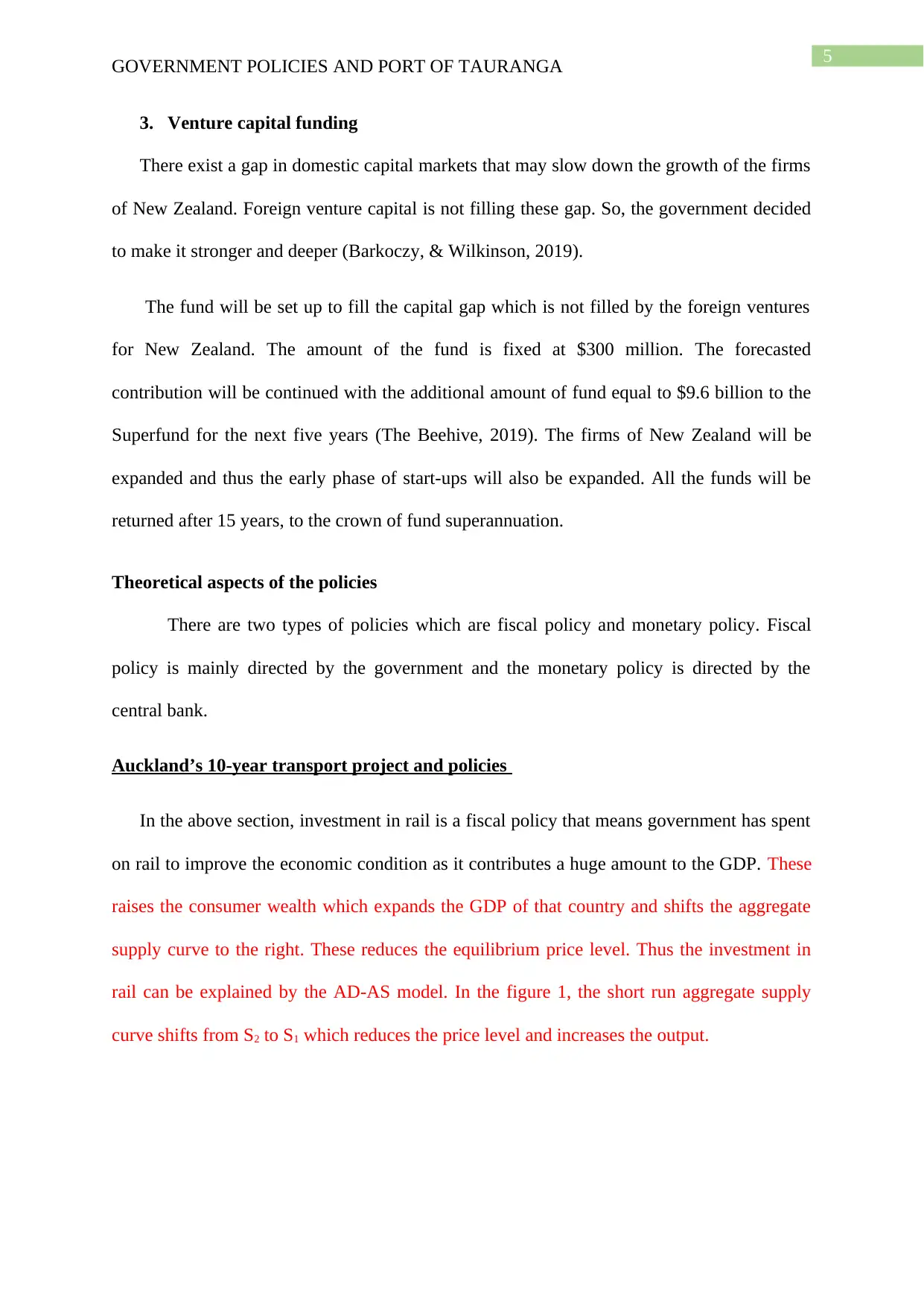
rail can be explained by the AD-AS model. In the figure 1, the short run aggregate supply
curve shifts from S2 to S1 which reduces the price level and increases the output.
Document Page
6
GOVERNMENT POLICIES AND PORT OF TAURANGA
Figure 1: Rightward shift of aggregate supply
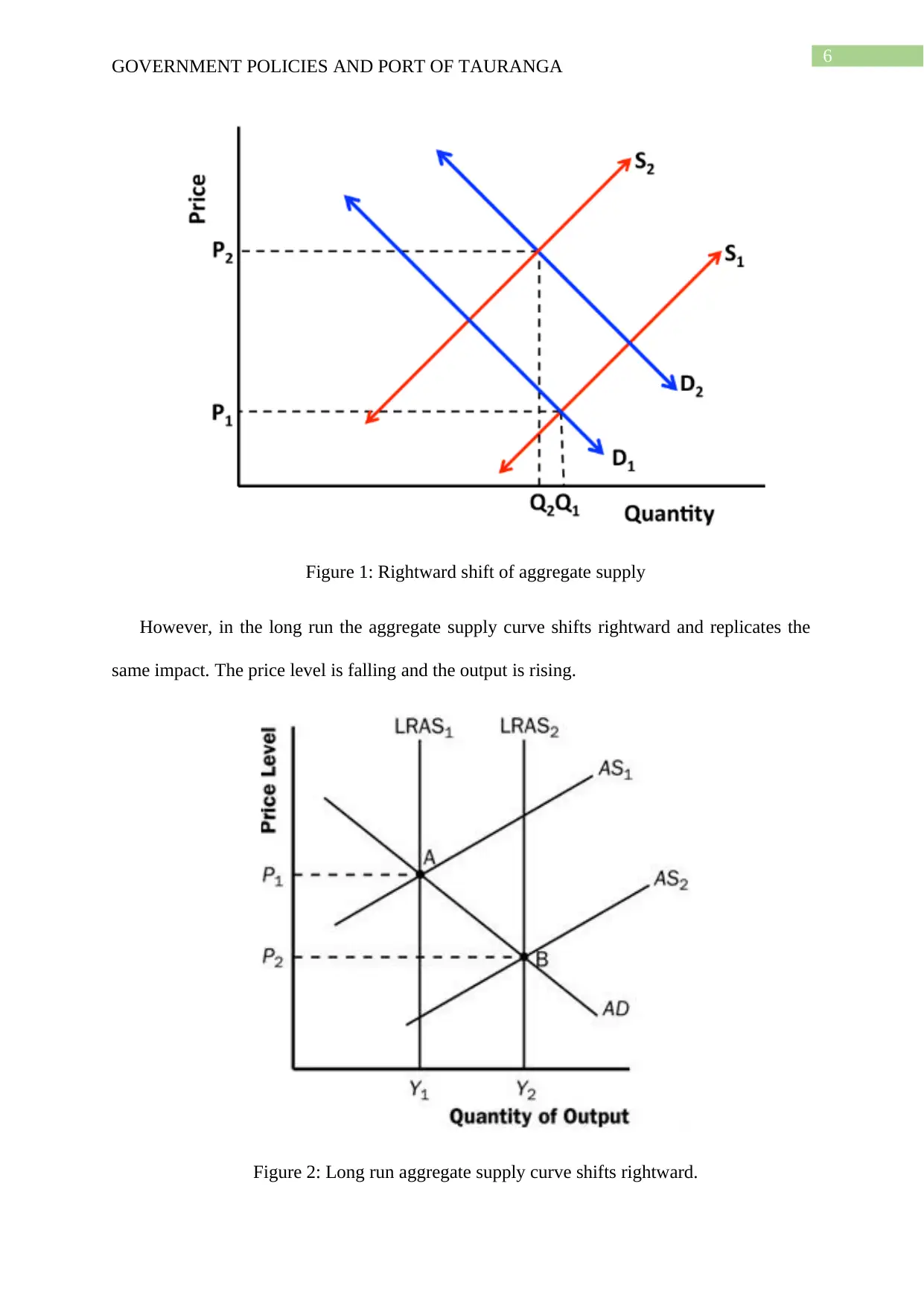
However, in the long run the aggregate supply curve shifts rightward and replicates the
same impact. The price level is falling and the output is rising.
Figure 2: Long run aggregate supply curve shifts rightward.
tabler-icon-diamond-filled.svg

Paraphrase This Document

Need a fresh take? Get an instant paraphrase of this document with our AI Paraphraser
Document Page
7
GOVERNMENT POLICIES AND PORT OF TAURANGA
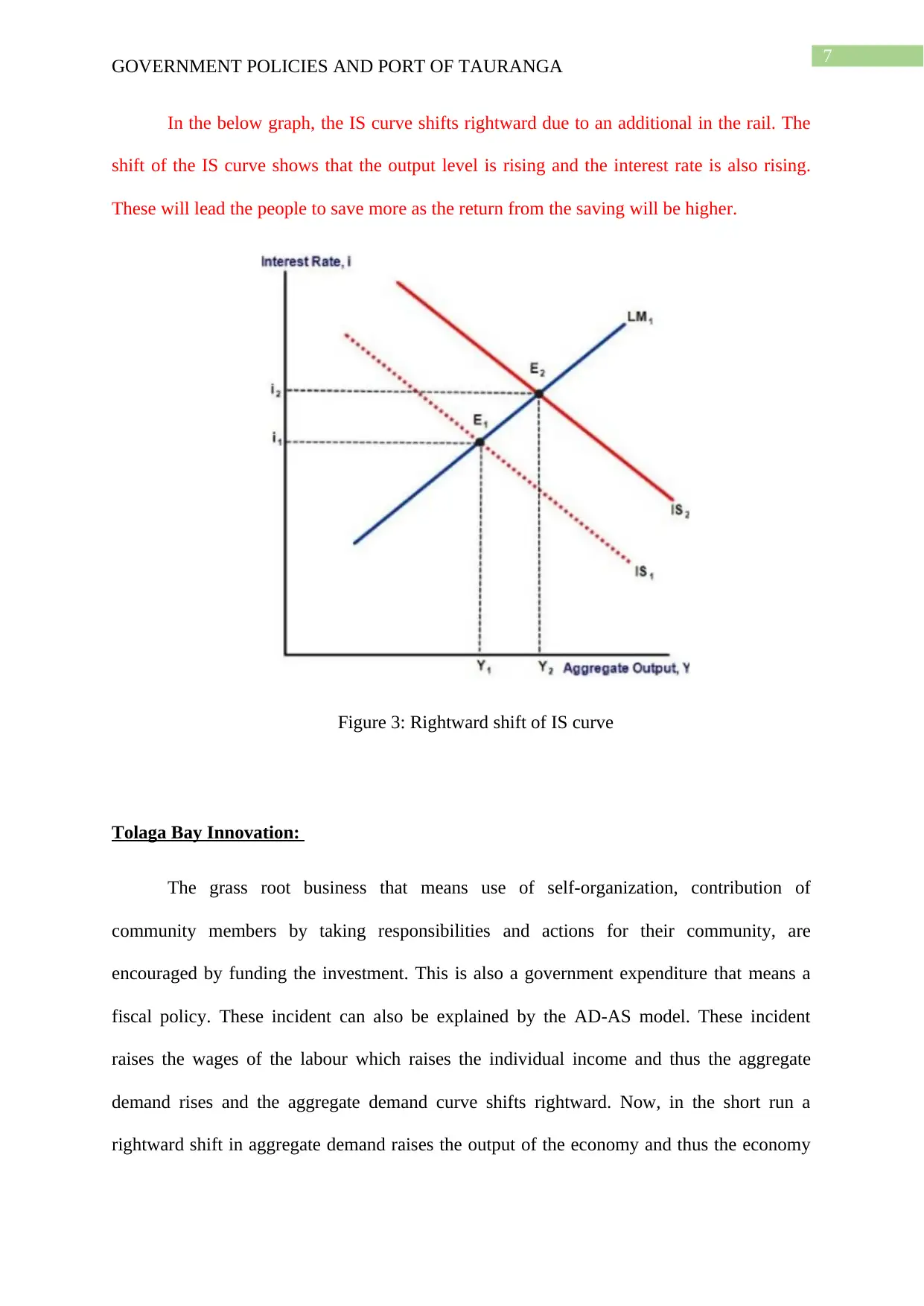
In the below graph, the IS curve shifts rightward due to an additional in the rail. The
shift of the IS curve shows that the output level is rising and the interest rate is also rising.
These will lead the people to save more as the return from the saving will be higher.
Figure 3: Rightward shift of IS curve
Tolaga Bay Innovation:
The grass root business that means use of self-organization, contribution of
community members by taking responsibilities and actions for their community, are
encouraged by funding the investment. This is also a government expenditure that means a
fiscal policy. These incident can also be explained by the AD-AS model. These incident
raises the wages of the labour which raises the individual income and thus the aggregate
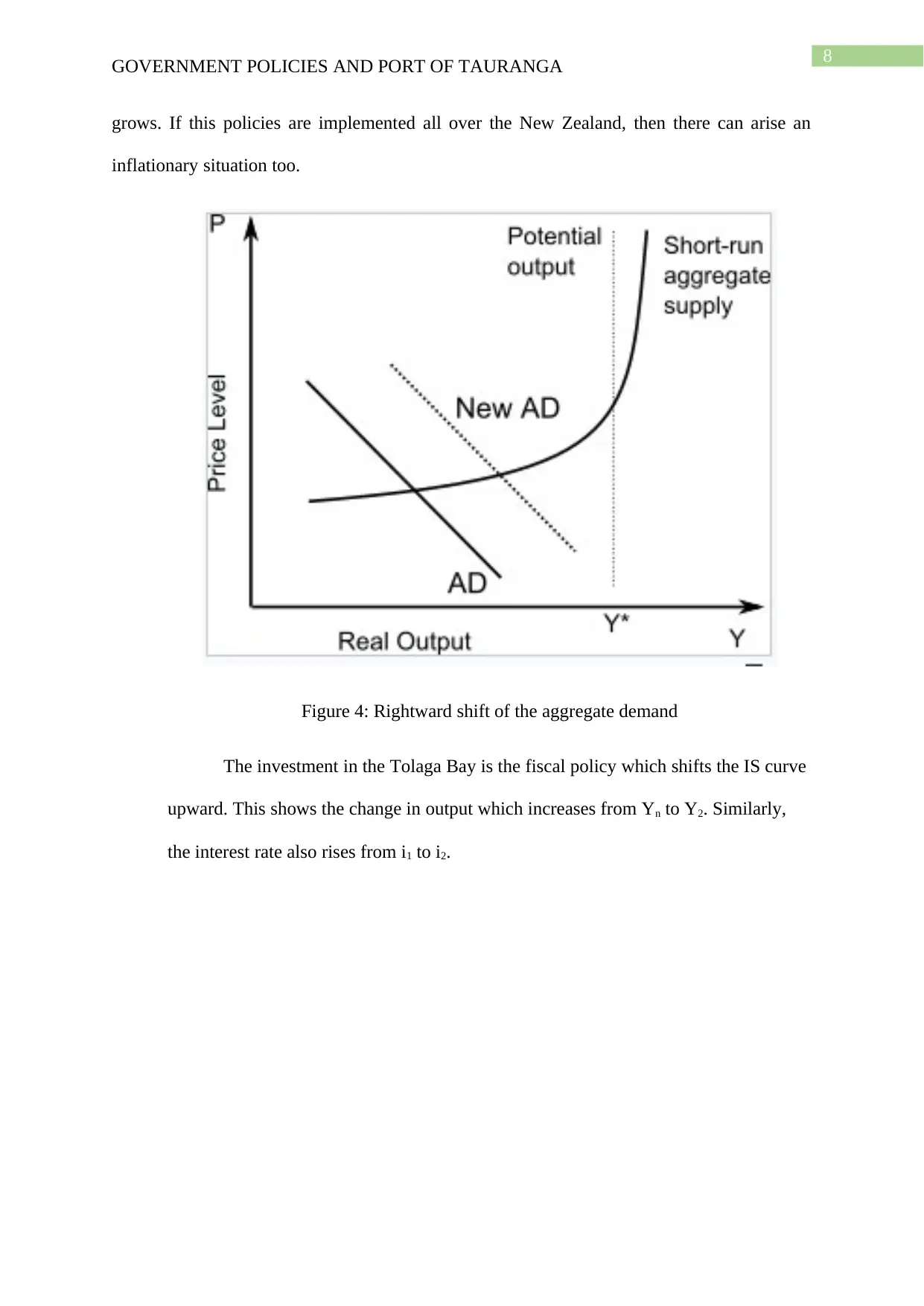
demand rises and the aggregate demand curve shifts rightward. Now, in the short run a
rightward shift in aggregate demand raises the output of the economy and thus the economy
Document Page
8
GOVERNMENT POLICIES AND PORT OF TAURANGA
grows. If this policies are implemented all over the New Zealand, then there can arise an
inflationary situation too.
Figure 4: Rightward shift of the aggregate demand
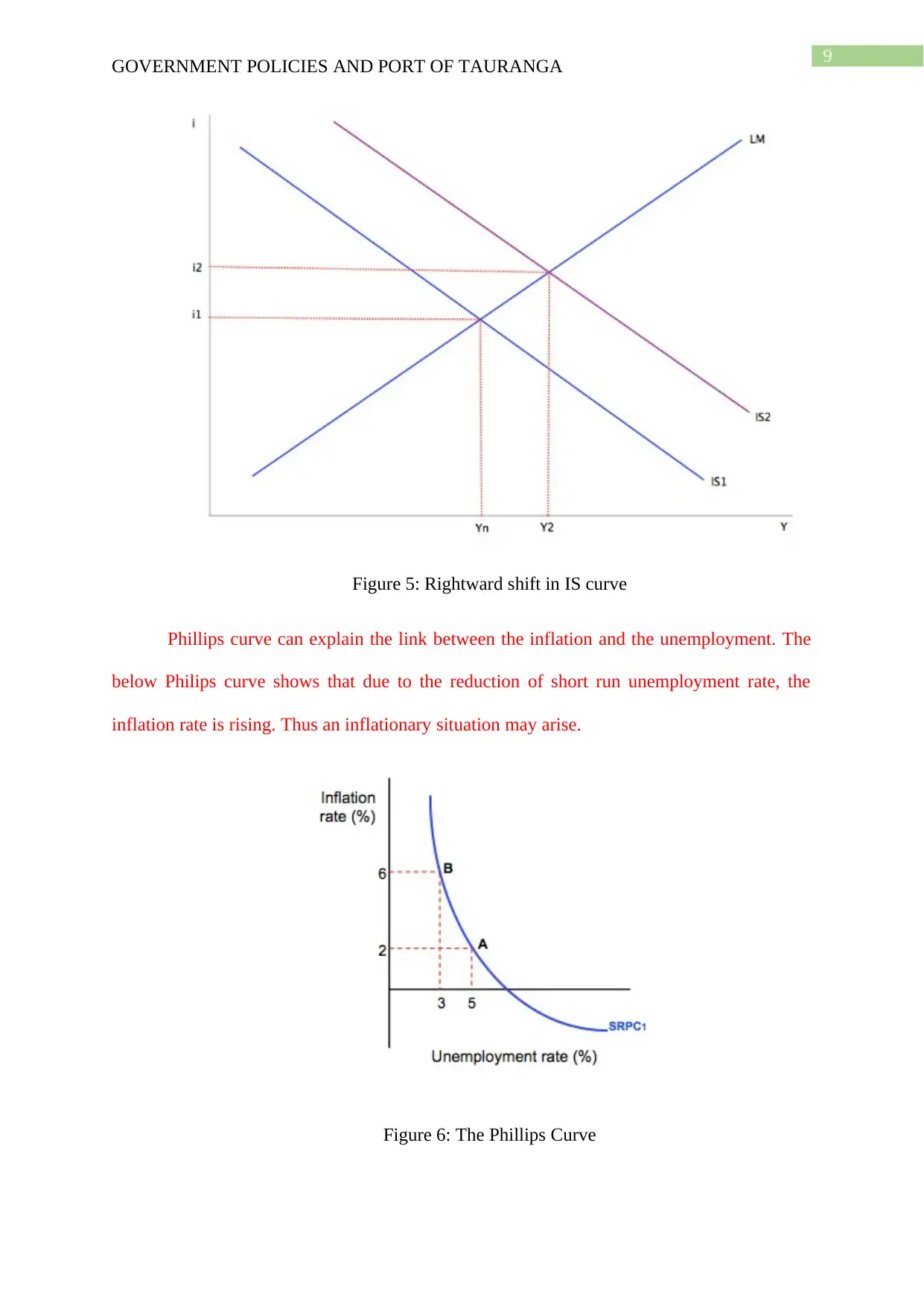
The investment in the Tolaga Bay is the fiscal policy which shifts the IS curve
upward. This shows the change in output which increases from Yn to Y2. Similarly,
the interest rate also rises from i1 to i2.
Document Page
9
GOVERNMENT POLICIES AND PORT OF TAURANGA
Figure 5: Rightward shift in IS curve
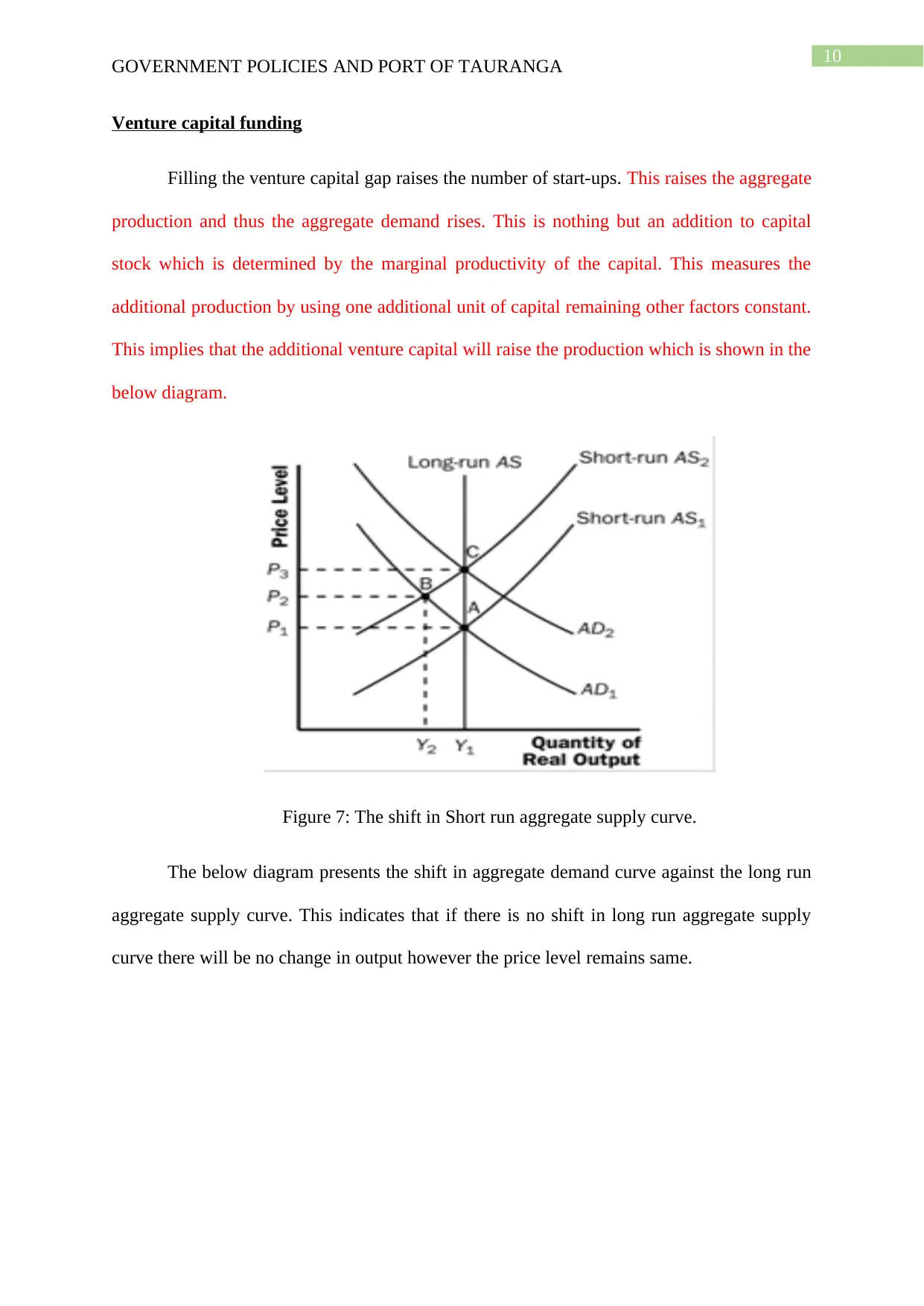
Phillips curve can explain the link between the inflation and the unemployment. The
below Philips curve shows that due to the reduction of short run unemployment rate, the
inflation rate is rising. Thus an inflationary situation may arise.
Figure 6: The Phillips Curve
tabler-icon-diamond-filled.svg

Paraphrase This Document

Need a fresh take? Get an instant paraphrase of this document with our AI Paraphraser
Document Page
10
GOVERNMENT POLICIES AND PORT OF TAURANGA
Venture capital funding
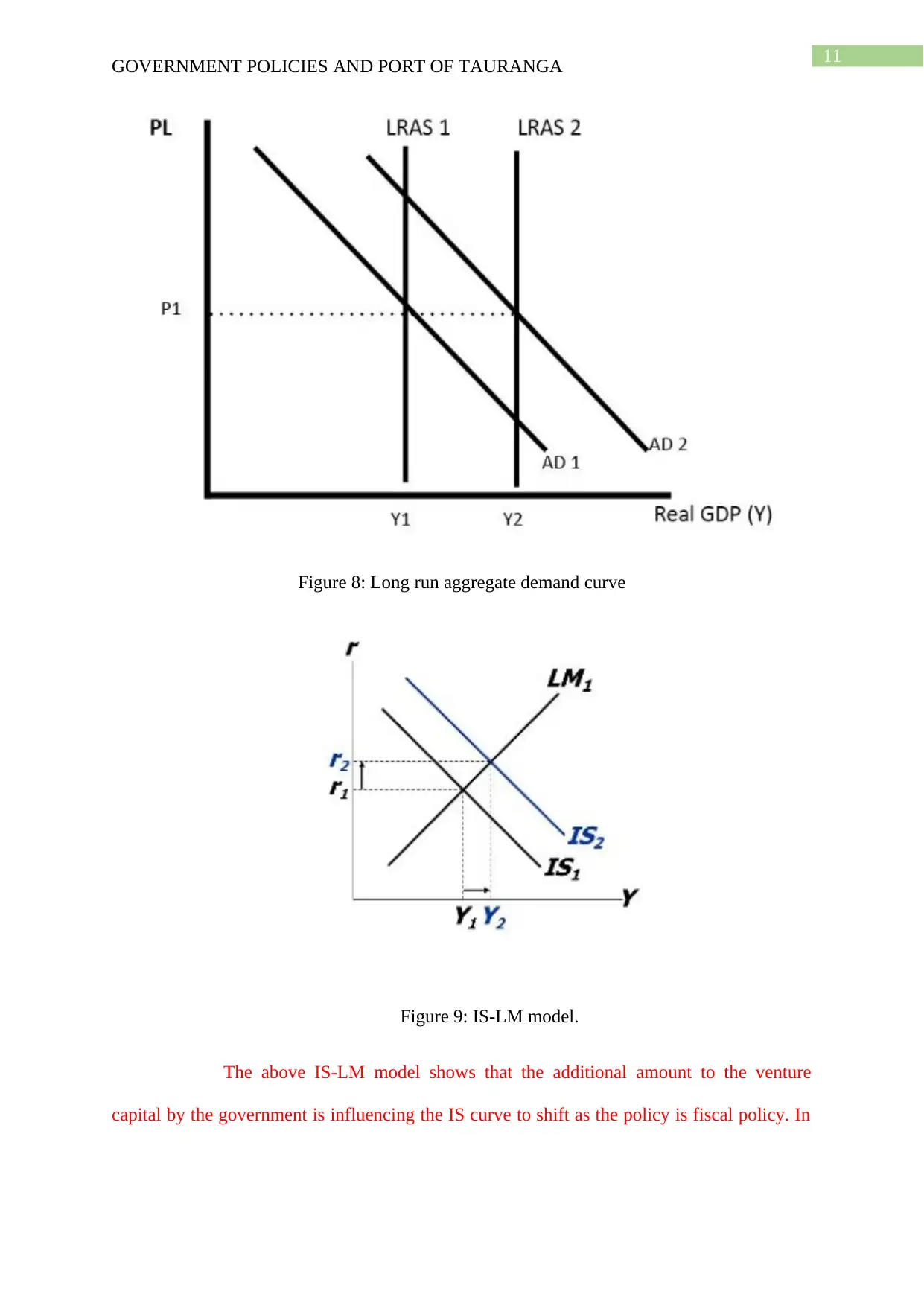
Filling the venture capital gap raises the number of start-ups. This raises the aggregate
production and thus the aggregate demand rises. This is nothing but an addition to capital
stock which is determined by the marginal productivity of the capital. This measures the
additional production by using one additional unit of capital remaining other factors constant.
This implies that the additional venture capital will raise the production which is shown in the
below diagram.
Figure 7: The shift in Short run aggregate supply curve.
The below diagram presents the shift in aggregate demand curve against the long run
aggregate supply curve. This indicates that if there is no shift in long run aggregate supply
curve there will be no change in output however the price level remains same.
Document Page
11
GOVERNMENT POLICIES AND PORT OF TAURANGA
Figure 8: Long run aggregate demand curve
Figure 9: IS-LM model.
The above IS-LM model shows that the additional amount to the venture
capital by the government is influencing the IS curve to shift as the policy is fiscal policy. In
chevron_up_icon
1 out of 23
circle_padding
hide_on_mobile
zoom_out_icon
[object Object]