Microeconomics Report: Government Spending, Debt, and Analysis

Verified

Added on  2022/09/21

|7
|1244
|25
Report
AI Summary
This microeconomics report analyzes the changing composition of U.S. government spending since the 1960s, highlighting the shift from public investment to entitlement programs. It categorizes federal government spending as either consumption or investment, defining each with examples. Consumption spending satisfies individual or societal needs, while investment spending yields long-term benefits. The report then examines the relationship between changing spending patterns, budget deficits, and the growing national debt. It discusses how increased entitlement spending and reduced investment spending contribute to rising deficits and debt, potentially increasing the economic burden. The report references relevant sources to support its findings, providing a comprehensive overview of the topic.
Document Page
Running head: MICROECONOMICS
Microeconomics
Name of the Student
Name of the University
Course ID
tabler-icon-diamond-filled.svg

Paraphrase This Document

Need a fresh take? Get an instant paraphrase of this document with our AI Paraphraser
Document Page
1MICROECONOMICS
Table of Contents
Composition of government spending.............................................................................................2
Categories of government spending................................................................................................3
Changing government spending and national debt..........................................................................4
References........................................................................................................................................6
Document Page
2MICROECONOMICS
Composition of government spending
There is a drastic transformation in the composition of federal government spending in
recent years as compared to that during 1960s. Previously government was mainly the providers
of different public goods and services. Today however the role has been shifted towards
providers of payment to the household. The composition of government spending has been
changed in that spending for entitlement has increased rapidly while that for public investment
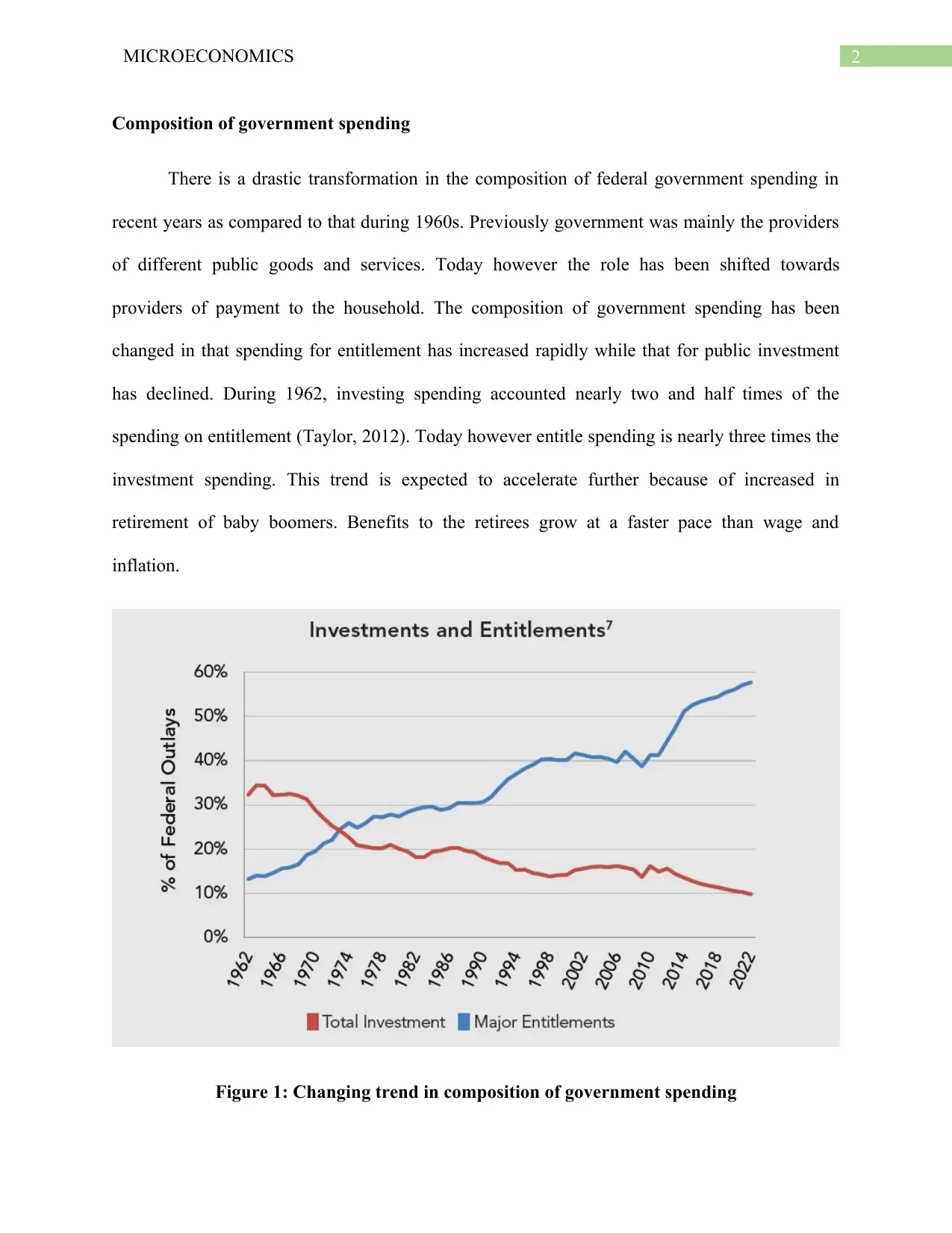
has declined. During 1962, investing spending accounted nearly two and half times of the
spending on entitlement (Taylor, 2012). Today however entitle spending is nearly three times the
investment spending. This trend is expected to accelerate further because of increased in
retirement of baby boomers. Benefits to the retirees grow at a faster pace than wage and
inflation.
Figure 1: Changing trend in composition of government spending
Document Page
3MICROECONOMICS
The figure above shows reversal in composition of government spending. Since 1962,
there is a continuous decline in spending on total investment meaning less and less share of total
government expenditure has been allotted for investment overtime. During the same time frame,
there is a continuous increase in spending on major entitlement implying an overtime increasing
share of entitlement spending in the total spending.
Categories of government spending
Government expenditure on various categories can be classified either as consumption
spending or as investment spending. Spending of federal government used to satisfy individual
need or needs of the society collectively is defined as consumption spending. As mentioned in
the article, the proposed Federal government budget for the fiscal year of 2013 included some
mandatory spending. The category of mandatory spending in 2011 had a total amount of $2
trillion. Of the total mandatory spending, almost 75% was made for social security amounting
$725 billion, Medicare amounting $480 billion and Medicaid amount $275 billion. Other major
categories of spending include payments given to federal retirees amounting $124 billion,
unemployment insurance amounting nearly $117 billion and food and nutrition assistance
amounting almost 96 billion (Taylor, 2012). All these categories of spending can be identified as
consumption spending as it directly or indirectly serve consumption need of individual
household or the society as a whole.
Investment spending of Federal government refers to the part of spending used for
yielding long term benefits for the country and the economy. It aims to promote efficiency of
Federal government agencies and also leads to economic efficiency of the national economy by
adding to the stock of physical or human capital. The investment spending can be tangible or
intangible. If investment is made to increase stock of physical capital, then it is part of tangible
tabler-icon-diamond-filled.svg

Paraphrase This Document

Need a fresh take? Get an instant paraphrase of this document with our AI Paraphraser
Document Page
4MICROECONOMICS
spending. On the other hand, if spending is made on education, research and development,
training and such other, then these are intangible investment spending. The estimated amount of
investment on physical capital stock in 2011 was $3054 billion. The spending on physical capital
was made up of spending on national defense ($925 billion), transportation ($1017 billion),
power, water, natural resources, region and community resources and others. The spending on
research and development was $1.5 trillion in 2011 which were divided between basic and
applied research in 50:50 ratios and that between non-defense and defense spending in a 60:40
ratios (Taylor, 2012). The investment spending on education amounted to $2 trillion including
spending on elementary, secondary and higher education.
Changing government spending and national debt
The concept of national debt and that of budget deficit though is different however they
are interrelated. Budget deficit refers to a situation where government spends more than collected
revenue. The national debt on the other hand is the monetary amount that federal government
needs to borrow in order to finance the budget deficit. Both budget deficit and national debt in
U.S. are following an increasing trend. The increase in budget deficit is responsible for the
increase in national debt. The changing composition of government budget resulted in a growing
divergence between government spending and revenue. The unfunded elements of mandatory
spending of federal government has increased government deficit over time. The huge spending
on social security (amounting nearly 1 trillion) is one significant contributor of fiscal deficit. The
Medicare cost is expected to be $722 billion in the fiscal year of 2021. Around 60% of the
Medicare spending is financed by premiums and payroll taxes. The mandatory spending that
were not financed out of tax revenue adds to budget deficit. One such component is spending on
Document Page
5MICROECONOMICS
Medicaid. Expenditure on this area is expected to be $448 billion in the fiscal year of 2021. The
Medicaid spending aims to provided health care service to the low income household.
Federal government mandatory budget also includes income support programs for the
individuals who are unable to support their livings. The income support program includes
different welfare program such as EITC, TANF and housing assistance (Amadeo, 2020). Federal
government also offers unemployment benefits for the laid off workers. Besides this retirements
program and several disability program cost federal government a lot. Spending on most of these
area do not yield any return in exchange of the spending. Spending on investment in contrast
yield long term benefits to the economy. Spending on physical capital contributes to
development of infrastructure which enhances productivity. Expenditure on education, research
and development and other areas contribute to development of human capital. As the stock of
human capital increases future productivity of the nation increases enhancing economic growth.
Shifting government spending from productive investment spending to increase spending for
social security, health care and other unnecessary areas has increased budget deficit of federal
government overtime. Since tax revenue has not been increased in the same pace of government
spending deficit continued to increase. National debt currently is stood at $21 trillion (Collin,
2020). Higher deficit thus increases real burden of the economy by increasing the debt burden. In
order to meet the deficit federal government has to borrow from countries like Japan, Saudi
Arabia and China. The unsustainable national debt reduces government ability to support the
economy in times of unforeseen crisis like that occurred in 2008.
Document Page
6MICROECONOMICS
References
Taylor, T. (2012). Entitlements, Public Investment, and the Changing Nature of the U.S.
Government. Conversableeconomist.blogspot.com. Retrieved 17 April 2020, from
http://conversableeconomist.blogspot.com/2012/08/entitlements-public-investment-and.html
Amadeo, K. (2020) 3 Reasons the U.S. Deficit Is Out of Control. The Balance. Retrieved 17
April 2020, from https://www.thebalance.com/current-u-s-federal-budget-deficit-3305783
Collin, M. (2020). Usatoday.com. Retrieved 17 April 2020, from
https://www.usatoday.com/story/news/politics/2018/10/16/government-spending-how-rising-
federal-debt-deficit-impact-americans/1589889002
chevron_up_icon
1 out of 7
circle_padding
hide_on_mobile
zoom_out_icon
[object Object]