LSBM306: A Case Study on Grab's Strategy, Enterprise, and Innovation
VerifiedAdded on 2023/06/15
|12
|3874
|97
Case Study
AI Summary
This case study examines Grab, a leading Southeast Asian mobile technology and transportation company, focusing on its strategic innovation and enterprise development. It identifies key drivers of innovation contributing to Grab's success, including product, process, position, and paradigm innovations. The analysis delves into the reasons behind Grab's success, such as its fintech offerings and hyperlocal approaches. Strategic frameworks like the Ansoff Matrix and Porter's Five Forces are applied to analyze Grab's growth strategies and competitive forces, respectively. The report also explores the Blue Ocean Strategy implemented by Grab to examine its market position. Ultimately, the study provides a comprehensive overview of Grab's strategic initiatives and their impact on its market leadership.
Strategy, Enterprise
and Innovation
and Innovation

Paraphrase This Document
Need a fresh take? Get an instant paraphrase of this document with our AI Paraphraser
Table of Contents
INTRODUCTION...........................................................................................................................1
MAIN BODY...................................................................................................................................1
The key drivers of innovation contributing to the success of Grab............................................1
Reasons behind success of Grab ................................................................................................3
Ansoff Matrix of Grab (Shweta).................................................................................................3
Porter's five forces.......................................................................................................................4
Blue Ocean Strategy (Riya)........................................................................................................6
Strategy canvas............................................................................................................................6
CONCLUSION................................................................................................................................8
REFERENCES..............................................................................................................................10
INTRODUCTION...........................................................................................................................1
MAIN BODY...................................................................................................................................1
The key drivers of innovation contributing to the success of Grab............................................1
Reasons behind success of Grab ................................................................................................3
Ansoff Matrix of Grab (Shweta).................................................................................................3
Porter's five forces.......................................................................................................................4
Blue Ocean Strategy (Riya)........................................................................................................6
Strategy canvas............................................................................................................................6
CONCLUSION................................................................................................................................8
REFERENCES..............................................................................................................................10
INTRODUCTION
Strategic innovation is described as the procedure of redesigning or inventing business
operations by companies so that they could gain competitive advantage and enhance their
productivity. Implementation of strategic innovation by organisations is very essential as it helps
them in increasing growth and further develop opportunities to expand business on global level
(Tavares, 2021). The following report includes a South-east Asia company named as Grab which
is a leading transportation and technology company. The company deals in several sectors such
as grocery, food delivery and financial facilities. The selected organisation was established in the
year 2012 in Malaysia by Tan Hooi Ling and Anthony Tan. The report discuss the key drivers of
innovation that helps in getting success for respective firm. Furthermore, strategy frameworks
has been applied in order to analysis various approaches implemented by organisation to assist
shaping its vision and mission. In the report, Blue Ocean strategy has also been implemented os
that the success of respective company could be examined.
MAIN BODY
The key drivers of innovation contributing to the success of Grab
Innovation is defined as the process where companies applied new ideas or strategies in
order to develop opportunities where they could enhance their present products or services to
gain competitive advantage over rivals in the market (Tomashuk and Tomashuk, 2021). In
context to Grab, the company always initiates innovation strategies in the market so that they
could provide unique services or products to their potential customers along with making
themselves strong in position within market. The implementation of 4Ps has been explained
below in context to the selected organisation where it has been discussed that how company
execute this strategy. The 4Ps of innovation are described below:
Product Innovation: This is the first phase of innovation where the main purpose of
company is to make their products or services more unique from its rivals. Product
development could be achieved by implementing improvement in current products or
introducing new range of goods or services in the market. In case of the respective
company, it was previously offering transportation services where it introduced taxi
facilities in Malaysia followed by several other services in the country so that it could
expand its business operations. The company is introducing new facilities in the market
1
Strategic innovation is described as the procedure of redesigning or inventing business
operations by companies so that they could gain competitive advantage and enhance their
productivity. Implementation of strategic innovation by organisations is very essential as it helps
them in increasing growth and further develop opportunities to expand business on global level
(Tavares, 2021). The following report includes a South-east Asia company named as Grab which
is a leading transportation and technology company. The company deals in several sectors such
as grocery, food delivery and financial facilities. The selected organisation was established in the
year 2012 in Malaysia by Tan Hooi Ling and Anthony Tan. The report discuss the key drivers of
innovation that helps in getting success for respective firm. Furthermore, strategy frameworks
has been applied in order to analysis various approaches implemented by organisation to assist
shaping its vision and mission. In the report, Blue Ocean strategy has also been implemented os
that the success of respective company could be examined.
MAIN BODY
The key drivers of innovation contributing to the success of Grab
Innovation is defined as the process where companies applied new ideas or strategies in
order to develop opportunities where they could enhance their present products or services to
gain competitive advantage over rivals in the market (Tomashuk and Tomashuk, 2021). In
context to Grab, the company always initiates innovation strategies in the market so that they
could provide unique services or products to their potential customers along with making
themselves strong in position within market. The implementation of 4Ps has been explained
below in context to the selected organisation where it has been discussed that how company
execute this strategy. The 4Ps of innovation are described below:
Product Innovation: This is the first phase of innovation where the main purpose of
company is to make their products or services more unique from its rivals. Product
development could be achieved by implementing improvement in current products or
introducing new range of goods or services in the market. In case of the respective
company, it was previously offering transportation services where it introduced taxi
facilities in Malaysia followed by several other services in the country so that it could
expand its business operations. The company is introducing new facilities in the market
1
⊘ This is a preview!⊘
Do you want full access?
Subscribe today to unlock all pages.

Trusted by 1+ million students worldwide
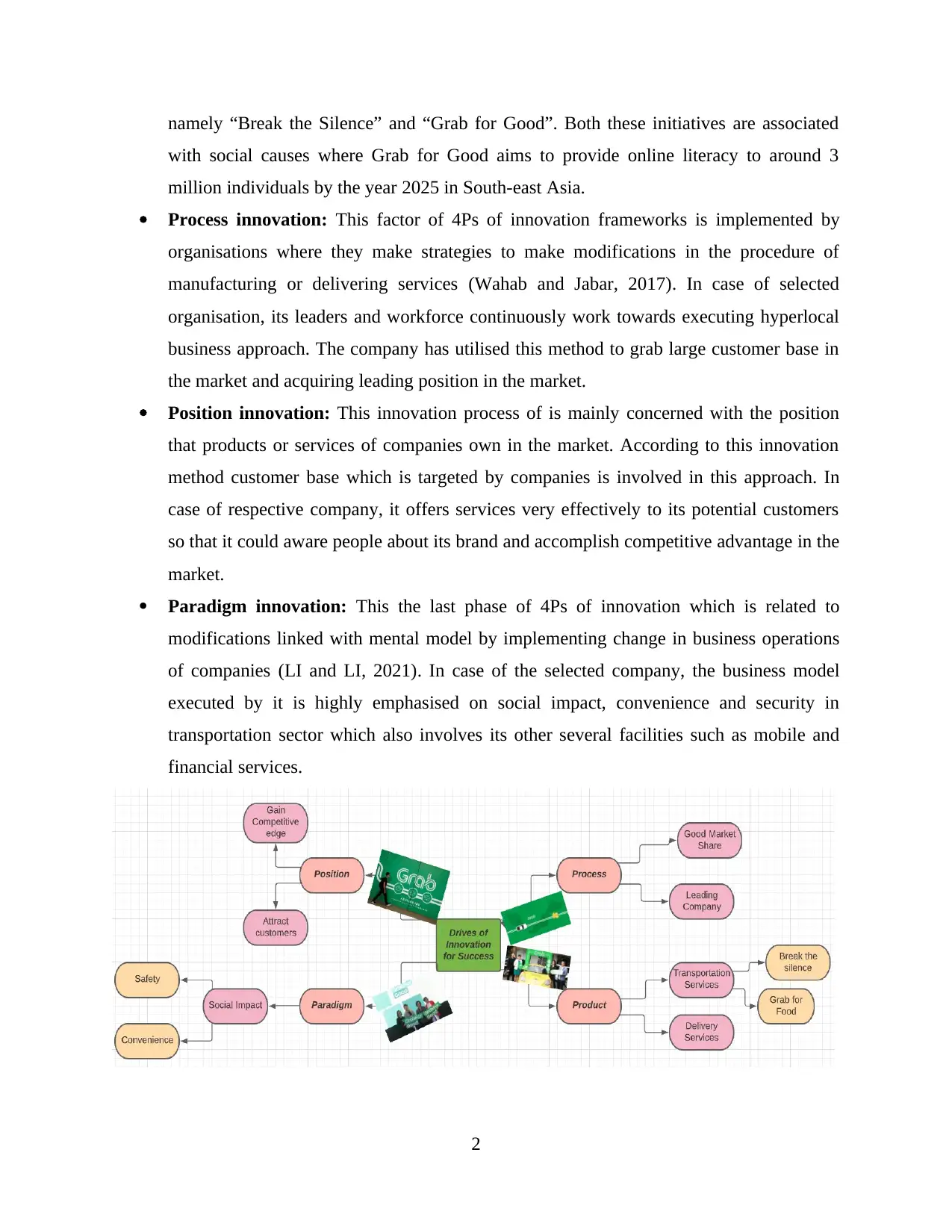
namely “Break the Silence” and “Grab for Good”. Both these initiatives are associated
with social causes where Grab for Good aims to provide online literacy to around 3
million individuals by the year 2025 in South-east Asia.
Process innovation: This factor of 4Ps of innovation frameworks is implemented by
organisations where they make strategies to make modifications in the procedure of
manufacturing or delivering services (Wahab and Jabar, 2017). In case of selected
organisation, its leaders and workforce continuously work towards executing hyperlocal
business approach. The company has utilised this method to grab large customer base in
the market and acquiring leading position in the market.
Position innovation: This innovation process of is mainly concerned with the position
that products or services of companies own in the market. According to this innovation
method customer base which is targeted by companies is involved in this approach. In
case of respective company, it offers services very effectively to its potential customers
so that it could aware people about its brand and accomplish competitive advantage in the
market.
Paradigm innovation: This the last phase of 4Ps of innovation which is related to
modifications linked with mental model by implementing change in business operations
of companies (LI and LI, 2021). In case of the selected company, the business model
executed by it is highly emphasised on social impact, convenience and security in
transportation sector which also involves its other several facilities such as mobile and
financial services.
2
with social causes where Grab for Good aims to provide online literacy to around 3
million individuals by the year 2025 in South-east Asia.
Process innovation: This factor of 4Ps of innovation frameworks is implemented by
organisations where they make strategies to make modifications in the procedure of
manufacturing or delivering services (Wahab and Jabar, 2017). In case of selected
organisation, its leaders and workforce continuously work towards executing hyperlocal
business approach. The company has utilised this method to grab large customer base in
the market and acquiring leading position in the market.
Position innovation: This innovation process of is mainly concerned with the position
that products or services of companies own in the market. According to this innovation
method customer base which is targeted by companies is involved in this approach. In
case of respective company, it offers services very effectively to its potential customers
so that it could aware people about its brand and accomplish competitive advantage in the
market.
Paradigm innovation: This the last phase of 4Ps of innovation which is related to
modifications linked with mental model by implementing change in business operations
of companies (LI and LI, 2021). In case of the selected company, the business model
executed by it is highly emphasised on social impact, convenience and security in
transportation sector which also involves its other several facilities such as mobile and
financial services.
2
Paraphrase This Document
Need a fresh take? Get an instant paraphrase of this document with our AI Paraphraser
Reasons behind success of Grab
There are various components of the company which play crucial role in accomplishing
success for the respective organisation in South-east Asia market. The company emphasised
several strategies and techniques associated with innovation which assist it in enhancing wide
customer base. The strategies which are used by selected company to gain success are described
below in detail:
Fintech Offering: In the year 2016, the respective company launched its own QR based
mobile payment facilities. This payment facilitates its customer base to complete their
daily activities effectively and efficiently (Jnr, 2020). This facility is available for people
from any part of South-east Asia where they could pay their payments associated with
many activities such as food purchasing, cab rides, fund transfer and store shopping.
Under the initiative “Grow with Grab” of the selected company, it offers loan and
insurance facilities to its potential clients. The firm is also providing loan services to
many small and medium sized enterprises operating in the country. Another facility of
company which is “Grabpay” also facilitate its users to pay their payment for company's
services after the end of the month without paying any extra charges.
Hyperlocal approaches: According to this method, the selected company appoints local
people of the country and interact with them so that it could understand demands or needs
of domestic market (Shuangzhe, 2020). This approach of the company helps it in garbing
attention of customers and gaining strong brand image. The approach of interacting with
local people assist respective company in enhancing its relationship with them which
further result into more interaction in the process of company. Through providing
employment to local people the respective firm is helping in increasing employment rate
of the country.
Ansoff Matrix of Grab
This is one of the most effective strategies which is used analyse the options which a
company have for their growth. Companies use various kind of growth strategies and this matrix
discuss about four main types of growth strategies which are essential for a company to analyse
and adopt any one for their successful growth. In context of Grab Company, is suggested that
they will analyse advantages and disadvantages of every growth strategy according to their
3
There are various components of the company which play crucial role in accomplishing
success for the respective organisation in South-east Asia market. The company emphasised
several strategies and techniques associated with innovation which assist it in enhancing wide
customer base. The strategies which are used by selected company to gain success are described
below in detail:
Fintech Offering: In the year 2016, the respective company launched its own QR based
mobile payment facilities. This payment facilitates its customer base to complete their
daily activities effectively and efficiently (Jnr, 2020). This facility is available for people
from any part of South-east Asia where they could pay their payments associated with
many activities such as food purchasing, cab rides, fund transfer and store shopping.
Under the initiative “Grow with Grab” of the selected company, it offers loan and
insurance facilities to its potential clients. The firm is also providing loan services to
many small and medium sized enterprises operating in the country. Another facility of
company which is “Grabpay” also facilitate its users to pay their payment for company's
services after the end of the month without paying any extra charges.
Hyperlocal approaches: According to this method, the selected company appoints local
people of the country and interact with them so that it could understand demands or needs
of domestic market (Shuangzhe, 2020). This approach of the company helps it in garbing
attention of customers and gaining strong brand image. The approach of interacting with
local people assist respective company in enhancing its relationship with them which
further result into more interaction in the process of company. Through providing
employment to local people the respective firm is helping in increasing employment rate
of the country.
Ansoff Matrix of Grab
This is one of the most effective strategies which is used analyse the options which a
company have for their growth. Companies use various kind of growth strategies and this matrix
discuss about four main types of growth strategies which are essential for a company to analyse
and adopt any one for their successful growth. In context of Grab Company, is suggested that
they will analyse advantages and disadvantages of every growth strategy according to their
3
organisational aim and financial condition and then adopt any strategy which will provide them
maximum benefit. Ansoff Matrix of Grab is discussed below- Market penetration- This is the strategy which define that the company must gain
appropriate growth in current market in which they are already serving with their existing
product. Here the main aim of the company is to increase the sales by various ways like
increasing promotional activities (Scupola and Nicolajsen, 2021). In context of Grab
Company, they can increase their sales by increasing awareness of customers about their
products and services and the benefits if they purchase their products and services. They
can promote their products and services through social media marketing which is having
global reach and can also focus on good quality of their product. Product development- This is the growth strategy where companies modify or bring new
product line in existing market. This is one of the most used growth strategies for those
companies whose products are not in demand in existing market. This strategy is also
opted by those companies who need to capture more market share and gain competitive
advantage by their effective growth. In context of Grab Company, they are already
serving various kinds of products and services to their customers. Hence, they are not
thinking to gain more growth by this strategy as they already opted before and gain
appropriate growth in their serving market. Market development- This is the strategy which is opted by most of the companies and it
states that a company gain growth by serving their existing products and services to new
market (Aleksin, 2019). This is the growth option which can be opted by Grab Company;
they can target other countries and their customers to gain high growth at international
level. The main benefits of opting this strategy is that the company will gain high
reputation, the number of their customers will increase and gain more profit. But they are
required to conduct effective marketing research by investing more in their Research and
Development department.
Diversification- This is the last growth strategy in this matrix and also considered as one
of the most risky strategy where a company bring their new modified or new product line
in new market. Hence, it is risky because here a company is not sure that the customers of
new market will like or dislike their product. Therefore, in context of Grab Company, if
they want to opt this strategy then they are required to invest high in their Research and
4
maximum benefit. Ansoff Matrix of Grab is discussed below- Market penetration- This is the strategy which define that the company must gain
appropriate growth in current market in which they are already serving with their existing
product. Here the main aim of the company is to increase the sales by various ways like
increasing promotional activities (Scupola and Nicolajsen, 2021). In context of Grab
Company, they can increase their sales by increasing awareness of customers about their
products and services and the benefits if they purchase their products and services. They
can promote their products and services through social media marketing which is having
global reach and can also focus on good quality of their product. Product development- This is the growth strategy where companies modify or bring new
product line in existing market. This is one of the most used growth strategies for those
companies whose products are not in demand in existing market. This strategy is also
opted by those companies who need to capture more market share and gain competitive
advantage by their effective growth. In context of Grab Company, they are already
serving various kinds of products and services to their customers. Hence, they are not
thinking to gain more growth by this strategy as they already opted before and gain
appropriate growth in their serving market. Market development- This is the strategy which is opted by most of the companies and it
states that a company gain growth by serving their existing products and services to new
market (Aleksin, 2019). This is the growth option which can be opted by Grab Company;
they can target other countries and their customers to gain high growth at international
level. The main benefits of opting this strategy is that the company will gain high
reputation, the number of their customers will increase and gain more profit. But they are
required to conduct effective marketing research by investing more in their Research and
Development department.
Diversification- This is the last growth strategy in this matrix and also considered as one
of the most risky strategy where a company bring their new modified or new product line
in new market. Hence, it is risky because here a company is not sure that the customers of
new market will like or dislike their product. Therefore, in context of Grab Company, if
they want to opt this strategy then they are required to invest high in their Research and
4
⊘ This is a preview!⊘
Do you want full access?
Subscribe today to unlock all pages.
Trusted by 1+ million students worldwide
Marketing department and analyse what are the products which is most preferred by the
customers and then bring only those products which has more demand in the specific
market.
Porter's five forces
This is the marketing tool which assists companies in examining competitive forces
which could impact their position and business operations in the market. These forces directly or
indirectly impacts growth or profitability of organisations, hence, it is very essential for firms to
evaluate their competitive forces through applying this porter's five forces (Wang and Yang,
2021). The implication of this frameworks in context to Grab has been explained below in detail:
Threat of new entrants: This factor of the framework helps in examining how
effectively presence of new entrants could impact business functions of existing
organisations. In context to the selected organisation, it has maintained a strong image
in the market which makes it a leader in transport industry. The power of new entrants
for the respective firm is low which makes it easy for company to expand its business
and ensure its longevity in the market. It might become difficult for new companied to
compete with already established organisation who has build a strong image and trust
among customers.
Threat of substitute products: This component of the model helps company in
examining how existence of secondary goods could impact on the performance of
present products (Kalaman, Savenko and Dolynska, 2019). In case of the respective
company, the threat for substitute products is moderate as there are various other
transport options available for people to travel. But as the respective company holds a
very strong position in the market which helps in minimizing impact of secondary
products.
Bargaining Power of Supplier: This is the component which assist companies in
examining to which extend suppliers could negotiate which decides their power. In case
of the selected organisation, the company has classified its suppliers under two
categorise which involves Technical and IT suppliers along with other supplier that is
cooperation and investment firms. The presence of high number of suppliers results in
their low power which makes it difficult for them to negotiate on their terms. The
5
customers and then bring only those products which has more demand in the specific
market.
Porter's five forces
This is the marketing tool which assists companies in examining competitive forces
which could impact their position and business operations in the market. These forces directly or
indirectly impacts growth or profitability of organisations, hence, it is very essential for firms to
evaluate their competitive forces through applying this porter's five forces (Wang and Yang,
2021). The implication of this frameworks in context to Grab has been explained below in detail:
Threat of new entrants: This factor of the framework helps in examining how
effectively presence of new entrants could impact business functions of existing
organisations. In context to the selected organisation, it has maintained a strong image
in the market which makes it a leader in transport industry. The power of new entrants
for the respective firm is low which makes it easy for company to expand its business
and ensure its longevity in the market. It might become difficult for new companied to
compete with already established organisation who has build a strong image and trust
among customers.
Threat of substitute products: This component of the model helps company in
examining how existence of secondary goods could impact on the performance of
present products (Kalaman, Savenko and Dolynska, 2019). In case of the respective
company, the threat for substitute products is moderate as there are various other
transport options available for people to travel. But as the respective company holds a
very strong position in the market which helps in minimizing impact of secondary
products.
Bargaining Power of Supplier: This is the component which assist companies in
examining to which extend suppliers could negotiate which decides their power. In case
of the selected organisation, the company has classified its suppliers under two
categorise which involves Technical and IT suppliers along with other supplier that is
cooperation and investment firms. The presence of high number of suppliers results in
their low power which makes it difficult for them to negotiate on their terms. The
5
Paraphrase This Document
Need a fresh take? Get an instant paraphrase of this document with our AI Paraphraser
respective organisation has several options available to buy its raw materials from
various suppliers which helps it in lowering their power.
Bargaining Power of Buyers: This is the factor of Porter's Five Forces which assist in
examining how preferences of customers could impact on the position of company
(Kahn, 2018). In context to the selected organisation, it provide cab and taxi services at
very low prices which helps in making itself more strong and trustworthy among its
potential customers. The demand and unique facilities provided by the respective
company assist it in lowering the bargaining power of buyers. The lower bargaining
power helps the company in improving its productivity and gaining competitive
advantage over its rivals in the market.
Rivalry among existing competitors: This component of the framework helps
companies in determining their position in the market among its competitors. In context
to the selected organisation, there are several transportation companies such as Ola,
Uber and others presence in the market which impact the market share of the company.
These companies increase pressure on the respective company to perform outstanding
and offer innovative services which could help it in minimising their impact on position
of the company.
Blue Ocean Strategy
The focus of this strategy is on developing uniqueness while also reducing costs to create
new market opportunities. Blue ocean strategy can be used to expand industry boundaries and
helps identify markets with low competition in order to gain market leadership. In this strategy
demand is created through innovation and cost reduction instead of contesting with other
companies over demand in a specific market (Zhu and Bai, 2019). With the application of blue
ocean strategy unexplored and untapped markets can be created which provide opportunities for
continuous growth for the company. In this strategy value innovation is used to equally focus on
reducing costs while creating differentiated products which complete needs of the consumers.
The usage of this strategy makes the competition irrelevant as products with unique quality are
provided to the consumers opening new markets. Value innovation is defined as an innovation
which is not only technology driven and realistic but also provides consumers better value. In
order to achieve value innovation business firms need to align their innovation with utility, price
and cost position. This can help the company lower costs while also creating value for the
6
various suppliers which helps it in lowering their power.
Bargaining Power of Buyers: This is the factor of Porter's Five Forces which assist in
examining how preferences of customers could impact on the position of company
(Kahn, 2018). In context to the selected organisation, it provide cab and taxi services at
very low prices which helps in making itself more strong and trustworthy among its
potential customers. The demand and unique facilities provided by the respective
company assist it in lowering the bargaining power of buyers. The lower bargaining
power helps the company in improving its productivity and gaining competitive
advantage over its rivals in the market.
Rivalry among existing competitors: This component of the framework helps
companies in determining their position in the market among its competitors. In context
to the selected organisation, there are several transportation companies such as Ola,
Uber and others presence in the market which impact the market share of the company.
These companies increase pressure on the respective company to perform outstanding
and offer innovative services which could help it in minimising their impact on position
of the company.
Blue Ocean Strategy
The focus of this strategy is on developing uniqueness while also reducing costs to create
new market opportunities. Blue ocean strategy can be used to expand industry boundaries and
helps identify markets with low competition in order to gain market leadership. In this strategy
demand is created through innovation and cost reduction instead of contesting with other
companies over demand in a specific market (Zhu and Bai, 2019). With the application of blue
ocean strategy unexplored and untapped markets can be created which provide opportunities for
continuous growth for the company. In this strategy value innovation is used to equally focus on
reducing costs while creating differentiated products which complete needs of the consumers.
The usage of this strategy makes the competition irrelevant as products with unique quality are
provided to the consumers opening new markets. Value innovation is defined as an innovation
which is not only technology driven and realistic but also provides consumers better value. In
order to achieve value innovation business firms need to align their innovation with utility, price
and cost position. This can help the company lower costs while also creating value for the
6
consumer throughout the supply chain so that they receive maximum satisfaction product
differentiation is completed.
Strategy Canvas
This refers to a diagnostic and action model for the blue ocean strategy. It offers a
simplistic way of detailing the ways through which competing organizations are able to attract
consumers and the ways in which consumers make decisions for selecting commodities in the
specific category. With the help of the strategic canvas industry positions of the main players
along with the investments made by the competitors is covered and visualized so that it can be
easily understood by any individual. It is important to construct a strategy canvas so that future
decision making becomes easier through simple depiction of important data and blue ocean
strategy can be executed effectively. In addition this, it also helps prepare foundation for change
so that the steps for successfully implementing blue ocean strategy can be implemented.
Developing a strategy canvas is initial step of successfully completing the blue ocean strategy
and gaining entrepreneurial success by expanding industry boundaries. It showcases the actions
which can be adopted by an organization to create a distinctive image from the competition so
that non-consumers can be attracted to the industry to enhance profitability. The two primary
aims of building a strategy canvas are stated below:
Creation of a strategy canvas helps organizations understand the current situation of the
market so that farther investment and strategic decisions can be improved (Suna and
Liub, 2021). Business firms are able to build strategic profiles of the consumers and
focus on building value innovation by usage of blue ocean strategy.
The company is able to shift their focus from rivals to alternatives which provide
sustainable growth and from current consumer base to non-consumers. This helps move
away fro red ocean reality and capture blue ocean strategy for future success.
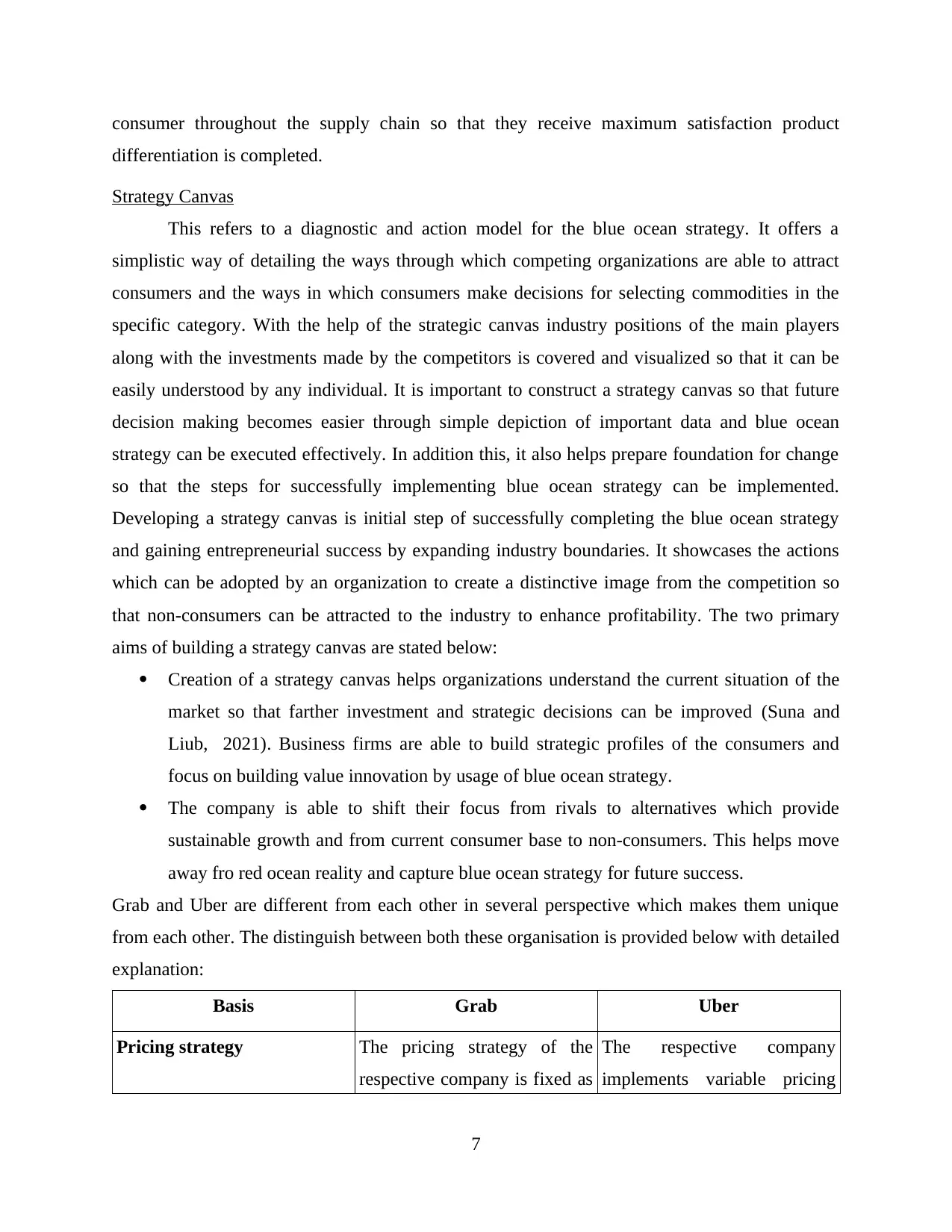
Grab and Uber are different from each other in several perspective which makes them unique
from each other. The distinguish between both these organisation is provided below with detailed
explanation:
Basis Grab Uber
Pricing strategy The pricing strategy of the
respective company is fixed as
The respective company
implements variable pricing
7
differentiation is completed.
Strategy Canvas
This refers to a diagnostic and action model for the blue ocean strategy. It offers a
simplistic way of detailing the ways through which competing organizations are able to attract
consumers and the ways in which consumers make decisions for selecting commodities in the
specific category. With the help of the strategic canvas industry positions of the main players
along with the investments made by the competitors is covered and visualized so that it can be
easily understood by any individual. It is important to construct a strategy canvas so that future
decision making becomes easier through simple depiction of important data and blue ocean
strategy can be executed effectively. In addition this, it also helps prepare foundation for change
so that the steps for successfully implementing blue ocean strategy can be implemented.
Developing a strategy canvas is initial step of successfully completing the blue ocean strategy
and gaining entrepreneurial success by expanding industry boundaries. It showcases the actions
which can be adopted by an organization to create a distinctive image from the competition so
that non-consumers can be attracted to the industry to enhance profitability. The two primary
aims of building a strategy canvas are stated below:
Creation of a strategy canvas helps organizations understand the current situation of the
market so that farther investment and strategic decisions can be improved (Suna and
Liub, 2021). Business firms are able to build strategic profiles of the consumers and
focus on building value innovation by usage of blue ocean strategy.
The company is able to shift their focus from rivals to alternatives which provide
sustainable growth and from current consumer base to non-consumers. This helps move
away fro red ocean reality and capture blue ocean strategy for future success.
Grab and Uber are different from each other in several perspective which makes them unique
from each other. The distinguish between both these organisation is provided below with detailed
explanation:
Basis Grab Uber
Pricing strategy The pricing strategy of the
respective company is fixed as
The respective company
implements variable pricing
7
⊘ This is a preview!⊘
Do you want full access?
Subscribe today to unlock all pages.
Trusted by 1+ million students worldwide
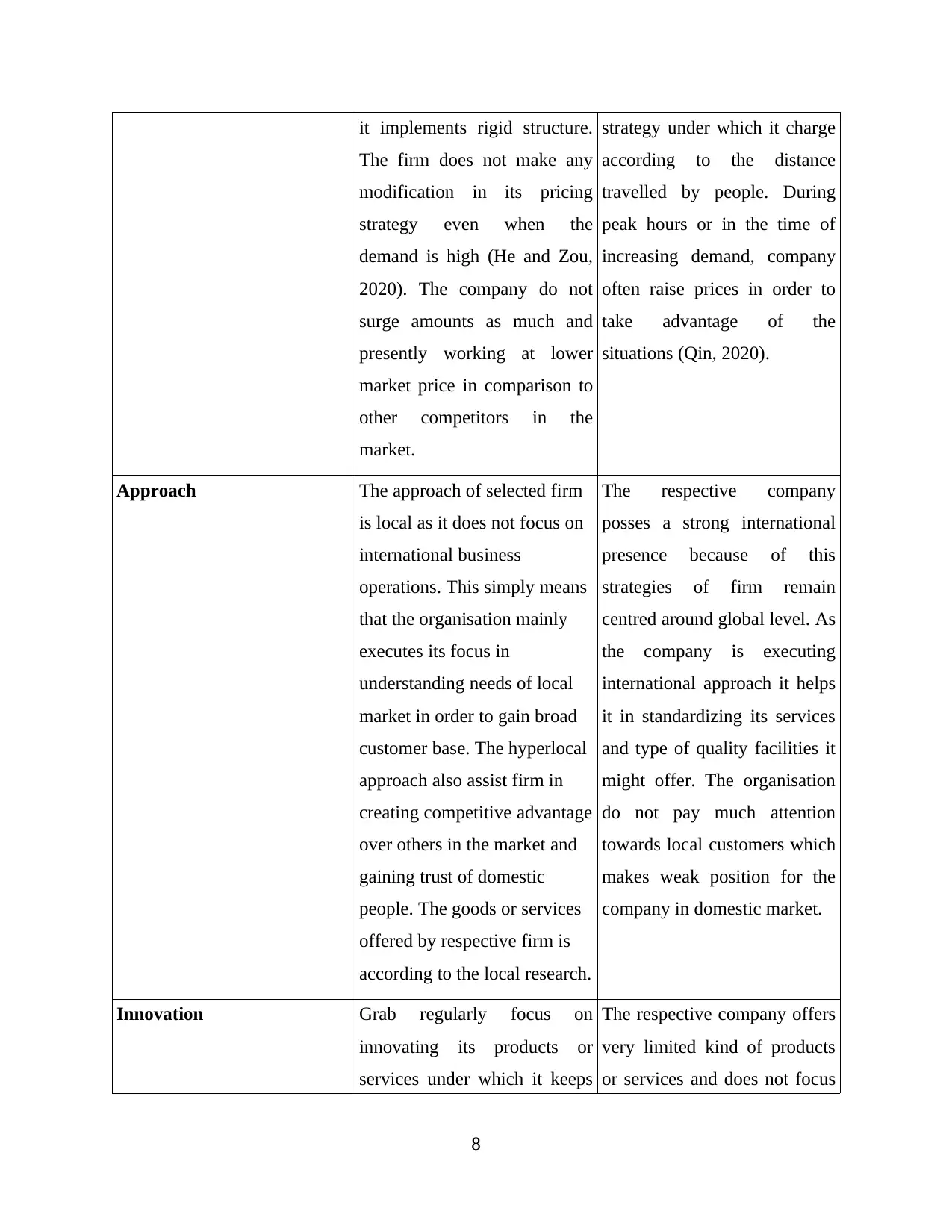
it implements rigid structure.
The firm does not make any
modification in its pricing
strategy even when the
demand is high (He and Zou,
2020). The company do not
surge amounts as much and
presently working at lower
market price in comparison to
other competitors in the
market.
strategy under which it charge
according to the distance
travelled by people. During
peak hours or in the time of
increasing demand, company
often raise prices in order to
take advantage of the
situations (Qin, 2020).
Approach The approach of selected firm
is local as it does not focus on
international business
operations. This simply means
that the organisation mainly
executes its focus in
understanding needs of local
market in order to gain broad
customer base. The hyperlocal
approach also assist firm in
creating competitive advantage
over others in the market and
gaining trust of domestic
people. The goods or services
offered by respective firm is
according to the local research.
The respective company
posses a strong international
presence because of this
strategies of firm remain
centred around global level. As
the company is executing
international approach it helps
it in standardizing its services
and type of quality facilities it
might offer. The organisation
do not pay much attention
towards local customers which
makes weak position for the
company in domestic market.
Innovation Grab regularly focus on
innovating its products or
services under which it keeps
The respective company offers
very limited kind of products
or services and does not focus
8
The firm does not make any
modification in its pricing
strategy even when the
demand is high (He and Zou,
2020). The company do not
surge amounts as much and
presently working at lower
market price in comparison to
other competitors in the
market.
strategy under which it charge
according to the distance
travelled by people. During
peak hours or in the time of
increasing demand, company
often raise prices in order to
take advantage of the
situations (Qin, 2020).
Approach The approach of selected firm
is local as it does not focus on
international business
operations. This simply means
that the organisation mainly
executes its focus in
understanding needs of local
market in order to gain broad
customer base. The hyperlocal
approach also assist firm in
creating competitive advantage
over others in the market and
gaining trust of domestic
people. The goods or services
offered by respective firm is
according to the local research.
The respective company
posses a strong international
presence because of this
strategies of firm remain
centred around global level. As
the company is executing
international approach it helps
it in standardizing its services
and type of quality facilities it
might offer. The organisation
do not pay much attention
towards local customers which
makes weak position for the
company in domestic market.
Innovation Grab regularly focus on
innovating its products or
services under which it keeps
The respective company offers
very limited kind of products
or services and does not focus
8
Paraphrase This Document
Need a fresh take? Get an instant paraphrase of this document with our AI Paraphraser
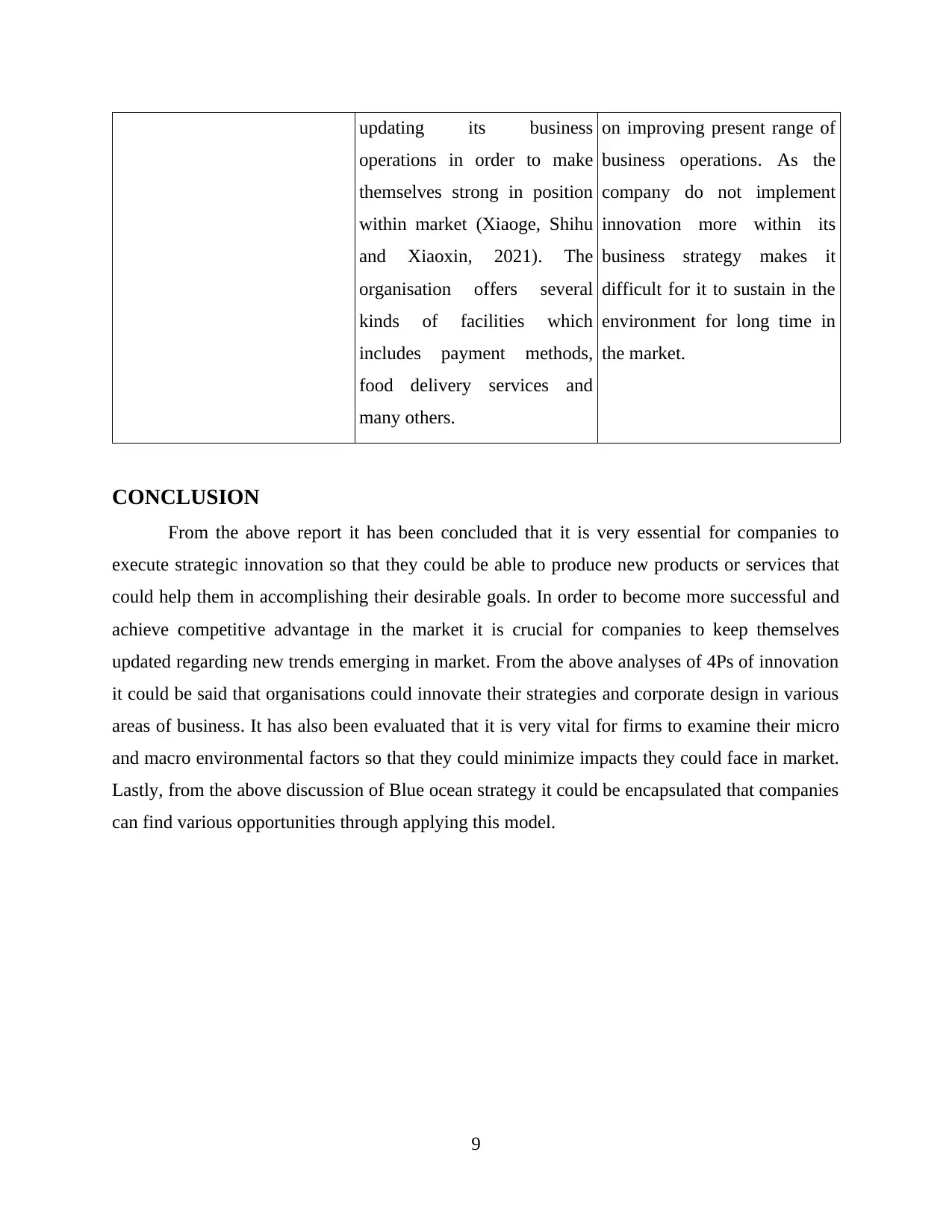
updating its business
operations in order to make
themselves strong in position
within market (Xiaoge, Shihu
and Xiaoxin, 2021). The
organisation offers several
kinds of facilities which
includes payment methods,
food delivery services and
many others.
on improving present range of
business operations. As the
company do not implement
innovation more within its
business strategy makes it
difficult for it to sustain in the
environment for long time in
the market.
CONCLUSION
From the above report it has been concluded that it is very essential for companies to
execute strategic innovation so that they could be able to produce new products or services that
could help them in accomplishing their desirable goals. In order to become more successful and
achieve competitive advantage in the market it is crucial for companies to keep themselves
updated regarding new trends emerging in market. From the above analyses of 4Ps of innovation
it could be said that organisations could innovate their strategies and corporate design in various
areas of business. It has also been evaluated that it is very vital for firms to examine their micro
and macro environmental factors so that they could minimize impacts they could face in market.
Lastly, from the above discussion of Blue ocean strategy it could be encapsulated that companies
can find various opportunities through applying this model.
9
operations in order to make
themselves strong in position
within market (Xiaoge, Shihu
and Xiaoxin, 2021). The
organisation offers several
kinds of facilities which
includes payment methods,
food delivery services and
many others.
on improving present range of
business operations. As the
company do not implement
innovation more within its
business strategy makes it
difficult for it to sustain in the
environment for long time in
the market.
CONCLUSION
From the above report it has been concluded that it is very essential for companies to
execute strategic innovation so that they could be able to produce new products or services that
could help them in accomplishing their desirable goals. In order to become more successful and
achieve competitive advantage in the market it is crucial for companies to keep themselves
updated regarding new trends emerging in market. From the above analyses of 4Ps of innovation
it could be said that organisations could innovate their strategies and corporate design in various
areas of business. It has also been evaluated that it is very vital for firms to examine their micro
and macro environmental factors so that they could minimize impacts they could face in market.
Lastly, from the above discussion of Blue ocean strategy it could be encapsulated that companies
can find various opportunities through applying this model.
9
REFERENCES
Books and Journals
Aleksin, G., 2019. The Financial Strategy Instrument in the Context of Enterprise Modernization.
Scientific Bulletin of the National Academy of Statistics, Accounting and Audit, (3),
pp.20-29.
He, D. and Zou, H., 2020, April. Evolutionary Game of Technology Sharing Based on Enterprise
Incentives. In 3rd International Conference on Advances in Management Science and
Engineering (IC-AMSE 2020) (pp. 181-185). Atlantis Press.
Jnr, B.A., 2020. Examining the role of green IT/IS innovation in collaborative enterprise-
implications in an emerging economy. Technology in Society, 62, p.101301.
Kahn, K.B., 2018. Understanding innovation. Business Horizons, 61(3), pp.453-460.
Kalaman, O., Savenko, I. and Dolynska, O., 2019. Conceptual positions of enterprise strategy
functioning. Food Industry Economics, 11(3).
LI, E.J. and LI, Q., 2021. Local Government Innovation Competition and Enterprise Innovation.
Contemporary Finance & Economics, (4), p.16.
Qin, M., 2020, October. Innovation of Enterprise Economic Management Based on Artificial
Intelligence Technology. In 2020 International Conference on Computers, Information
Processing and Advanced Education (CIPAE) (pp. 125-129). IEEE.
Scupola, A. and Nicolajsen, H.W., 2021. Enterprise Crowdsourcing and Organizational Culture:
Lessons From an Engineering Consultancy. International Journal of E-Services and
Mobile Applications (IJESMA), 13(2), pp.1-20.
Shuangzhe, L., 2020, December. Analysis of Enterprise Technological Innovation in the Era of
Big Data Based on Mathematical Models. In 2020 16th Dahe Fortune China Forum
and Chinese High-educational Management Annual Academic Conference (DFHMC)
(pp. 348-351). IEEE.
Suna, J. and Liub, G., 2021. Research on the Impact of Product Quality Upgrading on Enterprise
Performance.
Tavares, C., 2021. Digital Lab Strategy: Enterprise Approach. Digital Transformation of the
Laboratory: A Practical Guide to the Connected Lab, pp.265-273.
Tomashuk, I.V. and Tomashuk, I.O., 2021. Enterprise development strategy: innovation and
internal flexibility. Сolloquium-journal. Warszawa. Poland: Warszawa, 2021.№ 3 (90),
vol 4. Р. 51-66.
Wahab, N.A.A. and Jabar, J., 2017. Organizational Innovation Strategy Towards Small Medium
Enterprise Performance in Malaysia. International Journal of Arts Humanities and
Social Sciences, 2(7), pp.1-9.
Wang, Y. and Yang, Y., 2021. Jiangsu Financial Policy on Enterprise Technological Innovation.
Frontiers in Economics and Management, 2(11), pp.168-174.
Xiaoge, Z., Shihu, Z. and Xiaoxin, G., 2021. Digital inclusive finance development, financial
mismatch mitigation and enterprise innovations. Science Research Management, 42(4),
p.158.
Zhu, W. and Bai, D., 2019, December. Analysis on the current situation of patent cooperation
between school and enterprise. In 2019 International Conference on Economic
Management and Model Engineering (ICEMME) (pp. 8-11). IEEE.
10
Books and Journals
Aleksin, G., 2019. The Financial Strategy Instrument in the Context of Enterprise Modernization.
Scientific Bulletin of the National Academy of Statistics, Accounting and Audit, (3),
pp.20-29.
He, D. and Zou, H., 2020, April. Evolutionary Game of Technology Sharing Based on Enterprise
Incentives. In 3rd International Conference on Advances in Management Science and
Engineering (IC-AMSE 2020) (pp. 181-185). Atlantis Press.
Jnr, B.A., 2020. Examining the role of green IT/IS innovation in collaborative enterprise-
implications in an emerging economy. Technology in Society, 62, p.101301.
Kahn, K.B., 2018. Understanding innovation. Business Horizons, 61(3), pp.453-460.
Kalaman, O., Savenko, I. and Dolynska, O., 2019. Conceptual positions of enterprise strategy
functioning. Food Industry Economics, 11(3).
LI, E.J. and LI, Q., 2021. Local Government Innovation Competition and Enterprise Innovation.
Contemporary Finance & Economics, (4), p.16.
Qin, M., 2020, October. Innovation of Enterprise Economic Management Based on Artificial
Intelligence Technology. In 2020 International Conference on Computers, Information
Processing and Advanced Education (CIPAE) (pp. 125-129). IEEE.
Scupola, A. and Nicolajsen, H.W., 2021. Enterprise Crowdsourcing and Organizational Culture:
Lessons From an Engineering Consultancy. International Journal of E-Services and
Mobile Applications (IJESMA), 13(2), pp.1-20.
Shuangzhe, L., 2020, December. Analysis of Enterprise Technological Innovation in the Era of
Big Data Based on Mathematical Models. In 2020 16th Dahe Fortune China Forum
and Chinese High-educational Management Annual Academic Conference (DFHMC)
(pp. 348-351). IEEE.
Suna, J. and Liub, G., 2021. Research on the Impact of Product Quality Upgrading on Enterprise
Performance.
Tavares, C., 2021. Digital Lab Strategy: Enterprise Approach. Digital Transformation of the
Laboratory: A Practical Guide to the Connected Lab, pp.265-273.
Tomashuk, I.V. and Tomashuk, I.O., 2021. Enterprise development strategy: innovation and
internal flexibility. Сolloquium-journal. Warszawa. Poland: Warszawa, 2021.№ 3 (90),
vol 4. Р. 51-66.
Wahab, N.A.A. and Jabar, J., 2017. Organizational Innovation Strategy Towards Small Medium
Enterprise Performance in Malaysia. International Journal of Arts Humanities and
Social Sciences, 2(7), pp.1-9.
Wang, Y. and Yang, Y., 2021. Jiangsu Financial Policy on Enterprise Technological Innovation.
Frontiers in Economics and Management, 2(11), pp.168-174.
Xiaoge, Z., Shihu, Z. and Xiaoxin, G., 2021. Digital inclusive finance development, financial
mismatch mitigation and enterprise innovations. Science Research Management, 42(4),
p.158.
Zhu, W. and Bai, D., 2019, December. Analysis on the current situation of patent cooperation
between school and enterprise. In 2019 International Conference on Economic
Management and Model Engineering (ICEMME) (pp. 8-11). IEEE.
10
⊘ This is a preview!⊘
Do you want full access?
Subscribe today to unlock all pages.
Trusted by 1+ million students worldwide

1 out of 12


Related Documents


Your All-in-One AI-Powered Toolkit for Academic Success.
+13062052269
info@desklib.com
Available 24*7 on WhatsApp / Email
![[object Object]](/_next/static/media/star-bottom.7253800d.svg)
Unlock your academic potential
Copyright © 2020–2026 A2Z Services. All Rights Reserved. Developed and managed by ZUCOL.