Graduate Certificate Career Development Assignment
VerifiedAdded on 2022/11/14
|9
|2249
|192
Homework Assignment
AI Summary
This assignment addresses career development, focusing on worker and employer issues, and diverse populations. It analyzes a case study involving workplace harassment, exploring relevant laws and career management skills. The assignment also delves into career development theories, including trait and factor, social learning, and social cognitive theories. Furthermore, it examines the career journey of Chris Sarra, an Indigenous individual, considering the barriers faced and the support required. The document also discusses employment trends and their impact on recruitment, selection processes, and client preparation for transitioning into employment. Additionally, the assignment provides resources like joboutlook.gov.au and labour market information portals to assist clients in their career planning.
Running head: CAREER DEVELOPMENT
CAREER DEVELOPMENT
Name of the Student
Name of the University
Author note
CAREER DEVELOPMENT
Name of the Student
Name of the University
Author note

Paraphrase This Document
Need a fresh take? Get an instant paraphrase of this document with our AI Paraphraser
1CAREER DEVELOPMENT
Assessment Task 2: Worker and Employer Issues
a) Aleena requires proper communicative skills and understanding of workplace laws and
regulations to bring this issue to the higher authority in order to maintain a safe and ethical
workplace environment for herself.
Laws: Fair Work Act 2009, Sex Discrimination act 1984, Racial Discrimination Act 1975.
b) Occupational health and Safety forms the crux of a safe, healthy and productive working
environment for all employees as well as employers alike. This general notion of OHS can be
made specific to the clients when career planning by specifically highlighting how a proper
OHS framework functions, which are the aspects of health and safety that are particular to
each industry of work (for instance a construction OHS will be different from a laboratory
OHS) and how the safe work Australia resources can be utilised to gather an in depth
understanding of each of these aspects.
c) The Victorian Equal opportunities and Human Rights Commission identifies the fair
and respectful treatment of employees as a key employer responsibility
(Humanrightscommission.vic.gov.au, 2019), as set out in the Equal Opportunity Act 2010
and the Federal Human Rights Laws. The Fairwork templates and best practice guides can be
used with clients in Melbourne, Victoria to provide important information and training to
clients. For instance, the Fairwork templates that provide support regarding a variety of
employment related elements including working hours, work – life balance maintenance,
performance and underperformance management, record keeping of pay slips etc, serve as a
detailed resource for understanding and keeping explicit records of progress and barriers.
Similarly, the best practice guides can be used to provide individual or group training to a
cohort of clients regarding how to manage and maintain those specific aspects as mentioned
above, during their tenure of employment.
Alternately, the following resources can be used with my clients –
Assessment Task 2: Worker and Employer Issues
a) Aleena requires proper communicative skills and understanding of workplace laws and
regulations to bring this issue to the higher authority in order to maintain a safe and ethical
workplace environment for herself.
Laws: Fair Work Act 2009, Sex Discrimination act 1984, Racial Discrimination Act 1975.
b) Occupational health and Safety forms the crux of a safe, healthy and productive working
environment for all employees as well as employers alike. This general notion of OHS can be
made specific to the clients when career planning by specifically highlighting how a proper
OHS framework functions, which are the aspects of health and safety that are particular to
each industry of work (for instance a construction OHS will be different from a laboratory
OHS) and how the safe work Australia resources can be utilised to gather an in depth
understanding of each of these aspects.
c) The Victorian Equal opportunities and Human Rights Commission identifies the fair
and respectful treatment of employees as a key employer responsibility
(Humanrightscommission.vic.gov.au, 2019), as set out in the Equal Opportunity Act 2010
and the Federal Human Rights Laws. The Fairwork templates and best practice guides can be
used with clients in Melbourne, Victoria to provide important information and training to
clients. For instance, the Fairwork templates that provide support regarding a variety of
employment related elements including working hours, work – life balance maintenance,
performance and underperformance management, record keeping of pay slips etc, serve as a
detailed resource for understanding and keeping explicit records of progress and barriers.
Similarly, the best practice guides can be used to provide individual or group training to a
cohort of clients regarding how to manage and maintain those specific aspects as mentioned
above, during their tenure of employment.
Alternately, the following resources can be used with my clients –
2CAREER DEVELOPMENT
The Foundation for Young Australians (FYA 2019) – the latest report in the FYA
titled ‘The New Work Reality’ (June 2018), reports how almost half of Australia’s 25 year
old youths are unable to secure an employment despite holding post school qualifications as
well as identifies significant factors that can help students transition effectively from full time
education to employment.
National Centre for Student Equity in Higher Education (NCSEHE) – It’s a
Curtin University based research and policy centre responsible for providing national
leadership in student equity in higher education by connecting research, policy and practice in
order to improve participation and success in higher education for the marginalised and
disadvantaged people.
OECD report (OECD 2019) – The OECD reports regarding education and
employment provides a variety of qualitative and quantitative resources ranging from skills
and requirements for jobs to adult education as well as inclusive and innovative ways of
working with Indigenous Australians to improve employment prospects.
Bradley Report – the Bradley Review of Higher Education considers and reports
about the structural, functional and financial organisation of higher education sectors
responsible for promoting for a skilled Australian workforce (Bradley et al. 2008).
d) “out-of-date industrial age career choice paradigm is putting [people] at risk”
This statement is a direct indication to the disparity between the old paradigm (career choice)
and the new paradigm (career management). The extract is not just a highlight of the
conundrum but also an indirect call for action where a paradigm shift is identified as a
mandate. It means that there is a disparity between the traditional and contemporary career
choice practices where the former entails finding a particular job, identifying it as the only
possible opportunity to establish oneself and grow and the latter entails identifying a career as
an opportunity for personal growth and development for further future prospects. Therefore
The Foundation for Young Australians (FYA 2019) – the latest report in the FYA
titled ‘The New Work Reality’ (June 2018), reports how almost half of Australia’s 25 year
old youths are unable to secure an employment despite holding post school qualifications as
well as identifies significant factors that can help students transition effectively from full time
education to employment.
National Centre for Student Equity in Higher Education (NCSEHE) – It’s a
Curtin University based research and policy centre responsible for providing national
leadership in student equity in higher education by connecting research, policy and practice in
order to improve participation and success in higher education for the marginalised and
disadvantaged people.
OECD report (OECD 2019) – The OECD reports regarding education and
employment provides a variety of qualitative and quantitative resources ranging from skills
and requirements for jobs to adult education as well as inclusive and innovative ways of
working with Indigenous Australians to improve employment prospects.
Bradley Report – the Bradley Review of Higher Education considers and reports
about the structural, functional and financial organisation of higher education sectors
responsible for promoting for a skilled Australian workforce (Bradley et al. 2008).
d) “out-of-date industrial age career choice paradigm is putting [people] at risk”
This statement is a direct indication to the disparity between the old paradigm (career choice)
and the new paradigm (career management). The extract is not just a highlight of the
conundrum but also an indirect call for action where a paradigm shift is identified as a
mandate. It means that there is a disparity between the traditional and contemporary career
choice practices where the former entails finding a particular job, identifying it as the only
possible opportunity to establish oneself and grow and the latter entails identifying a career as
an opportunity for personal growth and development for further future prospects. Therefore
⊘ This is a preview!⊘
Do you want full access?
Subscribe today to unlock all pages.

Trusted by 1+ million students worldwide
3CAREER DEVELOPMENT
the new paradigm offers a much more versatile and flexible prospect for the employees where
they do not have to stay stagnant in one job but can move forward with multiple short term
jobs, expanding their base of skill and knowledge, while gathering experience.
e) In the next four years, the key employment trends that will be affecting clients is the
steadily advancing domain of technology and artificial intelligence which, with the increased
work efficiency and outcome, put the manual labour and workforce at risk of unemployment
(Talwar 2015; Welsh 2015). At the same time further changes in the employment paradigm
include a further shift in the development of new work opportunities that evolve from the
newer combinations of various multidisciplinary skills, and the independence that the
individuals will have regarding their own responsibilities towards employability and career
development. This would include increase in contract based and part time jobs (McMahon &
Tatham 2001; Feller 2003), short term employments and self employments (Inkson 2002;
Krumboltz 1998), as well as more reliance on specific personal skills and experience than on
occupational titles (Savickas 2000)
f) This shift affects the recruitment and selection process by eliminating the previously held
notions of employability and eligibility based on a limited skill set. Preparing clients for
transitioning into employment would require a focused intervention where the clients are
made aware of the emerging trends, their associated risks and benefits as well as the
opportunities that they can capitalise in order to build and develop their own employability
options (McMahon, Patton & Tatham 2003).
g)
Resource Information provided Client use
http://joboutlook.gov.au (website
accessed Nov 2018)
Future job outlooks
Pay scale
Job requirements
Additional career demands
Employment prospects
Miscellaneous resources
Clients can search for
specific information
regarding employability,
industry and match them
with the relevant skills they
possess.
They can also take career
the new paradigm offers a much more versatile and flexible prospect for the employees where
they do not have to stay stagnant in one job but can move forward with multiple short term
jobs, expanding their base of skill and knowledge, while gathering experience.
e) In the next four years, the key employment trends that will be affecting clients is the
steadily advancing domain of technology and artificial intelligence which, with the increased
work efficiency and outcome, put the manual labour and workforce at risk of unemployment
(Talwar 2015; Welsh 2015). At the same time further changes in the employment paradigm
include a further shift in the development of new work opportunities that evolve from the
newer combinations of various multidisciplinary skills, and the independence that the
individuals will have regarding their own responsibilities towards employability and career
development. This would include increase in contract based and part time jobs (McMahon &
Tatham 2001; Feller 2003), short term employments and self employments (Inkson 2002;
Krumboltz 1998), as well as more reliance on specific personal skills and experience than on
occupational titles (Savickas 2000)
f) This shift affects the recruitment and selection process by eliminating the previously held
notions of employability and eligibility based on a limited skill set. Preparing clients for
transitioning into employment would require a focused intervention where the clients are
made aware of the emerging trends, their associated risks and benefits as well as the
opportunities that they can capitalise in order to build and develop their own employability
options (McMahon, Patton & Tatham 2003).
g)
Resource Information provided Client use
http://joboutlook.gov.au (website
accessed Nov 2018)
Future job outlooks
Pay scale
Job requirements
Additional career demands
Employment prospects
Miscellaneous resources
Clients can search for
specific information
regarding employability,
industry and match them
with the relevant skills they
possess.
They can also take career
Paraphrase This Document
Need a fresh take? Get an instant paraphrase of this document with our AI Paraphraser
4CAREER DEVELOPMENT
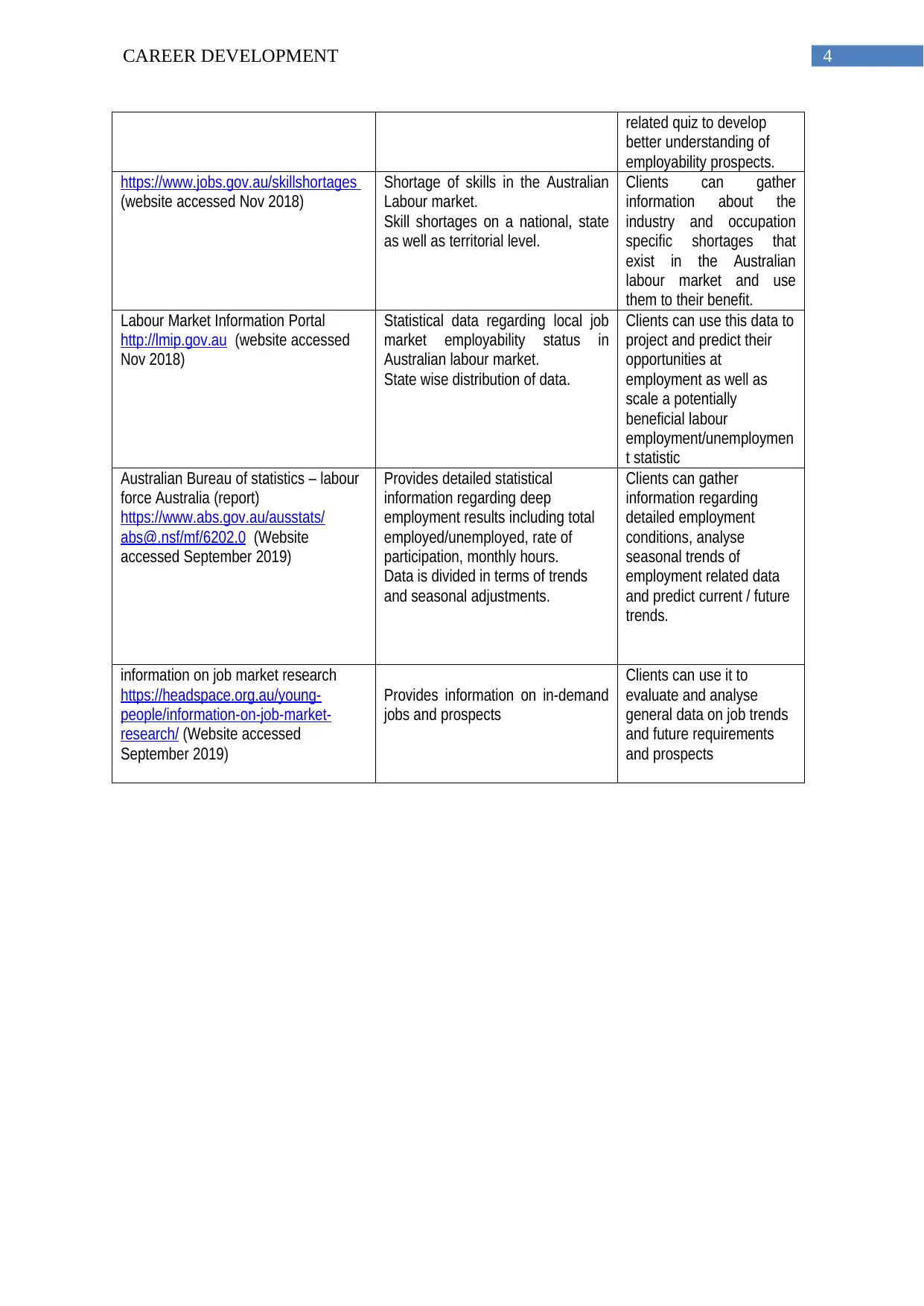
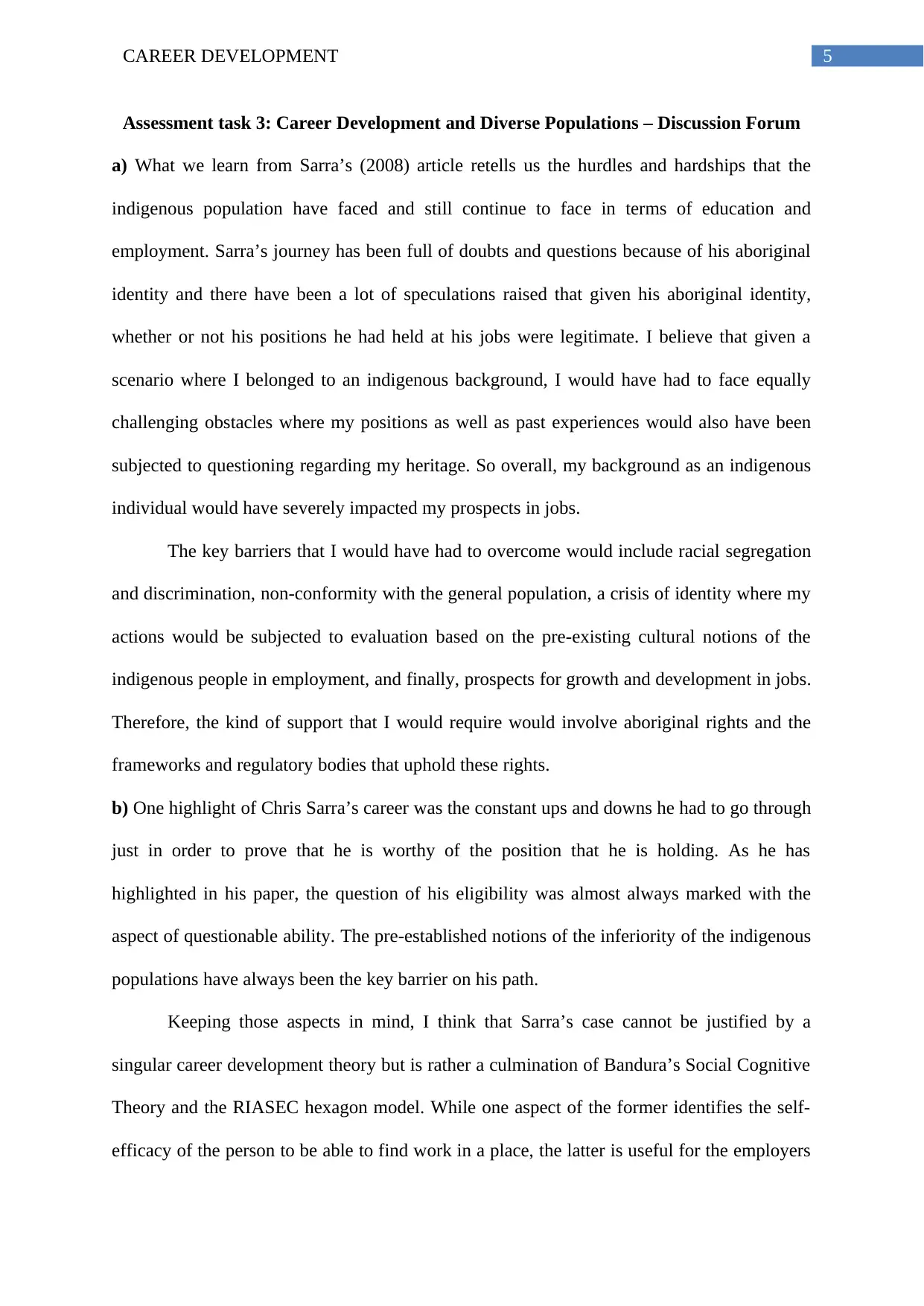
related quiz to develop
better understanding of
employability prospects.
https://www.jobs.gov.au/skillshortages
(website accessed Nov 2018)
Shortage of skills in the Australian
Labour market.
Skill shortages on a national, state
as well as territorial level.
Clients can gather
information about the
industry and occupation
specific shortages that
exist in the Australian
labour market and use
them to their benefit.
Labour Market Information Portal
http://lmip.gov.au (website accessed
Nov 2018)
Statistical data regarding local job
market employability status in
Australian labour market.
State wise distribution of data.
Clients can use this data to
project and predict their
opportunities at
employment as well as
scale a potentially
beneficial labour
employment/unemploymen
t statistic
Australian Bureau of statistics – labour
force Australia (report)
https://www.abs.gov.au/ausstats/
abs@.nsf/mf/6202.0 (Website
accessed September 2019)
Provides detailed statistical
information regarding deep
employment results including total
employed/unemployed, rate of
participation, monthly hours.
Data is divided in terms of trends
and seasonal adjustments.
Clients can gather
information regarding
detailed employment
conditions, analyse
seasonal trends of
employment related data
and predict current / future
trends.
information on job market research
https://headspace.org.au/young-
people/information-on-job-market-
research/ (Website accessed
September 2019)
Provides information on in-demand
jobs and prospects
Clients can use it to
evaluate and analyse
general data on job trends
and future requirements
and prospects
related quiz to develop
better understanding of
employability prospects.
https://www.jobs.gov.au/skillshortages
(website accessed Nov 2018)
Shortage of skills in the Australian
Labour market.
Skill shortages on a national, state
as well as territorial level.
Clients can gather
information about the
industry and occupation
specific shortages that
exist in the Australian
labour market and use
them to their benefit.
Labour Market Information Portal
http://lmip.gov.au (website accessed
Nov 2018)
Statistical data regarding local job
market employability status in
Australian labour market.
State wise distribution of data.
Clients can use this data to
project and predict their
opportunities at
employment as well as
scale a potentially
beneficial labour
employment/unemploymen
t statistic
Australian Bureau of statistics – labour
force Australia (report)
https://www.abs.gov.au/ausstats/
abs@.nsf/mf/6202.0 (Website
accessed September 2019)
Provides detailed statistical
information regarding deep
employment results including total
employed/unemployed, rate of
participation, monthly hours.
Data is divided in terms of trends
and seasonal adjustments.
Clients can gather
information regarding
detailed employment
conditions, analyse
seasonal trends of
employment related data
and predict current / future
trends.
information on job market research
https://headspace.org.au/young-
people/information-on-job-market-
research/ (Website accessed
September 2019)
Provides information on in-demand
jobs and prospects
Clients can use it to
evaluate and analyse
general data on job trends
and future requirements
and prospects
5CAREER DEVELOPMENT
Assessment task 3: Career Development and Diverse Populations – Discussion Forum
a) What we learn from Sarra’s (2008) article retells us the hurdles and hardships that the
indigenous population have faced and still continue to face in terms of education and
employment. Sarra’s journey has been full of doubts and questions because of his aboriginal
identity and there have been a lot of speculations raised that given his aboriginal identity,
whether or not his positions he had held at his jobs were legitimate. I believe that given a
scenario where I belonged to an indigenous background, I would have had to face equally
challenging obstacles where my positions as well as past experiences would also have been
subjected to questioning regarding my heritage. So overall, my background as an indigenous
individual would have severely impacted my prospects in jobs.
The key barriers that I would have had to overcome would include racial segregation
and discrimination, non-conformity with the general population, a crisis of identity where my
actions would be subjected to evaluation based on the pre-existing cultural notions of the
indigenous people in employment, and finally, prospects for growth and development in jobs.
Therefore, the kind of support that I would require would involve aboriginal rights and the
frameworks and regulatory bodies that uphold these rights.
b) One highlight of Chris Sarra’s career was the constant ups and downs he had to go through
just in order to prove that he is worthy of the position that he is holding. As he has
highlighted in his paper, the question of his eligibility was almost always marked with the
aspect of questionable ability. The pre-established notions of the inferiority of the indigenous
populations have always been the key barrier on his path.
Keeping those aspects in mind, I think that Sarra’s case cannot be justified by a
singular career development theory but is rather a culmination of Bandura’s Social Cognitive
Theory and the RIASEC hexagon model. While one aspect of the former identifies the self-
efficacy of the person to be able to find work in a place, the latter is useful for the employers
Assessment task 3: Career Development and Diverse Populations – Discussion Forum
a) What we learn from Sarra’s (2008) article retells us the hurdles and hardships that the
indigenous population have faced and still continue to face in terms of education and
employment. Sarra’s journey has been full of doubts and questions because of his aboriginal
identity and there have been a lot of speculations raised that given his aboriginal identity,
whether or not his positions he had held at his jobs were legitimate. I believe that given a
scenario where I belonged to an indigenous background, I would have had to face equally
challenging obstacles where my positions as well as past experiences would also have been
subjected to questioning regarding my heritage. So overall, my background as an indigenous
individual would have severely impacted my prospects in jobs.
The key barriers that I would have had to overcome would include racial segregation
and discrimination, non-conformity with the general population, a crisis of identity where my
actions would be subjected to evaluation based on the pre-existing cultural notions of the
indigenous people in employment, and finally, prospects for growth and development in jobs.
Therefore, the kind of support that I would require would involve aboriginal rights and the
frameworks and regulatory bodies that uphold these rights.
b) One highlight of Chris Sarra’s career was the constant ups and downs he had to go through
just in order to prove that he is worthy of the position that he is holding. As he has
highlighted in his paper, the question of his eligibility was almost always marked with the
aspect of questionable ability. The pre-established notions of the inferiority of the indigenous
populations have always been the key barrier on his path.
Keeping those aspects in mind, I think that Sarra’s case cannot be justified by a
singular career development theory but is rather a culmination of Bandura’s Social Cognitive
Theory and the RIASEC hexagon model. While one aspect of the former identifies the self-
efficacy of the person to be able to find work in a place, the latter is useful for the employers
⊘ This is a preview!⊘
Do you want full access?
Subscribe today to unlock all pages.
Trusted by 1+ million students worldwide
6CAREER DEVELOPMENT
in determining where an employee is lacking and help them get back on track. Through micro
– modifications, both these theories can effectively provide a justification for the case of
Sarra.
c) Career development theories are either too focused on an individual or on the aspect of
employment and the employer – employee dilemma. In order to be more inclusive, the career
development theories must include external aspects like how the social conception of
indigenous individuals are more affective of an individual’s career choices. In fact, Kerka
(2003) identifies that in order to formulate a more effective inclusive career development,
there are eight significant aspects that can be considered. Those aspects range from the
establishment of a culturally appropriate relationship, slowly includes and merges aspects of
assessment of the cultural influences on career choices and establishes a functional base
where the career development practitioners are aware of their own views of the world,
identity salience as well as the values and attitudes towards indigenous populations (Kerka
2003).
in determining where an employee is lacking and help them get back on track. Through micro
– modifications, both these theories can effectively provide a justification for the case of
Sarra.
c) Career development theories are either too focused on an individual or on the aspect of
employment and the employer – employee dilemma. In order to be more inclusive, the career
development theories must include external aspects like how the social conception of
indigenous individuals are more affective of an individual’s career choices. In fact, Kerka
(2003) identifies that in order to formulate a more effective inclusive career development,
there are eight significant aspects that can be considered. Those aspects range from the
establishment of a culturally appropriate relationship, slowly includes and merges aspects of
assessment of the cultural influences on career choices and establishes a functional base
where the career development practitioners are aware of their own views of the world,
identity salience as well as the values and attitudes towards indigenous populations (Kerka
2003).
Paraphrase This Document
Need a fresh take? Get an instant paraphrase of this document with our AI Paraphraser
7CAREER DEVELOPMENT
References
Bradley, D., Noonan, P., Nugent, H. and Scales, B., 2008. Review of Australian higher
education: Final report.
Feller, R.W., 2003. Aligning school counseling, the changing workplace, and career
development assumptions. Professional School Counseling, 6(4), pp.262-271.
FYA 2019. , Our Research, viewed 24 Sept 2019, < https://www.fya.org.au/our-research/ >.
Humanrightscommission.vic.gov.au 2019. Workplace Law viewed 24 Sept 2019, <
https://www.humanrightscommission.vic.gov.au/the-law/workplace-law >
Inkson, K., 2002. The transfiguration of careers: Some evidence from New Zealand. The
International Careers Journal (2002, November).
Jarvis, P., 2013. Perfect Storm to Hit Job Markets! Whole Community Approach to Career
and Workforce Development.
Kerka, S., 2003. Career Development of Diverse Populations. ERIC Digest.
Krumboltz, J.D., 1998. Counsellor actions needed for the new career perspective. British
Journal of Guidance and Counselling, 26(4), pp.559-564.
McMahon, M. and Tatham, P., 2001. Career, More Than Just a Job: Career Guidance
Understandings Informing the Development of the National Career Information System.
Canberra: DETYA & education.au. Ltd.
McMahon, M., Patton, W. and Tatham, P., 2003. Managing life, learning and work in the
21st century: Issues informing the design of an Australian blueprint for career
development. Subiaco, WA: Miles Morgan.
OECD 2019, Educattion, viewed 24 Sept
2019, <https://www.oecd.org/australia/bytopic/education/>
Sarra, C., 2008. Being Aboriginal: Some inter-cultural communication challenges for career
development practitioners from my life experiences.
References
Bradley, D., Noonan, P., Nugent, H. and Scales, B., 2008. Review of Australian higher
education: Final report.
Feller, R.W., 2003. Aligning school counseling, the changing workplace, and career
development assumptions. Professional School Counseling, 6(4), pp.262-271.
FYA 2019. , Our Research, viewed 24 Sept 2019, < https://www.fya.org.au/our-research/ >.
Humanrightscommission.vic.gov.au 2019. Workplace Law viewed 24 Sept 2019, <
https://www.humanrightscommission.vic.gov.au/the-law/workplace-law >
Inkson, K., 2002. The transfiguration of careers: Some evidence from New Zealand. The
International Careers Journal (2002, November).
Jarvis, P., 2013. Perfect Storm to Hit Job Markets! Whole Community Approach to Career
and Workforce Development.
Kerka, S., 2003. Career Development of Diverse Populations. ERIC Digest.
Krumboltz, J.D., 1998. Counsellor actions needed for the new career perspective. British
Journal of Guidance and Counselling, 26(4), pp.559-564.
McMahon, M. and Tatham, P., 2001. Career, More Than Just a Job: Career Guidance
Understandings Informing the Development of the National Career Information System.
Canberra: DETYA & education.au. Ltd.
McMahon, M., Patton, W. and Tatham, P., 2003. Managing life, learning and work in the
21st century: Issues informing the design of an Australian blueprint for career
development. Subiaco, WA: Miles Morgan.
OECD 2019, Educattion, viewed 24 Sept
2019, <https://www.oecd.org/australia/bytopic/education/>
Sarra, C., 2008. Being Aboriginal: Some inter-cultural communication challenges for career
development practitioners from my life experiences.
8CAREER DEVELOPMENT
Savickas, M.L., 2000. Renovating the psychology of careers for the twenty-first century. The
future of career, pp.53-68. Cambridge, UK: Cambridge University Press.
Talwar, R., 2015. Artificial Intelligence - What Every CEO Should be Asking. Retrieved
from: http://raconteur.net/technology/ai-what-every-ceo-should-be-asking (accessed Sep
2019)
Welsh, S., 2015. The drive towards ethical AI and responsible robots has begun. The
Conversation. Retrieved from: https://theconversation.com/the-drive-towards-ethical-ai-and-
responsible-robots-has-begun-52300 (accessed Sep 2019)
Savickas, M.L., 2000. Renovating the psychology of careers for the twenty-first century. The
future of career, pp.53-68. Cambridge, UK: Cambridge University Press.
Talwar, R., 2015. Artificial Intelligence - What Every CEO Should be Asking. Retrieved
from: http://raconteur.net/technology/ai-what-every-ceo-should-be-asking (accessed Sep
2019)
Welsh, S., 2015. The drive towards ethical AI and responsible robots has begun. The
Conversation. Retrieved from: https://theconversation.com/the-drive-towards-ethical-ai-and-
responsible-robots-has-begun-52300 (accessed Sep 2019)
⊘ This is a preview!⊘
Do you want full access?
Subscribe today to unlock all pages.
Trusted by 1+ million students worldwide

1 out of 9


Related Documents


Your All-in-One AI-Powered Toolkit for Academic Success.
+13062052269
info@desklib.com
Available 24*7 on WhatsApp / Email
![[object Object]](/_next/static/media/star-bottom.7253800d.svg)
Unlock your academic potential
Copyright © 2020–2026 A2Z Services. All Rights Reserved. Developed and managed by ZUCOL.