Organizational Behaviour: Great Household Tools Case Study

Verified

Added on  2022/09/05

|3
|624
|11
Case Study
AI Summary
This case study analysis focuses on Great Household Tools (GHT), a company facing organizational challenges. The analysis addresses problems related to employee feedback, management availability, and workplace bias, particularly within the context of a company acquisition. The solution proposes constant employee feedback and monthly meetings to improve manager-employee relations, along with a schedule/roster for employee training on new equipment to combat bias. The analysis evaluates the advantages and disadvantages of each proposed solution, referencing relevant research on organizational behavior and employee relations. The case study provides valuable insights into leadership, employee engagement, and the management of organizational change within a growing company.
Document Page
1
Organization Behaviour
Organization Behaviour: Case Study Analysis ‘Great Household Tools’
Student Name:
Institute Name:
tabler-icon-diamond-filled.svg

Paraphrase This Document

Need a fresh take? Get an instant paraphrase of this document with our AI Paraphraser
Document Page
2
Organization Behaviour
Organization Behaviour: Case Study Analysis ‘Great Household Tools’
Problem 2
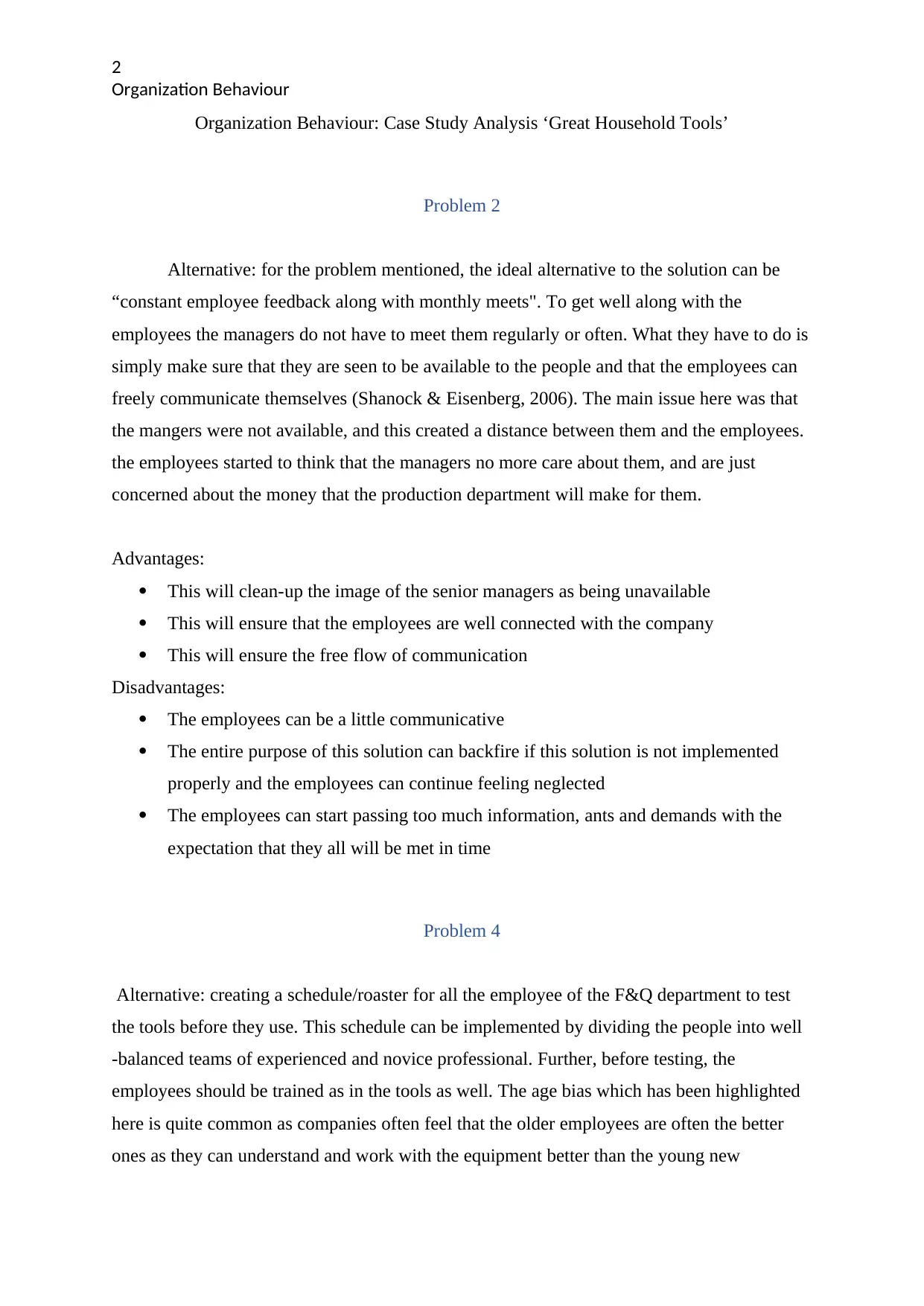
Alternative: for the problem mentioned, the ideal alternative to the solution can be
“constant employee feedback along with monthly meets". To get well along with the
employees the managers do not have to meet them regularly or often. What they have to do is
simply make sure that they are seen to be available to the people and that the employees can
freely communicate themselves (Shanock & Eisenberg, 2006). The main issue here was that
the mangers were not available, and this created a distance between them and the employees.
the employees started to think that the managers no more care about them, and are just
concerned about the money that the production department will make for them.
Advantages:
This will clean-up the image of the senior managers as being unavailable
This will ensure that the employees are well connected with the company
This will ensure the free flow of communication
Disadvantages:
The employees can be a little communicative
The entire purpose of this solution can backfire if this solution is not implemented
properly and the employees can continue feeling neglected
The employees can start passing too much information, ants and demands with the
expectation that they all will be met in time
Problem 4
Alternative: creating a schedule/roaster for all the employee of the F&Q department to test
the tools before they use. This schedule can be implemented by dividing the people into well
-balanced teams of experienced and novice professional. Further, before testing, the
employees should be trained as in the tools as well. The age bias which has been highlighted
here is quite common as companies often feel that the older employees are often the better
ones as they can understand and work with the equipment better than the young new
Document Page
3
Organization Behaviour
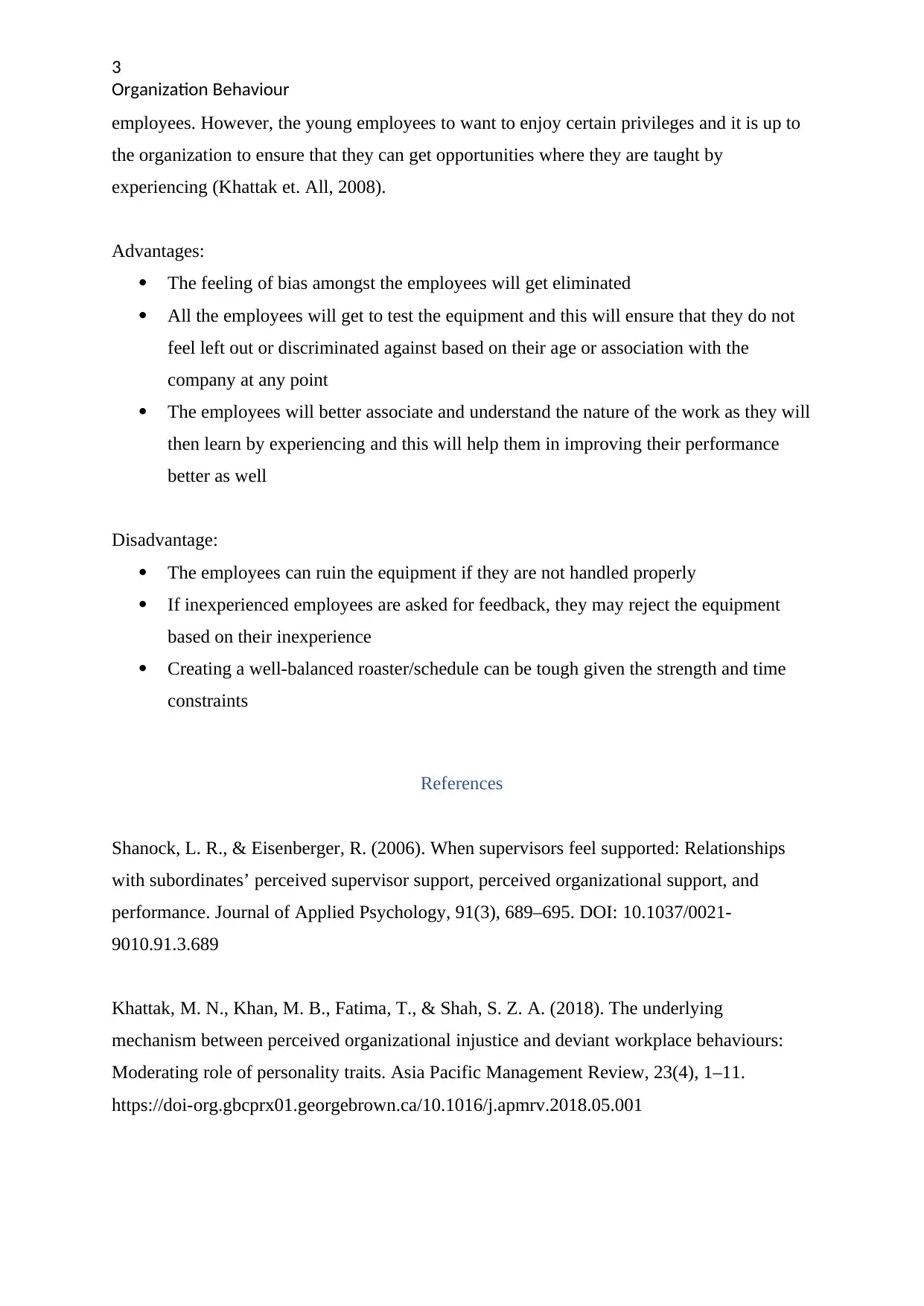
employees. However, the young employees to want to enjoy certain privileges and it is up to
the organization to ensure that they can get opportunities where they are taught by
experiencing (Khattak et. All, 2008).
Advantages:
The feeling of bias amongst the employees will get eliminated
All the employees will get to test the equipment and this will ensure that they do not
feel left out or discriminated against based on their age or association with the
company at any point
The employees will better associate and understand the nature of the work as they will
then learn by experiencing and this will help them in improving their performance
better as well
Disadvantage:
The employees can ruin the equipment if they are not handled properly
If inexperienced employees are asked for feedback, they may reject the equipment
based on their inexperience
Creating a well-balanced roaster/schedule can be tough given the strength and time
constraints
References
Shanock, L. R., & Eisenberger, R. (2006). When supervisors feel supported: Relationships
with subordinates’ perceived supervisor support, perceived organizational support, and
performance. Journal of Applied Psychology, 91(3), 689–695. DOI: 10.1037/0021-
9010.91.3.689
Khattak, M. N., Khan, M. B., Fatima, T., & Shah, S. Z. A. (2018). The underlying
mechanism between perceived organizational injustice and deviant workplace behaviours:
Moderating role of personality traits. Asia Pacific Management Review, 23(4), 1–11.
https://doi-org.gbcprx01.georgebrown.ca/10.1016/j.apmrv.2018.05.001
chevron_up_icon
1 out of 3
circle_padding
hide_on_mobile
zoom_out_icon
[object Object]