Faculty of Technology ENGT 5214: Green Building Projects Report

Verified

Added on  2023/05/27

|7
|892
|306
Report
AI Summary
This report provides an in-depth analysis of energy-efficient green building projects, aiming to understand their role and importance in the contemporary era. The report begins with a literature review, defining green buildings and discussing their benefits, such as resource efficiency, reduced energy consumption, and enhanced indoor environmental quality. It also addresses the challenges in constructing these buildings, including the need for skilled labor and the impact of changing climates. The proposed methodology includes both qualitative and quantitative approaches, employing interpretivism and an inductive research approach, with a descriptive research design. Data collection will be done using close-ended questionnaires and a non-probabilistic sampling method, followed by thematic data analysis. The research is planned to be completed in 16 weeks, with a timeline detailing the activities involved. The report concludes with a comprehensive list of references, supporting the findings and arguments presented throughout the analysis.
Document Page
Energy Efficient Green
Building Projects
tabler-icon-diamond-filled.svg

Paraphrase This Document

Need a fresh take? Get an instant paraphrase of this document with our AI Paraphraser
Document Page
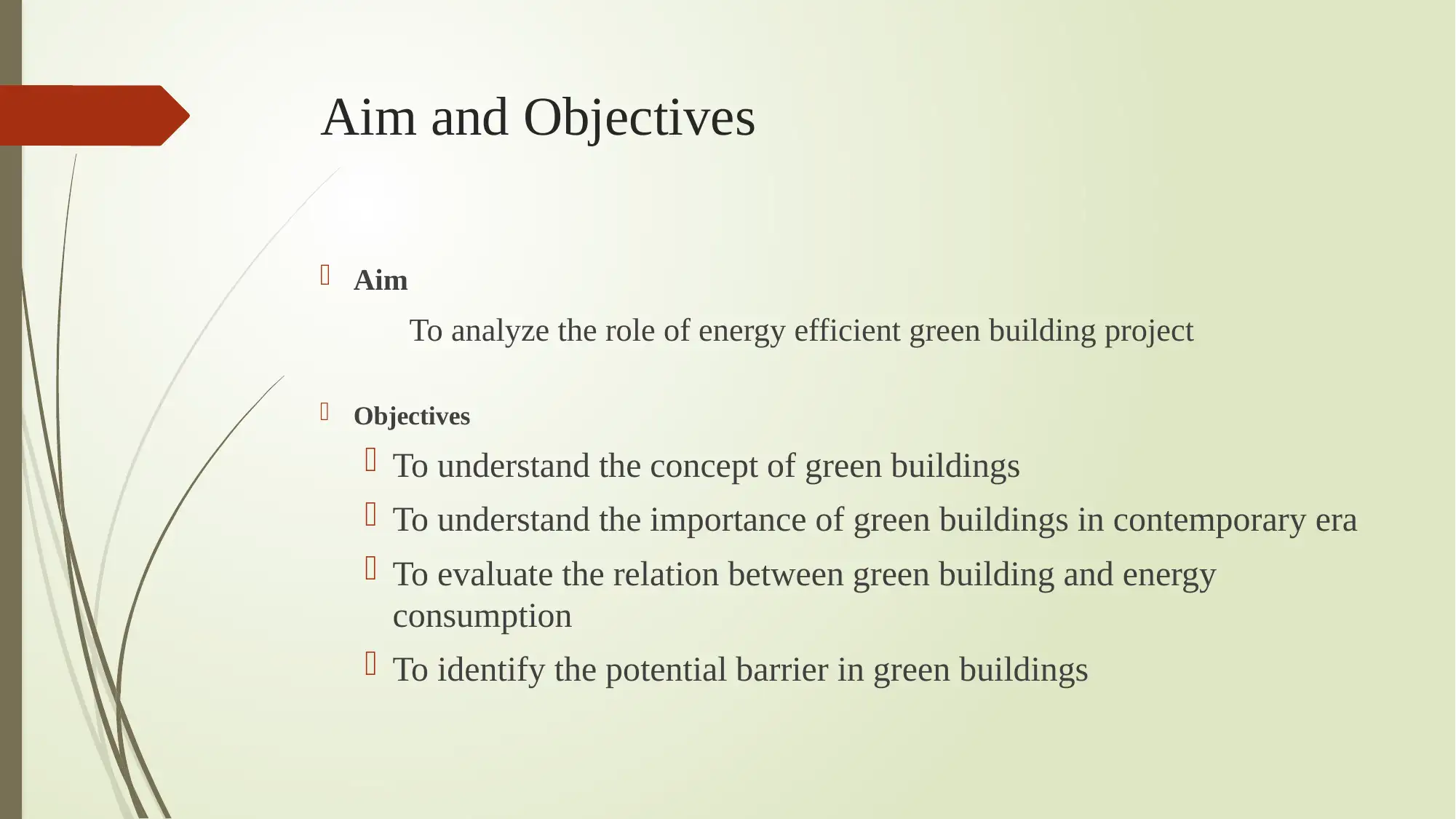
Aim and Objectives
Aim
To analyze the role of energy efficient green building project
Objectives
To understand the concept of green buildings
To understand the importance of green buildings in contemporary era
To evaluate the relation between green building and energy
consumption
To identify the potential barrier in green buildings
Document Page
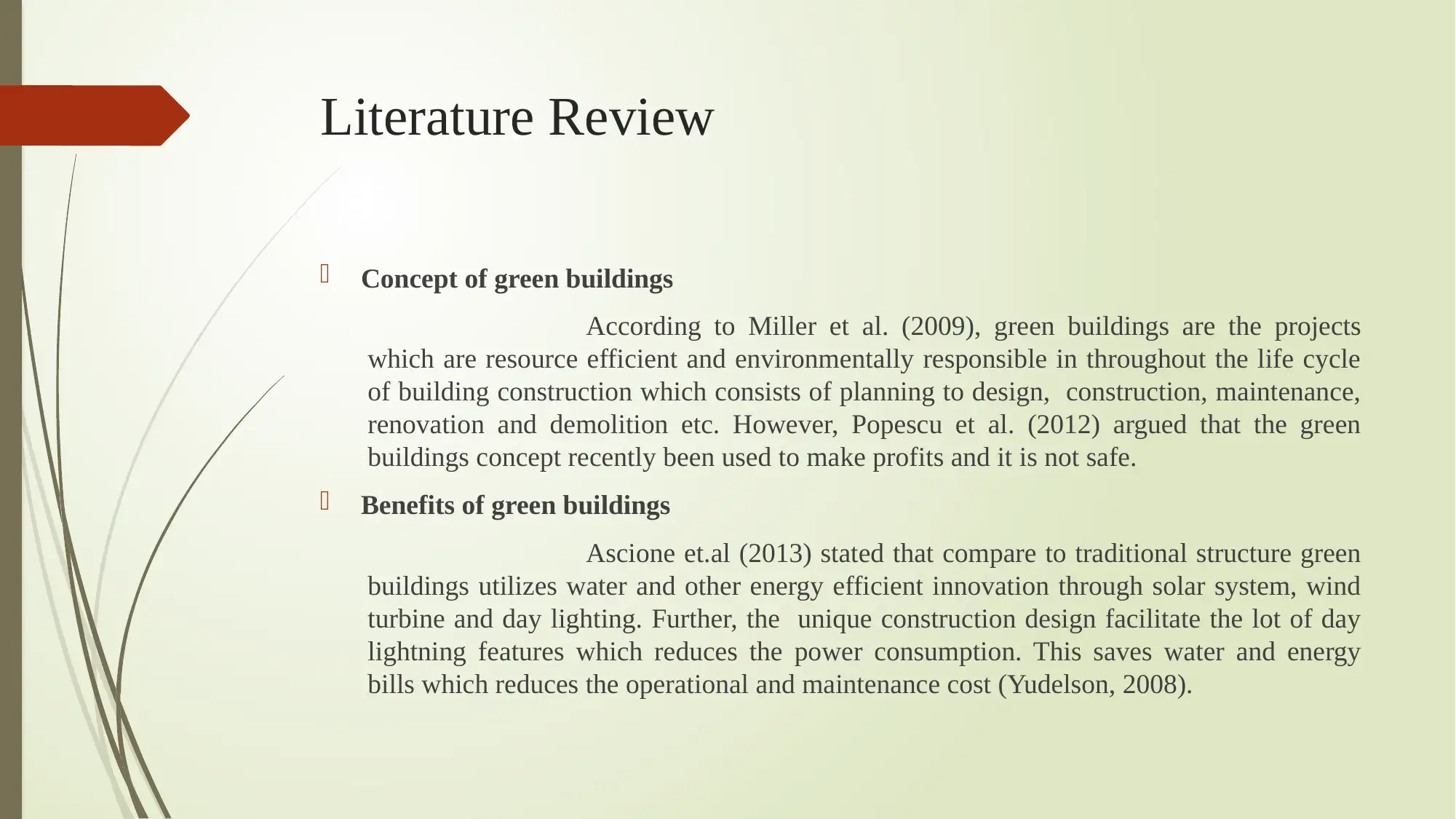
Literature Review
Concept of green buildings
According to Miller et al. (2009), green buildings are the projects
which are resource efficient and environmentally responsible in throughout the life cycle
of building construction which consists of planning to design, construction, maintenance,
renovation and demolition etc. However, Popescu et al. (2012) argued that the green
buildings concept recently been used to make profits and it is not safe.
Benefits of green buildings
Ascione et.al (2013) stated that compare to traditional structure green
buildings utilizes water and other energy efficient innovation through solar system, wind
turbine and day lighting. Further, the unique construction design facilitate the lot of day
lightning features which reduces the power consumption. This saves water and energy
bills which reduces the operational and maintenance cost (Yudelson, 2008).
Document Page
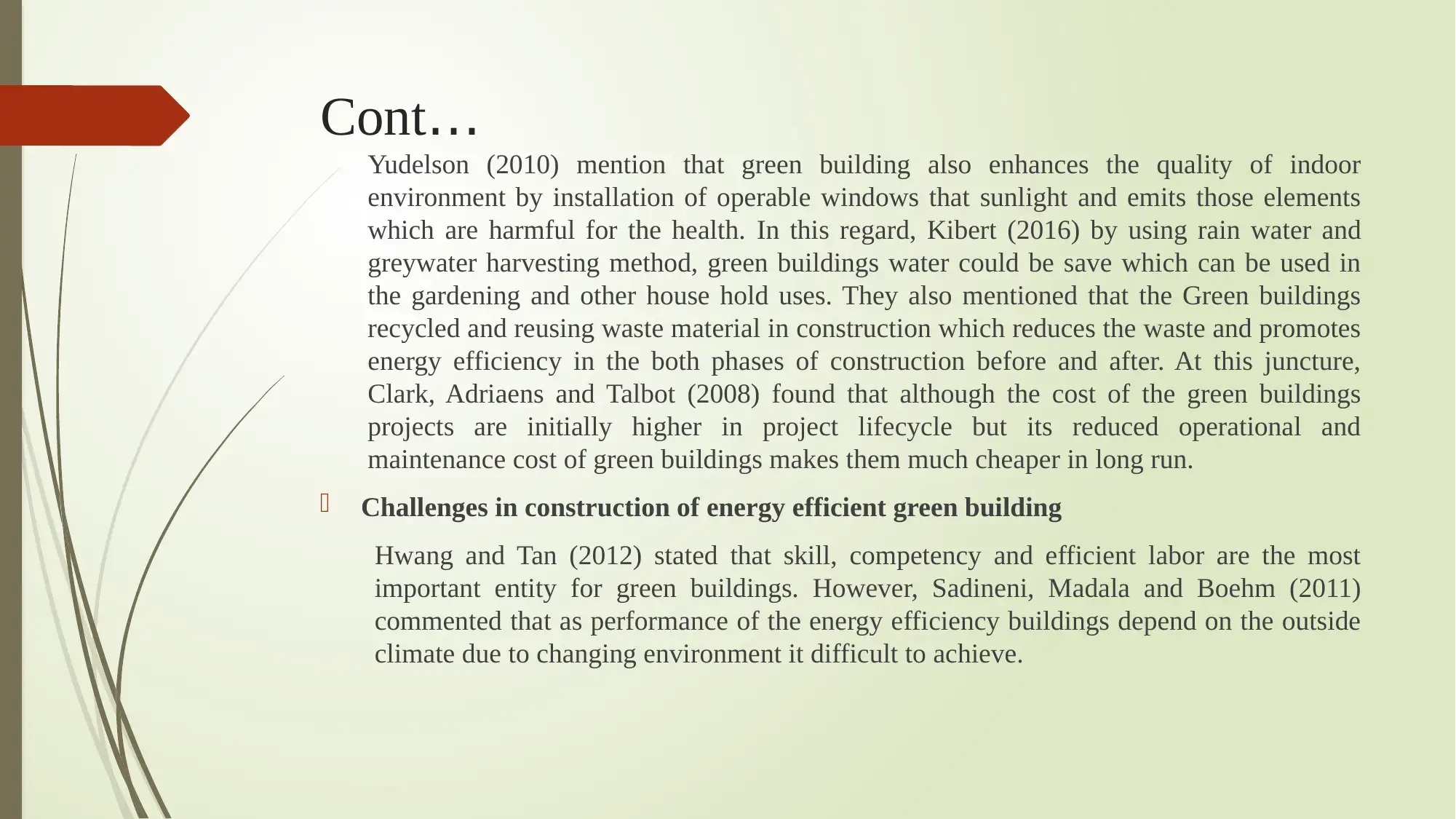
Cont
Yudelson (2010) mention that green building also enhances the quality of indoor
environment by installation of operable windows that sunlight and emits those elements
which are harmful for the health. In this regard, Kibert (2016) by using rain water and
greywater harvesting method, green buildings water could be save which can be used in
the gardening and other house hold uses. They also mentioned that the Green buildings
recycled and reusing waste material in construction which reduces the waste and promotes
energy efficiency in the both phases of construction before and after. At this juncture,
Clark, Adriaens and Talbot (2008) found that although the cost of the green buildings
projects are initially higher in project lifecycle but its reduced operational and
maintenance cost of green buildings makes them much cheaper in long run.
Challenges in construction of energy efficient green building
Hwang and Tan (2012) stated that skill, competency and efficient labor are the most
important entity for green buildings. However, Sadineni, Madala and Boehm (2011)
commented that as performance of the energy efficiency buildings depend on the outside
climate due to changing environment it difficult to achieve.
tabler-icon-diamond-filled.svg

Paraphrase This Document

Need a fresh take? Get an instant paraphrase of this document with our AI Paraphraser
Document Page
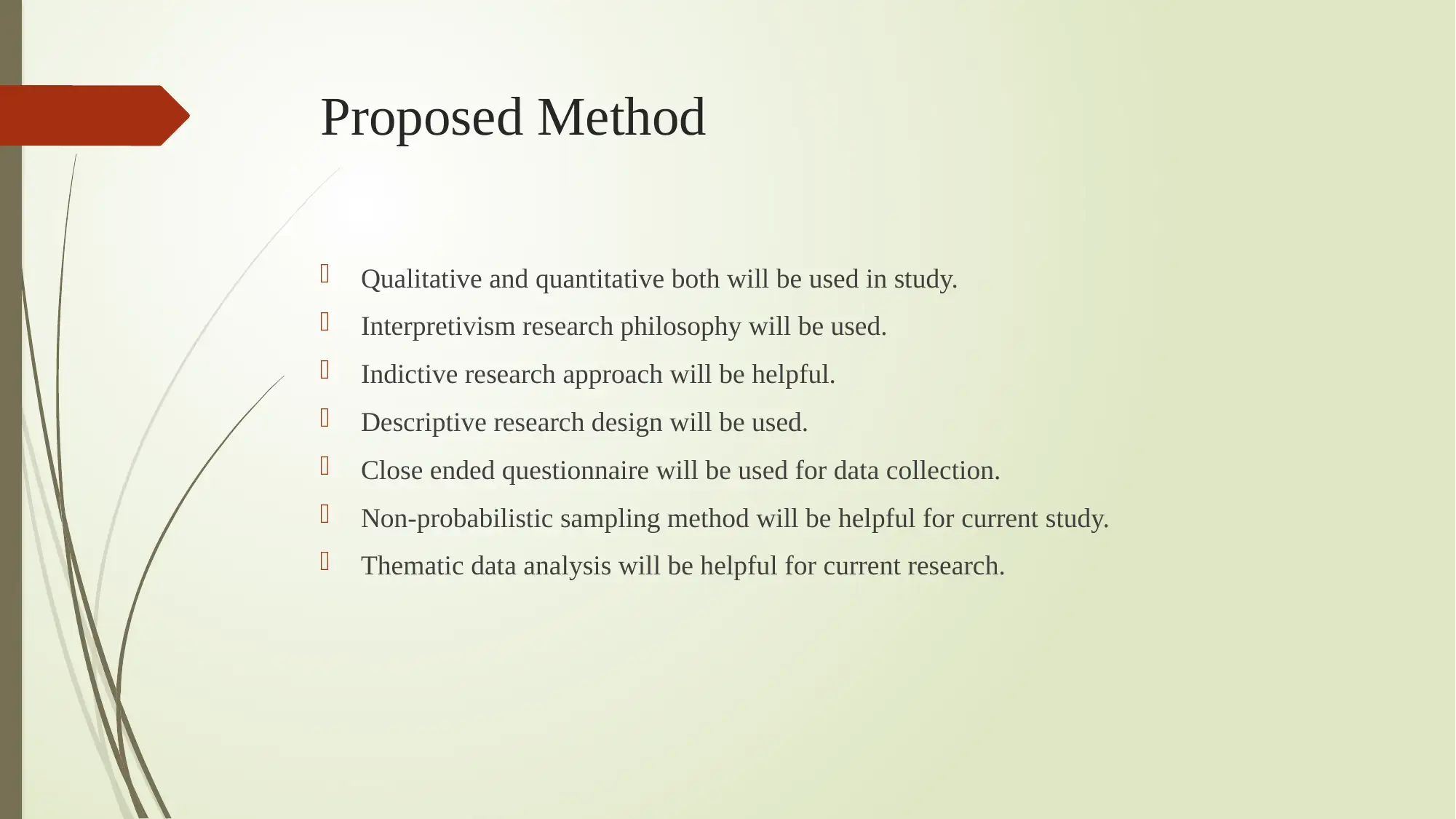
Proposed Method
Qualitative and quantitative both will be used in study.
Interpretivism research philosophy will be used.
Indictive research approach will be helpful.
Descriptive research design will be used.
Close ended questionnaire will be used for data collection.
Non-probabilistic sampling method will be helpful for current study.
Thematic data analysis will be helpful for current research.
Document Page
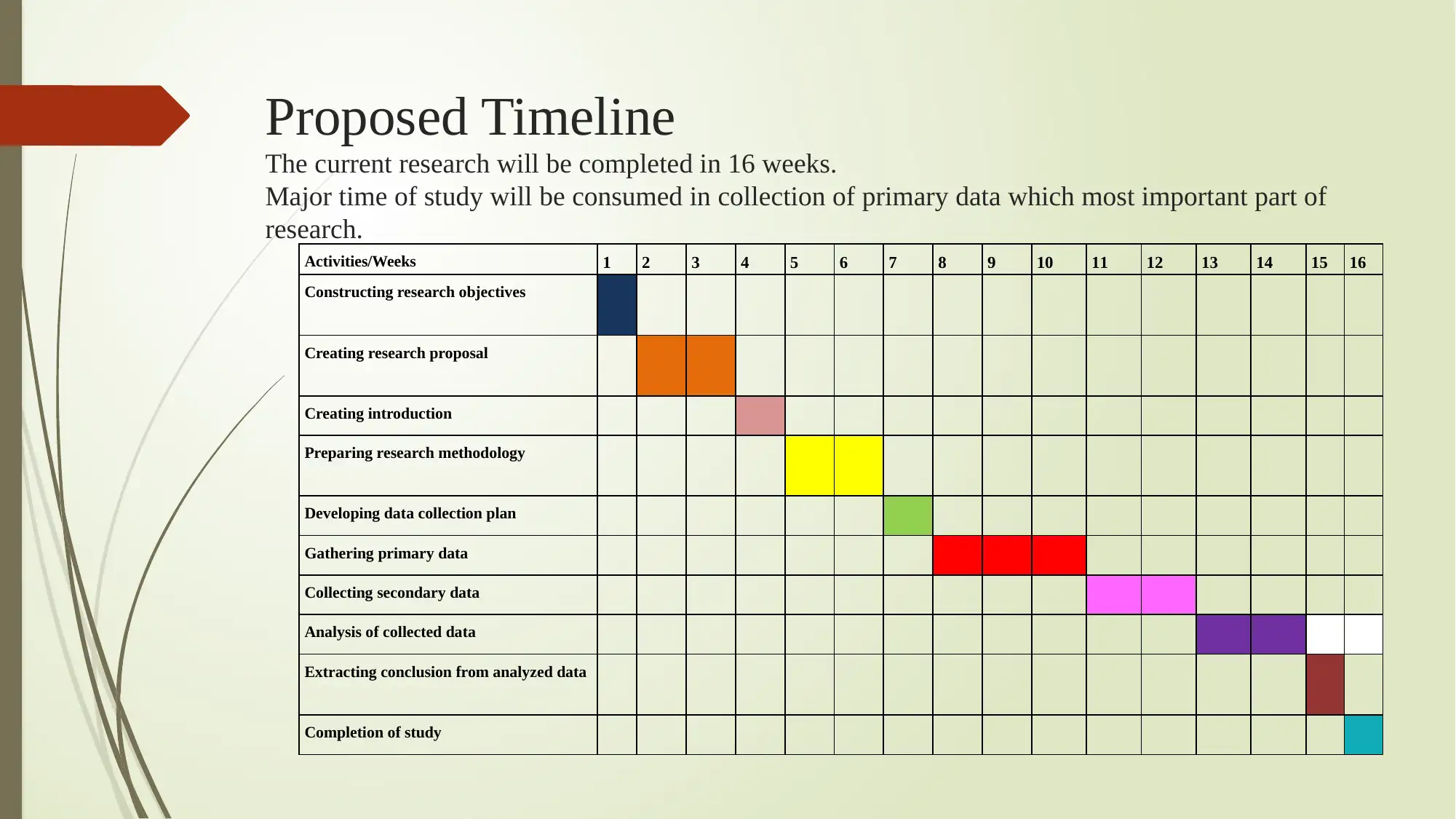
Proposed Timeline
The current research will be completed in 16 weeks.
Major time of study will be consumed in collection of primary data which most important part of
research.
Activities/Weeks 1 2 3 4 5 6 7 8 9 10 11 12 13 14 15 16
Constructing research objectives
Creating research proposal
Creating introduction
Preparing research methodology
Developing data collection plan
Gathering primary data
Collecting secondary data
Analysis of collected data
Extracting conclusion from analyzed data
Completion of study
Document Page
References
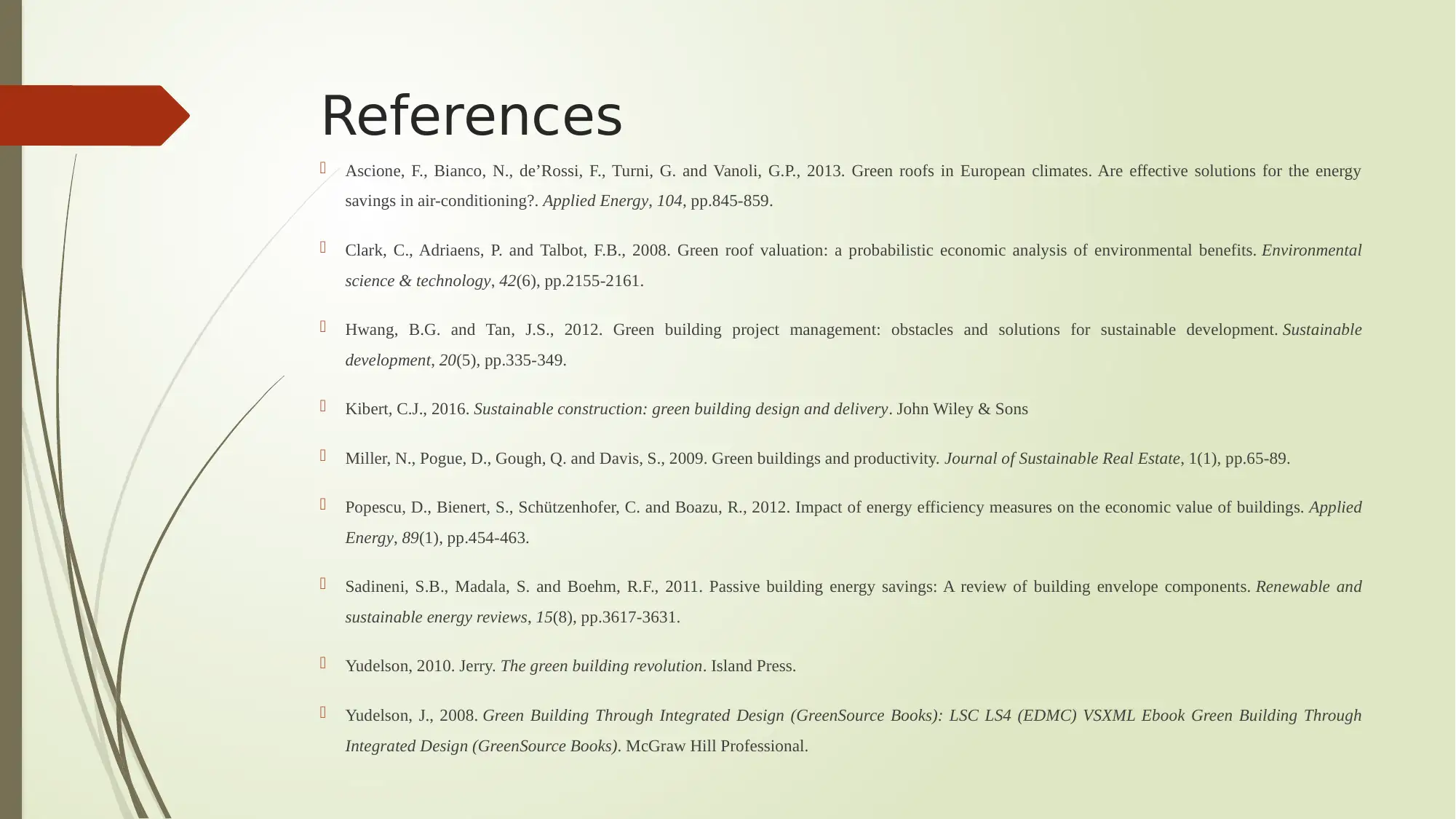
Ascione, F., Bianco, N., de’Rossi, F., Turni, G. and Vanoli, G.P., 2013. Green roofs in European climates. Are effective solutions for the energy
savings in air-conditioning?. Applied Energy, 104, pp.845-859.
Clark, C., Adriaens, P. and Talbot, F.B., 2008. Green roof valuation: a probabilistic economic analysis of environmental benefits. Environmental
science & technology, 42(6), pp.2155-2161.
Hwang, B.G. and Tan, J.S., 2012. Green building project management: obstacles and solutions for sustainable development. Sustainable
development, 20(5), pp.335-349.
Kibert, C.J., 2016. Sustainable construction: green building design and delivery. John Wiley & Sons
Miller, N., Pogue, D., Gough, Q. and Davis, S., 2009. Green buildings and productivity. Journal of Sustainable Real Estate, 1(1), pp.65-89.
Popescu, D., Bienert, S., Schützenhofer, C. and Boazu, R., 2012. Impact of energy efficiency measures on the economic value of buildings. Applied
Energy, 89(1), pp.454-463.
Sadineni, S.B., Madala, S. and Boehm, R.F., 2011. Passive building energy savings: A review of building envelope components. Renewable and
sustainable energy reviews, 15(8), pp.3617-3631.
Yudelson, 2010. Jerry. The green building revolution. Island Press.
Yudelson, J., 2008. Green Building Through Integrated Design (GreenSource Books): LSC LS4 (EDMC) VSXML Ebook Green Building Through
Integrated Design (GreenSource Books). McGraw Hill Professional.
chevron_up_icon
1 out of 7
circle_padding
hide_on_mobile
zoom_out_icon
[object Object]