Green Haven Case Study: Leadership, Change and Employee Retention
VerifiedAdded on 2020/02/05
|10
|3153
|35
Case Study
AI Summary
This case study examines the leadership and management challenges faced by Green Haven, a family-owned plant nursery, after a new CEO, Philip Cooper, takes over. The study analyzes the impact of Cooper's changes, such as eliminating monthly meetings, discontinuing free plants, and reducing customer interaction time, on employee morale, customer satisfaction, and overall business performance. The discussion identifies key issues like employee turnover, decreased customer base, and reduced profitability. It applies Maslow's hierarchy of needs to understand employee motivation and proposes solutions based on Lewin's change model, emphasizing the importance of involving employees in decision-making, open communication, and providing training. The recommendations focus on re-establishing employee engagement, leveraging technology for customer interaction, and involving employees in the organization's direction to regain staff confidence and improve business outcomes.
Case Study

Paraphrase This Document
Need a fresh take? Get an instant paraphrase of this document with our AI Paraphraser
TABLE OF CONTENTS
Introduction......................................................................................................................................3
Discussion .......................................................................................................................................3
Recommendation ............................................................................................................................6
Ethical consideration .......................................................................................................................7
References........................................................................................................................................9
Introduction......................................................................................................................................3
Discussion .......................................................................................................................................3
Recommendation ............................................................................................................................6
Ethical consideration .......................................................................................................................7
References........................................................................................................................................9
INTRODUCTION
The present case study show the techniques of managing the business in order to increase
sale, earn profit and enhance the satisfaction level of customers. In the present case study Philip
Cooper became the CEO of a small family- owned plant nursery business which named as Green
Haven. He taken over the responsibility of business about six months when its father get retired
due to ill health. Philip was an accountant by profession and had worked an accounting firm after
completing graduation over 20 years ago. Further, after handling entire business of Green Haven,
he started noticing that that there are some business practices which lead to increase unnecessary
cost. Business was doing extermly well but some changes that need to be made because they
were addi8ng to the cost of doing business. There were some changes which are implemented by
CEO of business. Philip decided that there will be no longer have day long monthly meeting.
Along with this, it stated that there was no real benefit in handling out free plants as in fact it was
an unnecessary cost to the business. All the staff members not spend long time with each
customer as according to him it is not very efficient way of working. Further it has been noticed
that most of employees resigned from the job, customer base decreases and profit of company
also impacted due to less sale of plant. The purpose of study is to identify issues which Green
Haven is facing due to changes which are implemented by Philip Cooper.
DISCUSSION
According to the given case study Philip cooper took responsibility of its family owned
plant nursery business called Green Haven which had been run by its father. By profession Philip
was an accountant and work at an accounting firm. However founder of the business who is
Adam Cooper, retired from the business due to ill health. Then its son Philip cooper who was 43
years old became CEO of the Green Haven firm. Managing business is not easy task because it
work at the accounting firm . At the time when Adam was the owner of company success was
changed file within Green haven. It is so because all staff members worked as a team and they
were provided some reward for their best work. Further they were fully supported by Adam and
customer satisfaction was the top priority and staff were given freedom to engage with
customers. Along with this, success was achieved within Green Haven because firm sale high
quality plants to the customers and they were presented with free gifts at the staff member
The present case study show the techniques of managing the business in order to increase
sale, earn profit and enhance the satisfaction level of customers. In the present case study Philip
Cooper became the CEO of a small family- owned plant nursery business which named as Green
Haven. He taken over the responsibility of business about six months when its father get retired
due to ill health. Philip was an accountant by profession and had worked an accounting firm after
completing graduation over 20 years ago. Further, after handling entire business of Green Haven,
he started noticing that that there are some business practices which lead to increase unnecessary
cost. Business was doing extermly well but some changes that need to be made because they
were addi8ng to the cost of doing business. There were some changes which are implemented by
CEO of business. Philip decided that there will be no longer have day long monthly meeting.
Along with this, it stated that there was no real benefit in handling out free plants as in fact it was
an unnecessary cost to the business. All the staff members not spend long time with each
customer as according to him it is not very efficient way of working. Further it has been noticed
that most of employees resigned from the job, customer base decreases and profit of company
also impacted due to less sale of plant. The purpose of study is to identify issues which Green
Haven is facing due to changes which are implemented by Philip Cooper.
DISCUSSION
According to the given case study Philip cooper took responsibility of its family owned
plant nursery business called Green Haven which had been run by its father. By profession Philip
was an accountant and work at an accounting firm. However founder of the business who is
Adam Cooper, retired from the business due to ill health. Then its son Philip cooper who was 43
years old became CEO of the Green Haven firm. Managing business is not easy task because it
work at the accounting firm . At the time when Adam was the owner of company success was
changed file within Green haven. It is so because all staff members worked as a team and they
were provided some reward for their best work. Further they were fully supported by Adam and
customer satisfaction was the top priority and staff were given freedom to engage with
customers. Along with this, success was achieved within Green Haven because firm sale high
quality plants to the customers and they were presented with free gifts at the staff member
⊘ This is a preview!⊘
Do you want full access?
Subscribe today to unlock all pages.

Trusted by 1+ million students worldwide
discretion. At the the time when Adam resigned from the business due to its ill health. All the
responsibility of business was taken by its Son Philip Cooper. After handling business he began
to to notice some changes that there were some practices that existed and he immediately picked
up as unnecessary cost (Haakstad, Voldner and Bø 2013). By observing all the changes it think
that some changes need to implement as they were adding cost to the business. For instance, it
discovered that each nursery regularly gave out plants for free and it was not uncommon for each
nursery. Further it notices that employees spend longer time with each customers. At the first
quarter of taking on CEO role, he spent out a message to all nursery managers for stopping the
practices of handling out free plants to customers with immediate effects. Further it also state
that no longer monthly meeting was be done and fortnighty meeting held with nursery managers
at his office. All the changes lead to impact reduce the employees turnover rate and also lead to
decrease in sale and profitability of business.
From the above case there are lots of problems which are find out that are described
below:
First problem is that employees are leaving the company along with this, oldest manager of
Green Havens had handed letter of resignation to Philip. Employees give resign because there
were no longer meeting was held which help them in sharing their knowledge and thought with
each other. Due to this reason employees were feel a lack of motivation. Further they were no
more provided recognized for their work. One of the another problem which has been find out is
that customers interaction issues in which it include customer were no more provided free
plants . Consumers were not give enough time for interaction and self service computer for
introduction was implemented at each of the nursing.
Maslow theory of motivation is one of the effective theory which can be implemented
within the Green Haven in order to motivates employees and retain them for longer time.
This theory help in understanding the way to develop employees needs while encouraging
increased level of performance. According to this theory there are five stages of employees need
(Rasskazova Ivanova, & Sheldon, 2016). At the first stage it comes employees need to provide
basic salary and stable employment. Here, Green Haven, CEO need to focus on fulfilling the
basic needs of its employees. After fulfilling the basic needs employees next level needs
increases that is security needs. In security needs it includes safe work environment, fair work
responsibility of business was taken by its Son Philip Cooper. After handling business he began
to to notice some changes that there were some practices that existed and he immediately picked
up as unnecessary cost (Haakstad, Voldner and Bø 2013). By observing all the changes it think
that some changes need to implement as they were adding cost to the business. For instance, it
discovered that each nursery regularly gave out plants for free and it was not uncommon for each
nursery. Further it notices that employees spend longer time with each customers. At the first
quarter of taking on CEO role, he spent out a message to all nursery managers for stopping the
practices of handling out free plants to customers with immediate effects. Further it also state
that no longer monthly meeting was be done and fortnighty meeting held with nursery managers
at his office. All the changes lead to impact reduce the employees turnover rate and also lead to
decrease in sale and profitability of business.
From the above case there are lots of problems which are find out that are described
below:
First problem is that employees are leaving the company along with this, oldest manager of
Green Havens had handed letter of resignation to Philip. Employees give resign because there
were no longer meeting was held which help them in sharing their knowledge and thought with
each other. Due to this reason employees were feel a lack of motivation. Further they were no
more provided recognized for their work. One of the another problem which has been find out is
that customers interaction issues in which it include customer were no more provided free
plants . Consumers were not give enough time for interaction and self service computer for
introduction was implemented at each of the nursing.
Maslow theory of motivation is one of the effective theory which can be implemented
within the Green Haven in order to motivates employees and retain them for longer time.
This theory help in understanding the way to develop employees needs while encouraging
increased level of performance. According to this theory there are five stages of employees need
(Rasskazova Ivanova, & Sheldon, 2016). At the first stage it comes employees need to provide
basic salary and stable employment. Here, Green Haven, CEO need to focus on fulfilling the
basic needs of its employees. After fulfilling the basic needs employees next level needs
increases that is security needs. In security needs it includes safe work environment, fair work
Paraphrase This Document
Need a fresh take? Get an instant paraphrase of this document with our AI Paraphraser
practices, benefits and pension. Green Haven CEO not provide any kind of benefits to its
employees and it also state that not longer monthly meeting will be conducted this all
demotivates employees. It is so because they are unable to share their ideas with each others.
Further after security needs it comes belongingess needs in which cover social acceptance issues
that is friendship or cooperation on the job. As in the given case study Philip give notice that no
employees will spend longer time with customer and it also introduced self serving computers
which lead to less interaction between customers and employees (Komives and Wagner, eds.,
2016). The next stage of Maslow theory is esteem needs which includes respect, and recognition
such as job titles, appropriate working environment etc. For instance in given case study, Philip
not provided any type of reward to its employees for their best performance. Further employees
were given no time for the sharing their view and ideas with each other. This all changes
demotivates employees from their work and they give resign from their job (Yang, Zheng and
Chen, 2014). Last stage of Malsow theory is self actualization needs such as achievement issues
such as workplace autonomy challenging work etc. this need to be fulfill by the Philip so that its
employees get demotivated and work hard for the organization.
Solution of the given issues is as follows:
Philip need to review the values which it tired to implement in its firm and it need to
research why the changes have not been embraced by the staff into of Green Haven.
For solving this all issues Philip can used lewin change model this model which lead to
equilibrium between forces that drive changes and other that resist change. Here below are given
some steps which help in proposed the changes (Komives, and Wagner, 2016).
Step 1: Describing plan for or proposal for changes: At this stage Green Haven can design its
goal and vision for changes so that changes can be implemented accordingly.
step 2: Identifying forces for changes
Different forces need to be think which drive changes this kind of changes can be external and
internal such as a need to increase profitability, declining team morale and outdated machinery
and program (Schultz, & Schultz, 2016). On the other hand external drivers includes disruptive
technology, change in culture and trend. There are many factors which influences the changes
implemented by firm.
Step 3: Identifying forces against change
employees and it also state that not longer monthly meeting will be conducted this all
demotivates employees. It is so because they are unable to share their ideas with each others.
Further after security needs it comes belongingess needs in which cover social acceptance issues
that is friendship or cooperation on the job. As in the given case study Philip give notice that no
employees will spend longer time with customer and it also introduced self serving computers
which lead to less interaction between customers and employees (Komives and Wagner, eds.,
2016). The next stage of Maslow theory is esteem needs which includes respect, and recognition
such as job titles, appropriate working environment etc. For instance in given case study, Philip
not provided any type of reward to its employees for their best performance. Further employees
were given no time for the sharing their view and ideas with each other. This all changes
demotivates employees from their work and they give resign from their job (Yang, Zheng and
Chen, 2014). Last stage of Malsow theory is self actualization needs such as achievement issues
such as workplace autonomy challenging work etc. this need to be fulfill by the Philip so that its
employees get demotivated and work hard for the organization.
Solution of the given issues is as follows:
Philip need to review the values which it tired to implement in its firm and it need to
research why the changes have not been embraced by the staff into of Green Haven.
For solving this all issues Philip can used lewin change model this model which lead to
equilibrium between forces that drive changes and other that resist change. Here below are given
some steps which help in proposed the changes (Komives, and Wagner, 2016).
Step 1: Describing plan for or proposal for changes: At this stage Green Haven can design its
goal and vision for changes so that changes can be implemented accordingly.
step 2: Identifying forces for changes
Different forces need to be think which drive changes this kind of changes can be external and
internal such as a need to increase profitability, declining team morale and outdated machinery
and program (Schultz, & Schultz, 2016). On the other hand external drivers includes disruptive
technology, change in culture and trend. There are many factors which influences the changes
implemented by firm.
Step 3: Identifying forces against change
At this stage it is important to identify the forces against change such as unfavorable the change
such as firm can manage all the work and its existing culture. Further it need to fulfill all the
requirements of its customers (Komives and Wagner, 2016).
step 4: Assign scores
Here firm can assign score from weak to strong according to the degree of influences. For
instance can notice force against the change that is loss of staff overtime, fear of new technology
to staff members and impact on working environment (Komives and Wagner, W. eds., 2016).
Step 5 Analyzing and applying
At this stage when all the forces field are analyses then it can be used in two ways that is to make
decision it not to move forward with the decision or changes or move forward. Further
supportive forces can be identified and training provided to staff member so that changes can be
implemented successfully (Harper, Cornish and Merrotsy, 2017).
Along with this Philip can involved its employees for the formation of the organization direction.
Further for decreasing the resistance to change firm can keep open discussion and reduce the
employees fear. Further firm can provide learning opportunity to the employees so that they can
easily gain knowledge and skills in order to move forward with the organization.
It is important for the firm to involve its employees in decision making process so that firm can
easily achieve success. Further company can provide training to its employees so that they can
easily use new technologies. Further Philip can also take suggestion from its customers in order
to run business successfully. Firm can gain trust of its employees by involving them in decision
making process. Review of changes which has been made and values which are implemented
Philip a small strategic team by taking help from its senior staff this help in making long term
relationship with employees. Further communicating face to face and through written
correspondence with employees help in implementing the changes successfully.
RECOMMENDATION
From the above case it can be recommended that Philip need to evaluate the values which
he is trying to implement into the core of business and have to investigate the reason behind that
why the staff is not embracing the change. If the challenge is emphasising the dilemma for the
hotel that which way to go, here leader s need to discover the need for the change and identify
the idea regarding which way will bring them more success and profit. There are number of
such as firm can manage all the work and its existing culture. Further it need to fulfill all the
requirements of its customers (Komives and Wagner, 2016).
step 4: Assign scores
Here firm can assign score from weak to strong according to the degree of influences. For
instance can notice force against the change that is loss of staff overtime, fear of new technology
to staff members and impact on working environment (Komives and Wagner, W. eds., 2016).
Step 5 Analyzing and applying
At this stage when all the forces field are analyses then it can be used in two ways that is to make
decision it not to move forward with the decision or changes or move forward. Further
supportive forces can be identified and training provided to staff member so that changes can be
implemented successfully (Harper, Cornish and Merrotsy, 2017).
Along with this Philip can involved its employees for the formation of the organization direction.
Further for decreasing the resistance to change firm can keep open discussion and reduce the
employees fear. Further firm can provide learning opportunity to the employees so that they can
easily gain knowledge and skills in order to move forward with the organization.
It is important for the firm to involve its employees in decision making process so that firm can
easily achieve success. Further company can provide training to its employees so that they can
easily use new technologies. Further Philip can also take suggestion from its customers in order
to run business successfully. Firm can gain trust of its employees by involving them in decision
making process. Review of changes which has been made and values which are implemented
Philip a small strategic team by taking help from its senior staff this help in making long term
relationship with employees. Further communicating face to face and through written
correspondence with employees help in implementing the changes successfully.
RECOMMENDATION
From the above case it can be recommended that Philip need to evaluate the values which
he is trying to implement into the core of business and have to investigate the reason behind that
why the staff is not embracing the change. If the challenge is emphasising the dilemma for the
hotel that which way to go, here leader s need to discover the need for the change and identify
the idea regarding which way will bring them more success and profit. There are number of
⊘ This is a preview!⊘
Do you want full access?
Subscribe today to unlock all pages.
Trusted by 1+ million students worldwide
researches highlighting and suggesting that because of change employees are fall into more
stress and lose their control over their task as they are confused about how and when they need to
perform and what they need to achieve. The recommended way for such a situation is employee
engagement. Through the employee engagement their emotions and motivation will flow in the
same direction and it will resulted as self efficacy of employee to perform the job. Better
communication between the CEO and employee bring the clarity about the organisational goals
and objective. The information sharing activities makes employee more confident while they
performing in the changing environment. By using all the above mentioned activities Philip will
able to regaining the employee engagement. Philip should have word with his team in order to
re-implementing a higher level of employee engagement. Implementation of technology as
Philip introduced the new idea of assemble the computers in the nursery so that customer can
gather the information about the plants will surely have the positive influence on the mind of
consumer. Using technology will be favorable for the company in the context of interacting with
the customers. The use of the technology will take away the aspect such as customer service as
of the business which will be resulted as improving the knowledge and fulfill the requirement.
Employee involvement in the formation of organization direction will be helpful tool for Philip
to regain the confidence of the staff in him or in the vision and mission which set by the
organization. For the purpose of minimizing the resistance from change organizations sometimes
need to sacrifice in term of workplace conditions, as the employee engagement is useful in the
long run of organization. If all other strategies are not worked as according to the plan then
organization can use coercion strategy but only if all other strategies are fail. AS the coercion
strategy can lead the confronting workplace for the employees. BY the use of democracy
organization can make the individual more responsible as it will enhance various positive aspect
in an individual such as employee self determination, competence, meaning and impact
associated with their role in the organization. It is important for they Philip that he provide the
learning opportunities to their employee as it will help them in personality development and they
will be able to gain the knowledge and skills which helpful in step forward in the organization.
ETHICAL CONSIDERATION
There are some morale ethical consideration issues which are identified in the give case
that are as follows:
stress and lose their control over their task as they are confused about how and when they need to
perform and what they need to achieve. The recommended way for such a situation is employee
engagement. Through the employee engagement their emotions and motivation will flow in the
same direction and it will resulted as self efficacy of employee to perform the job. Better
communication between the CEO and employee bring the clarity about the organisational goals
and objective. The information sharing activities makes employee more confident while they
performing in the changing environment. By using all the above mentioned activities Philip will
able to regaining the employee engagement. Philip should have word with his team in order to
re-implementing a higher level of employee engagement. Implementation of technology as
Philip introduced the new idea of assemble the computers in the nursery so that customer can
gather the information about the plants will surely have the positive influence on the mind of
consumer. Using technology will be favorable for the company in the context of interacting with
the customers. The use of the technology will take away the aspect such as customer service as
of the business which will be resulted as improving the knowledge and fulfill the requirement.
Employee involvement in the formation of organization direction will be helpful tool for Philip
to regain the confidence of the staff in him or in the vision and mission which set by the
organization. For the purpose of minimizing the resistance from change organizations sometimes
need to sacrifice in term of workplace conditions, as the employee engagement is useful in the
long run of organization. If all other strategies are not worked as according to the plan then
organization can use coercion strategy but only if all other strategies are fail. AS the coercion
strategy can lead the confronting workplace for the employees. BY the use of democracy
organization can make the individual more responsible as it will enhance various positive aspect
in an individual such as employee self determination, competence, meaning and impact
associated with their role in the organization. It is important for they Philip that he provide the
learning opportunities to their employee as it will help them in personality development and they
will be able to gain the knowledge and skills which helpful in step forward in the organization.
ETHICAL CONSIDERATION
There are some morale ethical consideration issues which are identified in the give case
that are as follows:
Paraphrase This Document
Need a fresh take? Get an instant paraphrase of this document with our AI Paraphraser
Firstly, Philip make some changes in Green Haven policies which is not right because as
his father build a business and run it successfully. Therefore making changes in its policies is not
right.
Further Philip not provided any type of rewards to its employees for their best work and
lead to affect morale of employees (Ling, 2017). As they work hard for the organization since
from longer time, but for this they no get any appreciation by Philip.
Employees cannot share there views and opinion with other staff members and manager
which lead to demotivate them (Schultz, & Schultz, 2016)). Along with this, formalized meeting
left employees to feel lack of motivation. It is so because at informal meeting they can easily
share the views and opinion and due to this reason employees started to resign.
Further for resolving this issues regaining employee involvement is first step for Philip
which would be consult with the team. Philip has less experience related to working in a nursery
which lead to create negative impact of working on employees work and company profitability.
For this purpose firm can gain trust of its employees by involving them in decision
making process (Ling, 2017). Review of changes which has been made and values which are
implemented Philip a small strategic team by taking help from its senior staff this help in making
long term relationship with employees. Further communicating face to face and through written
correspondence with employees help in implementing the changes successfully. Apart from this
Philip needs to valued its employees and engage and promotes that value.
his father build a business and run it successfully. Therefore making changes in its policies is not
right.
Further Philip not provided any type of rewards to its employees for their best work and
lead to affect morale of employees (Ling, 2017). As they work hard for the organization since
from longer time, but for this they no get any appreciation by Philip.
Employees cannot share there views and opinion with other staff members and manager
which lead to demotivate them (Schultz, & Schultz, 2016)). Along with this, formalized meeting
left employees to feel lack of motivation. It is so because at informal meeting they can easily
share the views and opinion and due to this reason employees started to resign.
Further for resolving this issues regaining employee involvement is first step for Philip
which would be consult with the team. Philip has less experience related to working in a nursery
which lead to create negative impact of working on employees work and company profitability.
For this purpose firm can gain trust of its employees by involving them in decision
making process (Ling, 2017). Review of changes which has been made and values which are
implemented Philip a small strategic team by taking help from its senior staff this help in making
long term relationship with employees. Further communicating face to face and through written
correspondence with employees help in implementing the changes successfully. Apart from this
Philip needs to valued its employees and engage and promotes that value.
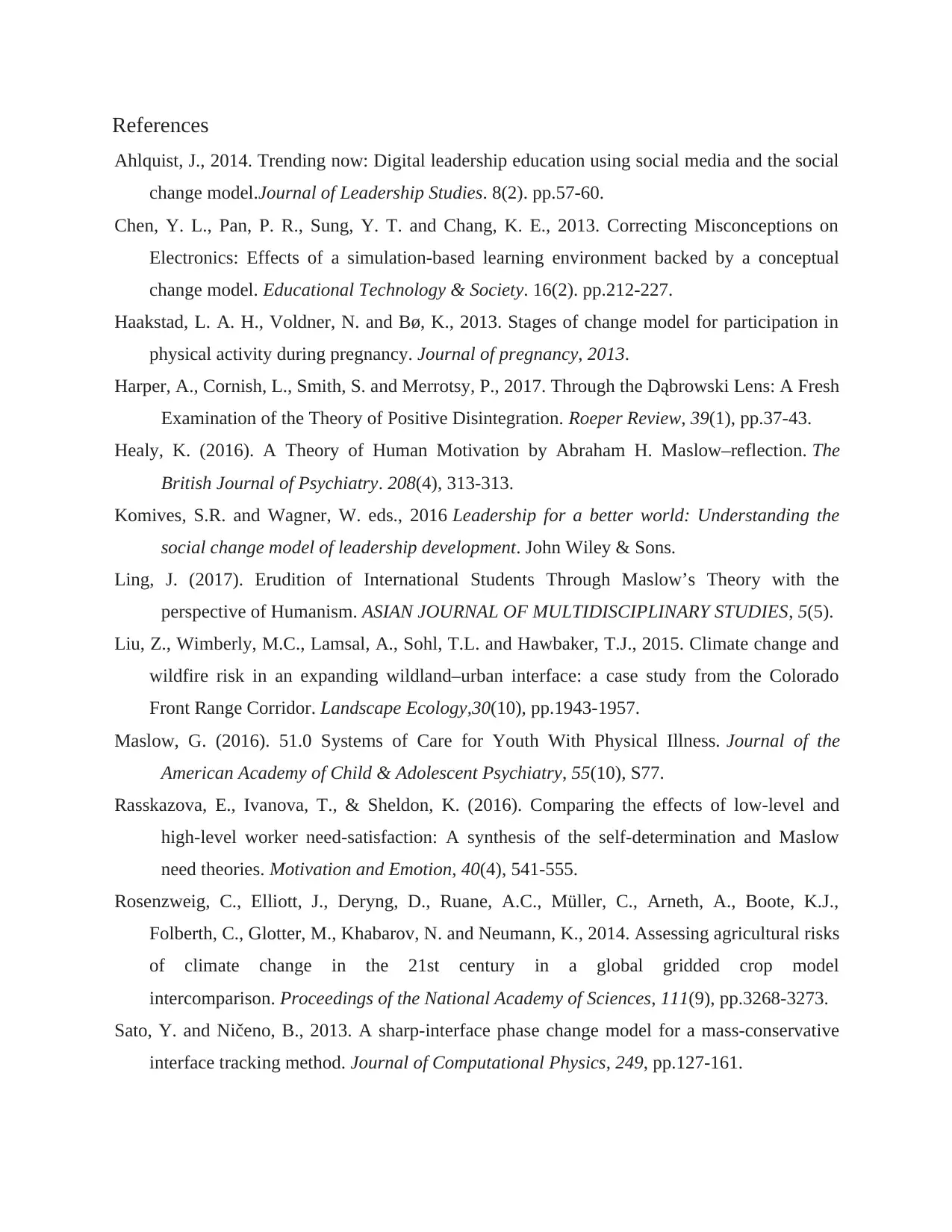
References
Ahlquist, J., 2014. Trending now: Digital leadership education using social media and the social
change model.Journal of Leadership Studies. 8(2). pp.57-60.
Chen, Y. L., Pan, P. R., Sung, Y. T. and Chang, K. E., 2013. Correcting Misconceptions on
Electronics: Effects of a simulation-based learning environment backed by a conceptual
change model. Educational Technology & Society. 16(2). pp.212-227.
Haakstad, L. A. H., Voldner, N. and Bø, K., 2013. Stages of change model for participation in
physical activity during pregnancy. Journal of pregnancy, 2013.
Harper, A., Cornish, L., Smith, S. and Merrotsy, P., 2017. Through the Dąbrowski Lens: A Fresh
Examination of the Theory of Positive Disintegration. Roeper Review, 39(1), pp.37-43.
Healy, K. (2016). A Theory of Human Motivation by Abraham H. Maslow–reflection. The
British Journal of Psychiatry. 208(4), 313-313.
Komives, S.R. and Wagner, W. eds., 2016 Leadership for a better world: Understanding the
social change model of leadership development. John Wiley & Sons.
Ling, J. (2017). Erudition of International Students Through Maslow’s Theory with the
perspective of Humanism. ASIAN JOURNAL OF MULTIDISCIPLINARY STUDIES, 5(5).
Liu, Z., Wimberly, M.C., Lamsal, A., Sohl, T.L. and Hawbaker, T.J., 2015. Climate change and
wildfire risk in an expanding wildland–urban interface: a case study from the Colorado
Front Range Corridor. Landscape Ecology,30(10), pp.1943-1957.
Maslow, G. (2016). 51.0 Systems of Care for Youth With Physical Illness. Journal of the
American Academy of Child & Adolescent Psychiatry, 55(10), S77.
Rasskazova, E., Ivanova, T., & Sheldon, K. (2016). Comparing the effects of low-level and
high-level worker need-satisfaction: A synthesis of the self-determination and Maslow
need theories. Motivation and Emotion, 40(4), 541-555.
Rosenzweig, C., Elliott, J., Deryng, D., Ruane, A.C., Müller, C., Arneth, A., Boote, K.J.,
Folberth, C., Glotter, M., Khabarov, N. and Neumann, K., 2014. Assessing agricultural risks
of climate change in the 21st century in a global gridded crop model
intercomparison. Proceedings of the National Academy of Sciences, 111(9), pp.3268-3273.
Sato, Y. and Ničeno, B., 2013. A sharp-interface phase change model for a mass-conservative
interface tracking method. Journal of Computational Physics, 249, pp.127-161.
Ahlquist, J., 2014. Trending now: Digital leadership education using social media and the social
change model.Journal of Leadership Studies. 8(2). pp.57-60.
Chen, Y. L., Pan, P. R., Sung, Y. T. and Chang, K. E., 2013. Correcting Misconceptions on
Electronics: Effects of a simulation-based learning environment backed by a conceptual
change model. Educational Technology & Society. 16(2). pp.212-227.
Haakstad, L. A. H., Voldner, N. and Bø, K., 2013. Stages of change model for participation in
physical activity during pregnancy. Journal of pregnancy, 2013.
Harper, A., Cornish, L., Smith, S. and Merrotsy, P., 2017. Through the Dąbrowski Lens: A Fresh
Examination of the Theory of Positive Disintegration. Roeper Review, 39(1), pp.37-43.
Healy, K. (2016). A Theory of Human Motivation by Abraham H. Maslow–reflection. The
British Journal of Psychiatry. 208(4), 313-313.
Komives, S.R. and Wagner, W. eds., 2016 Leadership for a better world: Understanding the
social change model of leadership development. John Wiley & Sons.
Ling, J. (2017). Erudition of International Students Through Maslow’s Theory with the
perspective of Humanism. ASIAN JOURNAL OF MULTIDISCIPLINARY STUDIES, 5(5).
Liu, Z., Wimberly, M.C., Lamsal, A., Sohl, T.L. and Hawbaker, T.J., 2015. Climate change and
wildfire risk in an expanding wildland–urban interface: a case study from the Colorado
Front Range Corridor. Landscape Ecology,30(10), pp.1943-1957.
Maslow, G. (2016). 51.0 Systems of Care for Youth With Physical Illness. Journal of the
American Academy of Child & Adolescent Psychiatry, 55(10), S77.
Rasskazova, E., Ivanova, T., & Sheldon, K. (2016). Comparing the effects of low-level and
high-level worker need-satisfaction: A synthesis of the self-determination and Maslow
need theories. Motivation and Emotion, 40(4), 541-555.
Rosenzweig, C., Elliott, J., Deryng, D., Ruane, A.C., Müller, C., Arneth, A., Boote, K.J.,
Folberth, C., Glotter, M., Khabarov, N. and Neumann, K., 2014. Assessing agricultural risks
of climate change in the 21st century in a global gridded crop model
intercomparison. Proceedings of the National Academy of Sciences, 111(9), pp.3268-3273.
Sato, Y. and Ničeno, B., 2013. A sharp-interface phase change model for a mass-conservative
interface tracking method. Journal of Computational Physics, 249, pp.127-161.
⊘ This is a preview!⊘
Do you want full access?
Subscribe today to unlock all pages.
Trusted by 1+ million students worldwide
Schultz, D. P., & Schultz, S. E. (2016). Theories of personality. Cengage Learning.
Yang, X., Zheng, X.Q. and Chen, R., 2014. A land use change model: Integrating landscape
pattern indexes and Markov-CA. Ecological Modelling,283, pp.1-7.
Yang, X., Zheng, X.Q. and Chen, R., 2014. A land use change model: Integrating landscape
pattern indexes and Markov-CA. Ecological Modelling,283, pp.1-7.

1 out of 10


Your All-in-One AI-Powered Toolkit for Academic Success.
+13062052269
info@desklib.com
Available 24*7 on WhatsApp / Email
![[object Object]](/_next/static/media/star-bottom.7253800d.svg)
Unlock your academic potential
Copyright © 2020–2026 A2Z Services. All Rights Reserved. Developed and managed by ZUCOL.