ENEC20003: Analysis of Vibroflotation Ground Improvement Technique

Verified

Added on  2023/06/10

|18
|2299
|155
Report
AI Summary
This report provides a comprehensive overview of vibroflotation, a ground improvement technique used to enhance soil strength and bearing capacity, particularly in areas with loose soil. It details the vibroflotation process, emphasizing the importance of vibration and water spouting to achieve soil compaction at depth, and distinguishes it from other vibrocompaction methods. The report covers quality control measures during the process, factors affecting vibroflotation quality such as equipment size and soil type, and the reasons for its necessity due to increasing construction in areas with poor soil quality. Furthermore, it highlights the advantages of vibroflotation, including reduced foundation settlement, slope stability, and prevention of natural disasters like earthquakes, supported by a literature review of numerical modeling and experimental studies. The report concludes by emphasizing the wide variety of ground improvement techniques available and the effectiveness of vibroflotation in enhancing soil quality for construction purposes, referencing numerous academic sources.
Document Page
Ground Improvement
Tehnique: Vibroflotation
tabler-icon-diamond-filled.svg

Paraphrase This Document

Need a fresh take? Get an instant paraphrase of this document with our AI Paraphraser
Document Page
Introduction
Loose soil in the ground surfaces is a very common
problem in the construction industries.
This problem of loose soil required immediate
solution which can be achieved by vibroflotation.
Vibroflotation can be defined as a technique to
enhance the strength of the soil and capacity of
bearing of the ground surface with the help of
vibration and spouting of the water.
It is used at the depth of the ground surface where
the soil is loose.
Document Page
Introduction
Vibroflotation sometimes also called as vibrocompaction in
general, but there exists a difference between two.
Vibroflotation is one kind of vibrocompaction technique, in
vibroflotation a device called as vibroflot is used which
moves horizontally for settling of the loose soil.
Second kind of vibrocompaction technique is a device
names as vibrating plate is used which moves vertically for
settling of the loose soil.
It is a vibro-replacement mechanism combining the
backfilling of gravel and vibroflotation to produce the
columns of the stone.
Document Page
Vibroflotation process
Strategy behind process is that it is very straightforward and
depends on reality inter-granular powers of cohesion-less soils
and vibration impacts.
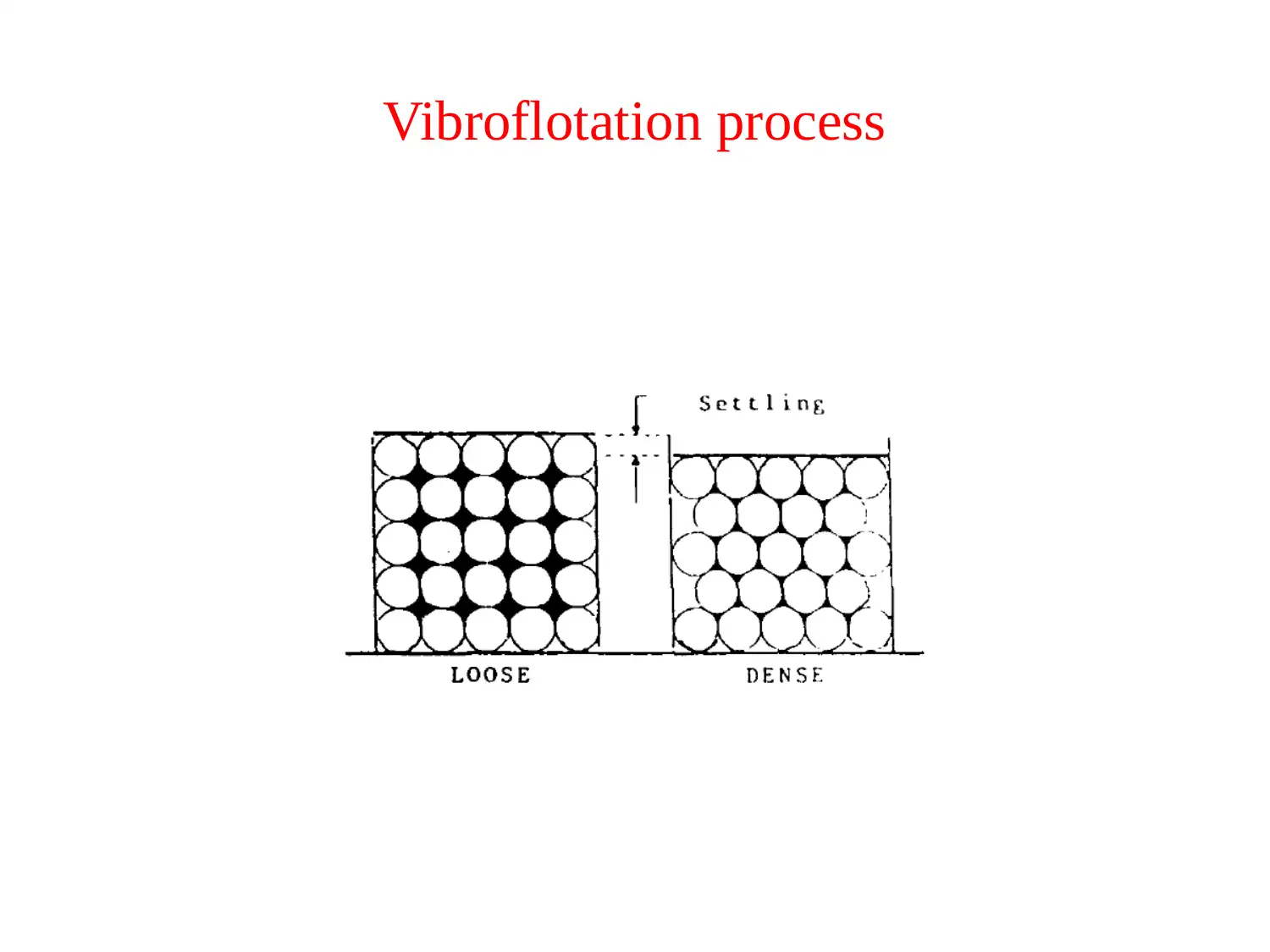
Reworking of soil grains obtain a compactness under the effect of
gravity, which is maximum.
Figure 1 demonstrates a misrepresented instance of the impacts
of Vibrocompaction on soil particles.
It was found at an early stage, that shear disappointments were
probably not going to happen with ordinary establishment
loadings on free granular soils.
Vibro-compaction use can be thought of as a pre-stack, for
hardware establishments.
tabler-icon-diamond-filled.svg

Paraphrase This Document

Need a fresh take? Get an instant paraphrase of this document with our AI Paraphraser
Document Page
Vibroflotation process
Document Page
Quality control during the process
During the procedure, guarantee that the method is
working proficiently and viably with the goal that low soil
densities are not found after fruition of the site change.
In the same way as other development exercises, quality
control is critical amid development.
A few perspectives can be checked amid execution,
including infiltration profundity, entrance rate,
withdrawal rate, legitimate test area, volume of included
inlay, refill degree, ammeter or water powered weight
crest, and vibroflot working recurrence.
Document Page
Factors affecting the vibroflotation quality
Size of the equipment
Quality of the equipment
Soil type
Technique of the vibroflot withdrawal
Type of backfill material
Skill of the employ
tabler-icon-diamond-filled.svg

Paraphrase This Document

Need a fresh take? Get an instant paraphrase of this document with our AI Paraphraser
Document Page
Why there is need of vibroflotation?
Increment in the population, construction and
industrialisation is resulting in the development in the
areas where quality and strength of the soil is poor,
which needs to be upgraded.
Due to the environment effect features of the quality
soils are getting degraded regularly.
To enhance the strength and decrease the
compressibility vibroflotation is conducted before
starting of any construction, this increases the life and
bearing capacity of the building structures.
Document Page
Advantages of vibroflotation
Reduction in the foundation settlement
Arrange for slope steadiness
Prevention of natural disasters like earthquake
Reducing the potential of liquefaction
Document Page
Literature review
Numerical modelling on vibroflotation soil improvement techniques using a densification
constitutive law is conducted. They utilized finite element modelling to analyse soil
improvements using vibroflotation. They developed a mean densification function for
each and every spatial point. They also optimize the distance between the vibration
points (Querol, Peco & Trujillo 2014).
A simplified homogenization method in stone column design is conducted by establishing
the equivalent material properties. They proposed an effective way of predicting the
performance of stone column, and are termed as equivalent column method. Their model
provides permeability and stiffness. Model developed by them is simpler to the other
models available in the literature as it accurately predicts the consolidation time (Ng &
Tan 2015).
Evaluation of the ability to control biological precipitation to improve sandy soils is
conducted. They utilized microbiologically induced calcite precipitation technique for soil
improvements. They targeted their study towards finding the time and location when
calcium carbonate sediments are biologically formed. Model developed by them works
very well and can be used in different applications like control of soil erosion, mitigation of
liquefaction and pollution immobilization (Kalantary & Kahani 2015).
tabler-icon-diamond-filled.svg

Paraphrase This Document

Need a fresh take? Get an instant paraphrase of this document with our AI Paraphraser
Document Page
Literature review
Experimental study of remediation measures of anchored sheet pile quay
walls using soil compaction is conducted. They analysed the effectiveness
of soil improvements near to embedded regions using recorded dynamic
responses. They found front densification increases tensile force and
limited seaward displacement (Zekri et al 2015)
Experimental research of spatial variation of compaction effect on
vibratory probe compaction method for ground improvement is
conducted. They conducted field pilot test for analysing the spatial
variation of the compaction. (Cheng et al, 2017).
Ground improvement with the help of rapid impact compaction (RIC),
vibroflotation with stone columns and dynamic cone penetration is
conducted. In their study the studied various ground improvements
techniques and selected rapid impact compaction as per the requirements
of the place of the application. (Kristiansen & Davies 2004)
Document Page
Study of different ground improvement techniques have been
studied in details.
Different techniques which help in increasing the soil strength and
decreasing the compressibility are also studied in details.
There are wide varieties of methods and techniques which can
help in increasing the soil strength.
Rapid impact compaction is a very great method which increases
the strength of the soil by great amount which further helps in
increasing the strength of the building or structures.
Vibroflotation is a very good technique which automatically
increases the soil quality after the utilization of the vibroflot which
increases the strength at the point where necessary.
Conclusions
chevron_up_icon
1 out of 18
circle_padding
hide_on_mobile
zoom_out_icon
[object Object]