Marketing Report: H Samuel's Strategies, Segmentation and Distribution
VerifiedAdded on 2020/01/23
|14
|3946
|54
Report
AI Summary
This report provides a detailed analysis of H Samuel's marketing strategies, covering various aspects of their business operations. It begins with an introduction to marketing principles and their application within the jewelry retail sector, specifically focusing on H Samuel. The report then delves into specific marketing elements, including research, environmental analysis (SWOT and PESTLE), and the marketing mix (product, price, place, and promotion). It explores marketing orientation, highlighting the importance of customer needs and long-term profitability. The report further examines environmental scanning tools, both micro (suppliers, customers, competitors) and macro (political, economic, social, and technological factors). Market segmentation strategies, including demographic and behavioral segmentation, are discussed, along with target marketing approaches. The report also explores buying behavior, considering factors like supply and demand, routine behavior, and complex decision-making processes. Additionally, it covers positioning strategies, new product development, distribution channels, and the product life cycle. The report concludes by emphasizing the importance of understanding competition, public relations, and media involvement for sustained competitive advantage in the market.
MARKETING
PRINCIPLES
PRINCIPLES

Paraphrase This Document
Need a fresh take? Get an instant paraphrase of this document with our AI Paraphraser
TABLE OF CONTENTS
INTRODUCTION...........................................................................................................................3
TASK 1............................................................................................................................................4
1.1.................................................................................................................................................4
1.2.................................................................................................................................................5
TASK 2............................................................................................................................................5
2.1.................................................................................................................................................5
2.2.................................................................................................................................................6
2.3.................................................................................................................................................7
2.4.................................................................................................................................................7
2.5.................................................................................................................................................8
TASK 3............................................................................................................................................9
3.1.................................................................................................................................................9
3.2.................................................................................................................................................9
3.3...............................................................................................................................................10
3.4...............................................................................................................................................10
3.5...............................................................................................................................................10
TASK 4..........................................................................................................................................11
4.1...............................................................................................................................................11
4.2...............................................................................................................................................11
4.3...............................................................................................................................................12
CONCLUSION..............................................................................................................................12
REFERENCE ................................................................................................................................14
2
INTRODUCTION...........................................................................................................................3
TASK 1............................................................................................................................................4
1.1.................................................................................................................................................4
1.2.................................................................................................................................................5
TASK 2............................................................................................................................................5
2.1.................................................................................................................................................5
2.2.................................................................................................................................................6
2.3.................................................................................................................................................7
2.4.................................................................................................................................................7
2.5.................................................................................................................................................8
TASK 3............................................................................................................................................9
3.1.................................................................................................................................................9
3.2.................................................................................................................................................9
3.3...............................................................................................................................................10
3.4...............................................................................................................................................10
3.5...............................................................................................................................................10
TASK 4..........................................................................................................................................11
4.1...............................................................................................................................................11
4.2...............................................................................................................................................11
4.3...............................................................................................................................................12
CONCLUSION..............................................................................................................................12
REFERENCE ................................................................................................................................14
2
INTRODUCTION
Marketing principles is a business process which involves guidelines through which
organization perform their business functions for promoting products and services. It can be
determine by various plans and operations within the business (Barone, Cerqueti and Quaranta,
2012). Present report is based on H Samuel which is the world largest specialist retail jeweller in
UK, US and other countries. It is a wide jewellery chain retailer and it has 303 stores in
worldwide. The present report covers various elements of marketing process which an
organization can adopt. Furthermore, it includes different segmentations that adopted by the firm
for a product in different markets. Moreover, it explains distribution which is arranged according
to the customer convenience. At last, it emphasizes on the difference between international and
domestic marketing.
TASK 1
1.1
There are many marketing elements which organizations can follow. H Samuel
organization uses this to compete effectively with their competitors (Bell, 2012). Important
decisions of the business can be take to compete through followings elements:
Research: In order to provide effective products to customers, H Samuel conducts
market research for understanding needs of the customers. Thus, they can easily identify,
what customers actually want so that they can provide products according to that. They
also demonstrate different types of medium which is best for develop the product into
markets (Borst, 2014).
Environment analysis: There are various competitors of H Samuel which provide same
products and services as the cited business offer. Thus, management should make use of
SWOT and PESTLE analysis for identifying the strength, weakness, opportunities and
threats. Further, it will help them to know political, environmental, social, technical,
ethical as well as legal factors that affect the business. Through this, they easily identify
what their competitors offer to customers and where business should improve their
performance (Child, 2015).
3
Marketing principles is a business process which involves guidelines through which
organization perform their business functions for promoting products and services. It can be
determine by various plans and operations within the business (Barone, Cerqueti and Quaranta,
2012). Present report is based on H Samuel which is the world largest specialist retail jeweller in
UK, US and other countries. It is a wide jewellery chain retailer and it has 303 stores in
worldwide. The present report covers various elements of marketing process which an
organization can adopt. Furthermore, it includes different segmentations that adopted by the firm
for a product in different markets. Moreover, it explains distribution which is arranged according
to the customer convenience. At last, it emphasizes on the difference between international and
domestic marketing.
TASK 1
1.1
There are many marketing elements which organizations can follow. H Samuel
organization uses this to compete effectively with their competitors (Bell, 2012). Important
decisions of the business can be take to compete through followings elements:
Research: In order to provide effective products to customers, H Samuel conducts
market research for understanding needs of the customers. Thus, they can easily identify,
what customers actually want so that they can provide products according to that. They
also demonstrate different types of medium which is best for develop the product into
markets (Borst, 2014).
Environment analysis: There are various competitors of H Samuel which provide same
products and services as the cited business offer. Thus, management should make use of
SWOT and PESTLE analysis for identifying the strength, weakness, opportunities and
threats. Further, it will help them to know political, environmental, social, technical,
ethical as well as legal factors that affect the business. Through this, they easily identify
what their competitors offer to customers and where business should improve their
performance (Child, 2015).
3
⊘ This is a preview!⊘
Do you want full access?
Subscribe today to unlock all pages.

Trusted by 1+ million students worldwide
Marketing mix: In marketing mix, H Samuel refers set of actions or tactics which are
used for promotion of business such as product, price, place and promotion. In term of
product, H Samuel business offer product that satisfy needs and wants of customers thus
they provide jewellery products (Clegg and Dunkerley, 2013). In term of price they use
penetration pricing because market is saturated from many variants of same product.
They provide their product at UK and Ireland store and that is how they have made their
products reach to service users. Cited firm also promote their product through internet,
newspaper, television, etc.
1.2
Marketing orientation is based on various positions such as production, product, sales and
market. In production orientation, H Samuel focus on the organization for reducing cost by
producing more products. They believe that mass production will reduce cost and it will
maximize the profits of business (Fant, 2015).
Benefit and cost marketing orientation of H Samuel
Marketing orientation is important element on today's time. H Samuel makes the needs
and wants of customers which is primary function of business (Fox and et.al., 2012). This is
because it helps to more focus on production according to the customers needs. Further, it is a
concentrated strategy which aligned with the strategic vision of meeting the goals of business. It
is also helpful in long-term profitability which leads to achieve ultimate goals of business
(Hakansson, 2014). Cited firm have to develop their investments so that they can easily get high
profits and growth of their business. Along with this they will be able to identify requirements of
customers which they can offer them accordingly.
TASK 2
2.1
Through monitoring the environment, H Samuel use different types of environmental
scanning tools which influence the functions of business. In order to evaluate micro factors,
following are the points that influence the decision making in cited organization: Suppliers: Suppliers are the person who provides raw-material to the business (Hilyard
and Cunningham, 2012). In this context, organization have responsibilities to maintain
4
used for promotion of business such as product, price, place and promotion. In term of
product, H Samuel business offer product that satisfy needs and wants of customers thus
they provide jewellery products (Clegg and Dunkerley, 2013). In term of price they use
penetration pricing because market is saturated from many variants of same product.
They provide their product at UK and Ireland store and that is how they have made their
products reach to service users. Cited firm also promote their product through internet,
newspaper, television, etc.
1.2
Marketing orientation is based on various positions such as production, product, sales and
market. In production orientation, H Samuel focus on the organization for reducing cost by
producing more products. They believe that mass production will reduce cost and it will
maximize the profits of business (Fant, 2015).
Benefit and cost marketing orientation of H Samuel
Marketing orientation is important element on today's time. H Samuel makes the needs
and wants of customers which is primary function of business (Fox and et.al., 2012). This is
because it helps to more focus on production according to the customers needs. Further, it is a
concentrated strategy which aligned with the strategic vision of meeting the goals of business. It
is also helpful in long-term profitability which leads to achieve ultimate goals of business
(Hakansson, 2014). Cited firm have to develop their investments so that they can easily get high
profits and growth of their business. Along with this they will be able to identify requirements of
customers which they can offer them accordingly.
TASK 2
2.1
Through monitoring the environment, H Samuel use different types of environmental
scanning tools which influence the functions of business. In order to evaluate micro factors,
following are the points that influence the decision making in cited organization: Suppliers: Suppliers are the person who provides raw-material to the business (Hilyard
and Cunningham, 2012). In this context, organization have responsibilities to maintain
4
Paraphrase This Document
Need a fresh take? Get an instant paraphrase of this document with our AI Paraphraser
healthy relationship with suppliers so that they get raw-material on time (LeBlanc and
et.al., 2012).
Customers: Organization have to provide products and services according to the
customers' need and requirements. When customers perceive different taste and
preference, then H Samuel has to make change in their decisions.
Competitors: There are many business who provides same products and services as H
Samuel offer. They need to develop their products in different lines to create something
new so customers can prefer their products (Levy, 2012).
Following are the macro factors which influence the decision of H Samuel business: Political factors: political factors include trade regulation and tariffs, political stability
and pricing regulation which influence the decisions of H Samuel. This is because
through these aspects, organization need to change pricing of their products so that they
can maintain political stability (Lin and et.al., 2012). Economic factors: In economic factors, includes system of economic, government
intervention and inflation or interest rate which create big impact on business. This is
because, these aspects change decisions of business due to changes in rates create
recession and prosperity (Maclean, Harvey and Chia, 2012). Social factors: Social factors include demographics, education, and culture as well as
taste. It influences the decisions of H Samuel because they offer their products to people
who belong to different types of region, class structure and gender, etc. thus, the business
have to understand needs of customers so that they can provide products according to that
(Nwankwo and et.al., 2013).
Technological factors: Changes of technology play a very important role in business. It
has negative impact over company if they do not make changes in technology. Thus,
cited firm should make use of advance technology which helps to provide better services
to customers (Nwibere, 2014).
2.2
Market segmentation is the best criteria to for offer product at different workplace. H
Samuel can develop their jewellery product for hand. They can offer slave bracelets, rings and
bangles, etc. In order to demonstrate different market organization can launch their product in
5
et.al., 2012).
Customers: Organization have to provide products and services according to the
customers' need and requirements. When customers perceive different taste and
preference, then H Samuel has to make change in their decisions.
Competitors: There are many business who provides same products and services as H
Samuel offer. They need to develop their products in different lines to create something
new so customers can prefer their products (Levy, 2012).
Following are the macro factors which influence the decision of H Samuel business: Political factors: political factors include trade regulation and tariffs, political stability
and pricing regulation which influence the decisions of H Samuel. This is because
through these aspects, organization need to change pricing of their products so that they
can maintain political stability (Lin and et.al., 2012). Economic factors: In economic factors, includes system of economic, government
intervention and inflation or interest rate which create big impact on business. This is
because, these aspects change decisions of business due to changes in rates create
recession and prosperity (Maclean, Harvey and Chia, 2012). Social factors: Social factors include demographics, education, and culture as well as
taste. It influences the decisions of H Samuel because they offer their products to people
who belong to different types of region, class structure and gender, etc. thus, the business
have to understand needs of customers so that they can provide products according to that
(Nwankwo and et.al., 2013).
Technological factors: Changes of technology play a very important role in business. It
has negative impact over company if they do not make changes in technology. Thus,
cited firm should make use of advance technology which helps to provide better services
to customers (Nwibere, 2014).
2.2
Market segmentation is the best criteria to for offer product at different workplace. H
Samuel can develop their jewellery product for hand. They can offer slave bracelets, rings and
bangles, etc. In order to demonstrate different market organization can launch their product in
5
India or Australia. Following are the two types of segmentation which helpful to the firm for
development their products: Demographic Segmentation: This segmentation used in India in which H Samuel can use
different aspects for target people such as age and gender (Paillé, 2013). They can target
to kids, female and male candidates in term of different styles of bracelets. Cited firm has
different price brackets and therefore people can purchase according to that. For instance,
those people who have higher income organization target high and buyers. Thus, in this
case organization done segmentation on the basis of earnings which is part of
demographic.
Behavioural Segmentation: This type of market segmentation used in Australia and
target to old and young generation people. In this divide population on the basis of their
behaviour and usage pattern. For example young people prefer designing and attractive
hands jewellery, whereas old people prefer traditional products. Thus, on the basis of
behaviour H Samuel determine their hands jewellery at market (Bhasin, 2016).
2.3
When organization select target market, they should focus on few segments to the whole
market. Choice of the target market, has determine marketing mix and positioning plan for H
Samuel. Following target marketing strategy can be used by the organization:
Undifferentiated marketing
According to the undifferentiated marketing strategy, customer has different
characteristics. H Samuel can use this for develop single product in the marketplace. It is helpful
for the business that they use one marketing mix for entire marketplace. Thus, organization
assume that no highly difference in customers characteristics so that they can use same strategy
for all the people (Barone, Cerqueti and Quaranta, 2012). Through this strategy organization can
save their production and marketing costs. When the organization use this strategy, there is no
competition at the stage. It is also beneficial to promote the products by single channel of
distribution.
2.4
Buying behaviour is made by the internal and external factors that defines reason of
buying certain product or services. This affects marketing strategy that business employ and
6
development their products: Demographic Segmentation: This segmentation used in India in which H Samuel can use
different aspects for target people such as age and gender (Paillé, 2013). They can target
to kids, female and male candidates in term of different styles of bracelets. Cited firm has
different price brackets and therefore people can purchase according to that. For instance,
those people who have higher income organization target high and buyers. Thus, in this
case organization done segmentation on the basis of earnings which is part of
demographic.
Behavioural Segmentation: This type of market segmentation used in Australia and
target to old and young generation people. In this divide population on the basis of their
behaviour and usage pattern. For example young people prefer designing and attractive
hands jewellery, whereas old people prefer traditional products. Thus, on the basis of
behaviour H Samuel determine their hands jewellery at market (Bhasin, 2016).
2.3
When organization select target market, they should focus on few segments to the whole
market. Choice of the target market, has determine marketing mix and positioning plan for H
Samuel. Following target marketing strategy can be used by the organization:
Undifferentiated marketing
According to the undifferentiated marketing strategy, customer has different
characteristics. H Samuel can use this for develop single product in the marketplace. It is helpful
for the business that they use one marketing mix for entire marketplace. Thus, organization
assume that no highly difference in customers characteristics so that they can use same strategy
for all the people (Barone, Cerqueti and Quaranta, 2012). Through this strategy organization can
save their production and marketing costs. When the organization use this strategy, there is no
competition at the stage. It is also beneficial to promote the products by single channel of
distribution.
2.4
Buying behaviour is made by the internal and external factors that defines reason of
buying certain product or services. This affects marketing strategy that business employ and
6
⊘ This is a preview!⊘
Do you want full access?
Subscribe today to unlock all pages.
Trusted by 1+ million students worldwide
promote their products (Bell, 2012). Following are the term that affect to the marketing activities
in different buying situations of H Samuel: Supply and Demand: Supply and demand consist ratio between amount of supply and
occur demand of the product. Two supply and demand situations affect to products of H
Samuel. This is because, when supply is increase and demand is scare whereas supply is
scare there is increased in demand for it. Routine Behaviour: Routine buying behaviour consist programme for certain types of
products. These products as not expensive such as cars and computers, etc. In cited firm,
products are not buy daily or week-to-week basis.
Complex decision making: Another type of buyer behaviour is complex decision making
which is associated with expensive or scare products such as jewellery, cars and
diamonds, etc. For purchasing these types of products, customers doing a lot research
before they make decision on which one is buy. In this type of decision making include
go through on peer review which give better information regarding products (Nwibere,
2014).
2.5
Positioning strategy can be done through various ways. It this context includes, object
attributes, competition, application and different types of customers involved in product class.
All these attributes represent different approaches for positioning a product. Different types of
positioning strategy includes, customers benefits, pricing, application and competitors, etc. From
the above positioning strategy H Samuel use positioning strategy based on competitors which is
develops implicit or explicit frame of reference is one or more competitors. In this context
organization use same or similar positioning strategy as used by the competitors (LeBlanc and
et.al., 2012). For example, H Samuel and Burberry H Samuel entered into market with focusing
on attract to the different segment of customers such as lifestyle, economic standards, males,
females and occasion, etc. by reducing price of jewellery. Beside this when, Burberry entered in
market they only focus on high price of product with attract to all types of people. Now cited
firm can be focus on high price strategy which is adopted by the competitors due to competition.
7
in different buying situations of H Samuel: Supply and Demand: Supply and demand consist ratio between amount of supply and
occur demand of the product. Two supply and demand situations affect to products of H
Samuel. This is because, when supply is increase and demand is scare whereas supply is
scare there is increased in demand for it. Routine Behaviour: Routine buying behaviour consist programme for certain types of
products. These products as not expensive such as cars and computers, etc. In cited firm,
products are not buy daily or week-to-week basis.
Complex decision making: Another type of buyer behaviour is complex decision making
which is associated with expensive or scare products such as jewellery, cars and
diamonds, etc. For purchasing these types of products, customers doing a lot research
before they make decision on which one is buy. In this type of decision making include
go through on peer review which give better information regarding products (Nwibere,
2014).
2.5
Positioning strategy can be done through various ways. It this context includes, object
attributes, competition, application and different types of customers involved in product class.
All these attributes represent different approaches for positioning a product. Different types of
positioning strategy includes, customers benefits, pricing, application and competitors, etc. From
the above positioning strategy H Samuel use positioning strategy based on competitors which is
develops implicit or explicit frame of reference is one or more competitors. In this context
organization use same or similar positioning strategy as used by the competitors (LeBlanc and
et.al., 2012). For example, H Samuel and Burberry H Samuel entered into market with focusing
on attract to the different segment of customers such as lifestyle, economic standards, males,
females and occasion, etc. by reducing price of jewellery. Beside this when, Burberry entered in
market they only focus on high price of product with attract to all types of people. Now cited
firm can be focus on high price strategy which is adopted by the competitors due to competition.
7
Paraphrase This Document
Need a fresh take? Get an instant paraphrase of this document with our AI Paraphraser
TASK 3
3.1
For the development of new product H Samuel need following factors to sustain
competitive advantage:
Understanding the competition: When organization develop new product in market,
they need to understand the competition of market. This can be done in H Samuel
through conducting research on the product. In this context, the organization evaluate
marketing tactics of products by reading websites, brochures and online ads.
Public relations and media involvement: When the cited organization launch new
product, public relation and media involvement play a very important role. Media covers
magazines, new shows and newspapers that help to target the audience (Barone, Cerqueti
and Quaranta, 2012).
Product life cycle: Products complete life cycle when it launches in the marketplace. In
this context, includes development, introduction, growth, maturity and decline stages.
Understanding and monitoring the product features directly affect to the marketing efforts
which is used by the H Samuel. For instance, marketing at the time of introduction stage
is oriented to reach the target audience of product and it creates demand for it. Further, in
growth stage marketing involve creates brand preference of the products (Lorette, 2016).
3.2
Distribution channel focus on making the product available in adequate quantities. The
aim of the organizations make convenience to keep the distribution cost as low as possible. Right
choice of these factors offer competitive advantage to H Samuel. According to the following
term organization can arrange distribution to provide customers convenience:
Based on different businesses: There are several ways which can be arranged by H
Samuel to provide customers convenience. In this context, they can use different business
to offer their products. For example, organization opens new branches of their business in
different areas of market (Bell, 2012).
E-Commerce: Through e-commerce customers can easily access their products on
internet. In this context, H Samuel can directly connect with the customers so that they
can get right product at right price.
8
3.1
For the development of new product H Samuel need following factors to sustain
competitive advantage:
Understanding the competition: When organization develop new product in market,
they need to understand the competition of market. This can be done in H Samuel
through conducting research on the product. In this context, the organization evaluate
marketing tactics of products by reading websites, brochures and online ads.
Public relations and media involvement: When the cited organization launch new
product, public relation and media involvement play a very important role. Media covers
magazines, new shows and newspapers that help to target the audience (Barone, Cerqueti
and Quaranta, 2012).
Product life cycle: Products complete life cycle when it launches in the marketplace. In
this context, includes development, introduction, growth, maturity and decline stages.
Understanding and monitoring the product features directly affect to the marketing efforts
which is used by the H Samuel. For instance, marketing at the time of introduction stage
is oriented to reach the target audience of product and it creates demand for it. Further, in
growth stage marketing involve creates brand preference of the products (Lorette, 2016).
3.2
Distribution channel focus on making the product available in adequate quantities. The
aim of the organizations make convenience to keep the distribution cost as low as possible. Right
choice of these factors offer competitive advantage to H Samuel. According to the following
term organization can arrange distribution to provide customers convenience:
Based on different businesses: There are several ways which can be arranged by H
Samuel to provide customers convenience. In this context, they can use different business
to offer their products. For example, organization opens new branches of their business in
different areas of market (Bell, 2012).
E-Commerce: Through e-commerce customers can easily access their products on
internet. In this context, H Samuel can directly connect with the customers so that they
can get right product at right price.
8
Store: Organization can also provide store facilities for their customers. It helps to make
various choice for the customers (Hilyard and Cunningham, 2012). H Samuel distribute
their products to provides store facilities. It assists to contact personal touch with the
people of business so it will be beneficial to create public relationship.
3.3
There are various pricing strategies which can be used by the business. It is the major
factor that demonstrate customers awareness regarding product or services (Paillé, 2013). When
organization introduced their product in the market they should use low price from the
competitors. Through this, H Samuel can achieve more customers towards the products or
services of organization. Beside this, organization can also use skimming pricing strategy, in that
they can determine high price for the product at starting level, then reduce price after initial level.
Objectives of the H Samuel is attracts potential customers so that they use penetration pricing
strategy. Organization also increase the attraction of store brand to customers through use of
branded differentiated and exclusive range (Nwibere, 2014).
3.4
For achieving marketing objectives, organization require various promotional activities.
In this context, H Samuel use sales promotion that helps to make more attractive product to
buyers. They can use coupons, discounts, sales and bulk pricing in form of sales promotions.
Further, they can use public relations which involve promoting a product or service. It helps to
develop company reputation for customer services so that people recommend products and
services to other people (Nwankwo and et.al., 2013). In addition to this, organization can also
use different types of social sites which help to develop brand image of business such as
Facebook, Twitter and other social media etc.
3.5
Following are the additional elements of marketing mix which extended marketing mix:
People: These are the employees of the firm for whom organization perform various
responsibility to deliver healthy workplace to them. If H Samuel provide comfort
environment to the employees, they will be able to offer better services to their customers
(Maclean, Harvey and Chia, 2012).
9
various choice for the customers (Hilyard and Cunningham, 2012). H Samuel distribute
their products to provides store facilities. It assists to contact personal touch with the
people of business so it will be beneficial to create public relationship.
3.3
There are various pricing strategies which can be used by the business. It is the major
factor that demonstrate customers awareness regarding product or services (Paillé, 2013). When
organization introduced their product in the market they should use low price from the
competitors. Through this, H Samuel can achieve more customers towards the products or
services of organization. Beside this, organization can also use skimming pricing strategy, in that
they can determine high price for the product at starting level, then reduce price after initial level.
Objectives of the H Samuel is attracts potential customers so that they use penetration pricing
strategy. Organization also increase the attraction of store brand to customers through use of
branded differentiated and exclusive range (Nwibere, 2014).
3.4
For achieving marketing objectives, organization require various promotional activities.
In this context, H Samuel use sales promotion that helps to make more attractive product to
buyers. They can use coupons, discounts, sales and bulk pricing in form of sales promotions.
Further, they can use public relations which involve promoting a product or service. It helps to
develop company reputation for customer services so that people recommend products and
services to other people (Nwankwo and et.al., 2013). In addition to this, organization can also
use different types of social sites which help to develop brand image of business such as
Facebook, Twitter and other social media etc.
3.5
Following are the additional elements of marketing mix which extended marketing mix:
People: These are the employees of the firm for whom organization perform various
responsibility to deliver healthy workplace to them. If H Samuel provide comfort
environment to the employees, they will be able to offer better services to their customers
(Maclean, Harvey and Chia, 2012).
9
⊘ This is a preview!⊘
Do you want full access?
Subscribe today to unlock all pages.
Trusted by 1+ million students worldwide
Physical evidence: Physical evidence refers to the physical existence which is display by
the organization properly.
Process: Through the process H Samuel can deliver their products to the customers. It is
helpful to maintain the relations of customers with adding value of services.
TASK 4
4.1
Segmentation based on Demographic for H Samuel hand accessories:
Female Product: From the help of research cited firm analysis that different types of female
design bracelets will be sold in different area of marketplace. Price: Organization can be use penetration pricing strategy to attract potential customers
(Levy, 2012). Place: H Samuel sold their products at physical store as well internet.
Promotion: Cited firm use advertisement, magazines and newspapers for promoting their
products and services to customers.
Segmentation criteria on Geographic for H Samuel hair and head ornaments:
Male Product: H Samuel can provide different types design in hand accessories to males which
are attractive so that customers can easily attracts. Price: The organization should use low price than their competitors so that they can
easily attract potential customers towards the products. Place: All the retail and online store can be used by the business for providing rings and
bracelets to the customers (Hilyard and Cunningham 2012).
Promotion: H Samuel can use social media, sales promotion and public relations for
promoting their products into markets.
4.2
Following are the difference between marketing of products and services between B2B and B2C:
Table 1: Difference between products or services in B2B and B2C
Basis B2B B2C
10
the organization properly.
Process: Through the process H Samuel can deliver their products to the customers. It is
helpful to maintain the relations of customers with adding value of services.
TASK 4
4.1
Segmentation based on Demographic for H Samuel hand accessories:
Female Product: From the help of research cited firm analysis that different types of female
design bracelets will be sold in different area of marketplace. Price: Organization can be use penetration pricing strategy to attract potential customers
(Levy, 2012). Place: H Samuel sold their products at physical store as well internet.
Promotion: Cited firm use advertisement, magazines and newspapers for promoting their
products and services to customers.
Segmentation criteria on Geographic for H Samuel hair and head ornaments:
Male Product: H Samuel can provide different types design in hand accessories to males which
are attractive so that customers can easily attracts. Price: The organization should use low price than their competitors so that they can
easily attract potential customers towards the products. Place: All the retail and online store can be used by the business for providing rings and
bracelets to the customers (Hilyard and Cunningham 2012).
Promotion: H Samuel can use social media, sales promotion and public relations for
promoting their products into markets.
4.2
Following are the difference between marketing of products and services between B2B and B2C:
Table 1: Difference between products or services in B2B and B2C
Basis B2B B2C
10
Paraphrase This Document
Need a fresh take? Get an instant paraphrase of this document with our AI Paraphraser
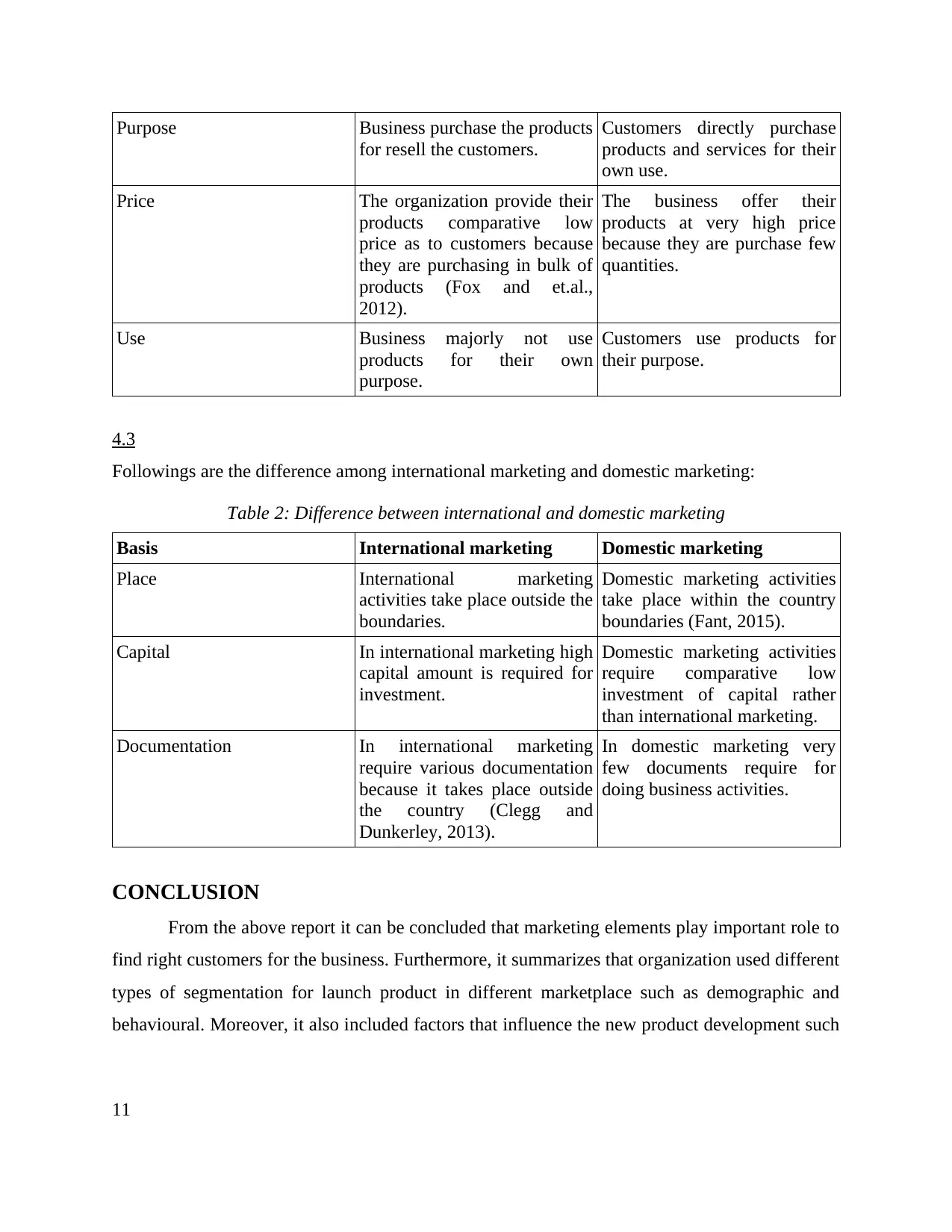
Purpose Business purchase the products
for resell the customers.
Customers directly purchase
products and services for their
own use.
Price The organization provide their
products comparative low
price as to customers because
they are purchasing in bulk of
products (Fox and et.al.,
2012).
The business offer their
products at very high price
because they are purchase few
quantities.
Use Business majorly not use
products for their own
purpose.
Customers use products for
their purpose.
4.3
Followings are the difference among international marketing and domestic marketing:
Table 2: Difference between international and domestic marketing
Basis International marketing Domestic marketing
Place International marketing
activities take place outside the
boundaries.
Domestic marketing activities
take place within the country
boundaries (Fant, 2015).
Capital In international marketing high
capital amount is required for
investment.
Domestic marketing activities
require comparative low
investment of capital rather
than international marketing.
Documentation In international marketing
require various documentation
because it takes place outside
the country (Clegg and
Dunkerley, 2013).
In domestic marketing very
few documents require for
doing business activities.
CONCLUSION
From the above report it can be concluded that marketing elements play important role to
find right customers for the business. Furthermore, it summarizes that organization used different
types of segmentation for launch product in different marketplace such as demographic and
behavioural. Moreover, it also included factors that influence the new product development such
11
for resell the customers.
Customers directly purchase
products and services for their
own use.
Price The organization provide their
products comparative low
price as to customers because
they are purchasing in bulk of
products (Fox and et.al.,
2012).
The business offer their
products at very high price
because they are purchase few
quantities.
Use Business majorly not use
products for their own
purpose.
Customers use products for
their purpose.
4.3
Followings are the difference among international marketing and domestic marketing:
Table 2: Difference between international and domestic marketing
Basis International marketing Domestic marketing
Place International marketing
activities take place outside the
boundaries.
Domestic marketing activities
take place within the country
boundaries (Fant, 2015).
Capital In international marketing high
capital amount is required for
investment.
Domestic marketing activities
require comparative low
investment of capital rather
than international marketing.
Documentation In international marketing
require various documentation
because it takes place outside
the country (Clegg and
Dunkerley, 2013).
In domestic marketing very
few documents require for
doing business activities.
CONCLUSION
From the above report it can be concluded that marketing elements play important role to
find right customers for the business. Furthermore, it summarizes that organization used different
types of segmentation for launch product in different marketplace such as demographic and
behavioural. Moreover, it also included factors that influence the new product development such
11
as product life cycle, understanding competition and public relations. In addition to this, it
explained difference between B2B and B2C on the basis of purpose, price and use.
12
explained difference between B2B and B2C on the basis of purpose, price and use.
12
⊘ This is a preview!⊘
Do you want full access?
Subscribe today to unlock all pages.
Trusted by 1+ million students worldwide

1 out of 14


Related Documents


Your All-in-One AI-Powered Toolkit for Academic Success.
+13062052269
info@desklib.com
Available 24*7 on WhatsApp / Email
![[object Object]](/_next/static/media/star-bottom.7253800d.svg)
Unlock your academic potential
Copyright © 2020–2026 A2Z Services. All Rights Reserved. Developed and managed by ZUCOL.