Comprehensive Analysis: Mechanism of Resources Management in Malaysia

Verified

Added on  2022/05/31

|19
|2956
|18
Report
AI Summary
This report provides a comprehensive overview of resource management within the Halal industry in Malaysia. It begins with an introduction emphasizing the significance of Halal principles in Malaysia and the importance of resource management. The report details the Malaysian Halal Management System (MHMS), including the Internal Halal Control System (IHCS) and Halal Assurance System (HAS), highlighting their general requirements. It then explores the roles of key regulatory bodies such as JAKIM, the Halal Development Corporation (HDC), and the Ministry of Domestic Trade, Cooperatives, and Consumerism. The report further examines Halal certification processes, Malaysian Halal standards, and international certification bodies recognized by JAKIM, including IMS 1900:2005 and MS 2200:2008. Finally, the report discusses Malaysian management resources in food premises and factories, emphasizing compliance with Halal standards, equipment, and employee guidelines. The report underscores the importance of these standards in ensuring consumer trust and promoting economic growth within the Halal sector.
Document Page
MECHANISM OF RESOURCES
MANAGEMENT IN MALAYSIA
MUHAMMAD IRFAN BIN ABDUL HADI
NUR FATINI WARDAH BINTI FARIZAN
NUR FARHAH IBRAH BINTI ZULKIPLI
WAJIHATUZ ZAHRA BINTI MOHAMAD ZAIMI
(2020458418)
(2020497618)
(2020893058)
(2020472144)
tabler-icon-diamond-filled.svg

Paraphrase This Document

Need a fresh take? Get an instant paraphrase of this document with our AI Paraphraser
Document Page
INTRODUCTION
Resource management in
Malaysia is one of the important
things to be looked at carefully
by those responsible and
consumers
As in Malaysia, the concept of halal is very
important because it is a major consumer
guideline for Muslim consumers. Halal has been
described as Sharia-compliant and permissible
for Muslims. Even the use of halal and clean
products is demanded and vital to practice, as
well as having a variety of benefits based on
evidence from the Quran and Hadith.
Halal management is the resources and
administration of all the functions and activities
required to determine and achieve halal products.
This is demonstrated by the fact that Malaysia
was the first Muslim majority country in which the
government designated the development of the
halal industry as one of the most promising
engines of national economic growth.
Document Page
1.0 MANAGEMENT HALAL MANAGEMENT
SYSTEM: MHMS
The Halal Assurance Management System or also known as HAS was first introduced in
2011 when the Ministry of Islamic Development Malaysia (JAKIM) issued guidelines on the
Halal Assurance Management System for Halal Certification in Malaysia. Introduce the
Malaysian Halal Management System (hereinafter referred to as MHMS 2020) to replace
the Halal Assurance Management System Guidelines for Malaysian Halal Certification.
Malaysian Halal Management System (MHMS) is an integrated management system
developed, implemented, and maintained by an organization/ company to manage
products and services to maintain halal guarantees through IHCS or HAS. Internal Halal
Control System (IHCS) control procedures for an organization/ company comprising halal
policies, raw material control procedures, or halal risk control procedures and traceability
procedures as minimum control measures to maintain the halal guarantee. This system is
specially used for small and micro industries. Halal Assurance System (HAS) is a set of
procedures used by an organization/company to achieve its objectives in maintaining a
comprehensive halal guarantee. This system is specially used for large and medium
industries.
MUHAMMAD IRFAN BIN ABDUL HADI (2020458418)
Document Page
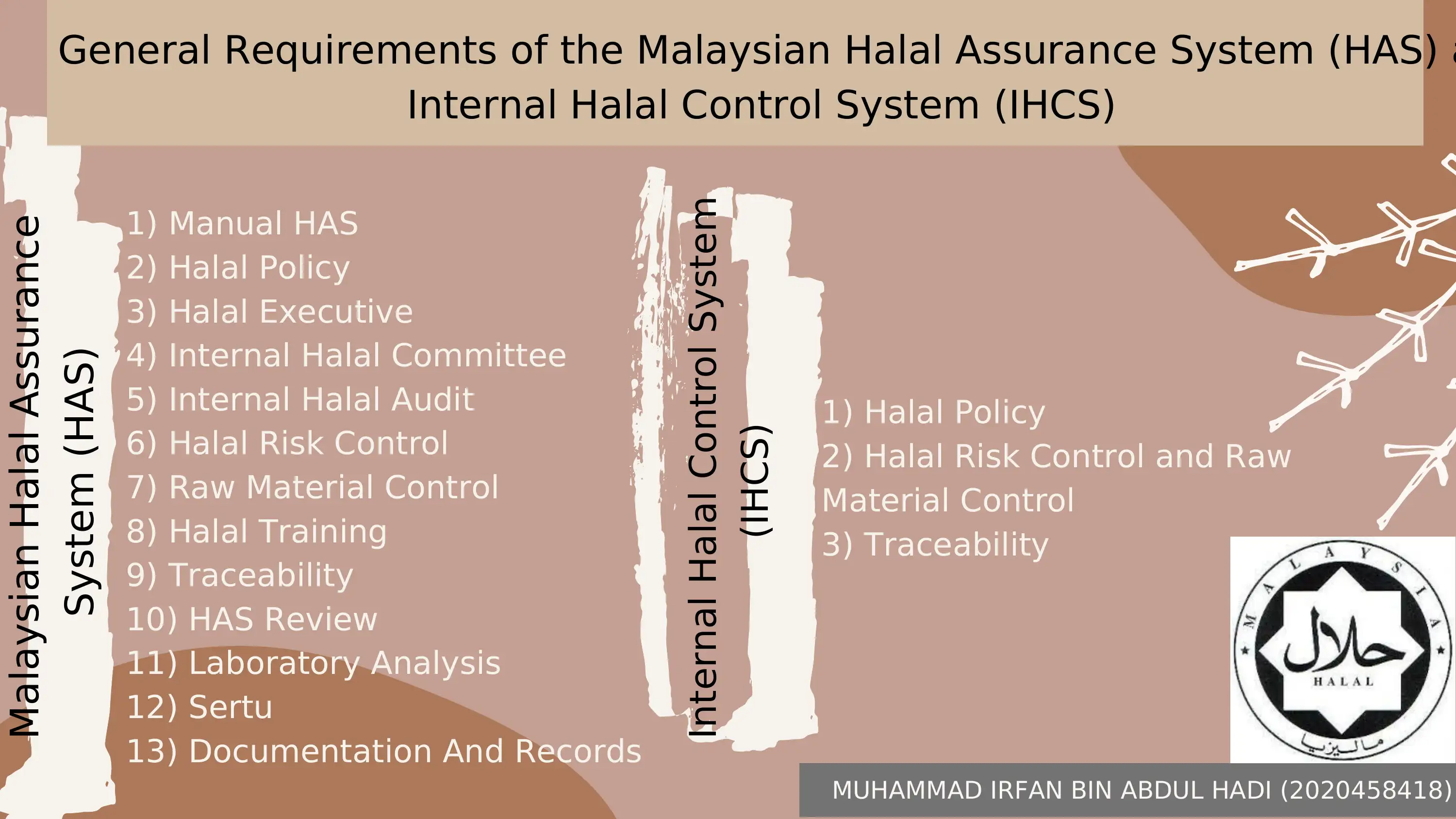
1) Manual HAS
2) Halal Policy
3) Halal Executive
4) Internal Halal Committee
5) Internal Halal Audit
6) Halal Risk Control
7) Raw Material Control
8) Halal Training
9) Traceability
10) HAS Review
11) Laboratory Analysis
12) Sertu
13) Documentation And Records
General Requirements of the Malaysian Halal Assurance System (HAS) a
Internal Halal Control System (IHCS)
Internal Halal Control System
(IHCS) 1) Halal Policy
2) Halal Risk Control and Raw
Material Control
3) Traceability
Malaysian Halal Assurance
System (HAS)
MUHAMMAD IRFAN BIN ABDUL HADI (2020458418)
tabler-icon-diamond-filled.svg

Paraphrase This Document

Need a fresh take? Get an instant paraphrase of this document with our AI Paraphraser
Document Page
2.0 SUPERVISOR BODY IN MALAYSIA
REGARDING HALAL
JAKIM is a Malaysian Government institution which has established Malaysia Halal logo
and implemented Halal Certification System, Issues Halal certificate for local and
export markets, Monitoring and enforcement of halal guidelines.
Its main goal was to review, verify, and oversee all food products and halal personal
care, and to ensure the cleanliness swiftly and effectively in order to be a legitimate
halal certification services centre that is recognised both nationally and globally.
NUR FATINI WARDAH BINTI FARIZAN (2020497618)
Document Page
HDC has been tasked with advancing the Halal agenda in terms of standard creation,
branding enhancement, commercial and industry development, and so on. Halal is
more than just a way of life; it is a worldwide industry. Halal Development has
become a key contributor to all aspects of economic growth, with a stake in
commercial sectors all over the world. Halal Industry Development Corporation,
founded on September 18, 2006, manages the overall development of the Halal
industry in Malaysia.
ROLES OF RELATED AGENCIES IN
HALAL
NUR FATINI WARDAH BINTI FARIZAN (2020497618)
HALAL INDUSTRY DEVELOPMENT
CORPORATION (HDC)
Document Page
The Ministry of Domestic Trade, Cooperatives, and Consumerism was
established with the goal of supporting ethical business practises and
protecting consumer interests. MDTCC provides an enforcement and monitoring
programme to defend Halal integrity, the Halal mark, and the interests of
consumers. They intend to be a pioneer in the development of domestic trade,
cooperatives, and consumerism.
ROLES OF RELATED AGENCIES IN
HALAL
NUR FATINI WARDAH BINTI FARIZAN (2020497618)
MINISTRY OF DOMESTIC TRADE, COOPERATIVE
AND CONSUMERISM
tabler-icon-diamond-filled.svg

Paraphrase This Document

Need a fresh take? Get an instant paraphrase of this document with our AI Paraphraser
Document Page
3.0 HALAL CERTIFICATION AND
HALAL STANDARD
Halal certification is a document that certifies that items and services
offered to muslims meet Islamic law's creteria these product and
services are regarded as suitable for consumption by Muslim the
quality and features of items must conform with the Islamic Council's
regulations during the Halal certication procedure
JAKIM is the governing body in Malaysia that overseas halal
certification for food products and develops policies that are
approved by the cabinet The presence of adequate Halal-certified
food is believed to have an impact to ensure Muslims have
responsible choices in their intake behavior
NUR FARHAH IBRAH BINTI ZULKIPLI (2020893058)
Document Page
Halal Standard
The term standards, according to the Malaysian Standards Act 1996,
Section 2, Act 549 defines a “standard” as a document established
by consensus and approved by a recognized body, which provides
for normal and repeated use. The document in question contains
rules, guidelines, or features for the activity or its results, aimed at
achieving an optimal level of order. The scope of the standard is
limited to specific parameters or areas in specific contexts whose
compliance is either voluntary or mandatory
Having specific standards gives rise to a process of standardization.
Standardization indicates any activity of creating, about an actual or
potential problem, provision for common and repetitive use, aimed at
achieving an optimal level of arrangement in a particular context.
NUR FARHAH IBRAH BINTI ZULKIPLI (2020893058)
Document Page
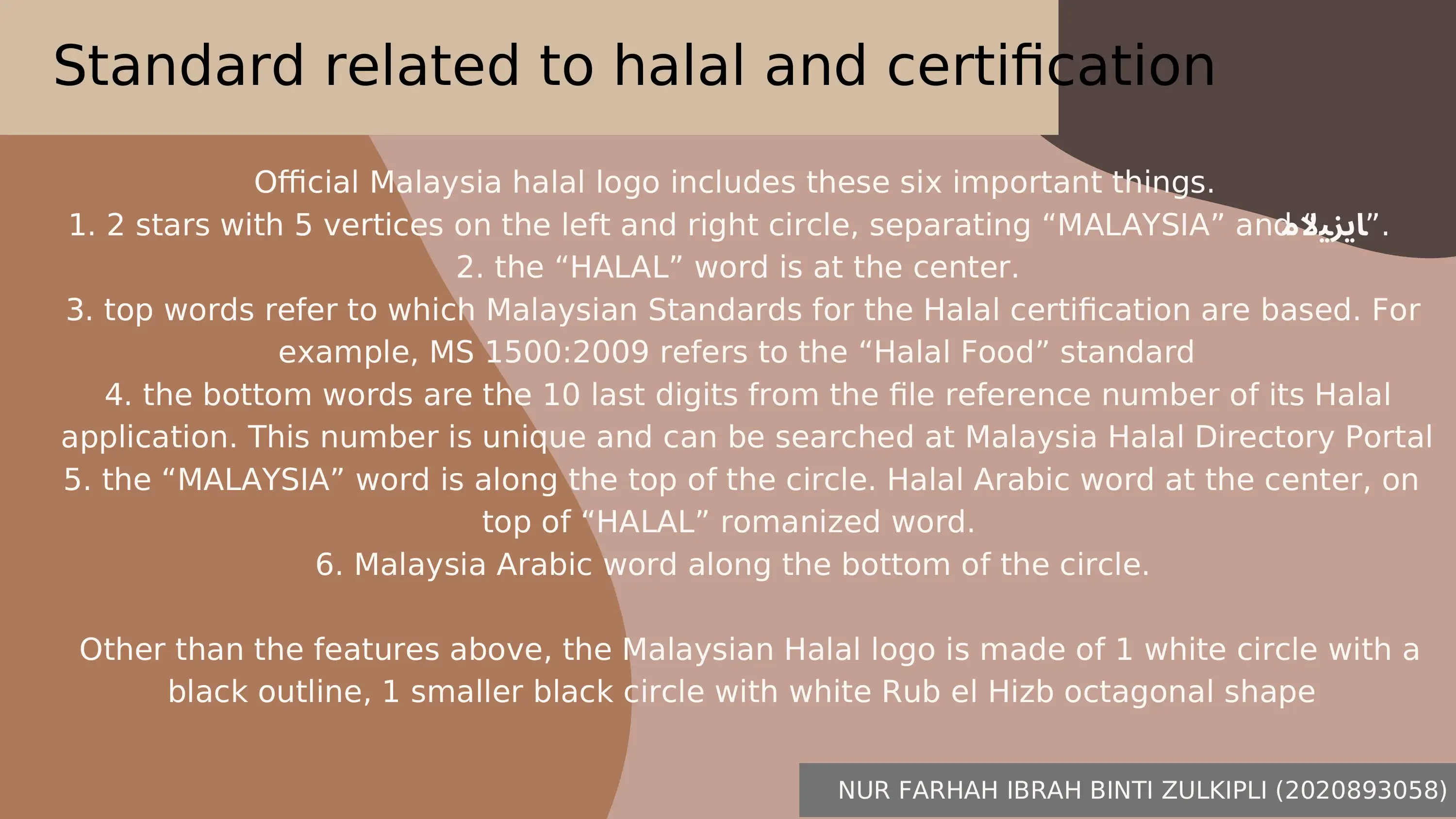
Standard related to halal and certification
NUR FARHAH IBRAH BINTI ZULKIPLI (2020893058)
Official Malaysia halal logo includes these six important things.
1. 2 stars with 5 vertices on the left and right circle, separating “MALAYSIA” and “ﺎﻳﺰﻴﺎﻟﻣ.
2. the “HALAL” word is at the center.
3. top words refer to which Malaysian Standards for the Halal certification are based. For
example, MS 1500:2009 refers to the “Halal Food” standard
4. the bottom words are the 10 last digits from the file reference number of its Halal
application. This number is unique and can be searched at Malaysia Halal Directory Portal
5. the “MALAYSIA” word is along the top of the circle. Halal Arabic word at the center, on
top of “HALAL” romanized word.
6. Malaysia Arabic word along the bottom of the circle.
Other than the features above, the Malaysian Halal logo is made of 1 white circle with a
black outline, 1 smaller black circle with white Rub el Hizb octagonal shape
tabler-icon-diamond-filled.svg

Paraphrase This Document

Need a fresh take? Get an instant paraphrase of this document with our AI Paraphraser
Document Page
Standard related to halal and certification
International Halal Certification Bodies Recognized by Jakim
This certification is important for all Muslim users to be aware of
approved Islamic bodies throughout the country. Users should also be
able to identify the logo for international Islamic agencies abroad as
this can help them in making decisions when buying consumer goods or
sheltering certain premises abroad
The Department of Islamic Development Malaysia (JAKIM) is the
responsible agency of Islamic affairs including halal certification in
Malaysia. Therefore, JAKIM is playing a very important role to protect
Muslim consumers in Malaysia, and it always has been It is JAKIM's
responsibility to ensure that they seek halal products as required by
Shariah
NUR FARHAH IBRAH BINTI ZULKIPLI (2020893058)
Document Page
Standard related to halal and certification
IMS 1900:2005 Management from Islamic Perspective
This MS outlines the requirements for a quality management system in
which an organization must demonstrate its ability to consistently
provide a product that meets customer and regulatory requirements, to
improve customer satisfaction through the effective implementation of
the system. The system includes mechanisms for continuous system
improvement and the assurance of compliance with consumer and
regulatory requirements
This MS lays out the specifications for a quality management system.
Where an organization must demonstrate its ability to provide regularly
the product that satisfies consumer and regulatory criteria, to increase
customer satisfaction through effective application of the system,
includes mechanisms for continuous system improvement and the
assurance of compliance with consumer and regulatory requirements
NUR FARHAH IBRAH BINTI ZULKIPLI (2020893058)
chevron_up_icon
1 out of 19
circle_padding
hide_on_mobile
zoom_out_icon
[object Object]