Comparison of Known and Unknown Halophilic Archaea Species: BIOL 1P92
VerifiedAdded on 2023/04/20
|5
|2763
|169
Report
AI Summary
This report presents a comparative analysis of halophilic archaea, focusing on the morphological, genetic, and phenotypic characteristics of Haloferax volcanii, Halobacterium salinarum, and an unknown species discovered in Dead Moose Lake. The study aimed to classify the unknown archaean by examining colony morphology, physiological and biochemical properties, and evolutionary relationships through phylogenetic analysis. The research involved culturing the organisms under varying conditions of temperature, pH, and salt concentration to determine optimal growth conditions and assess their ability to withstand extreme environments. Results revealed shared and unique characteristics among the species, with the unknown isolate showing distinct features suggesting it might be a new species within the genus Haloferax. The report concludes with recommendations for classifying the unknown species based on the gathered data, including its optimal growth conditions and its position in the phylogenetic tree. The report also evaluates the evolutionary relationships between the three species using phenotypic analysis and dendograms.
Comparison of Known Halophilic Archaeans Characteristics with
Unknown Halophilic Archaeans.
Aldhafiri, Danah a
a Department of Biological Sciences, Brock University, St. Catharines, Ontario. Canada, L2S 3A1
Journal of Biological Sciences 01 (2018) 001–001
Abstract
This experiment investigated two known species of halophilic archaeans and an unknown species that was discovered in Dead Moose Lake
in Canada. The known species were Haloferax volcanii and Halobacterium salinarum. The purpose of the experiment was to compare the
morphological, genetic and phenotypic characteristics of the three microorganisms with the view to classify the unknown halophilic
archaean. Different cultures were made and the organisms put in them under different conditions in order to study the said characteristics.
The ability of the halophiles to withstand extreme conditions was put to test with variations in temperatures, pH and concentration of the
culture being made in order to identify the optimal conditions for growth in the different species. Lab experiments were set up and the three
microorganisms placed in the same cultured conditions where observations were made and results recorded for analysis. The study was
structured to study the physical appearance of the colonies as well as the physiological and biochemical properties. The results revealed that
the three organisms shared some characteristics and also had some unique features which suggested that the belonged to different genera.
The unknown sample in particular was quite distinct in a majority of its properties suggesting that this might be a new species all together.
This study evaluates the optimal conditions of temperature salt concentration and pH required for the three species and comparisons of the
evolutionary relationships between the three species made using phenotypic analysis by the use of dendograms. From the results obtained
the unknown species should be classified as a member of genus Haloferax.
Keywords: Dihydrolase; Galactosidase; Halophilic; Hydrolysis; Morphology.
1. Introduction
The domain of archaea was first put in place in 1977 by a group of scientists who had spent time studying the rRNA
genes. They were classified into their own kingdom as they lacked the properties and features of other bacterial cells in
normal habitats. Halophilic archaea are a group of microorganisms belonging to the phylum Euryarchaeota. They were
initially categorised as halobacteria but they are now referred to archaea. There exist ten haloarchaeal genera that are
classified in both order halobacteriales and halofercales (Noha, Kristen, & Mostafa, 2012). 50 species have been
documented to exist in these genera. These microorganisms have the ability to withstand very saline conditions hence the
name halo which means salt (Stan-Lotter & Fendrihan, 2015). The organisms also exist in rocks that have existed on the
face of the earth for very many years. Also known as Haloarchaea, the bacteria thrives in salty conditions having the
ability to conduct it biological processes without being adversely affected. Researchers have even conducted studies the
demonstrated the existence of halophilic archaea in salted and fermented foods, some of them were even found in the
human digestive system suggesting that these microorganisms play an important role in the process of food storage and
manufacturing. Scientists have continued to conduct a plethora of research and discover new sequences of rRNA genes
that suggest the existence of a new species of Haloarchaea (Stan-Lotter & Fendrihan, 2015). Haloarchaea are able to
withstand very extreme conditions of very high temperatures, super saline conditions and in some cases ultraviolet
radiations. For this reason halophilic archaeans are considered to be extremophiles. To ensure the survival of halophiles
in the saline conditions, their cells are configured to have charged amino acids on the cell membranes which are essential
in the retention of water molecules within the cell. Being unable to produce spores which are a domicile form of most
bacteria when the environment becomes oligotrophic, some forms Haloarchaea form cysts and other resting states that
are still the subject of study by various scholars (Oren, 2006). These organisms have demonstrated resilience to ensure
that their survival is guaranteed including resistance to desiccation (Najjari, Elshahed, Cherif & Youssef, 2015). Due to
their ability to survive extreme conditions, halophilic archaea have some very distinct features associated with eukaryotic
organisms. Presence of multiple RNA polymerases and leaderless transcripts make them very unique from other type of
bacteria at the level of molecules. Some of the most studied genera of halophiles include Halobacterium, Haloferax, and
Haloarcula (Oren, 2011). Scholars have little information about many other genres that exist in terms of their structures
and patterns. Given the wide range of diversity in halobacteria, scientists have engaged in studies to determine the
significance of the different habitat factors and how they affect the growth of the halophiles (Gibtan et al., 2017). Studies
Unknown Halophilic Archaeans.
Aldhafiri, Danah a
a Department of Biological Sciences, Brock University, St. Catharines, Ontario. Canada, L2S 3A1
Journal of Biological Sciences 01 (2018) 001–001
Abstract
This experiment investigated two known species of halophilic archaeans and an unknown species that was discovered in Dead Moose Lake
in Canada. The known species were Haloferax volcanii and Halobacterium salinarum. The purpose of the experiment was to compare the
morphological, genetic and phenotypic characteristics of the three microorganisms with the view to classify the unknown halophilic
archaean. Different cultures were made and the organisms put in them under different conditions in order to study the said characteristics.
The ability of the halophiles to withstand extreme conditions was put to test with variations in temperatures, pH and concentration of the
culture being made in order to identify the optimal conditions for growth in the different species. Lab experiments were set up and the three
microorganisms placed in the same cultured conditions where observations were made and results recorded for analysis. The study was
structured to study the physical appearance of the colonies as well as the physiological and biochemical properties. The results revealed that
the three organisms shared some characteristics and also had some unique features which suggested that the belonged to different genera.
The unknown sample in particular was quite distinct in a majority of its properties suggesting that this might be a new species all together.
This study evaluates the optimal conditions of temperature salt concentration and pH required for the three species and comparisons of the
evolutionary relationships between the three species made using phenotypic analysis by the use of dendograms. From the results obtained
the unknown species should be classified as a member of genus Haloferax.
Keywords: Dihydrolase; Galactosidase; Halophilic; Hydrolysis; Morphology.
1. Introduction
The domain of archaea was first put in place in 1977 by a group of scientists who had spent time studying the rRNA
genes. They were classified into their own kingdom as they lacked the properties and features of other bacterial cells in
normal habitats. Halophilic archaea are a group of microorganisms belonging to the phylum Euryarchaeota. They were
initially categorised as halobacteria but they are now referred to archaea. There exist ten haloarchaeal genera that are
classified in both order halobacteriales and halofercales (Noha, Kristen, & Mostafa, 2012). 50 species have been
documented to exist in these genera. These microorganisms have the ability to withstand very saline conditions hence the
name halo which means salt (Stan-Lotter & Fendrihan, 2015). The organisms also exist in rocks that have existed on the
face of the earth for very many years. Also known as Haloarchaea, the bacteria thrives in salty conditions having the
ability to conduct it biological processes without being adversely affected. Researchers have even conducted studies the
demonstrated the existence of halophilic archaea in salted and fermented foods, some of them were even found in the
human digestive system suggesting that these microorganisms play an important role in the process of food storage and
manufacturing. Scientists have continued to conduct a plethora of research and discover new sequences of rRNA genes
that suggest the existence of a new species of Haloarchaea (Stan-Lotter & Fendrihan, 2015). Haloarchaea are able to
withstand very extreme conditions of very high temperatures, super saline conditions and in some cases ultraviolet
radiations. For this reason halophilic archaeans are considered to be extremophiles. To ensure the survival of halophiles
in the saline conditions, their cells are configured to have charged amino acids on the cell membranes which are essential
in the retention of water molecules within the cell. Being unable to produce spores which are a domicile form of most
bacteria when the environment becomes oligotrophic, some forms Haloarchaea form cysts and other resting states that
are still the subject of study by various scholars (Oren, 2006). These organisms have demonstrated resilience to ensure
that their survival is guaranteed including resistance to desiccation (Najjari, Elshahed, Cherif & Youssef, 2015). Due to
their ability to survive extreme conditions, halophilic archaea have some very distinct features associated with eukaryotic
organisms. Presence of multiple RNA polymerases and leaderless transcripts make them very unique from other type of
bacteria at the level of molecules. Some of the most studied genera of halophiles include Halobacterium, Haloferax, and
Haloarcula (Oren, 2011). Scholars have little information about many other genres that exist in terms of their structures
and patterns. Given the wide range of diversity in halobacteria, scientists have engaged in studies to determine the
significance of the different habitat factors and how they affect the growth of the halophiles (Gibtan et al., 2017). Studies

Paraphrase This Document
Need a fresh take? Get an instant paraphrase of this document with our AI Paraphraser
in molecular biology especially the sequencing of ribosomal RNA have been very important in understanding the
structure and composition of these organisms with the ability to survive in hypersaline environments. Interestingly, these
habitats which extreme saline conditions usually are populated with a lot of microbial activity. This is alluded to the
absence of predators and the plenty supply of nutrients. Extraction of lipid molecules from these habitats has proven to
be very useful in helping to further characterise halophilic organisms. Understanding that these organisms exist in special
environments, a study of their physiological and other important features is imperative so as to critically evaluate their
survival. Scientists continue to engage in studies to discover more species and genera of these halophilic organisms as
scholars believe that there is still so much to be discovered. Study techniques have therefore been refined from the
analysis of the rRNA sequences to exploring new areas with extreme conditions to analyse the ecosystems in search for
signs of life. An in depth look at the genetic features is also key to notice any genetic disparities between the known
halophiles and the new isolates that continue to be discovered every day. This study investigated two known species of
halophiles and one unknown isolate and made comparisons of their various morphological features, growth
characteristics, nutrition patterns and phylogenetic features. The features of the two species were then compared with
that of an unknown isolate under study with the aim of determining the existence of any relationship between the
different species. The behaviour of the isolate was analysed under different conditions to be able to deduce whether it is
a species in the existing genera or it is a whole new genera on its own. The unknown isolate under study was discovered
in Deadmoose Lake in Canada
2. Materials and methods
Isolation and culture conditions
20 μL of liquid culture was inoculated into 5 mL of growth media. Cultures were then incubated for a period of 14 days
after which absorbance was measured at 600nm. NaCl concentration was increased from 0 to 6.0 M. The pH was then
increased from 3-9. Cultures were then grown at different temperatures from 5-60 °C. Although culture conditions may
not reflect the habitat of the organisms, they provide an excellent environment for the study to take place. It is however
important to note that the results might be quite different if the organisms are studied in their original habitat.
Physiological and biochemical tests
Physiological tests are done to determine which factors affect the growth of halophiles. Physiological tests are carried out
by altering the temperature, pH and the concentration of the culture keeping the level of nutrients constant (Bowers and
Wiegel, 2011). Biochemical tests are conducted to determine the end products of enzymatic and metabolic reactions.
Reagents that change colour when the targeted enzyme is present are used for this particular part of the experiment.
Biochemical tests include ß-Galactosidase Activity, acid production from carbohydrates, arginine dihydrolase activity,
and starch hydrolysis just to mention a few. These tests provide good benchmark to measure the results obtained and
using the phenotypic characteristics create a diagrammatic illustration of how closely related the three organisms under
study are. These are basically the tests that enable the determination of evolutionary relationships between the organisms.
Phylogenetic analysis
A phylogenetic tree is constructed to establish the relationship between the two known species and the unknown species
by considering their individual characteristics. To effectively determine the evolutionary relations, sequences of rRNA
will be used to construct the phylogenetic tree. The choice of ribosomal RNA is due to their uniqueness and ability to
identify the distinct features of the organisms. RNAs are also very useful in creating relationships as some parts of the
sequence are usually the same for closely related organisms.
3. Results and Discussion
Colony Morphology
Observed results of the new species reveal the following characteristics: the species has a size of 4mm long with a brown
pigment and its density is opaque. The species has a smooth consistency with its form being circular. The margins are
entire and the species is immobile. The elevation of the species is pulvinate and there is a noticeable presence of gas
vesicles within the colony. These morphological characteristics of this colony suggest a very close relationship between
structure and composition of these organisms with the ability to survive in hypersaline environments. Interestingly, these
habitats which extreme saline conditions usually are populated with a lot of microbial activity. This is alluded to the
absence of predators and the plenty supply of nutrients. Extraction of lipid molecules from these habitats has proven to
be very useful in helping to further characterise halophilic organisms. Understanding that these organisms exist in special
environments, a study of their physiological and other important features is imperative so as to critically evaluate their
survival. Scientists continue to engage in studies to discover more species and genera of these halophilic organisms as
scholars believe that there is still so much to be discovered. Study techniques have therefore been refined from the
analysis of the rRNA sequences to exploring new areas with extreme conditions to analyse the ecosystems in search for
signs of life. An in depth look at the genetic features is also key to notice any genetic disparities between the known
halophiles and the new isolates that continue to be discovered every day. This study investigated two known species of
halophiles and one unknown isolate and made comparisons of their various morphological features, growth
characteristics, nutrition patterns and phylogenetic features. The features of the two species were then compared with
that of an unknown isolate under study with the aim of determining the existence of any relationship between the
different species. The behaviour of the isolate was analysed under different conditions to be able to deduce whether it is
a species in the existing genera or it is a whole new genera on its own. The unknown isolate under study was discovered
in Deadmoose Lake in Canada
2. Materials and methods
Isolation and culture conditions
20 μL of liquid culture was inoculated into 5 mL of growth media. Cultures were then incubated for a period of 14 days
after which absorbance was measured at 600nm. NaCl concentration was increased from 0 to 6.0 M. The pH was then
increased from 3-9. Cultures were then grown at different temperatures from 5-60 °C. Although culture conditions may
not reflect the habitat of the organisms, they provide an excellent environment for the study to take place. It is however
important to note that the results might be quite different if the organisms are studied in their original habitat.
Physiological and biochemical tests
Physiological tests are done to determine which factors affect the growth of halophiles. Physiological tests are carried out
by altering the temperature, pH and the concentration of the culture keeping the level of nutrients constant (Bowers and
Wiegel, 2011). Biochemical tests are conducted to determine the end products of enzymatic and metabolic reactions.
Reagents that change colour when the targeted enzyme is present are used for this particular part of the experiment.
Biochemical tests include ß-Galactosidase Activity, acid production from carbohydrates, arginine dihydrolase activity,
and starch hydrolysis just to mention a few. These tests provide good benchmark to measure the results obtained and
using the phenotypic characteristics create a diagrammatic illustration of how closely related the three organisms under
study are. These are basically the tests that enable the determination of evolutionary relationships between the organisms.
Phylogenetic analysis
A phylogenetic tree is constructed to establish the relationship between the two known species and the unknown species
by considering their individual characteristics. To effectively determine the evolutionary relations, sequences of rRNA
will be used to construct the phylogenetic tree. The choice of ribosomal RNA is due to their uniqueness and ability to
identify the distinct features of the organisms. RNAs are also very useful in creating relationships as some parts of the
sequence are usually the same for closely related organisms.
3. Results and Discussion
Colony Morphology
Observed results of the new species reveal the following characteristics: the species has a size of 4mm long with a brown
pigment and its density is opaque. The species has a smooth consistency with its form being circular. The margins are
entire and the species is immobile. The elevation of the species is pulvinate and there is a noticeable presence of gas
vesicles within the colony. These morphological characteristics of this colony suggest a very close relationship between
Haloferax salinarum and the unknown species. The colony also notably has a circular form. The size of your photo
should be adjusted to 5.0 cm (H) x 5.0 cm (W).
Fig. 1. Place the title of your colony morphology plate here.
Physiological and biochemical characteristics
The species reveal some distinct characteristics in starch hydrolysis, oxidase test, β-Galactosidase activity, alkalkine
phosphatase and production of acid from fructose. The other physiological and biochemical characteristics are
shared between the three species. The optimum pH for Halobacterium salinarum is 7. The optimum pH for
Haloferax volcanii is also 7 while the optimum pH for the unknown species is 6. Most of the characteristics are
however shared between Haloferax volcanii and the unknown species. It is important to note that the three strains
had similar results in catalse activity, hydrolysis of gelatin and tyrosinone and acid production from glycerol and
lactose. Other tests recorded significance differences with the unknown strain appearing to share more results with
Halobacterium salinarum. The results were as tabulated in the table below.
Table 1
Colony Morphology
Haloferax
exanimusalces
Halobacterium
salinarum
Haloferax
volcanii
Give the strain NRC-1 DS2
Pigmentation Brown Pink Light brown
Colony consistency Smooth Slimmy Smooth
Colony density Opaque Opaque Translucent
Motility No Yes No
Gas vesicles Yes Yes Yes
NaCl optimum (% w/v)
NaCl range (% w/v)
pH optimum 6 7 7
pH range 4-9 5-9 5-9
Temperature optimum (°C)
Temperature range (°C)
Table 2
Biochemical test results
Give the Genus and
species of the isolate
Halobacterium
salinarum
Haloferax
volcanii
Give the strain NRC-1 DS2
Catalase activity Positive Positive Positive
Oxidase activity Negative Positive Positive
Hydrolysis of:
should be adjusted to 5.0 cm (H) x 5.0 cm (W).
Fig. 1. Place the title of your colony morphology plate here.
Physiological and biochemical characteristics
The species reveal some distinct characteristics in starch hydrolysis, oxidase test, β-Galactosidase activity, alkalkine
phosphatase and production of acid from fructose. The other physiological and biochemical characteristics are
shared between the three species. The optimum pH for Halobacterium salinarum is 7. The optimum pH for
Haloferax volcanii is also 7 while the optimum pH for the unknown species is 6. Most of the characteristics are
however shared between Haloferax volcanii and the unknown species. It is important to note that the three strains
had similar results in catalse activity, hydrolysis of gelatin and tyrosinone and acid production from glycerol and
lactose. Other tests recorded significance differences with the unknown strain appearing to share more results with
Halobacterium salinarum. The results were as tabulated in the table below.
Table 1
Colony Morphology
Haloferax
exanimusalces
Halobacterium
salinarum
Haloferax
volcanii
Give the strain NRC-1 DS2
Pigmentation Brown Pink Light brown
Colony consistency Smooth Slimmy Smooth
Colony density Opaque Opaque Translucent
Motility No Yes No
Gas vesicles Yes Yes Yes
NaCl optimum (% w/v)
NaCl range (% w/v)
pH optimum 6 7 7
pH range 4-9 5-9 5-9
Temperature optimum (°C)
Temperature range (°C)
Table 2
Biochemical test results
Give the Genus and
species of the isolate
Halobacterium
salinarum
Haloferax
volcanii
Give the strain NRC-1 DS2
Catalase activity Positive Positive Positive
Oxidase activity Negative Positive Positive
Hydrolysis of:
⊘ This is a preview!⊘
Do you want full access?
Subscribe today to unlock all pages.

Trusted by 1+ million students worldwide
Casein Negative Positive Negative
Esculin Positive Negative Positive
Gelatin Negative Negative Negative
Starch Positive Negative Negative
Tyrosine Negative Negative Negative
H2S from:
Cysteine
Thiosulfate
Acid production from:
Galactose Positive Negative Positive
Glucose Positive Negative Positive
Glycerol Positive Positive Positive
Lactose Negative Negative Negative
Maltose Negative Negative Positive
Mannitol Negative Negative Negative
Sucrose Negative Negative Positive
Alkaline phosphatase Negative Positive Positive
Arginine dihydrolase Negative Positive Negative
Citrate utilization Positive Negative Positive
ß-Galactosidase Positive Negative Negative
Indole formation
Urease
Antibiotic sensitivity:
Bacitracin
Novobiocin
Rifampin
Phylogenetic analysis
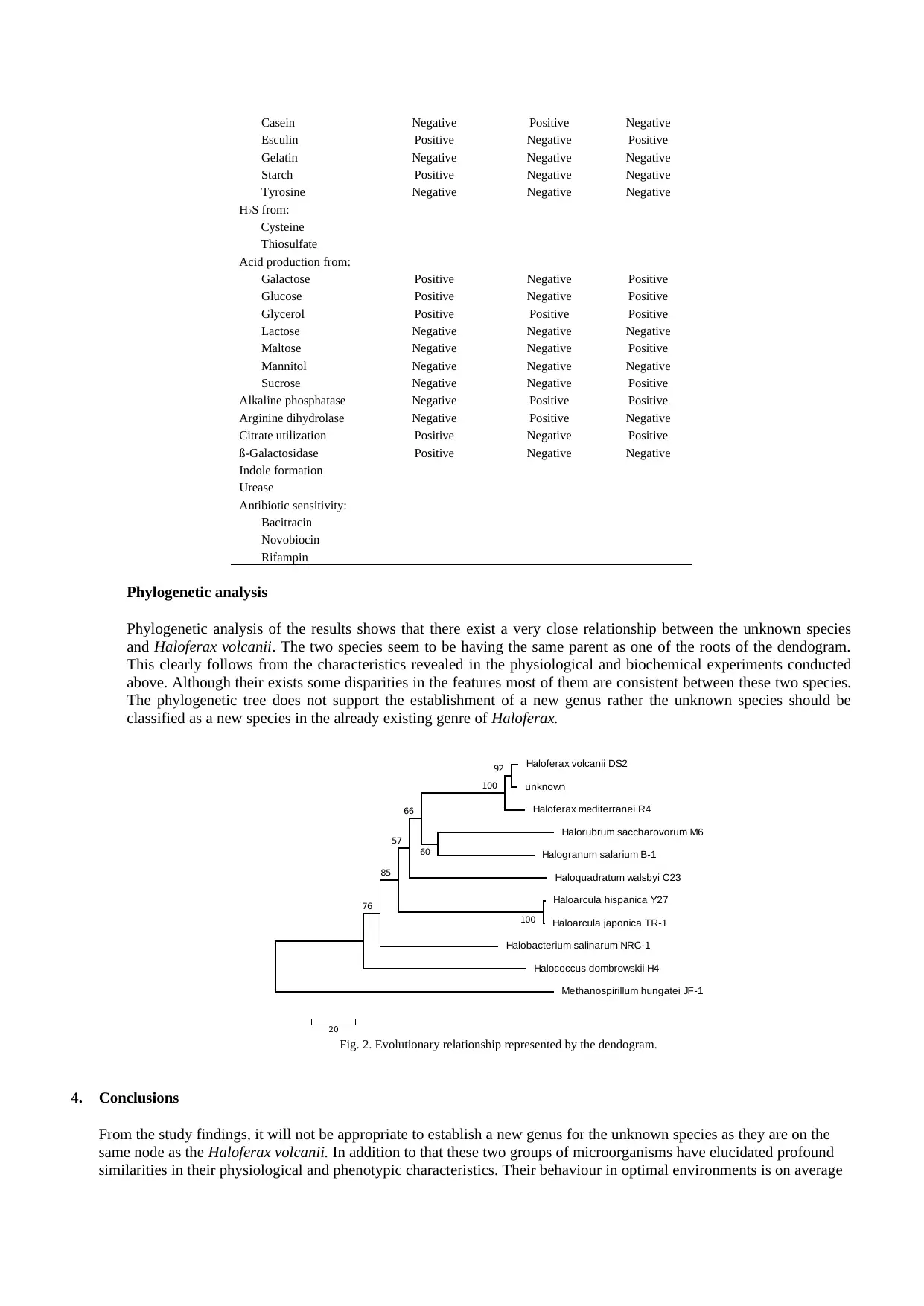
Phylogenetic analysis of the results shows that there exist a very close relationship between the unknown species
and Haloferax volcanii. The two species seem to be having the same parent as one of the roots of the dendogram.
This clearly follows from the characteristics revealed in the physiological and biochemical experiments conducted
above. Although their exists some disparities in the features most of them are consistent between these two species.
The phylogenetic tree does not support the establishment of a new genus rather the unknown species should be
classified as a new species in the already existing genre of Haloferax.
Fig. 2. Evolutionary relationship represented by the dendogram.
4. Conclusions
From the study findings, it will not be appropriate to establish a new genus for the unknown species as they are on the
same node as the Haloferax volcanii. In addition to that these two groups of microorganisms have elucidated profound
similarities in their physiological and phenotypic characteristics. Their behaviour in optimal environments is on average
Haloferax volcanii DS2
unknown
Haloferax mediterranei R4
Halorubrum saccharovorum M6
Halogranum salarium B-1
Haloquadratum walsbyi C23
Haloarcula hispanica Y27
Haloarcula japonica TR-1
Halobacterium salinarum NRC-1
Halococcus dombrowskii H4
Methanospirillum hungatei JF-1
100
92
100
76
60
66
57
85
20
Esculin Positive Negative Positive
Gelatin Negative Negative Negative
Starch Positive Negative Negative
Tyrosine Negative Negative Negative
H2S from:
Cysteine
Thiosulfate
Acid production from:
Galactose Positive Negative Positive
Glucose Positive Negative Positive
Glycerol Positive Positive Positive
Lactose Negative Negative Negative
Maltose Negative Negative Positive
Mannitol Negative Negative Negative
Sucrose Negative Negative Positive
Alkaline phosphatase Negative Positive Positive
Arginine dihydrolase Negative Positive Negative
Citrate utilization Positive Negative Positive
ß-Galactosidase Positive Negative Negative
Indole formation
Urease
Antibiotic sensitivity:
Bacitracin
Novobiocin
Rifampin
Phylogenetic analysis
Phylogenetic analysis of the results shows that there exist a very close relationship between the unknown species
and Haloferax volcanii. The two species seem to be having the same parent as one of the roots of the dendogram.
This clearly follows from the characteristics revealed in the physiological and biochemical experiments conducted
above. Although their exists some disparities in the features most of them are consistent between these two species.
The phylogenetic tree does not support the establishment of a new genus rather the unknown species should be
classified as a new species in the already existing genre of Haloferax.
Fig. 2. Evolutionary relationship represented by the dendogram.
4. Conclusions
From the study findings, it will not be appropriate to establish a new genus for the unknown species as they are on the
same node as the Haloferax volcanii. In addition to that these two groups of microorganisms have elucidated profound
similarities in their physiological and phenotypic characteristics. Their behaviour in optimal environments is on average
Haloferax volcanii DS2
unknown
Haloferax mediterranei R4
Halorubrum saccharovorum M6
Halogranum salarium B-1
Haloquadratum walsbyi C23
Haloarcula hispanica Y27
Haloarcula japonica TR-1
Halobacterium salinarum NRC-1
Halococcus dombrowskii H4
Methanospirillum hungatei JF-1
100
92
100
76
60
66
57
85
20
Paraphrase This Document
Need a fresh take? Get an instant paraphrase of this document with our AI Paraphraser
within the same range and it suffices that they should be placed within the same genus. The phylogenetic analysis
conducted shows that H. volcanii and the new isolate share the same parent node. The relationship between these two
microorganisms is therefore immediate. RNA sequences also show some close phenotypic relationship. These are
enough evidences to consider the placement of the isolate in genus Haloferax. Despite the slight difference in the
morphological characteristics, this can be described to be the unique characteristics of the individual species. However,
these preliminary findings will require a further study so as to determine other important characteristics of this
microorganism. Information on replication and repair of the DNA, and synthesis of RNA was not sufficient from the
experiment setup that was used to conduct this study.
5. Description of isolate
The new isolate can be described to be chemoautotrophic as they rely on oxidation to generate the energy that they
require, a facultative anaerobe, mesophilic as they thrive in moderate temperature conditions on average 40 degrees
Celsius and acidophilic as the optimum pH required for their effective growth is 6. The name of the new isolate is
Haloferax exanimusalces. Halo meaning salt ferax meaning fertile, exanimus meaning lifeless and alces meaning
moose.
6. Acknowledgments
Acknowledgements are made to the university, the teaching assistants and lecturers for their instrumental role in the
documenting and publication of this journal article.
7. References
Bowers, K. and Wiegel, J. (2011) Temperature and pH optima of extremely halophilic archaea: a mini-review.
Extremophiles 15: 119–128.
Gibtan, A., Park, K., Woo, M., Shin, J., Lee, D., & Sohn, J. et al. (2017). Diversity of Extremely Halophilic Archaeal and
Bacterial Communities from Commercial Salts. Frontiers In Microbiology, 8. doi: 10.3389/fmicb.2017.00799
Najjari, A., Elshahed, M., Cherif, A., & Youssef, N. (2015). Patterns and Determinants of Halophilic Archaea (Class
Halobacteria) Diversity in Tunisian Endorheic Salt Lakes and Sebkhet Systems. Applied And Environmental
Microbiology, 81(13), 4432-4441. doi: 10.1128/aem.01097-15
Noha, Y., Kristen, A.-S., & Mostafa, E. (2012). Phylogenetic Diversities and Community Structure of Members of the
Extremely Halophilic Archaea (Order Halobacteriales) in Multiple Saline Sediment Habitats. Applied and Environmental
Microbiology, 1332-1344.
Oren A. (2011) Diversity of Halophiles. In: Horikoshi K. (ed) Extremophiles Handbook. Springer, Tokyo
Oren, A. (2006) The Order Halobacteriales 3: 113-164 In: Dworkin, M., Falkow, S., Rosenberg, E., Schleifer, K.,
Stackebrandt, E. (eds) The Prokaryotes. Springer, New York
Stan-Lotter, H., & Fendrihan, S. (2015). Halophilic Archaea: Life with Desiccation, Radiation and Oligotrophy over
Geological Times. Life, 5(3), 1487-1496. doi: 10.3390/life5031487
conducted shows that H. volcanii and the new isolate share the same parent node. The relationship between these two
microorganisms is therefore immediate. RNA sequences also show some close phenotypic relationship. These are
enough evidences to consider the placement of the isolate in genus Haloferax. Despite the slight difference in the
morphological characteristics, this can be described to be the unique characteristics of the individual species. However,
these preliminary findings will require a further study so as to determine other important characteristics of this
microorganism. Information on replication and repair of the DNA, and synthesis of RNA was not sufficient from the
experiment setup that was used to conduct this study.
5. Description of isolate
The new isolate can be described to be chemoautotrophic as they rely on oxidation to generate the energy that they
require, a facultative anaerobe, mesophilic as they thrive in moderate temperature conditions on average 40 degrees
Celsius and acidophilic as the optimum pH required for their effective growth is 6. The name of the new isolate is
Haloferax exanimusalces. Halo meaning salt ferax meaning fertile, exanimus meaning lifeless and alces meaning
moose.
6. Acknowledgments
Acknowledgements are made to the university, the teaching assistants and lecturers for their instrumental role in the
documenting and publication of this journal article.
7. References
Bowers, K. and Wiegel, J. (2011) Temperature and pH optima of extremely halophilic archaea: a mini-review.
Extremophiles 15: 119–128.
Gibtan, A., Park, K., Woo, M., Shin, J., Lee, D., & Sohn, J. et al. (2017). Diversity of Extremely Halophilic Archaeal and
Bacterial Communities from Commercial Salts. Frontiers In Microbiology, 8. doi: 10.3389/fmicb.2017.00799
Najjari, A., Elshahed, M., Cherif, A., & Youssef, N. (2015). Patterns and Determinants of Halophilic Archaea (Class
Halobacteria) Diversity in Tunisian Endorheic Salt Lakes and Sebkhet Systems. Applied And Environmental
Microbiology, 81(13), 4432-4441. doi: 10.1128/aem.01097-15
Noha, Y., Kristen, A.-S., & Mostafa, E. (2012). Phylogenetic Diversities and Community Structure of Members of the
Extremely Halophilic Archaea (Order Halobacteriales) in Multiple Saline Sediment Habitats. Applied and Environmental
Microbiology, 1332-1344.
Oren A. (2011) Diversity of Halophiles. In: Horikoshi K. (ed) Extremophiles Handbook. Springer, Tokyo
Oren, A. (2006) The Order Halobacteriales 3: 113-164 In: Dworkin, M., Falkow, S., Rosenberg, E., Schleifer, K.,
Stackebrandt, E. (eds) The Prokaryotes. Springer, New York
Stan-Lotter, H., & Fendrihan, S. (2015). Halophilic Archaea: Life with Desiccation, Radiation and Oligotrophy over
Geological Times. Life, 5(3), 1487-1496. doi: 10.3390/life5031487

1 out of 5


Your All-in-One AI-Powered Toolkit for Academic Success.
+13062052269
info@desklib.com
Available 24*7 on WhatsApp / Email
![[object Object]](/_next/static/media/star-bottom.7253800d.svg)
Unlock your academic potential
Copyright © 2020–2025 A2Z Services. All Rights Reserved. Developed and managed by ZUCOL.