Exploring Hamilton's Plan for Commercial Industrialization Era

Verified

Added on  2023/06/15

|4
|604
|177
Essay
AI Summary
This essay delves into Alexander Hamilton's plan for commercial industrialization, examining the opposition it faced from Republicans who feared centralized government control and monarchist institutions. The essay highlights concerns about the plan's potential to benefit specific segments of the nation and the lack of explicit constitutional support for national banks. It contrasts Hamilton's proposal with alternative plans like the Virginia Plan, which favored larger states, and the New Jersey Plan, which sought to strengthen the Articles of Confederation. The analysis provides a comprehensive overview of the debates and competing visions for the early American economy and governance. Desklib provides access to similar solved assignments for students.
Document Page
Running head: HAMILTON’S PLAN FOR COMMERCIAL INDUSTRIALIZATION
Hamilton’s Plan for Commercial Industrialization
Name of the Student
Name of the University
Author’s Note
tabler-icon-diamond-filled.svg

Paraphrase This Document

Need a fresh take? Get an instant paraphrase of this document with our AI Paraphraser
Document Page
1
HAMILTON’S PLAN FOR COMMERCIAL INDUSTRIALIZATION
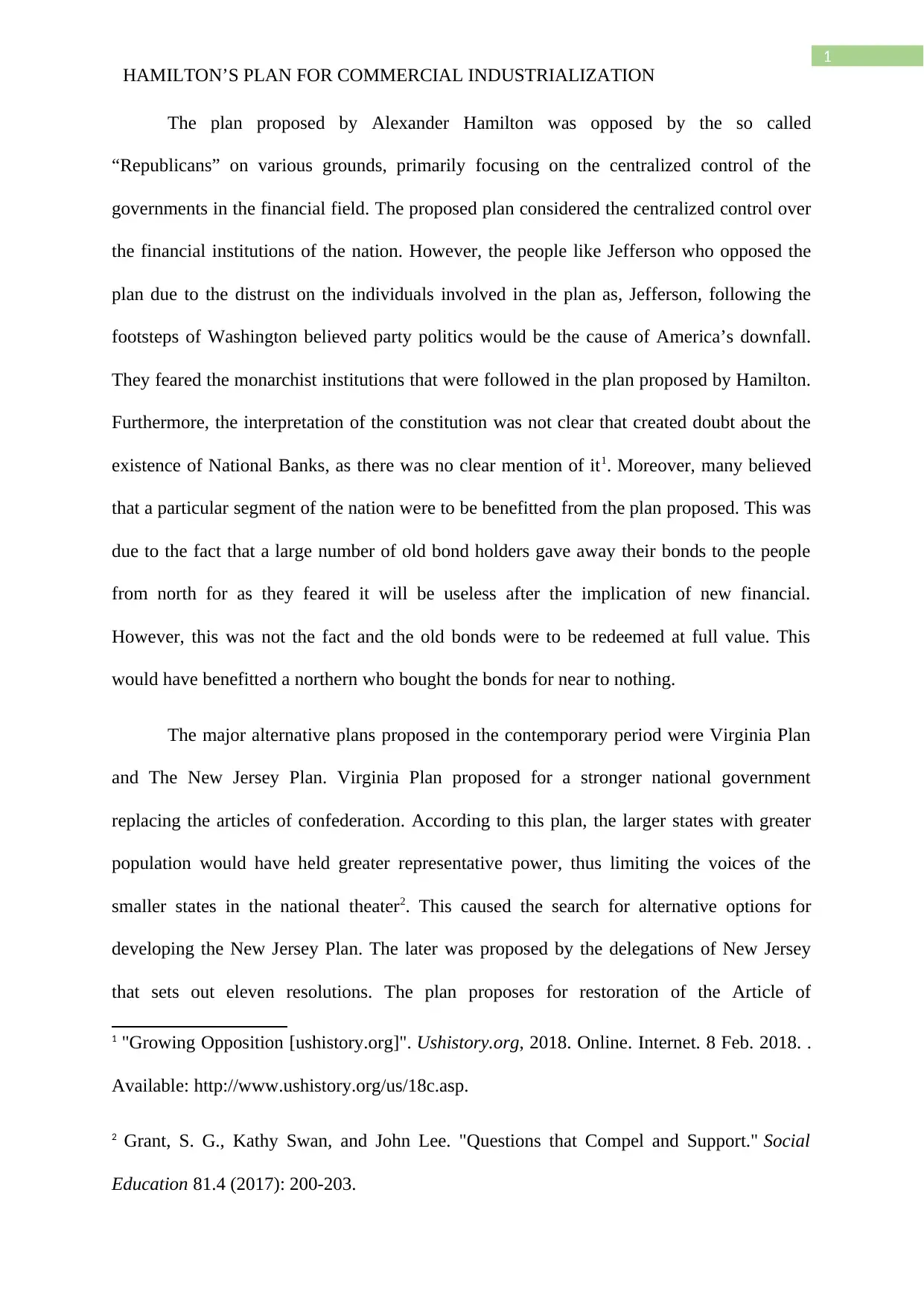
The plan proposed by Alexander Hamilton was opposed by the so called
“Republicans” on various grounds, primarily focusing on the centralized control of the
governments in the financial field. The proposed plan considered the centralized control over
the financial institutions of the nation. However, the people like Jefferson who opposed the
plan due to the distrust on the individuals involved in the plan as, Jefferson, following the
footsteps of Washington believed party politics would be the cause of America’s downfall.
They feared the monarchist institutions that were followed in the plan proposed by Hamilton.
Furthermore, the interpretation of the constitution was not clear that created doubt about the
existence of National Banks, as there was no clear mention of it1. Moreover, many believed
that a particular segment of the nation were to be benefitted from the plan proposed. This was
due to the fact that a large number of old bond holders gave away their bonds to the people
from north for as they feared it will be useless after the implication of new financial.
However, this was not the fact and the old bonds were to be redeemed at full value. This
would have benefitted a northern who bought the bonds for near to nothing.
The major alternative plans proposed in the contemporary period were Virginia Plan
and The New Jersey Plan. Virginia Plan proposed for a stronger national government
replacing the articles of confederation. According to this plan, the larger states with greater
population would have held greater representative power, thus limiting the voices of the
smaller states in the national theater2. This caused the search for alternative options for
developing the New Jersey Plan. The later was proposed by the delegations of New Jersey
that sets out eleven resolutions. The plan proposes for restoration of the Article of
1 "Growing Opposition [ushistory.org]". Ushistory.org, 2018. Online. Internet. 8 Feb. 2018. .
Available: http://www.ushistory.org/us/18c.asp.
2 Grant, S. G., Kathy Swan, and John Lee. "Questions that Compel and Support." Social
Education 81.4 (2017): 200-203.
Document Page
2
HAMILTON’S PLAN FOR COMMERCIAL INDUSTRIALIZATION
Confederation and revision accordingly, so that the federal government receives greater
authority. It also discarded the idea of bicameral legislature and proposed for the restoration
of single chamber structure mentioned in the articles3. This plan was intended to strengthen
the articles by supporting power to congress that included taxation and regulation of interstate
commerce.
3 Vile, John R. The Men who Made the Constitution: Lives of the Delegates to the
Constitutional Convention. Scarecrow Press, 2013.
Document Page
3
HAMILTON’S PLAN FOR COMMERCIAL INDUSTRIALIZATION
Bibliography
Grant, S. G., Kathy Swan, and John Lee. "Questions that Compel and Support." Social
Education 81.4 (2017): 200-203.
Growing Opposition [ushistory.org]. Ushistory.org, 2018. Online. Internet. 8 Feb. 2018. .
Available: http://www.ushistory.org/us/18c.asp.
Vile, John R. The Men who Made the Constitution: Lives of the Delegates to the
Constitutional Convention. Scarecrow Press, 2013.
chevron_up_icon
1 out of 4
circle_padding
hide_on_mobile
zoom_out_icon
[object Object]