K12 Hamlet Graded Assignment: Unit Test - Part 2, Literary Analysis
VerifiedAdded on 2022/09/01
|2
|1326
|40
Homework Assignment
AI Summary
This document presents a student's completed Hamlet unit test, covering key aspects of Shakespeare's play. The assignment includes answers to questions analyzing the literal and symbolic meanings of key events like the poison in the ear, the purpose of Hamlet's soliloquies, and the protagonist's tragic flaw. Furthermore, the student provides a literary essay comparing Hamlet to Laertes and Fortinbras, exploring themes of advice, duty, action versus inaction, and sanity versus madness. Another essay question analyzes the significance of role-playing in the play, examining its impact on plot events and character relationships. The responses incorporate textual evidence, demonstrating a comprehensive understanding of the play's themes and characters.
English | Graded Assignment | Unit Test, Part 2 | Hamlet
Name: Date:
Graded Assignment
Unit Test: Hamlet
Below are five questions on Hamlet. Answer Question 1, Question 2, and Question 3 with responses of at least
one paragraph. Then answer either Question 4 or Question 5 in a literary essay of at least five paragraphs.
Remember to incorporate textual evidence in all of your responses. You may refer to your copy of Hamlet and
your notes as you write.
Answer Questions 1, 2, and 3.
(Score for Question 1: ___ of 15 points)
1. Explain both the literal and symbolic meaning and importance of pouring poison in a person’s ear in Hamlet.
Answer:
The literal meaning of pouring poison in a person’s ear is the insinuating information which was passed to
the people of Denmark by Claudius and the father ghost again mentioning that he was stung by a serpent which
led to his death. The symbolical meaning of pouring poison in a person’s ears is feeding people with misleading
information to lead people into things which will be against their better judgment. We see the political case
strategy where the people of Denmark as a whole represents the ear and how people are led to believe that the
king is not good for their welfare which helps after his death as no one seemed to be bothered by the Queen’s
quick remarriage.
(Score for Question 2: ___ of 15 points)
2. What purpose do the soliloquies that Hamlet delivers over the course of the play serve? What do readers and
audience members learn about Hamlet from what he says in these speeches?
Answer:
The purpose of the soliloquies delivered by Hamlet over the course of the play an important role as it is
the only source of entry for readers to know the internal struggles which are the cause of his indecisive nature.
They give a picture of the battles he is fighting inside along with the struggles outside and gives us a better
understanding of his character. The audience and readers get closer to the protagonist and develop a feeling of
sympathy towards him as they are the only ones who are aware of his mourning for his father’s death.
(Score for Question 3: ___ of 15 points)
3. In drama, a character’s tragic flaw is the character trait that leads directly to his or her downfall in the work.
Many critics and scholars argue that Hamlet’s tragic flaw is his tendency toward inaction—his inability to act.
Do you agree? Why or why not? Cite specific examples from the text to support your response.
Answer:
I agree to the critical claim that it was Hamlet’s characteristic of indecision that led to his downfall or that
his inability to carry out the action is the tragic flaw which gives others an upper hand on him. As from the onset of
© 2015 K12 Inc. All rights reserved. Page 1 of 2
Copying or distributing without K12’s written consent is prohibited.
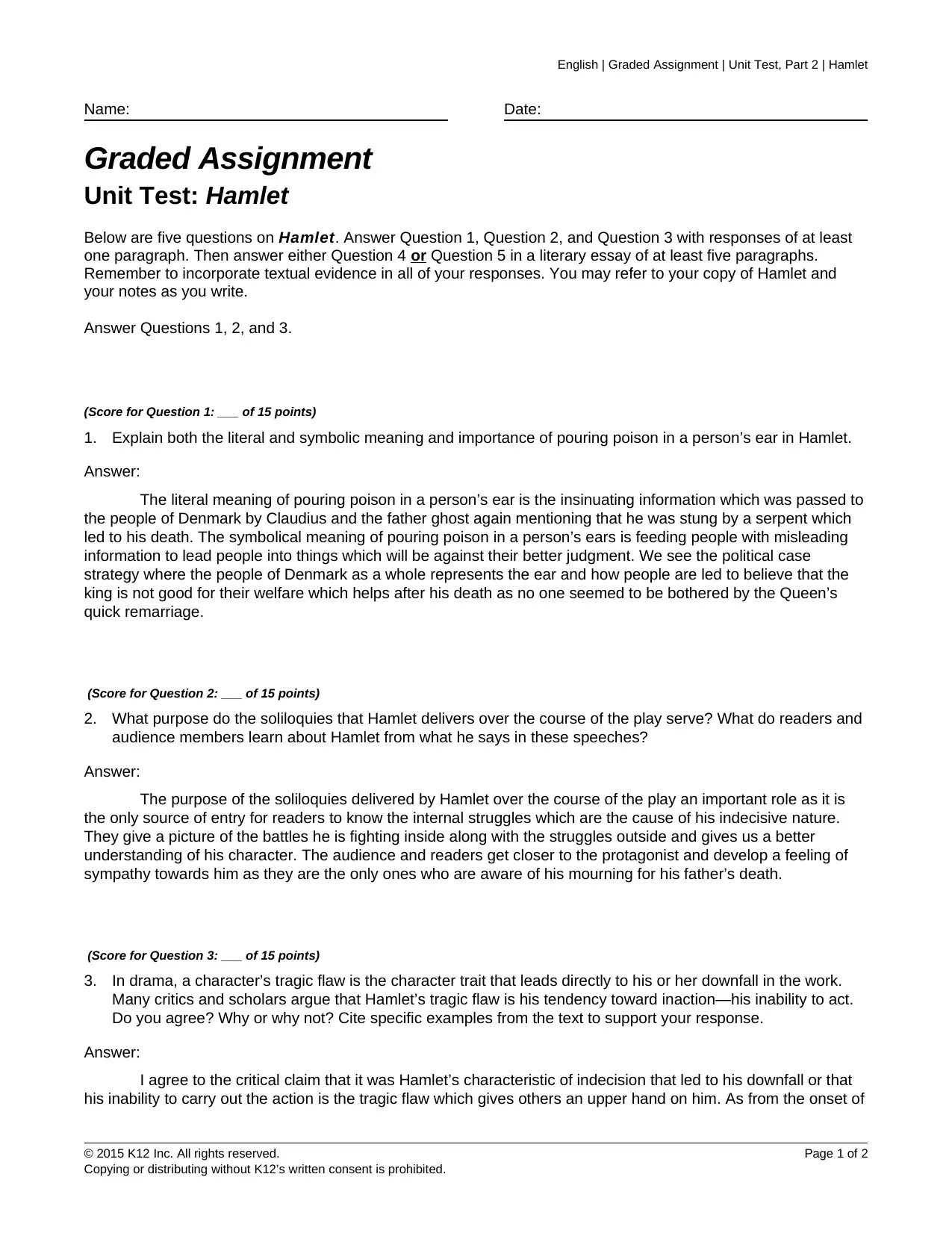
Name: Date:
Graded Assignment
Unit Test: Hamlet
Below are five questions on Hamlet. Answer Question 1, Question 2, and Question 3 with responses of at least
one paragraph. Then answer either Question 4 or Question 5 in a literary essay of at least five paragraphs.
Remember to incorporate textual evidence in all of your responses. You may refer to your copy of Hamlet and
your notes as you write.
Answer Questions 1, 2, and 3.
(Score for Question 1: ___ of 15 points)
1. Explain both the literal and symbolic meaning and importance of pouring poison in a person’s ear in Hamlet.
Answer:
The literal meaning of pouring poison in a person’s ear is the insinuating information which was passed to
the people of Denmark by Claudius and the father ghost again mentioning that he was stung by a serpent which
led to his death. The symbolical meaning of pouring poison in a person’s ears is feeding people with misleading
information to lead people into things which will be against their better judgment. We see the political case
strategy where the people of Denmark as a whole represents the ear and how people are led to believe that the
king is not good for their welfare which helps after his death as no one seemed to be bothered by the Queen’s
quick remarriage.
(Score for Question 2: ___ of 15 points)
2. What purpose do the soliloquies that Hamlet delivers over the course of the play serve? What do readers and
audience members learn about Hamlet from what he says in these speeches?
Answer:
The purpose of the soliloquies delivered by Hamlet over the course of the play an important role as it is
the only source of entry for readers to know the internal struggles which are the cause of his indecisive nature.
They give a picture of the battles he is fighting inside along with the struggles outside and gives us a better
understanding of his character. The audience and readers get closer to the protagonist and develop a feeling of
sympathy towards him as they are the only ones who are aware of his mourning for his father’s death.
(Score for Question 3: ___ of 15 points)
3. In drama, a character’s tragic flaw is the character trait that leads directly to his or her downfall in the work.
Many critics and scholars argue that Hamlet’s tragic flaw is his tendency toward inaction—his inability to act.
Do you agree? Why or why not? Cite specific examples from the text to support your response.
Answer:
I agree to the critical claim that it was Hamlet’s characteristic of indecision that led to his downfall or that
his inability to carry out the action is the tragic flaw which gives others an upper hand on him. As from the onset of
© 2015 K12 Inc. All rights reserved. Page 1 of 2
Copying or distributing without K12’s written consent is prohibited.
Paraphrase This Document
Need a fresh take? Get an instant paraphrase of this document with our AI Paraphraser

English | Graded Assignment | Unit Test, Part 2 | Hamlet
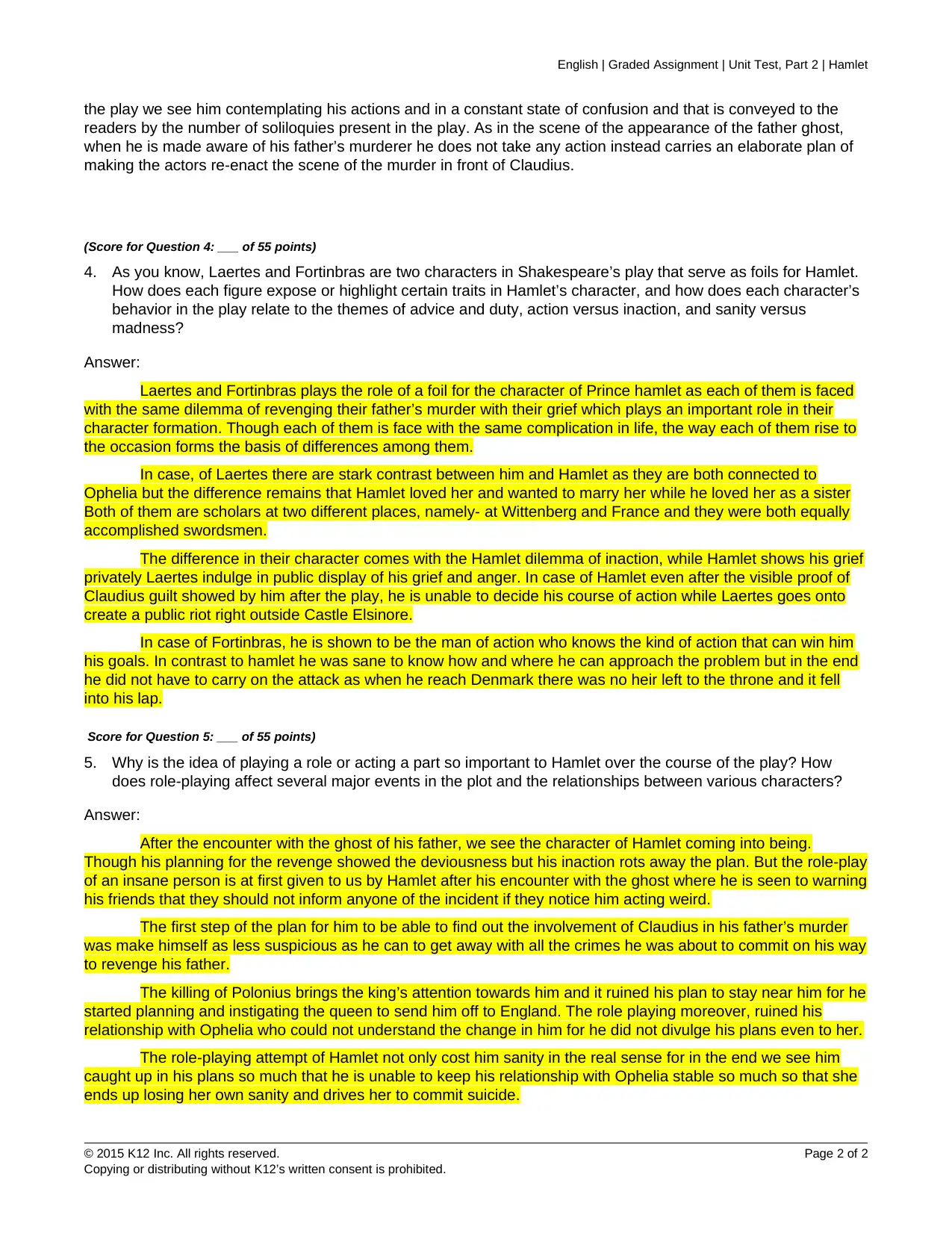
the play we see him contemplating his actions and in a constant state of confusion and that is conveyed to the
readers by the number of soliloquies present in the play. As in the scene of the appearance of the father ghost,
when he is made aware of his father’s murderer he does not take any action instead carries an elaborate plan of
making the actors re-enact the scene of the murder in front of Claudius.
(Score for Question 4: ___ of 55 points)
4. As you know, Laertes and Fortinbras are two characters in Shakespeare’s play that serve as foils for Hamlet.
How does each figure expose or highlight certain traits in Hamlet’s character, and how does each character’s
behavior in the play relate to the themes of advice and duty, action versus inaction, and sanity versus
madness?
Answer:
Laertes and Fortinbras plays the role of a foil for the character of Prince hamlet as each of them is faced
with the same dilemma of revenging their father’s murder with their grief which plays an important role in their
character formation. Though each of them is face with the same complication in life, the way each of them rise to
the occasion forms the basis of differences among them.
In case, of Laertes there are stark contrast between him and Hamlet as they are both connected to
Ophelia but the difference remains that Hamlet loved her and wanted to marry her while he loved her as a sister
Both of them are scholars at two different places, namely- at Wittenberg and France and they were both equally
accomplished swordsmen.
The difference in their character comes with the Hamlet dilemma of inaction, while Hamlet shows his grief
privately Laertes indulge in public display of his grief and anger. In case of Hamlet even after the visible proof of
Claudius guilt showed by him after the play, he is unable to decide his course of action while Laertes goes onto
create a public riot right outside Castle Elsinore.
In case of Fortinbras, he is shown to be the man of action who knows the kind of action that can win him
his goals. In contrast to hamlet he was sane to know how and where he can approach the problem but in the end
he did not have to carry on the attack as when he reach Denmark there was no heir left to the throne and it fell
into his lap.
Score for Question 5: ___ of 55 points)
5. Why is the idea of playing a role or acting a part so important to Hamlet over the course of the play? How
does role-playing affect several major events in the plot and the relationships between various characters?
Answer:
After the encounter with the ghost of his father, we see the character of Hamlet coming into being.
Though his planning for the revenge showed the deviousness but his inaction rots away the plan. But the role-play
of an insane person is at first given to us by Hamlet after his encounter with the ghost where he is seen to warning
his friends that they should not inform anyone of the incident if they notice him acting weird.
The first step of the plan for him to be able to find out the involvement of Claudius in his father’s murder
was make himself as less suspicious as he can to get away with all the crimes he was about to commit on his way
to revenge his father.
The killing of Polonius brings the king’s attention towards him and it ruined his plan to stay near him for he
started planning and instigating the queen to send him off to England. The role playing moreover, ruined his
relationship with Ophelia who could not understand the change in him for he did not divulge his plans even to her.
The role-playing attempt of Hamlet not only cost him sanity in the real sense for in the end we see him
caught up in his plans so much that he is unable to keep his relationship with Ophelia stable so much so that she
ends up losing her own sanity and drives her to commit suicide.
© 2015 K12 Inc. All rights reserved. Page 2 of 2
Copying or distributing without K12’s written consent is prohibited.
the play we see him contemplating his actions and in a constant state of confusion and that is conveyed to the
readers by the number of soliloquies present in the play. As in the scene of the appearance of the father ghost,
when he is made aware of his father’s murderer he does not take any action instead carries an elaborate plan of
making the actors re-enact the scene of the murder in front of Claudius.
(Score for Question 4: ___ of 55 points)
4. As you know, Laertes and Fortinbras are two characters in Shakespeare’s play that serve as foils for Hamlet.
How does each figure expose or highlight certain traits in Hamlet’s character, and how does each character’s
behavior in the play relate to the themes of advice and duty, action versus inaction, and sanity versus
madness?
Answer:
Laertes and Fortinbras plays the role of a foil for the character of Prince hamlet as each of them is faced
with the same dilemma of revenging their father’s murder with their grief which plays an important role in their
character formation. Though each of them is face with the same complication in life, the way each of them rise to
the occasion forms the basis of differences among them.
In case, of Laertes there are stark contrast between him and Hamlet as they are both connected to
Ophelia but the difference remains that Hamlet loved her and wanted to marry her while he loved her as a sister
Both of them are scholars at two different places, namely- at Wittenberg and France and they were both equally
accomplished swordsmen.
The difference in their character comes with the Hamlet dilemma of inaction, while Hamlet shows his grief
privately Laertes indulge in public display of his grief and anger. In case of Hamlet even after the visible proof of
Claudius guilt showed by him after the play, he is unable to decide his course of action while Laertes goes onto
create a public riot right outside Castle Elsinore.
In case of Fortinbras, he is shown to be the man of action who knows the kind of action that can win him
his goals. In contrast to hamlet he was sane to know how and where he can approach the problem but in the end
he did not have to carry on the attack as when he reach Denmark there was no heir left to the throne and it fell
into his lap.
Score for Question 5: ___ of 55 points)
5. Why is the idea of playing a role or acting a part so important to Hamlet over the course of the play? How
does role-playing affect several major events in the plot and the relationships between various characters?
Answer:
After the encounter with the ghost of his father, we see the character of Hamlet coming into being.
Though his planning for the revenge showed the deviousness but his inaction rots away the plan. But the role-play
of an insane person is at first given to us by Hamlet after his encounter with the ghost where he is seen to warning
his friends that they should not inform anyone of the incident if they notice him acting weird.
The first step of the plan for him to be able to find out the involvement of Claudius in his father’s murder
was make himself as less suspicious as he can to get away with all the crimes he was about to commit on his way
to revenge his father.
The killing of Polonius brings the king’s attention towards him and it ruined his plan to stay near him for he
started planning and instigating the queen to send him off to England. The role playing moreover, ruined his
relationship with Ophelia who could not understand the change in him for he did not divulge his plans even to her.
The role-playing attempt of Hamlet not only cost him sanity in the real sense for in the end we see him
caught up in his plans so much that he is unable to keep his relationship with Ophelia stable so much so that she
ends up losing her own sanity and drives her to commit suicide.
© 2015 K12 Inc. All rights reserved. Page 2 of 2
Copying or distributing without K12’s written consent is prohibited.
1 out of 2
Your All-in-One AI-Powered Toolkit for Academic Success.
+13062052269
info@desklib.com
Available 24*7 on WhatsApp / Email
Unlock your academic potential
Copyright © 2020–2025 A2Z Services. All Rights Reserved. Developed and managed by ZUCOL.