Marketing Mix Analysis Report: Hard Graft Tools Case Study
VerifiedAdded on 2023/01/12
|12
|2768
|79
Report
AI Summary
This report provides a comprehensive analysis of the marketing mix, focusing on how product features and benefits can be leveraged, particularly in the context of Hard Graft Tools, a medium-sized organization in the tools manufacturing sector. The report delves into the application of the marketing mix across the product life cycle, examining the introduction, growth, maturity, and decline stages. It also explores the roles of direct and indirect distribution channels, including intensive, selective, and exclusive distribution strategies. Furthermore, the report assesses how businesses can create customer lifetime value using the customer life cycle and highlights the advantages of direct marketing channels. The analysis includes an evaluation of the roles of product and place within the organization's marketing mix, offering insights into how these elements contribute to overall marketing effectiveness and customer engagement. The report emphasizes the importance of understanding consumer behavior and adapting marketing strategies to meet evolving market demands and competitive pressures.
The Marketing Mix
1
1

Paraphrase This Document
Need a fresh take? Get an instant paraphrase of this document with our AI Paraphraser
INTRODUCTION...........................................................................................................................4
TASK 1............................................................................................................................................4
(AC 1.1) An analysis of how the features and benefits of a product or service can be used in
the marketing mix........................................................................................................................4
(AC 1.2) A description of the use of the marketing mix at each stage of the Product Life
Cycle............................................................................................................................................5
(AC 3.1) An analysis of the role of direct and indirect distribution channels.............................7
(AC 3.2) An analysis of the use of intensive distribution, selective distribution and exclusive
distribution in the market.............................................................................................................7
(AC1 M1) An analysis of how a business can create lifetime value to the customer by using
the Customer Life Cycle..............................................................................................................7
(AC3 M1) An explanation of the advantages of using a direct marketing channel....................7
(AC1D1) An evaluation of the role of product in that organisation’s marketing mix................7
(AC3 D1) An evaluation of the role of place in that organisation’s marketing mix...................7
REFERENCES................................................................................................................................8
2
TASK 1............................................................................................................................................4
(AC 1.1) An analysis of how the features and benefits of a product or service can be used in
the marketing mix........................................................................................................................4
(AC 1.2) A description of the use of the marketing mix at each stage of the Product Life
Cycle............................................................................................................................................5
(AC 3.1) An analysis of the role of direct and indirect distribution channels.............................7
(AC 3.2) An analysis of the use of intensive distribution, selective distribution and exclusive
distribution in the market.............................................................................................................7
(AC1 M1) An analysis of how a business can create lifetime value to the customer by using
the Customer Life Cycle..............................................................................................................7
(AC3 M1) An explanation of the advantages of using a direct marketing channel....................7
(AC1D1) An evaluation of the role of product in that organisation’s marketing mix................7
(AC3 D1) An evaluation of the role of place in that organisation’s marketing mix...................7
REFERENCES................................................................................................................................8
2

3
⊘ This is a preview!⊘
Do you want full access?
Subscribe today to unlock all pages.

Trusted by 1+ million students worldwide
INTRODUCTION
Marketing mix is defined as a set of actions and tactics that are being duly undertaken by
an organisation in order to promote their brand services or product in marketplace. It is a
marketing tool with the help of which country can pursue their marketing objectives in target
market. With the assistant of this model into organisational functioning entities can effectively
able to fulfil their marketing goals as well as objectives in a well-defined manner (Abuznaid,
2012). Marketing mainly involves different aspects product, place, price and promotion through
which companies can accomplish their marketing functions. By considering the entire entire
element into their promotion process organisation can effectively able to ensure high profitable
advantages. Present report has been conducted on a medium sized organisation hard graft tools.
Company engage in the process of manufacturing tools within an aim to sell their products in
retail sector. By eliminating role of retailers in this report formative discussion has been made on
benefit of services and products that can be used in marketing mix, utilisation of marketing mix
at every stage of product life cycle and role of direct as well as in direct and direct distribution
channel. In addition to this report include use of pricing along with aims of promotion in
marketing mix.
TASK 1
(AC 1.1) An analysis of how the features and benefits of a product or service can be used in the
marketing mix.
Within marketing mix the benefits as well as features of services and products are utilise to
offer right form of knowledge and information related to products in undertaking decisions in a
well-defined manner. In relation with Hard graft tools that mainly aim towards operating their
services in retail and online sector, it is essential for them to showcase benefits as well as
essential features of their services and products as this will aid entity to provide customers with
all necessary information and data related to services as well as benefits. This will allow
consumers to undertake their decision related to purchase (Chikweche and Fletcher, 2012). In
addition to this in order to promote services and products organisations are effectively required
to ensure that all the essential and necessary information are been provided to customer. In this
there are required to analyse competitors in order to ensure their competencies in marketplace.
Along with this it has been evaluated that for present organisation by showcasing benefits and
4
Marketing mix is defined as a set of actions and tactics that are being duly undertaken by
an organisation in order to promote their brand services or product in marketplace. It is a
marketing tool with the help of which country can pursue their marketing objectives in target
market. With the assistant of this model into organisational functioning entities can effectively
able to fulfil their marketing goals as well as objectives in a well-defined manner (Abuznaid,
2012). Marketing mainly involves different aspects product, place, price and promotion through
which companies can accomplish their marketing functions. By considering the entire entire
element into their promotion process organisation can effectively able to ensure high profitable
advantages. Present report has been conducted on a medium sized organisation hard graft tools.
Company engage in the process of manufacturing tools within an aim to sell their products in
retail sector. By eliminating role of retailers in this report formative discussion has been made on
benefit of services and products that can be used in marketing mix, utilisation of marketing mix
at every stage of product life cycle and role of direct as well as in direct and direct distribution
channel. In addition to this report include use of pricing along with aims of promotion in
marketing mix.
TASK 1
(AC 1.1) An analysis of how the features and benefits of a product or service can be used in the
marketing mix.
Within marketing mix the benefits as well as features of services and products are utilise to
offer right form of knowledge and information related to products in undertaking decisions in a
well-defined manner. In relation with Hard graft tools that mainly aim towards operating their
services in retail and online sector, it is essential for them to showcase benefits as well as
essential features of their services and products as this will aid entity to provide customers with
all necessary information and data related to services as well as benefits. This will allow
consumers to undertake their decision related to purchase (Chikweche and Fletcher, 2012). In
addition to this in order to promote services and products organisations are effectively required
to ensure that all the essential and necessary information are been provided to customer. In this
there are required to analyse competitors in order to ensure their competencies in marketplace.
Along with this it has been evaluated that for present organisation by showcasing benefits and
4
Paraphrase This Document
Need a fresh take? Get an instant paraphrase of this document with our AI Paraphraser
features information’s to consumers entity can effectively able to create large base of customers.
This will further allow them to ensure high competitive advancements and long-term
sustainability in marketplace (Shaw, 2016). Along with this, it also satisfies needs of customers
as they will have trust upon company through which their loyalty can be ensured.
(AC 1.2) A description of the use of the marketing mix at each stage of the Product Life Cycle.
Product life cycle is mainly defined as a procedure in which a product went through when
it is initially launched in marketplace until its declined or removed from market. Entire life cycle
of product is mainly goes through four stages that are introduction, growth, maturity and decline.
It is mainly linked with the changes in market situation thus, it is essential for entity to
effectively understand the aspect of product life cycle as it is having capability to impact
marketing mix and marketing strategy of company (Mintz and Currim, 2013). In addition to this
it has been evaluated that profits and revenue from product can be effectively plotted by
company by underlying function of life cycle stages in a well defined manner. In context with
respective organisation product life cycle stages is being defined:
Introduction stage:
It is a stage in which organisation aim to build product awareness as well as developed a
particular target market for the product. It is mainly known as introduction stage that effectively
aid entity to build demand of their services and products (Hanssens and et.al ., 2014). As it has
been evaluated that, at the initial stage customers nor or have less knowledge related to the
product or services. Thus, in the stage organisation make consumers aware of their offerings. In
context with hard graft tools with the help of the stage company can have systematic path
through which they can introduce their product. In addition to this it has been evaluated that at
the stage company is required to establish branding and quality level along with intellectual
property protections such as trademarks and patent are also required by company to obtained.
Along with this in order to gain subsequent consumer base entity is required to have low
penetration price in order to capture maximum market share (Horner and Swarbrooke, 2012). In
addition to this with the help of effective marketing communication company is required to build
awareness for their product in order to educate consumers about new product of company.
Growth stage:
At this stage organisation mainly tend towards building preferences and make significant
entries in market shares (Menegaki, 2012). At growth stage respective organisation is required to
5
This will further allow them to ensure high competitive advancements and long-term
sustainability in marketplace (Shaw, 2016). Along with this, it also satisfies needs of customers
as they will have trust upon company through which their loyalty can be ensured.
(AC 1.2) A description of the use of the marketing mix at each stage of the Product Life Cycle.
Product life cycle is mainly defined as a procedure in which a product went through when
it is initially launched in marketplace until its declined or removed from market. Entire life cycle
of product is mainly goes through four stages that are introduction, growth, maturity and decline.
It is mainly linked with the changes in market situation thus, it is essential for entity to
effectively understand the aspect of product life cycle as it is having capability to impact
marketing mix and marketing strategy of company (Mintz and Currim, 2013). In addition to this
it has been evaluated that profits and revenue from product can be effectively plotted by
company by underlying function of life cycle stages in a well defined manner. In context with
respective organisation product life cycle stages is being defined:
Introduction stage:
It is a stage in which organisation aim to build product awareness as well as developed a
particular target market for the product. It is mainly known as introduction stage that effectively
aid entity to build demand of their services and products (Hanssens and et.al ., 2014). As it has
been evaluated that, at the initial stage customers nor or have less knowledge related to the
product or services. Thus, in the stage organisation make consumers aware of their offerings. In
context with hard graft tools with the help of the stage company can have systematic path
through which they can introduce their product. In addition to this it has been evaluated that at
the stage company is required to establish branding and quality level along with intellectual
property protections such as trademarks and patent are also required by company to obtained.
Along with this in order to gain subsequent consumer base entity is required to have low
penetration price in order to capture maximum market share (Horner and Swarbrooke, 2012). In
addition to this with the help of effective marketing communication company is required to build
awareness for their product in order to educate consumers about new product of company.
Growth stage:
At this stage organisation mainly tend towards building preferences and make significant
entries in market shares (Menegaki, 2012). At growth stage respective organisation is required to
5
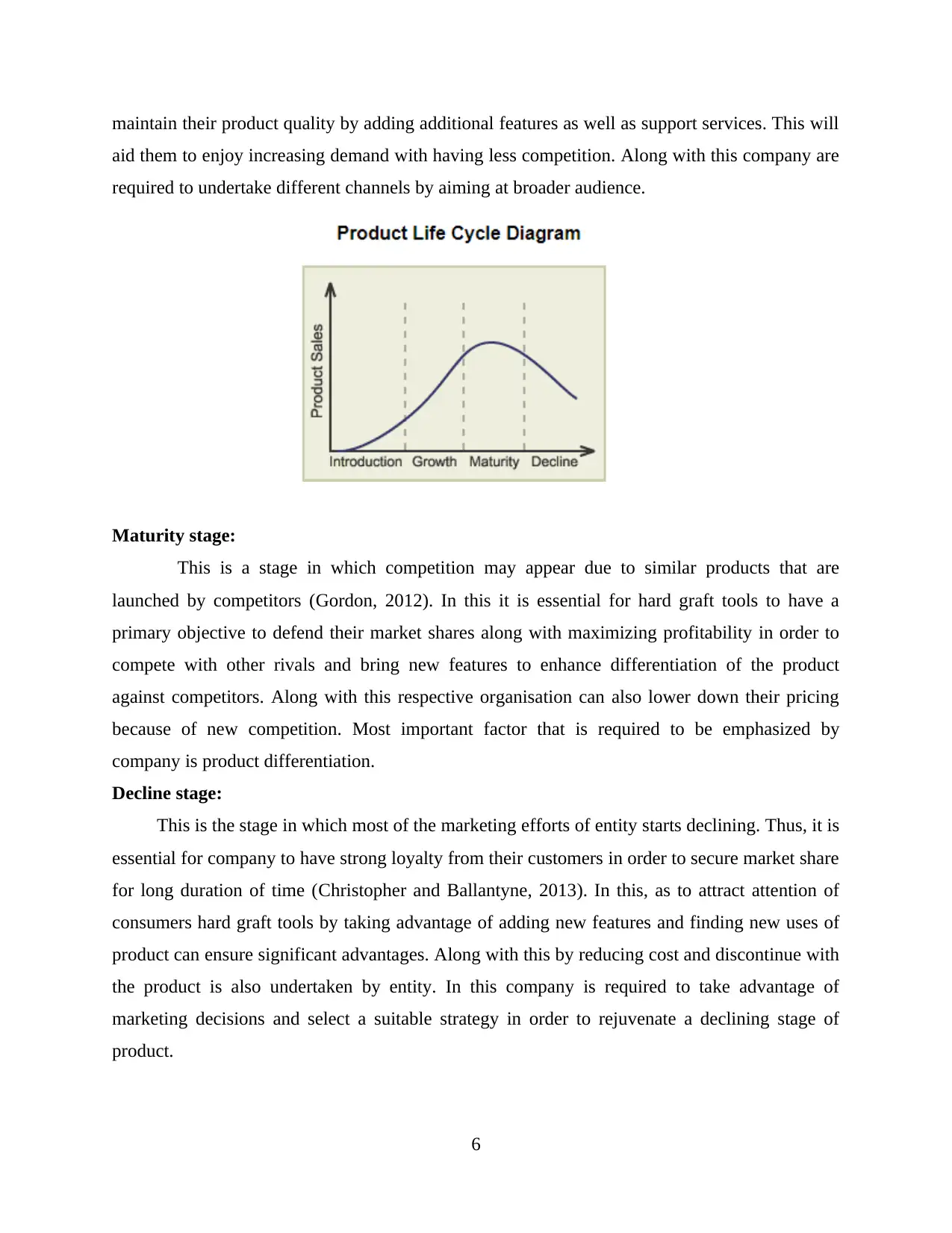
maintain their product quality by adding additional features as well as support services. This will
aid them to enjoy increasing demand with having less competition. Along with this company are
required to undertake different channels by aiming at broader audience.
Maturity stage:
This is a stage in which competition may appear due to similar products that are
launched by competitors (Gordon, 2012). In this it is essential for hard graft tools to have a
primary objective to defend their market shares along with maximizing profitability in order to
compete with other rivals and bring new features to enhance differentiation of the product
against competitors. Along with this respective organisation can also lower down their pricing
because of new competition. Most important factor that is required to be emphasized by
company is product differentiation.
Decline stage:
This is the stage in which most of the marketing efforts of entity starts declining. Thus, it is
essential for company to have strong loyalty from their customers in order to secure market share
for long duration of time (Christopher and Ballantyne, 2013). In this, as to attract attention of
consumers hard graft tools by taking advantage of adding new features and finding new uses of
product can ensure significant advantages. Along with this by reducing cost and discontinue with
the product is also undertaken by entity. In this company is required to take advantage of
marketing decisions and select a suitable strategy in order to rejuvenate a declining stage of
product.
6
aid them to enjoy increasing demand with having less competition. Along with this company are
required to undertake different channels by aiming at broader audience.
Maturity stage:
This is a stage in which competition may appear due to similar products that are
launched by competitors (Gordon, 2012). In this it is essential for hard graft tools to have a
primary objective to defend their market shares along with maximizing profitability in order to
compete with other rivals and bring new features to enhance differentiation of the product
against competitors. Along with this respective organisation can also lower down their pricing
because of new competition. Most important factor that is required to be emphasized by
company is product differentiation.
Decline stage:
This is the stage in which most of the marketing efforts of entity starts declining. Thus, it is
essential for company to have strong loyalty from their customers in order to secure market share
for long duration of time (Christopher and Ballantyne, 2013). In this, as to attract attention of
consumers hard graft tools by taking advantage of adding new features and finding new uses of
product can ensure significant advantages. Along with this by reducing cost and discontinue with
the product is also undertaken by entity. In this company is required to take advantage of
marketing decisions and select a suitable strategy in order to rejuvenate a declining stage of
product.
6
⊘ This is a preview!⊘
Do you want full access?
Subscribe today to unlock all pages.
Trusted by 1+ million students worldwide
(AC 3.1) An analysis of the role of direct and indirect distribution channels.
Direct distribution channel is defined as a chain of business or different intermediaries
through which services and good pass and reach to end consumers. Most important role of direct
distribution channel is, that it provide product to ultimate consumers in a cost effective and time
effective manner in order to duly build effective image among wide group of customers. This is
an oldest form of providing goods and services. In addition to this it has been evaluated that this
process is mainly undertaken by manufacture those who engage in the process of offering
expensive or perishable goods. In relation with this, Hard graft tools by taking use of direct
distribution can eliminate the role of intermediaries through which they can automatically save
time as well as cost in a well defined manner. On the other hand if there is involvement of direct
distribution channels in this process it mainly include middleman in order to provide product and
services to end consumers. In addition to this, indirect form of distribution also aid entity to
make significant increase in the base of customers without going through number of challenges
as it offers services as well as product to end users. Along with is it usually aid entity to put there
more focus upon needs and demand of consumers as well as on product enhancement as to
ensure high market share.
(AC 3.2) An analysis of the use of intensive distribution, selective distribution and exclusive
distribution in the market.
Intensive distribution is termed as a marketing strategy that mainly focus upon placing
services as well as product in kinds of retail stores without taking use of segmentation for
frequently replenished products. Main aim of this distribution is to reach out to large base of
customers by providing them services and products at every spare. This will aid in taking
advantage of awareness revenue and impulsive buying.
Selective distribution is defined as an effective distribution strategy that is being
undertaken by high end brands those who came towards to set some outlets in a particular
geographical location. It has been analysed that, this distribution strategy is mainly undertaken
for the consumers who have brand conscious and seeks to purchase product and services for a
specific brand.
Exclusive distribution is a form of agreement among retailer and supplier, it have
exclusive right within a specific geographical area in order to carry out product of suppliers in
order to ensure maximum outwards. According to the evaluation it has been identify that the
7
Direct distribution channel is defined as a chain of business or different intermediaries
through which services and good pass and reach to end consumers. Most important role of direct
distribution channel is, that it provide product to ultimate consumers in a cost effective and time
effective manner in order to duly build effective image among wide group of customers. This is
an oldest form of providing goods and services. In addition to this it has been evaluated that this
process is mainly undertaken by manufacture those who engage in the process of offering
expensive or perishable goods. In relation with this, Hard graft tools by taking use of direct
distribution can eliminate the role of intermediaries through which they can automatically save
time as well as cost in a well defined manner. On the other hand if there is involvement of direct
distribution channels in this process it mainly include middleman in order to provide product and
services to end consumers. In addition to this, indirect form of distribution also aid entity to
make significant increase in the base of customers without going through number of challenges
as it offers services as well as product to end users. Along with is it usually aid entity to put there
more focus upon needs and demand of consumers as well as on product enhancement as to
ensure high market share.
(AC 3.2) An analysis of the use of intensive distribution, selective distribution and exclusive
distribution in the market.
Intensive distribution is termed as a marketing strategy that mainly focus upon placing
services as well as product in kinds of retail stores without taking use of segmentation for
frequently replenished products. Main aim of this distribution is to reach out to large base of
customers by providing them services and products at every spare. This will aid in taking
advantage of awareness revenue and impulsive buying.
Selective distribution is defined as an effective distribution strategy that is being
undertaken by high end brands those who came towards to set some outlets in a particular
geographical location. It has been analysed that, this distribution strategy is mainly undertaken
for the consumers who have brand conscious and seeks to purchase product and services for a
specific brand.
Exclusive distribution is a form of agreement among retailer and supplier, it have
exclusive right within a specific geographical area in order to carry out product of suppliers in
order to ensure maximum outwards. According to the evaluation it has been identify that the
7
Paraphrase This Document
Need a fresh take? Get an instant paraphrase of this document with our AI Paraphraser
distribution channels. It holds importance for an organisation as this significantly allows them to
reach towards end consumers in a well defined manner.
(AC1 M1) An analysis of how a business can create lifetime value to the customer by using the
Customer Life Cycle
The consumer lifecycle act as a most important aspect for an organisation as it usually
provide product and services according to the consumer preferences, needs and taste in a well-
defined manner. In relation with Hard graft tools, entity duly believes in developing the lifetime
value in order to ensure long-term sustainability in marketplace. It also benefits them to take
advantage of consumer loyalty. In addition to this it has been evaluated that with the assistance
of consumer Life Cycle Company can effectively identify dynamic change within behaviour and
need of consumers and further satisfies their preferences accordingly. It not only provides
assistance to them in order to ensure high competitive advancements but also allow them to fulfil
consumer needs in best effective manner. This will aid them to undertake their loyalty that
creates high value for entity. In addition to this life cycle is define as a combination of different
step in which a consumer goes through when they consider when buying and remain loyal to
particular service and product of an organisation. Thus, this is one of the most important aspects
for respective organisation to effectively build consumer lifecycle management in order to form
effective relationship with consumers in order to satisfy their needs and ensure long-term
profitability.
(AC3 M1) An explanation of the advantages of using a direct marketing channel.
Direct marketing channel effectively provide advantage to organisation in order to allocate
effective and valuable information as well as data related to the consumer behaviour related to
their purchasing. With the help of this entity can effectively able differentiate their products and
services from other competitors in marketplace and confirm their value added services. In
addition to this, by adding value in their offerings entity can serve customers with best. It not
only helps them to ensure high competitiveness in marketplace. But also allow entity to increase
their profitability earning capacity. In relation with Hard graft tools with the help of taking
advantage of direct marketing channel entity can effectively able to save their unnecessary time
as well as cost in a well define manner. Along with is it also provide advantage to entity to
actively ensure loyalty from their customers by undertaking there aspects related to the services
and products. In this entity is required to analyse every aspects of their customers related to their
8
reach towards end consumers in a well defined manner.
(AC1 M1) An analysis of how a business can create lifetime value to the customer by using the
Customer Life Cycle
The consumer lifecycle act as a most important aspect for an organisation as it usually
provide product and services according to the consumer preferences, needs and taste in a well-
defined manner. In relation with Hard graft tools, entity duly believes in developing the lifetime
value in order to ensure long-term sustainability in marketplace. It also benefits them to take
advantage of consumer loyalty. In addition to this it has been evaluated that with the assistance
of consumer Life Cycle Company can effectively identify dynamic change within behaviour and
need of consumers and further satisfies their preferences accordingly. It not only provides
assistance to them in order to ensure high competitive advancements but also allow them to fulfil
consumer needs in best effective manner. This will aid them to undertake their loyalty that
creates high value for entity. In addition to this life cycle is define as a combination of different
step in which a consumer goes through when they consider when buying and remain loyal to
particular service and product of an organisation. Thus, this is one of the most important aspects
for respective organisation to effectively build consumer lifecycle management in order to form
effective relationship with consumers in order to satisfy their needs and ensure long-term
profitability.
(AC3 M1) An explanation of the advantages of using a direct marketing channel.
Direct marketing channel effectively provide advantage to organisation in order to allocate
effective and valuable information as well as data related to the consumer behaviour related to
their purchasing. With the help of this entity can effectively able differentiate their products and
services from other competitors in marketplace and confirm their value added services. In
addition to this, by adding value in their offerings entity can serve customers with best. It not
only helps them to ensure high competitiveness in marketplace. But also allow entity to increase
their profitability earning capacity. In relation with Hard graft tools with the help of taking
advantage of direct marketing channel entity can effectively able to save their unnecessary time
as well as cost in a well define manner. Along with is it also provide advantage to entity to
actively ensure loyalty from their customers by undertaking there aspects related to the services
and products. In this entity is required to analyse every aspects of their customers related to their
8
offerings. Along with this company is also required to take regular feedback from their
customers in order to serve consumers in best effective manner.
(AC1D1) An evaluation of the role of product in that organisation’s marketing mix
Product is termed as one of the most important aspect for an organisation in marketing mix
as it elaborate different type of element with the help of which entity can effectively increase
value of their product in marketplace. In context with Hard graft tools main product of entity is
that they engage in the manufacturing of tools that are valuable resources for organisation and
provide assistance to them to ensure high competitive advantage. Product play key significant
role thus it is essential for entity to develop effective marketing strategy along with planning in
order to increase value of their product. Thus, according to the evaluation it has been identified
that with the help of high quality product company can effectively able to gain attraction of from
their customers and can ensure long-term sustainability.
9
customers in order to serve consumers in best effective manner.
(AC1D1) An evaluation of the role of product in that organisation’s marketing mix
Product is termed as one of the most important aspect for an organisation in marketing mix
as it elaborate different type of element with the help of which entity can effectively increase
value of their product in marketplace. In context with Hard graft tools main product of entity is
that they engage in the manufacturing of tools that are valuable resources for organisation and
provide assistance to them to ensure high competitive advantage. Product play key significant
role thus it is essential for entity to develop effective marketing strategy along with planning in
order to increase value of their product. Thus, according to the evaluation it has been identified
that with the help of high quality product company can effectively able to gain attraction of from
their customers and can ensure long-term sustainability.
9
⊘ This is a preview!⊘
Do you want full access?
Subscribe today to unlock all pages.
Trusted by 1+ million students worldwide
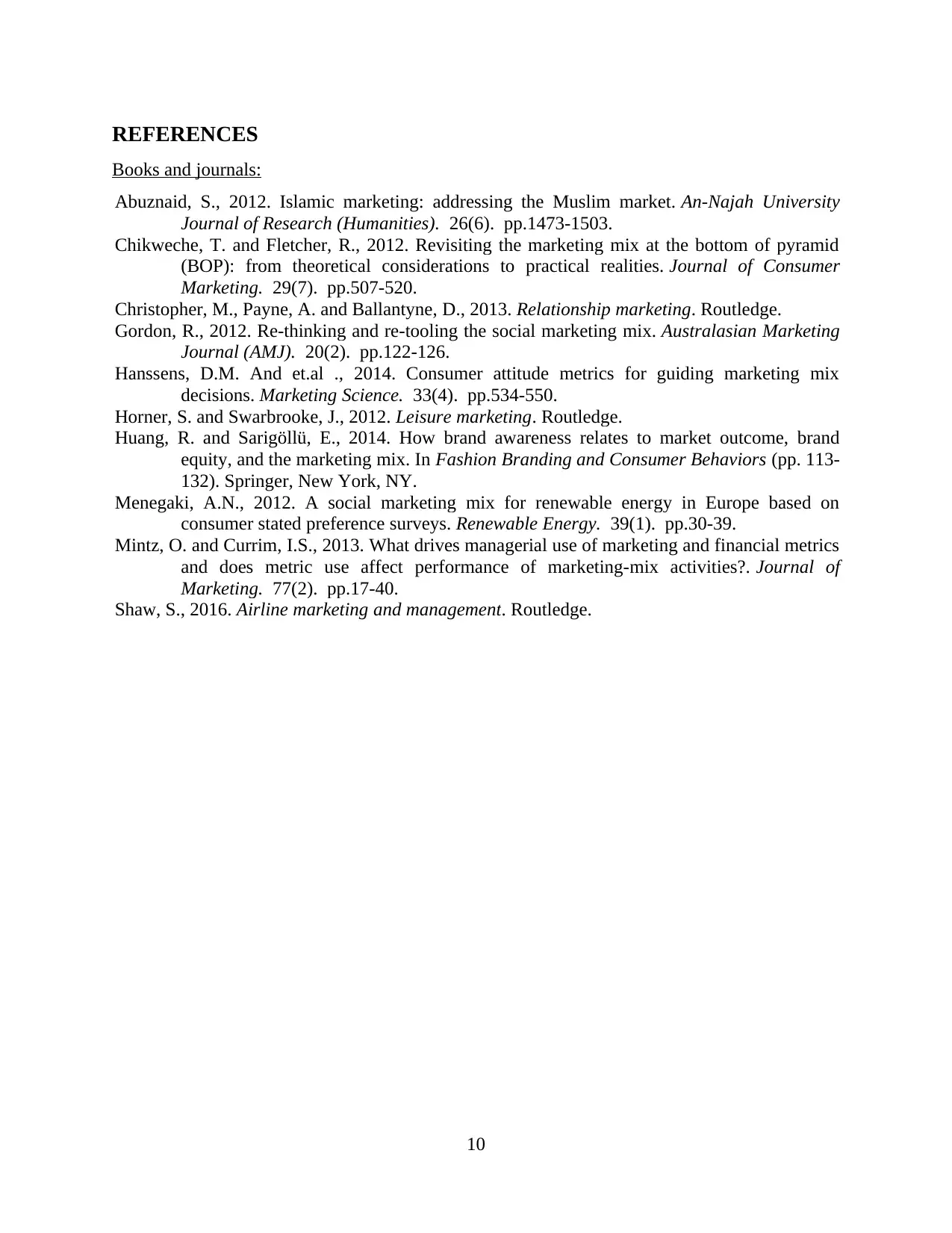
REFERENCES
Books and journals:
Abuznaid, S., 2012. Islamic marketing: addressing the Muslim market. An-Najah University
Journal of Research (Humanities). 26(6). pp.1473-1503.
Chikweche, T. and Fletcher, R., 2012. Revisiting the marketing mix at the bottom of pyramid
(BOP): from theoretical considerations to practical realities. Journal of Consumer
Marketing. 29(7). pp.507-520.
Christopher, M., Payne, A. and Ballantyne, D., 2013. Relationship marketing. Routledge.
Gordon, R., 2012. Re-thinking and re-tooling the social marketing mix. Australasian Marketing
Journal (AMJ). 20(2). pp.122-126.
Hanssens, D.M. And et.al ., 2014. Consumer attitude metrics for guiding marketing mix
decisions. Marketing Science. 33(4). pp.534-550.
Horner, S. and Swarbrooke, J., 2012. Leisure marketing. Routledge.
Huang, R. and Sarigöllü, E., 2014. How brand awareness relates to market outcome, brand
equity, and the marketing mix. In Fashion Branding and Consumer Behaviors (pp. 113-
132). Springer, New York, NY.
Menegaki, A.N., 2012. A social marketing mix for renewable energy in Europe based on
consumer stated preference surveys. Renewable Energy. 39(1). pp.30-39.
Mintz, O. and Currim, I.S., 2013. What drives managerial use of marketing and financial metrics
and does metric use affect performance of marketing-mix activities?. Journal of
Marketing. 77(2). pp.17-40.
Shaw, S., 2016. Airline marketing and management. Routledge.
10
Books and journals:
Abuznaid, S., 2012. Islamic marketing: addressing the Muslim market. An-Najah University
Journal of Research (Humanities). 26(6). pp.1473-1503.
Chikweche, T. and Fletcher, R., 2012. Revisiting the marketing mix at the bottom of pyramid
(BOP): from theoretical considerations to practical realities. Journal of Consumer
Marketing. 29(7). pp.507-520.
Christopher, M., Payne, A. and Ballantyne, D., 2013. Relationship marketing. Routledge.
Gordon, R., 2012. Re-thinking and re-tooling the social marketing mix. Australasian Marketing
Journal (AMJ). 20(2). pp.122-126.
Hanssens, D.M. And et.al ., 2014. Consumer attitude metrics for guiding marketing mix
decisions. Marketing Science. 33(4). pp.534-550.
Horner, S. and Swarbrooke, J., 2012. Leisure marketing. Routledge.
Huang, R. and Sarigöllü, E., 2014. How brand awareness relates to market outcome, brand
equity, and the marketing mix. In Fashion Branding and Consumer Behaviors (pp. 113-
132). Springer, New York, NY.
Menegaki, A.N., 2012. A social marketing mix for renewable energy in Europe based on
consumer stated preference surveys. Renewable Energy. 39(1). pp.30-39.
Mintz, O. and Currim, I.S., 2013. What drives managerial use of marketing and financial metrics
and does metric use affect performance of marketing-mix activities?. Journal of
Marketing. 77(2). pp.17-40.
Shaw, S., 2016. Airline marketing and management. Routledge.
10
Paraphrase This Document
Need a fresh take? Get an instant paraphrase of this document with our AI Paraphraser

11

12
⊘ This is a preview!⊘
Do you want full access?
Subscribe today to unlock all pages.
Trusted by 1+ million students worldwide

1 out of 12


Related Documents


Your All-in-One AI-Powered Toolkit for Academic Success.
+13062052269
info@desklib.com
Available 24*7 on WhatsApp / Email
![[object Object]](/_next/static/media/star-bottom.7253800d.svg)
Unlock your academic potential
Copyright © 2020–2026 A2Z Services. All Rights Reserved. Developed and managed by ZUCOL.