State University: MGMT-3069 Hardy Hospital Inventory Case Study

Verified

Added on  2022/08/15

|4
|609
|19
Case Study
AI Summary
This case study analyzes the inventory management system at Hardy Hospital, focusing on cost analysis and optimization. The analysis estimates order costs and carrying costs, calculates the Economic Order Quantity (EOQ) and reorder points, and evaluates the Fixed Order Quantity (FQS) system. The study highlights the inefficiencies in the current system, including excessive stock levels and variations in order sizes, and recommends improvements such as minimizing special orders, streamlining the materials-management system, and eliminating the state bidding system to reduce costs and improve efficiency. The author emphasizes the potential for significant cost savings by adopting a more efficient inventory control system. The provided solution includes calculations for EOQ, reorder point, and an analysis of the FQS, demonstrating how the hospital can reduce its inventory costs significantly. This case study aims to provide a comprehensive overview of inventory management, highlighting the importance of efficient systems and strategic planning in a healthcare setting.
Document Page
Running head: HARDY HOSPITAL INVENTORY 1
Hardy Hospital Inventory
Name
Institution
tabler-icon-diamond-filled.svg

Paraphrase This Document

Need a fresh take? Get an instant paraphrase of this document with our AI Paraphraser
Document Page
HARDY HOSPITAL INVENTORY 2
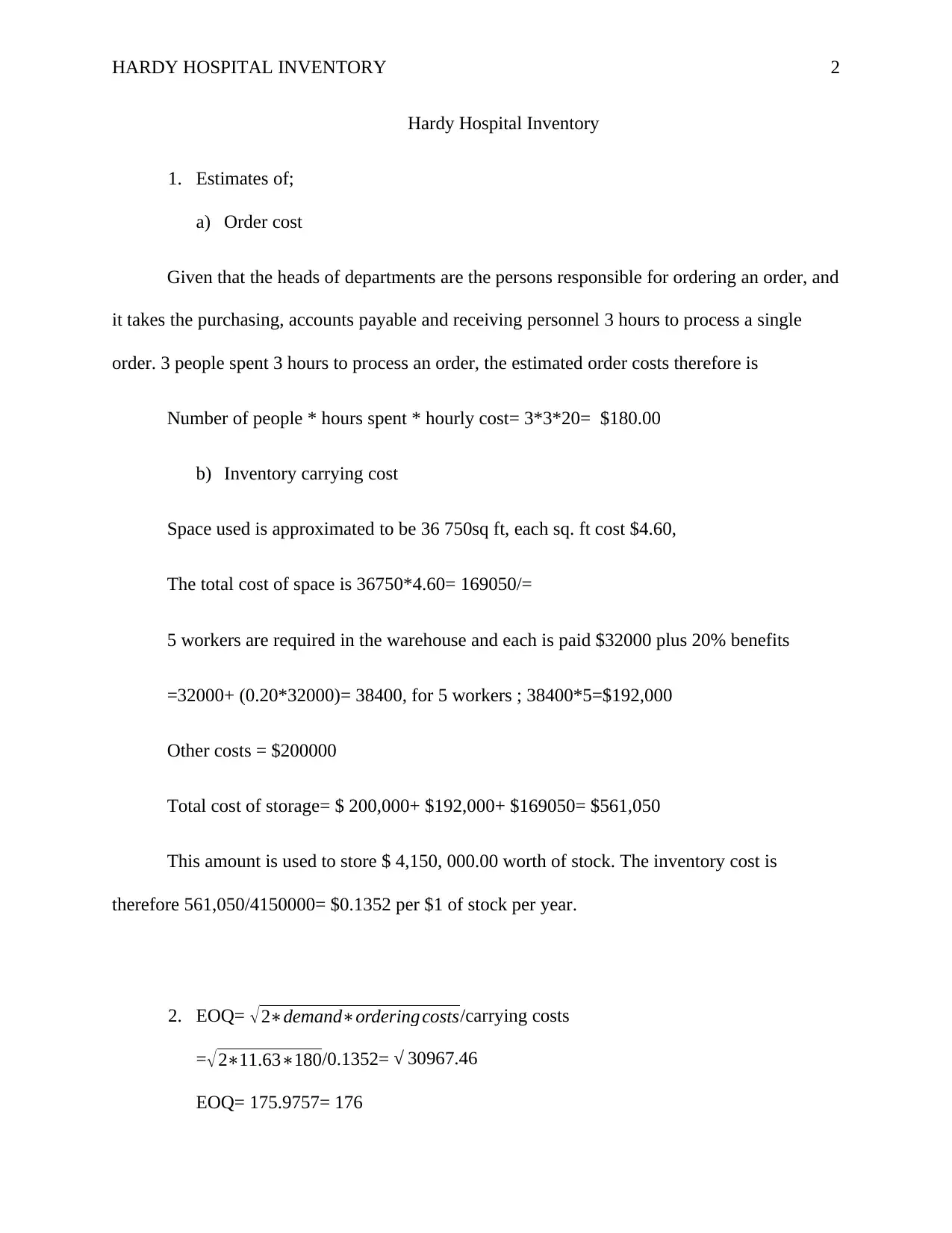
Hardy Hospital Inventory
1. Estimates of;
a) Order cost
Given that the heads of departments are the persons responsible for ordering an order, and
it takes the purchasing, accounts payable and receiving personnel 3 hours to process a single
order. 3 people spent 3 hours to process an order, the estimated order costs therefore is
Number of people * hours spent * hourly cost= 3*3*20= $180.00
b) Inventory carrying cost
Space used is approximated to be 36 750sq ft, each sq. ft cost $4.60,
The total cost of space is 36750*4.60= 169050/=
5 workers are required in the warehouse and each is paid $32000 plus 20% benefits
=32000+ (0.20*32000)= 38400, for 5 workers ; 38400*5=$192,000
Other costs = $200000
Total cost of storage= $ 200,000+ $192,000+ $169050= $561,050
This amount is used to store $ 4,150, 000.00 worth of stock. The inventory cost is
therefore 561,050/4150000= $0.1352 per $1 of stock per year.
2. EOQ= 2demandordering costs/carrying costs
=211.63180/0.1352= 30967.46
EOQ= 175.9757= 176
Document Page
HARDY HOSPITAL INVENTORY 3
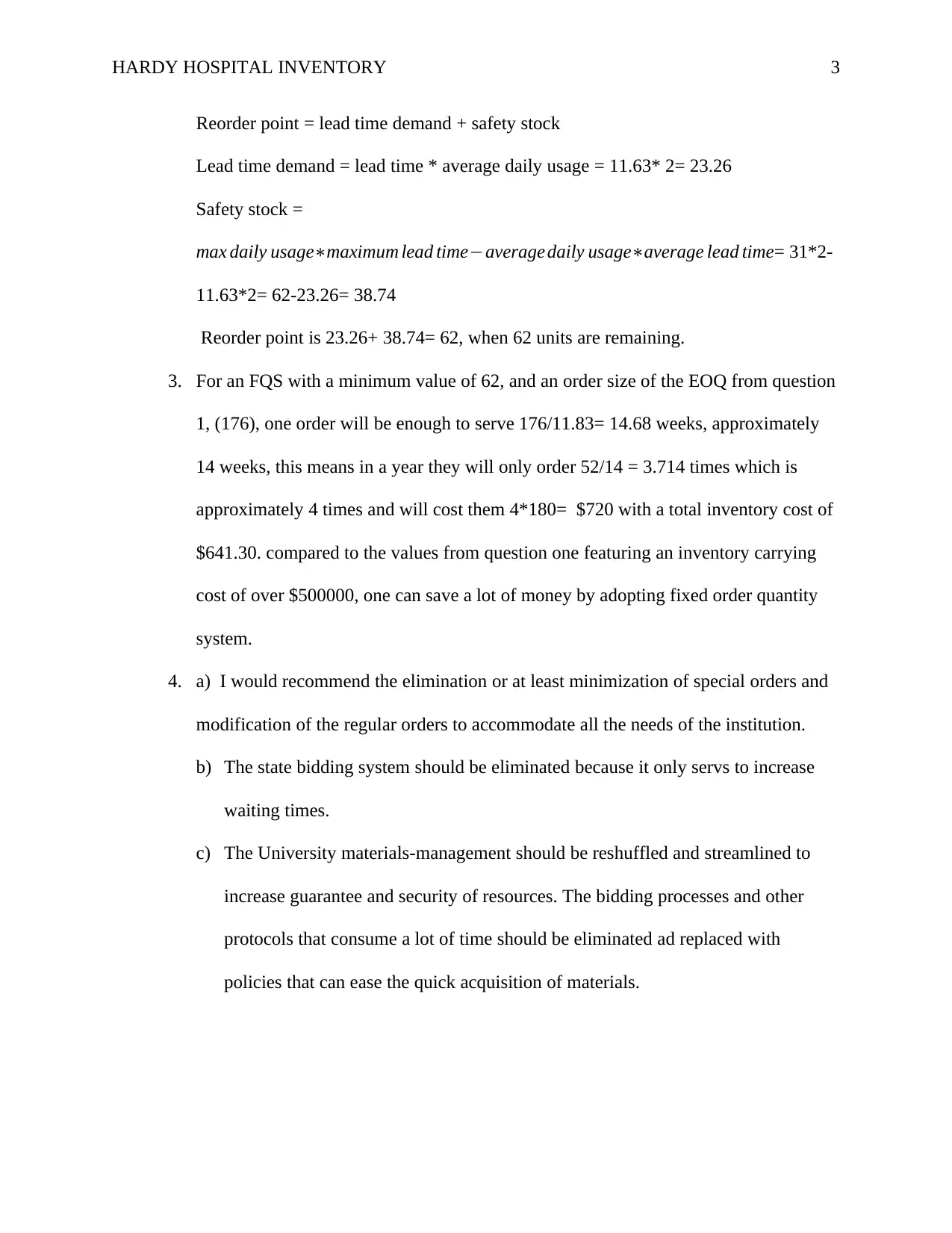
Reorder point = lead time demand + safety stock
Lead time demand = lead time * average daily usage = 11.63* 2= 23.26
Safety stock =
max daily usagemaximum lead timeaverage daily usageaverage lead time= 31*2-
11.63*2= 62-23.26= 38.74
Reorder point is 23.26+ 38.74= 62, when 62 units are remaining.
3. For an FQS with a minimum value of 62, and an order size of the EOQ from question
1, (176), one order will be enough to serve 176/11.83= 14.68 weeks, approximately
14 weeks, this means in a year they will only order 52/14 = 3.714 times which is
approximately 4 times and will cost them 4*180= $720 with a total inventory cost of
$641.30. compared to the values from question one featuring an inventory carrying
cost of over $500000, one can save a lot of money by adopting fixed order quantity
system.
4. a) I would recommend the elimination or at least minimization of special orders and
modification of the regular orders to accommodate all the needs of the institution.
b) The state bidding system should be eliminated because it only servs to increase
waiting times.
c) The University materials-management should be reshuffled and streamlined to
increase guarantee and security of resources. The bidding processes and other
protocols that consume a lot of time should be eliminated ad replaced with
policies that can ease the quick acquisition of materials.
Document Page
HARDY HOSPITAL INVENTORY 4
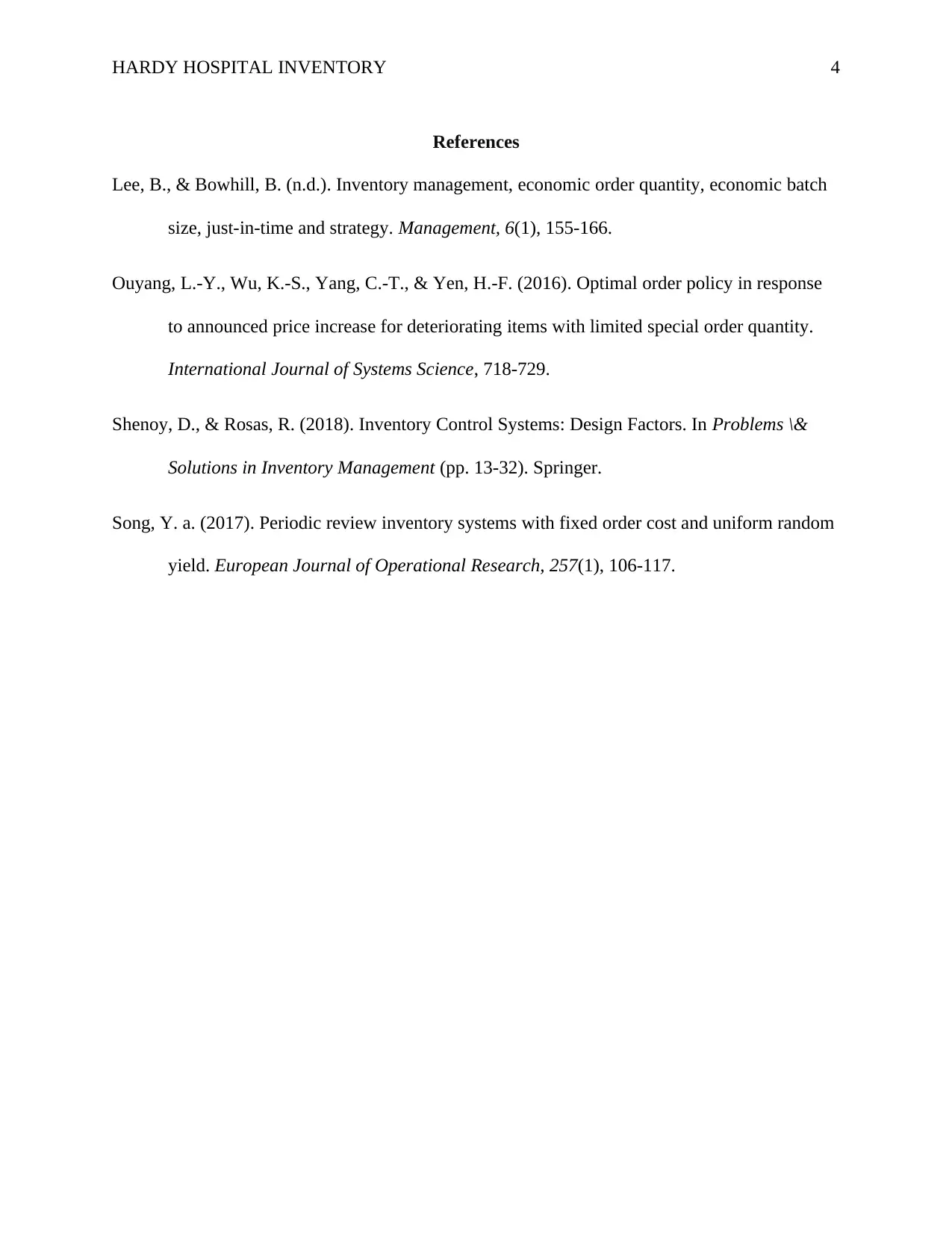
References
Lee, B., & Bowhill, B. (n.d.). Inventory management, economic order quantity, economic batch
size, just-in-time and strategy. Management, 6(1), 155-166.
Ouyang, L.-Y., Wu, K.-S., Yang, C.-T., & Yen, H.-F. (2016). Optimal order policy in response
to announced price increase for deteriorating items with limited special order quantity.
International Journal of Systems Science, 718-729.
Shenoy, D., & Rosas, R. (2018). Inventory Control Systems: Design Factors. In Problems \&
Solutions in Inventory Management (pp. 13-32). Springer.
Song, Y. a. (2017). Periodic review inventory systems with fixed order cost and uniform random
yield. European Journal of Operational Research, 257(1), 106-117.
chevron_up_icon
1 out of 4
circle_padding
hide_on_mobile
zoom_out_icon
[object Object]