Analysis of Management Transformation at Hattersley Electrics

Verified

Added on  2020/04/21

|8
|1371
|159
Report
AI Summary
This report provides an in-depth analysis of the management transformation at Hattersley Electrics, a division of the Hattersley Group PLC. Facing economic challenges, the company underwent restructuring and downsizing, focusing on advanced communication equipment. The report examines the sampling techniques used, including interviews and questionnaires, to assess employee perceptions and concerns regarding the changes. It details the methodology, response rates, and accuracy of the data collected. Furthermore, the report addresses the challenges of generalizing the questionnaire results across different departments and employee seniority levels. The report concludes by suggesting measures to improve future surveys and ensure the validity of findings, offering valuable insights into the complexities of organizational change and leadership management.
Document Page
Running head: MANAGEMENT TRANSFORMATION OF HATTERSLEY ELECTRICS
Management Transformation of Hattersley Electrics
Name of the Student:
Name of the University:
Author’s Note:
tabler-icon-diamond-filled.svg

Paraphrase This Document

Need a fresh take? Get an instant paraphrase of this document with our AI Paraphraser
Document Page
MANAGEMENT TRANSFORMATION OF HATTERSLEY ELECTRICS 1
Table of Contents
Introduction and Background:-..................................................................................................2
Answers......................................................................................................................................3
Answer. 1...............................................................................................................................3
Answer 2................................................................................................................................5
Answer 3................................................................................................................................5
Answer 4................................................................................................................................6
References:-................................................................................................................................7
Document Page
MANAGEMENT TRANSFORMATION OF HATTERSLEY ELECTRICS 2
Introduction and Background:-
‘Hattersley Electrics’ is a division of the ‘Hattersley’ Group PLC which is a United
Kingdom based manufacturing organization. The main markets of this group are the high tech
aerospace and the defense industries. In current years, the recession in airline industry and the
contraction in defense spending by European governments have hampered the division. To
overcome the crisis situation, ‘Hattersley’ Electrics has concentrated to reposition itself
within the marketplace of advanced communication equipment for civilians. As part of this it
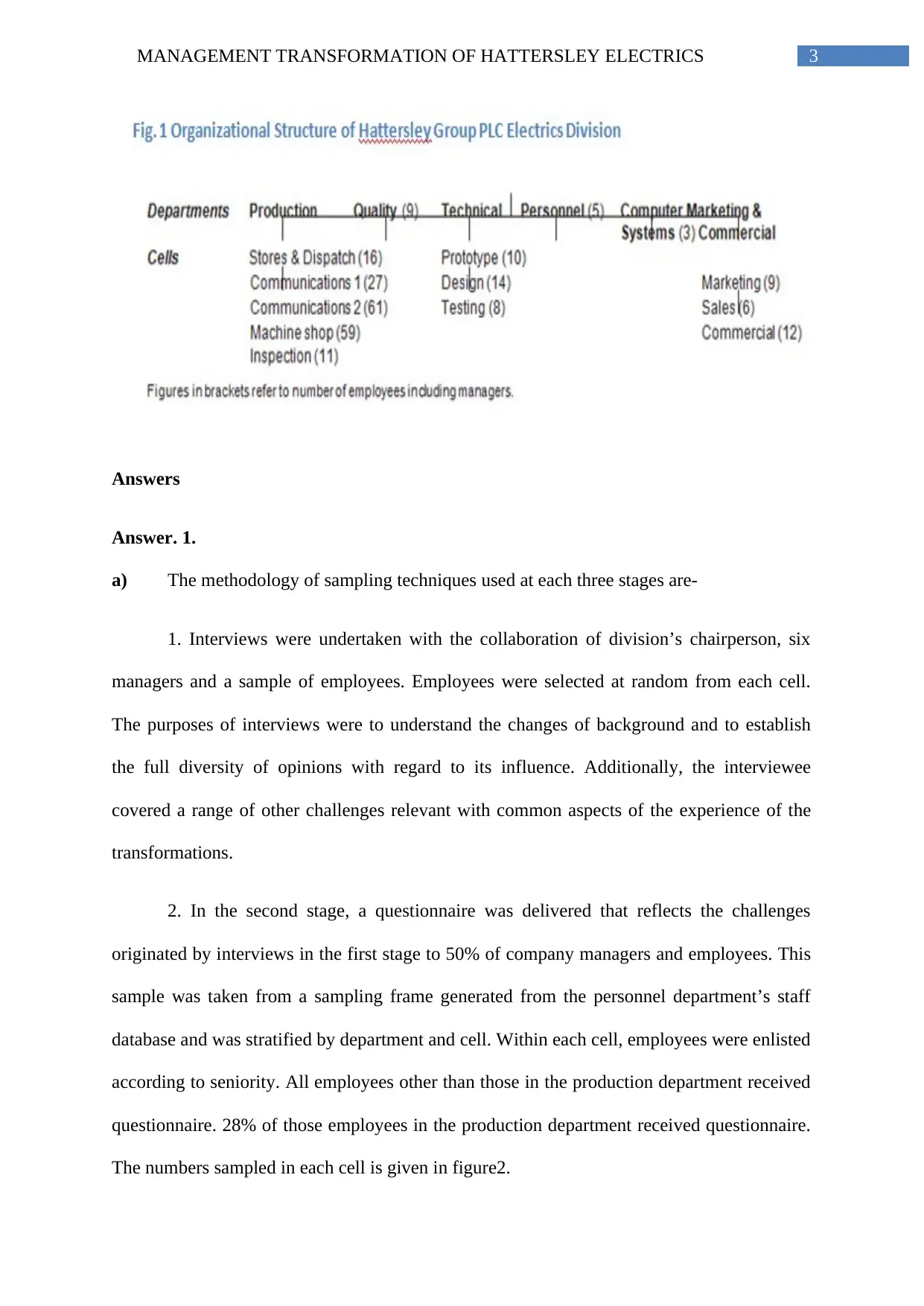
has transformed its focus of productivity, decided to downsize and restructure its workforce.
Primarily the workforce was not adverse to transform due to the extensive efforts
made by management to keep them aware and engaged at all stages. We found the
organizational restructuring division in cells in case of the electronic company and decreasing
the workforce from 380 to 250. After restructuring the works council informed the
management team of division that the workforce was concerned about the long term benefits
of these changes. Particularly they highlighted probable loss of employment, job security in
future and lack of division identity, direction from senior management and employee
inclusion in current decisions. The issue is only 28% of the employees received questionnaire
from production department.
Document Page
MANAGEMENT TRANSFORMATION OF HATTERSLEY ELECTRICS 3
Answers
Answer. 1.
a) The methodology of sampling techniques used at each three stages are-
1. Interviews were undertaken with the collaboration of division’s chairperson, six
managers and a sample of employees. Employees were selected at random from each cell.
The purposes of interviews were to understand the changes of background and to establish
the full diversity of opinions with regard to its influence. Additionally, the interviewee
covered a range of other challenges relevant with common aspects of the experience of the
transformations.
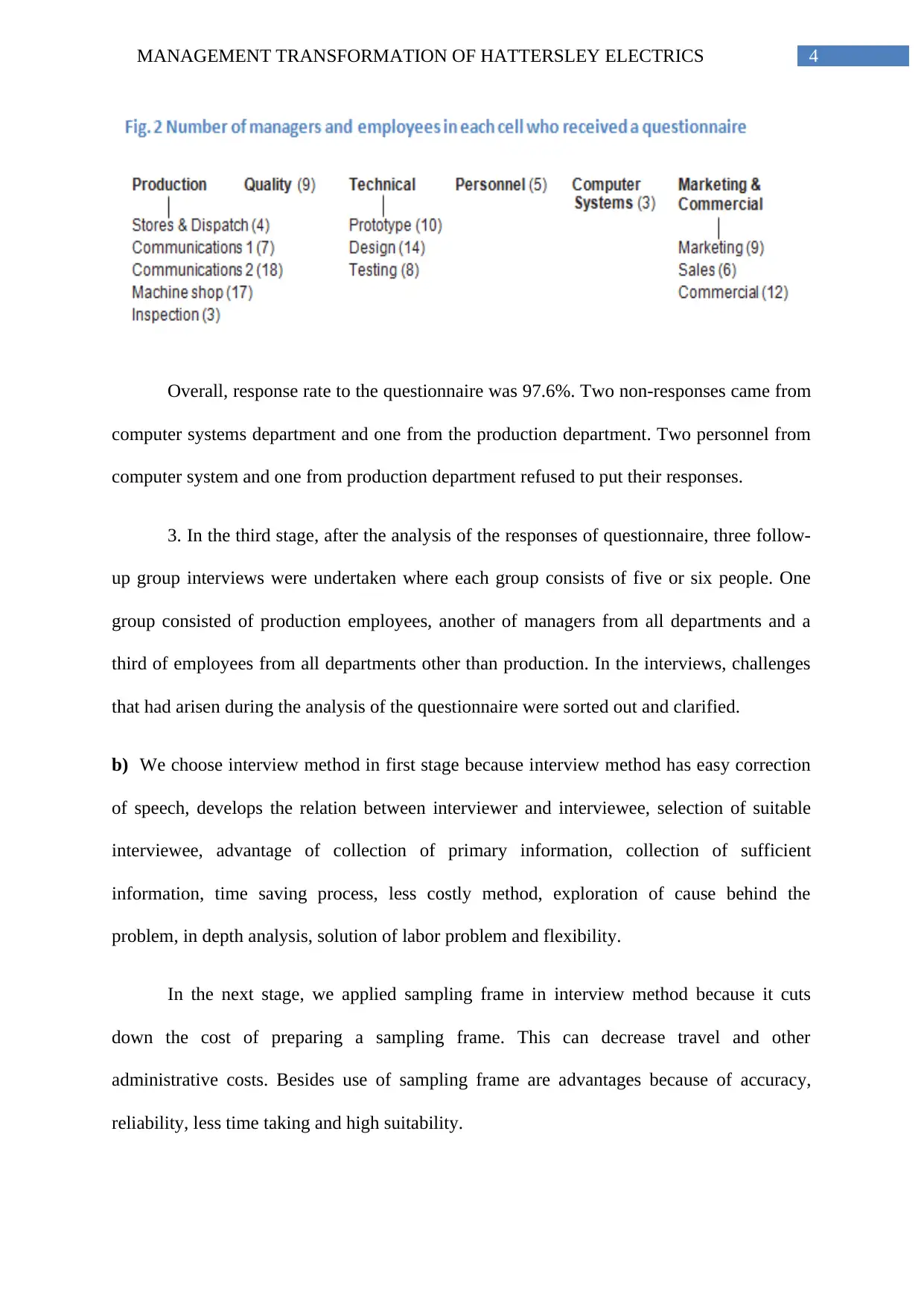
2. In the second stage, a questionnaire was delivered that reflects the challenges
originated by interviews in the first stage to 50% of company managers and employees. This
sample was taken from a sampling frame generated from the personnel department’s staff
database and was stratified by department and cell. Within each cell, employees were enlisted
according to seniority. All employees other than those in the production department received
questionnaire. 28% of those employees in the production department received questionnaire.
The numbers sampled in each cell is given in figure2.
tabler-icon-diamond-filled.svg

Paraphrase This Document

Need a fresh take? Get an instant paraphrase of this document with our AI Paraphraser
Document Page
MANAGEMENT TRANSFORMATION OF HATTERSLEY ELECTRICS 4
Overall, response rate to the questionnaire was 97.6%. Two non-responses came from
computer systems department and one from the production department. Two personnel from
computer system and one from production department refused to put their responses.
3. In the third stage, after the analysis of the responses of questionnaire, three follow-
up group interviews were undertaken where each group consists of five or six people. One
group consisted of production employees, another of managers from all departments and a
third of employees from all departments other than production. In the interviews, challenges
that had arisen during the analysis of the questionnaire were sorted out and clarified.
b) We choose interview method in first stage because interview method has easy correction
of speech, develops the relation between interviewer and interviewee, selection of suitable
interviewee, advantage of collection of primary information, collection of sufficient
information, time saving process, less costly method, exploration of cause behind the
problem, in depth analysis, solution of labor problem and flexibility.
In the next stage, we applied sampling frame in interview method because it cuts
down the cost of preparing a sampling frame. This can decrease travel and other
administrative costs. Besides use of sampling frame are advantages because of accuracy,
reliability, less time taking and high suitability.
Document Page
MANAGEMENT TRANSFORMATION OF HATTERSLEY ELECTRICS 5
In the third stage, we follow-up the questionnaire method taking a proper sample
including production employee, employee and managers as focus group (Barraquand et al.,
1997). It is quite comprehensible as the selected sample group is representative of actual
population. This method sorts out the difficulties arisen from first stage stratification.
Answer 2.
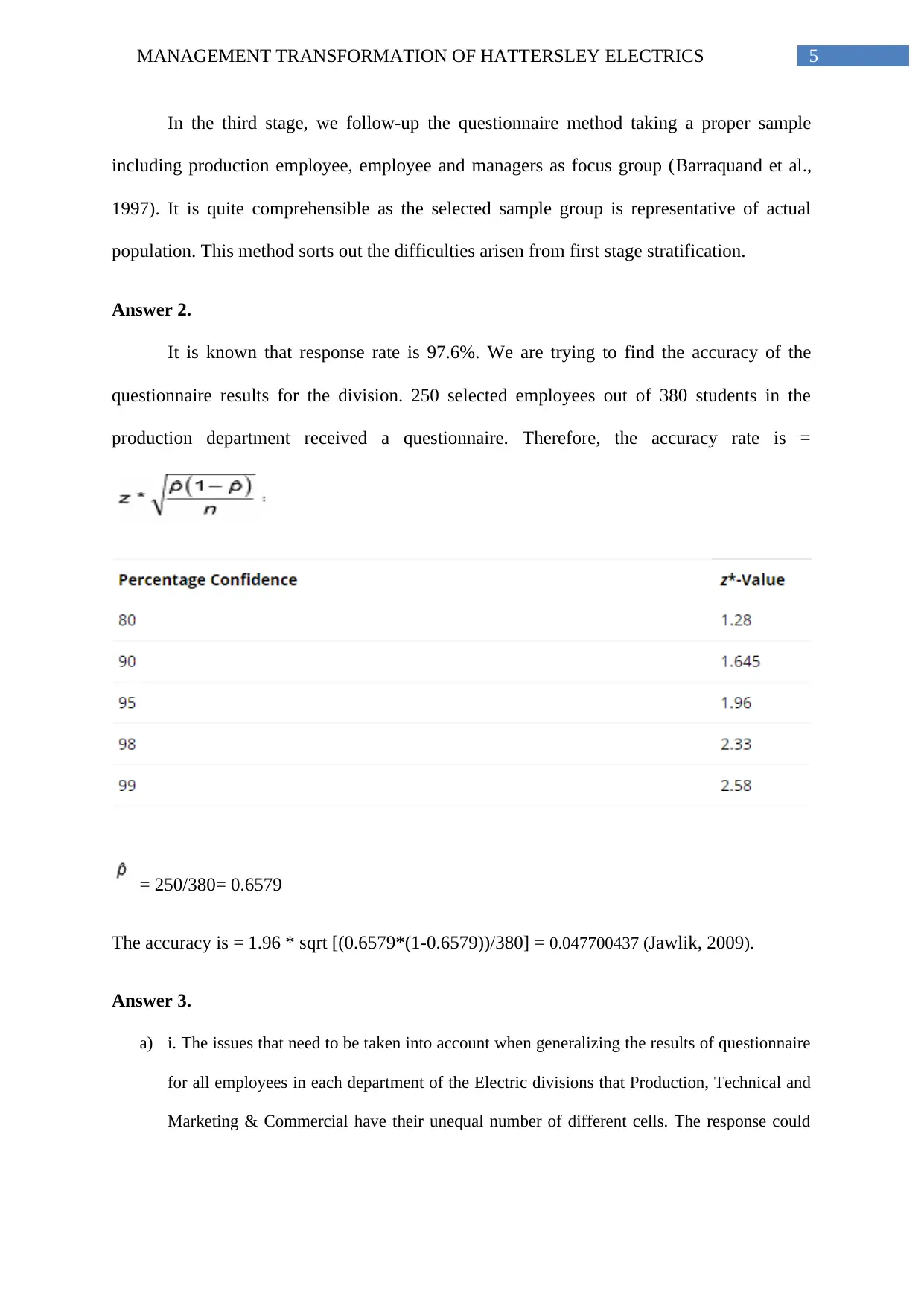
It is known that response rate is 97.6%. We are trying to find the accuracy of the
questionnaire results for the division. 250 selected employees out of 380 students in the
production department received a questionnaire. Therefore, the accuracy rate is =
= 250/380= 0.6579
The accuracy is = 1.96 * sqrt [(0.6579*(1-0.6579))/380] = 0.047700437 (Jawlik, 2009).
Answer 3.
a) i. The issues that need to be taken into account when generalizing the results of questionnaire
for all employees in each department of the Electric divisions that Production, Technical and
Marketing & Commercial have their unequal number of different cells. The response could
Document Page
MANAGEMENT TRANSFORMATION OF HATTERSLEY ELECTRICS 6
significantly differ of generalized questionnaire from communications to inspection,
prototype to testing and marketing to sales.
ii. The issues that need to be taken into account when generalizing the results of questionnaire
for all employees in all department of the Electric division are all the departments such as
Production, Quality, Technical, Personnel, Computer Systems and Marketing and commercial
have different expertise. Quality, Computer system and Personnel have low numbers of
employees. Production, Technical and Marketing & Commercial departments have high
number of employees. The questionnaire set could be irrelevant according to the various
departments as well as their responses too. Stratification with respect to seniority that is a
measure of years of working or age could not solve the actual problem.
b) Only 28% of employees of production department received the questionnaire. The reason may
be delivery problem or ignorance towards that field of the higher authority. The issue is non-
negligible and inevitable. The response sheet of generalized approach could bring error in
sampling scheme and further in analysis. Besides, stratification of sampling scheme with
respect to seniority might be irrelevant in many questions of the questionnaire.
Answer 4.
We could avoid problems by taking into account about whether there were any
differences in general perceptions between departments and between managers and
employees. Seniority may play a false role in some of the responses. For example, “How
much is your expectation about promotion?” or “what is the satisfaction level of your job?”
The management change in the Hattersley PLC group is dependent up on proper sample
surveys. These stratum should be different in each different and different in each cell, not for
all cells together with respect to seniority. The specific questionnaire set should be prepared
according to the cells and departments. The issue of distributing questionnaire should be
solved by quick measure of higher authority. Therefore, response data should be complete
tabler-icon-diamond-filled.svg

Paraphrase This Document

Need a fresh take? Get an instant paraphrase of this document with our AI Paraphraser
Document Page
MANAGEMENT TRANSFORMATION OF HATTERSLEY ELECTRICS 7
and response rate from each cell should be satisfactory. The analytical results then only be
fruitful in that business organization.
References:-
Barraquand, J., Kavraki, L., Latombe, J. C., Motwani, R., Li, T. Y., & Raghavan, P. (1997).
A random sampling scheme for path planning. The International Journal of Robotics
Research, 16(6), 759-774.
Jawlik, A. A. (2009). Margin of Error. Statistics from A to Z: Confusing Concepts Clarified:
Confusing Concepts Clarified, 220-222.
chevron_up_icon
1 out of 8
circle_padding
hide_on_mobile
zoom_out_icon
[object Object]