Hawkins vs. Clayton Case: Negligence and Duty of Care Analysis
VerifiedAdded on 2021/06/14
|9
|2248
|58
Case Study
AI Summary
This case study provides an in-depth analysis of the Hawkins vs. Clayton case, focusing on the legal principles of negligence and duty of care. The case revolves around a solicitor's failure to inform the executor of a will, leading to financial losses for the estate. The analysis examines the facts of the case, the arguments presented by both the plaintiff and the defendant, and the court's ruling. The study highlights the significance of the case in the development of negligence law, particularly regarding the responsibilities of solicitors and the application of the proximity test. The analysis also considers the impact of the ruling on future cases involving similar issues. The case study concludes by emphasizing the importance of the case in clarifying legal guidelines and addressing gaps in the law related to negligence in the legal practice. The provided solution is a critical review of the case file, representing the plaintiff and the relevance of the application to the development of the Australian law of negligence.
1
University
HAWKINS VS CLAYTON CASE
by
Name
Date
Lecturer’s Name
University
HAWKINS VS CLAYTON CASE
by
Name
Date
Lecturer’s Name

Paraphrase This Document
Need a fresh take? Get an instant paraphrase of this document with our AI Paraphraser
2
Hawkins VS Clayton Case
The Case Introduction
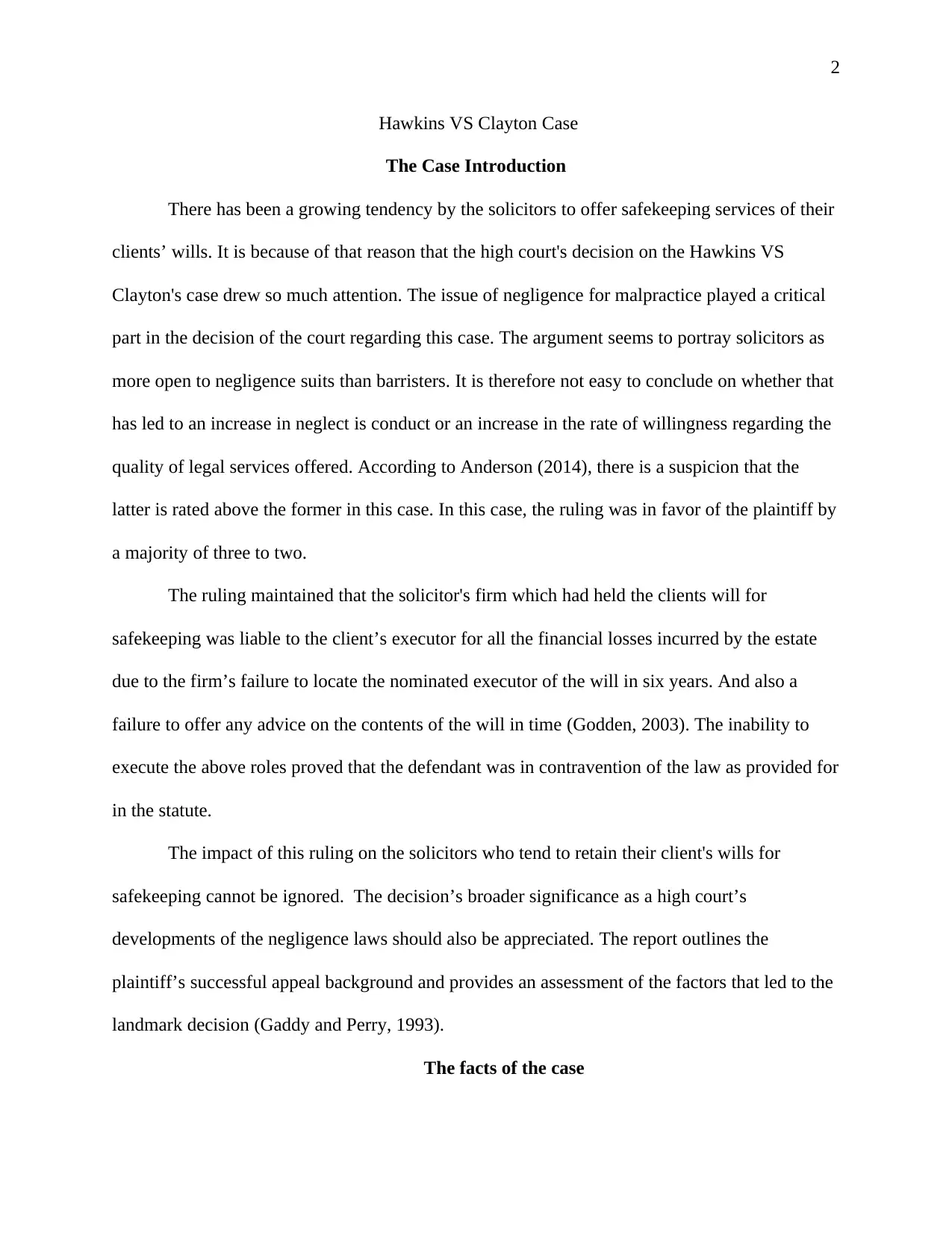
There has been a growing tendency by the solicitors to offer safekeeping services of their
clients’ wills. It is because of that reason that the high court's decision on the Hawkins VS
Clayton's case drew so much attention. The issue of negligence for malpractice played a critical
part in the decision of the court regarding this case. The argument seems to portray solicitors as
more open to negligence suits than barristers. It is therefore not easy to conclude on whether that
has led to an increase in neglect is conduct or an increase in the rate of willingness regarding the
quality of legal services offered. According to Anderson (2014), there is a suspicion that the
latter is rated above the former in this case. In this case, the ruling was in favor of the plaintiff by
a majority of three to two.
The ruling maintained that the solicitor's firm which had held the clients will for
safekeeping was liable to the client’s executor for all the financial losses incurred by the estate
due to the firm’s failure to locate the nominated executor of the will in six years. And also a
failure to offer any advice on the contents of the will in time (Godden, 2003). The inability to
execute the above roles proved that the defendant was in contravention of the law as provided for
in the statute.
The impact of this ruling on the solicitors who tend to retain their client's wills for
safekeeping cannot be ignored. The decision’s broader significance as a high court’s
developments of the negligence laws should also be appreciated. The report outlines the
plaintiff’s successful appeal background and provides an assessment of the factors that led to the
landmark decision (Gaddy and Perry, 1993).
The facts of the case
Hawkins VS Clayton Case
The Case Introduction
There has been a growing tendency by the solicitors to offer safekeeping services of their
clients’ wills. It is because of that reason that the high court's decision on the Hawkins VS
Clayton's case drew so much attention. The issue of negligence for malpractice played a critical
part in the decision of the court regarding this case. The argument seems to portray solicitors as
more open to negligence suits than barristers. It is therefore not easy to conclude on whether that
has led to an increase in neglect is conduct or an increase in the rate of willingness regarding the
quality of legal services offered. According to Anderson (2014), there is a suspicion that the
latter is rated above the former in this case. In this case, the ruling was in favor of the plaintiff by
a majority of three to two.
The ruling maintained that the solicitor's firm which had held the clients will for
safekeeping was liable to the client’s executor for all the financial losses incurred by the estate
due to the firm’s failure to locate the nominated executor of the will in six years. And also a
failure to offer any advice on the contents of the will in time (Godden, 2003). The inability to
execute the above roles proved that the defendant was in contravention of the law as provided for
in the statute.
The impact of this ruling on the solicitors who tend to retain their client's wills for
safekeeping cannot be ignored. The decision’s broader significance as a high court’s
developments of the negligence laws should also be appreciated. The report outlines the
plaintiff’s successful appeal background and provides an assessment of the factors that led to the
landmark decision (Gaddy and Perry, 1993).
The facts of the case
3
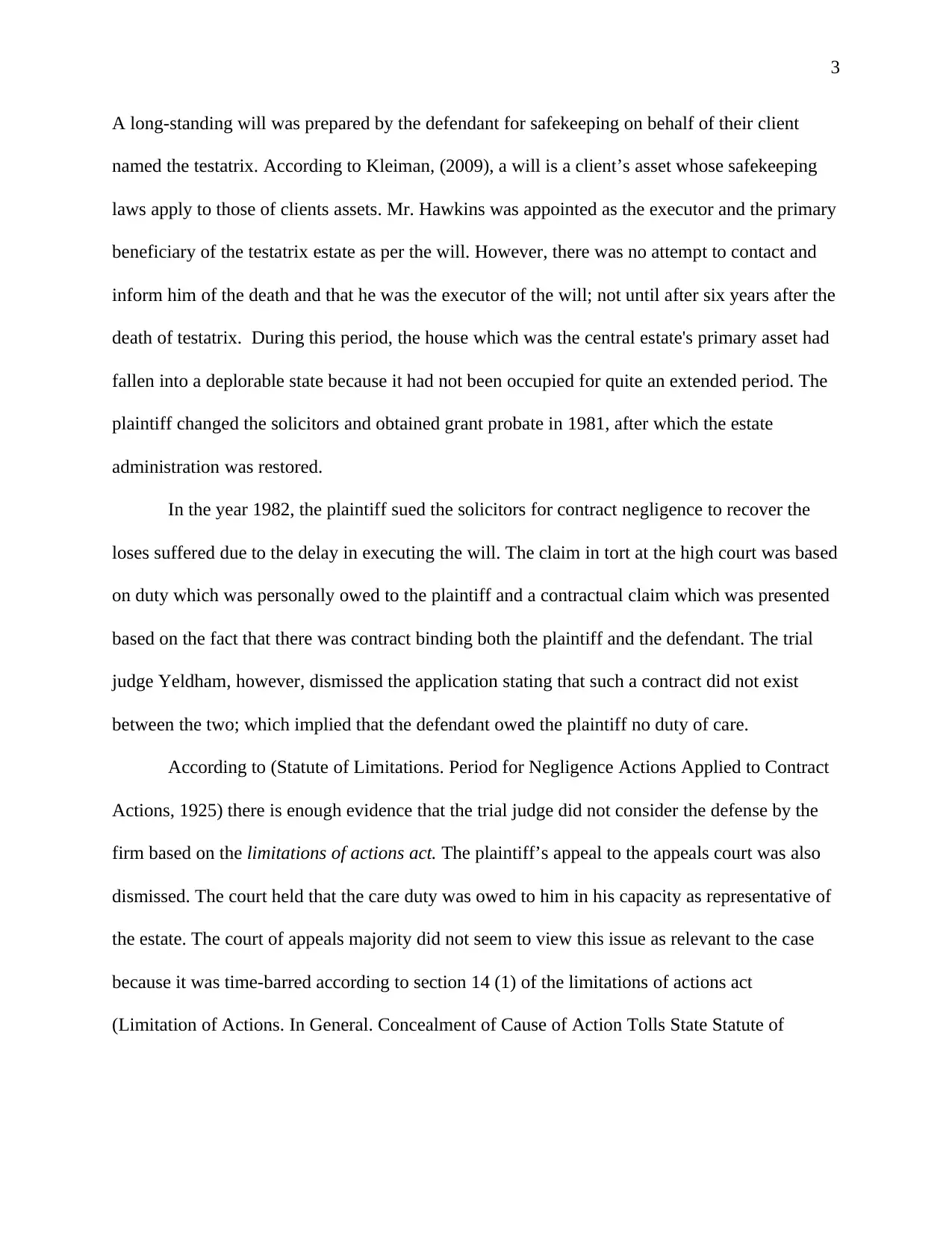
A long-standing will was prepared by the defendant for safekeeping on behalf of their client
named the testatrix. According to Kleiman, (2009), a will is a client’s asset whose safekeeping
laws apply to those of clients assets. Mr. Hawkins was appointed as the executor and the primary
beneficiary of the testatrix estate as per the will. However, there was no attempt to contact and
inform him of the death and that he was the executor of the will; not until after six years after the
death of testatrix. During this period, the house which was the central estate's primary asset had
fallen into a deplorable state because it had not been occupied for quite an extended period. The
plaintiff changed the solicitors and obtained grant probate in 1981, after which the estate
administration was restored.
In the year 1982, the plaintiff sued the solicitors for contract negligence to recover the
loses suffered due to the delay in executing the will. The claim in tort at the high court was based
on duty which was personally owed to the plaintiff and a contractual claim which was presented
based on the fact that there was contract binding both the plaintiff and the defendant. The trial
judge Yeldham, however, dismissed the application stating that such a contract did not exist
between the two; which implied that the defendant owed the plaintiff no duty of care.
According to (Statute of Limitations. Period for Negligence Actions Applied to Contract
Actions, 1925) there is enough evidence that the trial judge did not consider the defense by the
firm based on the limitations of actions act. The plaintiff’s appeal to the appeals court was also
dismissed. The court held that the care duty was owed to him in his capacity as representative of
the estate. The court of appeals majority did not seem to view this issue as relevant to the case
because it was time-barred according to section 14 (1) of the limitations of actions act
(Limitation of Actions. In General. Concealment of Cause of Action Tolls State Statute of
A long-standing will was prepared by the defendant for safekeeping on behalf of their client
named the testatrix. According to Kleiman, (2009), a will is a client’s asset whose safekeeping
laws apply to those of clients assets. Mr. Hawkins was appointed as the executor and the primary
beneficiary of the testatrix estate as per the will. However, there was no attempt to contact and
inform him of the death and that he was the executor of the will; not until after six years after the
death of testatrix. During this period, the house which was the central estate's primary asset had
fallen into a deplorable state because it had not been occupied for quite an extended period. The
plaintiff changed the solicitors and obtained grant probate in 1981, after which the estate
administration was restored.
In the year 1982, the plaintiff sued the solicitors for contract negligence to recover the
loses suffered due to the delay in executing the will. The claim in tort at the high court was based
on duty which was personally owed to the plaintiff and a contractual claim which was presented
based on the fact that there was contract binding both the plaintiff and the defendant. The trial
judge Yeldham, however, dismissed the application stating that such a contract did not exist
between the two; which implied that the defendant owed the plaintiff no duty of care.
According to (Statute of Limitations. Period for Negligence Actions Applied to Contract
Actions, 1925) there is enough evidence that the trial judge did not consider the defense by the
firm based on the limitations of actions act. The plaintiff’s appeal to the appeals court was also
dismissed. The court held that the care duty was owed to him in his capacity as representative of
the estate. The court of appeals majority did not seem to view this issue as relevant to the case
because it was time-barred according to section 14 (1) of the limitations of actions act
(Limitation of Actions. In General. Concealment of Cause of Action Tolls State Statute of
⊘ This is a preview!⊘
Do you want full access?
Subscribe today to unlock all pages.

Trusted by 1+ million students worldwide
4
Limitations Borrowed by Federal Court in Action at Law under Clayton Act. Moviecolor Ltd. v.
Eastman Kodak Co. (2d Cir. 1961), 1962).
Issues Raised by the plaintiff and the Defendant
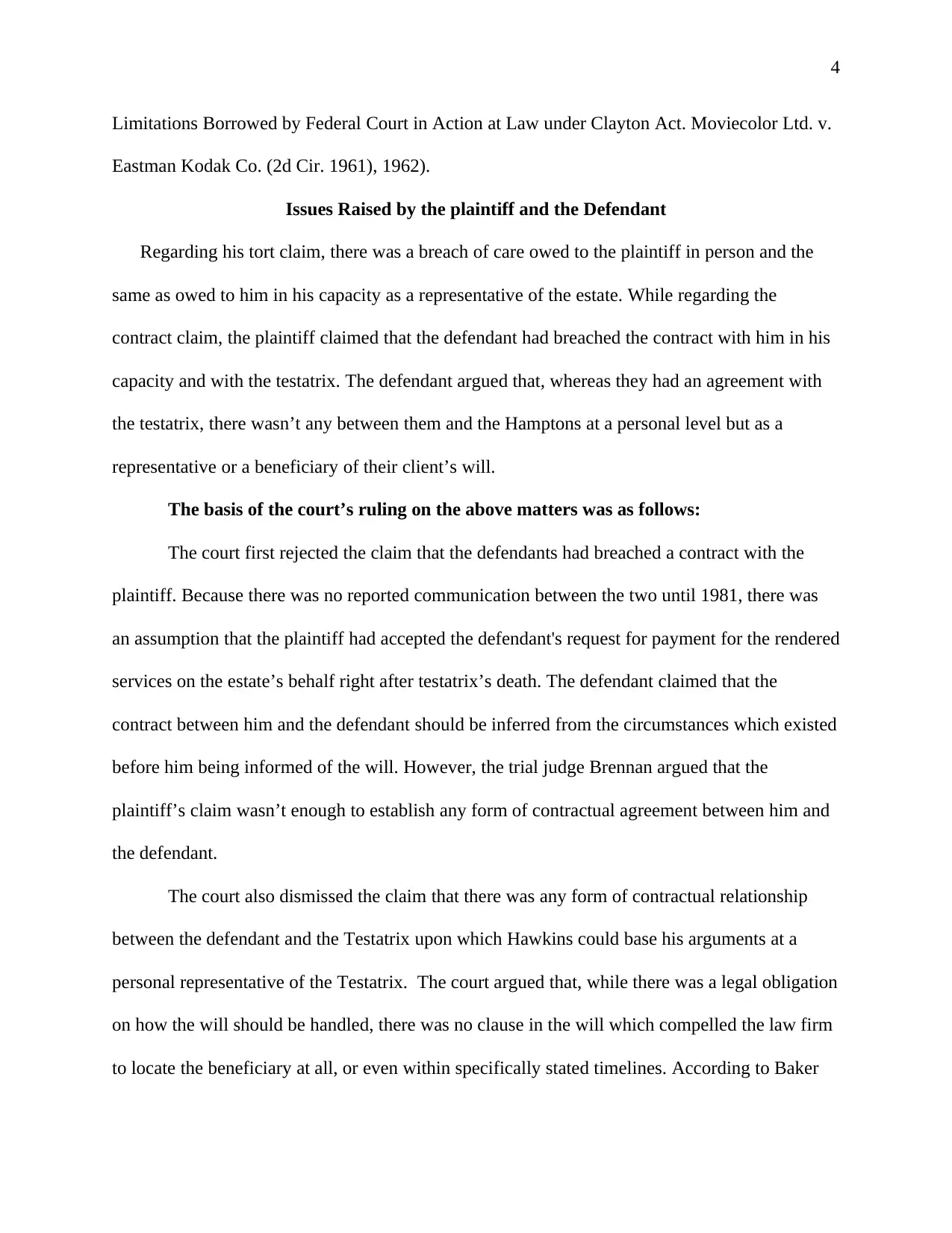
Regarding his tort claim, there was a breach of care owed to the plaintiff in person and the
same as owed to him in his capacity as a representative of the estate. While regarding the
contract claim, the plaintiff claimed that the defendant had breached the contract with him in his
capacity and with the testatrix. The defendant argued that, whereas they had an agreement with
the testatrix, there wasn’t any between them and the Hamptons at a personal level but as a
representative or a beneficiary of their client’s will.
The basis of the court’s ruling on the above matters was as follows:
The court first rejected the claim that the defendants had breached a contract with the
plaintiff. Because there was no reported communication between the two until 1981, there was
an assumption that the plaintiff had accepted the defendant's request for payment for the rendered
services on the estate’s behalf right after testatrix’s death. The defendant claimed that the
contract between him and the defendant should be inferred from the circumstances which existed
before him being informed of the will. However, the trial judge Brennan argued that the
plaintiff’s claim wasn’t enough to establish any form of contractual agreement between him and
the defendant.
The court also dismissed the claim that there was any form of contractual relationship
between the defendant and the Testatrix upon which Hawkins could base his arguments at a
personal representative of the Testatrix. The court argued that, while there was a legal obligation
on how the will should be handled, there was no clause in the will which compelled the law firm
to locate the beneficiary at all, or even within specifically stated timelines. According to Baker
Limitations Borrowed by Federal Court in Action at Law under Clayton Act. Moviecolor Ltd. v.
Eastman Kodak Co. (2d Cir. 1961), 1962).
Issues Raised by the plaintiff and the Defendant
Regarding his tort claim, there was a breach of care owed to the plaintiff in person and the
same as owed to him in his capacity as a representative of the estate. While regarding the
contract claim, the plaintiff claimed that the defendant had breached the contract with him in his
capacity and with the testatrix. The defendant argued that, whereas they had an agreement with
the testatrix, there wasn’t any between them and the Hamptons at a personal level but as a
representative or a beneficiary of their client’s will.
The basis of the court’s ruling on the above matters was as follows:
The court first rejected the claim that the defendants had breached a contract with the
plaintiff. Because there was no reported communication between the two until 1981, there was
an assumption that the plaintiff had accepted the defendant's request for payment for the rendered
services on the estate’s behalf right after testatrix’s death. The defendant claimed that the
contract between him and the defendant should be inferred from the circumstances which existed
before him being informed of the will. However, the trial judge Brennan argued that the
plaintiff’s claim wasn’t enough to establish any form of contractual agreement between him and
the defendant.
The court also dismissed the claim that there was any form of contractual relationship
between the defendant and the Testatrix upon which Hawkins could base his arguments at a
personal representative of the Testatrix. The court argued that, while there was a legal obligation
on how the will should be handled, there was no clause in the will which compelled the law firm
to locate the beneficiary at all, or even within specifically stated timelines. According to Baker
Paraphrase This Document
Need a fresh take? Get an instant paraphrase of this document with our AI Paraphraser
5
(1983), In line with the matter, the trial judge should have set out guidelines to determine
whether the exclusion was intentional on the part of the defendant or just a question of
negligence. The plaintiff’s chances of success rely upon the issue of negligence, which
dominated the case discussion. The importance of the problem of neglect as brought out, in this
case, plays a vital role in the development of future laws on negligence.
The safekeeping of the will was clear evidence that the Testatrix had any other hidden
intention. The agreement was above board; however, it becomes difficult to prove the firm’s
intentions in matters preceding the death so the contract’ principal. It can be assumed that
Testatrix was very cautious and that the actions were aimed at ensuring that will wasn't lost till it
served its full purpose.
Critical analysis
After reviewing the case file, I have decided to represent the plaintiff. The decision to
represent him is informed by the relevance of his application to the development of the
Australian law of negligence. The case brings to the fore the question of whether the issue of
negligence should be included in the tort contracts. One of the main reasons which contributed to
the success of the plaintiff was the approach taken on the issue of negligence. As Hawkins
defense, it is essential to identify the gap in the law regarding the issue and exploit it fully. The
trial bench would be put to task to offer guidelines on how to handle such cases in the future. The
level of negligence also provided better success chances in the case
Based on this case, there is clear evidence as presented by Hawkins that legal oversight
can lead to substantial economic loses (Negligence. Comparative Negligence. Wanton
Negligence of Defendant as Precluding Defense of Contributory Negligence of Plaintiff, 1931).
The development accorded the lawmakers and the legal fraternity with an opportunity for
(1983), In line with the matter, the trial judge should have set out guidelines to determine
whether the exclusion was intentional on the part of the defendant or just a question of
negligence. The plaintiff’s chances of success rely upon the issue of negligence, which
dominated the case discussion. The importance of the problem of neglect as brought out, in this
case, plays a vital role in the development of future laws on negligence.
The safekeeping of the will was clear evidence that the Testatrix had any other hidden
intention. The agreement was above board; however, it becomes difficult to prove the firm’s
intentions in matters preceding the death so the contract’ principal. It can be assumed that
Testatrix was very cautious and that the actions were aimed at ensuring that will wasn't lost till it
served its full purpose.
Critical analysis
After reviewing the case file, I have decided to represent the plaintiff. The decision to
represent him is informed by the relevance of his application to the development of the
Australian law of negligence. The case brings to the fore the question of whether the issue of
negligence should be included in the tort contracts. One of the main reasons which contributed to
the success of the plaintiff was the approach taken on the issue of negligence. As Hawkins
defense, it is essential to identify the gap in the law regarding the issue and exploit it fully. The
trial bench would be put to task to offer guidelines on how to handle such cases in the future. The
level of negligence also provided better success chances in the case
Based on this case, there is clear evidence as presented by Hawkins that legal oversight
can lead to substantial economic loses (Negligence. Comparative Negligence. Wanton
Negligence of Defendant as Precluding Defense of Contributory Negligence of Plaintiff, 1931).
The development accorded the lawmakers and the legal fraternity with an opportunity for
6
addressing the issues of negligence in the legal practice. The other main reason for the success
was the fact that the case also raised concerns regarding the appropriate methods required in
determining the determination of the duty of care exists in law (Velasco, 2014). The evidence
showed that there was a massive need for the review of the law of the duty of care since it had
severe legal gaps that could be used by licensed practitioners to exploit clients.
The significance of the case remains partly on the manner in which the proximity test was
applied in the case. The case offered an opportunity for the trial bench to determine the extent
and effectiveness of the proximity test (GÜNGÖR, 2008). In their application of the proximity
test. The court ruled that the economic losses incurred by the next party in a contractual
relationship required that the solicitor is responsible for duty to both their current clients the
client’s future representative as stated in the contract concerning all foreseeable financial losses
(Jolowicz, 1973).
The unanimity with which the trial bench handled this issue with only Deane having a
descanting opinion show how well the case was used to expose gaps in law on this matter which
required all the judges to embrace the common law to make a decision. The case was won both
through the use of existing laws and a focus on the review development of statutes necessary in
handling future related claims.
Conclusion
The case was decided based on the evidence gathered by the trial bench on whether there
was a clause in the agreement compelling the solicitor to inform Hawkins about the will. The
high court laid down straightforward legal guidelines on the implications of the terms used in the
contract and how they regulate the preparation, retention for safekeeping and execution of the
will. The case mostly leaned on the plaintiff's favor because the defendant failed to discharge its
addressing the issues of negligence in the legal practice. The other main reason for the success
was the fact that the case also raised concerns regarding the appropriate methods required in
determining the determination of the duty of care exists in law (Velasco, 2014). The evidence
showed that there was a massive need for the review of the law of the duty of care since it had
severe legal gaps that could be used by licensed practitioners to exploit clients.
The significance of the case remains partly on the manner in which the proximity test was
applied in the case. The case offered an opportunity for the trial bench to determine the extent
and effectiveness of the proximity test (GÜNGÖR, 2008). In their application of the proximity
test. The court ruled that the economic losses incurred by the next party in a contractual
relationship required that the solicitor is responsible for duty to both their current clients the
client’s future representative as stated in the contract concerning all foreseeable financial losses
(Jolowicz, 1973).
The unanimity with which the trial bench handled this issue with only Deane having a
descanting opinion show how well the case was used to expose gaps in law on this matter which
required all the judges to embrace the common law to make a decision. The case was won both
through the use of existing laws and a focus on the review development of statutes necessary in
handling future related claims.
Conclusion
The case was decided based on the evidence gathered by the trial bench on whether there
was a clause in the agreement compelling the solicitor to inform Hawkins about the will. The
high court laid down straightforward legal guidelines on the implications of the terms used in the
contract and how they regulate the preparation, retention for safekeeping and execution of the
will. The case mostly leaned on the plaintiff's favor because the defendant failed to discharge its
⊘ This is a preview!⊘
Do you want full access?
Subscribe today to unlock all pages.
Trusted by 1+ million students worldwide

7
duty of informing Mr. Hawkins about the existence and contents of the will appropriately. The
case shows that common law is very central to deciding such cases, and that that there was a
massive need for the review on the law of the duty of care since it had severe legal gaps that
could be used by licensed practitioners to exploit clients.
duty of informing Mr. Hawkins about the existence and contents of the will appropriately. The
case shows that common law is very central to deciding such cases, and that that there was a
massive need for the review on the law of the duty of care since it had severe legal gaps that
could be used by licensed practitioners to exploit clients.
Paraphrase This Document
Need a fresh take? Get an instant paraphrase of this document with our AI Paraphraser
8
Bibliography
Anderson, J. (2014). Professional Negligence, Solicitors: Recent Case Law, 2014. SSRN
Electronic Journal.
Baker, D. and Blumenthal, W. (1983). The 1982 Guidelines and Preexisting Law. California
Law Review, 71(2), p.311.
Blumenthal Kleiman, L. (2009). SEC proposes investment adviser custody rule amendments to
enhance safekeeping and oversight of client assets. Journal of Investment Compliance,
10(3), pp.41-43.
Godden, L. (2003). Grounding Law as Cultural Memory: A ‘Proper’ Account of Property and
Native Title in Australian Law and Land. Australian Feminist Law Journal, 19(1), pp.61-
80.
GÜNGÖR, G. (2008). THE PRINCIPLE OF PROXIMITY IN CONTRACTUAL
OBLIGATIONS THE NEW TURKISH LAW ON PRIVATE INTERNATIONAL LAW
AND INTERNATIONAL CIVIL PROCEDURE. Ankara Law Review, pp.001-021.
Gaddy, B. and Perry, C. (1993). Case Report. Journal of Orthopaedic Trauma, 7(4),
pp.388-390.
Jolowicz, J. (1973). Negligence—Loss of Profits—Economic Loss. The Cambridge Law
Journal, 32(01), p.20.
Limitation of Actions. In General. Concealment of Cause of Action Tolls State Statute of
Limitations Borrowed by Federal Court in Action at Law under Clayton Act. Moviecolor
Ltd. v. Eastman Kodak Co. (2d Cir. 1961). (1962). Harvard Law Review, 75(3), p.627.
Negligence. Comparative Negligence. Wanton Negligence of Defendant as Precluding Defense
of Contributory Negligence of Plaintiff. (1931). Virginia Law Review, 17(3), p.307.
Bibliography
Anderson, J. (2014). Professional Negligence, Solicitors: Recent Case Law, 2014. SSRN
Electronic Journal.
Baker, D. and Blumenthal, W. (1983). The 1982 Guidelines and Preexisting Law. California
Law Review, 71(2), p.311.
Blumenthal Kleiman, L. (2009). SEC proposes investment adviser custody rule amendments to
enhance safekeeping and oversight of client assets. Journal of Investment Compliance,
10(3), pp.41-43.
Godden, L. (2003). Grounding Law as Cultural Memory: A ‘Proper’ Account of Property and
Native Title in Australian Law and Land. Australian Feminist Law Journal, 19(1), pp.61-
80.
GÜNGÖR, G. (2008). THE PRINCIPLE OF PROXIMITY IN CONTRACTUAL
OBLIGATIONS THE NEW TURKISH LAW ON PRIVATE INTERNATIONAL LAW
AND INTERNATIONAL CIVIL PROCEDURE. Ankara Law Review, pp.001-021.
Gaddy, B. and Perry, C. (1993). Case Report. Journal of Orthopaedic Trauma, 7(4),
pp.388-390.
Jolowicz, J. (1973). Negligence—Loss of Profits—Economic Loss. The Cambridge Law
Journal, 32(01), p.20.
Limitation of Actions. In General. Concealment of Cause of Action Tolls State Statute of
Limitations Borrowed by Federal Court in Action at Law under Clayton Act. Moviecolor
Ltd. v. Eastman Kodak Co. (2d Cir. 1961). (1962). Harvard Law Review, 75(3), p.627.
Negligence. Comparative Negligence. Wanton Negligence of Defendant as Precluding Defense
of Contributory Negligence of Plaintiff. (1931). Virginia Law Review, 17(3), p.307.
9
Statute of Limitations. Period for Negligence Actions Applied to Contract Actions.
(1925). Columbia Law Review, 25(7), p.977.
Trindade, F., Cane, P. and Lunney, M. (2007). The law of torts in Australia. South Melbourne:
Oxford University Press.
Velasco, J. (2014). A Defense of the Corporate Law Duty of Care. SSRN Electronic Journal.
Statute of Limitations. Period for Negligence Actions Applied to Contract Actions.
(1925). Columbia Law Review, 25(7), p.977.
Trindade, F., Cane, P. and Lunney, M. (2007). The law of torts in Australia. South Melbourne:
Oxford University Press.
Velasco, J. (2014). A Defense of the Corporate Law Duty of Care. SSRN Electronic Journal.
⊘ This is a preview!⊘
Do you want full access?
Subscribe today to unlock all pages.
Trusted by 1+ million students worldwide

1 out of 9


Your All-in-One AI-Powered Toolkit for Academic Success.
+13062052269
info@desklib.com
Available 24*7 on WhatsApp / Email
![[object Object]](/_next/static/media/star-bottom.7253800d.svg)
Unlock your academic potential
Copyright © 2020–2026 A2Z Services. All Rights Reserved. Developed and managed by ZUCOL.