Canterbury Business College: SITXWHS002 Assignment on Workplace Safety
VerifiedAdded on 2023/06/07
|12
|2889
|309
Homework Assignment
AI Summary
This document presents a completed assignment for the SITXWHS002 unit, focusing on identifying hazards, assessing risks, and implementing control measures in a hospitality setting. The assignment includes detailed responses to questions about workplace health and safety legislation, codes of practice, and hazard categories. It provides examples of workplace hazards, such as biological, physical, chemical, ergonomic, and psychosocial hazards, and outlines control measures for each. Furthermore, the assignment addresses the requirements for work health and safety consultation, coordination, and cooperation as outlined in relevant codes of practice, and also includes a WHS risk assessment template for practical application. The document also covers the Model WHS Act's requirements for hazard analysis and risk controls. This assignment provides a comprehensive overview of workplace safety principles and practices relevant to the tourism, hospitality, and event industries.
Canterbury Business College
CRICOS Code – 01899K RTO Code - 6554
ASSESSMENT 1
Cluster: Hospitality 2
Units: SITXWHS002 Identify hazards, assess and control safety risks
Course Name: Certificate IV in Commercial Cookery – SIT40516
Training Package: SIT
Assessment Tool: Assignment
Candidate must fill this section:
Candidate Name:
Candidate ID:
Privacy Release
Clause:
“I give my permission for my assessment material to be used in the
auditing, assessment validation & moderation Process”
Student signature:
Feedback to student:
Assessment Completion Status
Attempt Satisfactory Non-Satisfactory Date Assessor’s
Signature
Initial attempt
2nd attempt/Re-assessment
Page 1 of 7
CBC-SITXWHS002-A1-V2018.1
Date
:
CRICOS Code – 01899K RTO Code - 6554
ASSESSMENT 1
Cluster: Hospitality 2
Units: SITXWHS002 Identify hazards, assess and control safety risks
Course Name: Certificate IV in Commercial Cookery – SIT40516
Training Package: SIT
Assessment Tool: Assignment
Candidate must fill this section:
Candidate Name:
Candidate ID:
Privacy Release
Clause:
“I give my permission for my assessment material to be used in the
auditing, assessment validation & moderation Process”
Student signature:
Feedback to student:
Assessment Completion Status
Attempt Satisfactory Non-Satisfactory Date Assessor’s
Signature
Initial attempt
2nd attempt/Re-assessment
Page 1 of 7
CBC-SITXWHS002-A1-V2018.1
Date
:

Paraphrase This Document
Need a fresh take? Get an instant paraphrase of this document with our AI Paraphraser
Canterbury Business College
CRICOS Code – 01899K RTO Code - 6554
Information for Candidate:
• All work is to be entirely of the candidate.
General Information for this assessment:
• Read the instructions for each question very carefully.
• Be sure to PRINT your FULL name & LAST name in every place that is provided.
• Short questions must be answered in the spaces provided.
• For those activities requesting extra evidence such as: research reports, ESSAY reports, etc. The student must attach its own work
formatted in double space, Arial 12 pts.
• All activities must be addressed correctly in order to obtain a competence for the unit of competency.
• If the candidate doesn’t understand the assessment, they can request help from the assessor to interpret the assessment.
Re-assessment of Result & Academic Appeal procedures:
If a student at Canterbury Business College is not happy with his/ her results, the student may appeal against their result via a written letter,
clearly stating the grounds of appeal to the MSS / DSS. This should be submitted after completion of the subject and within 14 days of
commencement of the new term.
Re-assessment Process:
• An appeal in writing is made to the ACC / MSS providing reasons for re-assessment /appeal.
• ACC / MSS will delegate another faculty member of CBC to review the assessment.
• The student will be advised of the review result done by another assessor.
• If the student is still not satisfied and further challenges the decision, then a review panel is formed comprising the lecturer/trainer in
charge, the ACC, the MSS and the DSS OR if need be an external assessor.
• The Institute will advise the student of the appeal decision within 14 days from the submission date of the appeal. The decision of the panel
will be deemed to be final.
• If the student is still not satisfied with the result, the he / she has the right to seek independent advice or follow external mediation option
with CBC’s nominated mediation agency.
• Any student who fails a compulsory subject or appeals unsuccessfully will be required to re-enrol in that subject.
The cost of reassessment will be borne by the Institute. The external assessor will base his/her judgement based on principles of assessment.
These principles require assessment to be reliable, fair, practical and valid.
Academic Appeals:
• If the student is dissatisfied with the outcome of the assessment marking process, he/she has a right to appeal the assessment results.
• The notice of appeal should be in writing addressed to the MSS / ACC and submitted within seven days of notification of the assessment
results.
• If the appeal is not lodged in the specified time, the result will stand as marked.
• In emergency circumstances, such as in cases of serious illness or injury, the student must forward a medical certificate in support of a
deferred appeal. The notice of appeal must be made within three working days of the concluding date shown on the medical certificate.
• The decision of MSS / ACC will be discussed with the DSS and will be final.
For further information please refer to Student Handbook.
“I understand all the above rules and guidelines for the assessment”
Full Name
Page 2 of 7
CBC-SITXWHS002-A1-V2018.1
Signature Date (dd/mm/yyyy)
CRICOS Code – 01899K RTO Code - 6554
Information for Candidate:
• All work is to be entirely of the candidate.
General Information for this assessment:
• Read the instructions for each question very carefully.
• Be sure to PRINT your FULL name & LAST name in every place that is provided.
• Short questions must be answered in the spaces provided.
• For those activities requesting extra evidence such as: research reports, ESSAY reports, etc. The student must attach its own work
formatted in double space, Arial 12 pts.
• All activities must be addressed correctly in order to obtain a competence for the unit of competency.
• If the candidate doesn’t understand the assessment, they can request help from the assessor to interpret the assessment.
Re-assessment of Result & Academic Appeal procedures:
If a student at Canterbury Business College is not happy with his/ her results, the student may appeal against their result via a written letter,
clearly stating the grounds of appeal to the MSS / DSS. This should be submitted after completion of the subject and within 14 days of
commencement of the new term.
Re-assessment Process:
• An appeal in writing is made to the ACC / MSS providing reasons for re-assessment /appeal.
• ACC / MSS will delegate another faculty member of CBC to review the assessment.
• The student will be advised of the review result done by another assessor.
• If the student is still not satisfied and further challenges the decision, then a review panel is formed comprising the lecturer/trainer in
charge, the ACC, the MSS and the DSS OR if need be an external assessor.
• The Institute will advise the student of the appeal decision within 14 days from the submission date of the appeal. The decision of the panel
will be deemed to be final.
• If the student is still not satisfied with the result, the he / she has the right to seek independent advice or follow external mediation option
with CBC’s nominated mediation agency.
• Any student who fails a compulsory subject or appeals unsuccessfully will be required to re-enrol in that subject.
The cost of reassessment will be borne by the Institute. The external assessor will base his/her judgement based on principles of assessment.
These principles require assessment to be reliable, fair, practical and valid.
Academic Appeals:
• If the student is dissatisfied with the outcome of the assessment marking process, he/she has a right to appeal the assessment results.
• The notice of appeal should be in writing addressed to the MSS / ACC and submitted within seven days of notification of the assessment
results.
• If the appeal is not lodged in the specified time, the result will stand as marked.
• In emergency circumstances, such as in cases of serious illness or injury, the student must forward a medical certificate in support of a
deferred appeal. The notice of appeal must be made within three working days of the concluding date shown on the medical certificate.
• The decision of MSS / ACC will be discussed with the DSS and will be final.
For further information please refer to Student Handbook.
“I understand all the above rules and guidelines for the assessment”
Full Name
Page 2 of 7
CBC-SITXWHS002-A1-V2018.1
Signature Date (dd/mm/yyyy)
1
2
3
Canterbury Business College
CRICOS Code – 01899K RTO Code - 6554
Submission Details:
The assessment task is due on the date provided by the assessor. Any variations to this arrangement must
be approved in writing by your assessor. Submit this document with any required evidence attached.
See specifications below for details
Performance objective
The candidate must demonstrate skills, knowledge and understanding of promote the use and
implementation of innovative work practices to effect change, as states the unit of competency
BSBITU202 . Throughout this program you are to demonstrate knowledge in:
Performance Evidence
Evidence of the ability to:
• produce documents following correct ergonomic, conservation, organisational and statutory
requirements
• consult with appropriate personnel as required
• adhere to organisational style and presentation requirements
• refer to online help function and user documentation to rectify document problems
• create and modify simple charts
• follow designated timelines and ensure high accuracy when preparing documents
• demonstrate ability to prevent data loss and damage.
• Note: If a specific volume or frequency is not stated, then evidence must be provided at least
once.
Knowledge Evidence
To complete the unit requirements safely and effectively, the individual must:
• demonstrate knowledge of how to format workplace documents
• describe organisational requirements for ergonomic standards, work periods and breaks, and
conservation techniques
• outline organisational guidelines on spreadsheet manipulation and processing
• explain purpose and range of use of spreadsheet functions.
Assessment description:
You will undertake computer based test based on class lectures and activities in this problem scenario.
Procedure:
You will need to follow instructions below and address all activities required.
This is an individual activity where each candidate will be assessed
individually;
Complete all activities and submit assessment evidence (including these papers) to your assessor by
the date provided (see submission details).
Specifications/Conditions:
Your assessor will be looking for evidence of:
• Industry technology
• organisational policies and procedures
• relevant legislation
• user manuals
• relevant workplace documentation and resources
• industry software packages
2
3
Canterbury Business College
CRICOS Code – 01899K RTO Code - 6554
Submission Details:
The assessment task is due on the date provided by the assessor. Any variations to this arrangement must
be approved in writing by your assessor. Submit this document with any required evidence attached.
See specifications below for details
Performance objective
The candidate must demonstrate skills, knowledge and understanding of promote the use and
implementation of innovative work practices to effect change, as states the unit of competency
BSBITU202 . Throughout this program you are to demonstrate knowledge in:
Performance Evidence
Evidence of the ability to:
• produce documents following correct ergonomic, conservation, organisational and statutory
requirements
• consult with appropriate personnel as required
• adhere to organisational style and presentation requirements
• refer to online help function and user documentation to rectify document problems
• create and modify simple charts
• follow designated timelines and ensure high accuracy when preparing documents
• demonstrate ability to prevent data loss and damage.
• Note: If a specific volume or frequency is not stated, then evidence must be provided at least
once.
Knowledge Evidence
To complete the unit requirements safely and effectively, the individual must:
• demonstrate knowledge of how to format workplace documents
• describe organisational requirements for ergonomic standards, work periods and breaks, and
conservation techniques
• outline organisational guidelines on spreadsheet manipulation and processing
• explain purpose and range of use of spreadsheet functions.
Assessment description:
You will undertake computer based test based on class lectures and activities in this problem scenario.
Procedure:
You will need to follow instructions below and address all activities required.
This is an individual activity where each candidate will be assessed
individually;
Complete all activities and submit assessment evidence (including these papers) to your assessor by
the date provided (see submission details).
Specifications/Conditions:
Your assessor will be looking for evidence of:
• Industry technology
• organisational policies and procedures
• relevant legislation
• user manuals
• relevant workplace documentation and resources
• industry software packages
⊘ This is a preview!⊘
Do you want full access?
Subscribe today to unlock all pages.

Trusted by 1+ million students worldwide
Canterbury Business College
CRICOS Code – 01899K RTO Code - 6554
In order to be able to perform a risk assessment in a workplace you need to be aware of the
current Workplace Health and Safety legislation and access the code relevant to your state.
You are required to answer all questions in this paper.
1. Access the website relevant for your state WHS legislation.
e.g. for New South Wales: www.safework.nsw.gov.au
2. Access the following examples of codes of practice. What is the purpose of each of
these? Describe in brief, what is covered in each of these codes?
•
•
•
Hazardous Manual Tasks
Hazardous Manual Tasks as mentioned in the Work health and safety Regulations,
2011 defines the activities that require a worker involved in any industry to lift, push,
lower, pull, carry or transfer , and grasp or restrain any person, animal or thing and
involve activities in attachment with them. When the activity is performed by the
individual make him susceptible to any kind of musculoskeletal disorder, the task is
categorized under Hazardous manual Task. These tasks include the use of repetitive
force or movement, working in a sustained or difficult posture and are exposed to
vibration1.
How to manage work health and safety risks
1 Safe Work Australia. (2018). Model Code of Practice: Hazardous manual tasks. [online] Available at:
https://www.safeworkaustralia.gov.au/doc/model-code-practice-hazardous-manual-tasks [Accessed 14
Sep. 2018].
Hazardous manual tasks
How to manage work health and safety risks
Work health and safety consultation, coordination and cooperation
CRICOS Code – 01899K RTO Code - 6554
In order to be able to perform a risk assessment in a workplace you need to be aware of the
current Workplace Health and Safety legislation and access the code relevant to your state.
You are required to answer all questions in this paper.
1. Access the website relevant for your state WHS legislation.
e.g. for New South Wales: www.safework.nsw.gov.au
2. Access the following examples of codes of practice. What is the purpose of each of
these? Describe in brief, what is covered in each of these codes?
•
•
•
Hazardous Manual Tasks
Hazardous Manual Tasks as mentioned in the Work health and safety Regulations,
2011 defines the activities that require a worker involved in any industry to lift, push,
lower, pull, carry or transfer , and grasp or restrain any person, animal or thing and
involve activities in attachment with them. When the activity is performed by the
individual make him susceptible to any kind of musculoskeletal disorder, the task is
categorized under Hazardous manual Task. These tasks include the use of repetitive
force or movement, working in a sustained or difficult posture and are exposed to
vibration1.
How to manage work health and safety risks
1 Safe Work Australia. (2018). Model Code of Practice: Hazardous manual tasks. [online] Available at:
https://www.safeworkaustralia.gov.au/doc/model-code-practice-hazardous-manual-tasks [Accessed 14
Sep. 2018].
Hazardous manual tasks
How to manage work health and safety risks
Work health and safety consultation, coordination and cooperation
Paraphrase This Document
Need a fresh take? Get an instant paraphrase of this document with our AI Paraphraser
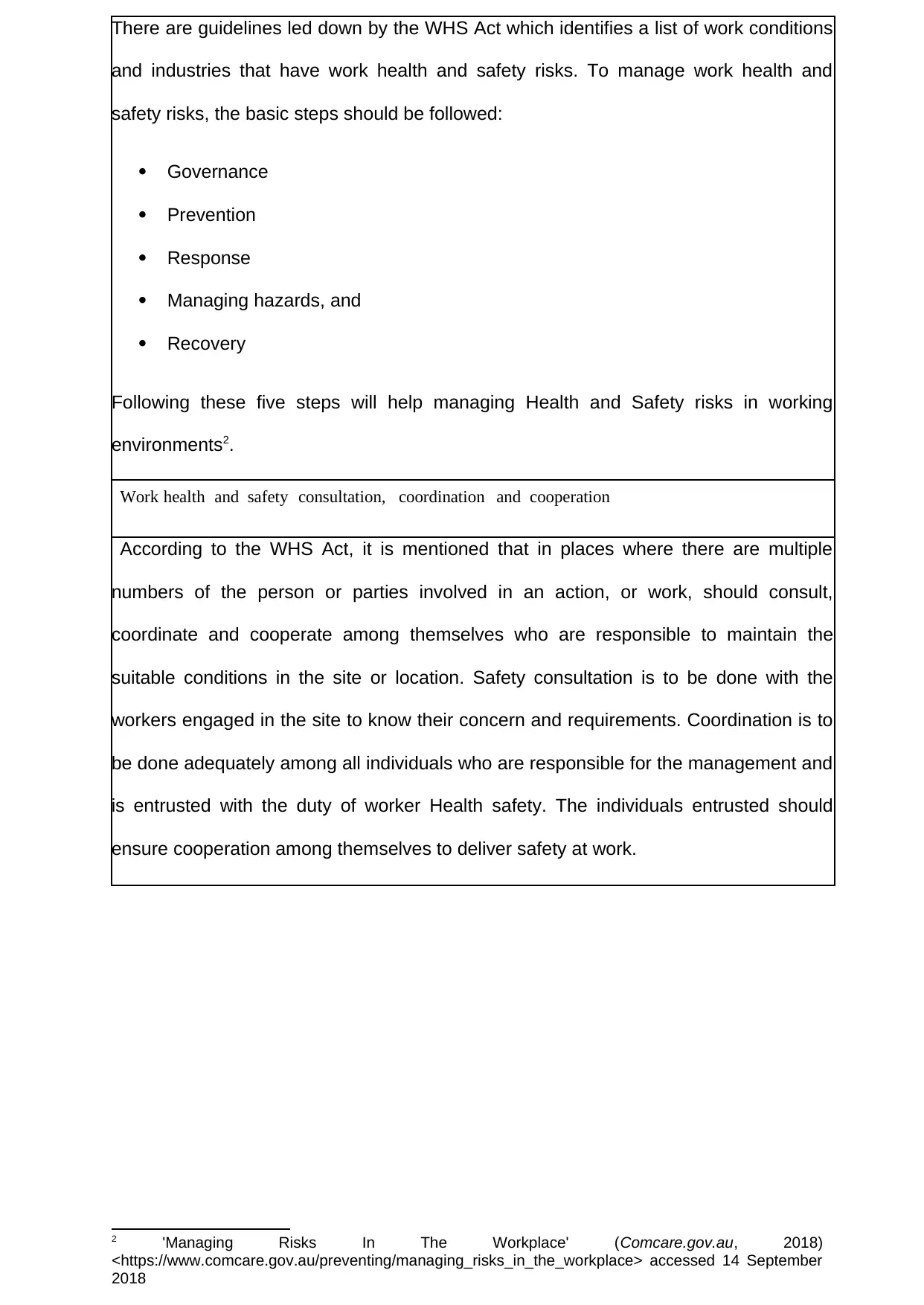
There are guidelines led down by the WHS Act which identifies a list of work conditions
and industries that have work health and safety risks. To manage work health and
safety risks, the basic steps should be followed:
Governance
Prevention
Response
Managing hazards, and
Recovery
Following these five steps will help managing Health and Safety risks in working
environments2.
Work health and safety consultation, coordination and cooperation
According to the WHS Act, it is mentioned that in places where there are multiple
numbers of the person or parties involved in an action, or work, should consult,
coordinate and cooperate among themselves who are responsible to maintain the
suitable conditions in the site or location. Safety consultation is to be done with the
workers engaged in the site to know their concern and requirements. Coordination is to
be done adequately among all individuals who are responsible for the management and
is entrusted with the duty of worker Health safety. The individuals entrusted should
ensure cooperation among themselves to deliver safety at work.
2 'Managing Risks In The Workplace' (Comcare.gov.au, 2018)
<https://www.comcare.gov.au/preventing/managing_risks_in_the_workplace> accessed 14 September
2018
and industries that have work health and safety risks. To manage work health and
safety risks, the basic steps should be followed:
Governance
Prevention
Response
Managing hazards, and
Recovery
Following these five steps will help managing Health and Safety risks in working
environments2.
Work health and safety consultation, coordination and cooperation
According to the WHS Act, it is mentioned that in places where there are multiple
numbers of the person or parties involved in an action, or work, should consult,
coordinate and cooperate among themselves who are responsible to maintain the
suitable conditions in the site or location. Safety consultation is to be done with the
workers engaged in the site to know their concern and requirements. Coordination is to
be done adequately among all individuals who are responsible for the management and
is entrusted with the duty of worker Health safety. The individuals entrusted should
ensure cooperation among themselves to deliver safety at work.
2 'Managing Risks In The Workplace' (Comcare.gov.au, 2018)
<https://www.comcare.gov.au/preventing/managing_risks_in_the_workplace> accessed 14 September
2018
Canterbury Business College
CRICOS Code – 01899K RTO Code - 6554
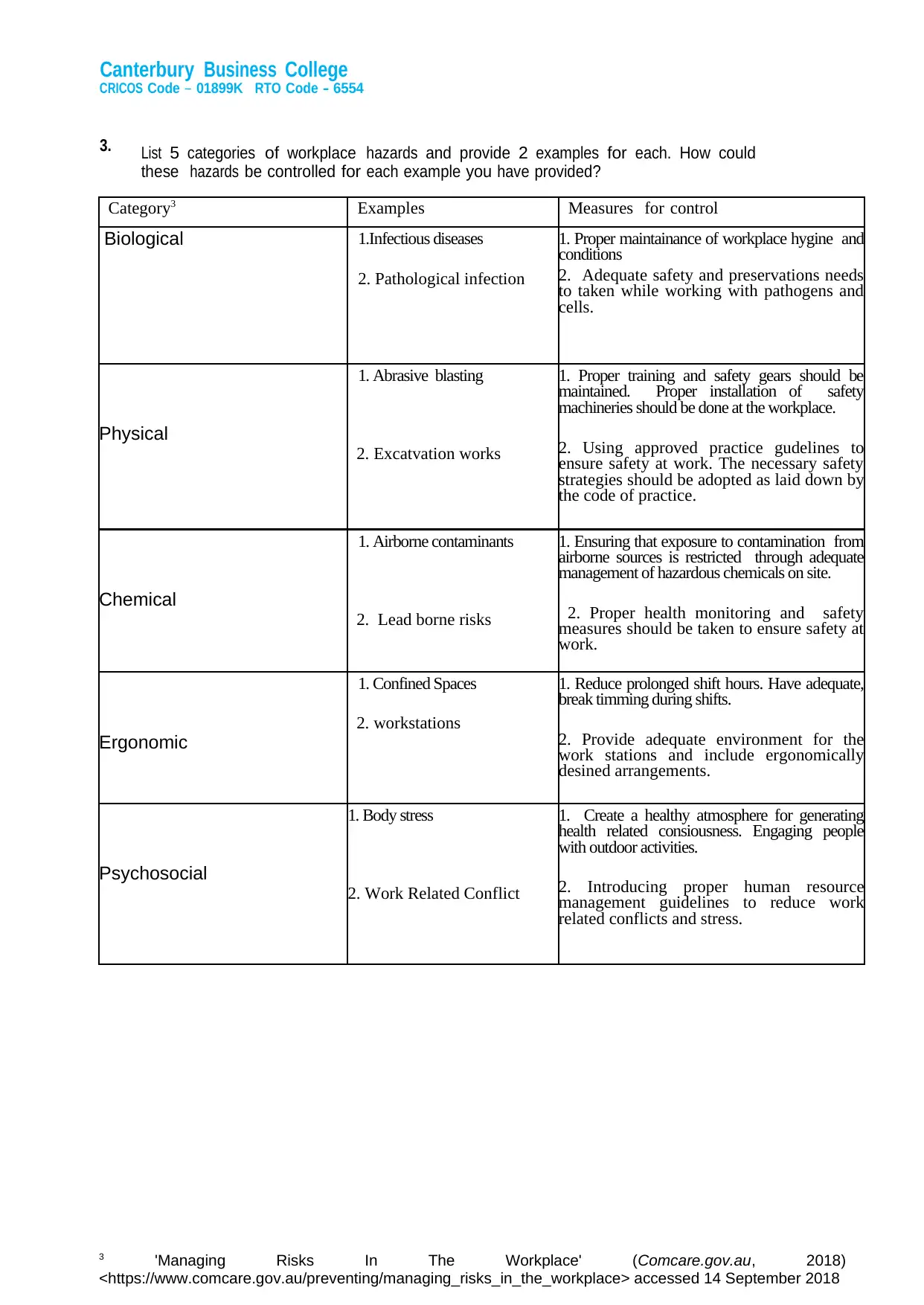
3.
Category3 Examples Measures for control
Biological 1.Infectious diseases
2. Pathological infection
1. Proper maintainance of workplace hygine and
conditions
2. Adequate safety and preservations needs
to taken while working with pathogens and
cells.
Physical
1. Abrasive blasting
2. Excatvation works
1. Proper training and safety gears should be
maintained. Proper installation of safety
machineries should be done at the workplace.
2. Using approved practice gudelines to
ensure safety at work. The necessary safety
strategies should be adopted as laid down by
the code of practice.
Chemical
1. Airborne contaminants
2. Lead borne risks
1. Ensuring that exposure to contamination from
airborne sources is restricted through adequate
management of hazardous chemicals on site.
2. Proper health monitoring and safety
measures should be taken to ensure safety at
work.
Ergonomic
1. Confined Spaces
2. workstations
1. Reduce prolonged shift hours. Have adequate,
break timming during shifts.
2. Provide adequate environment for the
work stations and include ergonomically
desined arrangements.
Psychosocial
1. Body stress
2. Work Related Conflict
1. Create a healthy atmosphere for generating
health related consiousness. Engaging people
with outdoor activities.
2. Introducing proper human resource
management guidelines to reduce work
related conflicts and stress.
3 'Managing Risks In The Workplace' (Comcare.gov.au, 2018)
<https://www.comcare.gov.au/preventing/managing_risks_in_the_workplace> accessed 14 September 2018
List 5 categories of workplace hazards and provide 2 examples for each. How could
these hazards be controlled for each example you have provided?
CRICOS Code – 01899K RTO Code - 6554
3.
Category3 Examples Measures for control
Biological 1.Infectious diseases
2. Pathological infection
1. Proper maintainance of workplace hygine and
conditions
2. Adequate safety and preservations needs
to taken while working with pathogens and
cells.
Physical
1. Abrasive blasting
2. Excatvation works
1. Proper training and safety gears should be
maintained. Proper installation of safety
machineries should be done at the workplace.
2. Using approved practice gudelines to
ensure safety at work. The necessary safety
strategies should be adopted as laid down by
the code of practice.
Chemical
1. Airborne contaminants
2. Lead borne risks
1. Ensuring that exposure to contamination from
airborne sources is restricted through adequate
management of hazardous chemicals on site.
2. Proper health monitoring and safety
measures should be taken to ensure safety at
work.
Ergonomic
1. Confined Spaces
2. workstations
1. Reduce prolonged shift hours. Have adequate,
break timming during shifts.
2. Provide adequate environment for the
work stations and include ergonomically
desined arrangements.
Psychosocial
1. Body stress
2. Work Related Conflict
1. Create a healthy atmosphere for generating
health related consiousness. Engaging people
with outdoor activities.
2. Introducing proper human resource
management guidelines to reduce work
related conflicts and stress.
3 'Managing Risks In The Workplace' (Comcare.gov.au, 2018)
<https://www.comcare.gov.au/preventing/managing_risks_in_the_workplace> accessed 14 September 2018
List 5 categories of workplace hazards and provide 2 examples for each. How could
these hazards be controlled for each example you have provided?
⊘ This is a preview!⊘
Do you want full access?
Subscribe today to unlock all pages.
Trusted by 1+ million students worldwide
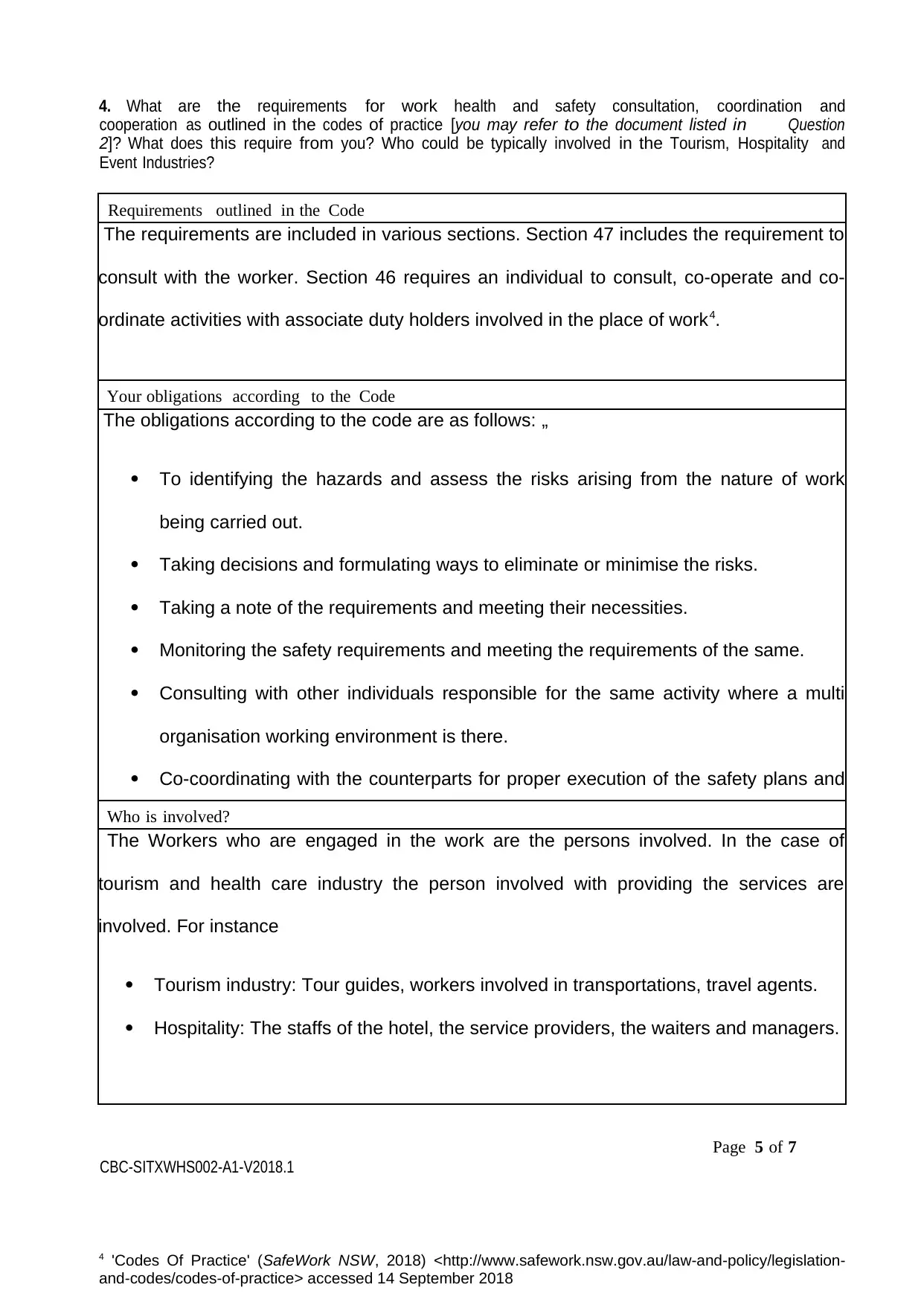
4. What are the requirements for work health and safety consultation, coordination and
cooperation as outlined in the codes of practice [you may refer to the document listed in Question
2]? What does this require from you? Who could be typically involved in the Tourism, Hospitality and
Event Industries?
Requirements outlined in the Code
The requirements are included in various sections. Section 47 includes the requirement to
consult with the worker. Section 46 requires an individual to consult, co-operate and co-
ordinate activities with associate duty holders involved in the place of work4.
Your obligations according to the Code
The obligations according to the code are as follows: „
To identifying the hazards and assess the risks arising from the nature of work
being carried out.
Taking decisions and formulating ways to eliminate or minimise the risks.
Taking a note of the requirements and meeting their necessities.
Monitoring the safety requirements and meeting the requirements of the same.
Consulting with other individuals responsible for the same activity where a multi
organisation working environment is there.
Co-coordinating with the counterparts for proper execution of the safety plans and
strategies.Who is involved?
The Workers who are engaged in the work are the persons involved. In the case of
tourism and health care industry the person involved with providing the services are
involved. For instance
Tourism industry: Tour guides, workers involved in transportations, travel agents.
Hospitality: The staffs of the hotel, the service providers, the waiters and managers.
Page 5 of 7
CBC-SITXWHS002-A1-V2018.1
4 'Codes Of Practice' (SafeWork NSW, 2018) <http://www.safework.nsw.gov.au/law-and-policy/legislation-
and-codes/codes-of-practice> accessed 14 September 2018
cooperation as outlined in the codes of practice [you may refer to the document listed in Question
2]? What does this require from you? Who could be typically involved in the Tourism, Hospitality and
Event Industries?
Requirements outlined in the Code
The requirements are included in various sections. Section 47 includes the requirement to
consult with the worker. Section 46 requires an individual to consult, co-operate and co-
ordinate activities with associate duty holders involved in the place of work4.
Your obligations according to the Code
The obligations according to the code are as follows: „
To identifying the hazards and assess the risks arising from the nature of work
being carried out.
Taking decisions and formulating ways to eliminate or minimise the risks.
Taking a note of the requirements and meeting their necessities.
Monitoring the safety requirements and meeting the requirements of the same.
Consulting with other individuals responsible for the same activity where a multi
organisation working environment is there.
Co-coordinating with the counterparts for proper execution of the safety plans and
strategies.Who is involved?
The Workers who are engaged in the work are the persons involved. In the case of
tourism and health care industry the person involved with providing the services are
involved. For instance
Tourism industry: Tour guides, workers involved in transportations, travel agents.
Hospitality: The staffs of the hotel, the service providers, the waiters and managers.
Page 5 of 7
CBC-SITXWHS002-A1-V2018.1
4 'Codes Of Practice' (SafeWork NSW, 2018) <http://www.safework.nsw.gov.au/law-and-policy/legislation-
and-codes/codes-of-practice> accessed 14 September 2018
Paraphrase This Document
Need a fresh take? Get an instant paraphrase of this document with our AI Paraphraser
Canterbury Business College
CRICOS Code – 01899K RTO Code - 6554
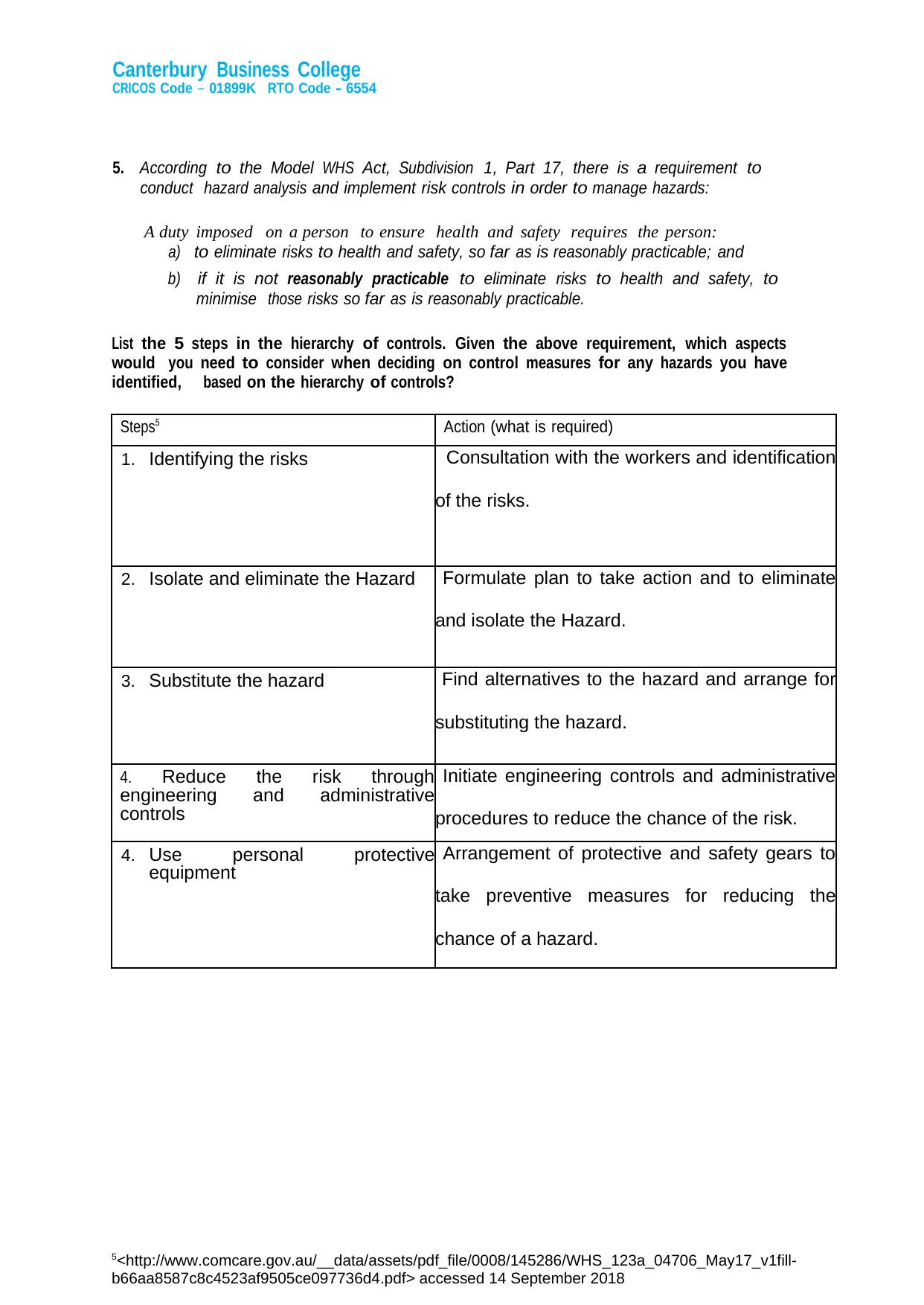
5. According to the Model WHS Act, Subdivision 1, Part 17, there is a requirement to
conduct hazard analysis and implement risk controls in order to manage hazards:
A duty imposed on a person to ensure health and safety requires the person:
a) to eliminate risks to health and safety, so far as is reasonably practicable; and
b) if it is not reasonably practicable to eliminate risks to health and safety, to
minimise those risks so far as is reasonably practicable.
List the 5 steps in the hierarchy of controls. Given the above requirement, which aspects
would you need to consider when deciding on control measures for any hazards you have
identified, based on the hierarchy of controls?
Steps 5 Action (what is required)
1. Identifying the risks Consultation with the workers and identification
of the risks.
2. Isolate and eliminate the Hazard Formulate plan to take action and to eliminate
and isolate the Hazard.
3. Substitute the hazard Find alternatives to the hazard and arrange for
substituting the hazard.
4. Reduce the risk through
engineering and administrative
controls
Initiate engineering controls and administrative
procedures to reduce the chance of the risk.
4. Use personal protective
equipment
Arrangement of protective and safety gears to
take preventive measures for reducing the
chance of a hazard.
5<http://www.comcare.gov.au/__data/assets/pdf_file/0008/145286/WHS_123a_04706_May17_v1fill-
b66aa8587c8c4523af9505ce097736d4.pdf> accessed 14 September 2018
CRICOS Code – 01899K RTO Code - 6554
5. According to the Model WHS Act, Subdivision 1, Part 17, there is a requirement to
conduct hazard analysis and implement risk controls in order to manage hazards:
A duty imposed on a person to ensure health and safety requires the person:
a) to eliminate risks to health and safety, so far as is reasonably practicable; and
b) if it is not reasonably practicable to eliminate risks to health and safety, to
minimise those risks so far as is reasonably practicable.
List the 5 steps in the hierarchy of controls. Given the above requirement, which aspects
would you need to consider when deciding on control measures for any hazards you have
identified, based on the hierarchy of controls?
Steps 5 Action (what is required)
1. Identifying the risks Consultation with the workers and identification
of the risks.
2. Isolate and eliminate the Hazard Formulate plan to take action and to eliminate
and isolate the Hazard.
3. Substitute the hazard Find alternatives to the hazard and arrange for
substituting the hazard.
4. Reduce the risk through
engineering and administrative
controls
Initiate engineering controls and administrative
procedures to reduce the chance of the risk.
4. Use personal protective
equipment
Arrangement of protective and safety gears to
take preventive measures for reducing the
chance of a hazard.
5<http://www.comcare.gov.au/__data/assets/pdf_file/0008/145286/WHS_123a_04706_May17_v1fill-
b66aa8587c8c4523af9505ce097736d4.pdf> accessed 14 September 2018
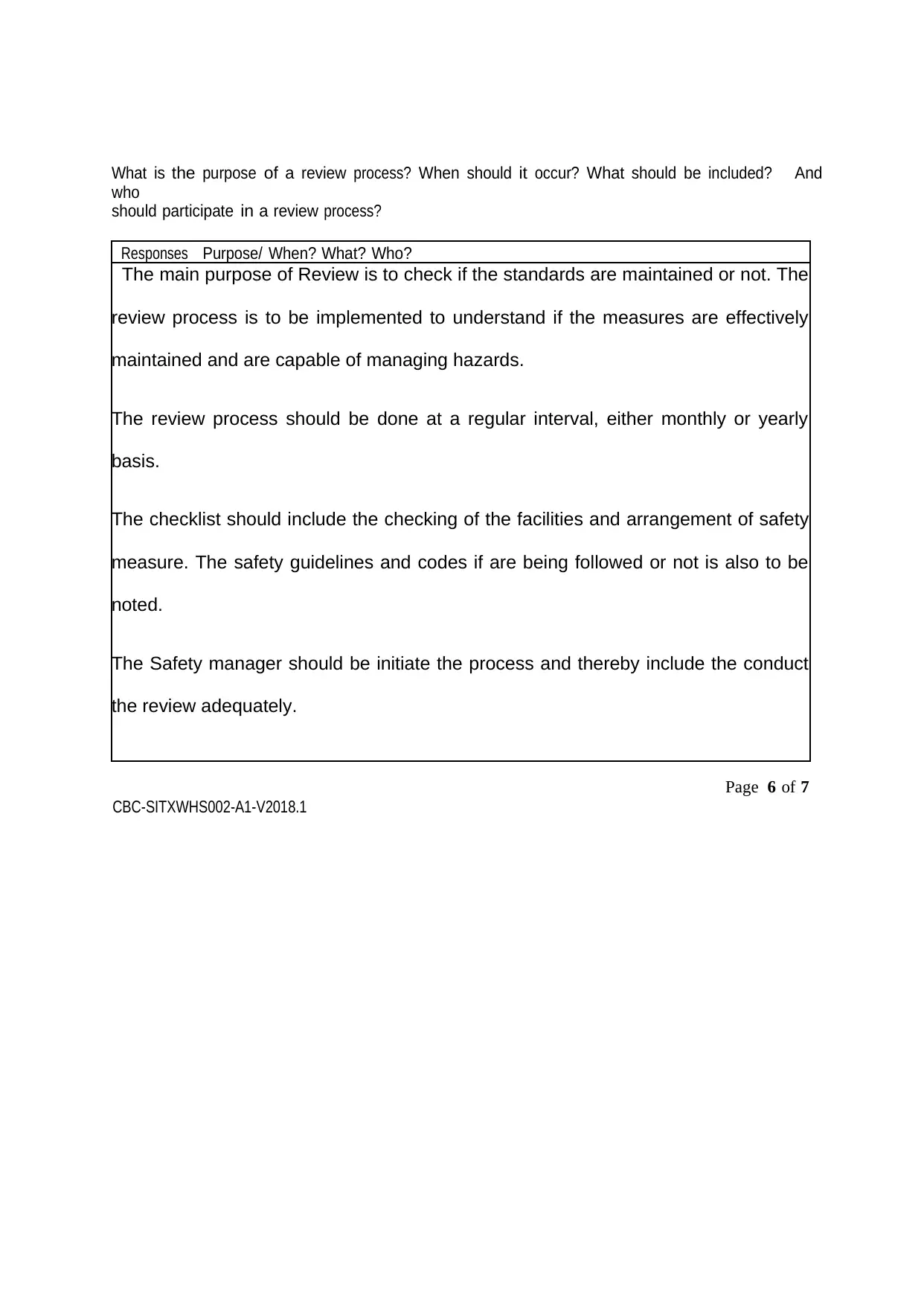
What is the purpose of a review process? When should it occur? What should be included? And
who
should participate in a review process?
Responses Purpose/ When? What? Who?
The main purpose of Review is to check if the standards are maintained or not. The
review process is to be implemented to understand if the measures are effectively
maintained and are capable of managing hazards.
The review process should be done at a regular interval, either monthly or yearly
basis.
The checklist should include the checking of the facilities and arrangement of safety
measure. The safety guidelines and codes if are being followed or not is also to be
noted.
The Safety manager should be initiate the process and thereby include the conduct
the review adequately.
Page 6 of 7
CBC-SITXWHS002-A1-V2018.1
who
should participate in a review process?
Responses Purpose/ When? What? Who?
The main purpose of Review is to check if the standards are maintained or not. The
review process is to be implemented to understand if the measures are effectively
maintained and are capable of managing hazards.
The review process should be done at a regular interval, either monthly or yearly
basis.
The checklist should include the checking of the facilities and arrangement of safety
measure. The safety guidelines and codes if are being followed or not is also to be
noted.
The Safety manager should be initiate the process and thereby include the conduct
the review adequately.
Page 6 of 7
CBC-SITXWHS002-A1-V2018.1
⊘ This is a preview!⊘
Do you want full access?
Subscribe today to unlock all pages.
Trusted by 1+ million students worldwide
Canterbury Business College
CRICOS Code – 01899K RTO Code - 6554
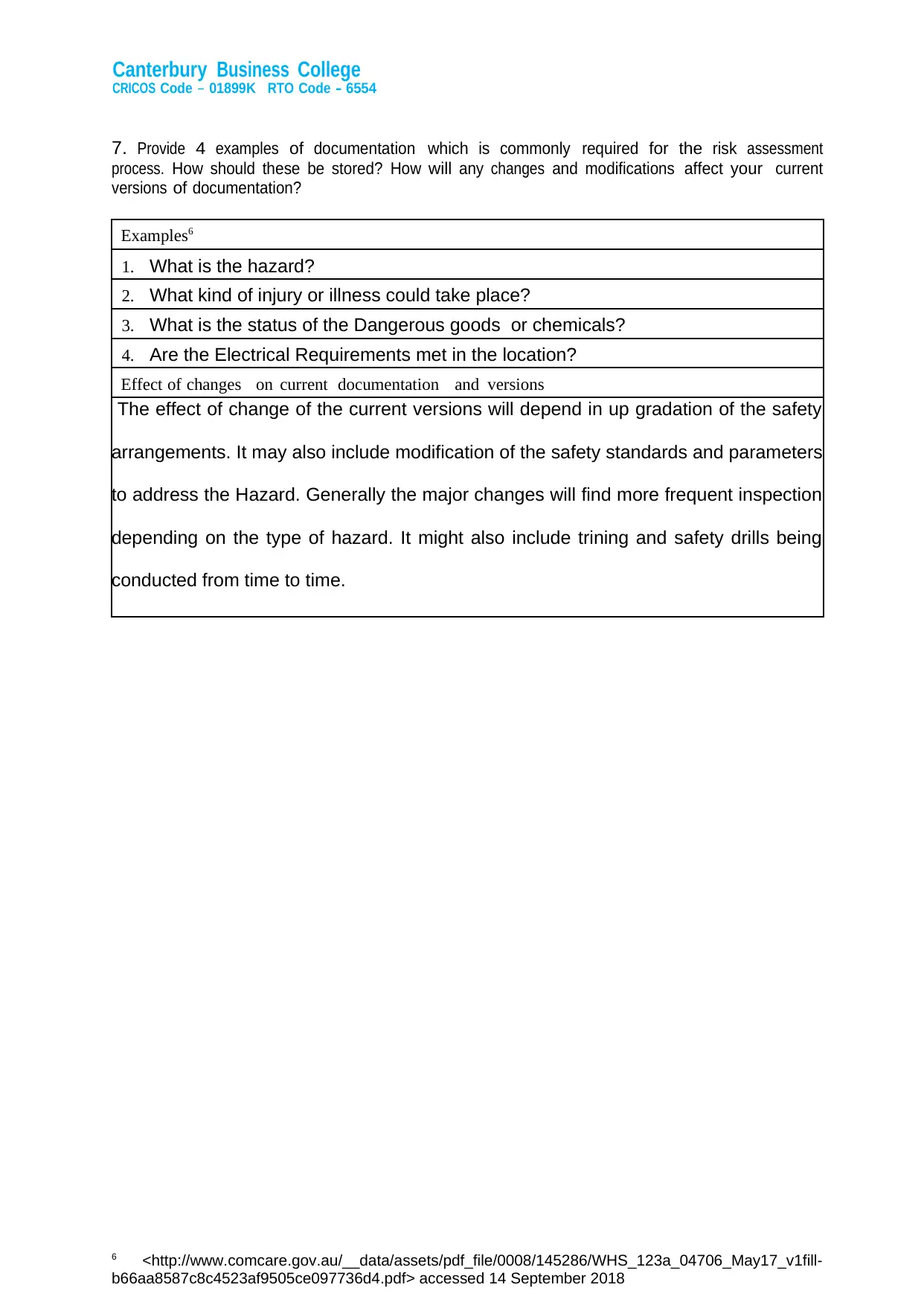
7. Provide 4 examples of documentation which is commonly required for the risk assessment
process. How should these be stored? How will any changes and modifications affect your current
versions of documentation?
Examples6
1. What is the hazard?
2. What kind of injury or illness could take place?
3. What is the status of the Dangerous goods or chemicals?
4. Are the Electrical Requirements met in the location?
Effect of changes on current documentation and versions
The effect of change of the current versions will depend in up gradation of the safety
arrangements. It may also include modification of the safety standards and parameters
to address the Hazard. Generally the major changes will find more frequent inspection
depending on the type of hazard. It might also include trining and safety drills being
conducted from time to time.
6 <http://www.comcare.gov.au/__data/assets/pdf_file/0008/145286/WHS_123a_04706_May17_v1fill-
b66aa8587c8c4523af9505ce097736d4.pdf> accessed 14 September 2018
CRICOS Code – 01899K RTO Code - 6554
7. Provide 4 examples of documentation which is commonly required for the risk assessment
process. How should these be stored? How will any changes and modifications affect your current
versions of documentation?
Examples6
1. What is the hazard?
2. What kind of injury or illness could take place?
3. What is the status of the Dangerous goods or chemicals?
4. Are the Electrical Requirements met in the location?
Effect of changes on current documentation and versions
The effect of change of the current versions will depend in up gradation of the safety
arrangements. It may also include modification of the safety standards and parameters
to address the Hazard. Generally the major changes will find more frequent inspection
depending on the type of hazard. It might also include trining and safety drills being
conducted from time to time.
6 <http://www.comcare.gov.au/__data/assets/pdf_file/0008/145286/WHS_123a_04706_May17_v1fill-
b66aa8587c8c4523af9505ce097736d4.pdf> accessed 14 September 2018
Paraphrase This Document
Need a fresh take? Get an instant paraphrase of this document with our AI Paraphraser
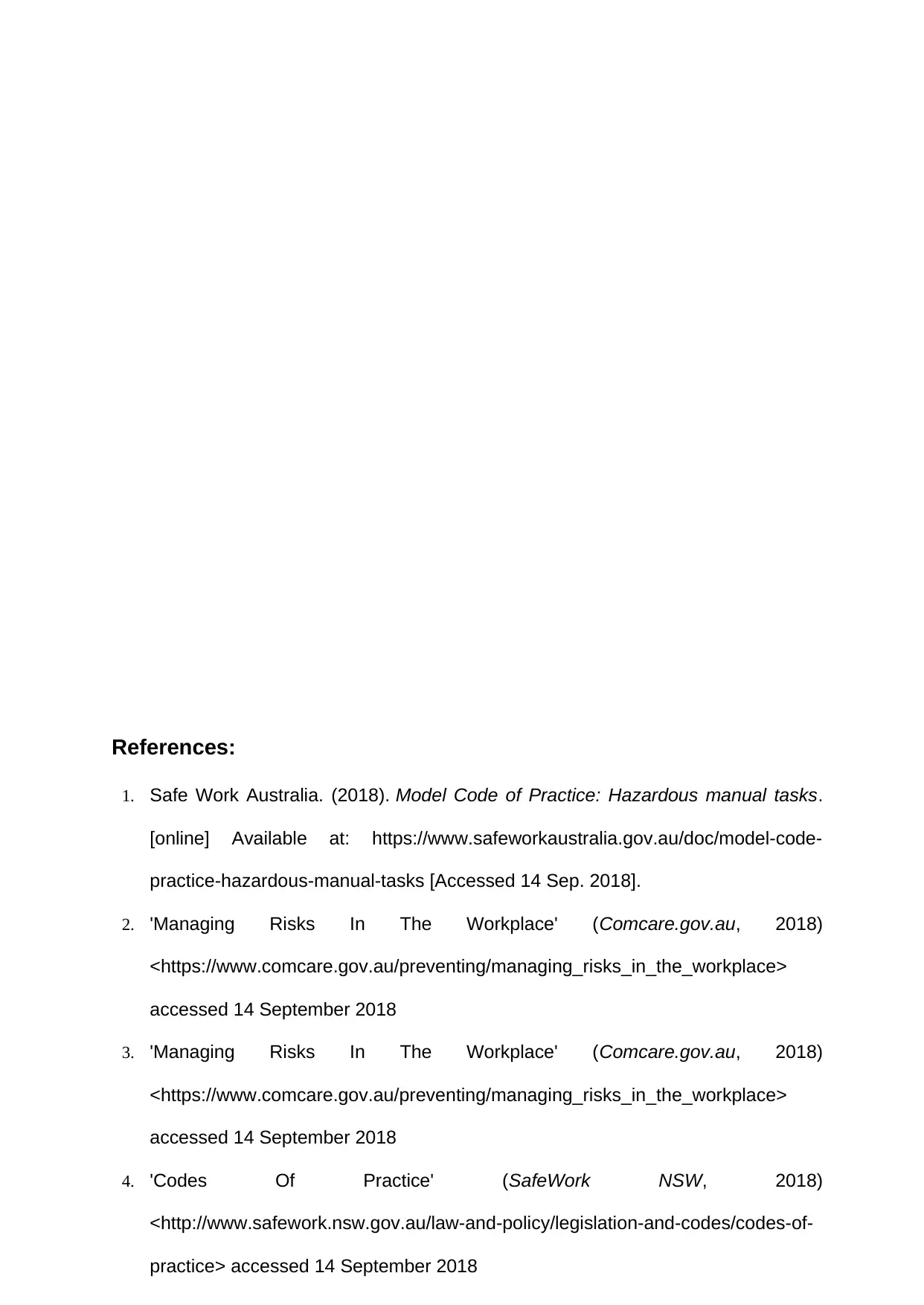
References:
1. Safe Work Australia. (2018). Model Code of Practice: Hazardous manual tasks.
[online] Available at: https://www.safeworkaustralia.gov.au/doc/model-code-
practice-hazardous-manual-tasks [Accessed 14 Sep. 2018].
2. 'Managing Risks In The Workplace' (Comcare.gov.au, 2018)
<https://www.comcare.gov.au/preventing/managing_risks_in_the_workplace>
accessed 14 September 2018
3. 'Managing Risks In The Workplace' (Comcare.gov.au, 2018)
<https://www.comcare.gov.au/preventing/managing_risks_in_the_workplace>
accessed 14 September 2018
4. 'Codes Of Practice' (SafeWork NSW, 2018)
<http://www.safework.nsw.gov.au/law-and-policy/legislation-and-codes/codes-of-
practice> accessed 14 September 2018
1. Safe Work Australia. (2018). Model Code of Practice: Hazardous manual tasks.
[online] Available at: https://www.safeworkaustralia.gov.au/doc/model-code-
practice-hazardous-manual-tasks [Accessed 14 Sep. 2018].
2. 'Managing Risks In The Workplace' (Comcare.gov.au, 2018)
<https://www.comcare.gov.au/preventing/managing_risks_in_the_workplace>
accessed 14 September 2018
3. 'Managing Risks In The Workplace' (Comcare.gov.au, 2018)
<https://www.comcare.gov.au/preventing/managing_risks_in_the_workplace>
accessed 14 September 2018
4. 'Codes Of Practice' (SafeWork NSW, 2018)
<http://www.safework.nsw.gov.au/law-and-policy/legislation-and-codes/codes-of-
practice> accessed 14 September 2018
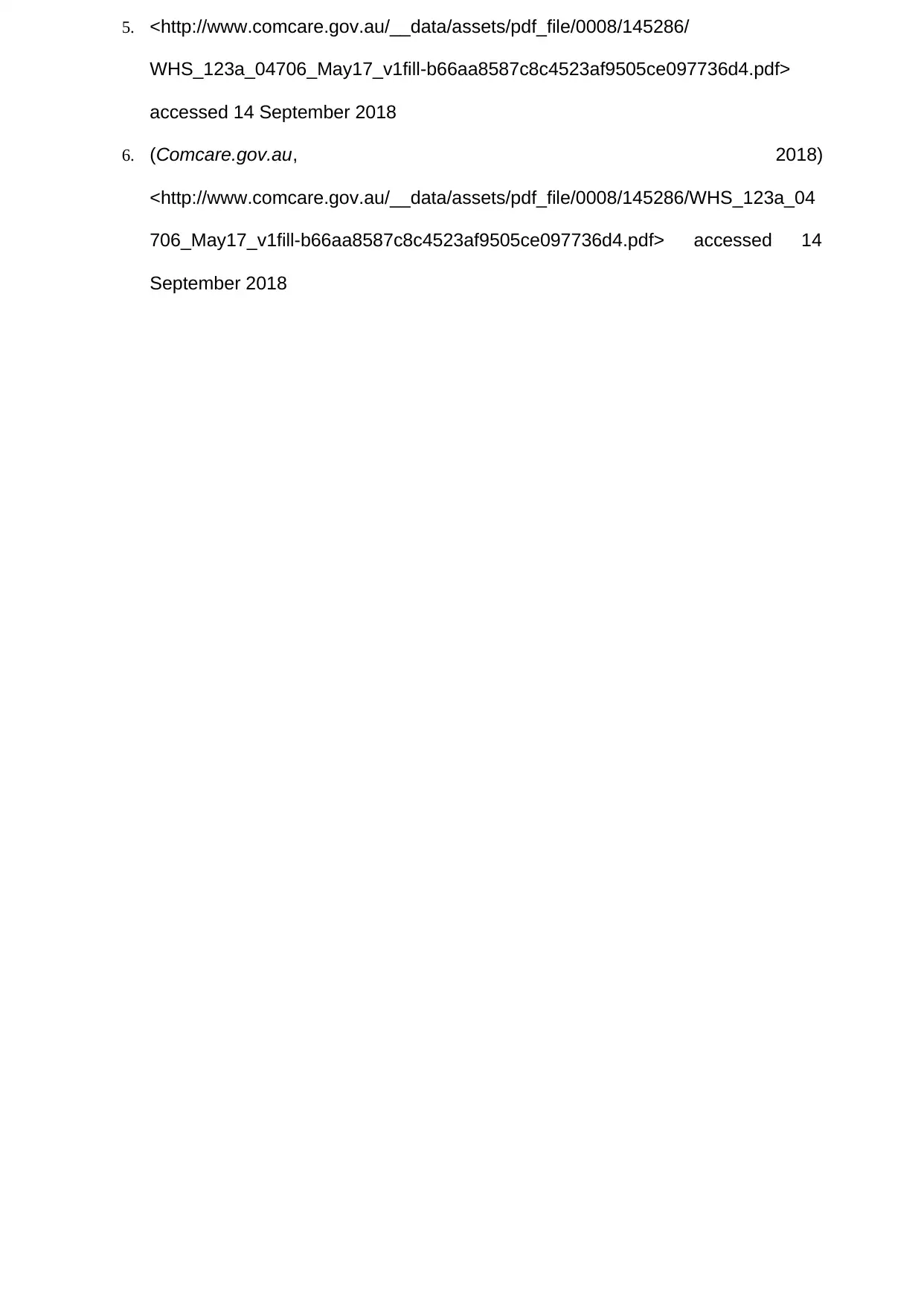
5. <http://www.comcare.gov.au/__data/assets/pdf_file/0008/145286/
WHS_123a_04706_May17_v1fill-b66aa8587c8c4523af9505ce097736d4.pdf>
accessed 14 September 2018
6. (Comcare.gov.au, 2018)
<http://www.comcare.gov.au/__data/assets/pdf_file/0008/145286/WHS_123a_04
706_May17_v1fill-b66aa8587c8c4523af9505ce097736d4.pdf> accessed 14
September 2018
WHS_123a_04706_May17_v1fill-b66aa8587c8c4523af9505ce097736d4.pdf>
accessed 14 September 2018
6. (Comcare.gov.au, 2018)
<http://www.comcare.gov.au/__data/assets/pdf_file/0008/145286/WHS_123a_04
706_May17_v1fill-b66aa8587c8c4523af9505ce097736d4.pdf> accessed 14
September 2018
⊘ This is a preview!⊘
Do you want full access?
Subscribe today to unlock all pages.
Trusted by 1+ million students worldwide

1 out of 12


Related Documents


Your All-in-One AI-Powered Toolkit for Academic Success.
+13062052269
info@desklib.com
Available 24*7 on WhatsApp / Email
![[object Object]](/_next/static/media/star-bottom.7253800d.svg)
Unlock your academic potential
Copyright © 2020–2025 A2Z Services. All Rights Reserved. Developed and managed by ZUCOL.