Hazardous Healthcare Waste Management in Healthcare Settings Report
VerifiedAdded on 2021/04/21
|28
|5207
|67
Report
AI Summary
This report delves into the critical issue of hazardous healthcare waste management within healthcare settings, particularly focusing on rural environments. It begins with an introduction and literature review, defining key terms like 'hazardous waste' and 'healthcare waste,' and exploring the risks associated with improper disposal. The report covers waste minimization strategies, containerization, and transportation methods, while also highlighting the health hazards posed by medical waste to both individuals and the environment. It emphasizes the importance of personnel knowledge in waste handling and identifies challenges faced by healthcare facilities, such as inadequate segregation measures, lack of regulations, and insufficient training. The report justifies the study's importance by referencing global health concerns and research questions addressing waste management techniques, handler knowledge, and encountered challenges. The methodology section outlines a cross-sectional descriptive study design, detailing the target population, sample procedures, and data analysis techniques. The study aims to provide insights into improving medical waste management practices, ultimately contributing to safer healthcare environments and reduced public health risks. The report highlights the importance of proper medical waste management for environmental and public health.
Hazardous Healthcare Waste Management in Healthcare Settings 1
Hazardous Healthcare Waste Management in Healthcare Settings
By Student’s Name
Course + Code
Class
Institution
Date
Hazardous Healthcare Waste Management in Healthcare Settings
By Student’s Name
Course + Code
Class
Institution
Date

Paraphrase This Document
Need a fresh take? Get an instant paraphrase of this document with our AI Paraphraser
Hazardous Healthcare Waste Management in Healthcare Settings 2
CHAPTER ONE: Background Information and Literature Review
1.0 Introduction
Health facilities are places that provide health care services to patients; however, they can
diffuse diseases and cause serious health problems to people and adverse effects on the
environment. They include clinics, outpatient care centers, hospitals, veterinary or dental,
medical laboratories and specialized care centers. Medical wastes are any wastes that contain
infectious materials or constituents that are potentially contagious (Chartier, 2015). Hazardous
waste materials pretenses health risks to patients and people who handle them as well to the
environment. Hazardous medicinal wastes are contagious and posture severe pressures to
personal health and environmental. It needs proper handling, managing, storage, and disposal,
(Blenkharn 2015, p. 543). Hospital wastes are alienated into two sets; Clinical hospital wastes
and over-all hospital wastes (non-clinical). Clinical wastes contain harmful wastes, which
constitute 10-25% of the total wastes formed in health services, and contains sharps,
pharmaceuticals, infectious, radioactive, pathological, genotoxic residues plus chemicals.
General residues include bagged wastes, spillage in the health facilities (Farzadika, 2016).
Keywords
Hazardous – unsafe, risk or dangerous that might cause harm to people or environment.
Healthcare waste- surplus materials generated due to health facility activities. Also, refer
to medical wastes.
CHAPTER ONE: Background Information and Literature Review
1.0 Introduction
Health facilities are places that provide health care services to patients; however, they can
diffuse diseases and cause serious health problems to people and adverse effects on the
environment. They include clinics, outpatient care centers, hospitals, veterinary or dental,
medical laboratories and specialized care centers. Medical wastes are any wastes that contain
infectious materials or constituents that are potentially contagious (Chartier, 2015). Hazardous
waste materials pretenses health risks to patients and people who handle them as well to the
environment. Hazardous medicinal wastes are contagious and posture severe pressures to
personal health and environmental. It needs proper handling, managing, storage, and disposal,
(Blenkharn 2015, p. 543). Hospital wastes are alienated into two sets; Clinical hospital wastes
and over-all hospital wastes (non-clinical). Clinical wastes contain harmful wastes, which
constitute 10-25% of the total wastes formed in health services, and contains sharps,
pharmaceuticals, infectious, radioactive, pathological, genotoxic residues plus chemicals.
General residues include bagged wastes, spillage in the health facilities (Farzadika, 2016).
Keywords
Hazardous – unsafe, risk or dangerous that might cause harm to people or environment.
Healthcare waste- surplus materials generated due to health facility activities. Also, refer
to medical wastes.
Hazardous Healthcare Waste Management in Healthcare Settings 3
1.1 Literature Review
Hazardous Medical wastes are any solid wastes produced in treatment, vaccination of
people or animals or during diagnosis, related to research, testing and production of biological
specimens from health care facilities (Nema 2015, p. 34). Infectious wastes include; pathological
wastes, human blood wastes and products of blood, used sharp objects, culture stock of
contagious agents, contaminated animal autopsy that had been contaminated due to direct
interaction with infectious and wastes starting with laboratories such as medical, corpses and
body fragments, pathological , surgical treatment and pharmaceutical (Ojuolape 2016, p. 50).
Management of medical wastes rural health services
Most hospitals separate medicinal wastes into three categories (Liu 2015, p. 938). The
conventional way is by use of the three-bin system to accommodate wastes. Highly infectious
wastes are placed inside a red bin, Infectious inside a yellow bin and general wastes inside a
black bin. Sharps are composed of safety boxes. A subsequent study carried out by World Health
Organization (Tayor, 2014), this can be deliberated as;
a) Sources of wastes
Waste weighing is prepared simultaneously in seven days to acquire the tendency of the week’s
waste generation. It is of great significance by way of picturing out the number of medical
wastes produced in health facilities to plan to manage them.
b) Minimizing Wastes
Waste Minimization of medical wastes is one of the necessary plans considered in the handling
of the health facilities’ wastes in proper ways.
1.1 Literature Review
Hazardous Medical wastes are any solid wastes produced in treatment, vaccination of
people or animals or during diagnosis, related to research, testing and production of biological
specimens from health care facilities (Nema 2015, p. 34). Infectious wastes include; pathological
wastes, human blood wastes and products of blood, used sharp objects, culture stock of
contagious agents, contaminated animal autopsy that had been contaminated due to direct
interaction with infectious and wastes starting with laboratories such as medical, corpses and
body fragments, pathological , surgical treatment and pharmaceutical (Ojuolape 2016, p. 50).
Management of medical wastes rural health services
Most hospitals separate medicinal wastes into three categories (Liu 2015, p. 938). The
conventional way is by use of the three-bin system to accommodate wastes. Highly infectious
wastes are placed inside a red bin, Infectious inside a yellow bin and general wastes inside a
black bin. Sharps are composed of safety boxes. A subsequent study carried out by World Health
Organization (Tayor, 2014), this can be deliberated as;
a) Sources of wastes
Waste weighing is prepared simultaneously in seven days to acquire the tendency of the week’s
waste generation. It is of great significance by way of picturing out the number of medical
wastes produced in health facilities to plan to manage them.
b) Minimizing Wastes
Waste Minimization of medical wastes is one of the necessary plans considered in the handling
of the health facilities’ wastes in proper ways.
⊘ This is a preview!⊘
Do you want full access?
Subscribe today to unlock all pages.

Trusted by 1+ million students worldwide
Hazardous Healthcare Waste Management in Healthcare Settings 4
c) Containers of wastes
A significant number of health facilities engendering sharps uses 5-liter boxes of sharps, and
some use plastic sharps containers of 2-liters. In the case of non-sharps wastes, 10 to 30-liter bins
are commonly used. Nevertheless, the invention of buckets and carton boxes to be applied
instead of waste bins have been detected in some of the healthcare facilities in rural areas.
Treatment of wastes, Storage, and their Transportation
In most rural health care facilities, wheelbarrows are used for transporting wastes within
the facility premises; other facilities use trolleys. Using wheelbarrows has been discouraged as it
leads to spillage of the residues on the way. Recommendations for transporting wastes within
hospitals would be trolleys separate from ones that contain infectious wastes.
Medical wastes are stored in specific refuse storage rooms, which should be fenced, and
their entry restricted from unauthorized personnel. However, in some health facilities, these
rooms have been observed to be disused, while some places have leaking roofs.
The most commonly used technique in treating wastes in most health facilities is by
incineration by use of functional combustion. Other ways of managing wastes are by use of
composite pits in the case of non-clinical biodegradable wastes and shredders.
Health hazards posed by hazardous medical wastes to people and the environment
Poor management of hazardous medical wastes leads to public and occupation health
risks. Waste handlers, health workers, haulers and the public are in great danger of being infected
with these wastes. Medical wastes lead to contamination of water, soil and air, which may affect
the ecological system (Chawla 2016, p. 254). If medical waste is not disposed of properly,
c) Containers of wastes
A significant number of health facilities engendering sharps uses 5-liter boxes of sharps, and
some use plastic sharps containers of 2-liters. In the case of non-sharps wastes, 10 to 30-liter bins
are commonly used. Nevertheless, the invention of buckets and carton boxes to be applied
instead of waste bins have been detected in some of the healthcare facilities in rural areas.
Treatment of wastes, Storage, and their Transportation
In most rural health care facilities, wheelbarrows are used for transporting wastes within
the facility premises; other facilities use trolleys. Using wheelbarrows has been discouraged as it
leads to spillage of the residues on the way. Recommendations for transporting wastes within
hospitals would be trolleys separate from ones that contain infectious wastes.
Medical wastes are stored in specific refuse storage rooms, which should be fenced, and
their entry restricted from unauthorized personnel. However, in some health facilities, these
rooms have been observed to be disused, while some places have leaking roofs.
The most commonly used technique in treating wastes in most health facilities is by
incineration by use of functional combustion. Other ways of managing wastes are by use of
composite pits in the case of non-clinical biodegradable wastes and shredders.
Health hazards posed by hazardous medical wastes to people and the environment
Poor management of hazardous medical wastes leads to public and occupation health
risks. Waste handlers, health workers, haulers and the public are in great danger of being infected
with these wastes. Medical wastes lead to contamination of water, soil and air, which may affect
the ecological system (Chawla 2016, p. 254). If medical waste is not disposed of properly,
Paraphrase This Document
Need a fresh take? Get an instant paraphrase of this document with our AI Paraphraser
Hazardous Healthcare Waste Management in Healthcare Settings 5
community members around a rural health facility may collect the wastes like syringes and resell
the materials that lead to severe diseases such as AIDS, Hepatitis B, and SARS. Improper
disposal of medical wastes to the environment has an enormous impact on the entire life cycle
(Thankur 2015, p. 860). Medical waste pollutants like heavy metals create inconvenience to the
surrounding, and their accumulation in the soil affects the plant. This may also result in
contamination of groundwater hence decreasing the quality of fresh water in the environment.
Knowledge of Medical Handlers
Knowledge of personnel involved in hazardous waste management is essential and
includes knowing the categories of medical wastes; risks associated medical wastes and proper
ways of handling and disposal methods. This personnel comprises medical officers, nurses,
public health officers and medical waste workers (Pai, 2015). According to (Windfeld 2015), one
of the steps recommended for improving medical waste management is to raise the awareness on
the risks that are associated to health facility waste and of harmless sound practices among
medical waste handlers.
Challenges encountered by healthcare facilities in hazardous medical waste management
The maintainable management of the medical wastes has continued to generate at a high
rate of public concern due to problems of health-related with exposure of people to high-risk
waste from health facilities (Gupta 2015, p. 104). The quantity and nature of these materials
generated, institutional practices about most perfect ways of managing the wastes; water
recycling and segregation are quite poorly examined and recorded in various countries despite
health risks posed by the wastes due to improper handling (Adegbith, 2014).
community members around a rural health facility may collect the wastes like syringes and resell
the materials that lead to severe diseases such as AIDS, Hepatitis B, and SARS. Improper
disposal of medical wastes to the environment has an enormous impact on the entire life cycle
(Thankur 2015, p. 860). Medical waste pollutants like heavy metals create inconvenience to the
surrounding, and their accumulation in the soil affects the plant. This may also result in
contamination of groundwater hence decreasing the quality of fresh water in the environment.
Knowledge of Medical Handlers
Knowledge of personnel involved in hazardous waste management is essential and
includes knowing the categories of medical wastes; risks associated medical wastes and proper
ways of handling and disposal methods. This personnel comprises medical officers, nurses,
public health officers and medical waste workers (Pai, 2015). According to (Windfeld 2015), one
of the steps recommended for improving medical waste management is to raise the awareness on
the risks that are associated to health facility waste and of harmless sound practices among
medical waste handlers.
Challenges encountered by healthcare facilities in hazardous medical waste management
The maintainable management of the medical wastes has continued to generate at a high
rate of public concern due to problems of health-related with exposure of people to high-risk
waste from health facilities (Gupta 2015, p. 104). The quantity and nature of these materials
generated, institutional practices about most perfect ways of managing the wastes; water
recycling and segregation are quite poorly examined and recorded in various countries despite
health risks posed by the wastes due to improper handling (Adegbith, 2014).
Hazardous Healthcare Waste Management in Healthcare Settings 6
Medical residues are a unique kind of wastes as they frequently contain constituents that
might be unsafe and can lead to ill health to people who are exposed (Caniato 2015). Some
studies have indicated that improper handling of medical wastes and their disposal leads to high
health risks to workers who may directly meet them, most likely children and scavengers. This
can lead to diseases like HIV/AIDS and hepatitis (Chopra 2017, p. 65). According to (Ojuolape,
2016), roughly 9-17 million new-fangled cases of Hepatitis B infection, 2.4- 4.8 million cases of
Hepatitis C in addition 80,0 00-16000 cases of HIV. This is mostly because of unsafe injections
and most properly improper waste managing techniques each year.
Healthcare waste streams during segregation and management are usually small in their
quantity. (Chudasama 2017, p. 21). Wastes that are generated in the facilities most of them are
treated as a regular municipal solid exception of a particular portion of the wastes that require
special treatment like the pathological wastes, sharps and other highly infectious wastes from
biological agents, chemicals, and pharmaceutical hazardous wastes. They require proper
handling of their packaging, transportation, storage, and disposal.
Most of the facilities lack segregation measures in managing the hazardous and in
hazardous wastes poses a great problem in the handling of these wastes in the facility. The
absence of laws and regulation in some facilities indicates a challenge in managing the wastes in
collection and transportation. Some facilities lack proper equipment for waste treatment, storage,
and disposal. Inadequate protective measures offered by the facility may lead to serious health
concerns to people. Some subordinate staff members lack knowledge and skills in the
management of healthcare wastes due to insufficient training offered by the facility hence
leading to poor healthcare waste managing facilities.
Medical residues are a unique kind of wastes as they frequently contain constituents that
might be unsafe and can lead to ill health to people who are exposed (Caniato 2015). Some
studies have indicated that improper handling of medical wastes and their disposal leads to high
health risks to workers who may directly meet them, most likely children and scavengers. This
can lead to diseases like HIV/AIDS and hepatitis (Chopra 2017, p. 65). According to (Ojuolape,
2016), roughly 9-17 million new-fangled cases of Hepatitis B infection, 2.4- 4.8 million cases of
Hepatitis C in addition 80,0 00-16000 cases of HIV. This is mostly because of unsafe injections
and most properly improper waste managing techniques each year.
Healthcare waste streams during segregation and management are usually small in their
quantity. (Chudasama 2017, p. 21). Wastes that are generated in the facilities most of them are
treated as a regular municipal solid exception of a particular portion of the wastes that require
special treatment like the pathological wastes, sharps and other highly infectious wastes from
biological agents, chemicals, and pharmaceutical hazardous wastes. They require proper
handling of their packaging, transportation, storage, and disposal.
Most of the facilities lack segregation measures in managing the hazardous and in
hazardous wastes poses a great problem in the handling of these wastes in the facility. The
absence of laws and regulation in some facilities indicates a challenge in managing the wastes in
collection and transportation. Some facilities lack proper equipment for waste treatment, storage,
and disposal. Inadequate protective measures offered by the facility may lead to serious health
concerns to people. Some subordinate staff members lack knowledge and skills in the
management of healthcare wastes due to insufficient training offered by the facility hence
leading to poor healthcare waste managing facilities.
⊘ This is a preview!⊘
Do you want full access?
Subscribe today to unlock all pages.
Trusted by 1+ million students worldwide
Hazardous Healthcare Waste Management in Healthcare Settings 7
1.2 Study Justification
Globally, governments are striving to come up with the most appropriate ways of
reducing communicable disease outbreaks among populations and in such way attempt to
safeguard the health of people to keep them disease free. Inadequate means of medical waste
handling can be disastrous to the public and the environment (Bdour, 2014).
In the year 2010, World Health Organization estimated a world level accident due to
harps that resulted to 66000 cases infected with Hepatitis C and 200-5000 circumstances of HIV
infections among workers of health facilities in rural areas. Most of the rural health facilities
imply to management to these medical wastes is not to standard level due to improper disposal
mechanisms also due to lack of machinery for managing of the wastes (Josh, 2015).
In reaction to this, the existing hazardous medical wastes management should be resolved
through adequate research to enhance medical waste management techniques, skills and
knowledge to handlers as well as challenges encountered by the management processes in the
rural health facilities.
1.3 Research Questions
1. What are medical, hazardous waste managing techniques amongst healthcare facilities?.
2. What skills and knowledge about hazardous medical waste handlers are there in health
care facilities?.
3. What challenges are facing waste management in healthcare facilities?.
1.2 Study Justification
Globally, governments are striving to come up with the most appropriate ways of
reducing communicable disease outbreaks among populations and in such way attempt to
safeguard the health of people to keep them disease free. Inadequate means of medical waste
handling can be disastrous to the public and the environment (Bdour, 2014).
In the year 2010, World Health Organization estimated a world level accident due to
harps that resulted to 66000 cases infected with Hepatitis C and 200-5000 circumstances of HIV
infections among workers of health facilities in rural areas. Most of the rural health facilities
imply to management to these medical wastes is not to standard level due to improper disposal
mechanisms also due to lack of machinery for managing of the wastes (Josh, 2015).
In reaction to this, the existing hazardous medical wastes management should be resolved
through adequate research to enhance medical waste management techniques, skills and
knowledge to handlers as well as challenges encountered by the management processes in the
rural health facilities.
1.3 Research Questions
1. What are medical, hazardous waste managing techniques amongst healthcare facilities?.
2. What skills and knowledge about hazardous medical waste handlers are there in health
care facilities?.
3. What challenges are facing waste management in healthcare facilities?.
Paraphrase This Document
Need a fresh take? Get an instant paraphrase of this document with our AI Paraphraser
Diagrammatic illustration of theoretical
framework
Independent variables Dependent Variables
Absence of discarding
locations
Absence of sufficient funds
Inadequate familiarity on suitable
waste
Managing techniques
Hazardous Medical waste Managing
Processes
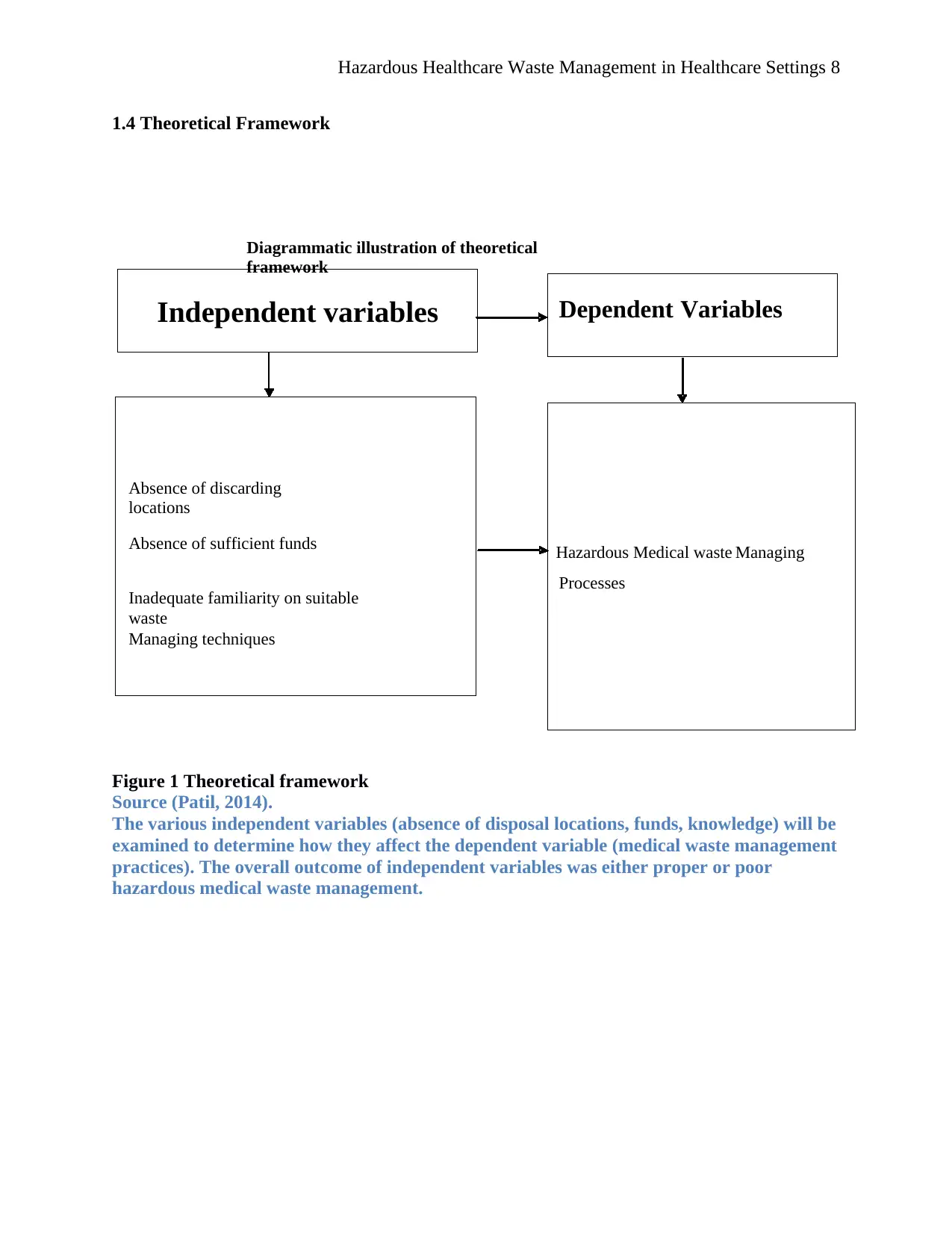
Figure 1 Theoretical framework
Source (Patil, 2014).
The various independent variables (absence of disposal locations, funds, knowledge) will be
examined to determine how they affect the dependent variable (medical waste management
practices). The overall outcome of independent variables was either proper or poor
hazardous medical waste management.
Hazardous Healthcare Waste Management in Healthcare Settings 8
1.4 Theoretical Framework
framework
Independent variables Dependent Variables
Absence of discarding
locations
Absence of sufficient funds
Inadequate familiarity on suitable
waste
Managing techniques
Hazardous Medical waste Managing
Processes
Figure 1 Theoretical framework
Source (Patil, 2014).
The various independent variables (absence of disposal locations, funds, knowledge) will be
examined to determine how they affect the dependent variable (medical waste management
practices). The overall outcome of independent variables was either proper or poor
hazardous medical waste management.
Hazardous Healthcare Waste Management in Healthcare Settings 8
1.4 Theoretical Framework
Hazardous Healthcare Waste Management in Healthcare Settings 9
CHAPTER TWO: Research Methodology
This sector discusses the research designs that will be used in coming up with the study,
target population, sample procedures, sample size determination, research tools, data collection
procedures, data analysis and presentation techniques.
2.0 Study Designs
The study takes a cross-sectional way for descriptive study design that involves the
procedure of gathering data so that to respond to questions concerning the existing state of the
matter being studied (Farzadika, 2016). This study adopts cross-sectional design since it will be
conducted in a spell to give implications on the prominence of hazardous medical waste handling
in health facilities (Liu, 2015). Nevertheless, a descriptive method is considered as time-
consuming and requires high accuracy on data collection, (Thankur, 2015), have an indication on
descriptive research that it tries to acquire a comprehensive and accurate explanation of a
situation. The descriptive study can be used for in describing and determining a relationship
between two variables. (Bdour, 2017).
2.1 Target Population
The target population is the entire group of individuals to which the researcher is
interested in. The theatrical population can be all members of the real hypothetical group of
people, objects or events to which the research generalizes (Caniato, 2015 p. 99). This study
targets the hazardous waste medical handlers in rural healthcare services.
CHAPTER TWO: Research Methodology
This sector discusses the research designs that will be used in coming up with the study,
target population, sample procedures, sample size determination, research tools, data collection
procedures, data analysis and presentation techniques.
2.0 Study Designs
The study takes a cross-sectional way for descriptive study design that involves the
procedure of gathering data so that to respond to questions concerning the existing state of the
matter being studied (Farzadika, 2016). This study adopts cross-sectional design since it will be
conducted in a spell to give implications on the prominence of hazardous medical waste handling
in health facilities (Liu, 2015). Nevertheless, a descriptive method is considered as time-
consuming and requires high accuracy on data collection, (Thankur, 2015), have an indication on
descriptive research that it tries to acquire a comprehensive and accurate explanation of a
situation. The descriptive study can be used for in describing and determining a relationship
between two variables. (Bdour, 2017).
2.1 Target Population
The target population is the entire group of individuals to which the researcher is
interested in. The theatrical population can be all members of the real hypothetical group of
people, objects or events to which the research generalizes (Caniato, 2015 p. 99). This study
targets the hazardous waste medical handlers in rural healthcare services.
⊘ This is a preview!⊘
Do you want full access?
Subscribe today to unlock all pages.
Trusted by 1+ million students worldwide
Hazardous Healthcare Waste Management in Healthcare Settings 10
2.2 Sample procedure and sampling size determination
I. Enclosure Criteria
The people involved in the study include the hazardous waste handlers and any other person who
assent to be a respondent.
II. Exclusion criteria
Those omitted from the study comprise of the patients within the premises of health facilities and
the community members around the facility who are not willing to consent.
Sample Size Determination
According to (Farzadika 2015), a minimum of 10% of a population is a worthy
representative in the study where the populace is huge like above 50. At least 40% of the
population where the population scope is minor that is below 50. He detected that a study
chooses a sample because of numerous limits like economic and time period, thus hindering
adequate research total population. The limits are applicable to this research because it has to be
carried out in the shortest time possible.
Sampling Procedures
Simple random sampling will be used in this study to get the demonstrative healthcare
services out of the total facilities available. In accordance to (Chartier, 2014) simple random
sample is a process wherein collective unit populace has an equivalent opportunity for inclusion.
Every facility that would have been selected will be numbered then placed in a locked container,
the will be shaken prior to selection of healthcare services one by one, and returning after noting
2.2 Sample procedure and sampling size determination
I. Enclosure Criteria
The people involved in the study include the hazardous waste handlers and any other person who
assent to be a respondent.
II. Exclusion criteria
Those omitted from the study comprise of the patients within the premises of health facilities and
the community members around the facility who are not willing to consent.
Sample Size Determination
According to (Farzadika 2015), a minimum of 10% of a population is a worthy
representative in the study where the populace is huge like above 50. At least 40% of the
population where the population scope is minor that is below 50. He detected that a study
chooses a sample because of numerous limits like economic and time period, thus hindering
adequate research total population. The limits are applicable to this research because it has to be
carried out in the shortest time possible.
Sampling Procedures
Simple random sampling will be used in this study to get the demonstrative healthcare
services out of the total facilities available. In accordance to (Chartier, 2014) simple random
sample is a process wherein collective unit populace has an equivalent opportunity for inclusion.
Every facility that would have been selected will be numbered then placed in a locked container,
the will be shaken prior to selection of healthcare services one by one, and returning after noting
Paraphrase This Document
Need a fresh take? Get an instant paraphrase of this document with our AI Paraphraser
Hazardous Healthcare Waste Management in Healthcare Settings 11
its identity until a required sample size achieved. The method is easy and minimizes bias thus, it
is good to use in this research (Nema 2015, p. 36). Person-in-charge and subordinate staff in the
facility will be the respondents to this research.
II.3 Study Variables
Dependent variables
Hazardous medical waste management practices will be the dependent variable in the healthcare
facility.
Independent Variables
Skills, knowledge, and attitude of subordinate staff, availability of disposal sites, obtainability of
financial resources and equipment provided for managing the medical wastes in the health
facility will be the independent variables.
II.4 Data collecting and Research Tools
The research includes collecting data starting with primary and from secondary sources.
The Primary sources in this study comprise of checklists and questionnaire, while Secondary
sources include government documents, books, and materials available in the facilities.
Qualitative and Quantitate are used in this research because they are appropriate in studying
health issues among healthcare facilities (Patil 2014). The tools that will be used to collect data
are discussed below;
its identity until a required sample size achieved. The method is easy and minimizes bias thus, it
is good to use in this research (Nema 2015, p. 36). Person-in-charge and subordinate staff in the
facility will be the respondents to this research.
II.3 Study Variables
Dependent variables
Hazardous medical waste management practices will be the dependent variable in the healthcare
facility.
Independent Variables
Skills, knowledge, and attitude of subordinate staff, availability of disposal sites, obtainability of
financial resources and equipment provided for managing the medical wastes in the health
facility will be the independent variables.
II.4 Data collecting and Research Tools
The research includes collecting data starting with primary and from secondary sources.
The Primary sources in this study comprise of checklists and questionnaire, while Secondary
sources include government documents, books, and materials available in the facilities.
Qualitative and Quantitate are used in this research because they are appropriate in studying
health issues among healthcare facilities (Patil 2014). The tools that will be used to collect data
are discussed below;
Hazardous Healthcare Waste Management in Healthcare Settings 12
Checklist
Checklists are essential as they help to assess the current situation of a matter of subject
hence facilitating acquisition information in the questionnaire (Windfeld 2015, p. 104). The
checklist should be prepared and identify various aspects of hazardous medical wastes in health
facilities. The researcher to determine the current medical waste practice in the facility should
verify the following.
A). placenta pit – present and in a secured location.
B). Waste collection bins – present, clean and color of each.
C). Waste disposal pits - present and in a secured location.
D). Incinerator- Present, fenced and secured.
Questionnaires
Inappropriate to obtain relevant information from the person in- charge of the healthcare
facility and other staff members, the questionnaire will be used in collecting data on the
managing practices of the hazardous medical wastes. The questionnaire covers a wide scope
(Ojuolape 2016, p. 50) as it provides information on appropriate areas that the respondent
will respond subjectively.
Interview
This will be used to gather more information on the sampled health facilities. The
information will be obtained from the heads of the facilities.
Checklist
Checklists are essential as they help to assess the current situation of a matter of subject
hence facilitating acquisition information in the questionnaire (Windfeld 2015, p. 104). The
checklist should be prepared and identify various aspects of hazardous medical wastes in health
facilities. The researcher to determine the current medical waste practice in the facility should
verify the following.
A). placenta pit – present and in a secured location.
B). Waste collection bins – present, clean and color of each.
C). Waste disposal pits - present and in a secured location.
D). Incinerator- Present, fenced and secured.
Questionnaires
Inappropriate to obtain relevant information from the person in- charge of the healthcare
facility and other staff members, the questionnaire will be used in collecting data on the
managing practices of the hazardous medical wastes. The questionnaire covers a wide scope
(Ojuolape 2016, p. 50) as it provides information on appropriate areas that the respondent
will respond subjectively.
Interview
This will be used to gather more information on the sampled health facilities. The
information will be obtained from the heads of the facilities.
⊘ This is a preview!⊘
Do you want full access?
Subscribe today to unlock all pages.
Trusted by 1+ million students worldwide

1 out of 28


Related Documents


Your All-in-One AI-Powered Toolkit for Academic Success.
+13062052269
info@desklib.com
Available 24*7 on WhatsApp / Email
![[object Object]](/_next/static/media/star-bottom.7253800d.svg)
Unlock your academic potential
Copyright © 2020–2026 A2Z Services. All Rights Reserved. Developed and managed by ZUCOL.