University Report: Headspace New Access System Design and Analysis
VerifiedAdded on 2023/06/07
|11
|1937
|136
Report
AI Summary
This report details the design and analysis of the Headspace New Access System, a health information control system planned for the Headspace regional center in New South Wales. The report begins with an introduction highlighting the importance of information systems in the healthcare industry and the specific need for efficient patient data management. A stakeholder map is presented, outlining the roles and responsibilities of various stakeholders, including government health departments, Headspace management, IT staff, investors, patients, and case workers. A questionnaire designed to gather system requirements from the Headspace NSW Managerial Director is included, covering functional and non-functional requirements, integration with existing systems, training needs, change frequency, and budget. A Use Case analysis is then provided, detailing use case diagrams and descriptions for key functionalities such as sign-up, login, viewing records, entering patient stories, searching patient history, and adding new case workers. The report concludes by emphasizing the benefits of the system for data management, treatment processes, and case worker efficiency.

Running head: HEADSPACE NEW ACCESS SYSTEM
Headspace New Access System
Name of the student:
Name of the University:
Author note:
Headspace New Access System
Name of the student:
Name of the University:
Author note:
Paraphrase This Document
Need a fresh take? Get an instant paraphrase of this document with our AI Paraphraser

1
HEADSPACE NEW ACCESS SYSTEM
Introduction
Information system is one of the major requirements of any form of service or
business in the modern world. The health service industry has over the time gained a lot from
using information technology means to enhance the storage and processing of data in order to
serve their patients in a better way (Stair & Reynolds, 2013). In this report, the New Access
System design planning will be carried out for the Headspace NWS agency. The report will
concentrate on describing the roles of all stakeholders through a stakeholder map, frame a
questionnaire for the respective stakeholder and further represent a detailed Use Case analysis
for the system (Li et al., 2012).
The Headspace New Access System
The Headspace regional center at New South Wales is planning to build their own
health information control system that will allow the easy and efficient storage and retrieval
of patient data. This data is to be collected from young-adult patients who come for check-up
in Headspace Lynne (Wilson, Cruickshank, & Lea, 2012). The system’s primary motif is to
capture the story of the patient at the very first time and keep gradual records of every
meeting as the story develops over the time. This is meant to aid the youth of Australia, into
leading a mentally healthy life (Rickwood et al., 2014).
HEADSPACE NEW ACCESS SYSTEM
Introduction
Information system is one of the major requirements of any form of service or
business in the modern world. The health service industry has over the time gained a lot from
using information technology means to enhance the storage and processing of data in order to
serve their patients in a better way (Stair & Reynolds, 2013). In this report, the New Access
System design planning will be carried out for the Headspace NWS agency. The report will
concentrate on describing the roles of all stakeholders through a stakeholder map, frame a
questionnaire for the respective stakeholder and further represent a detailed Use Case analysis
for the system (Li et al., 2012).
The Headspace New Access System
The Headspace regional center at New South Wales is planning to build their own
health information control system that will allow the easy and efficient storage and retrieval
of patient data. This data is to be collected from young-adult patients who come for check-up
in Headspace Lynne (Wilson, Cruickshank, & Lea, 2012). The system’s primary motif is to
capture the story of the patient at the very first time and keep gradual records of every
meeting as the story develops over the time. This is meant to aid the youth of Australia, into
leading a mentally healthy life (Rickwood et al., 2014).

2
HEADSPACE NEW ACCESS SYSTEM
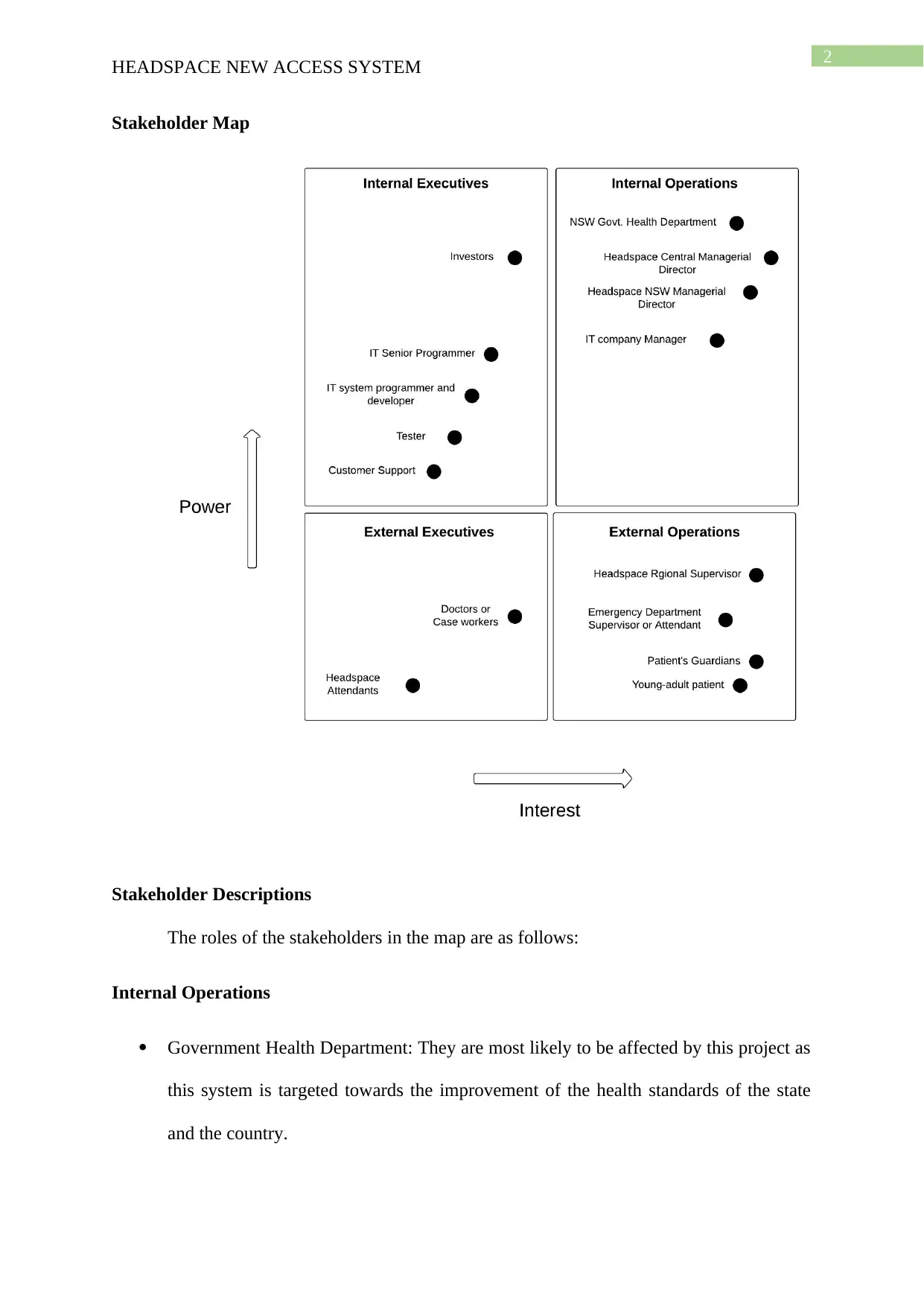
Stakeholder Map
Stakeholder Descriptions
The roles of the stakeholders in the map are as follows:
Internal Operations
Government Health Department: They are most likely to be affected by this project as
this system is targeted towards the improvement of the health standards of the state
and the country.
HEADSPACE NEW ACCESS SYSTEM
Stakeholder Map
Stakeholder Descriptions
The roles of the stakeholders in the map are as follows:
Internal Operations
Government Health Department: They are most likely to be affected by this project as
this system is targeted towards the improvement of the health standards of the state
and the country.
⊘ This is a preview!⊘
Do you want full access?
Subscribe today to unlock all pages.

Trusted by 1+ million students worldwide

3
HEADSPACE NEW ACCESS SYSTEM
Headspace Central Managing Director: He is the person who runs the organization
from the central level. Hence, it is certain that his interest and power in the project
will be unparalleled.
Regional Directing Manager: He has to take all the calls regarding the development of
the system and manage the upbringing of the project and review its post-
implementation feedbacks on a regular basis.
IT Manager: He or she will get to complete the deal with the respective authorities
and to sit with the development team to start the project.
Internal Executives
Investors: They help with the initiative by providing monetary or materialistic
resources to the project. They have moderate interest in the implementation of the
project, but bestow more power over the development and maintenance phase
(Andritzky, 2012).
Senior Programmer: Governs the development and design of the system based on the
requirements.
Associate developers: They develop the system based on all the requirements and
design.
Tester: They test the system based on variable inputs and considerations and
henceforth recommend amendments (Jorgensen, 2013).
Customer support: They have very low interest in the project, however, they can form
the bridge between the developer team and the client side, to fix necessary bugs or
make amendments (McLean & Wilson, 2016).
External Operations
HEADSPACE NEW ACCESS SYSTEM
Headspace Central Managing Director: He is the person who runs the organization
from the central level. Hence, it is certain that his interest and power in the project
will be unparalleled.
Regional Directing Manager: He has to take all the calls regarding the development of
the system and manage the upbringing of the project and review its post-
implementation feedbacks on a regular basis.
IT Manager: He or she will get to complete the deal with the respective authorities
and to sit with the development team to start the project.
Internal Executives
Investors: They help with the initiative by providing monetary or materialistic
resources to the project. They have moderate interest in the implementation of the
project, but bestow more power over the development and maintenance phase
(Andritzky, 2012).
Senior Programmer: Governs the development and design of the system based on the
requirements.
Associate developers: They develop the system based on all the requirements and
design.
Tester: They test the system based on variable inputs and considerations and
henceforth recommend amendments (Jorgensen, 2013).
Customer support: They have very low interest in the project, however, they can form
the bridge between the developer team and the client side, to fix necessary bugs or
make amendments (McLean & Wilson, 2016).
External Operations
Paraphrase This Document
Need a fresh take? Get an instant paraphrase of this document with our AI Paraphraser

4
HEADSPACE NEW ACCESS SYSTEM
Regional Supervisor: He is in duty of handling the operations of the application and
its resources from the regional center of the organization.
ED supervisor or management: They will suffice to input the patient’s records into the
system and make sure that the data flow is cordially maintained.
Patient’s guardians: They have high interest in the system with no or very limited
power. It is their young ones who are directly involved and hence they can control the
data that is to be allowed into the system and other details.
Patient: The young ones, who are the direct data contributors and motif of the system.
External Executives
Case workers: They will review all previous records of a patient from the system and
also the ED documentations and then work on them.
Nurses or attendants: They have very less interest and power over the system as they
are only the petty back-office attendants within the system.
Questionnaire
This questionnaire is to be forwarded to the Headspace NSW Managerial Director as
he or she would be the best person to explain the functional and other details about the
system that would be helpful in the process of design and development (ur Rehman, Khan &
Riaz, 2013).
Questionnaire Introduction
The system requirements for the entire project will be collected through this
questionnaire. The questions will address the various aspects of the project which ranges
from describing all the functional components that it needs to behold, the list of all
stakeholders involved and also the project deadline and budget. The output of this
questionnaire will be considered as the final requirement gathering document for the project.
HEADSPACE NEW ACCESS SYSTEM
Regional Supervisor: He is in duty of handling the operations of the application and
its resources from the regional center of the organization.
ED supervisor or management: They will suffice to input the patient’s records into the
system and make sure that the data flow is cordially maintained.
Patient’s guardians: They have high interest in the system with no or very limited
power. It is their young ones who are directly involved and hence they can control the
data that is to be allowed into the system and other details.
Patient: The young ones, who are the direct data contributors and motif of the system.
External Executives
Case workers: They will review all previous records of a patient from the system and
also the ED documentations and then work on them.
Nurses or attendants: They have very less interest and power over the system as they
are only the petty back-office attendants within the system.
Questionnaire
This questionnaire is to be forwarded to the Headspace NSW Managerial Director as
he or she would be the best person to explain the functional and other details about the
system that would be helpful in the process of design and development (ur Rehman, Khan &
Riaz, 2013).
Questionnaire Introduction
The system requirements for the entire project will be collected through this
questionnaire. The questions will address the various aspects of the project which ranges
from describing all the functional components that it needs to behold, the list of all
stakeholders involved and also the project deadline and budget. The output of this
questionnaire will be considered as the final requirement gathering document for the project.

5
HEADSPACE NEW ACCESS SYSTEM
The IT representatives team will consider all the mentioned points and proceed further with
the project based on the collected details.
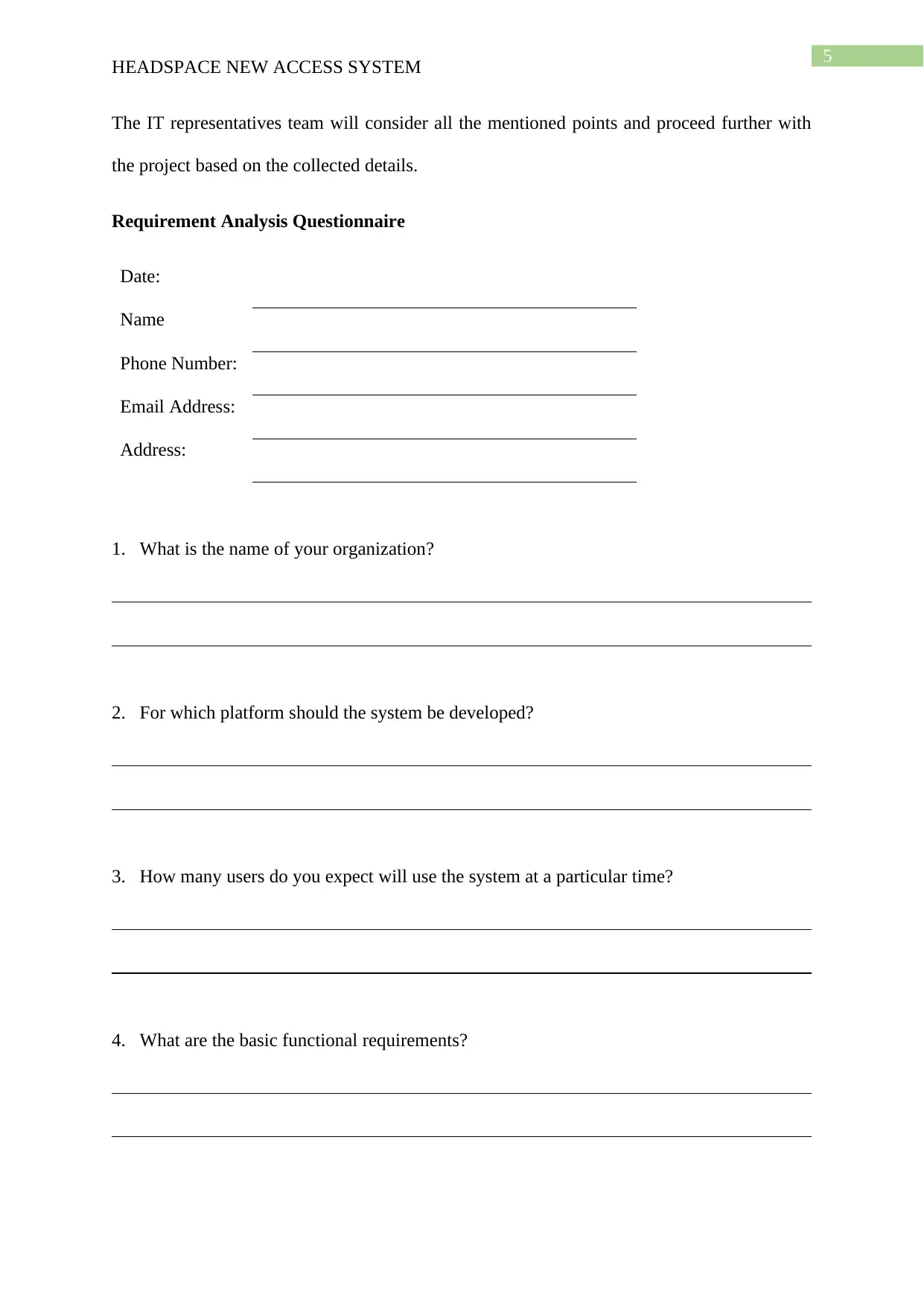
Requirement Analysis Questionnaire
Date:
Name
Phone Number:
Email Address:
Address:
1. What is the name of your organization?
2. For which platform should the system be developed?
3. How many users do you expect will use the system at a particular time?
4. What are the basic functional requirements?
HEADSPACE NEW ACCESS SYSTEM
The IT representatives team will consider all the mentioned points and proceed further with
the project based on the collected details.
Requirement Analysis Questionnaire
Date:
Name
Phone Number:
Email Address:
Address:
1. What is the name of your organization?
2. For which platform should the system be developed?
3. How many users do you expect will use the system at a particular time?
4. What are the basic functional requirements?
⊘ This is a preview!⊘
Do you want full access?
Subscribe today to unlock all pages.

Trusted by 1+ million students worldwide

6
HEADSPACE NEW ACCESS SYSTEM
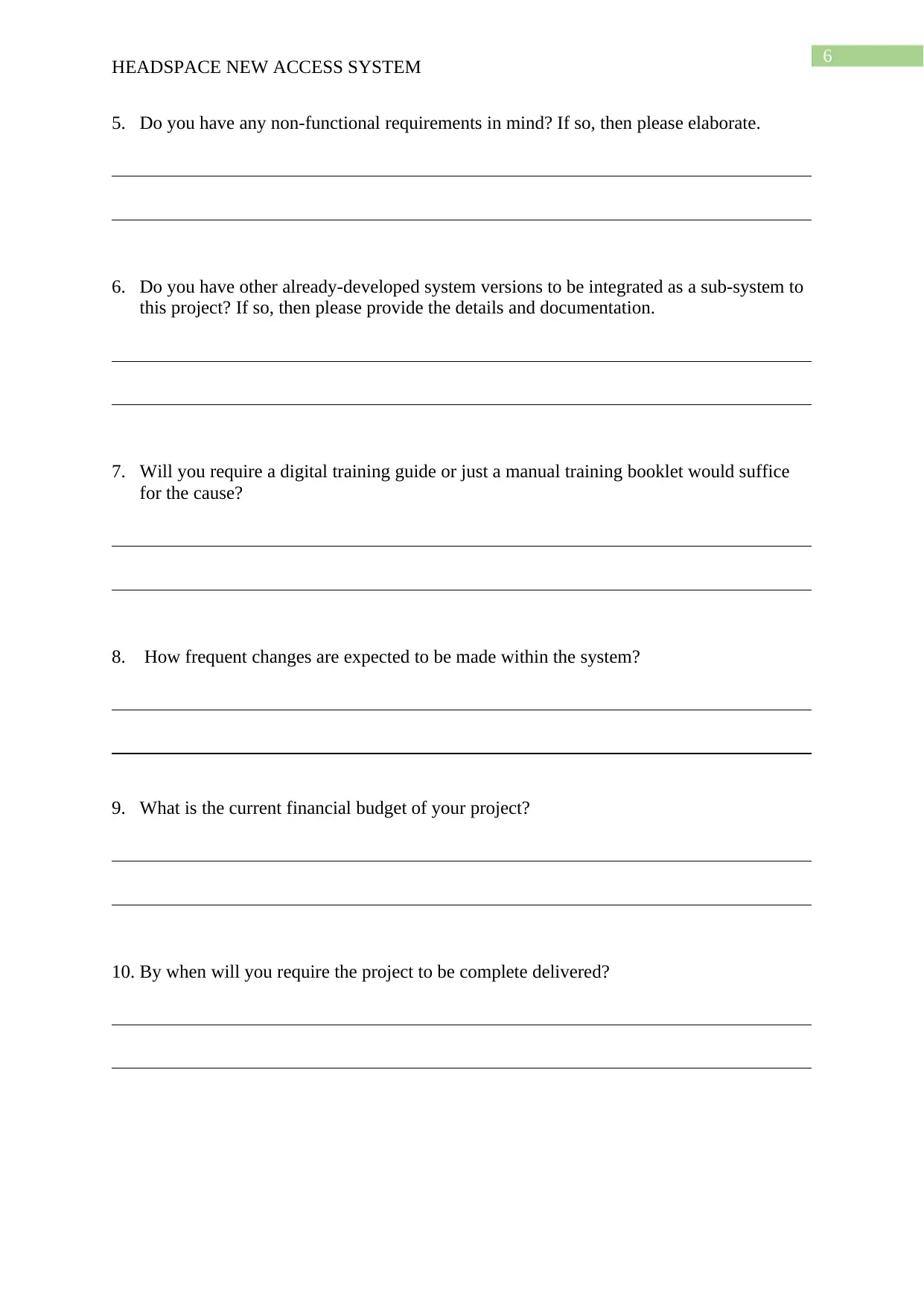
5. Do you have any non-functional requirements in mind? If so, then please elaborate.
6. Do you have other already-developed system versions to be integrated as a sub-system to
this project? If so, then please provide the details and documentation.
7. Will you require a digital training guide or just a manual training booklet would suffice
for the cause?
8. How frequent changes are expected to be made within the system?
9. What is the current financial budget of your project?
10. By when will you require the project to be complete delivered?
HEADSPACE NEW ACCESS SYSTEM
5. Do you have any non-functional requirements in mind? If so, then please elaborate.
6. Do you have other already-developed system versions to be integrated as a sub-system to
this project? If so, then please provide the details and documentation.
7. Will you require a digital training guide or just a manual training booklet would suffice
for the cause?
8. How frequent changes are expected to be made within the system?
9. What is the current financial budget of your project?
10. By when will you require the project to be complete delivered?
Paraphrase This Document
Need a fresh take? Get an instant paraphrase of this document with our AI Paraphraser

7
HEADSPACE NEW ACCESS SYSTEM
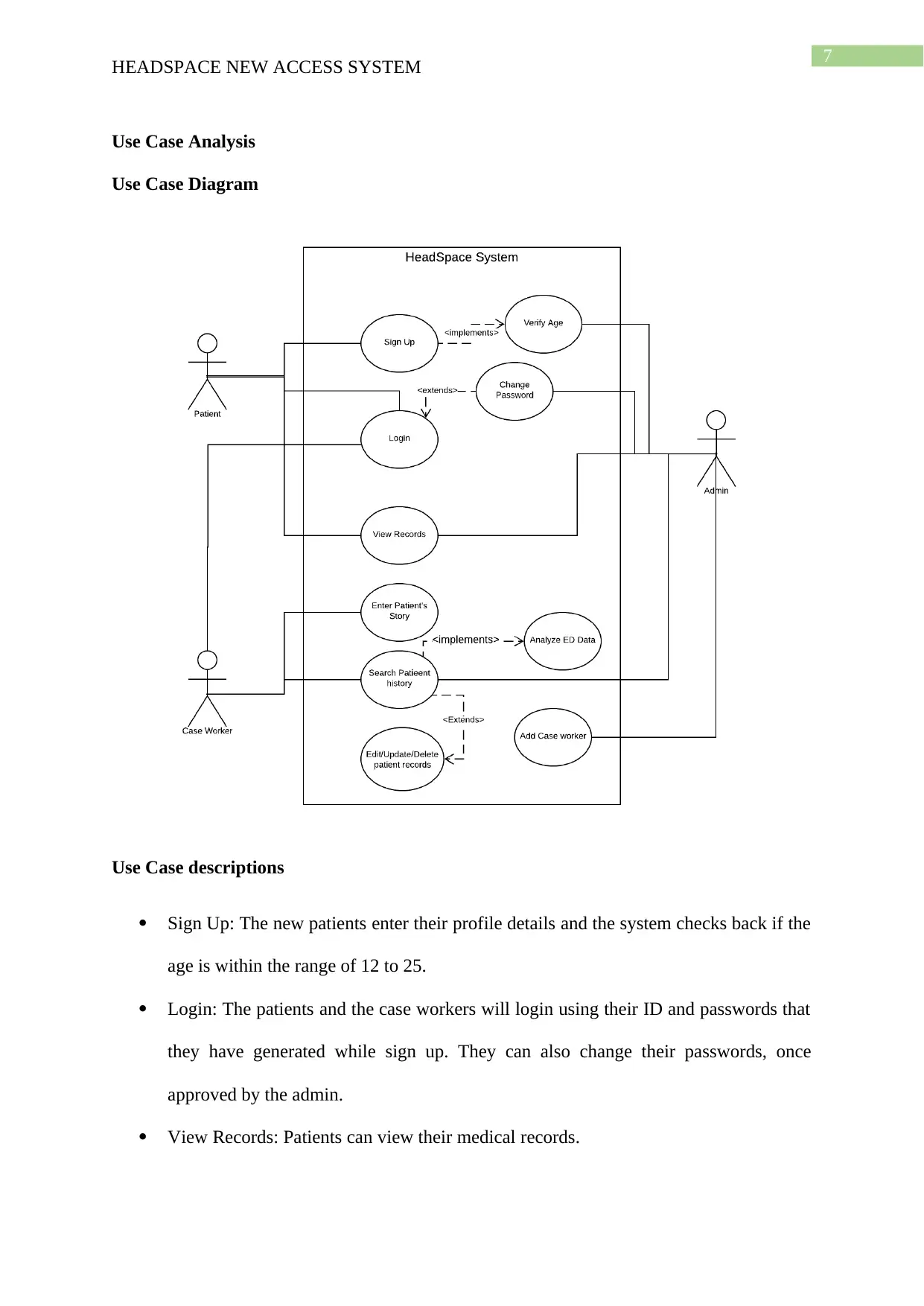
Use Case Analysis
Use Case Diagram
Use Case descriptions
Sign Up: The new patients enter their profile details and the system checks back if the
age is within the range of 12 to 25.
Login: The patients and the case workers will login using their ID and passwords that
they have generated while sign up. They can also change their passwords, once
approved by the admin.
View Records: Patients can view their medical records.
HEADSPACE NEW ACCESS SYSTEM
Use Case Analysis
Use Case Diagram
Use Case descriptions
Sign Up: The new patients enter their profile details and the system checks back if the
age is within the range of 12 to 25.
Login: The patients and the case workers will login using their ID and passwords that
they have generated while sign up. They can also change their passwords, once
approved by the admin.
View Records: Patients can view their medical records.

8
HEADSPACE NEW ACCESS SYSTEM
Enter Patient’s story: The case workers can add to the patient’s records, their new
stories.
Search patient history: The case workers can search for particular patient records and
then make amendments or recall the ED data from it.
Add new case workers: The administrator can add new case workers to the system.
Detailed Case Description
The Search patient history is one of the major use cases of the system. This allows
the case workers to search for particular patient details. This will present them with all the
past records of the patient. They can work on them, analyze the stories and build a strong
foundation for the cure of the issue (Murdoch & Detsky, 2013). They can also get access to
the Emergency Department data that has been put into the system for that particular patient.
Furthermore, the workers can enter and edit necessary stories or check-up updates for the
concerned patient, through this system. The administrators can also access this use case.
Conclusion
From the above report, it can hence be concluded that the NSW based Headspace
agency system will perform better with the information system installed at their premises.
This will not only allow them to keep track of the flow of data within the organization, but
will also allow the proper access of data and information. This will in turn affect the
treatment process of the young ones in a more positive way than ever. The doctors or the case
workers at the agency will be able to view all stories recorded by the workers at the very first
instance and so on. Even the case workers will be informed of when a patient is released from
the emergency department, so that they can right away start with the further rehab treatment.
The system requirement analysis and the design process will further enhance the development
process for the proposed application.
HEADSPACE NEW ACCESS SYSTEM
Enter Patient’s story: The case workers can add to the patient’s records, their new
stories.
Search patient history: The case workers can search for particular patient records and
then make amendments or recall the ED data from it.
Add new case workers: The administrator can add new case workers to the system.
Detailed Case Description
The Search patient history is one of the major use cases of the system. This allows
the case workers to search for particular patient details. This will present them with all the
past records of the patient. They can work on them, analyze the stories and build a strong
foundation for the cure of the issue (Murdoch & Detsky, 2013). They can also get access to
the Emergency Department data that has been put into the system for that particular patient.
Furthermore, the workers can enter and edit necessary stories or check-up updates for the
concerned patient, through this system. The administrators can also access this use case.
Conclusion
From the above report, it can hence be concluded that the NSW based Headspace
agency system will perform better with the information system installed at their premises.
This will not only allow them to keep track of the flow of data within the organization, but
will also allow the proper access of data and information. This will in turn affect the
treatment process of the young ones in a more positive way than ever. The doctors or the case
workers at the agency will be able to view all stories recorded by the workers at the very first
instance and so on. Even the case workers will be informed of when a patient is released from
the emergency department, so that they can right away start with the further rehab treatment.
The system requirement analysis and the design process will further enhance the development
process for the proposed application.
⊘ This is a preview!⊘
Do you want full access?
Subscribe today to unlock all pages.

Trusted by 1+ million students worldwide

9
HEADSPACE NEW ACCESS SYSTEM
References
Andritzky, M. J. R. (2012). Government bonds and their investors: What are the facts and do
they matter? (No. 12-158). International Monetary Fund.
Jorgensen, P. C. (2013). Software testing: a craftsman's approach. Auerbach Publications.
Kellermann, A. L., & Jones, S. S. (2013). What it will take to achieve the as-yet-unfulfilled
promises of health information technology. Health affairs, 32(1), 63-68.
Li, L., Ge, R. L., Zhou, S. M., & Valerdi, R. (2012). Guest EditorialIntegrated Healthcare
Information Systems. IEEE Transactions on Information Technology in
Biomedicine, 16(4), 515-517.
Lynne Wilson, R., Cruickshank, M., & Lea, J. (2012). Experiences of families who help
young rural men with emergent mental health problems in a rural community in New
South Wales, Australia. Contemporary Nurse, 42(2), 167-177.
McLean, G., & Wilson, A. (2016). Evolving the online customer experience… is there a role
for online customer support?. Computers in Human Behavior, 60, 602-610.
Murdoch, T. B., & Detsky, A. S. (2013). The inevitable application of big data to health
care. Jama, 309(13), 1351-1352.
Rickwood, D. J., Telford, N. R., Parker, A. G., Tanti, C. J., & McGorry, P. D. (2014).
Headspace—Australia’s innovation in youth mental health: who are the clients and
why are they presenting. Med J Aust, 200(2), 108-11.
Stair, R., & Reynolds, G. (2013). Principles of information systems. Cengage Learning.
HEADSPACE NEW ACCESS SYSTEM
References
Andritzky, M. J. R. (2012). Government bonds and their investors: What are the facts and do
they matter? (No. 12-158). International Monetary Fund.
Jorgensen, P. C. (2013). Software testing: a craftsman's approach. Auerbach Publications.
Kellermann, A. L., & Jones, S. S. (2013). What it will take to achieve the as-yet-unfulfilled
promises of health information technology. Health affairs, 32(1), 63-68.
Li, L., Ge, R. L., Zhou, S. M., & Valerdi, R. (2012). Guest EditorialIntegrated Healthcare
Information Systems. IEEE Transactions on Information Technology in
Biomedicine, 16(4), 515-517.
Lynne Wilson, R., Cruickshank, M., & Lea, J. (2012). Experiences of families who help
young rural men with emergent mental health problems in a rural community in New
South Wales, Australia. Contemporary Nurse, 42(2), 167-177.
McLean, G., & Wilson, A. (2016). Evolving the online customer experience… is there a role
for online customer support?. Computers in Human Behavior, 60, 602-610.
Murdoch, T. B., & Detsky, A. S. (2013). The inevitable application of big data to health
care. Jama, 309(13), 1351-1352.
Rickwood, D. J., Telford, N. R., Parker, A. G., Tanti, C. J., & McGorry, P. D. (2014).
Headspace—Australia’s innovation in youth mental health: who are the clients and
why are they presenting. Med J Aust, 200(2), 108-11.
Stair, R., & Reynolds, G. (2013). Principles of information systems. Cengage Learning.
Paraphrase This Document
Need a fresh take? Get an instant paraphrase of this document with our AI Paraphraser

10
HEADSPACE NEW ACCESS SYSTEM
ur Rehman, T., Khan, M. N. A., & Riaz, N. (2013). Analysis of requirement engineering
processes, tools/techniques and methodologies. International Journal of Information
Technology and Computer Science (IJITCS), 5(3), 40.
HEADSPACE NEW ACCESS SYSTEM
ur Rehman, T., Khan, M. N. A., & Riaz, N. (2013). Analysis of requirement engineering
processes, tools/techniques and methodologies. International Journal of Information
Technology and Computer Science (IJITCS), 5(3), 40.
1 out of 11
Related Documents
Your All-in-One AI-Powered Toolkit for Academic Success.
+13062052269
info@desklib.com
Available 24*7 on WhatsApp / Email
Unlock your academic potential
Copyright © 2020–2025 A2Z Services. All Rights Reserved. Developed and managed by ZUCOL.