Grand Canyon University Case Study: Healing and Autonomy Review

Verified

Added on  2022/11/10

|5
|1029
|202
Case Study
AI Summary
This case study analyzes the ethical considerations surrounding a medical case involving a child (James) whose parents, due to their religious beliefs, are hesitant to consent to a necessary medical procedure. The assignment explores the conflict between patient autonomy, parental rights, and the physician's responsibility to provide the best possible care. It delves into the four ethical principles: beneficence, non-maleficence, autonomy, and justice, applying them to the case to determine the appropriate course of action. The solution also discusses the Christian perspective on sickness, medical intervention, and the role of faith in healthcare decisions, including the importance of spiritual assessment. Furthermore, it examines the physician's role in navigating the parents' beliefs while advocating for the child's well-being, including the legal implications of parental decisions that could harm the child. The case study emphasizes the need to balance religious beliefs with medical evidence and patient rights to ensure the best possible outcomes for the patient.
Document Page
Running head: CASE STUDY: HEALING AND AUTONOMY 1
Case Study: Healing and Autonomy
Student’s Name
Institutional Affiliation
tabler-icon-diamond-filled.svg

Paraphrase This Document

Need a fresh take? Get an instant paraphrase of this document with our AI Paraphraser
Document Page
CASE STUDY: HEALING AND AUTONOMY 2
Question 1
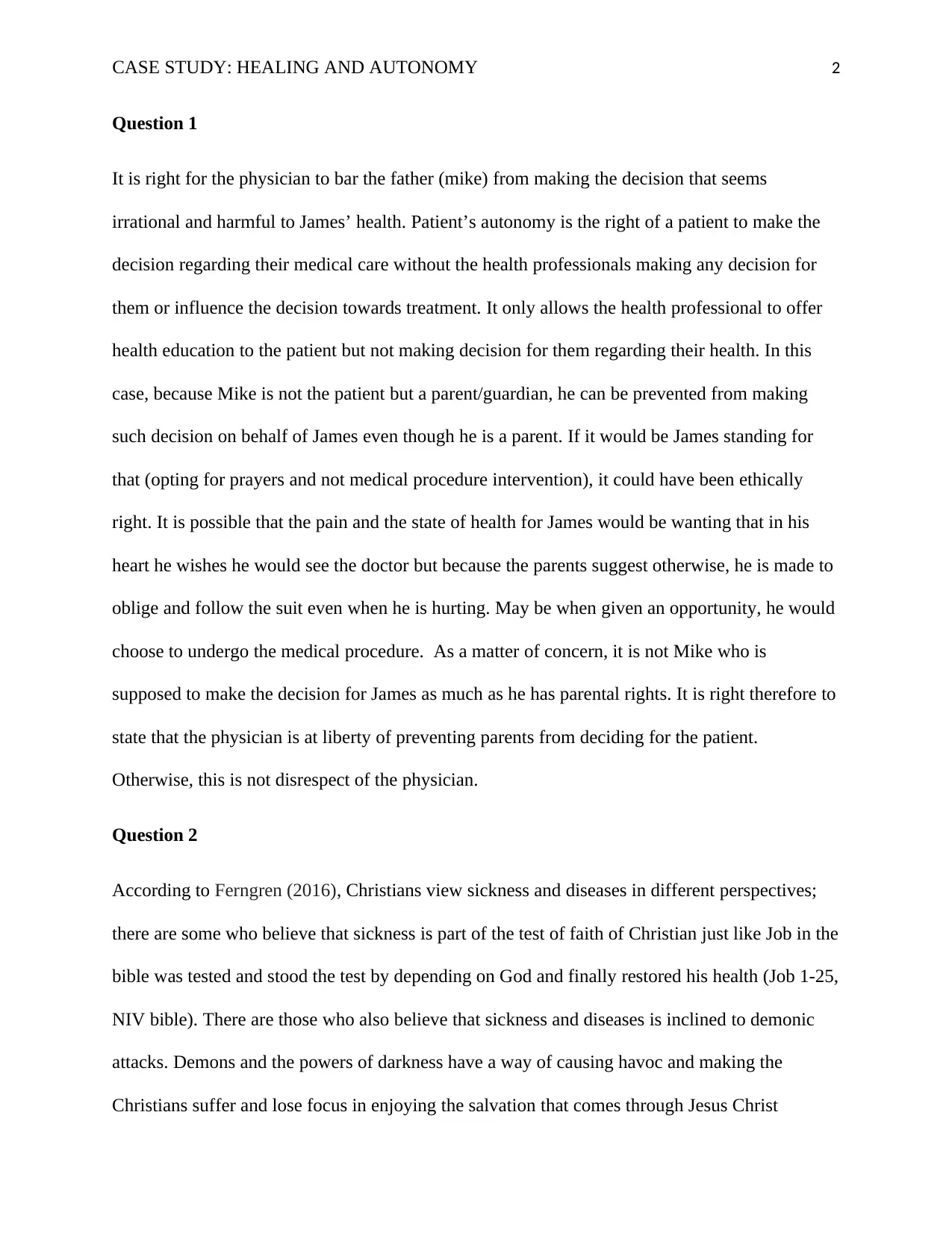
It is right for the physician to bar the father (mike) from making the decision that seems
irrational and harmful to James’ health. Patient’s autonomy is the right of a patient to make the
decision regarding their medical care without the health professionals making any decision for
them or influence the decision towards treatment. It only allows the health professional to offer
health education to the patient but not making decision for them regarding their health. In this
case, because Mike is not the patient but a parent/guardian, he can be prevented from making
such decision on behalf of James even though he is a parent. If it would be James standing for
that (opting for prayers and not medical procedure intervention), it could have been ethically
right. It is possible that the pain and the state of health for James would be wanting that in his
heart he wishes he would see the doctor but because the parents suggest otherwise, he is made to
oblige and follow the suit even when he is hurting. May be when given an opportunity, he would
choose to undergo the medical procedure. As a matter of concern, it is not Mike who is
supposed to make the decision for James as much as he has parental rights. It is right therefore to
state that the physician is at liberty of preventing parents from deciding for the patient.
Otherwise, this is not disrespect of the physician.
Question 2
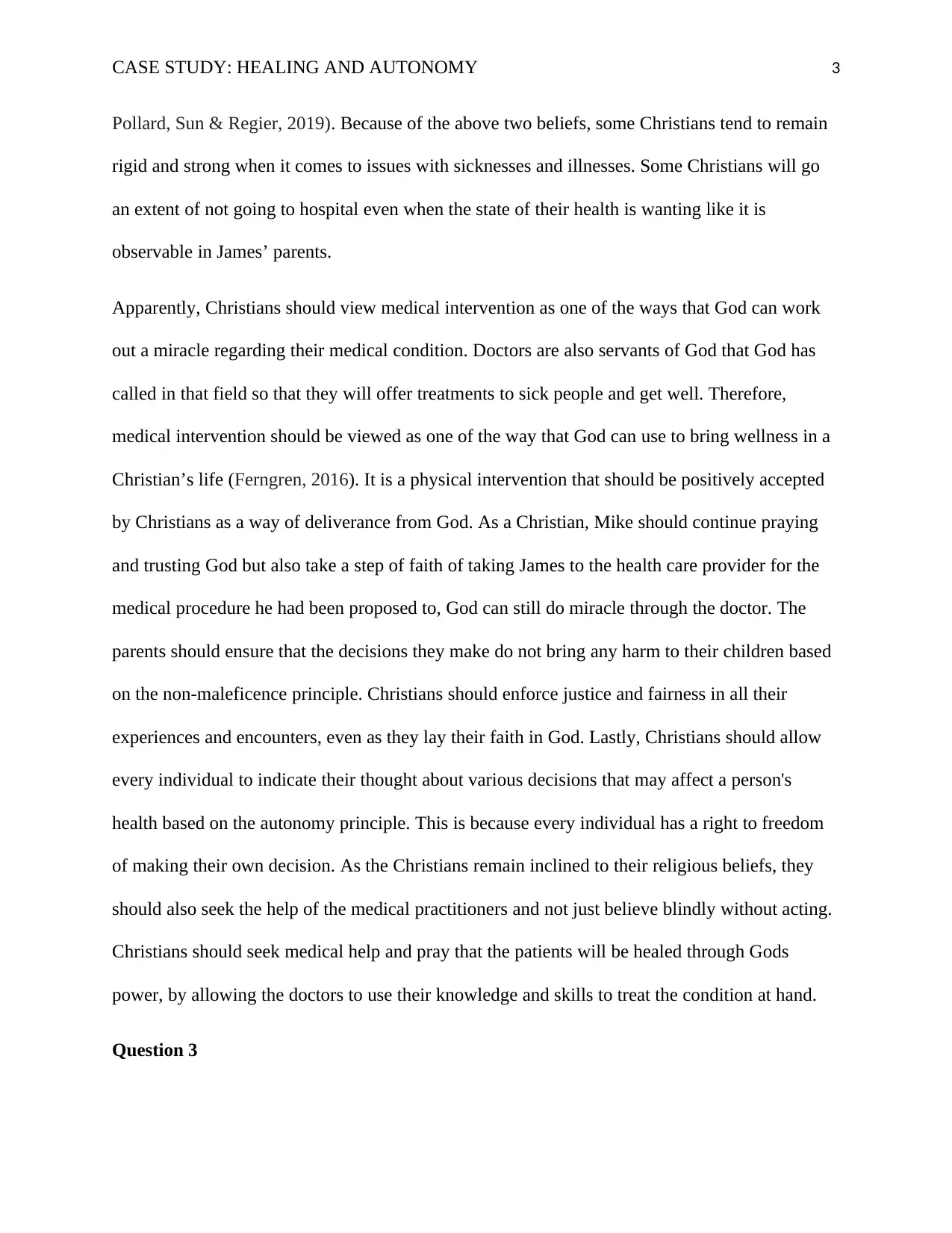
According to Ferngren (2016), Christians view sickness and diseases in different perspectives;
there are some who believe that sickness is part of the test of faith of Christian just like Job in the
bible was tested and stood the test by depending on God and finally restored his health (Job 1-25,
NIV bible). There are those who also believe that sickness and diseases is inclined to demonic
attacks. Demons and the powers of darkness have a way of causing havoc and making the
Christians suffer and lose focus in enjoying the salvation that comes through Jesus Christ
Document Page
CASE STUDY: HEALING AND AUTONOMY 3
Pollard, Sun & Regier, 2019). Because of the above two beliefs, some Christians tend to remain
rigid and strong when it comes to issues with sicknesses and illnesses. Some Christians will go
an extent of not going to hospital even when the state of their health is wanting like it is
observable in James’ parents.
Apparently, Christians should view medical intervention as one of the ways that God can work
out a miracle regarding their medical condition. Doctors are also servants of God that God has
called in that field so that they will offer treatments to sick people and get well. Therefore,
medical intervention should be viewed as one of the way that God can use to bring wellness in a
Christian’s life (Ferngren, 2016). It is a physical intervention that should be positively accepted
by Christians as a way of deliverance from God. As a Christian, Mike should continue praying
and trusting God but also take a step of faith of taking James to the health care provider for the
medical procedure he had been proposed to, God can still do miracle through the doctor. The
parents should ensure that the decisions they make do not bring any harm to their children based
on the non-maleficence principle. Christians should enforce justice and fairness in all their
experiences and encounters, even as they lay their faith in God. Lastly, Christians should allow
every individual to indicate their thought about various decisions that may affect a person's
health based on the autonomy principle. This is because every individual has a right to freedom
of making their own decision. As the Christians remain inclined to their religious beliefs, they
should also seek the help of the medical practitioners and not just believe blindly without acting.
Christians should seek medical help and pray that the patients will be healed through Gods
power, by allowing the doctors to use their knowledge and skills to treat the condition at hand.
Question 3
Document Page
CASE STUDY: HEALING AND AUTONOMY 4
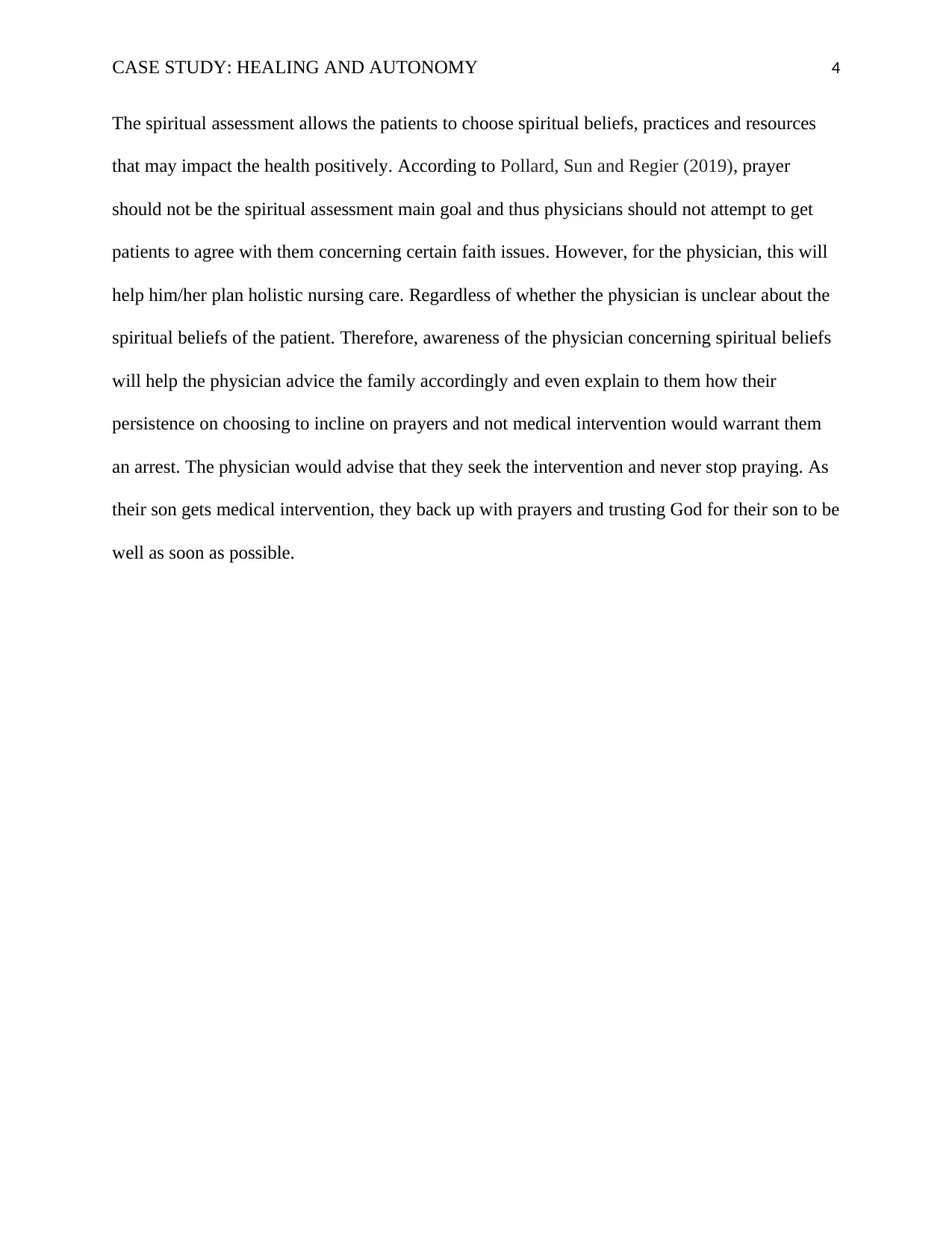
The spiritual assessment allows the patients to choose spiritual beliefs, practices and resources
that may impact the health positively. According to Pollard, Sun and Regier (2019), prayer
should not be the spiritual assessment main goal and thus physicians should not attempt to get
patients to agree with them concerning certain faith issues. However, for the physician, this will
help him/her plan holistic nursing care. Regardless of whether the physician is unclear about the
spiritual beliefs of the patient. Therefore, awareness of the physician concerning spiritual beliefs
will help the physician advice the family accordingly and even explain to them how their
persistence on choosing to incline on prayers and not medical intervention would warrant them
an arrest. The physician would advise that they seek the intervention and never stop praying. As
their son gets medical intervention, they back up with prayers and trusting God for their son to be
well as soon as possible.
tabler-icon-diamond-filled.svg

Paraphrase This Document

Need a fresh take? Get an instant paraphrase of this document with our AI Paraphraser
Document Page
CASE STUDY: HEALING AND AUTONOMY 5
References.
Ferngren, G. B. (2016). Medicine and health care in early Christianity. JHU Press.
Pollard, S., Sun, S., & Regier, D. A. (2019). Balancing uncertainty with patient autonomy in
precision medicine. Nature Reviews Genetics, 20(5), 251.
Searight, H. R. (2019). Ethical Theories Applied to End-of-Life Medical Care. In Ethical
Challenges in Multi-Cultural Patient Care (pp. 15-27). Springer, Cham.
chevron_up_icon
1 out of 5
circle_padding
hide_on_mobile
zoom_out_icon
[object Object]