Healthcare Case Study: Healing and Autonomy - Ethical Dilemmas
VerifiedAdded on  2022/11/28
|6
|1126
|198
Case Study
AI Summary
This case study, titled "Healing and Autonomy," presents a complex healthcare scenario involving James, an 8-year-old suffering from kidney failure due to complications from a strep throat infection. His parents, Mike and Joanne, influenced by their religious beliefs, initially refuse dialysis and opt for faith healing, conflicting with the physician's recommendation for immediate treatment. The case study explores the ethical dilemmas arising from this conflict, focusing on the principles of beneficence, non-maleficence, and patient autonomy. It further examines the Christian perspective on sickness and health, the importance of spiritual assessment in healthcare, and the need for physicians to balance medical expertise with patient beliefs to ensure the best possible care. The analysis highlights the challenges of medical decision-making when religious beliefs influence treatment choices and the role of healthcare professionals in navigating such situations.
Running head: CASE STUDY: HEALING AND AUTONOMY
CASE STUDY: HEALING AND AUTONOMY
Name of the student:
Name of the university:
Author note:
CASE STUDY: HEALING AND AUTONOMY
Name of the student:
Name of the university:
Author note:
Paraphrase This Document
Need a fresh take? Get an instant paraphrase of this document with our AI Paraphraser

1CASE STUDY: HEALING AND AUTONOMY
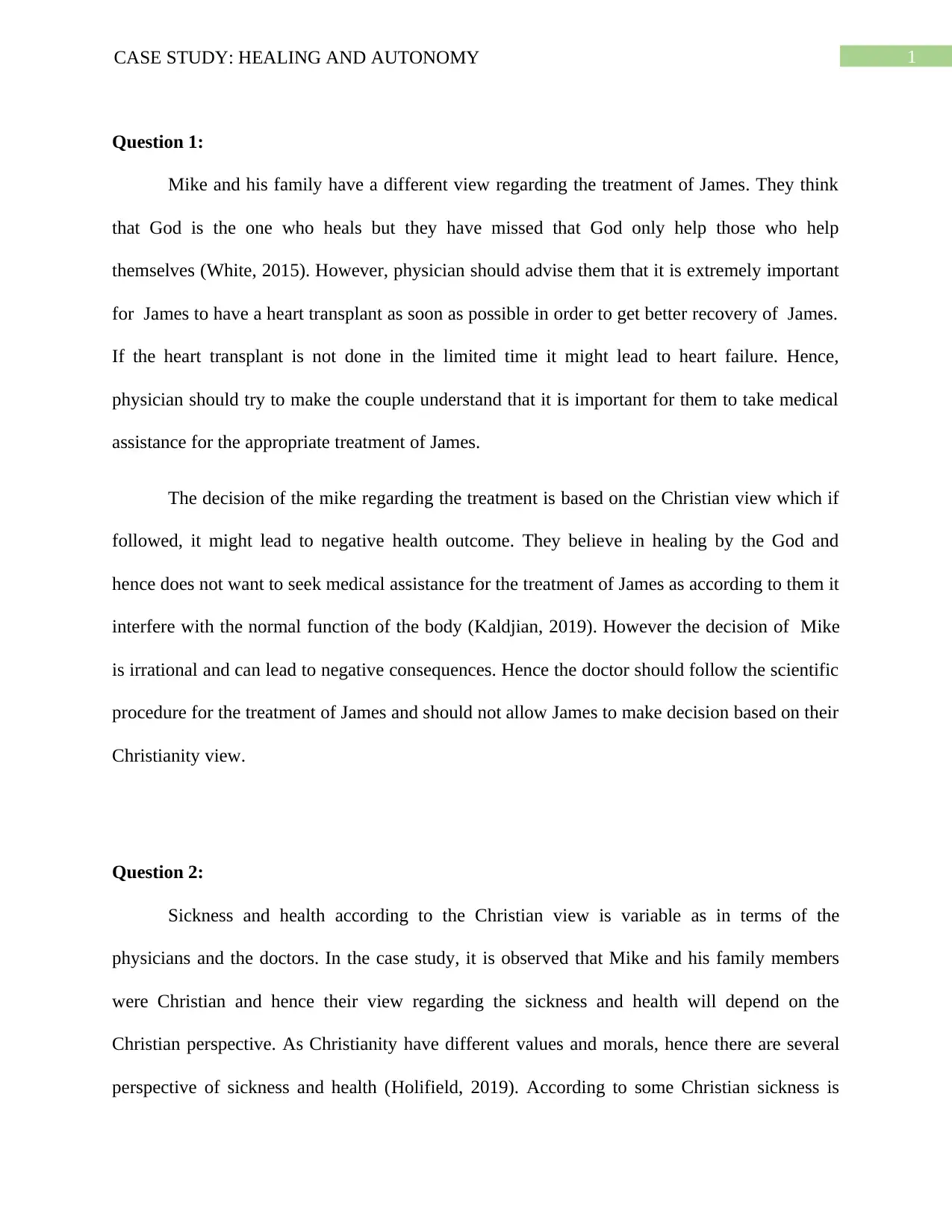
Question 1:
Mike and his family have a different view regarding the treatment of James. They think
that God is the one who heals but they have missed that God only help those who help
themselves (White, 2015). However, physician should advise them that it is extremely important
for James to have a heart transplant as soon as possible in order to get better recovery of James.
If the heart transplant is not done in the limited time it might lead to heart failure. Hence,
physician should try to make the couple understand that it is important for them to take medical
assistance for the appropriate treatment of James.
The decision of the mike regarding the treatment is based on the Christian view which if
followed, it might lead to negative health outcome. They believe in healing by the God and
hence does not want to seek medical assistance for the treatment of James as according to them it
interfere with the normal function of the body (Kaldjian, 2019). However the decision of Mike
is irrational and can lead to negative consequences. Hence the doctor should follow the scientific
procedure for the treatment of James and should not allow James to make decision based on their
Christianity view.
Question 2:
Sickness and health according to the Christian view is variable as in terms of the
physicians and the doctors. In the case study, it is observed that Mike and his family members
were Christian and hence their view regarding the sickness and health will depend on the
Christian perspective. As Christianity have different values and morals, hence there are several
perspective of sickness and health (Holifield, 2019). According to some Christian sickness is
Question 1:
Mike and his family have a different view regarding the treatment of James. They think
that God is the one who heals but they have missed that God only help those who help
themselves (White, 2015). However, physician should advise them that it is extremely important
for James to have a heart transplant as soon as possible in order to get better recovery of James.
If the heart transplant is not done in the limited time it might lead to heart failure. Hence,
physician should try to make the couple understand that it is important for them to take medical
assistance for the appropriate treatment of James.
The decision of the mike regarding the treatment is based on the Christian view which if
followed, it might lead to negative health outcome. They believe in healing by the God and
hence does not want to seek medical assistance for the treatment of James as according to them it
interfere with the normal function of the body (Kaldjian, 2019). However the decision of Mike
is irrational and can lead to negative consequences. Hence the doctor should follow the scientific
procedure for the treatment of James and should not allow James to make decision based on their
Christianity view.
Question 2:
Sickness and health according to the Christian view is variable as in terms of the
physicians and the doctors. In the case study, it is observed that Mike and his family members
were Christian and hence their view regarding the sickness and health will depend on the
Christian perspective. As Christianity have different values and morals, hence there are several
perspective of sickness and health (Holifield, 2019). According to some Christian sickness is

2CASE STUDY: HEALING AND AUTONOMY
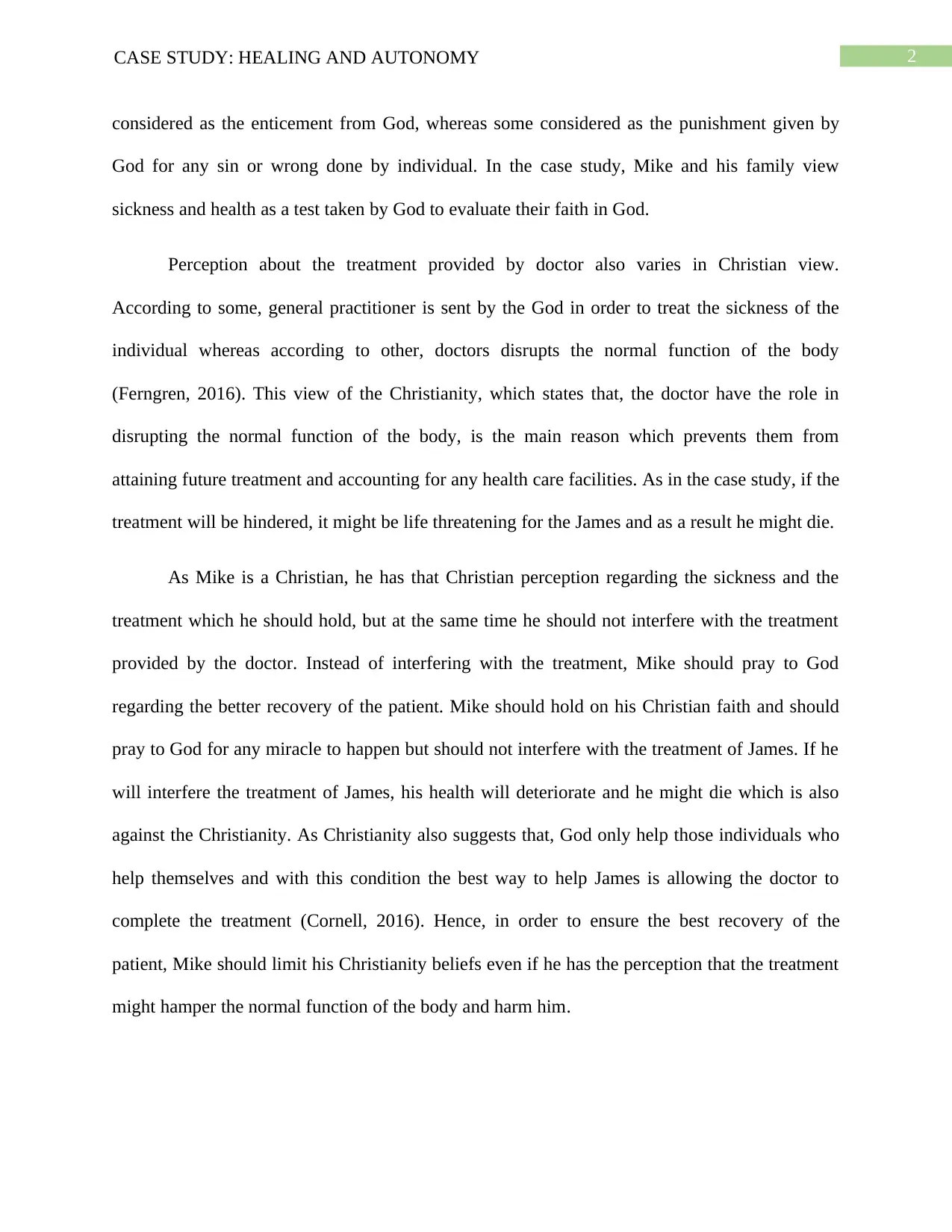
considered as the enticement from God, whereas some considered as the punishment given by
God for any sin or wrong done by individual. In the case study, Mike and his family view
sickness and health as a test taken by God to evaluate their faith in God.
Perception about the treatment provided by doctor also varies in Christian view.
According to some, general practitioner is sent by the God in order to treat the sickness of the
individual whereas according to other, doctors disrupts the normal function of the body
(Ferngren, 2016). This view of the Christianity, which states that, the doctor have the role in
disrupting the normal function of the body, is the main reason which prevents them from
attaining future treatment and accounting for any health care facilities. As in the case study, if the
treatment will be hindered, it might be life threatening for the James and as a result he might die.
As Mike is a Christian, he has that Christian perception regarding the sickness and the
treatment which he should hold, but at the same time he should not interfere with the treatment
provided by the doctor. Instead of interfering with the treatment, Mike should pray to God
regarding the better recovery of the patient. Mike should hold on his Christian faith and should
pray to God for any miracle to happen but should not interfere with the treatment of James. If he
will interfere the treatment of James, his health will deteriorate and he might die which is also
against the Christianity. As Christianity also suggests that, God only help those individuals who
help themselves and with this condition the best way to help James is allowing the doctor to
complete the treatment (Cornell, 2016). Hence, in order to ensure the best recovery of the
patient, Mike should limit his Christianity beliefs even if he has the perception that the treatment
might hamper the normal function of the body and harm him.
considered as the enticement from God, whereas some considered as the punishment given by
God for any sin or wrong done by individual. In the case study, Mike and his family view
sickness and health as a test taken by God to evaluate their faith in God.
Perception about the treatment provided by doctor also varies in Christian view.
According to some, general practitioner is sent by the God in order to treat the sickness of the
individual whereas according to other, doctors disrupts the normal function of the body
(Ferngren, 2016). This view of the Christianity, which states that, the doctor have the role in
disrupting the normal function of the body, is the main reason which prevents them from
attaining future treatment and accounting for any health care facilities. As in the case study, if the
treatment will be hindered, it might be life threatening for the James and as a result he might die.
As Mike is a Christian, he has that Christian perception regarding the sickness and the
treatment which he should hold, but at the same time he should not interfere with the treatment
provided by the doctor. Instead of interfering with the treatment, Mike should pray to God
regarding the better recovery of the patient. Mike should hold on his Christian faith and should
pray to God for any miracle to happen but should not interfere with the treatment of James. If he
will interfere the treatment of James, his health will deteriorate and he might die which is also
against the Christianity. As Christianity also suggests that, God only help those individuals who
help themselves and with this condition the best way to help James is allowing the doctor to
complete the treatment (Cornell, 2016). Hence, in order to ensure the best recovery of the
patient, Mike should limit his Christianity beliefs even if he has the perception that the treatment
might hamper the normal function of the body and harm him.
⊘ This is a preview!⊘
Do you want full access?
Subscribe today to unlock all pages.

Trusted by 1+ million students worldwide

3CASE STUDY: HEALING AND AUTONOMY
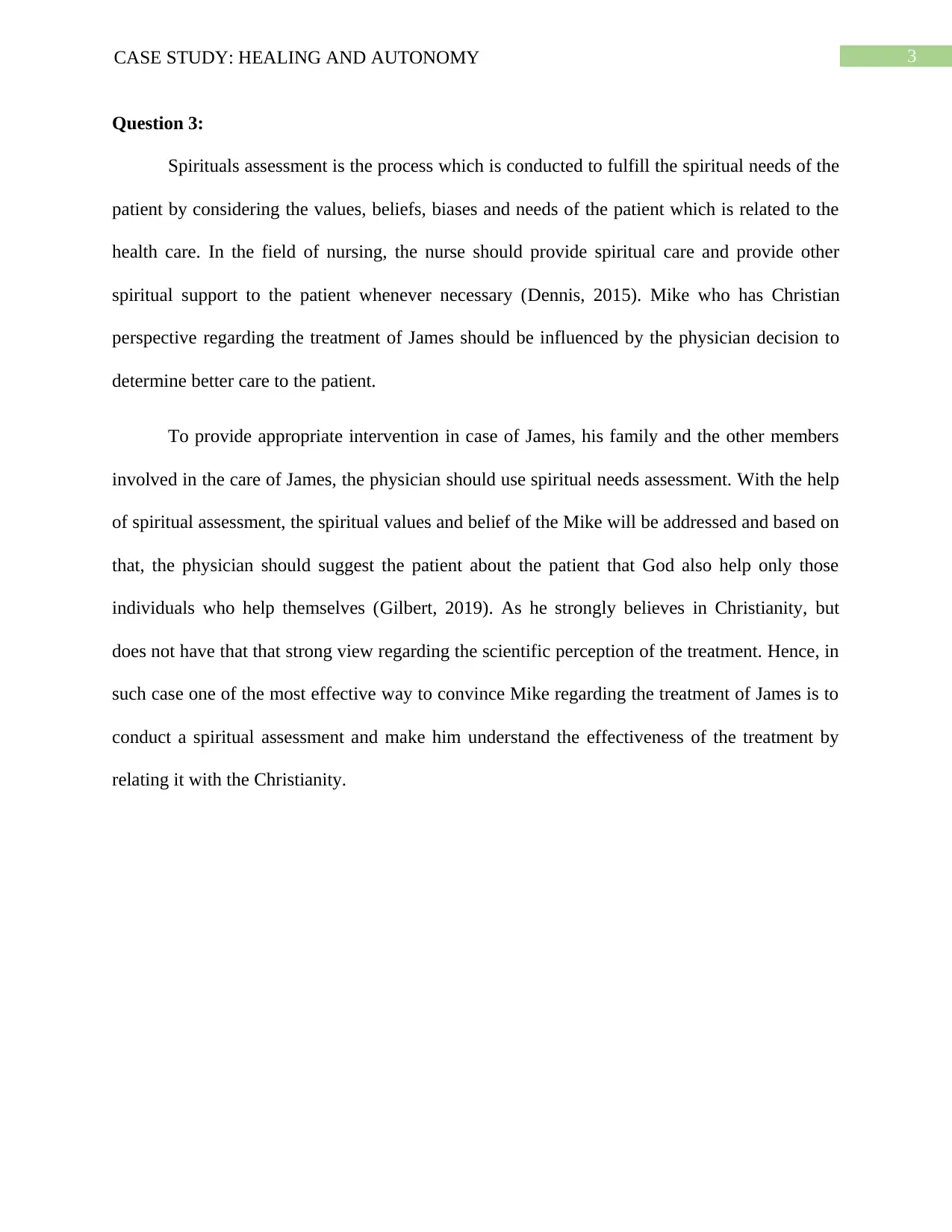
Question 3:
Spirituals assessment is the process which is conducted to fulfill the spiritual needs of the
patient by considering the values, beliefs, biases and needs of the patient which is related to the
health care. In the field of nursing, the nurse should provide spiritual care and provide other
spiritual support to the patient whenever necessary (Dennis, 2015). Mike who has Christian
perspective regarding the treatment of James should be influenced by the physician decision to
determine better care to the patient.
To provide appropriate intervention in case of James, his family and the other members
involved in the care of James, the physician should use spiritual needs assessment. With the help
of spiritual assessment, the spiritual values and belief of the Mike will be addressed and based on
that, the physician should suggest the patient about the patient that God also help only those
individuals who help themselves (Gilbert, 2019). As he strongly believes in Christianity, but
does not have that that strong view regarding the scientific perception of the treatment. Hence, in
such case one of the most effective way to convince Mike regarding the treatment of James is to
conduct a spiritual assessment and make him understand the effectiveness of the treatment by
relating it with the Christianity.
Question 3:
Spirituals assessment is the process which is conducted to fulfill the spiritual needs of the
patient by considering the values, beliefs, biases and needs of the patient which is related to the
health care. In the field of nursing, the nurse should provide spiritual care and provide other
spiritual support to the patient whenever necessary (Dennis, 2015). Mike who has Christian
perspective regarding the treatment of James should be influenced by the physician decision to
determine better care to the patient.
To provide appropriate intervention in case of James, his family and the other members
involved in the care of James, the physician should use spiritual needs assessment. With the help
of spiritual assessment, the spiritual values and belief of the Mike will be addressed and based on
that, the physician should suggest the patient about the patient that God also help only those
individuals who help themselves (Gilbert, 2019). As he strongly believes in Christianity, but
does not have that that strong view regarding the scientific perception of the treatment. Hence, in
such case one of the most effective way to convince Mike regarding the treatment of James is to
conduct a spiritual assessment and make him understand the effectiveness of the treatment by
relating it with the Christianity.
Paraphrase This Document
Need a fresh take? Get an instant paraphrase of this document with our AI Paraphraser

4CASE STUDY: HEALING AND AUTONOMY
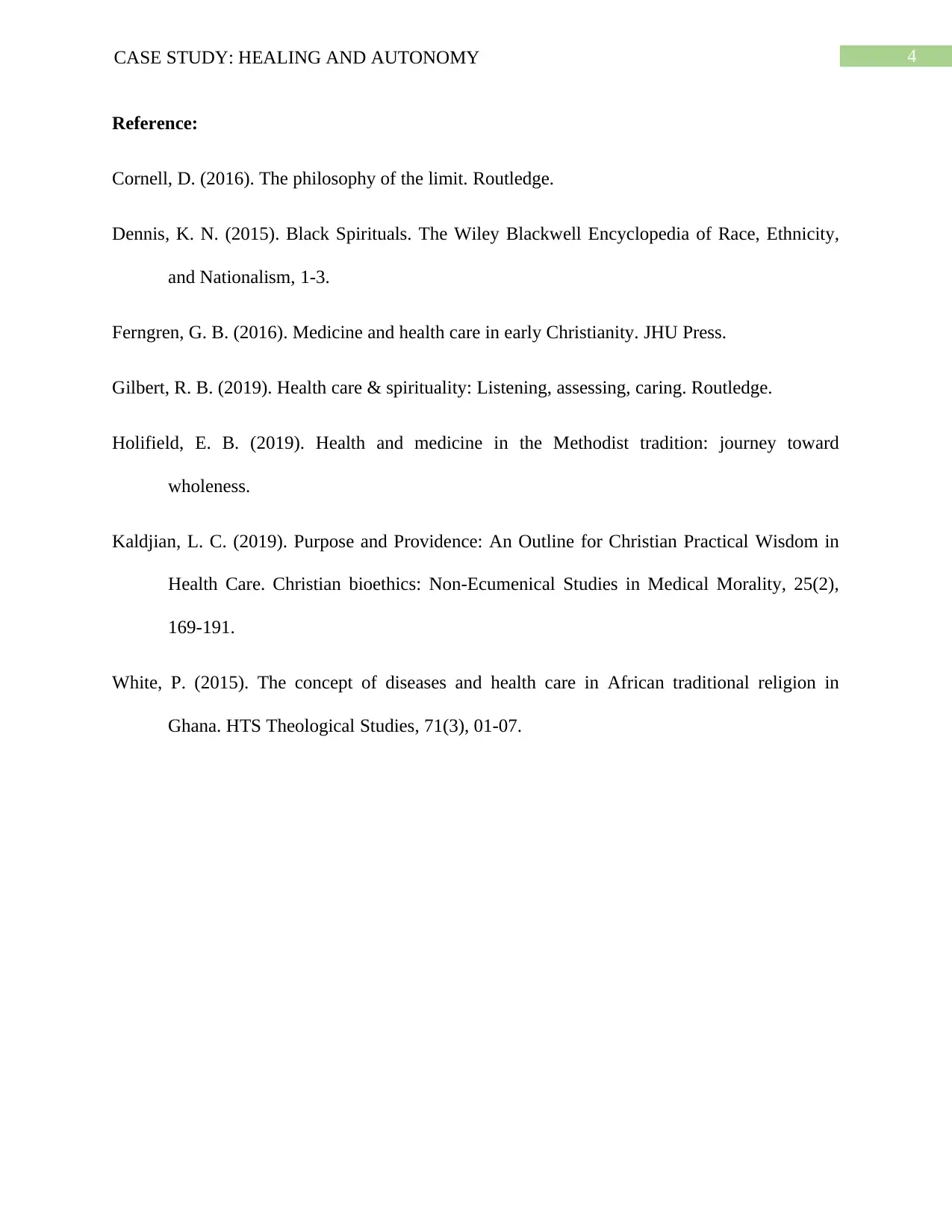
Reference:
Cornell, D. (2016). The philosophy of the limit. Routledge.
Dennis, K. N. (2015). Black Spirituals. The Wiley Blackwell Encyclopedia of Race, Ethnicity,
and Nationalism, 1-3.
Ferngren, G. B. (2016). Medicine and health care in early Christianity. JHU Press.
Gilbert, R. B. (2019). Health care & spirituality: Listening, assessing, caring. Routledge.
Holifield, E. B. (2019). Health and medicine in the Methodist tradition: journey toward
wholeness.
Kaldjian, L. C. (2019). Purpose and Providence: An Outline for Christian Practical Wisdom in
Health Care. Christian bioethics: Non-Ecumenical Studies in Medical Morality, 25(2),
169-191.
White, P. (2015). The concept of diseases and health care in African traditional religion in
Ghana. HTS Theological Studies, 71(3), 01-07.
Reference:
Cornell, D. (2016). The philosophy of the limit. Routledge.
Dennis, K. N. (2015). Black Spirituals. The Wiley Blackwell Encyclopedia of Race, Ethnicity,
and Nationalism, 1-3.
Ferngren, G. B. (2016). Medicine and health care in early Christianity. JHU Press.
Gilbert, R. B. (2019). Health care & spirituality: Listening, assessing, caring. Routledge.
Holifield, E. B. (2019). Health and medicine in the Methodist tradition: journey toward
wholeness.
Kaldjian, L. C. (2019). Purpose and Providence: An Outline for Christian Practical Wisdom in
Health Care. Christian bioethics: Non-Ecumenical Studies in Medical Morality, 25(2),
169-191.
White, P. (2015). The concept of diseases and health care in African traditional religion in
Ghana. HTS Theological Studies, 71(3), 01-07.

5CASE STUDY: HEALING AND AUTONOMY
⊘ This is a preview!⊘
Do you want full access?
Subscribe today to unlock all pages.

Trusted by 1+ million students worldwide
1 out of 6
Related Documents
Your All-in-One AI-Powered Toolkit for Academic Success.
 +13062052269
info@desklib.com
Available 24*7 on WhatsApp / Email
Unlock your academic potential
Copyright © 2020–2025 A2Z Services. All Rights Reserved. Developed and managed by ZUCOL.