Case Study: Health Assessment of Priya De Silva in Global Context
VerifiedAdded on 2023/05/28
|13
|2921
|220
Practical Assignment
AI Summary
This assignment presents a comprehensive health assessment of Priya De Silva, an elderly patient experiencing several health concerns. The assessment begins with a general overview of her physical appearance and subjective information, including her reported symptoms of swollen joints, chest pain, shortness of breath, and problems with urination. Objective data, such as vital signs and BMI, are also provided. The assignment then moves into a health assessment framework, identifying normal and abnormal findings. The core of the assignment involves analyzing three problem statements: irregular heart rate, problems with urine formation, and lack of medical history. For each problem, the assignment provides objective data, rationale, and potential nursing interventions. The final section discusses the importance of accurate and systematic assessments in nursing practice, referencing GLO1 and GLO2, and the need for comprehensive patient assessment and communication. The document also explores the role of registered nurses in patient care, emphasizing the significance of medical history, allergies, and medication information in developing effective care plans and highlights the importance of assessment for safe patient care.
Running Head: Accounting in Global Organisations
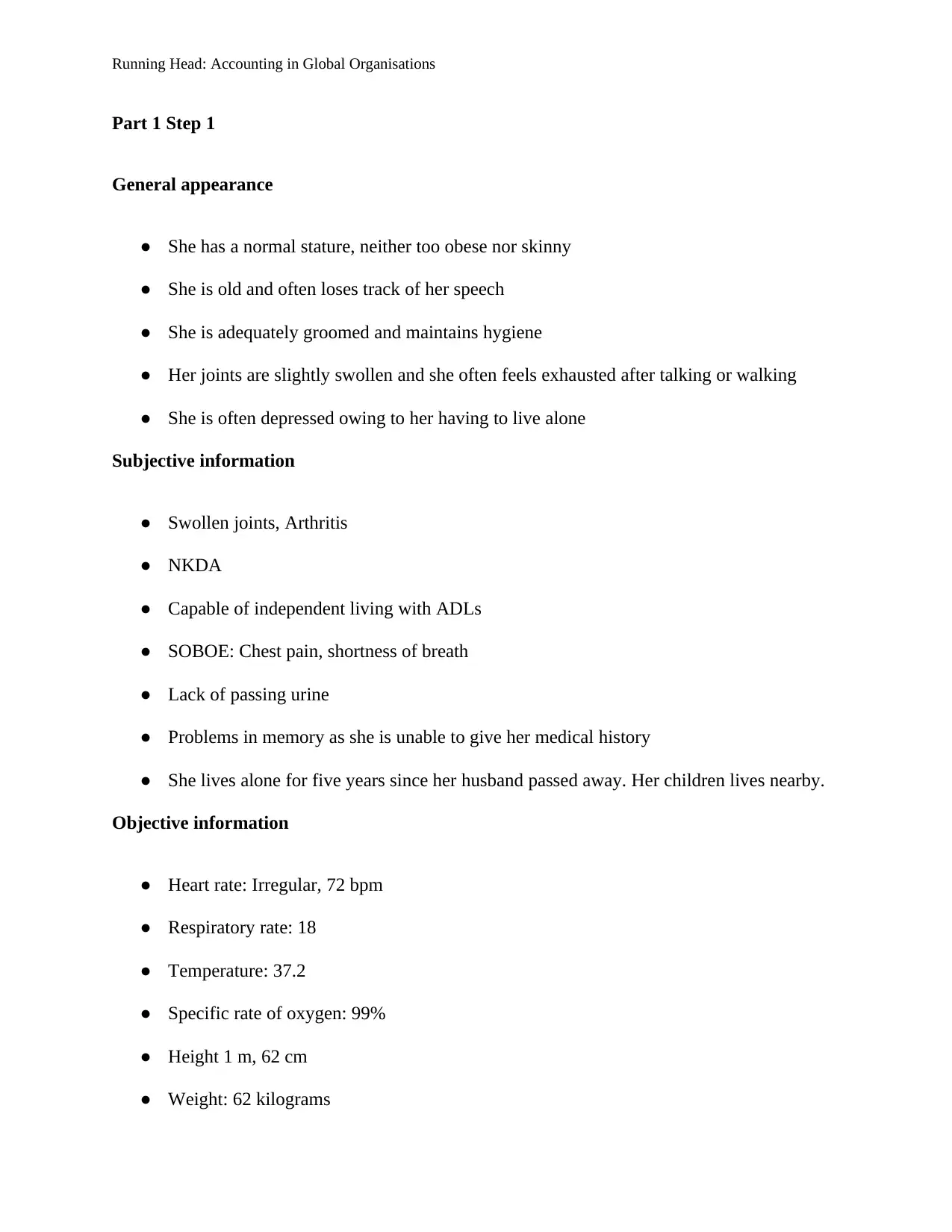
Part 1 Step 1
General appearance
● She has a normal stature, neither too obese nor skinny
● She is old and often loses track of her speech
● She is adequately groomed and maintains hygiene
● Her joints are slightly swollen and she often feels exhausted after talking or walking
● She is often depressed owing to her having to live alone
Subjective information
● Swollen joints, Arthritis
● NKDA
● Capable of independent living with ADLs
● SOBOE: Chest pain, shortness of breath
● Lack of passing urine
● Problems in memory as she is unable to give her medical history
● She lives alone for five years since her husband passed away. Her children lives nearby.
Objective information
● Heart rate: Irregular, 72 bpm
● Respiratory rate: 18
● Temperature: 37.2
● Specific rate of oxygen: 99%
● Height 1 m, 62 cm
● Weight: 62 kilograms
Part 1 Step 1
General appearance
● She has a normal stature, neither too obese nor skinny
● She is old and often loses track of her speech
● She is adequately groomed and maintains hygiene
● Her joints are slightly swollen and she often feels exhausted after talking or walking
● She is often depressed owing to her having to live alone
Subjective information
● Swollen joints, Arthritis
● NKDA
● Capable of independent living with ADLs
● SOBOE: Chest pain, shortness of breath
● Lack of passing urine
● Problems in memory as she is unable to give her medical history
● She lives alone for five years since her husband passed away. Her children lives nearby.
Objective information
● Heart rate: Irregular, 72 bpm
● Respiratory rate: 18
● Temperature: 37.2
● Specific rate of oxygen: 99%
● Height 1 m, 62 cm
● Weight: 62 kilograms

Paraphrase This Document
Need a fresh take? Get an instant paraphrase of this document with our AI Paraphraser
Accounting in Global Organisations Page 2 of 13
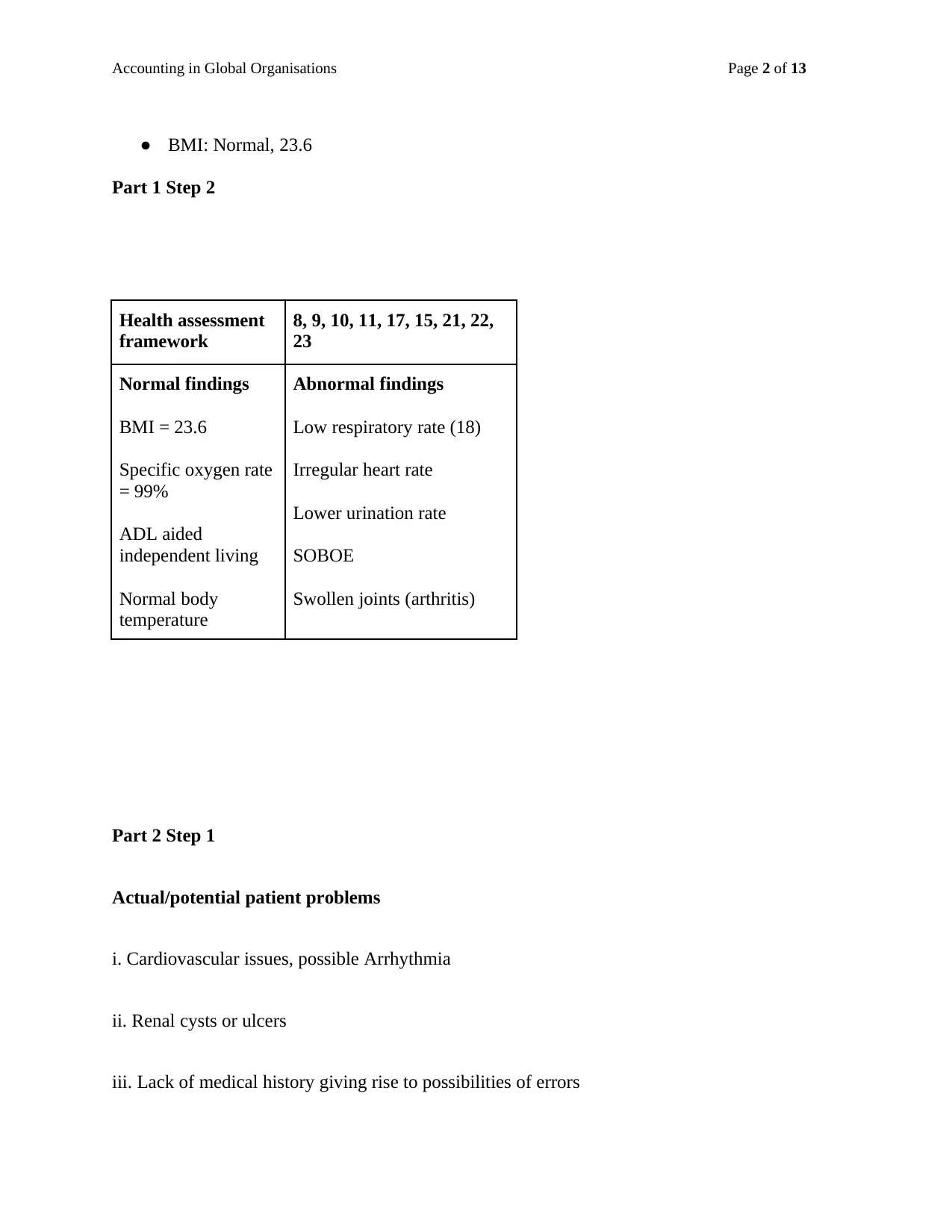
● BMI: Normal, 23.6
Part 1 Step 2
Health assessment
framework
8, 9, 10, 11, 17, 15, 21, 22,
23
Normal findings
BMI = 23.6
Specific oxygen rate
= 99%
ADL aided
independent living
Normal body
temperature
Abnormal findings
Low respiratory rate (18)
Irregular heart rate
Lower urination rate
SOBOE
Swollen joints (arthritis)
Part 2 Step 1
Actual/potential patient problems
i. Cardiovascular issues, possible Arrhythmia
ii. Renal cysts or ulcers
iii. Lack of medical history giving rise to possibilities of errors
● BMI: Normal, 23.6
Part 1 Step 2
Health assessment
framework
8, 9, 10, 11, 17, 15, 21, 22,
23
Normal findings
BMI = 23.6
Specific oxygen rate
= 99%
ADL aided
independent living
Normal body
temperature
Abnormal findings
Low respiratory rate (18)
Irregular heart rate
Lower urination rate
SOBOE
Swollen joints (arthritis)
Part 2 Step 1
Actual/potential patient problems
i. Cardiovascular issues, possible Arrhythmia
ii. Renal cysts or ulcers
iii. Lack of medical history giving rise to possibilities of errors
Accounting in Global Organisations Page 3 of 13
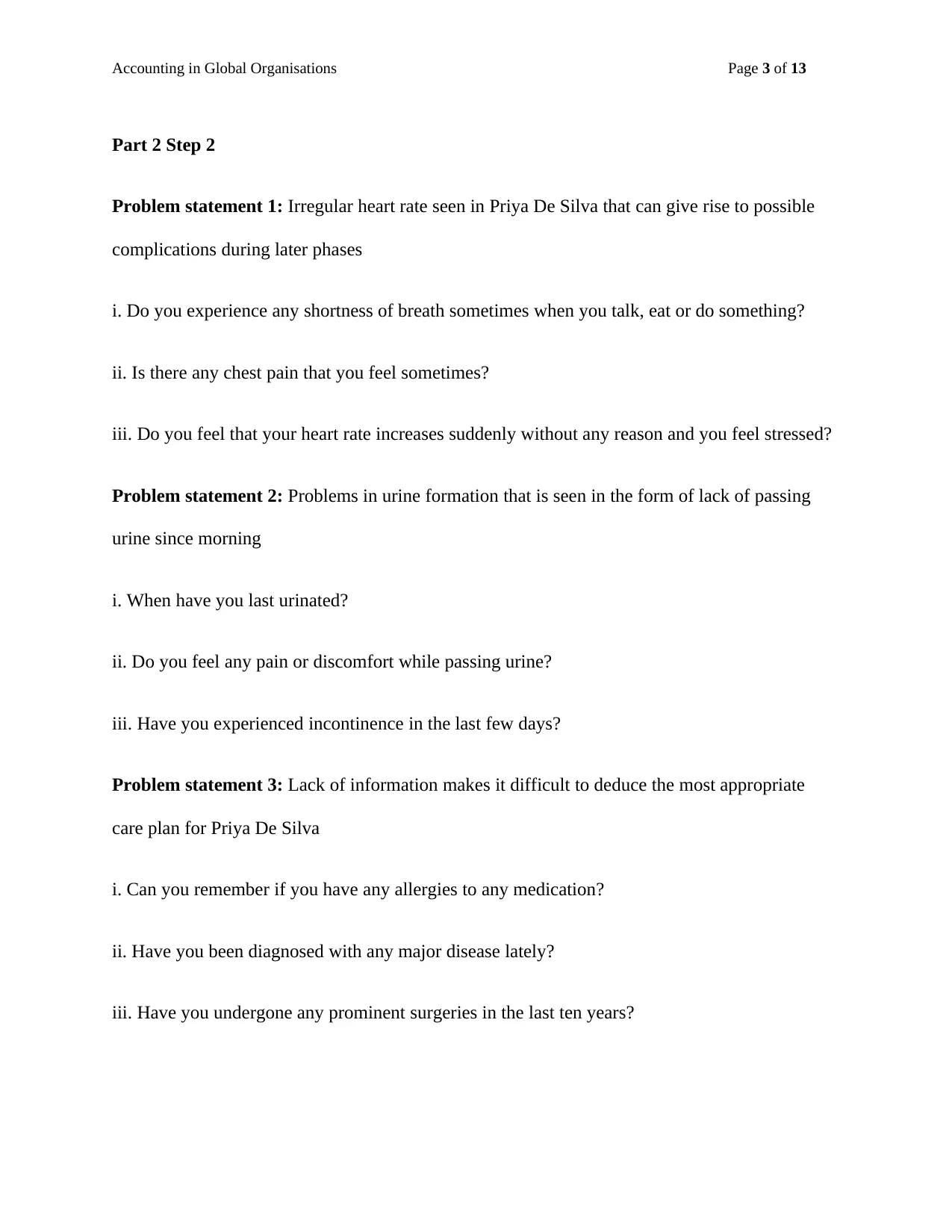
Part 2 Step 2
Problem statement 1: Irregular heart rate seen in Priya De Silva that can give rise to possible
complications during later phases
i. Do you experience any shortness of breath sometimes when you talk, eat or do something?
ii. Is there any chest pain that you feel sometimes?
iii. Do you feel that your heart rate increases suddenly without any reason and you feel stressed?
Problem statement 2: Problems in urine formation that is seen in the form of lack of passing
urine since morning
i. When have you last urinated?
ii. Do you feel any pain or discomfort while passing urine?
iii. Have you experienced incontinence in the last few days?
Problem statement 3: Lack of information makes it difficult to deduce the most appropriate
care plan for Priya De Silva
i. Can you remember if you have any allergies to any medication?
ii. Have you been diagnosed with any major disease lately?
iii. Have you undergone any prominent surgeries in the last ten years?
Part 2 Step 2
Problem statement 1: Irregular heart rate seen in Priya De Silva that can give rise to possible
complications during later phases
i. Do you experience any shortness of breath sometimes when you talk, eat or do something?
ii. Is there any chest pain that you feel sometimes?
iii. Do you feel that your heart rate increases suddenly without any reason and you feel stressed?
Problem statement 2: Problems in urine formation that is seen in the form of lack of passing
urine since morning
i. When have you last urinated?
ii. Do you feel any pain or discomfort while passing urine?
iii. Have you experienced incontinence in the last few days?
Problem statement 3: Lack of information makes it difficult to deduce the most appropriate
care plan for Priya De Silva
i. Can you remember if you have any allergies to any medication?
ii. Have you been diagnosed with any major disease lately?
iii. Have you undergone any prominent surgeries in the last ten years?
⊘ This is a preview!⊘
Do you want full access?
Subscribe today to unlock all pages.

Trusted by 1+ million students worldwide

Accounting in Global Organisations Page 4 of 13
Paraphrase This Document
Need a fresh take? Get an instant paraphrase of this document with our AI Paraphraser
Accounting in Global Organisations Page 5 of 13
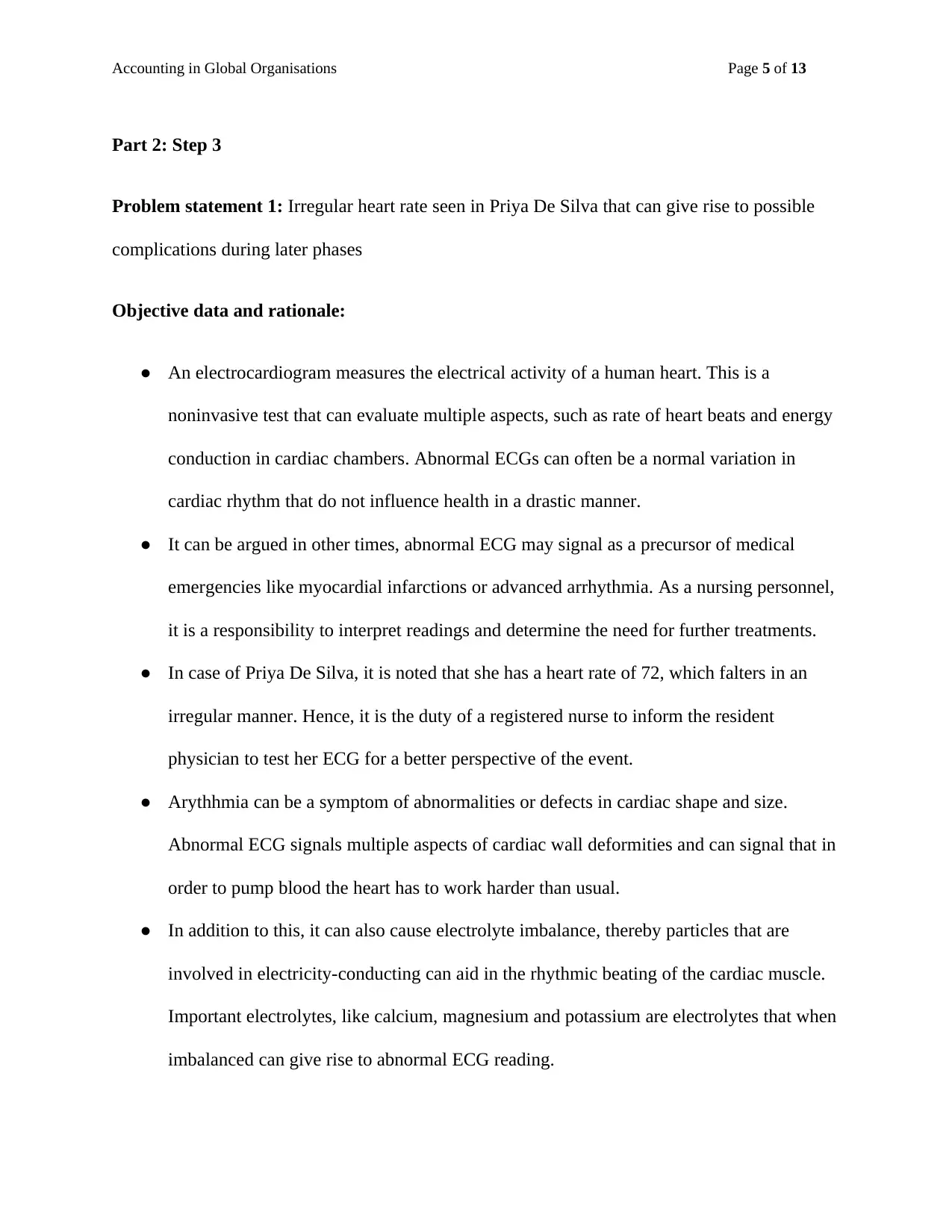
Part 2: Step 3
Problem statement 1: Irregular heart rate seen in Priya De Silva that can give rise to possible
complications during later phases
Objective data and rationale:
● An electrocardiogram measures the electrical activity of a human heart. This is a
noninvasive test that can evaluate multiple aspects, such as rate of heart beats and energy
conduction in cardiac chambers. Abnormal ECGs can often be a normal variation in
cardiac rhythm that do not influence health in a drastic manner.
● It can be argued in other times, abnormal ECG may signal as a precursor of medical
emergencies like myocardial infarctions or advanced arrhythmia. As a nursing personnel,
it is a responsibility to interpret readings and determine the need for further treatments.
● In case of Priya De Silva, it is noted that she has a heart rate of 72, which falters in an
irregular manner. Hence, it is the duty of a registered nurse to inform the resident
physician to test her ECG for a better perspective of the event.
● Arythhmia can be a symptom of abnormalities or defects in cardiac shape and size.
Abnormal ECG signals multiple aspects of cardiac wall deformities and can signal that in
order to pump blood the heart has to work harder than usual.
● In addition to this, it can also cause electrolyte imbalance, thereby particles that are
involved in electricity-conducting can aid in the rhythmic beating of the cardiac muscle.
Important electrolytes, like calcium, magnesium and potassium are electrolytes that when
imbalanced can give rise to abnormal ECG reading.
Part 2: Step 3
Problem statement 1: Irregular heart rate seen in Priya De Silva that can give rise to possible
complications during later phases
Objective data and rationale:
● An electrocardiogram measures the electrical activity of a human heart. This is a
noninvasive test that can evaluate multiple aspects, such as rate of heart beats and energy
conduction in cardiac chambers. Abnormal ECGs can often be a normal variation in
cardiac rhythm that do not influence health in a drastic manner.
● It can be argued in other times, abnormal ECG may signal as a precursor of medical
emergencies like myocardial infarctions or advanced arrhythmia. As a nursing personnel,
it is a responsibility to interpret readings and determine the need for further treatments.
● In case of Priya De Silva, it is noted that she has a heart rate of 72, which falters in an
irregular manner. Hence, it is the duty of a registered nurse to inform the resident
physician to test her ECG for a better perspective of the event.
● Arythhmia can be a symptom of abnormalities or defects in cardiac shape and size.
Abnormal ECG signals multiple aspects of cardiac wall deformities and can signal that in
order to pump blood the heart has to work harder than usual.
● In addition to this, it can also cause electrolyte imbalance, thereby particles that are
involved in electricity-conducting can aid in the rhythmic beating of the cardiac muscle.
Important electrolytes, like calcium, magnesium and potassium are electrolytes that when
imbalanced can give rise to abnormal ECG reading.
Accounting in Global Organisations Page 6 of 13
● As seen in case of Priya De Silva, she also has trouble passing urine. This can mean that
she is having difficulties in electrolyte balance. During ischemia, cardiac blood flow can
be affected and as a result the heart tissue can start losing oxygen and eventually die.
Hence, cardiac tissue starts losing its conductivity that may also be another reason for the
abnormal heartbeats.
Problem statement 2: Problems in urine formation that is seen in the form of lack of passing
urine since morning
Objective data and rationale:
● Formation of urine is a complex process, which occurs in kidneys. This essential protocol
offers a critical mechanism for human body that helps to flush out toxins and metabolic
wastes that can be often considered deadly if accumulation is allowed in body.
● According to the findings from the nursing handovers, kidneys are responsible to produce
urine, a process through which the human body eliminates its waste. However, stones can
form in kidneys in the presence of crystallisation of acid and mineral salts. Smaller stones
can pass through urinary system and is often flushed out of the human body.
● However, in case of larger stones, they get obstructed by the narrow circumference in
urinary tracts. This can happen in case of Priya De Silva, who is thus facing problems in
passing urine. Additional issues in her bladder control may aris if her sphincter muscles
starts getting weak, thus giving rise to incontinence.
● As seen in this above case, Priya De Silva has not urinated since the morning. This can
hint in the formation of kidney cyst. Renal cysts are rounded fluid-filled pouches that can
● As seen in case of Priya De Silva, she also has trouble passing urine. This can mean that
she is having difficulties in electrolyte balance. During ischemia, cardiac blood flow can
be affected and as a result the heart tissue can start losing oxygen and eventually die.
Hence, cardiac tissue starts losing its conductivity that may also be another reason for the
abnormal heartbeats.
Problem statement 2: Problems in urine formation that is seen in the form of lack of passing
urine since morning
Objective data and rationale:
● Formation of urine is a complex process, which occurs in kidneys. This essential protocol
offers a critical mechanism for human body that helps to flush out toxins and metabolic
wastes that can be often considered deadly if accumulation is allowed in body.
● According to the findings from the nursing handovers, kidneys are responsible to produce
urine, a process through which the human body eliminates its waste. However, stones can
form in kidneys in the presence of crystallisation of acid and mineral salts. Smaller stones
can pass through urinary system and is often flushed out of the human body.
● However, in case of larger stones, they get obstructed by the narrow circumference in
urinary tracts. This can happen in case of Priya De Silva, who is thus facing problems in
passing urine. Additional issues in her bladder control may aris if her sphincter muscles
starts getting weak, thus giving rise to incontinence.
● As seen in this above case, Priya De Silva has not urinated since the morning. This can
hint in the formation of kidney cyst. Renal cysts are rounded fluid-filled pouches that can
⊘ This is a preview!⊘
Do you want full access?
Subscribe today to unlock all pages.
Trusted by 1+ million students worldwide
Accounting in Global Organisations Page 7 of 13
form inside the renal tissue layer. In order to check for cysts, the registered nurse may
assess if the kidneys show signs of enlargement.
● This can also be an inherited condition, which may be confirmed through a thorough
analysis of Priya’s medical and family history. As opined in the nursing assessment, lack
of urination can be a symptom high blood pressure. However, Priya is suffering from a
low blood pressure, as her BP reading denotes 98 over 58.
● Hence, the possible scenarios of glomerulonephritis, necrosis or aneurysm can be
discarded. However, lack of urination in low blood pressure can indicate dehydration,
shock or blood loss.
Problem statement 3: Lack of information makes it difficult to deduce the most appropriate
care plan for Priya De Silva
Objective data and rationale:
● This is by far the most problematic situation that has to be faced by the nurses. As seen in
case of Priya De Silva, no information is found on past medical histories. In addition to
this, there is a negligible amount of light shed on previous clinical checkups as well as
medications.
● Information is a critical factor to establish the required care service plan. It is essential for
a registered nurse to understand the vital information catering to medical histories or
medications that a patient may have been subjected to. It can be confirmed by the
information that is critical due to the fact it provides an overview of the past complexities
that may have been suffered by the patient.
form inside the renal tissue layer. In order to check for cysts, the registered nurse may
assess if the kidneys show signs of enlargement.
● This can also be an inherited condition, which may be confirmed through a thorough
analysis of Priya’s medical and family history. As opined in the nursing assessment, lack
of urination can be a symptom high blood pressure. However, Priya is suffering from a
low blood pressure, as her BP reading denotes 98 over 58.
● Hence, the possible scenarios of glomerulonephritis, necrosis or aneurysm can be
discarded. However, lack of urination in low blood pressure can indicate dehydration,
shock or blood loss.
Problem statement 3: Lack of information makes it difficult to deduce the most appropriate
care plan for Priya De Silva
Objective data and rationale:
● This is by far the most problematic situation that has to be faced by the nurses. As seen in
case of Priya De Silva, no information is found on past medical histories. In addition to
this, there is a negligible amount of light shed on previous clinical checkups as well as
medications.
● Information is a critical factor to establish the required care service plan. It is essential for
a registered nurse to understand the vital information catering to medical histories or
medications that a patient may have been subjected to. It can be confirmed by the
information that is critical due to the fact it provides an overview of the past complexities
that may have been suffered by the patient.
Paraphrase This Document
Need a fresh take? Get an instant paraphrase of this document with our AI Paraphraser
Accounting in Global Organisations Page 8 of 13
● Consideration of medical history of the patient is a key factor of nursing appraisal. This is
because, it enables delivery of quality care as per the needs and preferences of a patient.
Comprehension of complexity and protocols involved in the study of medical history can
allow the registered nurses to get an effective understanding of the problem.
● Priorities of care can be recognised as appropriate interventions that has commenced the
optimisation of clinical outcomes. Similarly, clinical and familial history of patient is
essential in the discourse of care strategy and check for possible inherited ailments. As a
registered nurse, it is their duty to understand the implications of an attentive medical
history and its retainment to attract concern and attention of appropriate medical
personnel and strategies.
● Contextual information such as history of substance abuse, allergies and their reactions or
past medication is not recorded in this scenario. Unknown to most nurses, these
information can cater to nursing concentration that can cater to the confirmation of
plausible care strategies in the presence of clinical practices.
● Consideration of medical history of the patient is a key factor of nursing appraisal. This is
because, it enables delivery of quality care as per the needs and preferences of a patient.
Comprehension of complexity and protocols involved in the study of medical history can
allow the registered nurses to get an effective understanding of the problem.
● Priorities of care can be recognised as appropriate interventions that has commenced the
optimisation of clinical outcomes. Similarly, clinical and familial history of patient is
essential in the discourse of care strategy and check for possible inherited ailments. As a
registered nurse, it is their duty to understand the implications of an attentive medical
history and its retainment to attract concern and attention of appropriate medical
personnel and strategies.
● Contextual information such as history of substance abuse, allergies and their reactions or
past medication is not recorded in this scenario. Unknown to most nurses, these
information can cater to nursing concentration that can cater to the confirmation of
plausible care strategies in the presence of clinical practices.
Accounting in Global Organisations Page 9 of 13
Part 3: GLO1 and GLO2
RNs accurately conduct comprehensive and systematic assessments. They analyse information
and data and communicate outcomes as the basis of practice.
Assessment is considered to be critical constituent of nursing practice and is essential for
provision of family and patient centred care (Ancker et al. 2015). Nursing and Midwifery Board
of Australia state in the national competency standards that registered nurses must conduct a
methodical and comprehensive nursing appraisal. This assessment is essential to plan appropriate
care strategies to consult with interdisciplinary healthcare teams and respond efficiently to
change. According to Giger (2016), comprehensive nursing appraisal involve general
appearance, patient history, vital signs and physical examination. Concise appraisals are also
implemented when shift commences or condition of a patient changes over time. On contrary,
Balboni et al. (2014) state focused appraisal involves detailed nursing appraisal of body systems
that relate to appraisal of present concerns of patients. This can include one or more systems of
the body.
Nurses must consider age of their patients and implement appropriate behaviours to
respect their state (O'hagan et al. 2014). Modification of communication styles is usually
consistent in accordance to the needs of the child. According to Dougherty and Lister (2015),
possible clusters of assessments can be implemented at times when the needs of a patient are
interrelated. This can instil relaxation and compliance in the patients during the assesseent.
However, Tobiano et al. (2015) argue clinical appraisal can also be delayed owing to issues
catering to availability of staff. Completion of the admission assessment can be done by a nurse
Part 3: GLO1 and GLO2
RNs accurately conduct comprehensive and systematic assessments. They analyse information
and data and communicate outcomes as the basis of practice.
Assessment is considered to be critical constituent of nursing practice and is essential for
provision of family and patient centred care (Ancker et al. 2015). Nursing and Midwifery Board
of Australia state in the national competency standards that registered nurses must conduct a
methodical and comprehensive nursing appraisal. This assessment is essential to plan appropriate
care strategies to consult with interdisciplinary healthcare teams and respond efficiently to
change. According to Giger (2016), comprehensive nursing appraisal involve general
appearance, patient history, vital signs and physical examination. Concise appraisals are also
implemented when shift commences or condition of a patient changes over time. On contrary,
Balboni et al. (2014) state focused appraisal involves detailed nursing appraisal of body systems
that relate to appraisal of present concerns of patients. This can include one or more systems of
the body.
Nurses must consider age of their patients and implement appropriate behaviours to
respect their state (O'hagan et al. 2014). Modification of communication styles is usually
consistent in accordance to the needs of the child. According to Dougherty and Lister (2015),
possible clusters of assessments can be implemented at times when the needs of a patient are
interrelated. This can instil relaxation and compliance in the patients during the assesseent.
However, Tobiano et al. (2015) argue clinical appraisal can also be delayed owing to issues
catering to availability of staff. Completion of the admission assessment can be done by a nurse
⊘ This is a preview!⊘
Do you want full access?
Subscribe today to unlock all pages.
Trusted by 1+ million students worldwide
Accounting in Global Organisations Page 10 of 13
or caregiver, upon the arrival of the patient to wards. Klok, Kaptein and Brand (2015) state this
assessment must take place within 24 hours of the patient undergoing admission.
Admission appraisal is catered by ADT navigator where additional information is entered
through progress notes. As opined by Banerjee et al. (2016), patient privacy is one of the basic
needs that has to be considered by a registered nursing personnel. Comprehensive assessment
should include clinical history, allergies and their reactions, immunisation status, implants and
medications. Munroe et al. (2015) state this is important because, appraisal is considered integral
for a nursing responsibility and role while its provides safe care to patients. Hence, Oh, Jeon and
Koh (2015) conclude it is the responsibility of a registered nurse to ensure relevant competencies
in licensed areas. Nurses gain considerable amount of experiential skill and knowledge with
time, yet communication is key to steadfast and easy learning (Sand‐Jecklin and Sherman, 2014).
Some of the nursing students can prefer independent learning or use multiple resources for long-
term learning.
Expertise in assessment of patients stems from the utilisation of a methodical strategy,
regular practice and working on feedback. Multiple factors can influence nursing competency in
clinical assessments. Hence, Dougherty and Lister (2015) suggest frequent reviews can enhance
and strengthen competent and safe nursing practices. Participatory tools can be applied for self-
appraisal of nursing skills and relevant levels of competency. Tobiano et al. (2015) state nursing
expectations for practice are articulated through guiding principles that renders a definite
framework for practice expectations and contributes to each practitioning set. Thus, it is
essential that nurses acquaint themselves with the Nursing and Midwifery Board documents and
set practice context to carry out competencies relevant to appraisals. Thus, it can be concluded
or caregiver, upon the arrival of the patient to wards. Klok, Kaptein and Brand (2015) state this
assessment must take place within 24 hours of the patient undergoing admission.
Admission appraisal is catered by ADT navigator where additional information is entered
through progress notes. As opined by Banerjee et al. (2016), patient privacy is one of the basic
needs that has to be considered by a registered nursing personnel. Comprehensive assessment
should include clinical history, allergies and their reactions, immunisation status, implants and
medications. Munroe et al. (2015) state this is important because, appraisal is considered integral
for a nursing responsibility and role while its provides safe care to patients. Hence, Oh, Jeon and
Koh (2015) conclude it is the responsibility of a registered nurse to ensure relevant competencies
in licensed areas. Nurses gain considerable amount of experiential skill and knowledge with
time, yet communication is key to steadfast and easy learning (Sand‐Jecklin and Sherman, 2014).
Some of the nursing students can prefer independent learning or use multiple resources for long-
term learning.
Expertise in assessment of patients stems from the utilisation of a methodical strategy,
regular practice and working on feedback. Multiple factors can influence nursing competency in
clinical assessments. Hence, Dougherty and Lister (2015) suggest frequent reviews can enhance
and strengthen competent and safe nursing practices. Participatory tools can be applied for self-
appraisal of nursing skills and relevant levels of competency. Tobiano et al. (2015) state nursing
expectations for practice are articulated through guiding principles that renders a definite
framework for practice expectations and contributes to each practitioning set. Thus, it is
essential that nurses acquaint themselves with the Nursing and Midwifery Board documents and
set practice context to carry out competencies relevant to appraisals. Thus, it can be concluded
Paraphrase This Document
Need a fresh take? Get an instant paraphrase of this document with our AI Paraphraser
Accounting in Global Organisations Page 11 of 13
that registered nurses are responsible for carrying out comprehensible and methodical clinical
assessment of their patients.
Reference list
Giger, J.N., (2016). Transcultural Nursing-E-Book: Assessment and Intervention. London, UK:
Elsevier Health Sciences.
Dougherty, L. and Lister, S. eds., (2015). The Royal Marsden manual of clinical nursing
procedures. New Jersey, US: John Wiley & Sons.
Tobiano, G., Marshall, A., Bucknall, T. and Chaboyer, W., (2015). Patient participation in
nursing care on medical wards: an integrative review. International Journal of Nursing
Studies, 52(6), 1107-1120.
Oh, P.J., Jeon, K.D. and Koh, M.S., (2015). The effects of simulation-based learning using
standardized patients in nursing students: A meta-analysis. Nurse education today, 35(5),
e6-e15.
Munroe, B., Curtis, K., Murphy, M., Strachan, L. and Buckley, T., (2015). HIRAID: an
evidence-informed emergency nursing assessment framework. Australasian emergency
nursing journal, 18(2), 83-97.
that registered nurses are responsible for carrying out comprehensible and methodical clinical
assessment of their patients.
Reference list
Giger, J.N., (2016). Transcultural Nursing-E-Book: Assessment and Intervention. London, UK:
Elsevier Health Sciences.
Dougherty, L. and Lister, S. eds., (2015). The Royal Marsden manual of clinical nursing
procedures. New Jersey, US: John Wiley & Sons.
Tobiano, G., Marshall, A., Bucknall, T. and Chaboyer, W., (2015). Patient participation in
nursing care on medical wards: an integrative review. International Journal of Nursing
Studies, 52(6), 1107-1120.
Oh, P.J., Jeon, K.D. and Koh, M.S., (2015). The effects of simulation-based learning using
standardized patients in nursing students: A meta-analysis. Nurse education today, 35(5),
e6-e15.
Munroe, B., Curtis, K., Murphy, M., Strachan, L. and Buckley, T., (2015). HIRAID: an
evidence-informed emergency nursing assessment framework. Australasian emergency
nursing journal, 18(2), 83-97.
Accounting in Global Organisations Page 12 of 13
O'hagan, S., Manias, E., Elder, C., Pill, J., Woodward‐Kron, R., McNamara, T., Webb, G. and
McColl, G., (2014). What counts as effective communication in nursing? Evidence from
nurse educators' and clinicians' feedback on nurse interactions with simulated patients.
Journal of advanced nursing, 70(6), 1344-1355.
Sand‐Jecklin, K. and Sherman, J., (2014). A quantitative assessment of patient and nurse
outcomes of bedside nursing report implementation. Journal of clinical nursing, 23(19-
20), 2854-2863.
Forsberg, E., Ziegert, K., Hult, H. and Fors, U., (2014). Clinical reasoning in nursing, a think-
aloud study using virtual patients–A base for an innovative assessment. Nurse Education
Today, 34(4), 538-542.
Banerjee, S.C., Manna, R., Coyle, N., Shen, M.J., Pehrson, C., Zaider, T., Hammonds, S.,
Krueger, C.A., Parker, P.A. and Bylund, C.L., (2016). Oncology nurses' communication
challenges with patients and families: a qualitative study. Nurse education in practice,
16(1), 193-201.
Tobiano, G., Marshall, A., Bucknall, T. and Chaboyer, W., (2015). Patient participation in
nursing care on medical wards: an integrative review. International Journal of Nursing
Studies, 52(6), 1107-1120.
Ancker, J.S., Witteman, H.O., Hafeez, B., Provencher, T., Van de Graaf, M. and Wei, E., (2015).
The invisible work of personal health information management among people with
multiple chronic conditions: qualitative interview study among patients and providers.
Journal of medical Internet research, 17(6), 38-45.
O'hagan, S., Manias, E., Elder, C., Pill, J., Woodward‐Kron, R., McNamara, T., Webb, G. and
McColl, G., (2014). What counts as effective communication in nursing? Evidence from
nurse educators' and clinicians' feedback on nurse interactions with simulated patients.
Journal of advanced nursing, 70(6), 1344-1355.
Sand‐Jecklin, K. and Sherman, J., (2014). A quantitative assessment of patient and nurse
outcomes of bedside nursing report implementation. Journal of clinical nursing, 23(19-
20), 2854-2863.
Forsberg, E., Ziegert, K., Hult, H. and Fors, U., (2014). Clinical reasoning in nursing, a think-
aloud study using virtual patients–A base for an innovative assessment. Nurse Education
Today, 34(4), 538-542.
Banerjee, S.C., Manna, R., Coyle, N., Shen, M.J., Pehrson, C., Zaider, T., Hammonds, S.,
Krueger, C.A., Parker, P.A. and Bylund, C.L., (2016). Oncology nurses' communication
challenges with patients and families: a qualitative study. Nurse education in practice,
16(1), 193-201.
Tobiano, G., Marshall, A., Bucknall, T. and Chaboyer, W., (2015). Patient participation in
nursing care on medical wards: an integrative review. International Journal of Nursing
Studies, 52(6), 1107-1120.
Ancker, J.S., Witteman, H.O., Hafeez, B., Provencher, T., Van de Graaf, M. and Wei, E., (2015).
The invisible work of personal health information management among people with
multiple chronic conditions: qualitative interview study among patients and providers.
Journal of medical Internet research, 17(6), 38-45.
⊘ This is a preview!⊘
Do you want full access?
Subscribe today to unlock all pages.
Trusted by 1+ million students worldwide

1 out of 13


Your All-in-One AI-Powered Toolkit for Academic Success.
+13062052269
info@desklib.com
Available 24*7 on WhatsApp / Email
![[object Object]](/_next/static/media/star-bottom.7253800d.svg)
Unlock your academic potential
Copyright © 2020–2026 A2Z Services. All Rights Reserved. Developed and managed by ZUCOL.