Case Study Analysis: Obesity and Dementia in Elderly Patient

Verified

Added on  2022/08/08

|8
|2160
|42
Case Study
AI Summary
This case study presents a health assessment of a 68-year-old independent client living alone, who is experiencing obesity and signs of dementia (oriented x4). The assessment includes calculating Body Mass Index (BMI) to classify obesity, and recommending the Mini Nutritional Assessment (MNA) to evaluate the patient's nutritional status. The study also suggests the use of pedometers or accelerometers to assess physical activity levels. Key developmental outcomes are identified as obesity and dementia, with effective nursing interventions including nutritional counseling, encouraging regular exercise, and providing emotional support. The importance of person-centered care, active communication, and establishing a supportive environment for the patient, especially given their living situation and cognitive state, are emphasized. The case highlights the nurses' role in managing both physiological and psychological aspects, including diet planning, exercise recommendations, and assisting with dementia management. The paper underscores the significance of early intervention and personalized care to improve the patient's quality of life.
Document Page
Running head: CASE STUDY 1
Case Study
Name of the Student
Name of the University
Authors Note
tabler-icon-diamond-filled.svg

Paraphrase This Document

Need a fresh take? Get an instant paraphrase of this document with our AI Paraphraser
Document Page
CASE STUDY 2
Health assessment is a method of giving specific planned care to a particular patient. The
plan also classifies the exact need of a patient and how health care professionals can discourse
those requirements. A process of physical examination, as well as taking a brief history of patient
health, is done to evaluate and identify the condition (Potter et al., 2016). There are various
components of physical health assessments that are usually considered in planning the routine of
care towards any patient. These physical components are checkup, auscultation, percussion and
palpation. It is one of the most critical aspects of nursing care and practice because it improves
the quality of care and intervention for any patient by identifying their strengths and weakness
(Lanceley, 2017). The primary purpose of the below paper is to identify a patient’s condition
based upon a case study and to provide correct solutions and interventions.
Body Mass Index or BMI is a measurement of an individual’s weight to their height. This
index broadly categories patient as underweight, standard weight and obese depending upon the
fat, muscle and bones (Nuttal, 2015). The body comprises of fats, especially triglycerides, also
known as adipose that are stored in different areas of the body like intramuscular, intra-
abdominal and subcutaneous which are usually difficult to measure. This process is useful in the
estimation of body fat. The case given case the candidates weight is 210lb and height is 5’6”.
The standard formula for estimation of BMI is weight divided by height. The person BMI is
210lb/5’6”, which are 33.9kg/m2. The body index classification the person as obesity class I.
The normal range lies between 18.5kg/m2 to 24.9kg/m2 (Bickley, 2017). Waist circumference
also needs to be measured for this case as many complications may arise due to obese condition
in the patient like hypertension, diabetes and cardiovascular diseases.
Nutritional assessment is a process of identifying the correct dietary status of the body,
and it helps in promoting better health of a patient and helps in preventing as well as treating
Document Page
CASE STUDY 3
chronic diseases of the body. It is one of the critical aspects in nursing practice because it helps
in the planning of proper diet and health programs for curing any patient and to promote better
health condition (Burman et al., 2015). In this case, the screening tool that can be used to assess
the nutritional status of the person is the Mini Nutritional Assessment or MNA (Bickley, 2017).
It is an important screening tool used in the identification of the nutritional status of an older
adult. The assessment is based on a few questions which provide complete knowledge about the
nutritional status of any individual. The screening questions comprises information about the
food intake in the last few months, condition of weight, mobility, psychological stress, the BMI
and neuropsychological problems. The assessment is judged upon a scoring system which
indicates the current state of the body. Other tools that can be used in the evaluation are
Subjective Global Assessment; it comprises of patients history, food intake, weight as well as
clinical symptoms present in the body (Fink et al., 2015). The useful screening tool for the case
will be Mini Nutritional assessment as the person is an elderly one, and the BMI indicates the
obese condition. This will be helpful in taking the correct diet for the patient.
The person, in this case, is active with all daily activities and does not have a restricted
movement body. The screening tool that can be used to know about the exercise and physical
knowledge of the body are pedometers or accelerometers and International Physical Activity
Questionnaires (Shook et al., 2016). The questionnaires aim to deliver health and physical
activity data. The pedometers can be used for this purpose because it will help to tie distance in
footsteps with the burned calories (Bickley, 2017). The person here is suffering from obesity and
needs daily exercise to lose weight. This tool will improve the health care professionals to have
knowledge about physical activity and exercise and to plan the diet as well.
Document Page
CASE STUDY 4
There are mainly two developmental outcomes for this case; these are obesity and
dementia. These outcomes are accurate, determinate and reliable for the character as the person
is suffering from obesity, which is identified by calculation of body mass index. The person also
has oriented x4, which is a common outcome of dementia among the aged person. Oriented x4 is
an assessment of mental status test which is used to observe the dementia condition of a person
and to evaluate cognitive behaviour. The test determines the person level of awareness regarding
people, time, situation and place. There are several stages of this alert and awareness. The person
belongs to level x4 where the candidate is aware of location, name, time and also aware of
medical conditions.
Nurses play an active role in treating or managing both physiological and psychological
diseases and helps to acquire as well as leading a normal life. In this case, the patient is an older
person who has dementia and most importantly, obesity. Three most effective intervention and
management that can be done to address the obesity problem are- planning a proper nutritional
diet chart for the person along with providing adequate information about nutrition which can be
called as nutritional counselling, encouraging the person to practice regular exercise and finally
providing emotional support (Bickley, 2017).Nurses can also recommend and assist medication
in resolving this issue by consulting with doctors.
Nutritional counselling will help in resolving the problem by setting goals and giving
proper information about the disease along with its complication in long-terms like diabetes,
heart disease, homeostatic condition. The nurse can motivate the patients to improve their health
conditions and plan effective diet plans for them.
tabler-icon-diamond-filled.svg

Paraphrase This Document

Need a fresh take? Get an instant paraphrase of this document with our AI Paraphraser
Document Page
CASE STUDY 5
The nurses can plan and encourage the patients to exercise regularly, as it is essential to
lose weight and have a healthy life. They can assist and help the patient in using pedometers to
observe the calorie burnt. They can support and recommend the patient with daily physical
activity for 30 to 60mins.
The most critical intervention is proper planning of diet for the candidate. The diet
planning is also a type of person-centred care where the food included must be of the patient’s
choice. However, the food that is included should be of balanced calories, fruits, low sodium
level food; restrictions must be made in consuming sweets, low-fat milk and whole grains. The
nurse must be also aware and inform the patient not to avoid meal, as that can also be a cause for
obesity of the given case as the client is survived alone.
The nurse plays a vital role in managing dementia in-patient; few interventions can be
beneficial for this purpose like active communication with the patient, support patient with
person-centred care and lastly establishing proper physical health care for the patient (Machiels
et al., 2017). In this case, building a stable relationship with the patient is essential because the
person lives alone and has oriented x4 condition. Communicating warmly and politely with the
person will provide positive support for the patient, and this will resolve the issue as the person
leaves alone. The caregiver must also focus on active listening, which can empathize the patient
and help in determining the challenging situation.
Another intervention must be of person-centred, as it will help in managing the
behavioural condition of the patient in this case. Family care and support are can also be
included in the plan as the patient lives alone; all this will provide coordinated care and offering
treatment.
Document Page
CASE STUDY 6
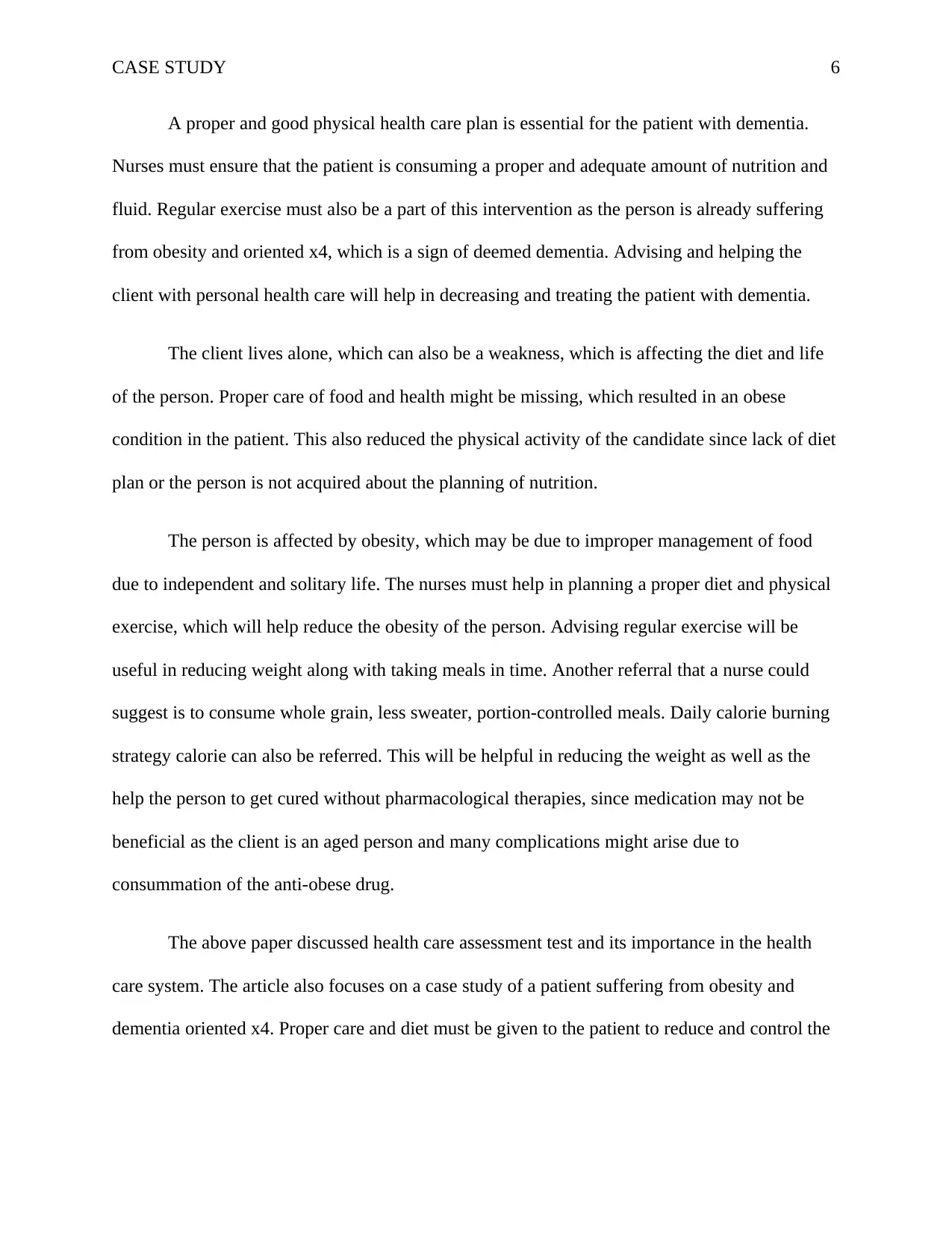
A proper and good physical health care plan is essential for the patient with dementia.
Nurses must ensure that the patient is consuming a proper and adequate amount of nutrition and
fluid. Regular exercise must also be a part of this intervention as the person is already suffering
from obesity and oriented x4, which is a sign of deemed dementia. Advising and helping the
client with personal health care will help in decreasing and treating the patient with dementia.
The client lives alone, which can also be a weakness, which is affecting the diet and life
of the person. Proper care of food and health might be missing, which resulted in an obese
condition in the patient. This also reduced the physical activity of the candidate since lack of diet
plan or the person is not acquired about the planning of nutrition.
The person is affected by obesity, which may be due to improper management of food
due to independent and solitary life. The nurses must help in planning a proper diet and physical
exercise, which will help reduce the obesity of the person. Advising regular exercise will be
useful in reducing weight along with taking meals in time. Another referral that a nurse could
suggest is to consume whole grain, less sweater, portion-controlled meals. Daily calorie burning
strategy calorie can also be referred. This will be helpful in reducing the weight as well as the
help the person to get cured without pharmacological therapies, since medication may not be
beneficial as the client is an aged person and many complications might arise due to
consummation of the anti-obese drug.
The above paper discussed health care assessment test and its importance in the health
care system. The article also focuses on a case study of a patient suffering from obesity and
dementia oriented x4. Proper care and diet must be given to the patient to reduce and control the
Document Page
CASE STUDY 7
condition by the nurses effectively. Lastly, the paper discussed the weakness that is responsible
for the person's health and diet and its effective interventions to reduce obesity.
tabler-icon-diamond-filled.svg

Paraphrase This Document

Need a fresh take? Get an instant paraphrase of this document with our AI Paraphraser
Document Page
CASE STUDY 8
References
Bickley, L. (2017). Bate's Guide to Physical Examination & History Talking [Ebook]. Retrieved
from https://shop.lww.com/Bates--Guide-to-Physical-Examination-and-History-Taking/
p/9781469893419
Burman, M., Säätelä, S., Carlsson, M., Olofsson, B., Gustafson, Y., & Hörnsten, C. (2015). Body
mass index, Mini Nutritional Assessment, and their association with five-year mortality
in very old people. The journal of nutrition, health & aging, 19(4), 461-467.
da Silva Fink, J., de Mello, P. D., & de Mello, E. D. (2015). Subjective global assessment of
nutritional status–a systematic review of the literature. Clinical nutrition, 34(5), 785-792.
Lanceley, F. J. (2017). Physical Examination Procedures for Advanced Practitioners and Non-
Medical Prescribers: Evidence and rationale. CRC Press.
Machiels, M., Metzelthin, S. F., Hamers, J. P., & Zwakhalen, S. M. (2017). Interventions to
improve communication between people with dementia and nursing staff during daily
nursing care: a systematic review. International journal of nursing studies, 66, 37-46.
Nuttall, F. Q. (2015). Body mass index: obesity, BMI, and health: a critical review. Nutrition
today, 50(3), 117.
Potter, P. A., Perry, A. G., Stockert, P., & Hall, A. (2016). Fundamentals of Nursing-E-Book.
Elsevier health sciences.
Shook, R. P., Gribben, N. C., Hand, G. A., Paluch, A. E., Welk, G. J., Jakicic, J. M., ... & Blair,
S. N. (2016). Subjective estimation of physical activity using the international physical
activity questionnaire varies by fitness level. Journal of Physical Activity and
Health, 13(1), 79-86.
chevron_up_icon
1 out of 8
circle_padding
hide_on_mobile
zoom_out_icon
[object Object]